Articles | Volume 5, issue 2
https://doi.org/10.5194/esd-5-295-2014
© Author(s) 2014. This work is distributed under
the Creative Commons Attribution 3.0 License.
https://doi.org/10.5194/esd-5-295-2014
© Author(s) 2014. This work is distributed under
the Creative Commons Attribution 3.0 License.
Long-range memory in internal and forced dynamics of millennium-long climate model simulations
L. Østvand
Department of Physics and Technology, UiT The Arctic University of Norway, Tromsø, Norway
T. Nilsen
Department of Mathematics and Statistics, UiT The Arctic University of Norway, Tromsø, Norway
K. Rypdal
Department of Mathematics and Statistics, UiT The Arctic University of Norway, Tromsø, Norway
D. Divine
Norwegian Polar Institute, Tromsø, Norway
M. Rypdal
Department of Mathematics and Statistics, UiT The Arctic University of Norway, Tromsø, Norway
Related authors
No articles found.
Clara Hummel, Niklas Boers, and Martin Rypdal
Earth Syst. Dynam., 16, 2035–2062, https://doi.org/10.5194/esd-16-2035-2025, https://doi.org/10.5194/esd-16-2035-2025, 2025
Short summary
Short summary
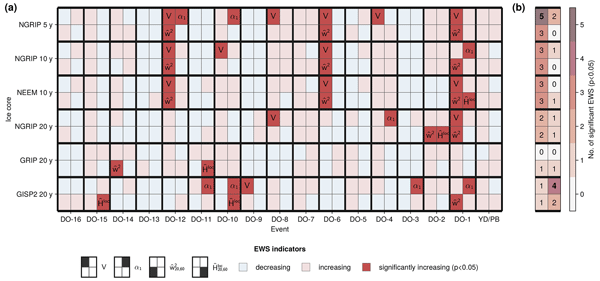
We revisit early warning signals (EWS) for past abrupt climate changes known as Dansgaard-Oeschger (DO) events. Using advanced statistical methods, we find fewer significant EWS than previously reported. While some signals appear consistent across Greenland ice core records, they are not enough to identify the still unknown mechanisms behind DO events. This study highlights the complexity of predicting climate changes and urges caution in interpreting (paleo-)climate data.
Eirik Myrvoll-Nilsen, Luc Hallali, and Martin Rypdal
Earth Syst. Dynam., 16, 1539–1556, https://doi.org/10.5194/esd-16-1539-2025, https://doi.org/10.5194/esd-16-1539-2025, 2025
Short summary
Short summary
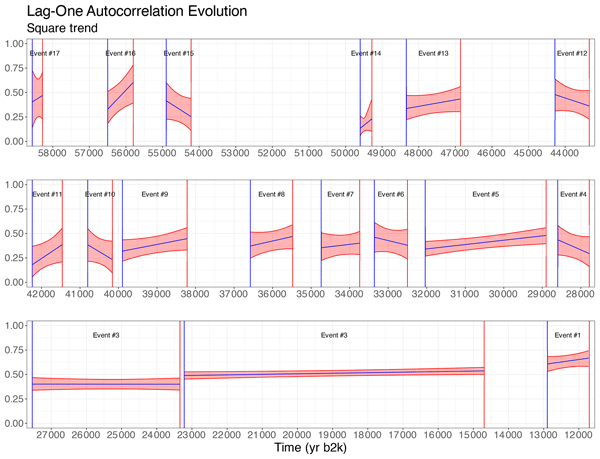
Before a climate component reaches a tipping point, there may be observable changes in its statistical properties. These are known as early warning signals and include increased fluctuation and correlation times. We present a Bayesian approach to detect these signals, using a model where the correlation parameter depends linearly on time for which the slope can be estimated directly from the data. The model is then applied to Dansgaard–Oeschger events using Greenland ice core data.
Anna Poltronieri, Nils Bochow, and Martin Rypdal
EGUsphere, https://doi.org/10.5194/egusphere-2025-1134, https://doi.org/10.5194/egusphere-2025-1134, 2025
Preprint archived
Short summary
Short summary
As Arctic sea ice shrinks, new shipping routes become more accessible. This study compares the effects of two main Arctic pathways: the Northern and the Transpolar Sea routes. Using a high-complexity climate model, we simulate black carbon emissions from ships. When deposited on sea ice, black carbon increases solar absorption, enhancing melt. We analyze absorbed solar radiation, sea ice extent, and air temperature, finding that the Transpolar Sea Route has a greater effect on Arctic sea ice.
Eirik Myrvoll-Nilsen, Keno Riechers, Martin Wibe Rypdal, and Niklas Boers
Clim. Past, 18, 1275–1294, https://doi.org/10.5194/cp-18-1275-2022, https://doi.org/10.5194/cp-18-1275-2022, 2022
Short summary
Short summary
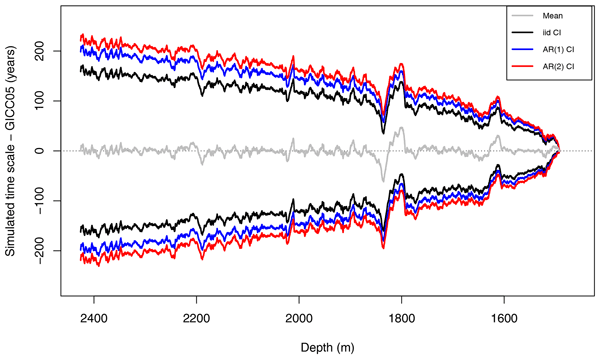
In layer counted proxy records each measurement is accompanied by a timestamp typically measured by counting periodic layers. Knowledge of the uncertainty of this timestamp is important for a rigorous propagation to further analyses. By assuming a Bayesian regression model to the layer increments we express the dating uncertainty by the posterior distribution, from which chronologies can be sampled efficiently. We apply our framework to dating abrupt warming transitions during the last glacial.
Cited articles
Balmaceda, L., Krivova, N. A., and Solanki, S. K.: Reconstruction of solar irradiance using the group sunspot number, Adv. Space. Res., 40, 986–989, 2007.
Blender, R. and Fraedrich, K.: Long time memory in global warming simulations, Geophys. Res. Lett., 30, 1769, https://doi.org/10.1029/2003GL017666, 2003.
Bunde, A. and Havlin, S.: Power-law persistence in the atmosphere and in the oceans, Physica A, 314, 15–24, 2002.
Bunde, A., Havlin, S., Koscielny-Bunde, E., and Schellnhuber, H.-J.: Long term persistence in the atmosphere: global laws and tests of climate models, Physica A, 302, 255–267, 2001.
Crowley, T. J.: Causes of climate change over the past 1000 years, Science, 289, 270–277, 2000.
Crowley, T. J., Baum, S. K., Kim, K.-Y., Hegerl, G. C., and Hyde, W. T.: Modeling ocean heat content changes during the last millennium, Geophys. Res. Lett., 30, 1932, https://doi.org/10.1029/2003GL017801, 2003.
Crowley, T. J., G., Z., Vinther, B., Udisti, R., Kreutzs, K., Cole-Dai, J., and Castellano, E.: Volcanism and the Little Ice Age, 16, 22–23, 2008.
Eichner, J. F., Koscielny-Bunde, E., Bunde, A., Havlin, S., and Schellnhuber, H.-J.: Power-law persistence and trends in the atmosphere: A detailed study of long temperature records, Phys. Rev. E, 68, 046133, https://doi.org/10.1103/PhysRevE.68.046133, 2003.
Flandrin, P.: Wavelet analysis and synthesis of fractional Brownian motion, Information Theory, IEEE Trans., 38, 910–917, 1992.
Fraedrich, K. and Blender, R.: Scaling of Atmosphere and Ocean Temperature Correlations in Observations and Climate Models, Phys. Rev. Lett., 90, 108501, https://doi.org/10.1103/PhysRevLett.90.108501, 2003.
González-Rouco, F., von Storch, H., and Zorita, E.: Deep soil temperature as proxy for surface air-temperature in a coupled model simulation of the last thousand years, Geophys. Res. Lett., 30, 2166, https://doi.org/10.1029/2003GL018264, 2003.
Goosse, H., Brovkin, V., Fichefet, T., Haarsma, R., Huybrechts, P., Jongma, J., Mouchet, A., Selten, F., Barriat, P.-Y., Campin, J.-M., Deleersnijder, E., Driesschaert, E., Goelzer, H., Janssens, I., Loutre, M.-F., Morales Maqueda, M. A., Opsteegh, T., Mathieu, P.-P., Munhoven, G., Pettersson, E. J., Renssen, H., Roche, D. M., Schaeffer, M., Tartinville, B., Timmermann, A., and Weber, S. L.: Description of the Earth system model of intermediate complexity LOVECLIM version 1.2, Geosci. Model Dev., 3, 603–633, https://doi.org/10.5194/gmd-3-603-2010, 2010.
Goosse, H., Crespin, E., Dubinkina, S., Loutre, M.-F., Mann, M. E., Renssen, H., Sallaz-Damaz, Y., and Shindell, D.: The role of forcing and internal dynamics in explaining the Medieval Climate Anomaly, Clim. Dynam., 39, 2847–2866, 2012.
Gordon, C., Cooper, C., Senior, C. A., Banks, H., Gregory, J. M., Johns, T. C., Mitchell, J. F. B., and Wood, R. A.: The simulation of SST, sea ice extents and ocean heat transports in a version of the Hadley Centre coupled model without flux adjustments, Clim. Dynam., 16, 147–168, 2000.
Govindan, R. B., Vjushin, D., Brenner, S., Bunde, A., Havlin, S., and Schellnhuber, H.-J.: Long-range correlation and trends in global cliamte models: Comparison with real data, Physica A, 294, 239–248, 2001.
Govindan, R. B., Vjushin, D., Bunde, A., Brenner, S., Havlin, S., and Schellnhuber, H.-J.: Global climate Models Violate Scaling of the Observed Atmospheric Variability, Phys. Rev. Lett., 89, 028501, https://doi.org/10.1103/PhysRevLett.89.028501, 2002.
Henriksson, S., Raisanen, P., Silen, J., Jarvinen, H., and Laaksonen, A.: Improved power-law estimates from multiple samples provided by millennium climate simulations, Theor. Appl. Climatol., 1–11, https://doi.org/10.1007/s00704-014-1132-0, 2014.
Hu, K., Ivanov, P. C., Chen, Z., Carpena, P., and Stanley, H. E.: Effect of trends on detrended fluctuation analysis, Phys. Rev. E., 64, 011114, https://doi.org/10.1103/PhysRevE.64.011114, 2001.
Jungclaus, J. H., Lorenz, S. J., Timmreck, C., Reick, C. H., Brovkin, V., Six, K., Segschneider, J., Giorgetta, M. A., Crowley, T. J., Pongratz, J., Krivova, N. A., Vieira, L. E., Solanki, S. K., Klocke, D., Botzet, M., Esch, M., Gayler, V., Haak, H., Raddatz, T. J., Roeckner, E., Schnur, R., Widmann, H., Claussen, M., Stevens, B., and Marotzke, J.: Climate and carbon-cycle variability over the last millennium, Clim. Past, 6, 723–737, https://doi.org/10.5194/cp-6-723-2010, 2010.
Kantelhardt, J. W., Koscielny-Bunde, E., Rego, H. H., Havlin, S., and Bunde, A.: Detecting long-range correlations with detrended fluctuation analysis, Physica A, 295, 441–454, 2001.
Krivova, N. A. and Solanki, S. K.: Reconstruction of total solar irradiance since 1700 from the surface magnetic flux, Astron. Astrophys., 467, 335–346, 2007.
Krivova, N. A. and Solanki, S. K.: Models of solar irradiance variations: Current status, J. Astrophys. Astron., 29, 151–158, 2008.
Legutke, S. and Maier-Reime, E.: Climatology of the HOPE}-G {Global Ocean – Sea Ice General Circulation Model, DKRZ Tech. Rep., DKRZ-TR–21, 1999.
Legutke, S. and Voss, R.: The H}amburg Atmosphere-Ocean Coupled Circulation Model ECHO-{G, DKRZ Tech. Rep.. DKRZ-TR–18, 1999.
Lennartz, S. and Bunde, A.: Trend evaluation in records with long-term memory: Application to global warming, Geophys. Res. Lett., 36, L16706, https://doi.org/10.1029/2009GL039516, 2009a.
Lennartz, S. and Bunde, A.: Eliminating finite-size effects and detecting the amount of white noise in short records with long-term memory, Phys. Rev. E, 79, 066101, https://doi.org/10.1103/PhysRevE.79.066101, 2009b.
Malamud, B. D. and Turcotte, D. L.: Self-affine time series: measures of weak and strong persistence, J. Stat. Plann. Inference, 80, 173–196, 1999.
Mann, M. E., Zhang, Z., Rutherford, S., Bradley, R. S., Hughes, M. K., Shindell, D., Ammann, C., Faluvegi, G., and Ni, F.: Global Signatures and Dynamical Origins of the Little Ice Age and Medieval Climate Anomaly, Science, 326, 1256–1260, 2009.
Marland, G., Boden, T. A., and Andres, R. J.: Global, regional and national emissions, in: Trends: a compendium of data on global change. Carbon Dioxide Information Center, Oak Ridge National Laboratory, US Department of Energy, Oak Ridge, Tenn., USA, 2003.
Marsland, S., Haak, H., Jungclaus, J., Latif, M., and Röske, F.: The Max-Planck-Institute global ocean/sea ice model with orthogonal curvilinear coordinates, Ocean Modell., 5, 91–127, 2003.
Miettinen, A., Divine, D., Ko, N., Godtliebsen, F., and Hall, I. R.: Multicentennial Variability of the Sea Surface Temperature Gradient across the Subpolar North Atlantic over the Last 2.8 kyr, J. Climate, 25, 4205–4219, 2012.
Mills, T. C.: Time series modelling of two millennia of northern hemisphere temperatures: long memory or shifting trends?, J. Roy. Stat. Soc. A Sta., 170, 83–94, 2007.
Moberg, A., Sonechkin, D. M., Holmgren, K., Datsenko, N. M., and Karlén, W.: Highly variable Northern Hemisphere temperatures reconstructed from low-and high-resolution proxy data, Nature, 433, 613–617, 2005.
Muscheler, R., Joos, F., Beer, J., Müller, S. A., Vonmoos, M., and Snowball, I.: Solar activity during the last 1000yr inferred from radionuclide records, Quaternary Sci. Rev., 26, 82–97, 2007.
Pelletier, J. D.: Analysis and Modeling of the Natural Variability of Climate, J. Climate, 10, 1331–1342, 1997.
Peng, C.-K., Buldyrev, S. V., Havlin, S., Simons, M., Stanley, H. E., and Goldberger, A.: Mosaic organization of DNA nucleotides, Phys. Rev. E., 49, 1685–1689, 1994.
Pope, V. D., Gallani, M. L., Rowntree, P. R., and Stratton, R. A.: The impact of new physical parametrizations in the Hadley Centre climate model: HadAM3, Clim. Dynam., 16, 123–146, 2000.
Raddatz, T., Reick, C., Knorr, W., Kattge, J., Roeckner, E., Schnur, R., Schnitzler, K.-G., Wetzel, P., and Jungclaus, J.: Will the tropical land biosphere dominate the climate-carbon cycle feedback during the twenty-first century?, Clim. Dynam., 29, 565–574, 2007.
Reynolds, R. W., Rayner, N. A., Smith, T. M., Stokes, D. C., and Wang, W.: An improved in situ and satellite SST analysis for climate, J. Climate, 15, 1609–1625, 2002.
Roeckner, E., Arpe, K., Bengtsson, L., Christoph, M., Claussen, M., Dümenil, L., Esch, M., Giorgetta, M., Schlese, U., and Schulzweida, U.: The atmospheric general circulation model ECHAM-4: Model description and simulation of present-day climate, MPI Tech. Rep. Rep. 218, 1996.
Roeckner, E., Arpe, K., Bengtsson, L., Christoph, M., Claussen, M., Dümenil, L., Esch, M., Giorgetta, M., Schlese, U., and Schulzweida, U.: The atmospheric general circulation model ECHAM-5, part 1: Model description, MPI Tech. Rep. Rep. 349, 2003.
Rybski, D., Bunde, A., Havlin, S., and von Storch, H.: Long-term persistence in climate and the detection problem, Geophys. Res. Lett., 33, L06718, https://doi.org/10.1029/2005GL025591, 2006.
Rybski, D., Bunde, A., and von Storch, H.: Long-term memory in 1000-year simulated temperature records, J. Geophys. Res., 113, D02106, https://doi.org/10.1029/2007JD008568, 2008.
Rypdal, K., Østvand, L., and Rypdal, M.: Long-range memory in Earth's surface temperature on time scales from months to centuries, J. Geophys. Res., 118, 7046–7062, 2013.
Rypdal, M. and Rypdal, K.: Long-memory effects in linear-response models of Earth's temperature and implications for future global warming, J. Climate, submitted, 2013.
Schmidt, G. A., Jungclaus, J. H., Ammann, C. M., Bard, E., Braconnot, P., Crowley, T. J., Delaygue, G., Joos, F., Krivova, N. A., Muscheler, R., Otto-Bliesner, B. L., Pongratz, J., Shindell, D. T., Solanki, S. K., Steinhilber, F., and Vieira, L. E. A.: Climate forcing reconstructions for use in PMIP simulations of the last millennium (v1.0), Geosci. Model Dev., 4, 33–45, https://doi.org/10.5194/gmd-4-33-2011, 2011.
Smith, T. M. and Reynolds, R. W.: Improved E}xtended Reconstruction of {SST (1854–1997), J. Climate, 17, 2466–2477, https://doi.org/10.1175/1520-0442(2004)017<2466:IEROS>2.0.CO;2, 2004.
Smith, T. M. and Reynolds, R. W.: A Global Merged Land–Air–Sea Surface Temperature Reconstruction Based on Historical Observations (1880–1997), J. Climate, 18, 2021–2036, https://doi.org/10.1175/JCLI3362.1, 2005.
Solanki, S. K., Usoskin, I. G., Kromer, B., Schuessler, M., and Beer, J.: Unusual activity of the Sun during recent decades compared to the previous 11 000 years, Nature, 431, 1084–1087, 2004.
Steinhilber, F., Beer, J., and Frohlich, C.: Total solar irradiance during the Holocene, Geophys. Res. Lett., 36, L19704, https://doi.org/10.1029/2009GL040142, 2009.
Syroka, J. and Toumi, R.: Scaling and persistence in observed and modeled surface temperature, Geophys. Res. Lett., 28, 3255–3258, 2001.
ter Braak, C. J. and Juggins, S.: Weighted averaging partial least squares regression (WA-PLS): an improved method for reconstructing environmental variables from species assemblages, Hydrobiologia, 269, 485–502, 1993.
Usoskin, I. G., Solanki, S. K., and Kovaltsov, G. A.: Grand minima of solar activity during the last millennia, Proceedings of the International Astronomical Union, 7, 372–382, 2011.
von Storch, H., Zorita, E., Jones, J. M., Dimitriev, Y., González-Rouco, F., and Tett, S. F. B.: Reconstructing Past Climate from Noisy Data, Science, 306, 679–682, 2004.
Vyushin, D., Zhidkov, I., Havlin, S., Bunde, A., and Brenner, S.: Volcanic forcing improves Atmosphere-Ocean Coupled General Circulation Model scaling performance, Geophys. Res. Lett., 31, L10206, https://doi.org/10.1029/2004GL019499, 2004.
Weber, R. O. and Talkner, P.: Spectra and correlations of climate data from days to decades, J. Geophys. Res., 106, 20131–20144, 2001.
Wetzel, P., Maier-Reimer, E., Botzet, M., Jungclaus, J., Keenlyside, N., and Latif, M.: Effects of ocean biology on the penetrative radiation in a coupled climate model, J. Climate, 19, 3973–3987, 2006.
Zorita, E., González-Rouco, F., and Legutke, S.: Testing the Mann et al. (1998) A}pproach to Paleoclimate Reconstructions in the Context of a 1000-Yr Control Simulation with the ECHO-G {Coupled Climate Model, J. Climate, 16, 1378–1390, 2003.
Altmetrics
Final-revised paper
Preprint