
Articles | Volume 17, issue 2
https://doi.org/10.5194/esd-17-387-2026
© Author(s) 2026. This work is distributed under
the Creative Commons Attribution 4.0 License.
the Creative Commons Attribution 4.0 License.
https://doi.org/10.5194/esd-17-387-2026
© Author(s) 2026. This work is distributed under
the Creative Commons Attribution 4.0 License.
the Creative Commons Attribution 4.0 License.
Research article
| Highlight paper
| 
22 Apr 2026
Research article | Highlight paper |
| 22 Apr 2026
| 22 Apr 2026
Stratospheric aerosol injection geoengineering has the potential to increase land carbon storage and to protect the Amazon rainforest
Isobel M. Parry
CORRESPONDING AUTHOR

Department of Mathematics and Statistics, Faculty of Environment, Science and Economy, University of Exeter, Exeter, EX4 4QE, UK
Paul D. L. Ritchie
Department of Mathematics and Statistics, Faculty of Environment, Science and Economy, University of Exeter, Exeter, EX4 4QE, UK
Olivier Boucher
Institut Pierre-Simon Laplace, Sorbonne Université/CNRS, Paris, France
Peter M. Cox
Department of Mathematics and Statistics, Faculty of Environment, Science and Economy, University of Exeter, Exeter, EX4 4QE, UK
Global Systems Institute, University of Exeter, Exeter, UK
James M. Haywood
Department of Mathematics and Statistics, Faculty of Environment, Science and Economy, University of Exeter, Exeter, EX4 4QE, UK
Met Office Hadley Centre, Exeter, UK
Ulrike Niemeier
Max Planck Institute for Meteorology, Hamburg, Germany
Roland Séférian
CNRM, Université de Toulouse, Météo-France, CNRS, Toulouse, France
Simone Tilmes
Atmospheric Chemistry, Observations and Modeling Laboratory, National Center for Atmospheric Research, Boulder, CO, USA
Daniele Visioni
Department of Earth and Atmospheric Sciences, Cornell University, Ithaca, NY, USA
Related authors
No articles found.
Brendan Clark and Daniele Visioni
EGUsphere, https://doi.org/10.5194/egusphere-2026-6174, https://doi.org/10.5194/egusphere-2026-6174, 2026
This preprint is open for discussion and under review for Earth System Dynamics (ESD).
Short summary
Short summary
Reflective aerosols have been proposed as a way to temporarily cool Earth. Assessing potential impacts of this usually focuses on temperature and precipitation, but radiation may be a primary driver of vegetation responses. We compare simulations from two land models with different complexities. The big leaf model shows negligible radiation effects from aerosols, while the model with canopy structure identifies radiation as a primary driver of plant response to atmospheric aerosols.
Chris Huntingford, Jesse F. Abrams, Peter Ashwin, Niklas Boers, Chris A. Boulton, Joshua E. Buxton, Joseph Clarke, Peter M. Cox, Andrew M. Cunliffe, Henk A. Dijkstra, Bahar Emirzade, Darren Ghent, Daniel Giles, Sneha Kachhara, Timothy M. Lenton, Valerio Lucarini, Helen Millman, Robert J. Parker, Sergei Petrovskii, Paul D. L. Ritchie, Cristina Ruiz Villena, Mark S. Williamson, and Niccolò Zagli
EGUsphere, https://doi.org/10.5194/egusphere-2026-5606, https://doi.org/10.5194/egusphere-2026-5606, 2026
This preprint is open for discussion and under review for Earth System Dynamics (ESD).
Short summary
Short summary
Future tipping of key parts of the Earth system, driven by human-induced climate change, poses serious risks to society. These concerns have spurred the development of Early Warning Systems (EWSs) that use data to show how close we are to tipping. However, existing EWSs are often generic statistical forms. We first review current EWS methods, then present a broad set of hypotheses that may help improve them. We argue strongly for process knowledge to guide more refined EWS forms.
Charles Koven, Benjamin M. Sanderson, Abigail L. S. Swann, Victor Brovkin, John Dunne, Rosie A. Fisher, Tomohiro Hajima, Chris D. Jones, Spencer K. Liddicoat, Anastasia Romanou, Roland Séférian, Norman J. Steinert, Jerry Tjiputra, Tilo Ziehn, Tatiana Ilyina, Nancy Y. Kiang, David M. Lawrence, Peter Lawrence, Hongmei Li, Jorg Schwinger, and Lori T. Sentman
EGUsphere, https://doi.org/10.5194/egusphere-2026-5381, https://doi.org/10.5194/egusphere-2026-5381, 2026
This preprint is open for discussion and under review for Earth System Dynamics (ESD).
Short summary
Short summary
We use a set of climate models to ask how aspects of climate beyond global mean temperatures would differ if we first emit, and then remove, a given amount of CO2, compared to a case where the CO2 hadn't been emitted. We show that precipitation increases, and that land cools relative to the ocean. Models disagree on many of the finer-scale regional changes, but they do agree that many of the regional changes that occur under positive and then negative emissions also occur under zero emissions.
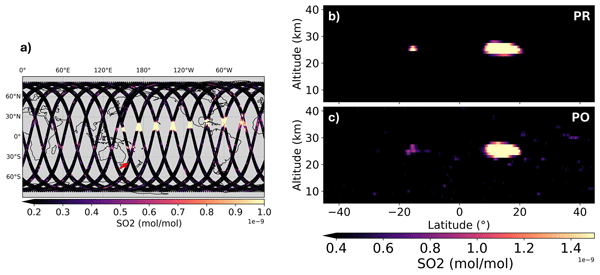
Pasquale Sellitto, Mona Kosary, Michael Höpfner, Bernd Funke, Alex Hoffmann, Jörn Ungermann, Quentin Errera, Simone Tilmes, and Björn-Martin Sinnhuber
Atmos. Meas. Tech., 19, 6379–6393, https://doi.org/10.5194/amt-19-6379-2026, https://doi.org/10.5194/amt-19-6379-2026, 2026
Short summary
Short summary
To counterbalance human-caused global warming, highly controversial geoengineering techniques, based on stratospheric aerosol injection (SAI), have been proposed as a complement to climate change mitigation. Possible unilateral SAI deployments or tests are a risk. We show that existing satellite instruments do not have the capability to detect unilateral SAI experiments and we propose a future satellite technique, infrared limb emission sounding, that can provide this missing capability.
Jens Terhaar, Laurent Bopp, Pierre Friedlingstein, Thomas Frölicher, Helene Hollitzer, Tatiana Ilyina, Lester Kwiatkowski, Paul Lerner, Hongmei Li, Anastasia Romanou, Jörg Schwinger, Roland Séférian, and Aaron Wienkers
EGUsphere, https://doi.org/10.5194/egusphere-2026-5757, https://doi.org/10.5194/egusphere-2026-5757, 2026
This preprint is open for discussion and under review for Biogeosciences (BG).
Short summary
Short summary
The ocean absorbs about 30% of CO2 emissions, but how much it will keep absorbing as CO2 levels rise and the climate warms is highly uncertain. Combining climate models with observations, we show models underestimate both the ocean CO2 uptake with increasing atmospheric CO2 and how strongly this uptake weakens with warming, and that the two are linked. Our tighter estimate reduces uncertainty in how much emitted CO2 stays in the atmosphere, and in the warming caused by future emissions.
Haruki Hirasawa, Knut von Salzen, Matthew Henry, Josh Smith, Frida A.-M. Bender, Cindy Wang, Sarah Doherty, Robert Wood, Philip J. Rasch, and James Haywood
EGUsphere, https://doi.org/10.5194/egusphere-2026-5460, https://doi.org/10.5194/egusphere-2026-5460, 2026
This preprint is open for discussion and under review for Atmospheric Chemistry and Physics (ACP).
Short summary
Short summary
Marine cloud brightening (MCB) is a solar climate intervention proposal to spray sea salt aerosol (SSA) to increase sunlight reflection by low marine clouds. Earth System Models (ESMs) are our main tool for studying potential MCB climate impacts, but there is a large range across ESMs in the MCB sunlight reflection. Comparing MCB in ten ESMs, we find that much of this range is from the size of the SSA and cloud droplet formation from the SSA, both relatively well understood processes.
Andreas Karpasitis, Manabu Abe, Isaline Bossert, Friederike Fröb, Thomas Frölicher, Panos Hadjinicolaou, Colin Jones, Roland Séférian, Tomas Torsvik, Jeremy Walton, Klaus Wyser, Tokuta Yokohata, and George Zittis
EGUsphere, https://doi.org/10.5194/egusphere-2026-5285, https://doi.org/10.5194/egusphere-2026-5285, 2026
This preprint is open for discussion and under review for Weather and Climate Dynamics (WCD).
Short summary
Short summary
The tropical atmosphere plays a key role in driving rainfall and influencing weather around the world. In this study, we used idealized simulations to examine how tropical rainfall and atmospheric circulation change as the planet warms. We found that the main tropical rain belt shifts closer to the Equator. Although vertical air motion becomes weaker, rainfall becomes more intense. These changes could affect regional rainfall patterns and climate regimes in other parts of the world.
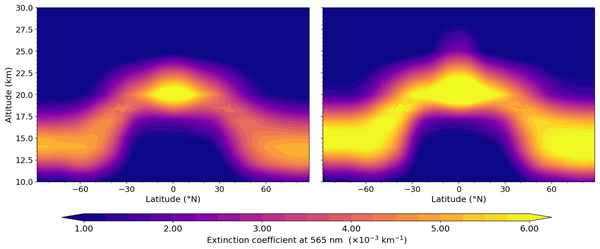
Anna Lange, John Andrew Dykema, Sandro Vattioni, Ulrike Niemeier, Alexei Rozanov, and Christian von Savigny
Atmos. Chem. Phys., 26, 13055–13067, https://doi.org/10.5194/acp-26-13055-2026, https://doi.org/10.5194/acp-26-13055-2026, 2026
Short summary
Short summary
This study addresses the question of whether it is possible to detect the continuous injection of 5 Tg yr-1 of alumina or calcite into the stratosphere using satellite solar occultation instruments. The research shows that it is possible to detect these injections of solid particles into the stratosphere and that they can also be distinguished from natural variability, considering the assumptions made.

Daniele Visioni, Alan Robock, Alistair Duffey, Matthew Henry, Haruki Hirasawa, Walker Raymond Lee, Cindy Wang, Kelsey Roberts, Shingo Watanabe, Michelle Simões Reboita, Masahiro Sugiyama, Ben Kravitz, Jim Haywood, Simone Tilmes, Frédéric K. Bonou, Jack Chen, Timofei Sukhodolov, Sandro Vattioni, Andrin Jörimann, Diego Villanueva, Ryan Vella, Paul Farron, Ewa Bednarz, Ulrike Niemeier, Colleen Golja, and Juan A. Añel
Geosci. Model Dev., 19, 8469–8499, https://doi.org/10.5194/gmd-19-8469-2026, https://doi.org/10.5194/gmd-19-8469-2026, 2026
Short summary
Short summary
The Geoengineering Model Intercomparison Project is a coordinated international model intercomparison effort aiming to provide robust experimental protocols for simulations of various Solar Radiation Modification (SRM) methods. In this manuscript, we describe a list of novel experiments decided by the community, to be run by climate models to better understand sources of uncertainty in SRM. We also show and discuss some preliminary results from a few climate models.
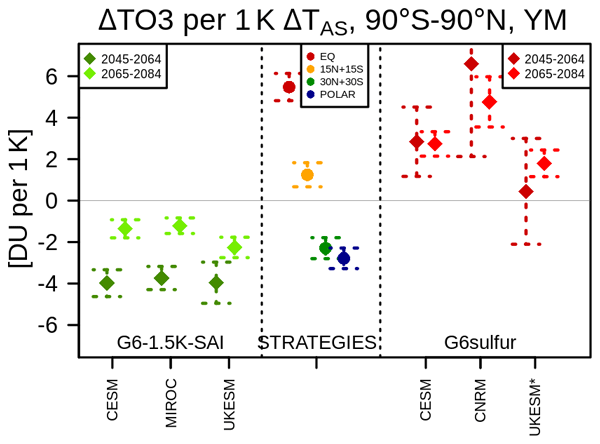
Ewa M. Bednarz, Amy H. Butler, James M. Haywood, Matthew Henry, Andy Jones, Ben Kravitz, Walker R. Lee, Douglas G. MacMartin, Amanda C. Maycock, Takashi Sekiya, Shingo Watanabe, and Daniele Visioni
Atmos. Chem. Phys., 26, 12751–12770, https://doi.org/10.5194/acp-26-12751-2026, https://doi.org/10.5194/acp-26-12751-2026, 2026
Short summary
Short summary
An assessment of the potential impacts of Stratospheric Aerosol Injection, a proposed method to offset global warming, on stratospheric ozone projections over the 21st century using the new multi-model GeoMIP (Geoengineering Model Intercomparison Project) G6-1.5K-SAI (Stratospheric Aerosol Injection) experiment. We discuss drivers of the responses, identify areas of model agreement and disagreement and sources of uncertainty. Our results highlight the need to assess any projected SAI impacts in wider strategy and scenario dimension using a multi-model framework.
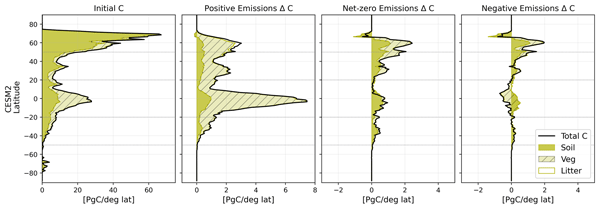
Abigail L. S. Swann, Charles D. Koven, Cristian Proistosecu, Rosie A. Fisher, Benjamin M. Sanderson, Victor Brovkin, Tomohiro Hajima, Chris D. Jones, Nancy Y. Kiang, David M. Lawrence, Spencer Liddicoat, Hannah Liddy, Anastasia Romanou, Roland Séférian, Lori T. Sentman, Norman J. Steinert, Jerry Tjiputra, and Tilo Ziehn
Earth Syst. Dynam., 17, 1237–1275, https://doi.org/10.5194/esd-17-1237-2026, https://doi.org/10.5194/esd-17-1237-2026, 2026
Short summary
Short summary
We analyzed simulations from Earth system models (ESM) with a constant rate of emissions, zero emissions, and negative emissions of CO2 to quantify the response of land carbon sinks. We found that under positive emissions vegetation in the tropics gained carbon. Under zero emissions and negative emissions most ESMs lost carbon from vegetation in the tropics but gained carbon in mid- and high-latitudes, mostly in soils. Our findings imply that tropical carbon is vulnerable under zero emissions.
Mona Kosary, Pasquale Sellitto, Michael Höpfner, Bernd Funke, Alex Hoffmann, Jörn Ungermann, Quentin Errera, Simone Tilmes, and Björn-Martin Sinnhuber
EGUsphere, https://doi.org/10.5194/egusphere-2026-4654, https://doi.org/10.5194/egusphere-2026-4654, 2026
Short summary
Short summary
We investigated whether future satellites could track changes in the ozone layer if reflective particles were deliberately added high in the atmosphere to cool the planet. Using climate model simulations, we created virtual satellite measurements and compared them with the original data. The method captured the key changes, especially stronger ozone loss and delayed recovery over Antarctica, while showing low artificial distortion. This suggests such satellites could provide important oversight.
Walker Raymond Lee, Simone Tilmes, and Ewa M. Bednarz
Earth Syst. Dynam., 17, 1117–1134, https://doi.org/10.5194/esd-17-1117-2026, https://doi.org/10.5194/esd-17-1117-2026, 2026
Short summary
Short summary
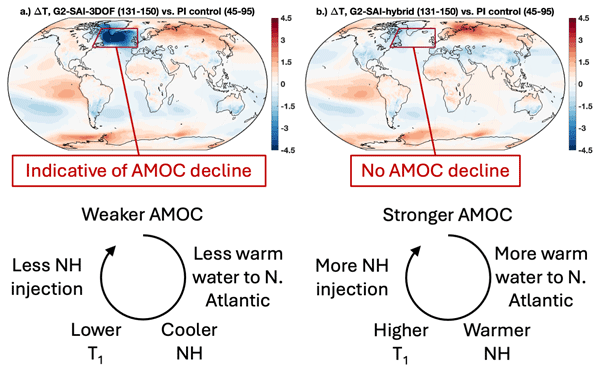
We present climate model simulation of stratospheric aerosol injection, a proposed method of climate intervention where reflective particles are placed in the stratosphere to cool the planet. We design our simulated interventions to maintain certain surface temperature patterns, and show that the same temperatures can be maintained in different ways because of how the ocean transports heat. This has implications for how climate intervention model experiments are designed in the future.
Ewa M. Bednarz, Valentina Aquila, Amy H. Butler, Peter Colarco, Eric Fleming, Freja F. Østerstrøm, David Plummer, Ilaria Quaglia, William Randel, Michelle L. Santee, Takashi Sekiya, Simone Tilmes, Xinyue Wang, Shingo Watanabe, Wandi Yu, Jun Zhang, Yunqian Zhu, and Zhihong Zhuo
Atmos. Chem. Phys., 26, 11355–11370, https://doi.org/10.5194/acp-26-11355-2026, https://doi.org/10.5194/acp-26-11355-2026, 2026
Short summary
Short summary
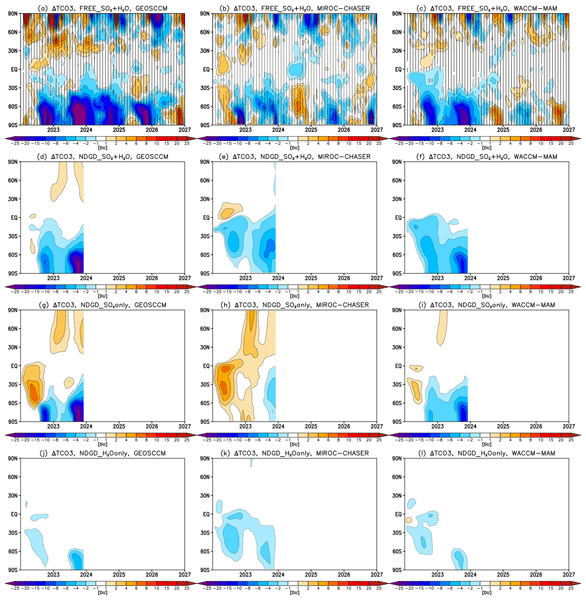
The 2022 Hunga eruption injected unprecedented quantities of water vapor into the stratosphere, alongside modest amounts of aerosol precursors. We assess its impacts on stratospheric ozone layer using a multi-model ensemble of chemistry-climate simulations. The results confirm the eruption's role in modulating SH (Southern Hemisphere) mid and high latitudes ozone abundances in the short term, and discuss the different chemical and dynamical processes driving those changes as well as the role of natural variability.
Andrin Jörimann, Timofei Sukhodolov, Simone Tilmes, David Plummer, Shingo Watanabe, Hideharu Akiyoshi, Gabriel Chiodo, Daniele Visioni, Sandro Vattioni, Eugene Rozanov, Ewa Monika Bednarz, Béatrice Josse, Yousuke Yamashita, and Thomas Peter
Atmos. Chem. Phys., 26, 11207–11234, https://doi.org/10.5194/acp-26-11207-2026, https://doi.org/10.5194/acp-26-11207-2026, 2026
Short summary
Short summary
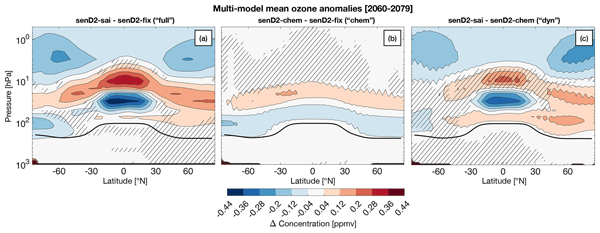
We study a future scenario where artificial stratospheric aerosol injections counter medium climate change, to understand possible negative side effects like ozone depletion. The injected aerosol layer is implemented uniformly in five climate models, which eliminates some uncertainty from model-specific aerosol evolution. The models agree well on where and how key thermodynamical (heating, circulation) and chemical processes change, however, the strength of the changes varies considerably.
Anna Lange, Ilaria Quaglia, Daniele Visioni, Alexei Rozanov, and Christian von Savigny
EGUsphere, https://doi.org/10.5194/egusphere-2026-3347, https://doi.org/10.5194/egusphere-2026-3347, 2026
This preprint is open for discussion and under review for Atmospheric Chemistry and Physics (ACP).
Short summary
Short summary
What happens to the colours of the sky when a volcano erupts during an ongoing stratospheric aerosol injection deployment? This study is the first to tackle this question, combining climate model simulations, radiative transfer calculations, and colour modelling. The results show several optical phenomena, including Bishop's Rings, unusual greenish twilight colours, and purple light.
Katharina Perny, Timofei Sukhodolov, Ales Kuchar, Pavle Arsenovic, Bernadette Rosati, Christoph Brühl, Sandip S. Dhomse, Andrin Jörimann, Anton Laakso, Graham Mann, Ulrike Niemeier, Giovanni Pitari, Ilaria Quaglia, Takashi Sekiya, Kengo Sudo, Claudia Timmreck, Simone Tilmes, Daniele Visioni, and Harald E. Rieder
Atmos. Chem. Phys., 26, 10997–11025, https://doi.org/10.5194/acp-26-10997-2026, https://doi.org/10.5194/acp-26-10997-2026, 2026
Short summary
Short summary
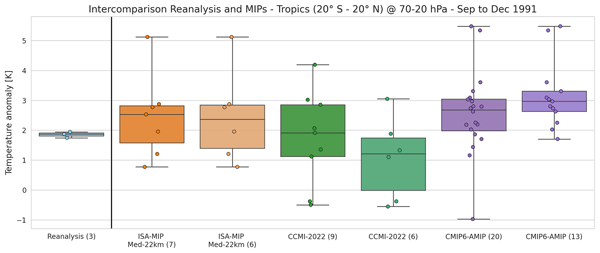
Major volcanic eruptions, such as the one of Mt. Pinatubo in 1991, can inject large amounts of sulfur dioxide into the stratosphere. The resulting aerosol cloud affects stratospheric temperature and thereby middle atmospheric dynamics and chemistry. Here we investigate similarities and differences across an ensemble of climate models in reproducing the stratospheric temperature signal following the Mt. Pinatubo eruption.
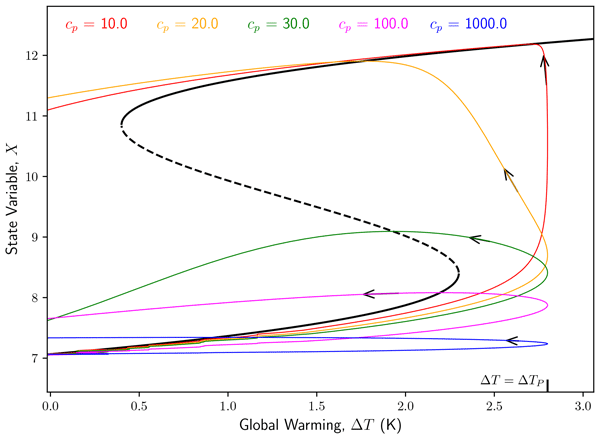
Chris Huntingford, Paul D. L. Ritchie, and Joseph Clarke
Nonlin. Processes Geophys., 33, 385–399, https://doi.org/10.5194/npg-33-385-2026, https://doi.org/10.5194/npg-33-385-2026, 2026
Short summary
Short summary
The risk of climate change triggering tipping points is a concern. While Earth System Models (ESMs) predict these points, their timing often varies. Equations of nonlinear dynamical systems can model tipping, hysteresis, and inertia, enabling comparison with ESMs. We propose a method to map tipping timing estimates onto a dynamical system that simulates a full hysteresis loop. We focus on solutions to the equation under overshoot forcing in global temperature and different inertia levels.
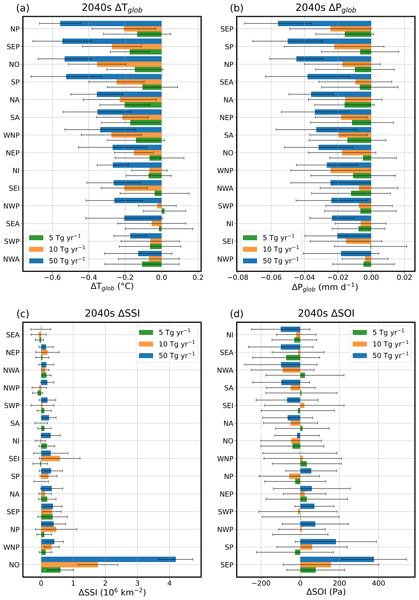
Alex M. Mason, Matthew Henry, Haruki Hirasawa, Fiona M. O'Connor, and James Haywood
Atmos. Chem. Phys., 26, 10861–10879, https://doi.org/10.5194/acp-26-10861-2026, https://doi.org/10.5194/acp-26-10861-2026, 2026
Short summary
Short summary
Marine Cloud Brightening (MCB) proposes the spraying of sea salt particles into marine clouds to cool the planet. MCB in midlatitude regions in models gave a relatively even climate response. We use 42 simulations of MCB to target several climate responses. Two optimised combinations are compared to a midlatitude MCB simulation, which improved sea ice restoration and the temperature response pattern, highlighting the importance of high latitude MCB for MCB optimisation in this model.
Colleen Marie Golja, Marianna Linz, Ewa Monika Bednarz, Daniele Visioni, Ben Kravitz, John A. Dykema, Michelle E. Frazer, Anthony C. Jones, Isla R. Simpson, and Shingo Watanabe
EGUsphere, https://doi.org/10.5194/egusphere-2026-4200, https://doi.org/10.5194/egusphere-2026-4200, 2026
Short summary
Short summary
Adding reflective particles to the stratosphere has been proposed to cool the planet, but how the resulting lower-stratospheric heating affects the broader climate remains unclear. This study simulates idealized lower-stratospheric heating across five climate models finding large inter-model differences in the stratospheric and surface response. The results highlight ways in which these differences may be explained by biases in the stratospheric climatological mean state.
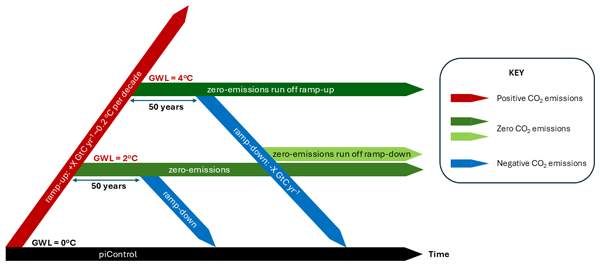
Colin Jones, Isaline Bossert, Donovan P. Dennis, Hazel A. Jeffery, Chris D. Jones, Torben Koenigk, Sina Loriani, Benjamin Sanderson, Roland Séférian, Klaus Wyser, Shuting Yang, Manabu Abe, Sebastian Bathiany, Pascale Braconnot, Victor Brovkin, Friedrich A. Burger, Patrica Cadule, Frederic S. Castruccio, Gokhan Danabasoglu, Andrea Dittus, Jonathan F. Donges, Friederike Fröb, Thomas L. Frölicher, Goran Georgievski, Chuncheng Guo, Aixue Hu, Peter Lawrence, Paul Lerner, José Licón-Saláiz, Bette Otto-Bliesner, Anastasia Romanou, Elena Shevliakova, Yona Silvy, Didier Swingedouw, Jerry Tjiputra, Jeremy Walton, Andy Wiltshire, Ricarda Winkelmann, Richard Wood, Tokuta Yokohata, and Tilo Ziehn
Geosci. Model Dev., 19, 6941–6966, https://doi.org/10.5194/gmd-19-6941-2026, https://doi.org/10.5194/gmd-19-6941-2026, 2026
Short summary
Short summary
We introduce a new Earth system model experiment protocol to help researchers understand how Earth might respond to positive, zero, and negative carbon emissions. This protocol enables different models to be compared following similar warming and cooling rates. Researchers use the models to explore how the Earth reacts to different climate futures, including the risk of tipping points being exceeded and whether changes can be reversed. The results will support improved long-term climate policy.
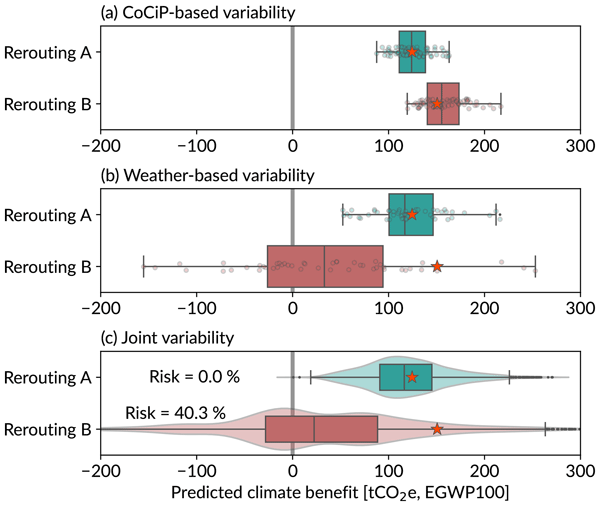
Audran Borella, Cameron Steer, Nicolas Bellouin, and Olivier Boucher
J. Env. Com. Air Transp. Sys., 1, 3, https://doi.org/10.5194/jecats-1-3-2026, https://doi.org/10.5194/jecats-1-3-2026, 2026
Short summary
Short summary
Targeted contrail avoidance consists of rerouting aircraft to minimise the formation of warming contrails. However, current predictions of contrail climate impact are highly uncertain. In this study, we show that some reroutings that were predicted to be beneficial for the climate are in fact damaging it. We further demonstrate that the risk of unintentionally damaging the climate can and should be included in the decision-making of contrail avoidance.
Azfar Hussain, Huizing Liu, Abolfazl Rezaei, Ping Zhu, Daniele Visioni, Guanglang Xu, Chao Yang, Yan Ma, Tianye Cao, and Qingquan Li
EGUsphere, https://doi.org/10.5194/egusphere-2026-3008, https://doi.org/10.5194/egusphere-2026-3008, 2026
Short summary
Short summary
Central–South Asia and the Tibetan Plateau depend on fragile water systems shaped by rain, snow, ice, and heat. We used future climate model results to test how warming and sunlight-reflecting climate intervention could affect water, plants, snow, and seasonal timing. Warming greatly increases water extremes and shifts seasons earlier. Intervention reduces heat and some extremes, but cannot fully prevent water stress, and its effects vary strongly by region and design.
Temitope S. Egbebiyi, Temitope S. Fafure, Daniele Visioni, Romaric C. Odoulami, Babatunde J. Abiodun, Simone Tilmes, Chris Lennard, and Mark G. New
EGUsphere, https://doi.org/10.5194/egusphere-2026-3436, https://doi.org/10.5194/egusphere-2026-3436, 2026
Short summary
Short summary
Exceeding the global warming thresholds of 1.5 & 2.0 °C before potential mitigation efforts and Carbon dioxide removal are possible future trajectories. While Climate Intervention could reduce peak warming in future, however, their impact in Africa is unknown. We show this intervention may reduce temperature extremes while its impact on precipitation varies across Africa. The result has implications for agricultural planning and water resource management during potential overshoot periods.
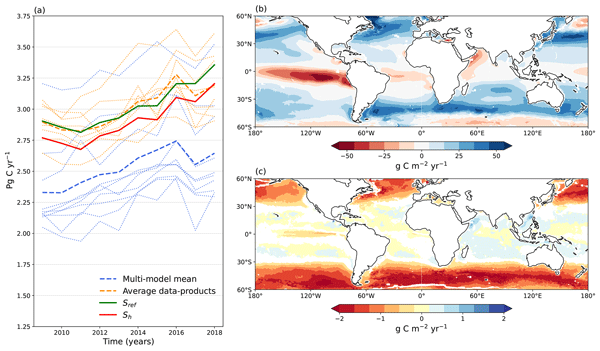
Jeanne Dombret, Hugo Bellenger, Xavier Perrot, Laëtitia Parc, Lester Kwiatkowski, Frédéric Chevallier, Laurent Bopp, Marion Gehlen, Roland Séférian, Sarah Berthet, and James C. Orr
Biogeosciences, 23, 4133–4143, https://doi.org/10.5194/bg-23-4133-2026, https://doi.org/10.5194/bg-23-4133-2026, 2026
Short summary
Short summary
Estimates of ocean CO2 uptake based on atmospheric and oceanic observations typically rely on monthly averages, except for wind speed. Thus they neglect effects of shorter-term events such as storms, which are included in models. Here we account for the effect of this shorter-term variability on ocean carbon uptake and find that it is reduced, mainly because storms lower atmospheric pressure. This refinement closes the gap between data-based and model-based estimates by 25 %.
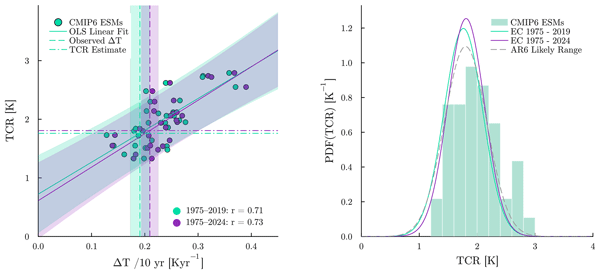
Patric J. L. Boardman, Joseph Clarke, Peter M. Cox, Chris Huntingford, Chris D. Jones, and Mark S. Williamson
Earth Syst. Dynam., 17, 829–841, https://doi.org/10.5194/esd-17-829-2026, https://doi.org/10.5194/esd-17-829-2026, 2026
Short summary
Short summary
Climate sensitivity quantifies how much Earth warms for a given radiative forcing, and is often described by the Transient Climate Response (TCR) value. Although the Intergovernmental Panel on Climate Change (IPCC) estimates the most likely TCR to be 1.8 K, some models predict values >2.4 K. Record warmth in 2023–2024 raises questions as to whether the TCR may be larger than previously suggested. Using up-to-date data, we estimate the TCR to be ~1.8 K. We also show that future warming falls within the low–mid model range, making the 2°C Paris target still feasible.
Suki C. K. Wong, Galen A. McKinley, Richard Seager, Tess Wei-Ping Jacobson, Amanda Fay, Özgür Gürses, Nicolas Gruber, Tatiana Ilyina, Tereza Jarnikova, Laure Resplandy, Jörg Schwinger, and Roland Séférian
EGUsphere, https://doi.org/10.5194/egusphere-2026-3104, https://doi.org/10.5194/egusphere-2026-3104, 2026
Short summary
Short summary
The ocean absorbs nearly a third of human-made carbon dioxide, slowing climate change. This uptake varies from decade to decade for reasons we do not fully understand. Using a 66-year ocean carbon dataset, we found that the tropical Pacific and Southern Ocean drive this variability, in step with broader climate patterns across the Pacific. But these patterns cannot fully explain the recent weakening of the Southern Ocean sink, suggesting biological processes may also play an important role.
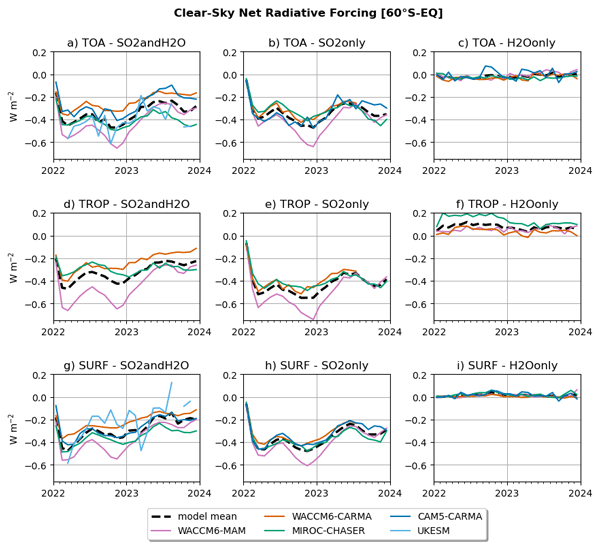
Ilaria Quaglia, Daniele Visioni, Ewa M. Bednarz, Yunqian Zhu, Georgiy Stenchikov, Valentina Aquila, Cheng-Cheng Liu, Graham W. Mann, Yifeng Peng, Takashi Sekiya, Simone Tilmes, Xinyue Wang, Shingo Watanabe, Pengfei Yu, Jun Zhang, Wandi Yu, and Zhihong Zhuo
Atmos. Chem. Phys., 26, 7677–7704, https://doi.org/10.5194/acp-26-7677-2026, https://doi.org/10.5194/acp-26-7677-2026, 2026
Short summary
Short summary
On January 15, 2022, the Hunga volcano eruption released unprecedented amounts of water vapor into the atmosphere alongside a modest amount of SO2. In this work we analyse results from multiple Earth system models. The models agree that the eruption led to small negative radiative forcing from sulfate aerosols and that the contribution from water vapor was minimal. Therefore, the Hunga eruption cannot explain the exceptional surface warming observed in 2023.
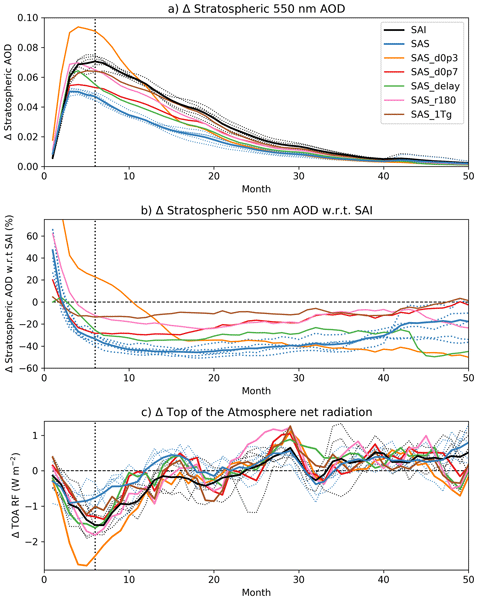
Anthony C. Jones, James M. Haywood, Matthew Henry, and Alistair Duffey
Atmos. Chem. Phys., 26, 7589–7605, https://doi.org/10.5194/acp-26-7589-2026, https://doi.org/10.5194/acp-26-7589-2026, 2026
Short summary
Short summary
Injecting aerosol into the stratosphere has been suggested to rapidly cool the planet and counter climate change. Rival actors who oppose deployment may seek to counter stratospheric aerosol injection. Using a climate model, we investigate whether stratospheric aerosol removal could be hastened by injecting coarse aerosol which promote aerosol growth and gravitational settling. We find that this could be effective, reducing aerosol impacts by 30 % in simulations, and warrants further research.
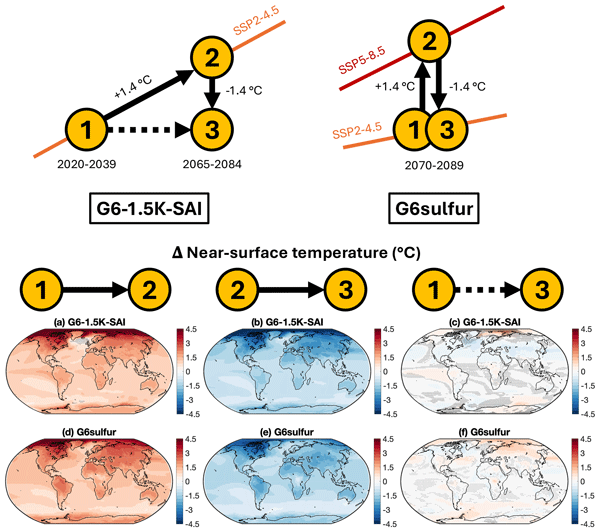
Walker Raymond Lee, Daniele Visioni, Benjamin Moore Wagman, Christopher Robert Wentland, Ben Kravitz, Shingo Watanabe, Takashi Sekiya, Andy Jones, Jim Haywood, Matthew Henry, and Ewa Monika Bednarz
Atmos. Chem. Phys., 26, 7463–7483, https://doi.org/10.5194/acp-26-7463-2026, https://doi.org/10.5194/acp-26-7463-2026, 2026
Short summary
Short summary
Stratospheric aerosol injection (SAI) is a proposed method of cooling the planet by introducing reflective particles called aerosols into the middle atmosphere to reflect sunlight back into space. We consider recent simulations of SAI from four different climate models. SAI cools the planet effectively in all four models; we examine the impacts on temperature and precipitation in each model and compare to previous experiments. Our simulations will help inform future research and policy.
Daniel A. Williams, Cyril J. Morcrette, and James M. Haywood
EGUsphere, https://doi.org/10.5194/egusphere-2026-2490, https://doi.org/10.5194/egusphere-2026-2490, 2026
Short summary
Short summary
Contrails (condensation trails) are ice clouds that form behind aircraft in a region of cold and moist atmosphere. If contrails persist for many hours or into the night, they warm the climate. A minority of flights produce persistent contrails, so the climate impact of aviation could be decreased if we can predict and avoid where contrails form in advance. Using statistics on climate model and satellite data, we developed a model to predict contrails and tested it against historical data.
Josh Smith, Matthew Henry, Masaru Yoshioka, Ben Johnson, and Jim Haywood
EGUsphere, https://doi.org/10.5194/egusphere-2026-2654, https://doi.org/10.5194/egusphere-2026-2654, 2026
Short summary
Short summary
In 2020, new international rules cut sulphur in shipping fuels by roughly eighty percent, removing particles that had been brightening clouds over the oceans and reflecting sunlight. Using a climate model, we tested how this loss of cooling has been calculated and found that recent studies have
likely underestimated the resulting warming by a factor of two to four. This means cleaner shipping fuels may be contributing more to recent global warming than previously recognised.
likely underestimated the resulting warming by a factor of two to four. This means cleaner shipping fuels may be contributing more to recent global warming than previously recognised.
Benjamin M. Sanderson, Marit Sandstad, Alejandro Romero-Prieto, Stuart Jenkins, Charles Koven, Glen Peters, Roland Séfèrian, Andrew H. MacDougall, Ashwin Seshadri, Victor Brovkin, John Dunne, Abigail L. S. Swann, Torben Koenigk, Rosie A. Fisher, David Hohn, Tatiana Ilyina, Chris D. Jones, Hongmei Li, Peter Lawrence, Spencer Liddicoat, Nadine Mengis, Anastasia Romanou, Lori T. Sentman, Chris Smith, Norman J. Steinert, Jerry Tjiputra, and Tilo Ziehn
EGUsphere, https://doi.org/10.5194/egusphere-2026-1875, https://doi.org/10.5194/egusphere-2026-1875, 2026
Short summary
Short summary
When humanity stops emitting carbon dioxide, will temperatures keep rising, stabilize, or fall? Our study reveals in most models, temperatures remain nearly stable, but this hides a balance between the warming in response to radiation imbalance, and the cooling due to uptake of carbon in the land and ocean. Understanding this balance helps refine how much more CO2 we can safely emit.
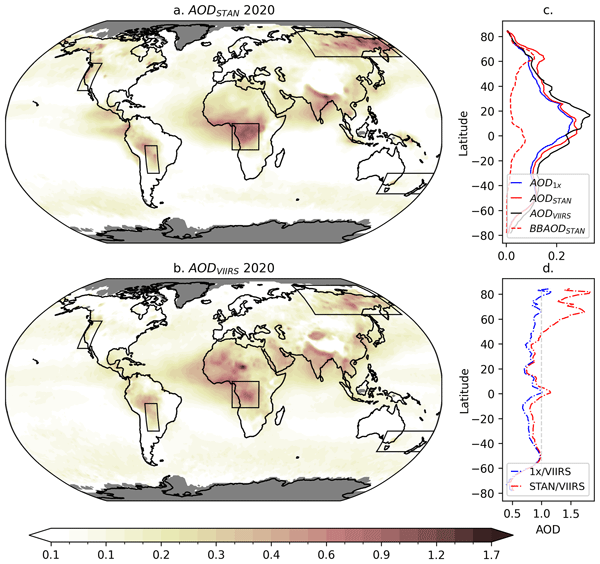
Elizabeth Quaye, Ben T. Johnson, James M. Haywood, Guido R. van der Werf, Roland Vernooij, Stephen A. Sitch, and Tom Eames
Atmos. Chem. Phys., 26, 6629–6654, https://doi.org/10.5194/acp-26-6629-2026, https://doi.org/10.5194/acp-26-6629-2026, 2026
Short summary
Short summary
We find aerosol optical depths in a global climate model are overestimated during extreme wildfire events if emissions are scaled up by a factor of two, typically applied to improve simulated aerosol on seasonal–annual timescales. We propose a technique where a variable scaling factor is determined by fuel consumption, improving correlation in five fire-affected areas. We explore the impact of this change on aerosol radiative effects, during extreme events and on broader space and time scales.
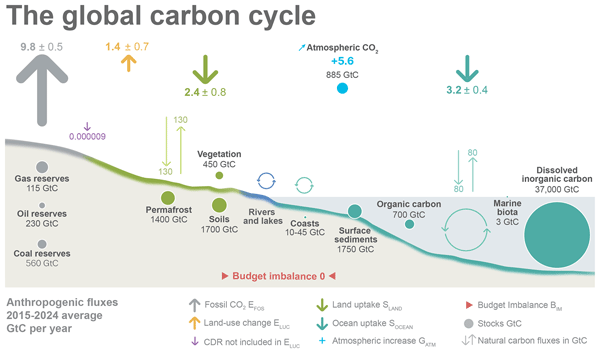
Pierre Friedlingstein, Michael O'Sullivan, Matthew W. Jones, Robbie M. Andrew, Dorothee C. E. Bakker, Judith Hauck, Peter Landschützer, Corinne Le Quéré, Hongmei Li, Ingrid T. Luijkx, Glen P. Peters, Wouter Peters, Julia Pongratz, Clemens Schwingshackl, Stephen Sitch, Josep G. Canadell, Philippe Ciais, Kjetil Aas, Simone R. Alin, Peter Anthoni, Leticia Barbero, Nicholas R. Bates, Nicolas Bellouin, Alice Benoit-Cattin, Carla F. Berghoff, Raffaele Bernardello, Laurent Bopp, Ida Bagus Mandhara Brasika, Matthew A. Chamberlain, Naveen Chandra, Frédéric Chevallier, Louise P. Chini, Nathan O. Collier, Thomas H. Colligan, Margot Cronin, Laique M. Djeutchouang, Xinyu Dou, Matt P. Enright, Kazutaka Enyo, Michael Erb, Wiley Evans, Richard A. Feely, Liang Feng, Daniel J. Ford, Adrianna Foster, Filippa Fransner, Thomas Gasser, Marion Gehlen, Thanos Gkritzalis, Jefferson Goncalves De Souza, Giacomo Grassi, Luke Gregor, Nicolas Gruber, Bertrand Guenet, Özgür Gürses, Kirsty Harrington, Ian Harris, Jens Heinke, George C. Hurtt, Yosuke Iida, Tatiana Ilyina, Akihiko Ito, Andrew R. Jacobson, Atul K. Jain, Tereza Jarníková, Annika Jersild, Fei Jiang, Steve D. Jones, Etsushi Kato, Ralph F. Keeling, Kees Klein Goldewijk, Jürgen Knauer, Yawen Kong, Jan Ivar Korsbakken, Charles Koven, Taro Kunimitsu, Xin Lan, Junjie Liu, Zhiqiang Liu, Zhu Liu, Claire Lo Monaco, Lei Ma, Gregg Marland, Patrick C. McGuire, Galen A. McKinley, Joe R. Melton, Natalie Monacci, Erwan Monier, Eric J. Morgan, David R. Munro, Jens D. Müller, Shin-Ichiro Nakaoka, Lorna R. Nayagam, Yosuke Niwa, Tobias Nutzel, Are Olsen, Abdirahman M. Omar, Naiqing Pan, Sudhanshu Pandey, Denis Pierrot, Zhangcai Qin, Pierre Regnier, Gregor Rehder, Laure Resplandy, Alizée Roobaert, Thais M. Rosan, Christian Rödenbeck, Jörg Schwinger, Ingunn Skjelvan, T. Luke Smallman, Victoria Spada, Mohanan G. Sreeush, Qing Sun, Adrienne J. Sutton, Colm Sweeney, Didier Swingedouw, Roland Séférian, Shintaro Takao, Hiroaki Tatebe, Hanqin Tian, Xiangjun Tian, Bronte Tilbrook, Hiroyuki Tsujino, Francesco Tubiello, Erik van Ooijen, Guido R. van der Werf, Sebastiaan J. van de Velde, Anthony P. Walker, Rik Wanninkhof, Xiaojuan Yang, Wenping Yuan, Xu Yue, and Jiye Zeng
Earth Syst. Sci. Data, 18, 3211–3288, https://doi.org/10.5194/essd-18-3211-2026, https://doi.org/10.5194/essd-18-3211-2026, 2026
Short summary
Short summary
The Global Carbon Budget 2025 describes the methodology, main results, and datasets used to quantify the anthropogenic emissions of carbon dioxide (CO2) and their partitioning among the atmosphere, land ecosystems, and the ocean over the historical period (1750–2025). These living datasets are updated every year to provide the highest transparency and traceability in the reporting of CO2, the key driver of climate change.
Eliza K. Duncan, George Jordan, Paul Kim, James M. Haywood, Duncan Watson-Parris, Ben Johnson, Alistair Sellar, Zak Kipling, João Teixeira, Florent Malavelle, and Daniel G. Partridge
EGUsphere, https://doi.org/10.5194/egusphere-2026-1043, https://doi.org/10.5194/egusphere-2026-1043, 2026
Short summary
Short summary
The 2014–15 Holuhraun eruption offers a natural experiment to assess how well climate models can capture the changes in aerosol associated with the plume. We investigate the aerosol lifecycle during transport to identify key differences in climate models' representation of aerosol processes, which could affect the models’ ability to capture changes in cloud properties. Our study highlights the importance of the representation of boundary layer nucleation processes in climate models.
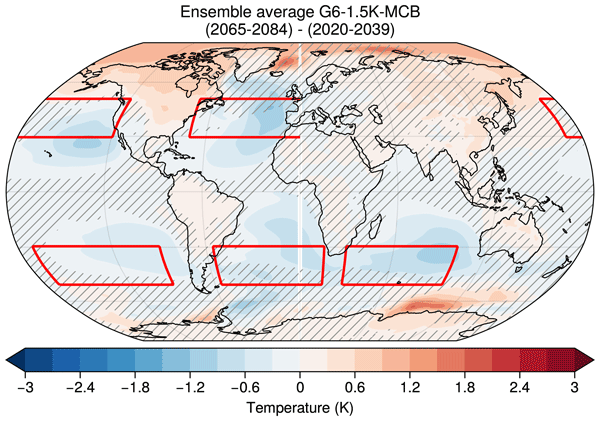
Haruki Hirasawa, Matthew Henry, Philip J. Rasch, Robert Wood, Sarah J. Doherty, James Haywood, Alex Wong, Jean-Francois Lamarque, Ezra Brody, and Hailong Wang
Geosci. Model Dev., 19, 3257–3283, https://doi.org/10.5194/gmd-19-3257-2026, https://doi.org/10.5194/gmd-19-3257-2026, 2026
Short summary
Short summary
Marine cloud brightening (MCB) is a proposal to emit sea salt aerosols to make clouds more reflective and cool the climate. Here, we use three climate models to study a hypothetical future where MCB is used to maintain temperatures near 2020–2039 conditions. The simulation results indicate that using MCB in midlatitude ocean regions can keep the climate close to present day conditions. This reduces many of the negative impacts shown in previous studies, informing future modeling efforts.
Alistair Duffey, Walker Lee, Lauren Wheeler, Peter Irvine, Benjamin Wagman, Matthew Henry, Daniele Visioni, Michel Tsamados, and Douglas MacMartin
Earth Syst. Dynam., 17, 353–385, https://doi.org/10.5194/esd-17-353-2026, https://doi.org/10.5194/esd-17-353-2026, 2026
Short summary
Short summary
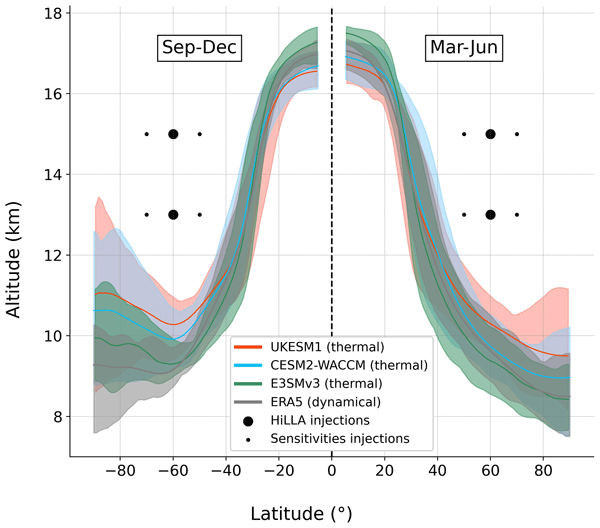
Adding a layer of reflective particles high in the atmosphere is one suggested way of cooling the planet and reducing the impacts of climate change. This technique might be less logistically difficult in the high latitudes, because the material could be released at lower altitude there. Here, we use new simulations in three earth system models to assess how this form of intervention, High-Latitude Low-Altitude Stratospheric Aerosol Injection (HiLLA-SAI), would impact the global climate.
Mathieu Antonopoulos, Jérémie Juvin-Quarroz, and Olivier Boucher
Atmos. Chem. Phys., 26, 4771–4784, https://doi.org/10.5194/acp-26-4771-2026, https://doi.org/10.5194/acp-26-4771-2026, 2026
Short summary
Short summary
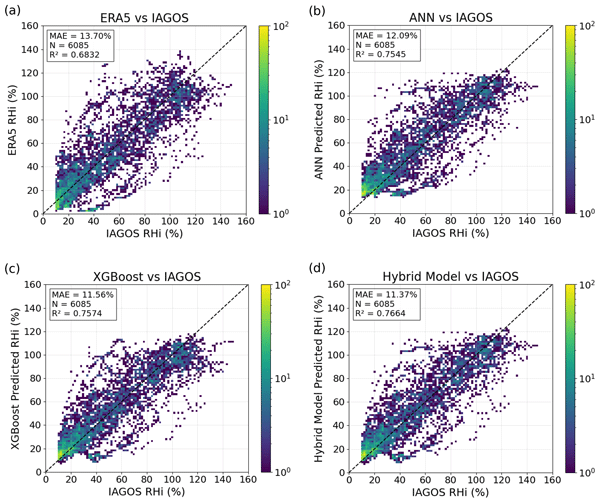
Aviation impacts climate by forming contrails that trap heat and can persist for hours at cruising altitudes. Forecasting these humid regions is difficult, as satellites lack accuracy, aircraft data are limited, and ERA5 reanalysis has random errors. This study presents a hybrid machine learning method that corrects ERA5 with aircraft data, using decision trees in dry air and neural networks in humid air. It improves relative humidity predictions, especially in the lower stratosphere.
Detlef P. Van Vuuren, Brian C. O'Neill, Claudia Tebaldi, Benjamin M. Sanderson, Louise P. Chini, Pierre Friedlingstein, Tomoko Hasegawa, Keywan Riahi, Bala Govindasamy, Nico Bauer, Veronika Eyring, Cheikh M. N. Fall, Katja Frieler, Matthew J. Gidden, Laila K. Gohar, Annika Högner, Andrew D. Jones, Jarmo Kikstra, Andrew King, Reto Knutti, Elmar Kriegler, Peter Lawrence, Chris Lennard, Jason Lowe, Camilla Mathison, Shahbaz Mehmood, Zebedee Nicholls, Luciana F. Prado, Qiang Zhang, Steven K. Rose, Alex C. Ruane, Marit Sandstad, Carl-Friedrich Schleussner, Roland Seferian, Jana Sillmann, Chris Smith, Anna A. Sörensson, Swapna Panickal, Kaoru Tachiiri, Naomi Vaughan, Saritha S. Vishwanathan, Tokuta Yokohata, Marco Zecchetto, and Tilo Ziehn
Geosci. Model Dev., 19, 2627–2656, https://doi.org/10.5194/gmd-19-2627-2026, https://doi.org/10.5194/gmd-19-2627-2026, 2026
Short summary
Short summary
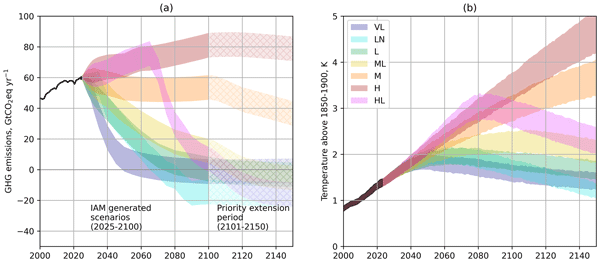
We propose a set of seven plausible 21st century emission scenarios, and their multi-century extensions, that will be used by the international community of climate modeling centers to produce the next generation of climate projections. These projections will support climate, impact and mitigation researchers, provide information to practitioners to address future risks from climate change, and contribute to policymakers’ considerations of the trade-offs among various levels of mitigation.
Masaru Yoshioka, Daniel P. Grosvenor, Amy H. Peace, Jim M. Haywood, Ying Chen, and Paul R. Field
Atmos. Chem. Phys., 26, 4341–4358, https://doi.org/10.5194/acp-26-4341-2026, https://doi.org/10.5194/acp-26-4341-2026, 2026
Short summary
Short summary
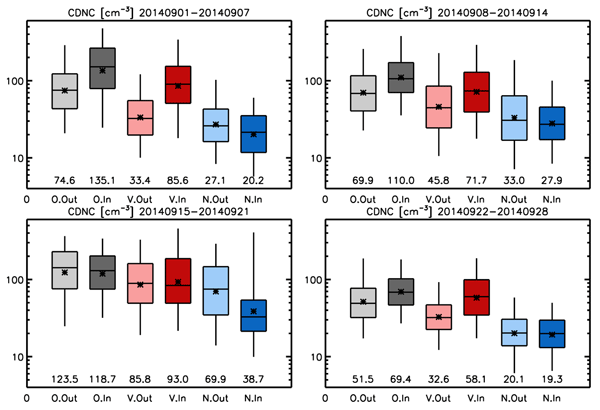
We used advanced computer simulations to study how aerosol particles from a volcanic eruption in Iceland affected clouds. The eruption plume increased small droplets, but changes in cloud water and horizontal extent were not clear. Satellite comparisons between plume and non-plume regions can miss volcanic effects due to spatial variability in weather and aerosol, but simulations can isolate the impact by comparing cases with and without the eruption.
Anna Lange, Ulrike Niemeier, Alexei Rozanov, and Christian von Savigny
Atmos. Meas. Tech., 19, 1973–1989, https://doi.org/10.5194/amt-19-1973-2026, https://doi.org/10.5194/amt-19-1973-2026, 2026
Short summary
Short summary
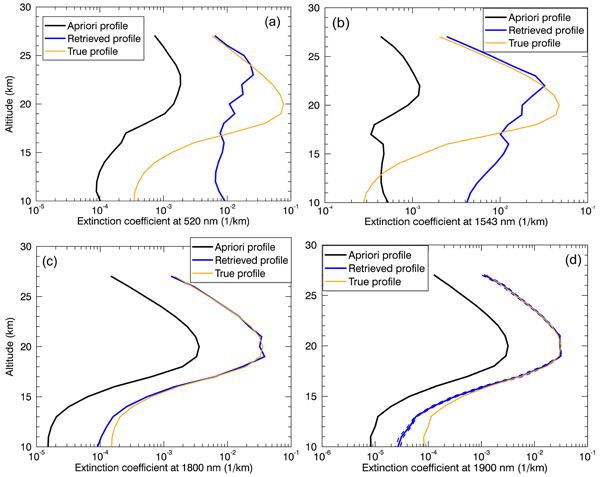
We investigate which wavelengths, depending on the latitude, are required for aerosol measurements after continuous sulphur injections of 30 Tg S yr-1 into the stratosphere, here at 19 km, in order to obtain physically meaningful stratospheric aerosol extinction profile retrieval results from the perspective of a typical satellite instrument with the so-called solar occultation geometry. Consistent with expectations, a longer wavelength is required for the latitude range of and near the injection.
Isaline Bossert, Roland Séférian, Yeray Santana-Falcón, and Thibault Guinaldo
EGUsphere, https://doi.org/10.5194/egusphere-2026-993, https://doi.org/10.5194/egusphere-2026-993, 2026
Short summary
Short summary
The response of the ocean to net-zero emissions remains poorly understood. Using 300-year net-zero Earth system simulations, we show that sea surface temperature and marine heatwaves continue to reorganize long after emissions stop, with major departures from transient projections, implying underestimated long-term marine ecosystem risks.
Yunqian Zhu, Cheng-Cheng Liu, Charles Bardeen, Lu Wang, Simone Tilmes, Ilaria Quaglia, Christopher M. Maloney, Francis Vitt, and Owen Brian Toon
EGUsphere, https://doi.org/10.22541/essoar.177135577.71771059/v1, https://doi.org/10.22541/essoar.177135577.71771059/v1, 2026
Short summary
Short summary
The Community Aerosol and Radiation Model for Atmospheres (CARMA) is a sectional microphysical model widely used to study the formation of aerosols and clouds. This paper presents an update to the CARMA model algorithms since Toon et al. 1988, with a focus on the newly developed CARMA Cloud model.
Jared Farley, Douglas G. MacMartin, Daniele Visioni, Ben Kravitz, Ewa M. Bednarz, Alistair Duffey, Matthew Henry, and Ali Akherati
Geosci. Model Dev., 19, 1809–1831, https://doi.org/10.5194/gmd-19-1809-2026, https://doi.org/10.5194/gmd-19-1809-2026, 2026
Short summary
Short summary
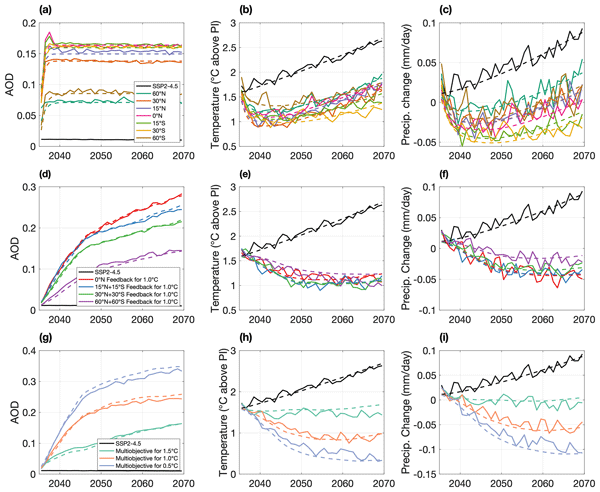
As the climate changes, many are studying sunlight reflection as a potential method of cooling. Such climate intervention could be deployed in many possible ways, including in scenarios where not every actor agrees on the strategy of cooling. These scenarios are so diverse that to explore all of them using earth system models proves to be too costly. In this paper, we develop a simplified climate model that allows users to easily explore climate intervention scenarios of their choice.
Simone Tilmes, Daniele Visioni, Ilaria Quaglia, Yunqian Zhu, Charles G. Bardeen, Francis Vitt, and Pengfei Yu
Atmos. Chem. Phys., 26, 2649–2666, https://doi.org/10.5194/acp-26-2649-2026, https://doi.org/10.5194/acp-26-2649-2026, 2026
Short summary
Short summary
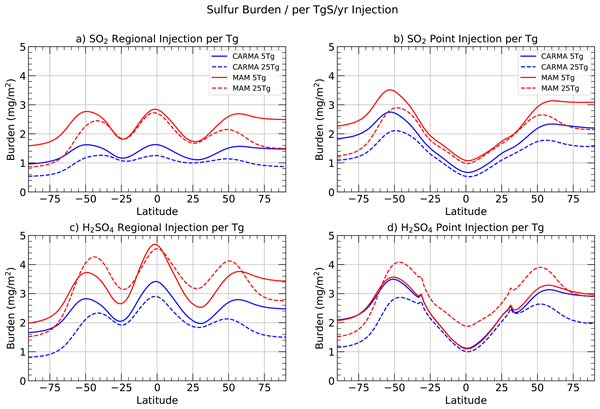
This study compares two sets of stratospheric aerosol injection (SAI) experiments using the same modeling framework, differing only in their aerosol microphysical schemes. Results show that these two schemes can yield substantially different aerosol burdens, radiative changes, and impacts when simulating the same injection scenarios. These findings suggest that more sophisticated aerosol models may be necessary to accurately assess the efficacy, side effects, and climate impacts of SAI.
Christine Pohl, Ulrike Niemeier, Alexei Rozanov, Felix Wrana, and Christian von Savigny
EGUsphere, https://doi.org/10.5194/egusphere-2026-578, https://doi.org/10.5194/egusphere-2026-578, 2026
Short summary
Short summary
Satellite aerosol retrievals and models are crucial for studying volcanic impacts on the stratosphere but remain uncertain in perturbed situations due to assumed aerosol properties. SCIAMACHY retrievals are compared with ECHAM simulations following the Manam and Sarychev eruptions to evaluate both approaches. Agreement is found for Sarychev, while Manam shows differences. Comparisons with SAGE II support the SCIAMACHY retrievals. The importance of model setup details is highlighted.
Cindy Wang, Daniele Visioni, Glen Chua, and Ewa M. Bednarz
Atmos. Chem. Phys., 26, 1339–1357, https://doi.org/10.5194/acp-26-1339-2026, https://doi.org/10.5194/acp-26-1339-2026, 2026
Short summary
Short summary
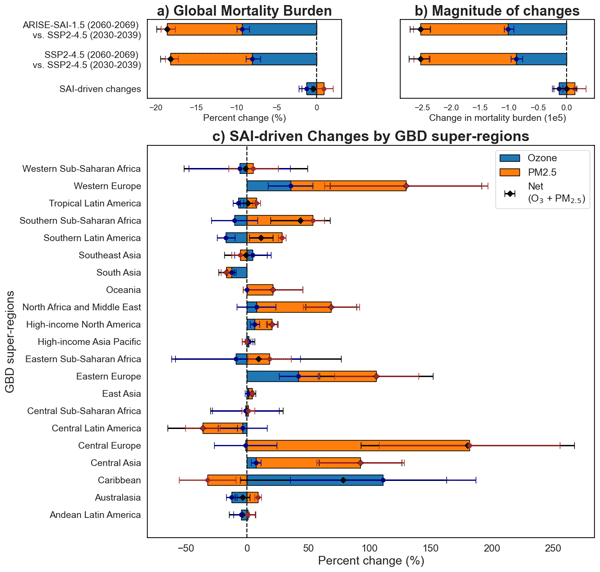
Stratospheric aerosol injection is a proposed method to slow global warming by adding tiny reflective particles high up in the atmosphere to cool the planet. We study how this proposed method might affect air quality and human health using climate models. We find that the health impacts would likely be small and are mainly driven by changes in climate, not by the particles themselves.
Benjamin M. Sanderson, Susanne Baur, Carl-Freidrich Schleussner, Glen P. Peters, Shivika Mittal, Marit Sandstad, Steffen Kallbekken, Chris Smith, Sabine Fuss, Bas van Ruijven, Rosie A. Fisher, Joeri Rogelj, Roland Séférian, Bjørn Samset, Norman J. Steinert, Laurent Terray, and Jan Fuglestvedt
EGUsphere, https://doi.org/10.5194/egusphere-2026-28, https://doi.org/10.5194/egusphere-2026-28, 2026
Preprint archived
Short summary
Short summary
Solar Radiation Modification by adding aerosols to the stratosphere could rapidly and temporarily cool the Earth, but this speed creates unprecedented risks. Fast climate responses coupled with political instability create risks of failure to decarbonise, super-rapid climate change, and conflict. Idealized scenarios or conventional modeling tools could lead to systematic ignorance of these risks. We thus introduce a framework outlining what must be represented in future modeling and assessment.
William J. Collins, John S. Daniel, Martyn P. Chipperfield, Martin Cussac, Makoto Deushi, Gregory Faluvegi, Paul Griffiths, Øivind Hodnebrog, Larry W. Horowitz, James Keeble, Douglas Kinnison, Vaishali Naik, Fiona M. O'Connor, Drew Shindell, Simone Tilmes, Kostas Tsigaridis, Zihao Wang, and James Weber
EGUsphere, https://doi.org/10.5194/egusphere-2025-6033, https://doi.org/10.5194/egusphere-2025-6033, 2026
Short summary
Short summary
Ozone depleting substances (ODSs) are also greenhouse gases that cause global warming. However, their destruction of ozone contributes a global cooling. We have used results from climate models that include atmospheric chemistry and found that the cooling effect of the ozone depletion diagnosed in the models was larger than that calculated using a standard method. We find that some ODSs have a net cooling effect whereas for others the warming effect is significantly reduced.
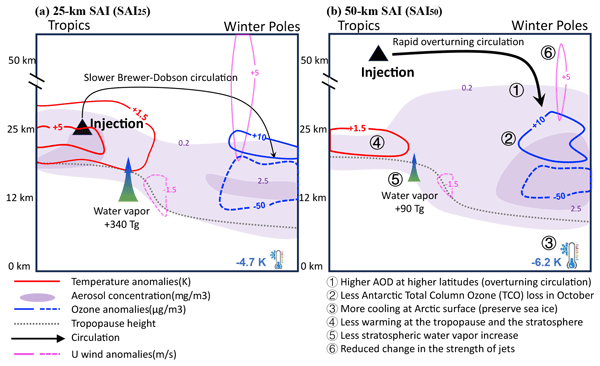
Pengfei Yu, Yifeng Peng, Karen H. Rosenlof, Ru-Shan Gao, Robert W. Portmann, Martin Ross, Eric Ray, Jianchun Bian, Simone Tilmes, and Owen B. Toon
Atmos. Chem. Phys., 25, 18449–18460, https://doi.org/10.5194/acp-25-18449-2025, https://doi.org/10.5194/acp-25-18449-2025, 2025
Short summary
Short summary
Injecting sulfur dioxide at 50 km – near the stratopause – offers a far safer and more effective climate intervention than conventional 25 km injection. Rapid downward–poleward transport distributes aerosols across 20–30 km, halving tropical stratospheric warming, reducing ozone recovery delays from decades to about 5 years, and enhancing global and polar cooling by over 20 %, while better preserving Arctic sea ice.
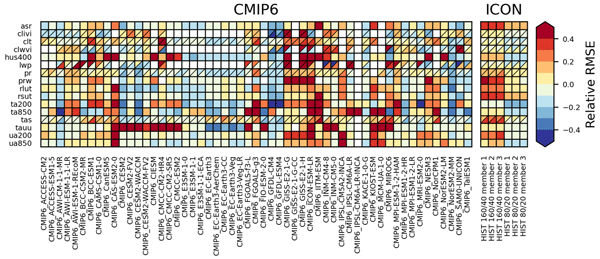
Wolfgang A. Müller, Stephan Lorenz, Trang V. Pham, Andrea Schneidereit, Renate Brokopf, Victor Brovkin, Nils Brüggemann, Fatemeh Chegini, Dietmar Dommenget, Kristina Fröhlich, Barbara Früh, Veronika Gayler, Helmuth Haak, Stefan Hagemann, Moritz Hanke, Tatiana Ilyina, Johann Jungclaus, Martin Köhler, Peter Korn, Luis Kornblueh, Clarissa A. Kroll, Julian Krüger, Karel Castro-Morales, Ulrike Niemeier, Holger Pohlmann, Iuliia Polkova, Roland Potthast, Thomas Riddick, Manuel Schlund, Tobias Stacke, Roland Wirth, Dakuan Yu, and Jochem Marotzke
Geosci. Model Dev., 18, 9385–9415, https://doi.org/10.5194/gmd-18-9385-2025, https://doi.org/10.5194/gmd-18-9385-2025, 2025
Short summary
Short summary
We provide a new Earth System model configuration framed into the ICON architecture, which provides the baseline for the next generation of climate predictions and projections (hereafter ICON XPP). Two resolutions of ICON XPP are presented that show high runtime performances making it suitable to run long integrations and large-ensemble experiments. ICON XPP similarly perform to CMIP6-class of climate models making it a good basis for climate forecasts and projections, and climate research.
Gaurav Dogra, Olivier Boucher, and Nicolas Bellouin
EGUsphere, https://doi.org/10.5194/egusphere-2025-5711, https://doi.org/10.5194/egusphere-2025-5711, 2025
Short summary
Short summary
We study how pollution particles and upward winds affect low level clouds over the ocean. The control of cloud properties by particles and winds is difficult to represent in numerical models. Our model simulates known behaviour, including how cloud droplet number increases with increased particle number and/or stronger upward winds. But clouds behaviour shifts between being limited by particle number or by the strength of the winds, indicating a dynamic interconnection of the two factors.
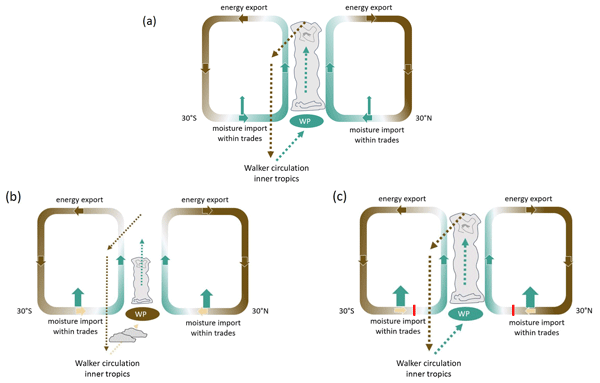
Clarissa A. Kroll, Robert C. Jnglin Wills, Luis Kornblueh, Ulrike Niemeier, and Andrea Schneidereit
Atmos. Chem. Phys., 25, 16915–16943, https://doi.org/10.5194/acp-25-16915-2025, https://doi.org/10.5194/acp-25-16915-2025, 2025
Short summary
Short summary
The double Inter-Tropical Convergence Zone is a prominent precipitation bias in climate models. We demonstrate its persistence from a resolution of 160 km up to 5 km. Its root cause lies in biased moisture transport from the subtropics to the inner tropics reducing convection and weakening tropical circulation. Increasing the surface wind speed addresses the bias, but deteriorates the global circulation. This highlights the importance of resolution hierarchies and parametrization development.
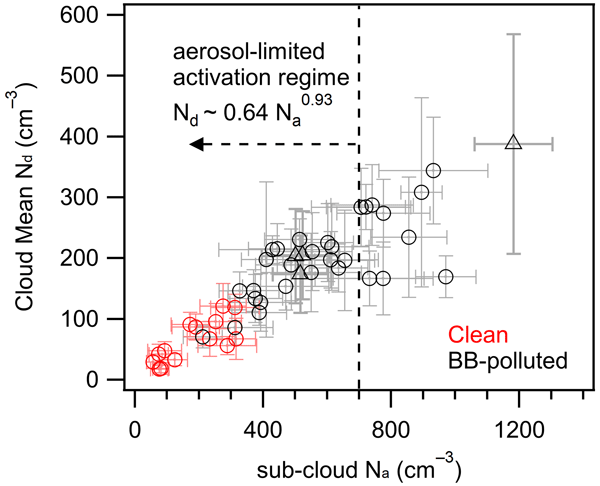
Huihui Wu, Fanny Peers, Jonathan W. Taylor, Chenjie Yu, Steven J. Abel, Paul A. Barrett, Jamie Trembath, Keith Bower, Jim M. Haywood, and Hugh Coe
Atmos. Chem. Phys., 25, 16589–16609, https://doi.org/10.5194/acp-25-16589-2025, https://doi.org/10.5194/acp-25-16589-2025, 2025
Short summary
Short summary
This study investigates the transport history of African Biomass-Burning aerosols (BBAs) over the Southeast Atlantic (SEA) and their impacts on cloud properties. Using in situ airborne measurements around Ascension Island, this work provides critical parameterizations of aerosol–cloud interactions to improve the assessment of radiative forcing in the SEA region. It also identifies key entrainment regions for understanding the vertical transport process of African BBAs.
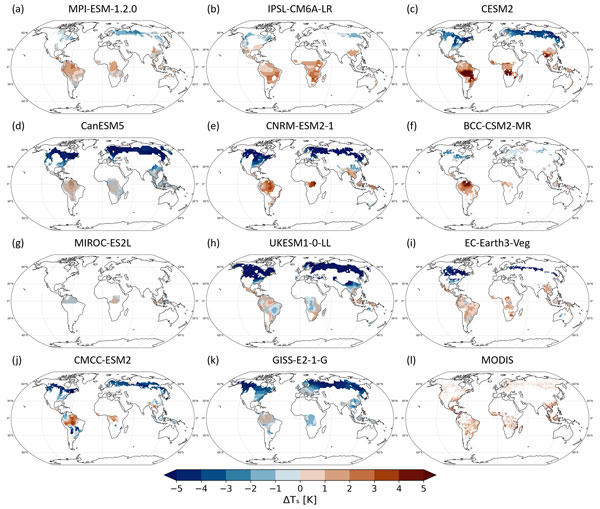
Nikolina Mileva, Julia Pongratz, Vivek K. Arora, Akihiko Ito, Sebastiaan Luyssaert, Sonali S. McDermid, Paul A. Miller, Daniele Peano, Roland Séférian, Yanwu Zhang, and Wolfgang Buermann
Earth Syst. Dynam., 16, 2137–2160, https://doi.org/10.5194/esd-16-2137-2025, https://doi.org/10.5194/esd-16-2137-2025, 2025
Short summary
Short summary
Despite forests being so important for mitigating climate change, there are still uncertainties about how much the changes in forest cover contribute to the cooling/warming of the climate. Climate models and real-world observations often disagree about the magnitude and even the direction of these changes. We constrain climate models scenarios of widespread deforestation with satellite and in-situ data and show that models still have difficulties representing the movement of heat and water.
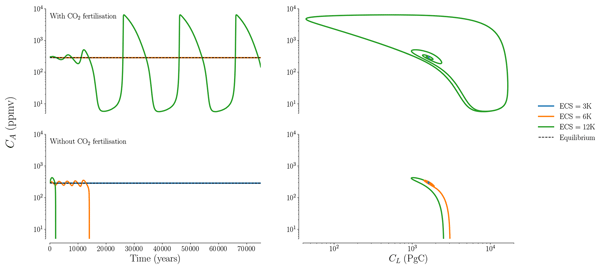
Joseph Clarke, Chris Huntingford, Paul D. L. Ritchie, Rebecca Varney, Mark S. Williamson, and Peter Cox
Earth Syst. Dynam., 16, 2087–2100, https://doi.org/10.5194/esd-16-2087-2025, https://doi.org/10.5194/esd-16-2087-2025, 2025
Short summary
Short summary
An increase in CO2 in the atmosphere warms the climate through the greenhouse effect, but also leads to uptake of CO2 by the land and ocean. However, the warming is also expected to suppress carbon uptake. If this suppression were strong enough, it could overwhelm the uptake of carbon, leading to a runaway feedback loop causing severe global warming. We find it is possible that this runaway could be relevant in complex climate models and even at the end of the last ice age.
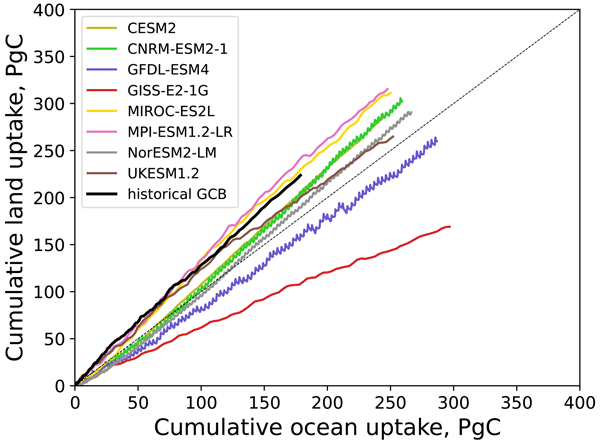
Victor Brovkin, Benjamin M. Sanderson, Noel G. Brizuela, Tomohiro Hajima, Tatiana Ilyina, Chris D. Jones, Charles Koven, David Lawrence, Peter Lawrence, Hongmei Li, Spencer Liddcoat, Anastasia Romanou, Roland Séférian, Lori T. Sentman, Abigail L. S. Swann, Jerry Tjiputra, Tilo Ziehn, and Alexander J. Winkler
Earth Syst. Dynam., 16, 2021–2034, https://doi.org/10.5194/esd-16-2021-2025, https://doi.org/10.5194/esd-16-2021-2025, 2025
Short summary
Short summary
Idealized experiments with Earth system models provide a basis for understanding the response of the carbon cycle to emissions. We show that most models exhibit a quasi-linear relationship between cumulative carbon uptake on land and in the ocean and hypothesize that this relationship does not depend on emission pathways. We reduce the coupled system to only one differential equation, which represents a powerful simplification of the Earth system dynamics as a function of fossil fuel emissions.
Eliza K. Duncan, Jonathan E. Fieldsend, Alistair Sellar, Emanuele Tovazzi, Paul Kim, James M. Haywood, and Daniel G. Partridge
EGUsphere, https://doi.org/10.5194/egusphere-2025-4298, https://doi.org/10.5194/egusphere-2025-4298, 2025
Short summary
Short summary
Atmospheric aerosol particles are a major confounding factor in accurately representing climate change. We build a novel generic framework to untangle the role of complex processes focusing on a remote site in Antarctica as a case study in near-pristine conditions. Our machine-learning model predicts aerosol concentrations from an airmass history, considering the meteorology and potential sources and removal processes, enabling improved representation in climate models.
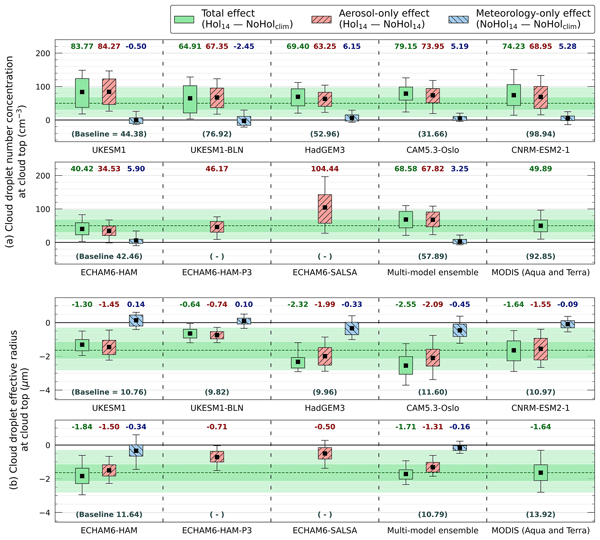
George Jordan, Florent Malavelle, Jim Haywood, Ying Chen, Ben Johnson, Daniel Partridge, Amy Peace, Eliza Duncan, Duncan Watson-Parris, David Neubauer, Anton Laakso, Martine Michou, and Pierre Nabat
Atmos. Chem. Phys., 25, 13393–13428, https://doi.org/10.5194/acp-25-13393-2025, https://doi.org/10.5194/acp-25-13393-2025, 2025
Short summary
Short summary
The 2014–15 Holuhraun eruption created a vast aerosol plume that acted as a natural experiment to assess how well climate models capture changes in cloud properties due to increased aerosol. We find that climate models represent the observed shift to smaller, more numerous cloud droplets well. However, climate models diverge in their aerosol-induced changes to large-scale cloud properties, particularly cloud liquid water content. Our study shows that Holuhraun had a cooling effect on the Earth.
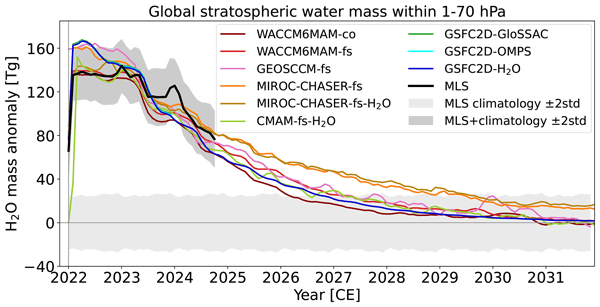
Zhihong Zhuo, Xinyue Wang, Yunqian Zhu, Wandi Yu, Ewa M. Bednarz, Eric Fleming, Peter R. Colarco, Shingo Watanabe, David Plummer, Georgiy Stenchikov, William Randel, Adam Bourassa, Valentina Aquila, Takashi Sekiya, Mark R. Schoeberl, Simone Tilmes, Jun Zhang, Paul J. Kushner, and Francesco S. R. Pausata
Atmos. Chem. Phys., 25, 13161–13176, https://doi.org/10.5194/acp-25-13161-2025, https://doi.org/10.5194/acp-25-13161-2025, 2025
Short summary
Short summary
The 2022 Hunga eruption caused unprecedented stratospheric water injection, triggering unique atmospheric impacts. This study combines observations and model simulations, projecting a stratospheric water vapor anomaly lasting 4–7 years, with significant temperature variations and ozone depletion in the upper atmosphere lasting 7–10 years. These findings offer critical insights into the role of stratospheric water vapor in shaping climate and atmospheric chemistry.
Hsi-Kai Chou, Anna B. Harper, Arthur P. K. Argles, Maria Carolina Duran Rojas, Emma W. Littleton, Richard A. Betts, and Peter M. Cox
EGUsphere, https://doi.org/10.5194/egusphere-2025-4536, https://doi.org/10.5194/egusphere-2025-4536, 2025
Short summary
Short summary
Global warming and climate change caused by greenhouse gas emissions will have multiple impacts on forest ecosystems. A core part of the strategy to mitigating these impacts is to use afforestation and forestry management to implement large-scale Greenhouse Gas Removal. Here we use the JULES-RED model to evaluate the afforestation under a changing environmental condition. We project that Sitka Forest afforestation could meet the target of GGR once the plantation locations been selected properly.
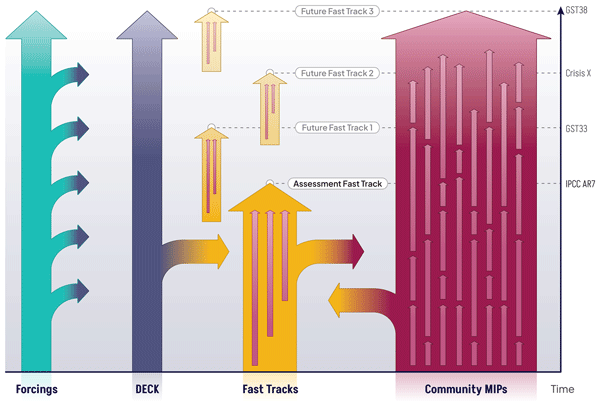
John P. Dunne, Helene T. Hewitt, Julie M. Arblaster, Frédéric Bonou, Olivier Boucher, Tereza Cavazos, Beth Dingley, Paul J. Durack, Birgit Hassler, Martin Juckes, Tomoki Miyakawa, Matt Mizielinski, Vaishali Naik, Zebedee Nicholls, Eleanor O'Rourke, Robert Pincus, Benjamin M. Sanderson, Isla R. Simpson, and Karl E. Taylor
Geosci. Model Dev., 18, 6671–6700, https://doi.org/10.5194/gmd-18-6671-2025, https://doi.org/10.5194/gmd-18-6671-2025, 2025
Short summary
Short summary
The seventh phase of the Coupled Model Intercomparison Project (CMIP7) coordinates efforts to answer key and timely climate science questions and facilitate delivery of relevant multi-model simulations for prediction and projection; characterization, attribution, and process understanding; and vulnerability, impact, and adaptation analysis. Key to the CMIP7 design are the mandatory Diagnostic, Evaluation and Characterization of Klima and optional Assessment Fast Track experiments.
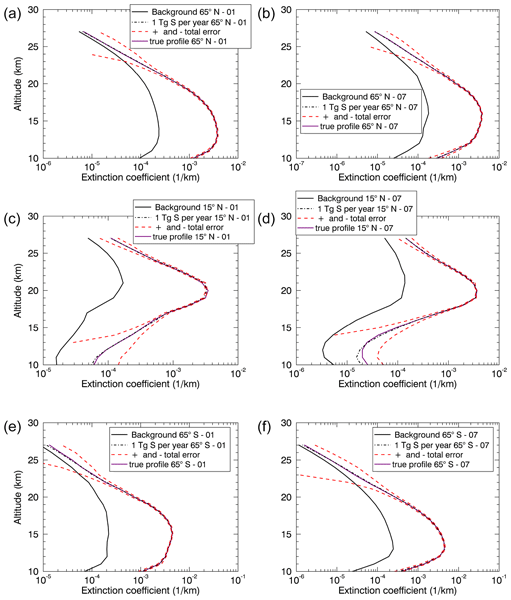
Anna Lange, Ulrike Niemeier, Alexei Rozanov, and Christian von Savigny
Atmos. Chem. Phys., 25, 11673–11688, https://doi.org/10.5194/acp-25-11673-2025, https://doi.org/10.5194/acp-25-11673-2025, 2025
Short summary
Short summary
Our paper investigates whether it is possible to observe continuous injections of 1 and 2 Tg S y-1 (sulfur per year) into the stratosphere with the currently active satellite occultation instruments. The calculations show that, considering the natural variability and the assumptions made here, the stratospheric aerosols formed from continuous emissions of 1 and 2 Tg S y-1 in the quasi-steady-state phase can be detected, which is not the case in the first month of the 2-year initial phase.
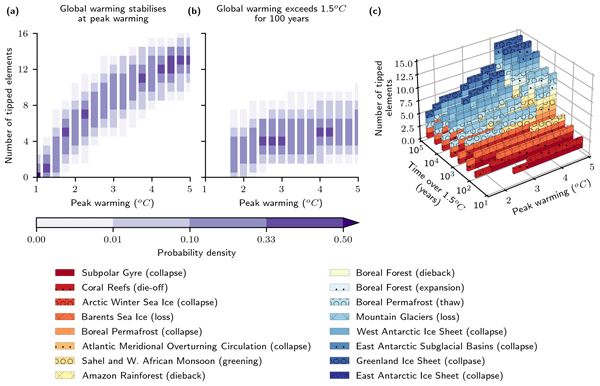
Paul D. L. Ritchie, Chris Huntingford, and Peter M. Cox
Earth Syst. Dynam., 16, 1523–1526, https://doi.org/10.5194/esd-16-1523-2025, https://doi.org/10.5194/esd-16-1523-2025, 2025
Short summary
Short summary
Climate tipping points are not committed upon crossing critical thresholds in global warming, as is often assumed. Instead, it is possible to temporarily overshoot a threshold without causing tipping, provided the duration of the overshoot is short. In this Idea, we demonstrate that restricting the time over 1.5 °C would considerably reduce tipping point risks.
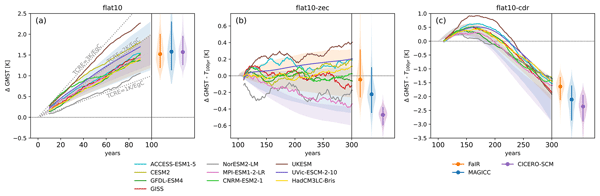
Benjamin M. Sanderson, Victor Brovkin, Rosie A. Fisher, David Hohn, Tatiana Ilyina, Chris D. Jones, Torben Koenigk, Charles Koven, Hongmei Li, David M. Lawrence, Peter Lawrence, Spencer Liddicoat, Andrew H. MacDougall, Nadine Mengis, Zebedee Nicholls, Eleanor O'Rourke, Anastasia Romanou, Marit Sandstad, Jörg Schwinger, Roland Séférian, Lori T. Sentman, Isla R. Simpson, Chris Smith, Norman J. Steinert, Abigail L. S. Swann, Jerry Tjiputra, and Tilo Ziehn
Geosci. Model Dev., 18, 5699–5724, https://doi.org/10.5194/gmd-18-5699-2025, https://doi.org/10.5194/gmd-18-5699-2025, 2025
Short summary
Short summary
This study investigates how climate models warm in response to simplified carbon emissions trajectories, refining the understanding of climate reversibility and commitment. Metrics are defined for warming response to cumulative emissions and for the cessation of emissions or ramp-down to net-zero and net-negative levels. Results indicate that previous concentration-driven experiments may have overstated the Zero Emissions Commitment due to emissions rates exceeding historical levels.
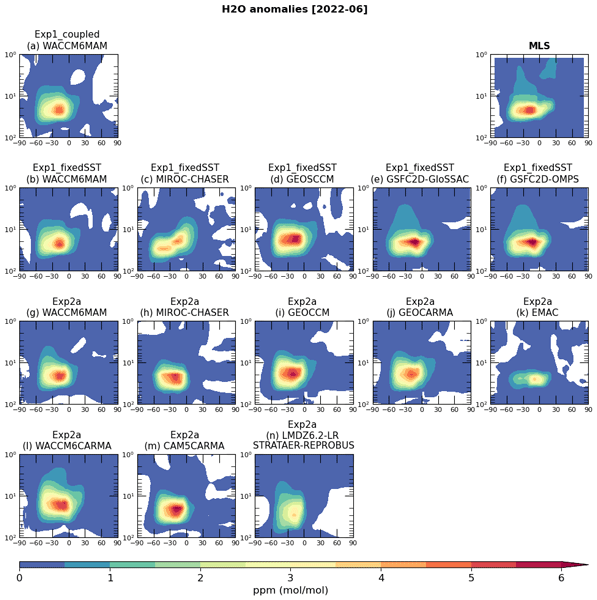
Yunqian Zhu, Hideharu Akiyoshi, Valentina Aquila, Elizabeth Asher, Ewa M. Bednarz, Slimane Bekki, Christoph Brühl, Amy H. Butler, Parker Case, Simon Chabrillat, Gabriel Chiodo, Margot Clyne, Peter R. Colarco, Sandip Dhomse, Lola Falletti, Eric Fleming, Ben Johnson, Andrin Jörimann, Mahesh Kovilakam, Gerbrand Koren, Ales Kuchar, Nicolas Lebas, Qing Liang, Cheng-Cheng Liu, Graham Mann, Michael Manyin, Marion Marchand, Olaf Morgenstern, Paul Newman, Luke D. Oman, Freja F. Østerstrøm, Yifeng Peng, David Plummer, Ilaria Quaglia, William Randel, Samuel Rémy, Takashi Sekiya, Stephen Steenrod, Timofei Sukhodolov, Simone Tilmes, Kostas Tsigaridis, Rei Ueyama, Daniele Visioni, Xinyue Wang, Shingo Watanabe, Yousuke Yamashita, Pengfei Yu, Wandi Yu, Jun Zhang, and Zhihong Zhuo
Geosci. Model Dev., 18, 5487–5512, https://doi.org/10.5194/gmd-18-5487-2025, https://doi.org/10.5194/gmd-18-5487-2025, 2025
Short summary
Short summary
To understand the climate impact of the 2022 Hunga volcanic eruption, we developed a climate model–observation comparison project. The paper describes the protocols and models that participate in the experiments. We designed several experiments to achieve our goals of this activity: (1) to evaluate the climate model performance and (2) to understand the Earth system responses to this eruption.
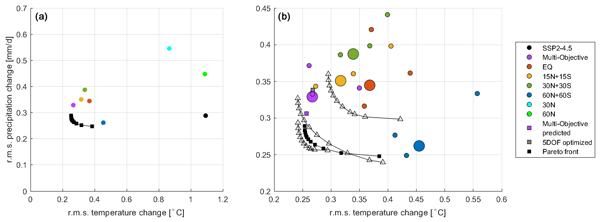
Ezra Brody, Yan Zhang, Douglas G. MacMartin, Daniele Visioni, Ben Kravitz, and Ewa M. Bednarz
Earth Syst. Dynam., 16, 1325–1341, https://doi.org/10.5194/esd-16-1325-2025, https://doi.org/10.5194/esd-16-1325-2025, 2025
Short summary
Short summary
Stratospheric aerosol injection (SAI) is being studied as a possible supplement to emission reduction to temporarily mitigate some of the risks associated with climate change. The latitudes at which SAI is done determine the effect on the climate. We try to find if there are combinations of latitudes that do a better job of counteracting climate change than existing strategies. We found that there are, but just how significant these improvements are depends on the amount of cooling.
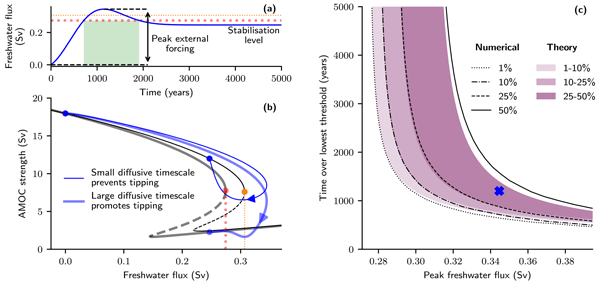
Kerstin Lux-Gottschalk and Paul D. L. Ritchie
Earth Syst. Dynam., 16, 1153–1168, https://doi.org/10.5194/esd-16-1153-2025, https://doi.org/10.5194/esd-16-1153-2025, 2025
Short summary
Short summary
For tipping points at low levels of global warming, overshoots of the threshold are becoming increasingly likely. Importantly, for some systems, tipping can still be avoided provided the forcing is reversed sufficiently quickly. Conditions for a mitigation window, which would avoid tipping, depend on system uncertainties. We highlight the need to account for uncertainty in the threshold location and other system features when designing climate mitigation strategies that avoid tipping.
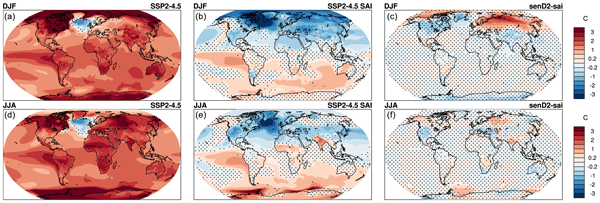
Simone Tilmes, Ewa M. Bednarz, Andrin Jörimann, Daniele Visioni, Douglas E. Kinnison, Gabriel Chiodo, and David Plummer
Atmos. Chem. Phys., 25, 6001–6023, https://doi.org/10.5194/acp-25-6001-2025, https://doi.org/10.5194/acp-25-6001-2025, 2025
Short summary
Short summary
In this paper, we describe the details of a new multi-model intercomparison experiment to assess the effects of Stratospheric Aerosol Intervention (SAI) on stratospheric chemistry and dynamics and, therefore, ozone. Second, we discuss the advantages and differences of the more constrained experiment compared to fully interactive model experiments. This way, we advance the process-level understanding of the drivers of SAI-induced atmospheric responses.
Sauvik Santra, Shubha Verma, Shubham Patel, Olivier Boucher, and Mathew Koll Roxy
EGUsphere, https://doi.org/10.5194/egusphere-2025-2302, https://doi.org/10.5194/egusphere-2025-2302, 2025
Preprint archived
Short summary
Short summary
Uneven spatial changes in Indian monsoon rainfall are linked to tiny airborne particles called aerosols, both human-made and natural (like dust). Using a high-resolution climate model, we show how persistent weakening and strengthening patterns in rainfall are driven by spatially varying aerosols. Reducing human-made aerosols may ease rainfall shortages in some areas but worsen excesses in others. These insights are key for better water management and policy planning.
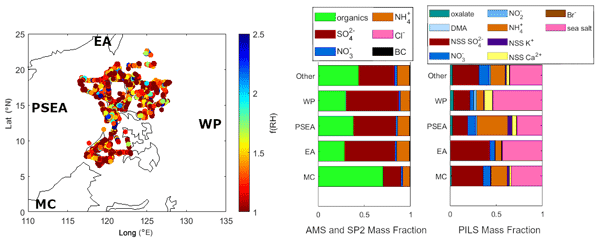
Genevieve Rose Lorenzo, Luke D. Ziemba, Avelino F. Arellano, Mary C. Barth, Ewan C. Crosbie, Joshua P. DiGangi, Glenn S. Diskin, Richard Ferrare, Miguel Ricardo A. Hilario, Michael A. Shook, Simone Tilmes, Jian Wang, Qian Xiao, Jun Zhang, and Armin Sorooshian
Atmos. Chem. Phys., 25, 5469–5495, https://doi.org/10.5194/acp-25-5469-2025, https://doi.org/10.5194/acp-25-5469-2025, 2025
Short summary
Short summary
Novel aerosol hygroscopicity analyses of CAMP2Ex (Cloud, Aerosol, and Monsoon Processes Philippines Experiment) field campaign data show low aerosol hygroscopicity values in Southeast Asia. Organic carbon from smoke decreases hygroscopicity to levels more like those in continental than in polluted marine regions. Hygroscopicity changes at cloud level demonstrate how surface particles impact clouds in the region, affecting model representation of aerosol and cloud interactions in similar polluted marine regions with high organic carbon emissions.
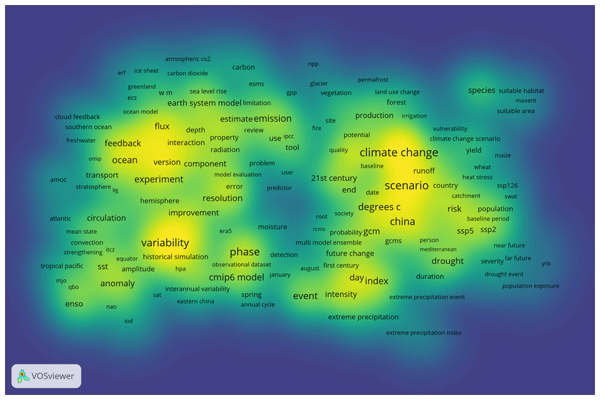
Martin Juckes, Karl E. Taylor, Fabrizio Antonio, David Brayshaw, Carlo Buontempo, Jian Cao, Paul J. Durack, Michio Kawamiya, Hyungjun Kim, Tomas Lovato, Chloe Mackallah, Matthew Mizielinski, Alessandra Nuzzo, Martina Stockhause, Daniele Visioni, Jeremy Walton, Briony Turner, Eleanor O'Rourke, and Beth Dingley
Geosci. Model Dev., 18, 2639–2663, https://doi.org/10.5194/gmd-18-2639-2025, https://doi.org/10.5194/gmd-18-2639-2025, 2025
Short summary
Short summary
The Baseline Climate Variables for Earth System Modelling (ESM-BCVs) are defined as a list of 135 variables which have high utility for the evaluation and exploitation of climate simulations. The list reflects the most frequently used variables from Earth system models based on an assessment of data publication and download records from the largest archive of global climate projects.
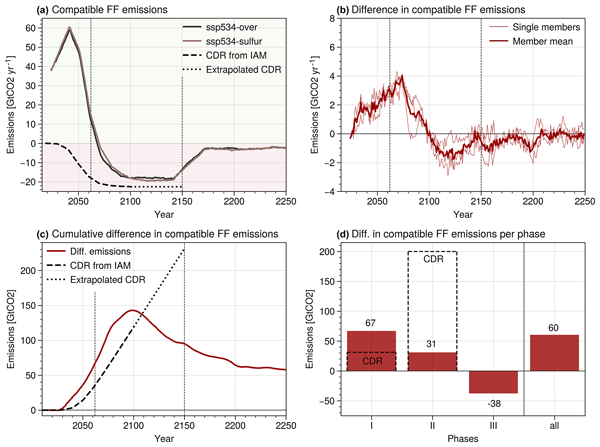
Susanne Baur, Benjamin M. Sanderson, Roland Séférian, and Laurent Terray
Earth Syst. Dynam., 16, 667–681, https://doi.org/10.5194/esd-16-667-2025, https://doi.org/10.5194/esd-16-667-2025, 2025
Short summary
Short summary
Stratospheric aerosol injection (SAI) could be used alongside mitigation to reduce global warming. Previous studies suggest that more atmospheric CO2 is taken up when SAI is deployed. Here, we look at the entire SAI deployment from start to after termination. We show how the initial CO2 uptake benefit, and hence lower mitigation burden, is reduced in later stages of SAI, where the reduction in natural CO2 uptake turns into an additional mitigation burden.
Tomohiro Hajima, Michio Kawamiya, Akihiko Ito, Kaoru Tachiiri, Chris D. Jones, Vivek Arora, Victor Brovkin, Roland Séférian, Spencer Liddicoat, Pierre Friedlingstein, and Elena Shevliakova
Biogeosciences, 22, 1447–1473, https://doi.org/10.5194/bg-22-1447-2025, https://doi.org/10.5194/bg-22-1447-2025, 2025
Short summary
Short summary
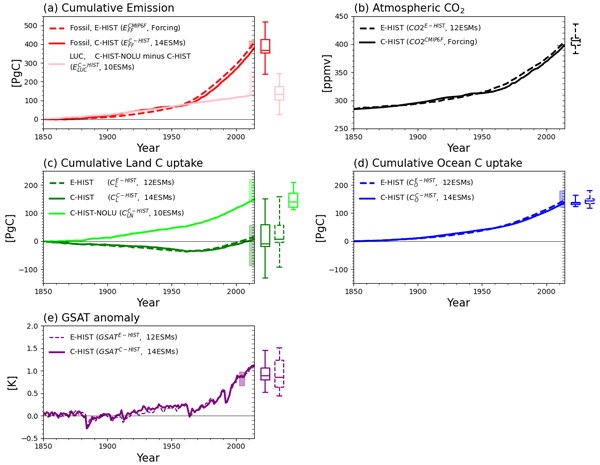
This study analyzes atmospheric CO2 concentrations and global carbon budgets simulated by multiple Earth system models, using several types of simulations (CO2 concentration- and emission-driven experiments). We successfully identified problems with regard to the global carbon budget in each model. We also found urgent issues with regard to land use change CO2 emissions that should be solved in the latest generation of models.
Pierre Friedlingstein, Michael O'Sullivan, Matthew W. Jones, Robbie M. Andrew, Judith Hauck, Peter Landschützer, Corinne Le Quéré, Hongmei Li, Ingrid T. Luijkx, Are Olsen, Glen P. Peters, Wouter Peters, Julia Pongratz, Clemens Schwingshackl, Stephen Sitch, Josep G. Canadell, Philippe Ciais, Robert B. Jackson, Simone R. Alin, Almut Arneth, Vivek Arora, Nicholas R. Bates, Meike Becker, Nicolas Bellouin, Carla F. Berghoff, Henry C. Bittig, Laurent Bopp, Patricia Cadule, Katie Campbell, Matthew A. Chamberlain, Naveen Chandra, Frédéric Chevallier, Louise P. Chini, Thomas Colligan, Jeanne Decayeux, Laique M. Djeutchouang, Xinyu Dou, Carolina Duran Rojas, Kazutaka Enyo, Wiley Evans, Amanda R. Fay, Richard A. Feely, Daniel J. Ford, Adrianna Foster, Thomas Gasser, Marion Gehlen, Thanos Gkritzalis, Giacomo Grassi, Luke Gregor, Nicolas Gruber, Özgür Gürses, Ian Harris, Matthew Hefner, Jens Heinke, George C. Hurtt, Yosuke Iida, Tatiana Ilyina, Andrew R. Jacobson, Atul K. Jain, Tereza Jarníková, Annika Jersild, Fei Jiang, Zhe Jin, Etsushi Kato, Ralph F. Keeling, Kees Klein Goldewijk, Jürgen Knauer, Jan Ivar Korsbakken, Xin Lan, Siv K. Lauvset, Nathalie Lefèvre, Zhu Liu, Junjie Liu, Lei Ma, Shamil Maksyutov, Gregg Marland, Nicolas Mayot, Patrick C. McGuire, Nicolas Metzl, Natalie M. Monacci, Eric J. Morgan, Shin-Ichiro Nakaoka, Craig Neill, Yosuke Niwa, Tobias Nützel, Lea Olivier, Tsuneo Ono, Paul I. Palmer, Denis Pierrot, Zhangcai Qin, Laure Resplandy, Alizée Roobaert, Thais M. Rosan, Christian Rödenbeck, Jörg Schwinger, T. Luke Smallman, Stephen M. Smith, Reinel Sospedra-Alfonso, Tobias Steinhoff, Qing Sun, Adrienne J. Sutton, Roland Séférian, Shintaro Takao, Hiroaki Tatebe, Hanqin Tian, Bronte Tilbrook, Olivier Torres, Etienne Tourigny, Hiroyuki Tsujino, Francesco Tubiello, Guido van der Werf, Rik Wanninkhof, Xuhui Wang, Dongxu Yang, Xiaojuan Yang, Zhen Yu, Wenping Yuan, Xu Yue, Sönke Zaehle, Ning Zeng, and Jiye Zeng
Earth Syst. Sci. Data, 17, 965–1039, https://doi.org/10.5194/essd-17-965-2025, https://doi.org/10.5194/essd-17-965-2025, 2025
Short summary
Short summary
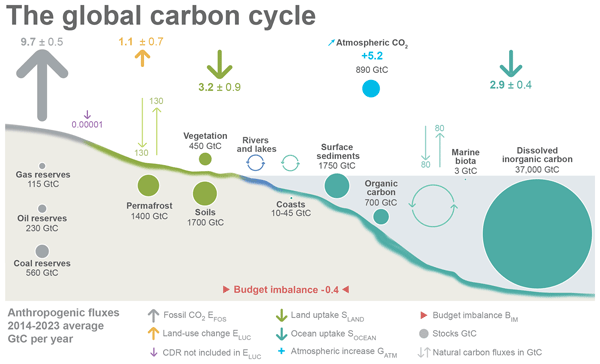
The Global Carbon Budget 2024 describes the methodology, main results, and datasets used to quantify the anthropogenic emissions of carbon dioxide (CO2) and their partitioning among the atmosphere, land ecosystems, and the ocean over the historical period (1750–2024). These living datasets are updated every year to provide the highest transparency and traceability in the reporting of CO2, the key driver of climate change.
Danny M. Leung, Jasper F. Kok, Longlei Li, David M. Lawrence, Natalie M. Mahowald, Simone Tilmes, and Erik Kluzek
Atmos. Chem. Phys., 25, 2311–2331, https://doi.org/10.5194/acp-25-2311-2025, https://doi.org/10.5194/acp-25-2311-2025, 2025
Short summary
Short summary
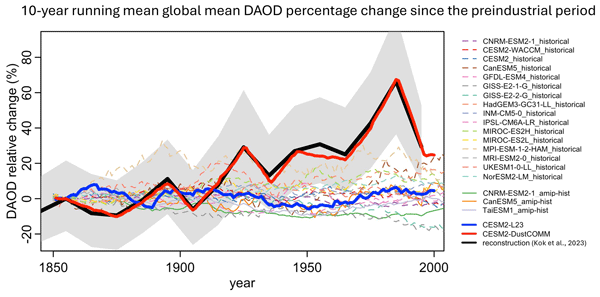
This study derives a gridded dust emission dataset for 1841–2000 by employing a combination of observed dust from core records and reanalyzed global dust cycle constraints. We evaluate the ability of global models to replicate the observed historical dust variability by using the emission dataset to force a historical simulation in an Earth system model. We show that prescribing our emissions forces the model to better match observations than other mechanistic models.
Irina Melnikova, Philippe Ciais, Katsumasa Tanaka, Hideo Shiogama, Kaoru Tachiiri, Tokuta Yokohata, and Olivier Boucher
Earth Syst. Dynam., 16, 257–273, https://doi.org/10.5194/esd-16-257-2025, https://doi.org/10.5194/esd-16-257-2025, 2025
Short summary
Short summary
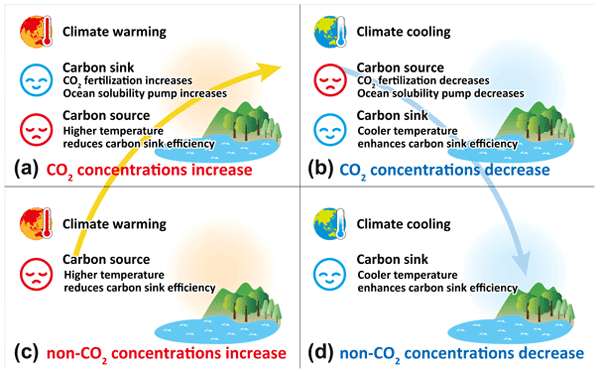
Reducing non-CO2 greenhouse gases is important alongside CO2 for climate mitigation. Here, we look at how reducing their emissions compares to reducing CO2 using an Earth system model. While both types of gases contribute to warming, their regional climate impacts differ. Besides, the carbon cycle responds differently depending on whether climate change is driven by CO2 or non-CO2 gases. Considering both types of gases is important for carbon cycle analysis and climate mitigation strategies.
Prashant Chavan, Suvarna Fadnavis, Anton Laakso, Jean-Paul Vernier, Simone Tilmes, and Rolf Müller
EGUsphere, https://doi.org/10.5194/egusphere-2024-3825, https://doi.org/10.5194/egusphere-2024-3825, 2025
Preprint archived
Short summary
Short summary
Our simulations with volcanoes, when compared without volcanoes, show that volcanic aerosol precursors enter the tropical stratosphere, propagating upward and enhancing sulphate aerosol and heating. This stratospheric heating caused by the volcanoes reduces the amplitude of the QBO and disrupts its phases. Since QBO also modulates tropical convection and weather, we suggest including volcanic emissions and the QBO in the weather prediction model for a better forecast.
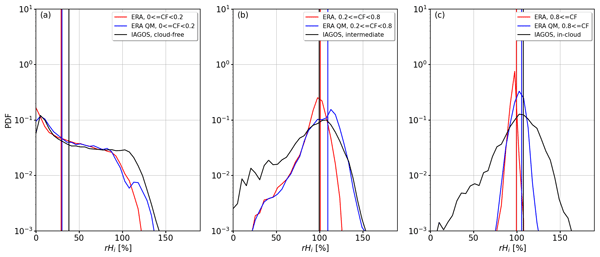
Kevin Wolf, Nicolas Bellouin, Olivier Boucher, Susanne Rohs, and Yun Li
Atmos. Chem. Phys., 25, 157–181, https://doi.org/10.5194/acp-25-157-2025, https://doi.org/10.5194/acp-25-157-2025, 2025
Short summary
Short summary
ERA5 atmospheric reanalysis and airborne in situ observations from IAGOS are compared in terms of the representation of the contrail formation potential and the presence of supersaturation. Differences are traced back to biases in ERA5 relative humidity fields. Those biases are addressed by applying a quantile mapping technique that significantly improved contrail estimation based on post-processed ERA5 data.
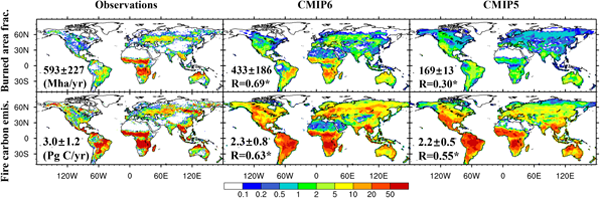
Fang Li, Xiang Song, Sandy P. Harrison, Jennifer R. Marlon, Zhongda Lin, L. Ruby Leung, Jörg Schwinger, Virginie Marécal, Shiyu Wang, Daniel S. Ward, Xiao Dong, Hanna Lee, Lars Nieradzik, Sam S. Rabin, and Roland Séférian
Geosci. Model Dev., 17, 8751–8771, https://doi.org/10.5194/gmd-17-8751-2024, https://doi.org/10.5194/gmd-17-8751-2024, 2024
Short summary
Short summary
This study provides the first comprehensive assessment of historical fire simulations from 19 Earth system models in phase 6 of the Coupled Model Intercomparison Project (CMIP6). Most models reproduce global totals, spatial patterns, seasonality, and regional historical changes well but fail to simulate the recent decline in global burned area and underestimate the fire response to climate variability. CMIP6 simulations address three critical issues of phase-5 models.
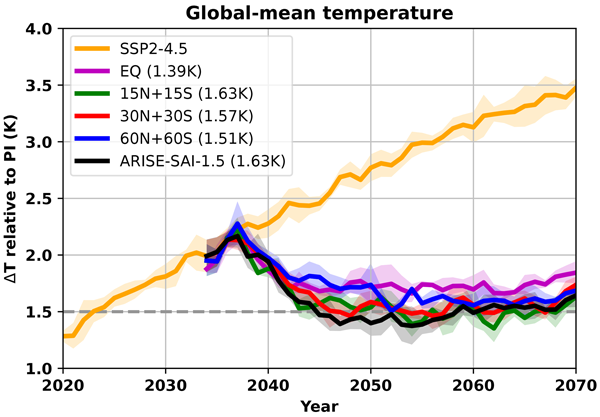
Matthew Henry, Ewa M. Bednarz, and Jim Haywood
Atmos. Chem. Phys., 24, 13253–13268, https://doi.org/10.5194/acp-24-13253-2024, https://doi.org/10.5194/acp-24-13253-2024, 2024
Short summary
Short summary
Stratospheric aerosol injection (SAI) refers to a climate intervention by which aerosols are intentionally added to the high atmosphere to increase the amount of reflected sunlight and reduce Earth's temperature. The climate outcomes of SAI depend on the latitude of injection. While injecting aerosols at the Equator has undesirable side effects, injecting away from the Equator has different effects on temperature, rainfall, ozone, and atmospheric circulation, which are analysed in this work.
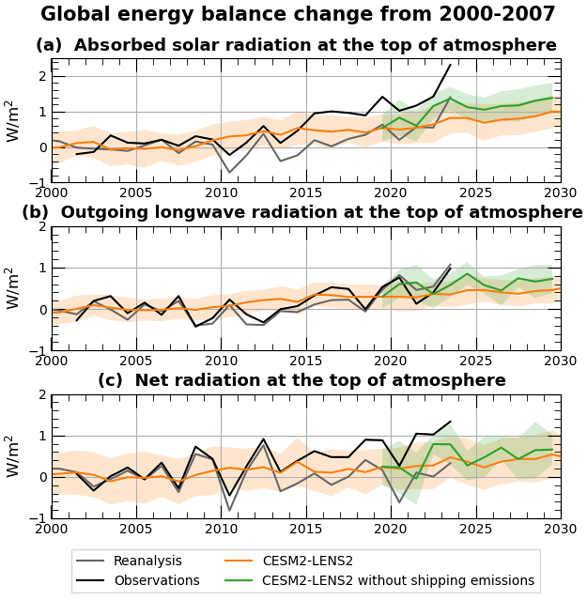
Ilaria Quaglia and Daniele Visioni
Earth Syst. Dynam., 15, 1527–1541, https://doi.org/10.5194/esd-15-1527-2024, https://doi.org/10.5194/esd-15-1527-2024, 2024
Short summary
Short summary
On 1 January 2020, international shipping vessels were required to substantially reduce the amount of particulate they emit to improve air quality. In this work we demonstrate how this regulatory change contributed to the anomalous warming observed in recent months using climate model simulations that include such a change. Future policies should also perhaps consider their impact on climate, and climate modelers should promptly include those changes in future modeling efforts.
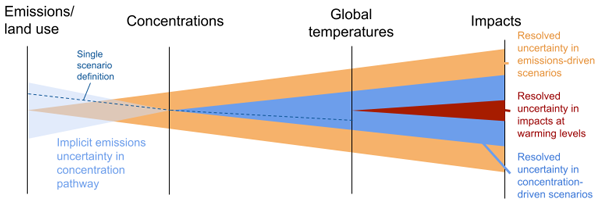
Benjamin M. Sanderson, Ben B. B. Booth, John Dunne, Veronika Eyring, Rosie A. Fisher, Pierre Friedlingstein, Matthew J. Gidden, Tomohiro Hajima, Chris D. Jones, Colin G. Jones, Andrew King, Charles D. Koven, David M. Lawrence, Jason Lowe, Nadine Mengis, Glen P. Peters, Joeri Rogelj, Chris Smith, Abigail C. Snyder, Isla R. Simpson, Abigail L. S. Swann, Claudia Tebaldi, Tatiana Ilyina, Carl-Friedrich Schleussner, Roland Séférian, Bjørn H. Samset, Detlef van Vuuren, and Sönke Zaehle
Geosci. Model Dev., 17, 8141–8172, https://doi.org/10.5194/gmd-17-8141-2024, https://doi.org/10.5194/gmd-17-8141-2024, 2024
Short summary
Short summary
We discuss how, in order to provide more relevant guidance for climate policy, coordinated climate experiments should adopt a greater focus on simulations where Earth system models are provided with carbon emissions from fossil fuels together with land use change instructions, rather than past approaches that have largely focused on experiments with prescribed atmospheric carbon dioxide concentrations. We discuss how these goals might be achieved in coordinated climate modeling experiments.
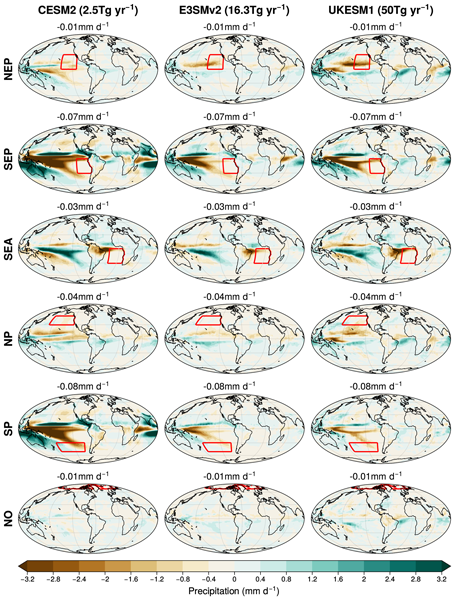
Philip J. Rasch, Haruki Hirasawa, Mingxuan Wu, Sarah J. Doherty, Robert Wood, Hailong Wang, Andy Jones, James Haywood, and Hansi Singh
Geosci. Model Dev., 17, 7963–7994, https://doi.org/10.5194/gmd-17-7963-2024, https://doi.org/10.5194/gmd-17-7963-2024, 2024
Short summary
Short summary
We introduce a protocol to compare computer climate simulations to better understand a proposed strategy intended to counter warming and climate impacts from greenhouse gas increases. This slightly changes clouds in six ocean regions to reflect more sunlight and cool the Earth. Example changes in clouds and climate are shown for three climate models. Cloud changes differ between the models, but precipitation and surface temperature changes are similar when their cooling effects are made similar.
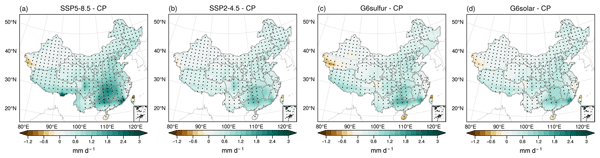
Ou Wang, Ju Liang, Yuchen Gu, Jim M. Haywood, Ying Chen, Chenwei Fang, and Qin'geng Wang
Atmos. Chem. Phys., 24, 12355–12373, https://doi.org/10.5194/acp-24-12355-2024, https://doi.org/10.5194/acp-24-12355-2024, 2024
Short summary
Short summary
As extreme precipitation events increase in China, this study explores the potential of stratospheric aerosol injection (SAI) to mitigate these effects by the end of the 21st century using the UKESM1 model. Results show that SAI reduces extreme precipitation in eastern China. However, caution is advised due to potential side effects in high-latitude regions, and further optimization is required for future SAI deployment.

Colin G. Jones, Fanny Adloff, Ben B. B. Booth, Peter M. Cox, Veronika Eyring, Pierre Friedlingstein, Katja Frieler, Helene T. Hewitt, Hazel A. Jeffery, Sylvie Joussaume, Torben Koenigk, Bryan N. Lawrence, Eleanor O'Rourke, Malcolm J. Roberts, Benjamin M. Sanderson, Roland Séférian, Samuel Somot, Pier Luigi Vidale, Detlef van Vuuren, Mario Acosta, Mats Bentsen, Raffaele Bernardello, Richard Betts, Ed Blockley, Julien Boé, Tom Bracegirdle, Pascale Braconnot, Victor Brovkin, Carlo Buontempo, Francisco Doblas-Reyes, Markus Donat, Italo Epicoco, Pete Falloon, Sandro Fiore, Thomas Frölicher, Neven S. Fučkar, Matthew J. Gidden, Helge F. Goessling, Rune Grand Graversen, Silvio Gualdi, José M. Gutiérrez, Tatiana Ilyina, Daniela Jacob, Chris D. Jones, Martin Juckes, Elizabeth Kendon, Erik Kjellström, Reto Knutti, Jason Lowe, Matthew Mizielinski, Paola Nassisi, Michael Obersteiner, Pierre Regnier, Romain Roehrig, David Salas y Mélia, Carl-Friedrich Schleussner, Michael Schulz, Enrico Scoccimarro, Laurent Terray, Hannes Thiemann, Richard A. Wood, Shuting Yang, and Sönke Zaehle
Earth Syst. Dynam., 15, 1319–1351, https://doi.org/10.5194/esd-15-1319-2024, https://doi.org/10.5194/esd-15-1319-2024, 2024
Short summary
Short summary
We propose a number of priority areas for the international climate research community to address over the coming decade. Advances in these areas will both increase our understanding of past and future Earth system change, including the societal and environmental impacts of this change, and deliver significantly improved scientific support to international climate policy, such as future IPCC assessments and the UNFCCC Global Stocktake.

Audran Borella, Olivier Boucher, Keith P. Shine, Marc Stettler, Katsumasa Tanaka, Roger Teoh, and Nicolas Bellouin
Atmos. Chem. Phys., 24, 9401–9417, https://doi.org/10.5194/acp-24-9401-2024, https://doi.org/10.5194/acp-24-9401-2024, 2024
Short summary
Short summary
This work studies how to compare the climate impact of the CO2 emitted and contrails formed by a flight. This is applied to contrail avoidance strategies that would decrease climate impact of flights by changing the trajectory of aircraft to avoid persistent contrail formation, at the risk of increasing CO2 emissions. We find that different comparison methods lead to different quantification of the total climate impact of a flight but lead to similar decisions of whether to reroute an aircraft.
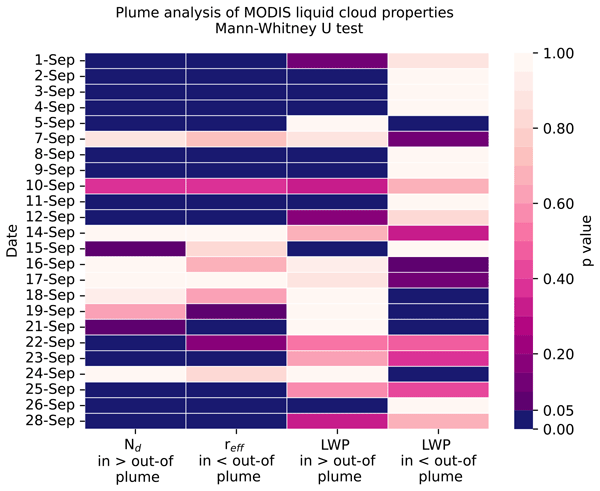
Amy H. Peace, Ying Chen, George Jordan, Daniel G. Partridge, Florent Malavelle, Eliza Duncan, and Jim M. Haywood
Atmos. Chem. Phys., 24, 9533–9553, https://doi.org/10.5194/acp-24-9533-2024, https://doi.org/10.5194/acp-24-9533-2024, 2024
Short summary
Short summary
Natural aerosols from volcanic eruptions can help us understand how anthropogenic aerosols modify climate. We use observations and model simulations of the 2014–2015 Holuhraun eruption plume to examine aerosol–cloud interactions in September 2014. We find a shift to clouds with smaller, more numerous cloud droplets in the first 2 weeks of the eruption. In the third week, the background meteorology and previous conditions experienced by air masses modulate the aerosol perturbation to clouds.
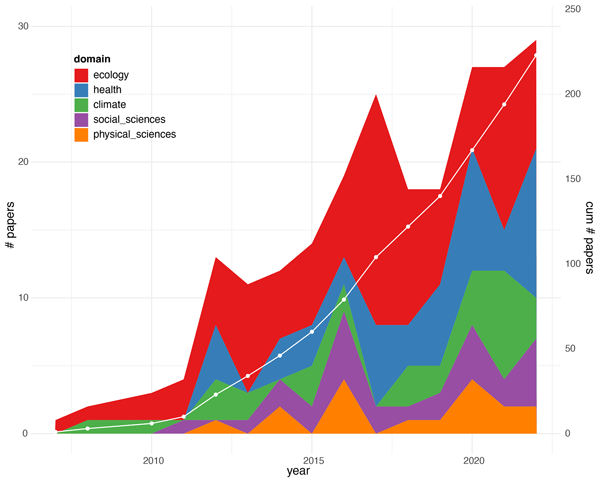
Vasilis Dakos, Chris A. Boulton, Joshua E. Buxton, Jesse F. Abrams, Beatriz Arellano-Nava, David I. Armstrong McKay, Sebastian Bathiany, Lana Blaschke, Niklas Boers, Daniel Dylewsky, Carlos López-Martínez, Isobel Parry, Paul Ritchie, Bregje van der Bolt, Larissa van der Laan, Els Weinans, and Sonia Kéfi
Earth Syst. Dynam., 15, 1117–1135, https://doi.org/10.5194/esd-15-1117-2024, https://doi.org/10.5194/esd-15-1117-2024, 2024
Short summary
Short summary
Tipping points are abrupt, rapid, and sometimes irreversible changes, and numerous approaches have been proposed to detect them in advance. Such approaches have been termed early warning signals and represent a set of methods for identifying changes in the underlying behaviour of a system across time or space that might indicate an approaching tipping point. Here, we review the literature to explore where, how, and which early warnings have been used in real-world case studies so far.
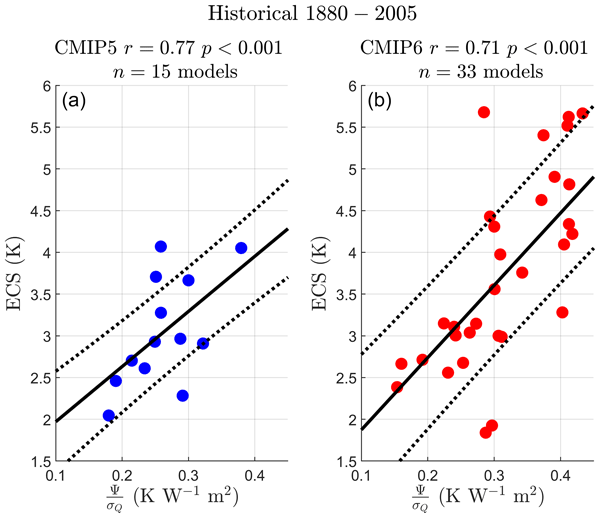
Mark S. Williamson, Peter M. Cox, Chris Huntingford, and Femke J. M. M. Nijsse
Earth Syst. Dynam., 15, 829–852, https://doi.org/10.5194/esd-15-829-2024, https://doi.org/10.5194/esd-15-829-2024, 2024
Short summary
Short summary
Emergent constraints on equilibrium climate sensitivity (ECS) have generally got statistically weaker in the latest set of state-of-the-art climate models (CMIP6) compared to past sets (CMIP5). We look at why this weakening happened for one particular study (Cox et al, 2018) and attribute it to an assumption made in the theory that when corrected for restores there is a stronger relationship between predictor and ECS.
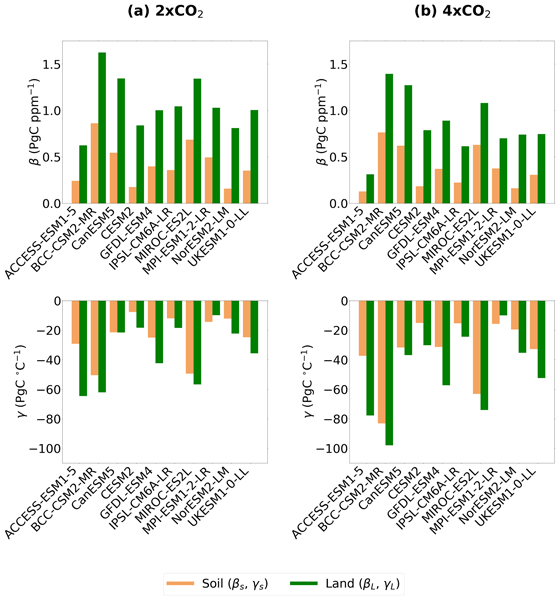
Rebecca M. Varney, Pierre Friedlingstein, Sarah E. Chadburn, Eleanor J. Burke, and Peter M. Cox
Biogeosciences, 21, 2759–2776, https://doi.org/10.5194/bg-21-2759-2024, https://doi.org/10.5194/bg-21-2759-2024, 2024
Short summary
Short summary
Soil carbon is the largest store of carbon on the land surface of Earth and is known to be particularly sensitive to climate change. Understanding this future response is vital to successfully meeting Paris Agreement targets, which rely heavily on carbon uptake by the land surface. In this study, the individual responses of soil carbon are quantified and compared amongst CMIP6 Earth system models used within the most recent IPCC report, and the role of soils in the land response is highlighted.
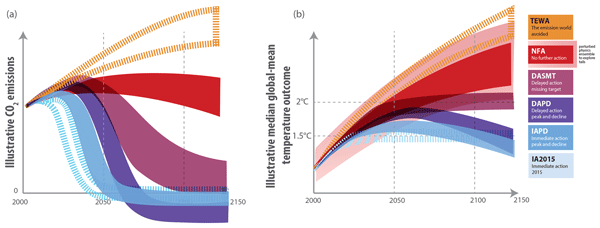
Malte Meinshausen, Carl-Friedrich Schleussner, Kathleen Beyer, Greg Bodeker, Olivier Boucher, Josep G. Canadell, John S. Daniel, Aïda Diongue-Niang, Fatima Driouech, Erich Fischer, Piers Forster, Michael Grose, Gerrit Hansen, Zeke Hausfather, Tatiana Ilyina, Jarmo S. Kikstra, Joyce Kimutai, Andrew D. King, June-Yi Lee, Chris Lennard, Tabea Lissner, Alexander Nauels, Glen P. Peters, Anna Pirani, Gian-Kasper Plattner, Hans Pörtner, Joeri Rogelj, Maisa Rojas, Joyashree Roy, Bjørn H. Samset, Benjamin M. Sanderson, Roland Séférian, Sonia Seneviratne, Christopher J. Smith, Sophie Szopa, Adelle Thomas, Diana Urge-Vorsatz, Guus J. M. Velders, Tokuta Yokohata, Tilo Ziehn, and Zebedee Nicholls
Geosci. Model Dev., 17, 4533–4559, https://doi.org/10.5194/gmd-17-4533-2024, https://doi.org/10.5194/gmd-17-4533-2024, 2024
Short summary
Short summary
The scientific community is considering new scenarios to succeed RCPs and SSPs for the next generation of Earth system model runs to project future climate change. To contribute to that effort, we reflect on relevant policy and scientific research questions and suggest categories for representative emission pathways. These categories are tailored to the Paris Agreement long-term temperature goal, high-risk outcomes in the absence of further climate policy and worlds “that could have been”.
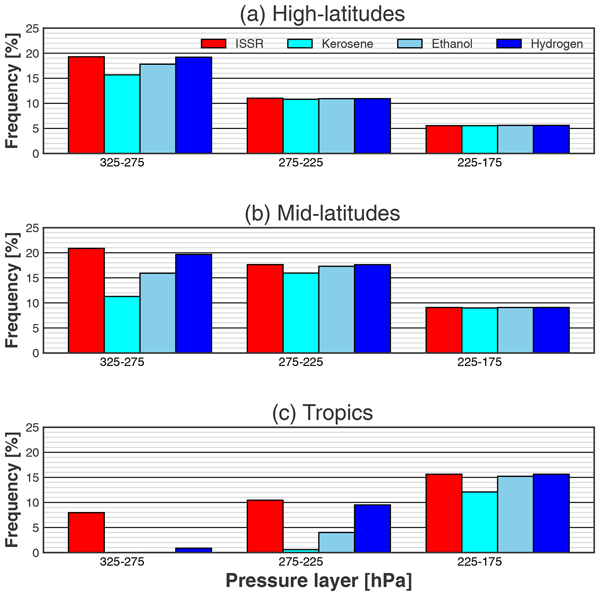
Sidiki Sanogo, Olivier Boucher, Nicolas Bellouin, Audran Borella, Kevin Wolf, and Susanne Rohs
Atmos. Chem. Phys., 24, 5495–5511, https://doi.org/10.5194/acp-24-5495-2024, https://doi.org/10.5194/acp-24-5495-2024, 2024
Short summary
Short summary
Relative humidity relative to ice (RHi) is a key variable in the formation of cirrus clouds and contrails. This study shows that the properties of the probability density function of RHi differ between the tropics and higher latitudes. In line with RHi and temperature variability, aircraft are likely to produce more contrails with bioethanol and liquid hydrogen as fuel. The impact of this fuel change decreases with decreasing pressure levels but increases from high latitudes to the tropics.

Christina V. Brodowsky, Timofei Sukhodolov, Gabriel Chiodo, Valentina Aquila, Slimane Bekki, Sandip S. Dhomse, Michael Höpfner, Anton Laakso, Graham W. Mann, Ulrike Niemeier, Giovanni Pitari, Ilaria Quaglia, Eugene Rozanov, Anja Schmidt, Takashi Sekiya, Simone Tilmes, Claudia Timmreck, Sandro Vattioni, Daniele Visioni, Pengfei Yu, Yunqian Zhu, and Thomas Peter
Atmos. Chem. Phys., 24, 5513–5548, https://doi.org/10.5194/acp-24-5513-2024, https://doi.org/10.5194/acp-24-5513-2024, 2024
Short summary
Short summary
The aerosol layer is an essential part of the climate system. We characterize the sulfur budget in a volcanically quiescent (background) setting, with a special focus on the sulfate aerosol layer using, for the first time, a multi-model approach. The aim is to identify weak points in the representation of the atmospheric sulfur budget in an intercomparison of nine state-of-the-art coupled global circulation models.
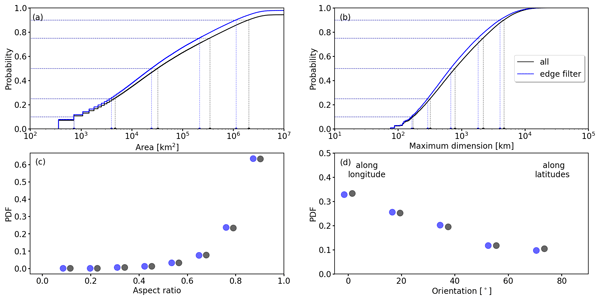
Kevin Wolf, Nicolas Bellouin, and Olivier Boucher
Atmos. Chem. Phys., 24, 5009–5024, https://doi.org/10.5194/acp-24-5009-2024, https://doi.org/10.5194/acp-24-5009-2024, 2024
Short summary
Short summary
The contrail formation potential and its tempo-spatial distribution are estimated for the North Atlantic flight corridor. Meteorological conditions of temperature and relative humidity are taken from the ERA5 re-analysis and IAGOS. Based on IAGOS flight tracks, crossing length, size, orientation, frequency of occurrence, and overlap of persistent contrail formation areas are determined. The presented conclusions might provide a guide for statistical flight track optimization to reduce contrails.
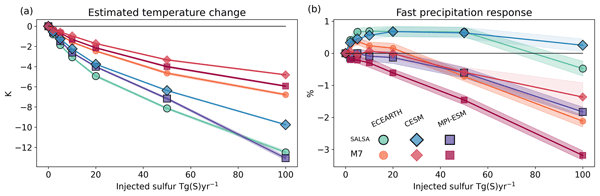
Anton Laakso, Daniele Visioni, Ulrike Niemeier, Simone Tilmes, and Harri Kokkola
Earth Syst. Dynam., 15, 405–427, https://doi.org/10.5194/esd-15-405-2024, https://doi.org/10.5194/esd-15-405-2024, 2024
Short summary
Short summary
This study is the second in a two-part series in which we explore the dependency of the impacts of stratospheric sulfur injections on both the model employed and the strategy of injection utilized. The study uncovers uncertainties associated with these techniques to cool climate, highlighting how the simulated climate impacts are dependent on both the selected model and the magnitude of the injections. We also show that estimating precipitation impacts of aerosol injection is a complex task.
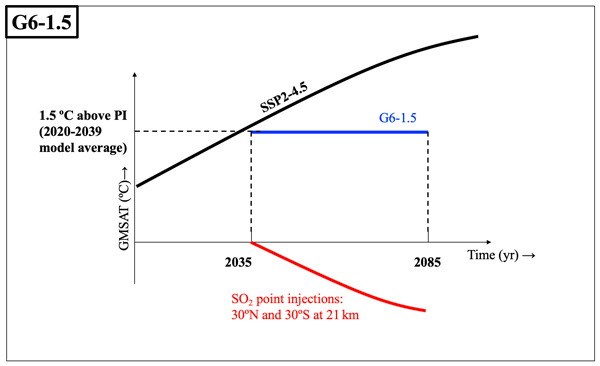
Daniele Visioni, Alan Robock, Jim Haywood, Matthew Henry, Simone Tilmes, Douglas G. MacMartin, Ben Kravitz, Sarah J. Doherty, John Moore, Chris Lennard, Shingo Watanabe, Helene Muri, Ulrike Niemeier, Olivier Boucher, Abu Syed, Temitope S. Egbebiyi, Roland Séférian, and Ilaria Quaglia
Geosci. Model Dev., 17, 2583–2596, https://doi.org/10.5194/gmd-17-2583-2024, https://doi.org/10.5194/gmd-17-2583-2024, 2024
Short summary
Short summary
This paper describes a new experimental protocol for the Geoengineering Model Intercomparison Project (GeoMIP). In it, we describe the details of a new simulation of sunlight reflection using the stratospheric aerosols that climate models are supposed to run, and we explain the reasons behind each choice we made when defining the protocol.
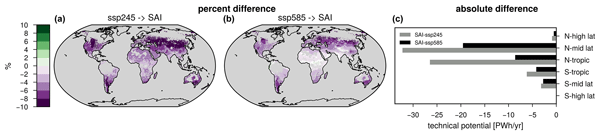
Susanne Baur, Benjamin M. Sanderson, Roland Séférian, and Laurent Terray
Earth Syst. Dynam., 15, 307–322, https://doi.org/10.5194/esd-15-307-2024, https://doi.org/10.5194/esd-15-307-2024, 2024
Short summary
Short summary
Most solar radiation modification (SRM) simulations assume no physical coupling between mitigation and SRM. We analyze the impact of SRM on photovoltaic (PV) and concentrated solar power (CSP) and find that almost all regions have reduced PV and CSP potential compared to a mitigated or unmitigated scenario, especially in the middle and high latitudes. This suggests that SRM could pose challenges for meeting energy demands with solar renewable resources.
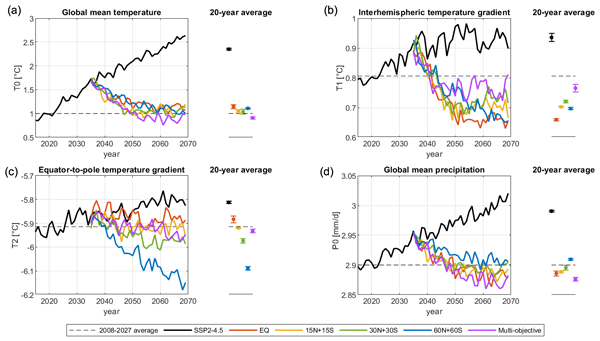
Yan Zhang, Douglas G. MacMartin, Daniele Visioni, Ewa M. Bednarz, and Ben Kravitz
Earth Syst. Dynam., 15, 191–213, https://doi.org/10.5194/esd-15-191-2024, https://doi.org/10.5194/esd-15-191-2024, 2024
Short summary
Short summary
Injecting SO2 into the lower stratosphere can temporarily reduce global mean temperature and mitigate some risks associated with climate change, but injecting it at different latitudes and seasons would have different impacts. This study introduces new stratospheric aerosol injection (SAI) strategies and explores the importance of the choice of SAI strategy, demonstrating that it notably affects the distribution of aerosol cloud, injection efficiency, and various surface climate impacts.
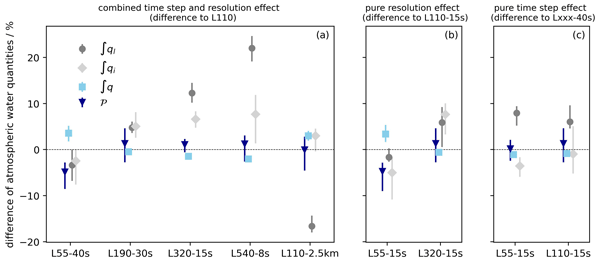
Hauke Schmidt, Sebastian Rast, Jiawei Bao, Amrit Cassim, Shih-Wei Fang, Diego Jimenez-de la Cuesta, Paul Keil, Lukas Kluft, Clarissa Kroll, Theresa Lang, Ulrike Niemeier, Andrea Schneidereit, Andrew I. L. Williams, and Bjorn Stevens
Geosci. Model Dev., 17, 1563–1584, https://doi.org/10.5194/gmd-17-1563-2024, https://doi.org/10.5194/gmd-17-1563-2024, 2024
Short summary
Short summary
A recent development in numerical simulations of the global atmosphere is the increase in horizontal resolution to grid spacings of a few kilometers. However, the vertical grid spacing of these models has not been reduced at the same rate as the horizontal grid spacing. Here, we assess the effects of much finer vertical grid spacings, in particular the impacts on cloud quantities and the atmospheric energy balance.
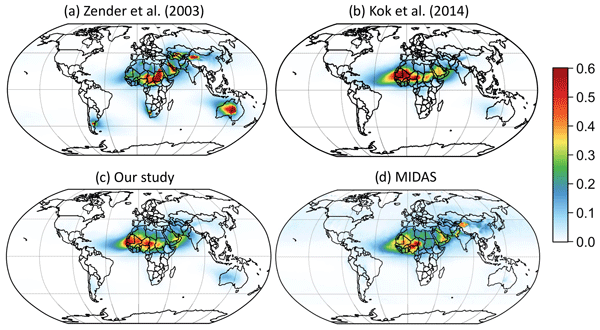
Danny M. Leung, Jasper F. Kok, Longlei Li, Natalie M. Mahowald, David M. Lawrence, Simone Tilmes, Erik Kluzek, Martina Klose, and Carlos Pérez García-Pando
Atmos. Chem. Phys., 24, 2287–2318, https://doi.org/10.5194/acp-24-2287-2024, https://doi.org/10.5194/acp-24-2287-2024, 2024
Short summary
Short summary
This study uses a premier Earth system model to evaluate a new desert dust emission scheme proposed in our companion paper. We show that our scheme accounts for more dust emission physics, hence matching better against observations than other existing dust emission schemes do. Our scheme's dust emissions also couple tightly with meteorology, hence likely improving the modeled dust sensitivity to climate change. We believe this work is vital for improving dust representation in climate models.
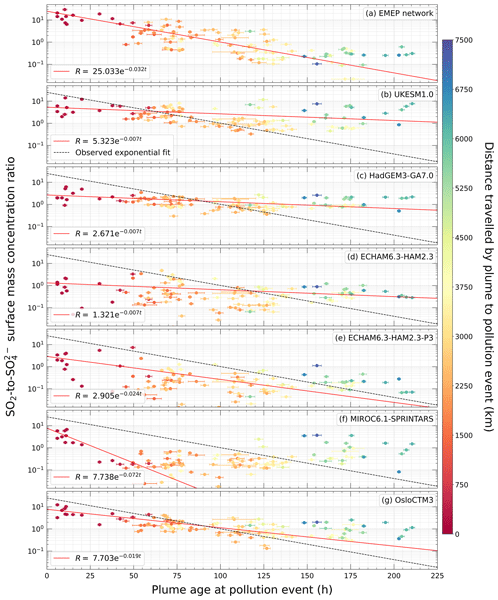
George Jordan, Florent Malavelle, Ying Chen, Amy Peace, Eliza Duncan, Daniel G. Partridge, Paul Kim, Duncan Watson-Parris, Toshihiko Takemura, David Neubauer, Gunnar Myhre, Ragnhild Skeie, Anton Laakso, and James Haywood
Atmos. Chem. Phys., 24, 1939–1960, https://doi.org/10.5194/acp-24-1939-2024, https://doi.org/10.5194/acp-24-1939-2024, 2024
Short summary
Short summary
The 2014–15 Holuhraun eruption caused a huge aerosol plume in an otherwise unpolluted region, providing a chance to study how aerosol alters cloud properties. This two-part study uses observations and models to quantify this relationship’s impact on the Earth’s energy budget. Part 1 suggests the models capture the observed spatial and chemical evolution of the plume, yet no model plume is exact. Understanding these differences is key for Part 2, where changes to cloud properties are explored.
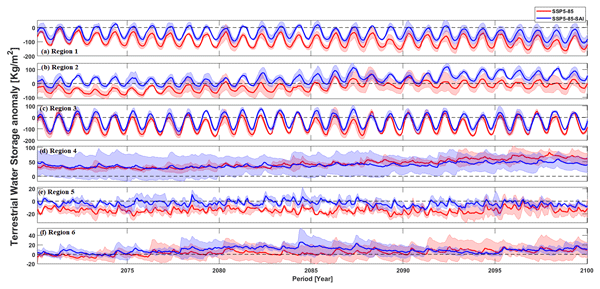
Abolfazl Rezaei, Khalil Karami, Simone Tilmes, and John C. Moore
Earth Syst. Dynam., 15, 91–108, https://doi.org/10.5194/esd-15-91-2024, https://doi.org/10.5194/esd-15-91-2024, 2024
Short summary
Short summary
Water storage (WS) plays a profound role in the lives of people in the Middle East and North Africa as well as Mediterranean climate "hot spots". WS change by greenhouse gas (GHG) warming is simulated with and without stratospheric aerosol intervention (SAI). WS significantly increases in the Arabian Peninsula and decreases around the Mediterranean under GHG. While SAI partially ameliorates GHG impacts, projected WS increases in dry regions and decreases in wet areas relative to present climate.
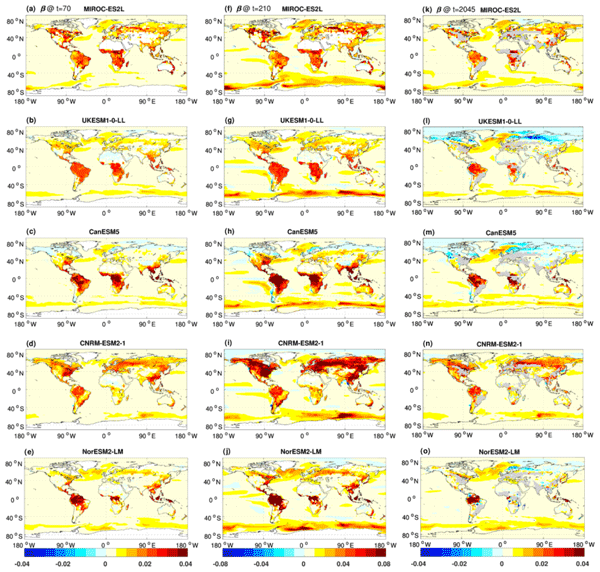
Ali Asaadi, Jörg Schwinger, Hanna Lee, Jerry Tjiputra, Vivek Arora, Roland Séférian, Spencer Liddicoat, Tomohiro Hajima, Yeray Santana-Falcón, and Chris D. Jones
Biogeosciences, 21, 411–435, https://doi.org/10.5194/bg-21-411-2024, https://doi.org/10.5194/bg-21-411-2024, 2024
Short summary
Short summary
Carbon cycle feedback metrics are employed to assess phases of positive and negative CO2 emissions. When emissions become negative, we find that the model disagreement in feedback metrics increases more strongly than expected from the assumption that the uncertainties accumulate linearly with time. The geographical patterns of such metrics over land highlight that differences in response between tropical/subtropical and temperate/boreal ecosystems are a major source of model disagreement.
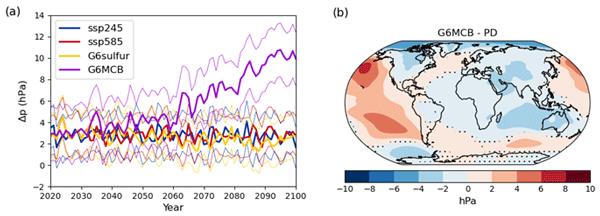
Jim M. Haywood, Andy Jones, Anthony C. Jones, Paul Halloran, and Philip J. Rasch
Atmos. Chem. Phys., 23, 15305–15324, https://doi.org/10.5194/acp-23-15305-2023, https://doi.org/10.5194/acp-23-15305-2023, 2023
Short summary
Short summary
The difficulties in ameliorating global warming and the associated climate change via conventional mitigation are well documented, with all climate model scenarios exceeding 1.5 °C above the preindustrial level in the near future. There is therefore a growing interest in geoengineering to reflect a greater proportion of sunlight back to space and offset some of the global warming. We use a state-of-the-art Earth-system model to investigate two of the most prominent geoengineering strategies.
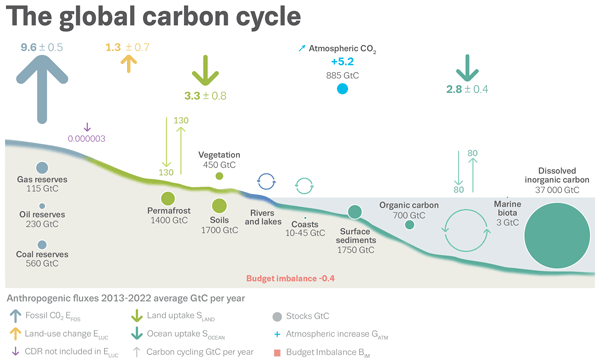
Pierre Friedlingstein, Michael O'Sullivan, Matthew W. Jones, Robbie M. Andrew, Dorothee C. E. Bakker, Judith Hauck, Peter Landschützer, Corinne Le Quéré, Ingrid T. Luijkx, Glen P. Peters, Wouter Peters, Julia Pongratz, Clemens Schwingshackl, Stephen Sitch, Josep G. Canadell, Philippe Ciais, Robert B. Jackson, Simone R. Alin, Peter Anthoni, Leticia Barbero, Nicholas R. Bates, Meike Becker, Nicolas Bellouin, Bertrand Decharme, Laurent Bopp, Ida Bagus Mandhara Brasika, Patricia Cadule, Matthew A. Chamberlain, Naveen Chandra, Thi-Tuyet-Trang Chau, Frédéric Chevallier, Louise P. Chini, Margot Cronin, Xinyu Dou, Kazutaka Enyo, Wiley Evans, Stefanie Falk, Richard A. Feely, Liang Feng, Daniel J. Ford, Thomas Gasser, Josefine Ghattas, Thanos Gkritzalis, Giacomo Grassi, Luke Gregor, Nicolas Gruber, Özgür Gürses, Ian Harris, Matthew Hefner, Jens Heinke, Richard A. Houghton, George C. Hurtt, Yosuke Iida, Tatiana Ilyina, Andrew R. Jacobson, Atul Jain, Tereza Jarníková, Annika Jersild, Fei Jiang, Zhe Jin, Fortunat Joos, Etsushi Kato, Ralph F. Keeling, Daniel Kennedy, Kees Klein Goldewijk, Jürgen Knauer, Jan Ivar Korsbakken, Arne Körtzinger, Xin Lan, Nathalie Lefèvre, Hongmei Li, Junjie Liu, Zhiqiang Liu, Lei Ma, Greg Marland, Nicolas Mayot, Patrick C. McGuire, Galen A. McKinley, Gesa Meyer, Eric J. Morgan, David R. Munro, Shin-Ichiro Nakaoka, Yosuke Niwa, Kevin M. O'Brien, Are Olsen, Abdirahman M. Omar, Tsuneo Ono, Melf Paulsen, Denis Pierrot, Katie Pocock, Benjamin Poulter, Carter M. Powis, Gregor Rehder, Laure Resplandy, Eddy Robertson, Christian Rödenbeck, Thais M. Rosan, Jörg Schwinger, Roland Séférian, T. Luke Smallman, Stephen M. Smith, Reinel Sospedra-Alfonso, Qing Sun, Adrienne J. Sutton, Colm Sweeney, Shintaro Takao, Pieter P. Tans, Hanqin Tian, Bronte Tilbrook, Hiroyuki Tsujino, Francesco Tubiello, Guido R. van der Werf, Erik van Ooijen, Rik Wanninkhof, Michio Watanabe, Cathy Wimart-Rousseau, Dongxu Yang, Xiaojuan Yang, Wenping Yuan, Xu Yue, Sönke Zaehle, Jiye Zeng, and Bo Zheng
Earth Syst. Sci. Data, 15, 5301–5369, https://doi.org/10.5194/essd-15-5301-2023, https://doi.org/10.5194/essd-15-5301-2023, 2023
Short summary
Short summary
The Global Carbon Budget 2023 describes the methodology, main results, and data sets used to quantify the anthropogenic emissions of carbon dioxide (CO2) and their partitioning among the atmosphere, land ecosystems, and the ocean over the historical period (1750–2023). These living datasets are updated every year to provide the highest transparency and traceability in the reporting of CO2, the key driver of climate change.
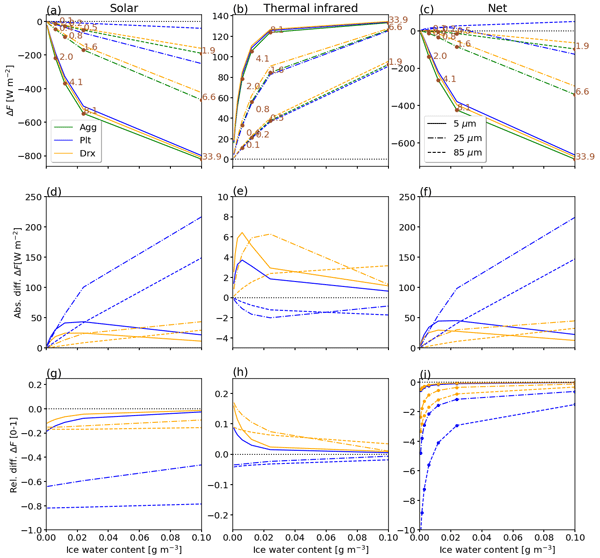
Kevin Wolf, Nicolas Bellouin, and Olivier Boucher
Atmos. Chem. Phys., 23, 14003–14037, https://doi.org/10.5194/acp-23-14003-2023, https://doi.org/10.5194/acp-23-14003-2023, 2023
Short summary
Short summary
Cirrus and contrails considerably impact Earth's energy budget. Such ice clouds can have a positive (warming) or negative (cooling) net radiative effect (RE), which depends on cloud and ambient properties. The effect of eight parameters on the cloud RE is estimated. In total, 283 500 radiative transfer simulations have been performed, spanning the typical parameter ranges associated with cirrus and contrails. Specific cases are selected and discussed. The data set is publicly available.
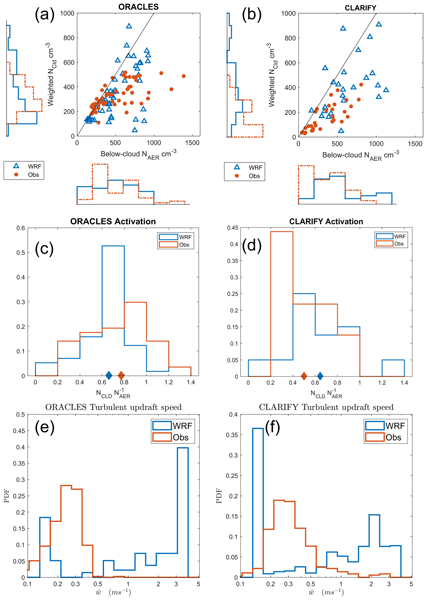
Calvin Howes, Pablo E. Saide, Hugh Coe, Amie Dobracki, Steffen Freitag, Jim M. Haywood, Steven G. Howell, Siddhant Gupta, Janek Uin, Mary Kacarab, Chongai Kuang, L. Ruby Leung, Athanasios Nenes, Greg M. McFarquhar, James Podolske, Jens Redemann, Arthur J. Sedlacek, Kenneth L. Thornhill, Jenny P. S. Wong, Robert Wood, Huihui Wu, Yang Zhang, Jianhao Zhang, and Paquita Zuidema
Atmos. Chem. Phys., 23, 13911–13940, https://doi.org/10.5194/acp-23-13911-2023, https://doi.org/10.5194/acp-23-13911-2023, 2023
Short summary
Short summary
To better understand smoke properties and its interactions with clouds, we compare the WRF-CAM5 model with observations from ORACLES, CLARIFY, and LASIC field campaigns in the southeastern Atlantic in August 2017. The model transports and mixes smoke well but does not fully capture some important processes. These include smoke chemical and physical aging over 4–12 days, smoke removal by rain, sulfate particle formation, aerosol activation into cloud droplets, and boundary layer turbulence.
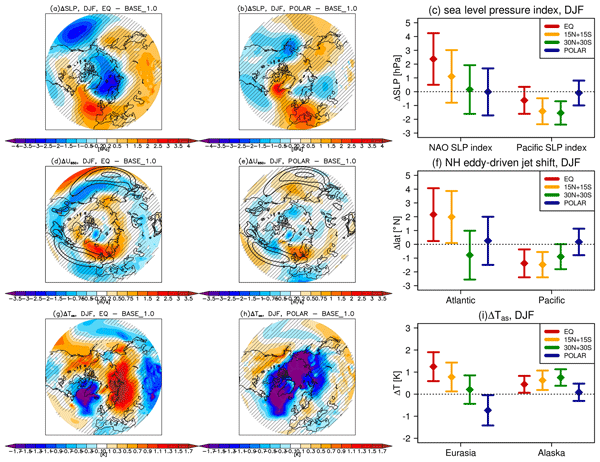
Ewa M. Bednarz, Amy H. Butler, Daniele Visioni, Yan Zhang, Ben Kravitz, and Douglas G. MacMartin
Atmos. Chem. Phys., 23, 13665–13684, https://doi.org/10.5194/acp-23-13665-2023, https://doi.org/10.5194/acp-23-13665-2023, 2023
Short summary
Short summary
We use a state-of-the-art Earth system model and a set of stratospheric aerosol injection (SAI) strategies to achieve the same level of global mean surface cooling through different combinations of location and/or timing of the injection. We demonstrate that the choice of SAI strategy can lead to contrasting impacts on stratospheric and tropospheric temperatures, circulation, and chemistry (including stratospheric ozone), thereby leading to different impacts on regional surface climate.
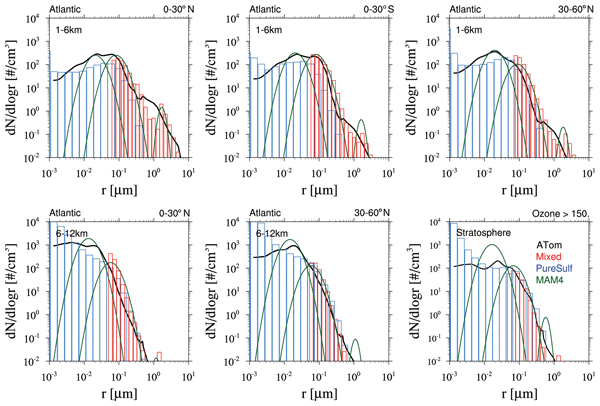
Simone Tilmes, Michael J. Mills, Yunqian Zhu, Charles G. Bardeen, Francis Vitt, Pengfei Yu, David Fillmore, Xiaohong Liu, Brian Toon, and Terry Deshler
Geosci. Model Dev., 16, 6087–6125, https://doi.org/10.5194/gmd-16-6087-2023, https://doi.org/10.5194/gmd-16-6087-2023, 2023
Short summary
Short summary
We implemented an alternative aerosol scheme in the high- and low-top model versions of the Community Earth System Model Version 2 (CESM2) with a more detailed description of tropospheric and stratospheric aerosol size distributions than the existing aerosol model. This development enables the comparison of different aerosol schemes with different complexity in the same model framework. It identifies improvements compared to a range of observations in both the troposphere and stratosphere.
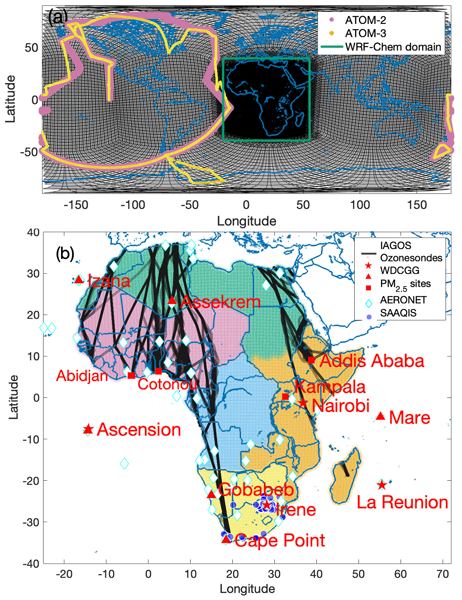
Wenfu Tang, Louisa K. Emmons, Helen M. Worden, Rajesh Kumar, Cenlin He, Benjamin Gaubert, Zhonghua Zheng, Simone Tilmes, Rebecca R. Buchholz, Sara-Eva Martinez-Alonso, Claire Granier, Antonin Soulie, Kathryn McKain, Bruce C. Daube, Jeff Peischl, Chelsea Thompson, and Pieternel Levelt
Geosci. Model Dev., 16, 6001–6028, https://doi.org/10.5194/gmd-16-6001-2023, https://doi.org/10.5194/gmd-16-6001-2023, 2023
Short summary
Short summary
The new MUSICAv0 model enables the study of atmospheric chemistry across all relevant scales. We develop a MUSICAv0 grid for Africa. We evaluate MUSICAv0 with observations and compare it with a previously used model – WRF-Chem. Overall, the performance of MUSICAv0 is comparable to WRF-Chem. Based on model–satellite discrepancies, we find that future field campaigns in an eastern African region (30°E–45°E, 5°S–5°N) could substantially improve the predictive skill of air quality models.
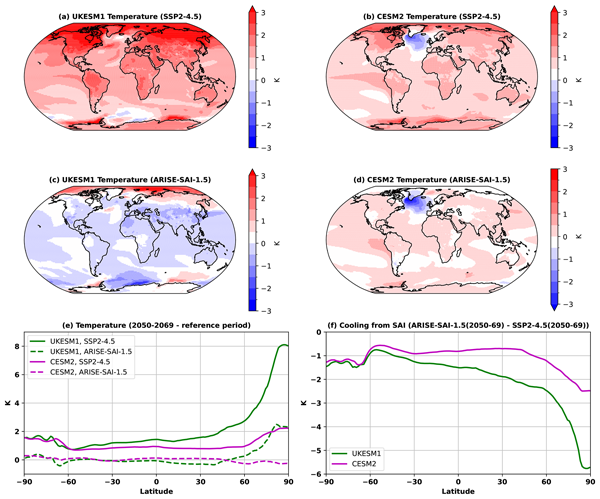
Matthew Henry, Jim Haywood, Andy Jones, Mohit Dalvi, Alice Wells, Daniele Visioni, Ewa M. Bednarz, Douglas G. MacMartin, Walker Lee, and Mari R. Tye
Atmos. Chem. Phys., 23, 13369–13385, https://doi.org/10.5194/acp-23-13369-2023, https://doi.org/10.5194/acp-23-13369-2023, 2023
Short summary
Short summary
Solar climate interventions, such as injecting sulfur in the stratosphere, may be used to offset some of the adverse impacts of global warming. We use two independently developed Earth system models to assess the uncertainties around stratospheric sulfur injections. The injection locations and amounts are optimized to maintain the same pattern of surface temperature. While both models show reduced warming, the change in rainfall patterns (even without sulfur injections) is uncertain.
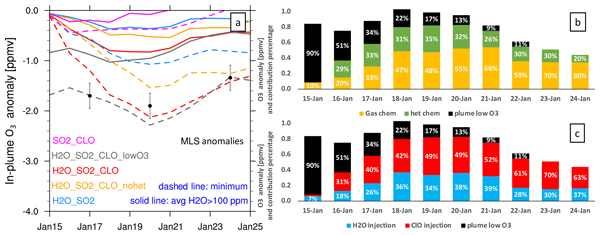
Yunqian Zhu, Robert W. Portmann, Douglas Kinnison, Owen Brian Toon, Luis Millán, Jun Zhang, Holger Vömel, Simone Tilmes, Charles G. Bardeen, Xinyue Wang, Stephanie Evan, William J. Randel, and Karen H. Rosenlof
Atmos. Chem. Phys., 23, 13355–13367, https://doi.org/10.5194/acp-23-13355-2023, https://doi.org/10.5194/acp-23-13355-2023, 2023
Short summary
Short summary
The 2022 Hunga Tonga eruption injected a large amount of water into the stratosphere. Ozone depletion was observed inside the volcanic plume. Chlorine and water vapor injected by this eruption exceeded the normal range, which made the ozone chemistry during this event occur at a higher temperature than polar ozone depletion. Unlike polar ozone chemistry where chlorine nitrate is more important, hypochlorous acid plays a large role in the in-plume chlorine balance and heterogeneous processes.
Christoph Heinze, Thorsten Blenckner, Peter Brown, Friederike Fröb, Anne Morée, Adrian L. New, Cara Nissen, Stefanie Rynders, Isabel Seguro, Yevgeny Aksenov, Yuri Artioli, Timothée Bourgeois, Friedrich Burger, Jonathan Buzan, B. B. Cael, Veli Çağlar Yumruktepe, Melissa Chierici, Christopher Danek, Ulf Dieckmann, Agneta Fransson, Thomas Frölicher, Giovanni Galli, Marion Gehlen, Aridane G. González, Melchor Gonzalez-Davila, Nicolas Gruber, Örjan Gustafsson, Judith Hauck, Mikko Heino, Stephanie Henson, Jenny Hieronymus, I. Emma Huertas, Fatma Jebri, Aurich Jeltsch-Thömmes, Fortunat Joos, Jaideep Joshi, Stephen Kelly, Nandini Menon, Precious Mongwe, Laurent Oziel, Sólveig Ólafsdottir, Julien Palmieri, Fiz F. Pérez, Rajamohanan Pillai Ranith, Juliano Ramanantsoa, Tilla Roy, Dagmara Rusiecka, J. Magdalena Santana Casiano, Yeray Santana-Falcón, Jörg Schwinger, Roland Séférian, Miriam Seifert, Anna Shchiptsova, Bablu Sinha, Christopher Somes, Reiner Steinfeldt, Dandan Tao, Jerry Tjiputra, Adam Ulfsbo, Christoph Völker, Tsuyoshi Wakamatsu, and Ying Ye
Biogeosciences Discuss., https://doi.org/10.5194/bg-2023-182, https://doi.org/10.5194/bg-2023-182, 2023
Revised manuscript not accepted
Short summary
Short summary
For assessing the consequences of human-induced climate change for the marine realm, it is necessary to not only look at gradual changes but also at abrupt changes of environmental conditions. We summarise abrupt changes in ocean warming, acidification, and oxygen concentration as the key environmental factors for ecosystems. Taking these abrupt changes into account requires greenhouse gas emissions to be reduced to a larger extent than previously thought to limit respective damage.
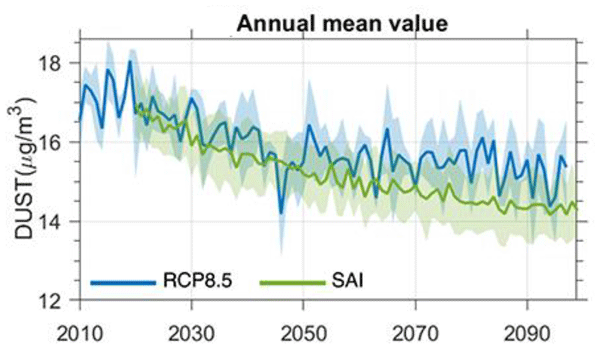
Seyed Vahid Mousavi, Khalil Karami, Simone Tilmes, Helene Muri, Lili Xia, and Abolfazl Rezaei
Atmos. Chem. Phys., 23, 10677–10695, https://doi.org/10.5194/acp-23-10677-2023, https://doi.org/10.5194/acp-23-10677-2023, 2023
Short summary
Short summary
Understanding atmospheric dust changes in the Middle East and North Africa (MENA) region under future climate scenarios is essential. By injecting sulfate aerosols into the stratosphere, stratospheric aerosol injection (SAI) geoengineering reflects some of the incoming sunlight back to space. This study shows that the MENA region would experience lower dust concentration under both SAI and RCP8.5 scenarios compared to the current climate (CTL) by the end of the century.
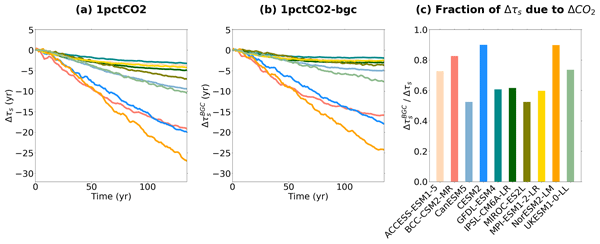
Rebecca M. Varney, Sarah E. Chadburn, Eleanor J. Burke, Simon Jones, Andy J. Wiltshire, and Peter M. Cox
Biogeosciences, 20, 3767–3790, https://doi.org/10.5194/bg-20-3767-2023, https://doi.org/10.5194/bg-20-3767-2023, 2023
Short summary
Short summary
This study evaluates soil carbon projections during the 21st century in CMIP6 Earth system models. In general, we find a reduced spread of changes in global soil carbon in CMIP6 compared to the previous CMIP5 generation. The reduced CMIP6 spread arises from an emergent relationship between soil carbon changes due to change in plant productivity and soil carbon changes due to changes in turnover time. We show that this relationship is consistent with false priming under transient climate change.
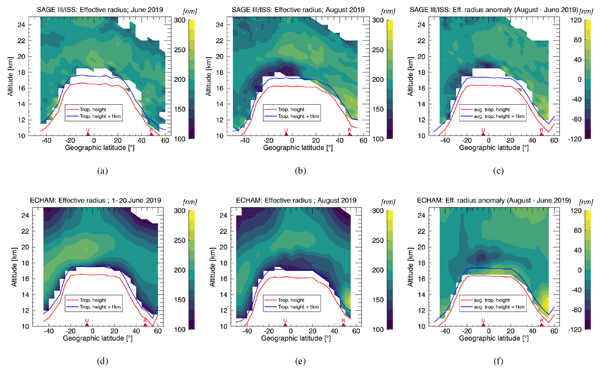
Felix Wrana, Ulrike Niemeier, Larry W. Thomason, Sandra Wallis, and Christian von Savigny
Atmos. Chem. Phys., 23, 9725–9743, https://doi.org/10.5194/acp-23-9725-2023, https://doi.org/10.5194/acp-23-9725-2023, 2023
Short summary
Short summary
The stratospheric aerosol layer is a naturally occurring and permanent layer of aerosol, in this case very small droplets of mostly sulfuric acid and water, that has a cooling effect on our climate. To quantify this effect and for our general understanding of stratospheric microphysical processes, knowledge of the size of those aerosol particles is needed. Using satellite measurements and atmospheric models we show that some volcanic eruptions can lead to on average smaller aerosol sizes.
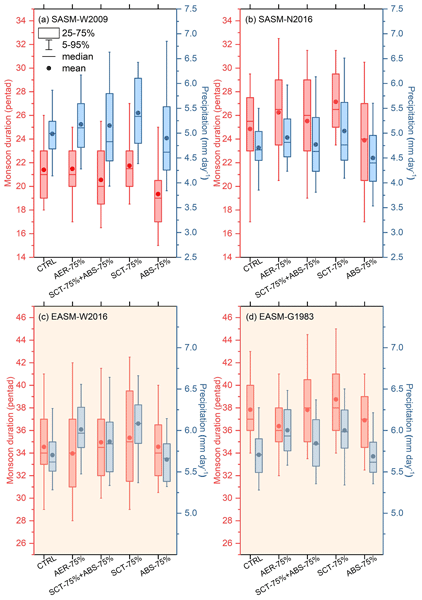
Chenwei Fang, Jim M. Haywood, Ju Liang, Ben T. Johnson, Ying Chen, and Bin Zhu
Atmos. Chem. Phys., 23, 8341–8368, https://doi.org/10.5194/acp-23-8341-2023, https://doi.org/10.5194/acp-23-8341-2023, 2023
Short summary
Short summary
The responses of Asian summer monsoon duration and intensity to air pollution mitigation are identified given the net-zero future. We show that reducing scattering aerosols makes the rainy season longer and stronger across South Asia and East Asia but that absorbing aerosol reduction has the opposite effect. Our results hint at distinct monsoon responses to emission controls that target different aerosols.
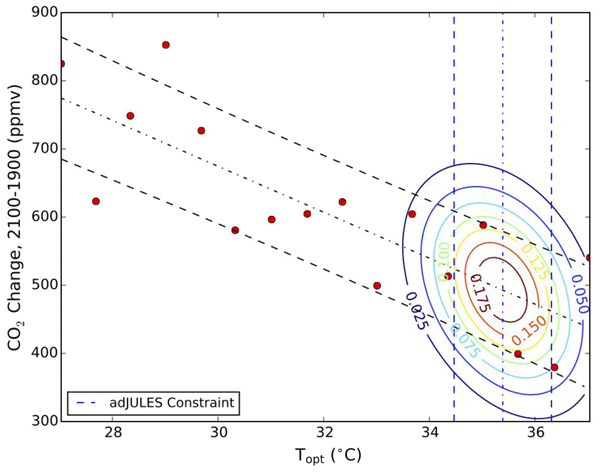
Nina Raoult, Tim Jupp, Ben Booth, and Peter Cox
Earth Syst. Dynam., 14, 723–731, https://doi.org/10.5194/esd-14-723-2023, https://doi.org/10.5194/esd-14-723-2023, 2023
Short summary
Short summary
Climate models are used to predict the impact of climate change. However, poorly constrained parameters used in the physics of the models mean that we simulate a large spread of possible future outcomes. We can use real-world observations to reduce the uncertainty of parameter values, but we do not have observations to reduce the spread of possible future outcomes directly. We present a method for translating the reduction in parameter uncertainty into a reduction in possible model projections.
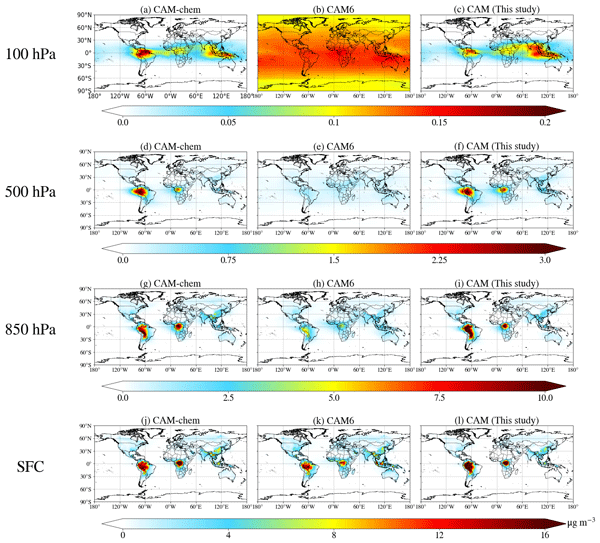
Duseong S. Jo, Simone Tilmes, Louisa K. Emmons, Siyuan Wang, and Francis Vitt
Geosci. Model Dev., 16, 3893–3906, https://doi.org/10.5194/gmd-16-3893-2023, https://doi.org/10.5194/gmd-16-3893-2023, 2023
Short summary
Short summary
A new simple secondary organic aerosol (SOA) scheme has been developed for the Community Atmosphere Model (CAM) based on the complex SOA scheme in CAM with detailed chemistry (CAM-chem). The CAM with the new SOA scheme shows better agreements with CAM-chem in terms of aerosol concentrations and radiative fluxes, which ensures more consistent results between different compsets in the Community Earth System Model. The new SOA scheme also has technical advantages for future developments.
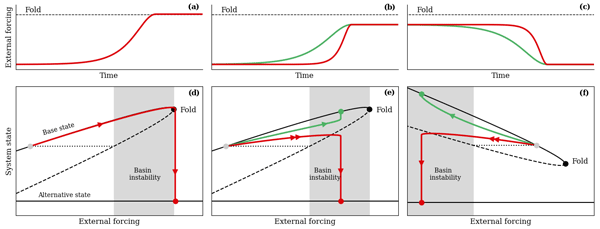
Paul D. L. Ritchie, Hassan Alkhayuon, Peter M. Cox, and Sebastian Wieczorek
Earth Syst. Dynam., 14, 669–683, https://doi.org/10.5194/esd-14-669-2023, https://doi.org/10.5194/esd-14-669-2023, 2023
Short summary
Short summary
Complex systems can undergo abrupt changes or tipping points when external forcing crosses a critical level and are of increasing concern because of their severe impacts. However, tipping points can also occur when the external forcing changes too quickly without crossing any critical levels, which is very relevant for Earth’s systems and contemporary climate. We give an intuitive explanation of such rate-induced tipping and provide illustrative examples from natural and human systems.
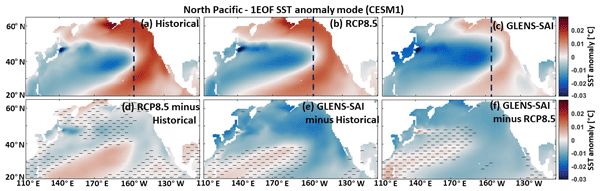
Abolfazl Rezaei, Khalil Karami, Simone Tilmes, and John C. Moore
Atmos. Chem. Phys., 23, 5835–5850, https://doi.org/10.5194/acp-23-5835-2023, https://doi.org/10.5194/acp-23-5835-2023, 2023
Short summary
Short summary
Teleconnection patterns are important characteristics of the climate system; well-known examples include the El Niño and La Niña events driven from the tropical Pacific. We examined how spatiotemporal patterns that arise in the Pacific and Atlantic oceans behave under stratospheric aerosol geoengineering and greenhouse gas (GHG)-induced warming. In general, geoengineering reverses trends; however, the changes in decadal oscillation for the AMO, NAO, and PDO imposed by GHG are not suppressed.
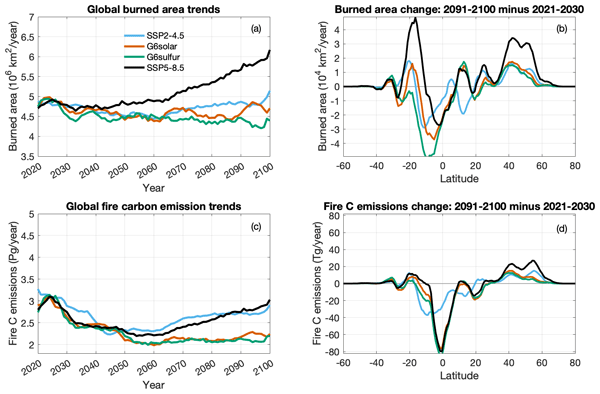
Wenfu Tang, Simone Tilmes, David M. Lawrence, Fang Li, Cenlin He, Louisa K. Emmons, Rebecca R. Buchholz, and Lili Xia
Atmos. Chem. Phys., 23, 5467–5486, https://doi.org/10.5194/acp-23-5467-2023, https://doi.org/10.5194/acp-23-5467-2023, 2023
Short summary
Short summary
Globally, total wildfire burned area is projected to increase over the 21st century under scenarios without geoengineering and decrease under the two geoengineering scenarios. Geoengineering reduces fire by decreasing surface temperature and wind speed and increasing relative humidity and soil water. However, geoengineering also yields reductions in precipitation, which offset some of the fire reduction.
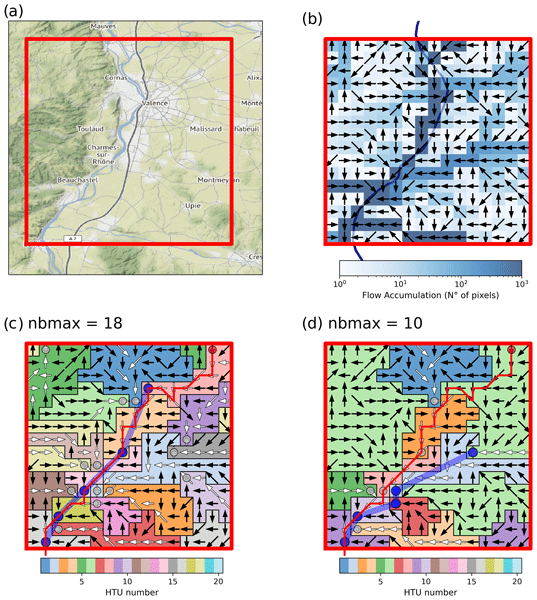
Jan Polcher, Anthony Schrapffer, Eliott Dupont, Lucia Rinchiuso, Xudong Zhou, Olivier Boucher, Emmanuel Mouche, Catherine Ottlé, and Jérôme Servonnat
Geosci. Model Dev., 16, 2583–2606, https://doi.org/10.5194/gmd-16-2583-2023, https://doi.org/10.5194/gmd-16-2583-2023, 2023
Short summary
Short summary
The proposed graphs of hydrological sub-grid elements for atmospheric models allow us to integrate the topographical elements needed in land surface models for a realistic representation of horizontal water and energy transport. The study demonstrates the numerical properties of the automatically built graphs and the simulated water flows.
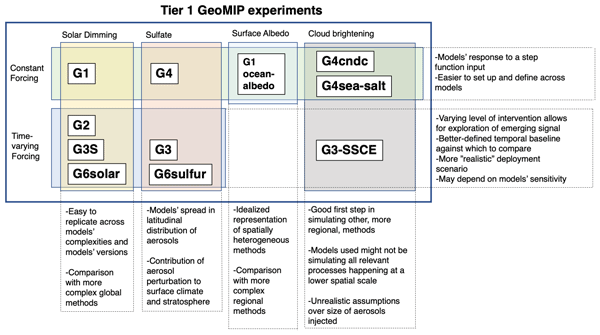
Daniele Visioni, Ben Kravitz, Alan Robock, Simone Tilmes, Jim Haywood, Olivier Boucher, Mark Lawrence, Peter Irvine, Ulrike Niemeier, Lili Xia, Gabriel Chiodo, Chris Lennard, Shingo Watanabe, John C. Moore, and Helene Muri
Atmos. Chem. Phys., 23, 5149–5176, https://doi.org/10.5194/acp-23-5149-2023, https://doi.org/10.5194/acp-23-5149-2023, 2023
Short summary
Short summary
Geoengineering indicates methods aiming to reduce the temperature of the planet by means of reflecting back a part of the incoming radiation before it reaches the surface or allowing more of the planetary radiation to escape into space. It aims to produce modelling experiments that are easy to reproduce and compare with different climate models, in order to understand the potential impacts of these techniques. Here we assess its past successes and failures and talk about its future.

Chris Huntingford, Peter M. Cox, Mark S. Williamson, Joseph J. Clarke, and Paul D. L. Ritchie
Earth Syst. Dynam., 14, 433–442, https://doi.org/10.5194/esd-14-433-2023, https://doi.org/10.5194/esd-14-433-2023, 2023
Short summary
Short summary
Emergent constraints (ECs) reduce the spread of projections between climate models. ECs estimate changes to climate features impacting adaptation policy, and with this high profile, the method is under scrutiny. Asking
What is an EC?, we suggest they are often the discovery of parameters that characterise hidden large-scale equations that climate models solve implicitly. We present this conceptually via two examples. Our analysis implies possible new paths to link ECs and physical processes.
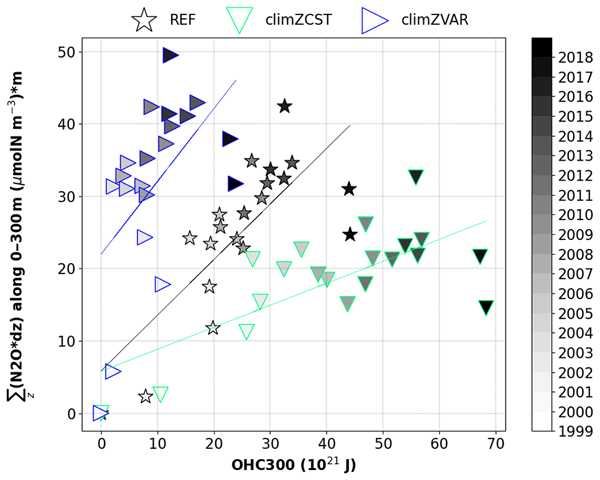
Sarah Berthet, Julien Jouanno, Roland Séférian, Marion Gehlen, and William Llovel
Earth Syst. Dynam., 14, 399–412, https://doi.org/10.5194/esd-14-399-2023, https://doi.org/10.5194/esd-14-399-2023, 2023
Short summary
Short summary
Phytoplankton absorbs the solar radiation entering the ocean surface and contributes to keeping the associated energy in surface waters. This natural effect is either not represented in the ocean component of climate models or its representation is simplified. An incomplete representation of this biophysical interaction affects the way climate models simulate ocean warming, which leads to uncertainties in projections of oceanic emissions of an important greenhouse gas (nitrous oxide).
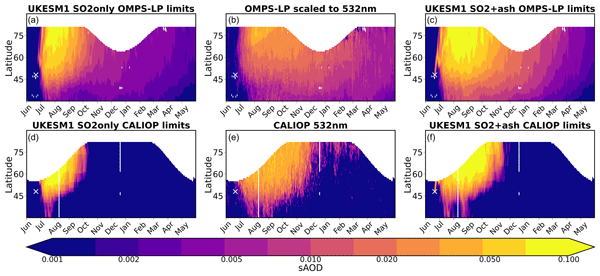
Alice F. Wells, Andy Jones, Martin Osborne, Lilly Damany-Pearce, Daniel G. Partridge, and James M. Haywood
Atmos. Chem. Phys., 23, 3985–4007, https://doi.org/10.5194/acp-23-3985-2023, https://doi.org/10.5194/acp-23-3985-2023, 2023
Short summary
Short summary
In 2019 the Raikoke volcano erupted explosively, emitting the largest injection of SO2 into the stratosphere since 2011. Observations indicated that a large amount of volcanic ash was also injected. Previous studies have identified that volcanic ash can prolong the lifetime of stratospheric aerosol optical depth, which we explore in UKESM1. Comparisons to observations suggest that including ash in model emission schemes can improve the representation of volcanic plumes in global climate models.
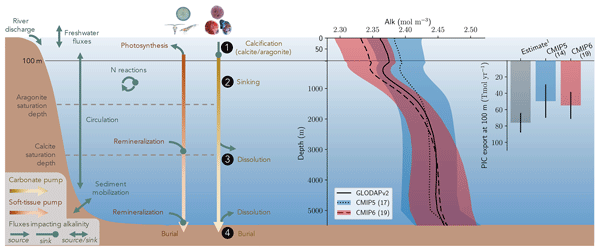
Alban Planchat, Lester Kwiatkowski, Laurent Bopp, Olivier Torres, James R. Christian, Momme Butenschön, Tomas Lovato, Roland Séférian, Matthew A. Chamberlain, Olivier Aumont, Michio Watanabe, Akitomo Yamamoto, Andrew Yool, Tatiana Ilyina, Hiroyuki Tsujino, Kristen M. Krumhardt, Jörg Schwinger, Jerry Tjiputra, John P. Dunne, and Charles Stock
Biogeosciences, 20, 1195–1257, https://doi.org/10.5194/bg-20-1195-2023, https://doi.org/10.5194/bg-20-1195-2023, 2023
Short summary
Short summary
Ocean alkalinity is critical to the uptake of atmospheric carbon and acidification in surface waters. We review the representation of alkalinity and the associated calcium carbonate cycle in Earth system models. While many parameterizations remain present in the latest generation of models, there is a general improvement in the simulated alkalinity distribution. This improvement is related to an increase in the export of biotic calcium carbonate, which closer resembles observations.
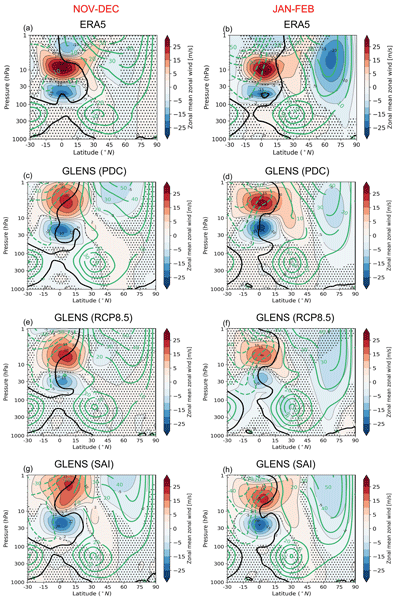
Khalil Karami, Rolando Garcia, Christoph Jacobi, Jadwiga H. Richter, and Simone Tilmes
Atmos. Chem. Phys., 23, 3799–3818, https://doi.org/10.5194/acp-23-3799-2023, https://doi.org/10.5194/acp-23-3799-2023, 2023
Short summary
Short summary
Alongside mitigation and adaptation efforts, stratospheric aerosol intervention (SAI) is increasingly considered a third pillar to combat dangerous climate change. We investigate the teleconnection between the quasi-biennial oscillation in the equatorial stratosphere and the Arctic stratospheric polar vortex under a warmer climate and an SAI scenario. We show that the Holton–Tan relationship weakens under both scenarios and discuss the physical mechanisms responsible for such changes.
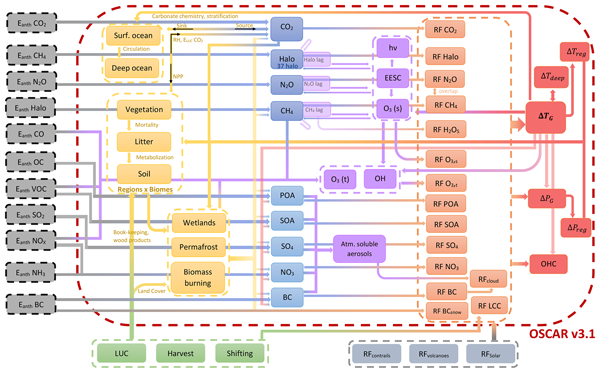
Yann Quilcaille, Thomas Gasser, Philippe Ciais, and Olivier Boucher
Geosci. Model Dev., 16, 1129–1161, https://doi.org/10.5194/gmd-16-1129-2023, https://doi.org/10.5194/gmd-16-1129-2023, 2023
Short summary
Short summary
The model OSCAR is a simple climate model, meaning its representation of the Earth system is simplified but calibrated on models of higher complexity. Here, we diagnose its latest version using a total of 99 experiments in a probabilistic framework and under observational constraints. OSCAR v3.1 shows good agreement with observations, complex Earth system models and emerging properties. Some points for improvements are identified, such as the ocean carbon cycle.
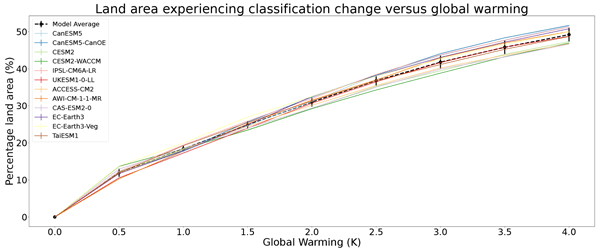
Morgan Sparey, Peter Cox, and Mark S. Williamson
Biogeosciences, 20, 451–488, https://doi.org/10.5194/bg-20-451-2023, https://doi.org/10.5194/bg-20-451-2023, 2023
Short summary
Short summary
Accurate climate models are vital for mitigating climate change; however, projections often disagree. Using Köppen–Geiger bioclimate classifications we show that CMIP6 climate models agree well on the fraction of global land surface that will change classification per degree of global warming. We find that 13 % of land will change climate per degree of warming from 1 to 3 K; thus, stabilising warming at 1.5 rather than 2 K would save over 7.5 million square kilometres from bioclimatic change.
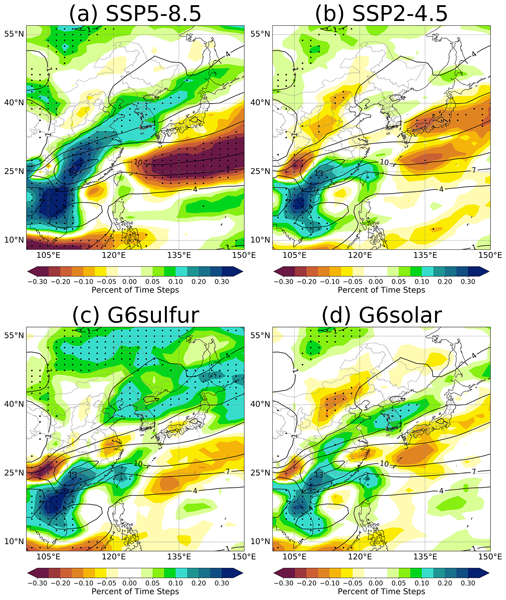
Ju Liang and Jim Haywood
Atmos. Chem. Phys., 23, 1687–1703, https://doi.org/10.5194/acp-23-1687-2023, https://doi.org/10.5194/acp-23-1687-2023, 2023
Short summary
Short summary
The recent record-breaking flood events in China during the summer of 2021 highlight the importance of mitigating the risks from future changes in high-impact weather systems under global warming. Based on a state-of-the-art Earth system model, we demonstrate a pilot study on the responses of atmospheric rivers and extreme precipitation over East Asia to anthropogenically induced climate warming and an unconventional mitigation strategy – stratospheric aerosol injection.
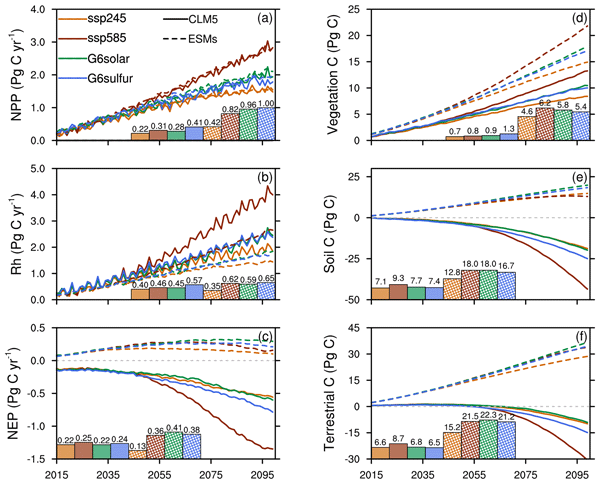
Yangxin Chen, Duoying Ji, Qian Zhang, John C. Moore, Olivier Boucher, Andy Jones, Thibaut Lurton, Michael J. Mills, Ulrike Niemeier, Roland Séférian, and Simone Tilmes
Earth Syst. Dynam., 14, 55–79, https://doi.org/10.5194/esd-14-55-2023, https://doi.org/10.5194/esd-14-55-2023, 2023
Short summary
Short summary
Solar geoengineering has been proposed as a way of counteracting the warming effects of increasing greenhouse gases by reflecting solar radiation. This work shows that solar geoengineering can slow down the northern-high-latitude permafrost degradation but cannot preserve the permafrost ecosystem as that under a climate of the same warming level without solar geoengineering.
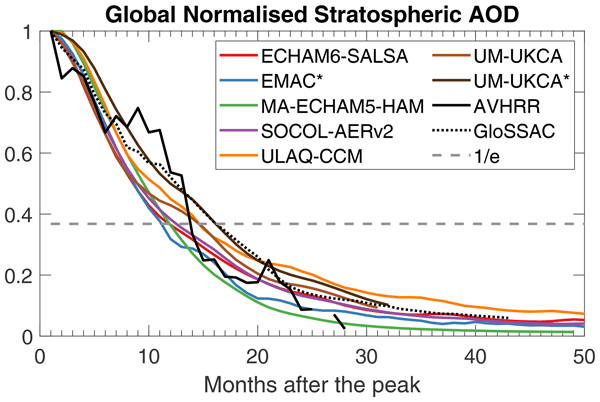
Ilaria Quaglia, Claudia Timmreck, Ulrike Niemeier, Daniele Visioni, Giovanni Pitari, Christina Brodowsky, Christoph Brühl, Sandip S. Dhomse, Henning Franke, Anton Laakso, Graham W. Mann, Eugene Rozanov, and Timofei Sukhodolov
Atmos. Chem. Phys., 23, 921–948, https://doi.org/10.5194/acp-23-921-2023, https://doi.org/10.5194/acp-23-921-2023, 2023
Short summary
Short summary
The last very large explosive volcanic eruption we have measurements for is the eruption of Mt. Pinatubo in 1991. It is therefore often used as a benchmark for climate models' ability to reproduce these kinds of events. Here, we compare available measurements with the results from multiple experiments conducted with climate models interactively simulating the aerosol cloud formation.
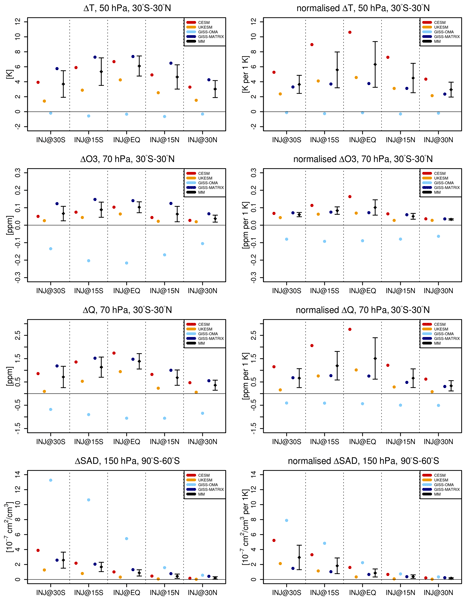
Ewa M. Bednarz, Daniele Visioni, Ben Kravitz, Andy Jones, James M. Haywood, Jadwiga Richter, Douglas G. MacMartin, and Peter Braesicke
Atmos. Chem. Phys., 23, 687–709, https://doi.org/10.5194/acp-23-687-2023, https://doi.org/10.5194/acp-23-687-2023, 2023
Short summary
Short summary
Building on Part 1 of this two-part study, we demonstrate the role of biases in climatological circulation and specific aspects of model microphysics in driving the differences in simulated sulfate distributions amongst three Earth system models. We then characterize the simulated changes in stratospheric and free-tropospheric temperatures, ozone, water vapor, and large-scale circulation, elucidating the role of the above aspects in the surface responses discussed in Part 1.

Daniele Visioni, Ewa M. Bednarz, Walker R. Lee, Ben Kravitz, Andy Jones, Jim M. Haywood, and Douglas G. MacMartin
Atmos. Chem. Phys., 23, 663–685, https://doi.org/10.5194/acp-23-663-2023, https://doi.org/10.5194/acp-23-663-2023, 2023
Short summary
Short summary
The paper constitutes Part 1 of a study performing a first systematic inter-model comparison of the atmospheric responses to stratospheric sulfate aerosol injections (SAIs) at various latitudes as simulated by three state-of-the-art Earth system models. We identify similarities and differences in the modeled aerosol burden, investigate the differences in the aerosol approaches between the models, and ultimately show the differences produced in surface climate, temperature and precipitation.
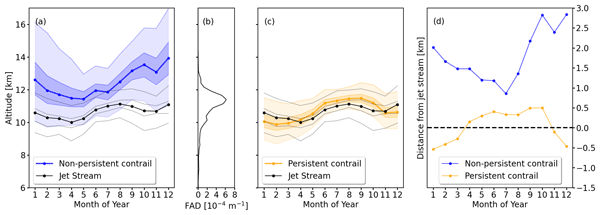
Kevin Wolf, Nicolas Bellouin, and Olivier Boucher
Atmos. Chem. Phys., 23, 287–309, https://doi.org/10.5194/acp-23-287-2023, https://doi.org/10.5194/acp-23-287-2023, 2023
Short summary
Short summary
Recent studies estimate the radiative impact of contrails to be similar to or larger than that of emitted CO2; thus, contrail mitigation might be an opportunity to reduce the climate effects of aviation. A radiosonde data set is analyzed in terms of the vertical distribution of potential contrails, contrail mitigation by flight altitude changes, and linkages with the tropopause and jet stream. The effect of prospective jet engine developments and alternative fuels are estimated.
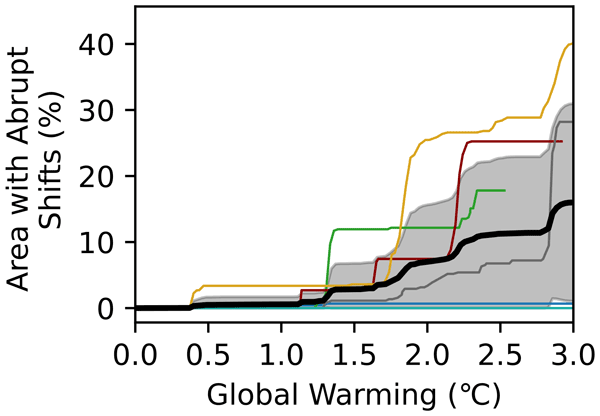
Isobel M. Parry, Paul D. L. Ritchie, and Peter M. Cox
Earth Syst. Dynam., 13, 1667–1675, https://doi.org/10.5194/esd-13-1667-2022, https://doi.org/10.5194/esd-13-1667-2022, 2022
Short summary
Short summary
Despite little evidence of regional Amazon rainforest dieback, many localised abrupt dieback events are observed in the latest state-of-the-art global climate models under anthropogenic climate change. The detected dieback events would still cause severe consequences for local communities and ecosystems. This study suggests that 7 ± 5 % of the northern South America region would experience abrupt downward shifts in vegetation carbon for every degree of global warming past 1.5 °C.
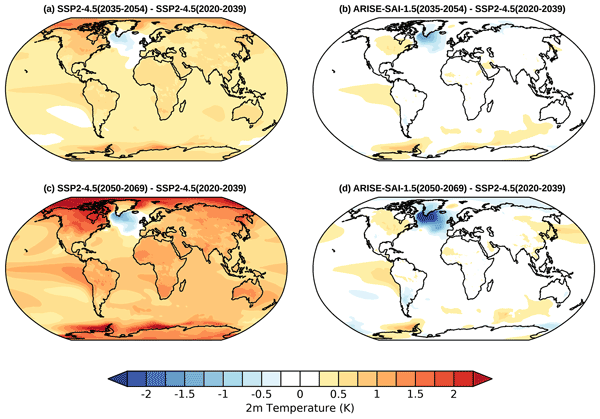
Jadwiga H. Richter, Daniele Visioni, Douglas G. MacMartin, David A. Bailey, Nan Rosenbloom, Brian Dobbins, Walker R. Lee, Mari Tye, and Jean-Francois Lamarque
Geosci. Model Dev., 15, 8221–8243, https://doi.org/10.5194/gmd-15-8221-2022, https://doi.org/10.5194/gmd-15-8221-2022, 2022
Short summary
Short summary
Solar climate intervention using stratospheric aerosol injection is a proposed method of reducing global mean temperatures to reduce the worst consequences of climate change. We present a new modeling protocol aimed at simulating a plausible deployment of stratospheric aerosol injection and reproducibility of simulations using other Earth system models: Assessing Responses and Impacts of Solar climate intervention on the Earth system with stratospheric aerosol injection (ARISE-SAI).
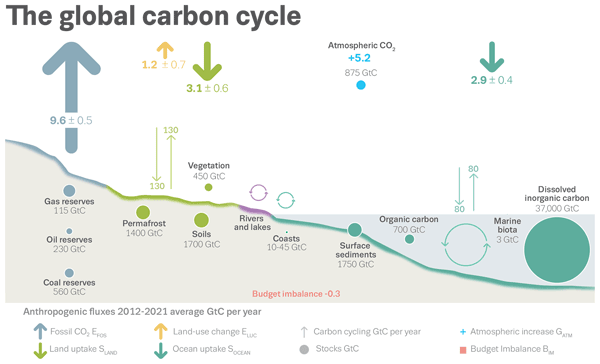
Pierre Friedlingstein, Michael O'Sullivan, Matthew W. Jones, Robbie M. Andrew, Luke Gregor, Judith Hauck, Corinne Le Quéré, Ingrid T. Luijkx, Are Olsen, Glen P. Peters, Wouter Peters, Julia Pongratz, Clemens Schwingshackl, Stephen Sitch, Josep G. Canadell, Philippe Ciais, Robert B. Jackson, Simone R. Alin, Ramdane Alkama, Almut Arneth, Vivek K. Arora, Nicholas R. Bates, Meike Becker, Nicolas Bellouin, Henry C. Bittig, Laurent Bopp, Frédéric Chevallier, Louise P. Chini, Margot Cronin, Wiley Evans, Stefanie Falk, Richard A. Feely, Thomas Gasser, Marion Gehlen, Thanos Gkritzalis, Lucas Gloege, Giacomo Grassi, Nicolas Gruber, Özgür Gürses, Ian Harris, Matthew Hefner, Richard A. Houghton, George C. Hurtt, Yosuke Iida, Tatiana Ilyina, Atul K. Jain, Annika Jersild, Koji Kadono, Etsushi Kato, Daniel Kennedy, Kees Klein Goldewijk, Jürgen Knauer, Jan Ivar Korsbakken, Peter Landschützer, Nathalie Lefèvre, Keith Lindsay, Junjie Liu, Zhu Liu, Gregg Marland, Nicolas Mayot, Matthew J. McGrath, Nicolas Metzl, Natalie M. Monacci, David R. Munro, Shin-Ichiro Nakaoka, Yosuke Niwa, Kevin O'Brien, Tsuneo Ono, Paul I. Palmer, Naiqing Pan, Denis Pierrot, Katie Pocock, Benjamin Poulter, Laure Resplandy, Eddy Robertson, Christian Rödenbeck, Carmen Rodriguez, Thais M. Rosan, Jörg Schwinger, Roland Séférian, Jamie D. Shutler, Ingunn Skjelvan, Tobias Steinhoff, Qing Sun, Adrienne J. Sutton, Colm Sweeney, Shintaro Takao, Toste Tanhua, Pieter P. Tans, Xiangjun Tian, Hanqin Tian, Bronte Tilbrook, Hiroyuki Tsujino, Francesco Tubiello, Guido R. van der Werf, Anthony P. Walker, Rik Wanninkhof, Chris Whitehead, Anna Willstrand Wranne, Rebecca Wright, Wenping Yuan, Chao Yue, Xu Yue, Sönke Zaehle, Jiye Zeng, and Bo Zheng
Earth Syst. Sci. Data, 14, 4811–4900, https://doi.org/10.5194/essd-14-4811-2022, https://doi.org/10.5194/essd-14-4811-2022, 2022
Short summary
Short summary
The Global Carbon Budget 2022 describes the datasets and methodology used to quantify the anthropogenic emissions of carbon dioxide (CO2) and their partitioning among the atmosphere, the land ecosystems, and the ocean. These living datasets are updated every year to provide the highest transparency and traceability in the reporting of CO2, the key driver of climate change.
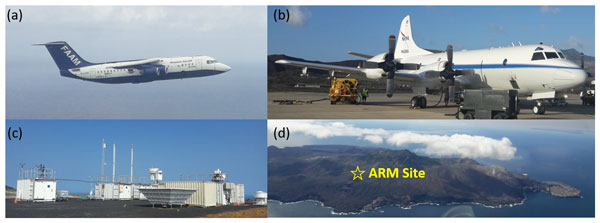
Paul A. Barrett, Steven J. Abel, Hugh Coe, Ian Crawford, Amie Dobracki, James Haywood, Steve Howell, Anthony Jones, Justin Langridge, Greg M. McFarquhar, Graeme J. Nott, Hannah Price, Jens Redemann, Yohei Shinozuka, Kate Szpek, Jonathan W. Taylor, Robert Wood, Huihui Wu, Paquita Zuidema, Stéphane Bauguitte, Ryan Bennett, Keith Bower, Hong Chen, Sabrina Cochrane, Michael Cotterell, Nicholas Davies, David Delene, Connor Flynn, Andrew Freedman, Steffen Freitag, Siddhant Gupta, David Noone, Timothy B. Onasch, James Podolske, Michael R. Poellot, Sebastian Schmidt, Stephen Springston, Arthur J. Sedlacek III, Jamie Trembath, Alan Vance, Maria A. Zawadowicz, and Jianhao Zhang
Atmos. Meas. Tech., 15, 6329–6371, https://doi.org/10.5194/amt-15-6329-2022, https://doi.org/10.5194/amt-15-6329-2022, 2022
Short summary
Short summary
To better understand weather and climate, it is vital to go into the field and collect observations. Often measurements take place in isolation, but here we compared data from two aircraft and one ground-based site. This was done in order to understand how well measurements made on one platform compared to those made on another. Whilst this is easy to do in a controlled laboratory setting, it is more challenging in the real world, and so these comparisons are as valuable as they are rare.
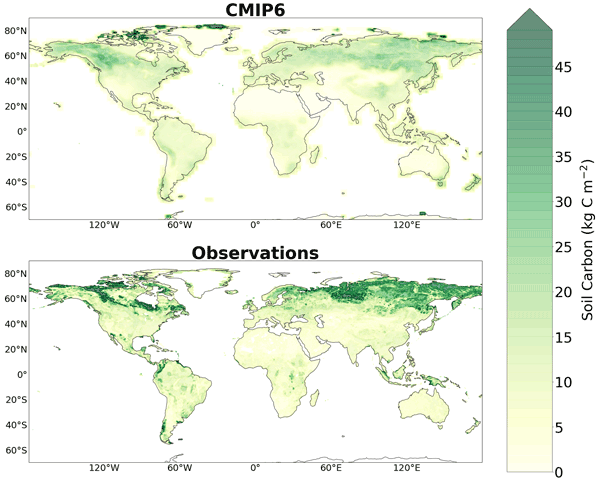
Rebecca M. Varney, Sarah E. Chadburn, Eleanor J. Burke, and Peter M. Cox
Biogeosciences, 19, 4671–4704, https://doi.org/10.5194/bg-19-4671-2022, https://doi.org/10.5194/bg-19-4671-2022, 2022
Short summary
Short summary
Soil carbon is the Earth’s largest terrestrial carbon store, and the response to climate change represents one of the key uncertainties in obtaining accurate global carbon budgets required to successfully militate against climate change. The ability of climate models to simulate present-day soil carbon is therefore vital. This study assesses soil carbon simulation in the latest ensemble of models which allows key areas for future model development to be identified.
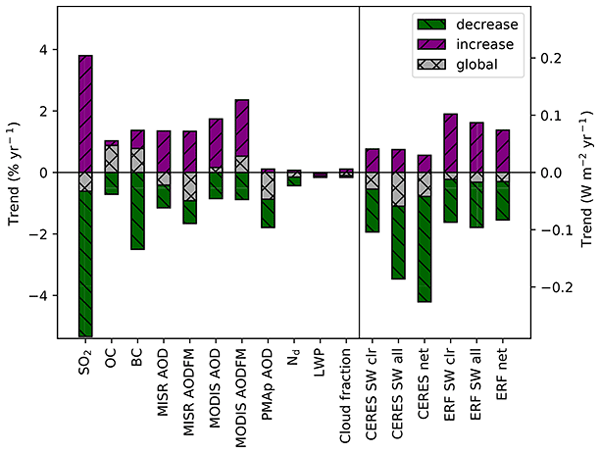
Johannes Quaas, Hailing Jia, Chris Smith, Anna Lea Albright, Wenche Aas, Nicolas Bellouin, Olivier Boucher, Marie Doutriaux-Boucher, Piers M. Forster, Daniel Grosvenor, Stuart Jenkins, Zbigniew Klimont, Norman G. Loeb, Xiaoyan Ma, Vaishali Naik, Fabien Paulot, Philip Stier, Martin Wild, Gunnar Myhre, and Michael Schulz
Atmos. Chem. Phys., 22, 12221–12239, https://doi.org/10.5194/acp-22-12221-2022, https://doi.org/10.5194/acp-22-12221-2022, 2022
Short summary
Short summary
Pollution particles cool climate and offset part of the global warming. However, they are washed out by rain and thus their effect responds quickly to changes in emissions. We show multiple datasets to demonstrate that aerosol emissions and their concentrations declined in many regions influenced by human emissions, as did the effects on clouds. Consequently, the cooling impact on the Earth energy budget became smaller. This change in trend implies a relative warming.
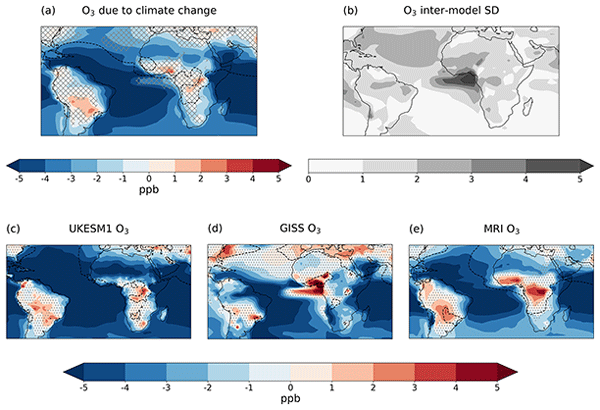
Flossie Brown, Gerd A. Folberth, Stephen Sitch, Susanne Bauer, Marijn Bauters, Pascal Boeckx, Alexander W. Cheesman, Makoto Deushi, Inês Dos Santos Vieira, Corinne Galy-Lacaux, James Haywood, James Keeble, Lina M. Mercado, Fiona M. O'Connor, Naga Oshima, Kostas Tsigaridis, and Hans Verbeeck
Atmos. Chem. Phys., 22, 12331–12352, https://doi.org/10.5194/acp-22-12331-2022, https://doi.org/10.5194/acp-22-12331-2022, 2022
Short summary
Short summary
Surface ozone can decrease plant productivity and impair human health. In this study, we evaluate the change in surface ozone due to climate change over South America and Africa using Earth system models. We find that if the climate were to change according to the worst-case scenario used here, models predict that forested areas in biomass burning locations and urban populations will be at increasing risk of ozone exposure, but other areas will experience a climate benefit.

Sébastien Gardoll and Olivier Boucher
Geosci. Model Dev., 15, 7051–7073, https://doi.org/10.5194/gmd-15-7051-2022, https://doi.org/10.5194/gmd-15-7051-2022, 2022
Short summary
Short summary
Tropical cyclones (TCs) are one of the most devastating natural disasters, which justifies monitoring and prediction in the context of a changing climate. In this study, we have adapted and tested a convolutional neural network (CNN) for the classification of reanalysis outputs (ERA5 and MERRA-2 labeled by HURDAT2) according to the presence or absence of TCs. We tested the impact of interpolation and of "mixing and matching" the training and test sets on the performance of the CNN.
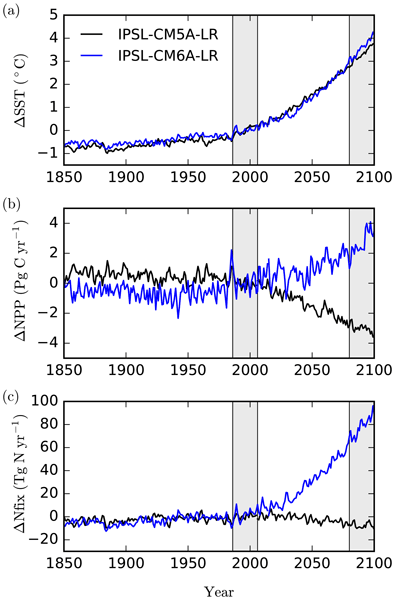
Laurent Bopp, Olivier Aumont, Lester Kwiatkowski, Corentin Clerc, Léonard Dupont, Christian Ethé, Thomas Gorgues, Roland Séférian, and Alessandro Tagliabue
Biogeosciences, 19, 4267–4285, https://doi.org/10.5194/bg-19-4267-2022, https://doi.org/10.5194/bg-19-4267-2022, 2022
Short summary
Short summary
The impact of anthropogenic climate change on the biological production of phytoplankton in the ocean is a cause for concern because its evolution could affect the response of marine ecosystems to climate change. Here, we identify biological N fixation and its response to future climate change as a key process in shaping the future evolution of marine phytoplankton production. Our results show that further study of how this nitrogen fixation responds to environmental change is essential.
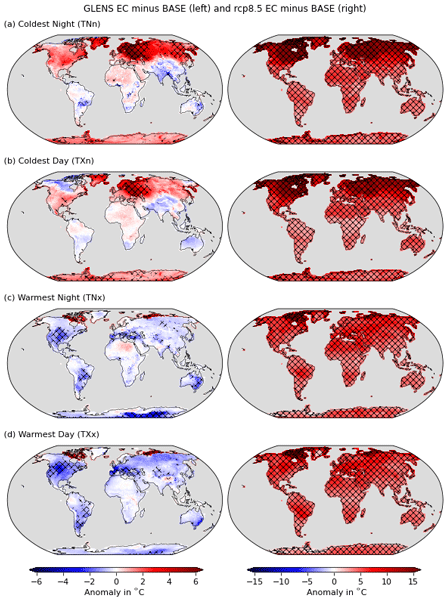
Mari R. Tye, Katherine Dagon, Maria J. Molina, Jadwiga H. Richter, Daniele Visioni, Ben Kravitz, and Simone Tilmes
Earth Syst. Dynam., 13, 1233–1257, https://doi.org/10.5194/esd-13-1233-2022, https://doi.org/10.5194/esd-13-1233-2022, 2022
Short summary
Short summary
We examined the potential effect of stratospheric aerosol injection (SAI) on extreme temperature and precipitation. SAI may cause daytime temperatures to cool but nighttime to warm. Daytime cooling may occur in all seasons across the globe, with the largest decreases in summer. In contrast, nighttime warming may be greatest at high latitudes in winter. SAI may reduce the frequency and intensity of extreme rainfall. The combined changes may exacerbate drying over parts of the global south.
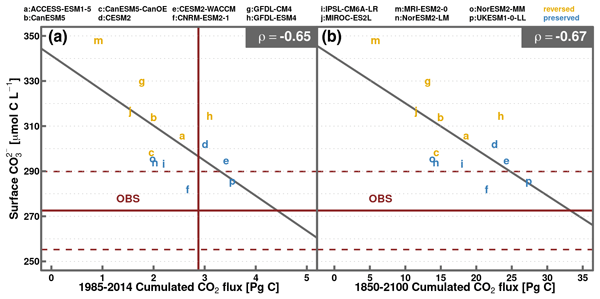
Pradeebane Vaittinada Ayar, Laurent Bopp, Jim R. Christian, Tatiana Ilyina, John P. Krasting, Roland Séférian, Hiroyuki Tsujino, Michio Watanabe, Andrew Yool, and Jerry Tjiputra
Earth Syst. Dynam., 13, 1097–1118, https://doi.org/10.5194/esd-13-1097-2022, https://doi.org/10.5194/esd-13-1097-2022, 2022
Short summary
Short summary
The El Niño–Southern Oscillation is the main driver for the natural variability of global atmospheric CO2. It modulates the CO2 fluxes in the tropical Pacific with anomalous CO2 influx during El Niño and outflux during La Niña. This relationship is projected to reverse by half of Earth system models studied here under the business-as-usual scenario. This study shows models that simulate a positive bias in surface carbonate concentrations simulate a shift in the ENSO–CO2 flux relationship.
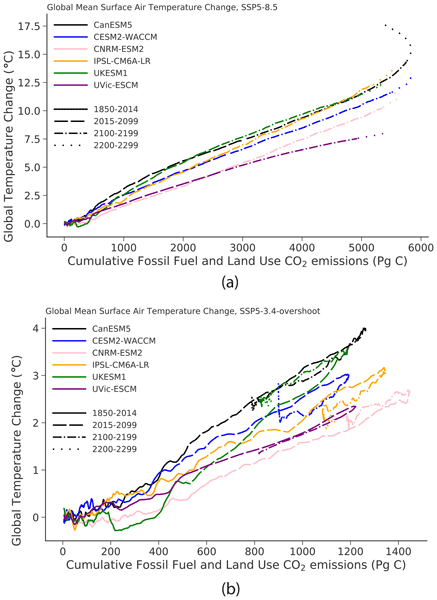
Charles D. Koven, Vivek K. Arora, Patricia Cadule, Rosie A. Fisher, Chris D. Jones, David M. Lawrence, Jared Lewis, Keith Lindsay, Sabine Mathesius, Malte Meinshausen, Michael Mills, Zebedee Nicholls, Benjamin M. Sanderson, Roland Séférian, Neil C. Swart, William R. Wieder, and Kirsten Zickfeld
Earth Syst. Dynam., 13, 885–909, https://doi.org/10.5194/esd-13-885-2022, https://doi.org/10.5194/esd-13-885-2022, 2022
Short summary
Short summary
We explore the long-term dynamics of Earth's climate and carbon cycles under a pair of contrasting scenarios to the year 2300 using six models that include both climate and carbon cycle dynamics. One scenario assumes very high emissions, while the second assumes a peak in emissions, followed by rapid declines to net negative emissions. We show that the models generally agree that warming is roughly proportional to carbon emissions but that many other aspects of the model projections differ.
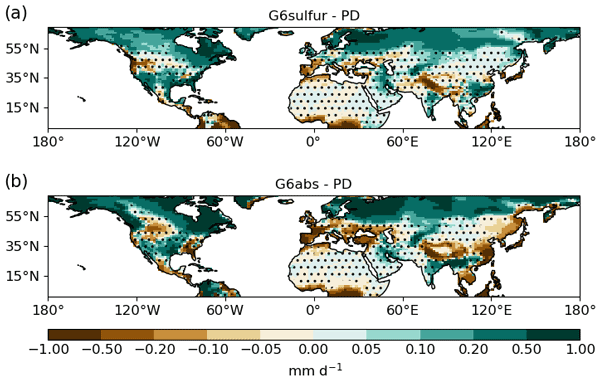
Jim M. Haywood, Andy Jones, Ben T. Johnson, and William McFarlane Smith
Atmos. Chem. Phys., 22, 6135–6150, https://doi.org/10.5194/acp-22-6135-2022, https://doi.org/10.5194/acp-22-6135-2022, 2022
Short summary
Short summary
Simulations are presented investigating the influence of moderately absorbing aerosol in the stratosphere to combat the impacts of climate change. A number of detrimental impacts are noted compared to sulfate aerosol, including (i) reduced cooling efficiency, (ii) increased deficits in global precipitation, (iii) delays in the recovery of the stratospheric ozone hole, and (iv) disruption of the stratospheric circulation and the wintertime storm tracks that impact European precipitation.
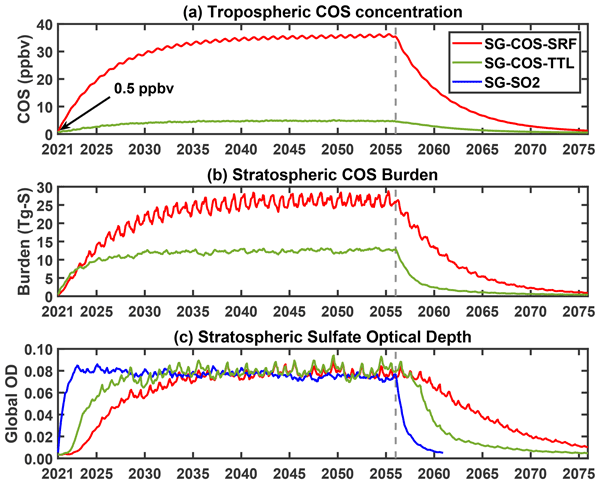
Ilaria Quaglia, Daniele Visioni, Giovanni Pitari, and Ben Kravitz
Atmos. Chem. Phys., 22, 5757–5773, https://doi.org/10.5194/acp-22-5757-2022, https://doi.org/10.5194/acp-22-5757-2022, 2022
Short summary
Short summary
Carbonyl sulfide is a gas that mixes very well in the atmosphere and can reach the stratosphere, where it reacts with sunlight and produces aerosol. Here we propose that, by increasing surface fluxes by an order of magnitude, the number of stratospheric aerosols produced may be enough to partially offset the warming produced by greenhouse gases. We explore what effect this would have on the atmospheric composition.
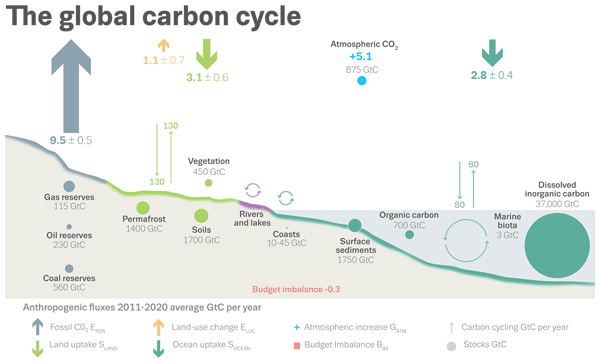
Pierre Friedlingstein, Matthew W. Jones, Michael O'Sullivan, Robbie M. Andrew, Dorothee C. E. Bakker, Judith Hauck, Corinne Le Quéré, Glen P. Peters, Wouter Peters, Julia Pongratz, Stephen Sitch, Josep G. Canadell, Philippe Ciais, Rob B. Jackson, Simone R. Alin, Peter Anthoni, Nicholas R. Bates, Meike Becker, Nicolas Bellouin, Laurent Bopp, Thi Tuyet Trang Chau, Frédéric Chevallier, Louise P. Chini, Margot Cronin, Kim I. Currie, Bertrand Decharme, Laique M. Djeutchouang, Xinyu Dou, Wiley Evans, Richard A. Feely, Liang Feng, Thomas Gasser, Dennis Gilfillan, Thanos Gkritzalis, Giacomo Grassi, Luke Gregor, Nicolas Gruber, Özgür Gürses, Ian Harris, Richard A. Houghton, George C. Hurtt, Yosuke Iida, Tatiana Ilyina, Ingrid T. Luijkx, Atul Jain, Steve D. Jones, Etsushi Kato, Daniel Kennedy, Kees Klein Goldewijk, Jürgen Knauer, Jan Ivar Korsbakken, Arne Körtzinger, Peter Landschützer, Siv K. Lauvset, Nathalie Lefèvre, Sebastian Lienert, Junjie Liu, Gregg Marland, Patrick C. McGuire, Joe R. Melton, David R. Munro, Julia E. M. S. Nabel, Shin-Ichiro Nakaoka, Yosuke Niwa, Tsuneo Ono, Denis Pierrot, Benjamin Poulter, Gregor Rehder, Laure Resplandy, Eddy Robertson, Christian Rödenbeck, Thais M. Rosan, Jörg Schwinger, Clemens Schwingshackl, Roland Séférian, Adrienne J. Sutton, Colm Sweeney, Toste Tanhua, Pieter P. Tans, Hanqin Tian, Bronte Tilbrook, Francesco Tubiello, Guido R. van der Werf, Nicolas Vuichard, Chisato Wada, Rik Wanninkhof, Andrew J. Watson, David Willis, Andrew J. Wiltshire, Wenping Yuan, Chao Yue, Xu Yue, Sönke Zaehle, and Jiye Zeng
Earth Syst. Sci. Data, 14, 1917–2005, https://doi.org/10.5194/essd-14-1917-2022, https://doi.org/10.5194/essd-14-1917-2022, 2022
Short summary
Short summary
The Global Carbon Budget 2021 describes the data sets and methodology used to quantify the emissions of carbon dioxide and their partitioning among the atmosphere, land, and ocean. These living data are updated every year to provide the highest transparency and traceability in the reporting of CO2, the key driver of climate change.
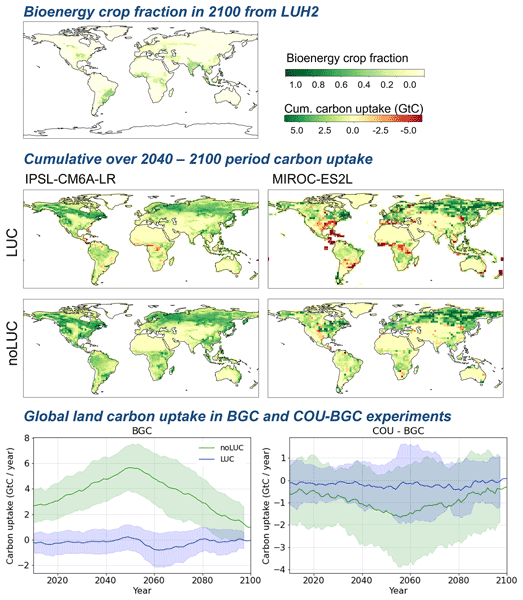
Irina Melnikova, Olivier Boucher, Patricia Cadule, Katsumasa Tanaka, Thomas Gasser, Tomohiro Hajima, Yann Quilcaille, Hideo Shiogama, Roland Séférian, Kaoru Tachiiri, Nicolas Vuichard, Tokuta Yokohata, and Philippe Ciais
Earth Syst. Dynam., 13, 779–794, https://doi.org/10.5194/esd-13-779-2022, https://doi.org/10.5194/esd-13-779-2022, 2022
Short summary
Short summary
The deployment of bioenergy crops for capturing carbon from the atmosphere facilitates global warming mitigation via generating negative CO2 emissions. Here, we explored the consequences of large-scale energy crops deployment on the land carbon cycle. The land-use change for energy crops leads to carbon emissions and loss of future potential increase in carbon uptake by natural ecosystems. This impact should be taken into account by the modeling teams and accounted for in mitigation policies.
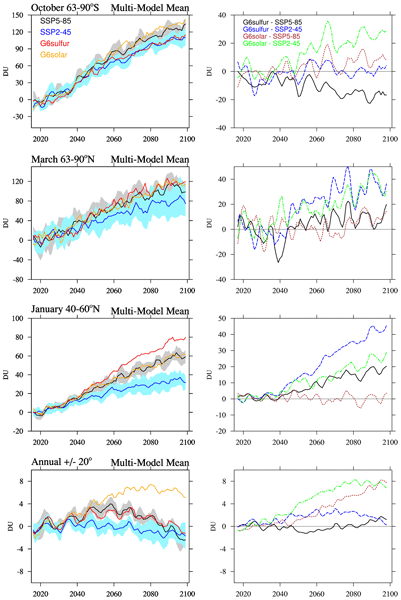
Simone Tilmes, Daniele Visioni, Andy Jones, James Haywood, Roland Séférian, Pierre Nabat, Olivier Boucher, Ewa Monica Bednarz, and Ulrike Niemeier
Atmos. Chem. Phys., 22, 4557–4579, https://doi.org/10.5194/acp-22-4557-2022, https://doi.org/10.5194/acp-22-4557-2022, 2022
Short summary
Short summary
This study assesses the impacts of climate interventions, using stratospheric sulfate aerosol and solar dimming on stratospheric ozone, based on three Earth system models with interactive stratospheric chemistry. The climate interventions have been applied to a high emission (baseline) scenario in order to reach global surface temperatures of a medium emission scenario. We find significant increases and decreases in total column ozone, depending on regions and seasons.
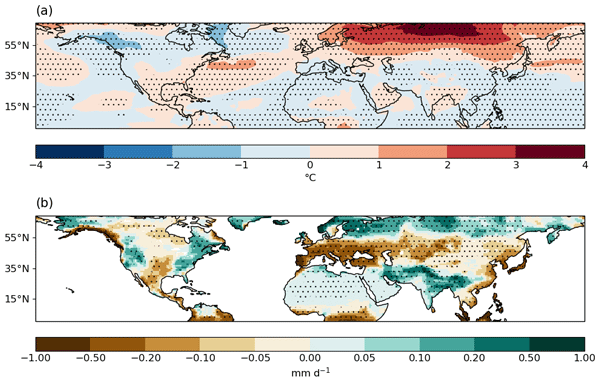
Andy Jones, Jim M. Haywood, Adam A. Scaife, Olivier Boucher, Matthew Henry, Ben Kravitz, Thibaut Lurton, Pierre Nabat, Ulrike Niemeier, Roland Séférian, Simone Tilmes, and Daniele Visioni
Atmos. Chem. Phys., 22, 2999–3016, https://doi.org/10.5194/acp-22-2999-2022, https://doi.org/10.5194/acp-22-2999-2022, 2022
Short summary
Short summary
Simulations by six Earth-system models of geoengineering by introducing sulfuric acid aerosols into the tropical stratosphere are compared. A robust impact on the northern wintertime North Atlantic Oscillation is found, exacerbating precipitation reduction over parts of southern Europe. In contrast, the models show no consistency with regard to impacts on the Quasi-Biennial Oscillation, although results do indicate a risk that the oscillation could become locked into a permanent westerly phase.
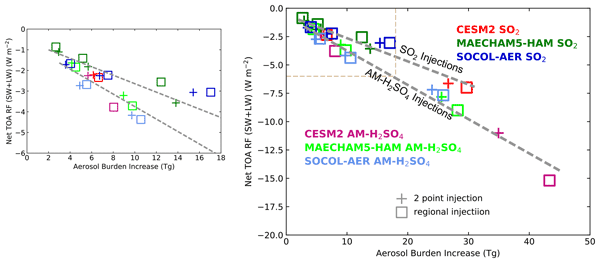
Debra K. Weisenstein, Daniele Visioni, Henning Franke, Ulrike Niemeier, Sandro Vattioni, Gabriel Chiodo, Thomas Peter, and David W. Keith
Atmos. Chem. Phys., 22, 2955–2973, https://doi.org/10.5194/acp-22-2955-2022, https://doi.org/10.5194/acp-22-2955-2022, 2022
Short summary
Short summary
This paper explores a potential method of geoengineering that could be used to slow the rate of change of climate over decadal scales. We use three climate models to explore how injections of accumulation-mode sulfuric acid aerosol change the large-scale stratospheric particle size distribution and radiative forcing response for the chosen scenarios. Radiative forcing per unit sulfur injected and relative to the change in aerosol burden is larger with particulate than with SO2 injections.
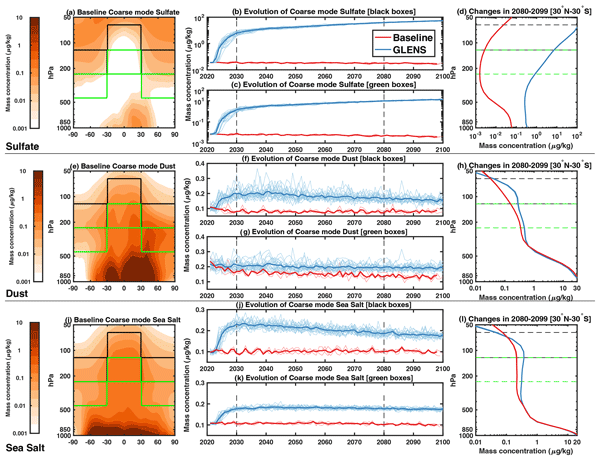
Daniele Visioni, Simone Tilmes, Charles Bardeen, Michael Mills, Douglas G. MacMartin, Ben Kravitz, and Jadwiga H. Richter
Atmos. Chem. Phys., 22, 1739–1756, https://doi.org/10.5194/acp-22-1739-2022, https://doi.org/10.5194/acp-22-1739-2022, 2022
Short summary
Short summary
Aerosols are simulated in a simplified way in climate models: in the model analyzed here, they are represented in every grid as described by three simple logarithmic distributions, mixing all different species together. The size can evolve when new particles are formed, particles merge together to create a larger one or particles are deposited to the surface. This approximation normally works fairly well. Here we show however that when large amounts of sulfate are simulated, there are problems.
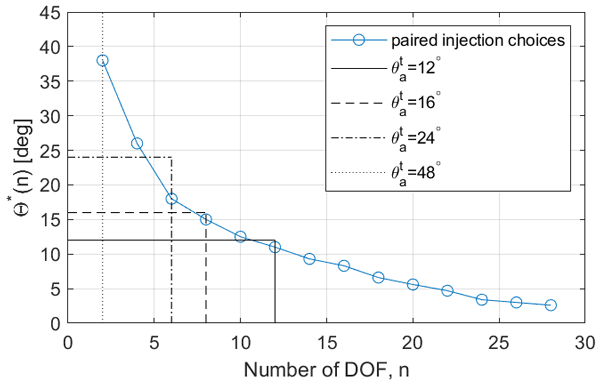
Yan Zhang, Douglas G. MacMartin, Daniele Visioni, and Ben Kravitz
Earth Syst. Dynam., 13, 201–217, https://doi.org/10.5194/esd-13-201-2022, https://doi.org/10.5194/esd-13-201-2022, 2022
Short summary
Short summary
Adding SO2 to the stratosphere could temporarily cool the planet by reflecting more sunlight back to space. However, adding SO2 at different latitude(s) and season(s) leads to significant differences in regional surface climate. This study shows that, to cool the planet by 1–1.5 °C, there are likely six to eight choices of injection latitude(s) and season(s) that lead to meaningfully different distributions of climate impacts.
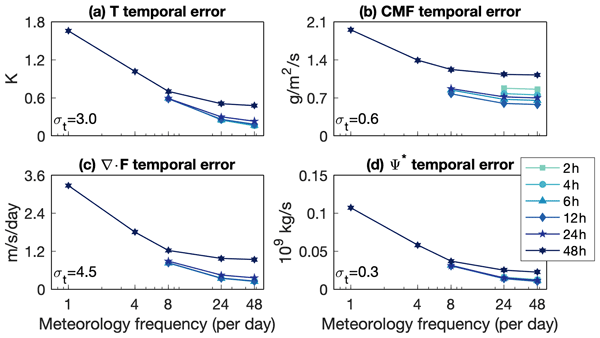
Nicholas A. Davis, Patrick Callaghan, Isla R. Simpson, and Simone Tilmes
Atmos. Chem. Phys., 22, 197–214, https://doi.org/10.5194/acp-22-197-2022, https://doi.org/10.5194/acp-22-197-2022, 2022
Short summary
Short summary
Specified dynamics schemes attempt to constrain the atmospheric circulation in a climate model to isolate the role of transport in chemical variability, evaluate model physics, and interpret field campaign observations. We show that the specified dynamics scheme in CESM2 erroneously suppresses convection and induces circulation errors that project onto errors in tracers, even using the most optimal settings. Development of a more sophisticated scheme is necessary for future progress.

Anton Laakso, Ulrike Niemeier, Daniele Visioni, Simone Tilmes, and Harri Kokkola
Atmos. Chem. Phys., 22, 93–118, https://doi.org/10.5194/acp-22-93-2022, https://doi.org/10.5194/acp-22-93-2022, 2022
Short summary
Short summary
The use of different spatio-temporal sulfur injection strategies with different magnitudes to create an artificial reflective aerosol layer to cool the climate is studied using sectional and modal aerosol schemes in a climate model. There are significant differences in the results depending on the aerosol microphysical module used. Different spatio-temporal injection strategies have a significant impact on the magnitude and zonal distribution of radiative forcing and atmospheric dynamics.
Cited articles
Abiodun, B. J., Odoulami, R. C., Sawadogo, W., Oloniyo, O. A., Abatan, A. A., New, M., Lennard, C., Izidine, P., Egbebiyi, T. S., and MacMartin, D. G.: Potential impacts of stratospheric aerosol injection on drought risk managements over major river basins in Africa, Climatic Change, 169, https://doi.org/10.1007/s10584-021-03268-w, 2021. a, b
Albertson, K., Aylen, J., Cavan, G., and McMorrow, J.: Forecasting the outbreak of moorland wildfires in the English Peak District, J. Environ. Manage., 90, 2642–2651, https://doi.org/10.1016/j.jenvman.2009.02.011, 2009. a
Armstrong McKay, D. I., Staal, A., Abrams, J. F., Winkelmann, R., Sakschewski, B., Loriani, S., Fetzer, I., Cornell, S. E., Rockström, J., and Lenton, T. M.: Exceeding 1.5 °C global warming could trigger multiple climate tipping points, Science, 377, https://doi.org/10.1126/science.abn7950, 2022. a, b
Arora, V. K., Katavouta, A., Williams, R. G., Jones, C. D., Brovkin, V., Friedlingstein, P., Schwinger, J., Bopp, L., Boucher, O., Cadule, P., Chamberlain, M. A., Christian, J. R., Delire, C., Fisher, R. A., Hajima, T., Ilyina, T., Joetzjer, E., Kawamiya, M., Koven, C. D., Krasting, J. P., Law, R. M., Lawrence, D. M., Lenton, A., Lindsay, K., Pongratz, J., Raddatz, T., Séférian, R., Tachiiri, K., Tjiputra, J. F., Wiltshire, A., Wu, T., and Ziehn, T.: Carbon–concentration and carbon–climate feedbacks in CMIP6 models and their comparison to CMIP5 models, Biogeosciences, 17, 4173–4222, https://doi.org/10.5194/bg-17-4173-2020, 2020. a, b, c, d, e
Ballantyne, A., Smith, W., Anderegg, W., Kauppi, P., Sarmiento, J., Tans, P., Shevliakova, E., Pan, Y., Poulter, B., Anav, A., Friedlingstein, P., Houghton, R., and Running, S.: Accelerating net terrestrial carbon uptake during the warming hiatus due to reduced respiration, Nat. Clim. Change, 7, 148–152, https://doi.org/10.1038/nclimate3204, 2017. a, b
Barrett, S.: The incredible economics of geoengineering, in: Environmental and Resource Economics, Springer Nature Link, 39, 45–54, https://doi.org/10.1007/s10640-007-9174-8, 2008. a, b, c
Betts, R. A., Belcher, S. E., Hermanson, L., Tank, A. K., Lowe, J. A., Jones, C. D., Morice, C. P., Rayner, N. A., Scaife, A. A., and Stott, P. A.: Approaching 1.5 °C: how will we know we’ve reached this crucial warming mark?, Nature, 624, 33–35, https://doi.org/10.1038/d41586-023-03775-z, 2023. a
Bond-Lamberty, B. and Thomson, A.: Temperature-associated increases in the global soil respiration record, Nature, 464, 579–582, https://doi.org/10.1038/nature08930, 2010. a, b
Boucher, O., Denvil, S., Levavasseur, G., Cozic, A., Caubel, A., Foujols, M.-A., Meurdesoif, Y., and Lurton, T.: IPSL IPSL-CM6A-LR model output prepared for CMIP6 GeoMIP G6sulfur, Earth System Grid Federation [data set], https://doi.org/10.22033/ESGF/CMIP6.5059, 2020a. a
Boucher, O., Servonnat, J., Albright, A. L., Aumont, O., Balkanski, Y., Bastrikov, V., Bekki, S., Bonnet, R., Bony, S., Bopp, L., Braconnot, P., Brockmann, P., Cadule, P., Caubel, A., Cheruy, F., Codron, F., Cozic, A., Cugnet, D., D'Andrea, F., Davini, P., de Lavergne, C., Denvil, S., Deshayes, J., Devilliers, M., Ducharne, A., Dufresne, J. L., Dupont, E., Éthé, C., Fairhead, L., Falletti, L., Flavoni, S., Foujols, M. A., Gardoll, S., Gastineau, G., Ghattas, J., Grandpeix, J. Y., Guenet, B., Lionel, E. G., Guilyardi, E., Guimberteau, M., Hauglustaine, D., Hourdin, F., Idelkadi, A., Joussaume, S., Kageyama, M., Khodri, M., Krinner, G., Lebas, N., Levavasseur, G., Lévy, C., Li, L., Lott, F., Lurton, T., Luyssaert, S., Madec, G., Madeleine, J. B., Maignan, F., Marchand, M., Marti, O., Mellul, L., Meurdesoif, Y., Mignot, J., Musat, I., Ottlé, C., Peylin, P., Planton, Y., Polcher, J., Rio, C., Rochetin, N., Rousset, C., Sepulchre, P., Sima, A., Swingedouw, D., Thiéblemont, R., Traore, A. K., Vancoppenolle, M., Vial, J., Vialard, J., Viovy, N., and Vuichard, N.: Presentation and Evaluation of the IPSL-CM6A-LR Climate Model, J. Adv. Model. Earth Sy., 12, https://doi.org/10.1029/2019MS002010, 2020b. a, b, c
Brando, P. M., Balch, J. K., Nepstad, D. C., Morton, D. C., Putz, F. E., Coe, M. T., Silvério, D., Macedo, M. N., Davidson, E. A., Nóbrega, C. C., Alencar, A., and Soares-Filho, B. S.: Abrupt increases in Amazonian tree mortality due to drought-fire interactions, P. Natl. Acad. Sci. USA, 111, 6347–6352, https://doi.org/10.1073/pnas.1305499111, 2014. a
Britain, R. S. G.: Geoengineering the climate: science, governance and uncertainty, Royal Society, ISBN 9780854037735, 2009. a
Calvin, K., Dasgupta, D., Krinner, G., Mukherji, A., Thorne, P. W., Trisos, C., Romero, J., Aldunce, P., Barrett, K., Blanco, G., Cheung, W. W., Connors, S., Denton, F., Diongue-Niang, A., Dodman, D., Garschagen, M., Geden, O., Hayward, B., Jones, C., Jotzo, F., Krug, T., Lasco, R., Lee, Y.-Y., Masson-Delmotte, V., Meinshausen, M., Mintenbeck, K., Mokssit, A., Otto, F. E., Pathak, M., Pirani, A., Poloczanska, E., Pörtner, H.-O., Revi, A., Roberts, D. C., Roy, J., Ruane, A. C., Skea, J., Shukla, P. R., Slade, R., Slangen, A., Sokona, Y., Sörensson, A. A., Tignor, M., van Vuuren, D., Wei, Y.-M., Winkler, H., Zhai, P., Zommers, Z., Hourcade, J.-C., Johnson, F. X., Pachauri, S., Simpson, N. P., Singh, C., Thomas, A., Totin, E., Alegría, A., Armour, K., Bednar-Friedl, B., Blok, K., Cissé, G., Dentener, F., Eriksen, S., Fischer, E., Garner, G., Guivarch, C., Haasnoot, M., Hansen, G., Hauser, M., Hawkins, E., Hermans, T., Kopp, R., Leprince-Ringuet, N., Lewis, J., Ley, D., Ludden, C., Niamir, L., Nicholls, Z., Some, S., Szopa, S., Trewin, B., van der Wijst, K.-I., Winter, G., Witting, M., Birt, A., and Ha, M.: IPCC, 2023: Climate Change 2023: Synthesis Report. Contribution of Working Groups I, II and III to the Sixth Assessment Report of the Intergovernmental Panel on Climate Change, edited by: Core Writing Team, Lee, H., and Romero, J., IPCC, Geneva, Switzerland., Tech. rep., Intergovernmental Panel on Climate Change, https://doi.org/10.59327/IPCC/AR6-9789291691647, 2023. a
Canadell, J. G., Monteiro, P. M. S., Costa, M. H., Cotrim da Cunha, L., Cox, P. M., Eliseev, A. V., Henson, S., Ishii, M., Jaccard, S., Koven, C., Lohila, A., Patra, P. K., Piao, S., Rogelj, J., Syampungani, S., Zaehle, S., and Zickfeld, K.: Global Carbon and Other Biogeochemical Cycles and Feedbacks, in: Climate Change 2021: The Physical Science Basis. Contribution of Working Group I to the Sixth Assessment Report of the Intergovernmental Panel on Climate Change, edited by: Masson-Delmotte, V., Zhai, P., Pirani, A., Connors, S. L., Péan, C., Berger, S., Caud, N., Chen, Y., Goldfarb, L., Gomis, M. I., Huang, M., Leitzell, K., Lonnoy, E., Matthews, J. B., Maycock, T. K., Waterfield, T., Yelekçi, R., Yu, R., and Zhou, B., 673–816, Cambridge University Press, Cambridge, United Kingdom and New York, NY, USA, https://doi.org/10.1017/9781009157896.007, 2023. a
Chakraborty, T., Lee, X., and Lawrence, D. M.: Diffuse Radiation Forcing Constraints on Gross Primary Productivity and Global Terrestrial Evapotranspiration, Earth's Future, 10, https://doi.org/10.1029/2022EF002805, 2022. a
Chen, A., Guan, H., and Batelaan, O.: Non-linear interactions between vegetation and terrestrial water storage in Australia, J. Hydrol., 613, https://doi.org/10.1016/j.jhydrol.2022.128336, 2022. a
Chen, X., Hu, H., Wang, Q., Wang, X., and Ma, B.: Exploring the Factors Affecting Terrestrial Soil Respiration in Global Warming Manipulation Experiments Based on Meta-Analysis, Agriculture, 14, 1581, https://doi.org/10.3390/agriculture14091581, 2024. a
Costa, F. R., Schietti, J., Stark, S. C., and Smith, M. N.: The other side of tropical forest drought: do shallow water table regions of Amazonia act as large-scale hydrological refugia from drought?, New Phytologist, 237, 714–733, https://doi.org/10.1111/nph.17914, 2023. a
Cox, P. M., Harris, P. P., Huntingford, C., Betts, R. A., Collins, M., Jones, C. D., Jupp, T. E., Marengo, J. A., and Nobre, C. A.: Increasing risk of Amazonian drought due to decreasing aerosol pollution, Nature, 453, 212–215, https://doi.org/10.1038/nature06960, 2008. a
Cox, P. M., Williamson, M. S., Friedlingstein, P., Jones, C. D., Raoult, N., Rogelj, J., and Varney, R. M.: Emergent constraints on carbon budgets as a function of global warming, Nat. Commun., 15, 1885, https://doi.org/10.1038/s41467-024-46137-7, 2024. a
Cramer, W., Bondeau, A., Woodward, F. I., Prentice, I. C., Betts, R. A., Brovkin, V., Cox, P. M., Fisher, V., Foley, J. A., Friend, A. D., Kucharik, C., Lomas, M. R., Ramankutty, N., Sitch, S., Smith, B., White, A., and Young-Molling, C.: Global response of terrestrial ecosystem structure and function to CO2 and climate change: Results from six dynamic global vegetation models, Glob. Change Biol., 7, 357–373, https://doi.org/10.1046/j.1365-2486.2001.00383.x, 2001. a
Crutzen, P. J.: Albedo enhancement by stratospheric sulfur injections: A contribution to resolve a policy dilemma?, Climatic Change, 77, 211–220, https://doi.org/10.1007/s10584-006-9101-y, 2006. a
Dagon, K. and Schrag, D. P.: Quantifying the effects of solar geoengineering on vegetation, Climatic Change, 153, 235–251, https://doi.org/10.1007/s10584-019-02387-9, 2019. a
Danabasoglu, G.: NCAR CESM2-WACCM model output prepared for CMIP6 GeoMIP G6sulfur, Earth System Grid Federation [data set], https://doi.org/10.22033/ESGF/CMIP6.10034, 2019. a
Danabasoglu, G., Lamarque, J. F., Bacmeister, J., Bailey, D. A., DuVivier, A. K., Edwards, J., Emmons, L. K., Fasullo, J., Garcia, R., Gettelman, A., Hannay, C., Holland, M. M., Large, W. G., Lauritzen, P. H., Lawrence, D. M., Lenaerts, J. T., Lindsay, K., Lipscomb, W. H., Mills, M. J., Neale, R., Oleson, K. W., Otto-Bliesner, B., Phillips, A. S., Sacks, W., Tilmes, S., van Kampenhout, L., Vertenstein, M., Bertini, A., Dennis, J., Deser, C., Fischer, C., Fox-Kemper, B., Kay, J. E., Kinnison, D., Kushner, P. J., Larson, V. E., Long, M. C., Mickelson, S., Moore, J. K., Nienhouse, E., Polvani, L., Rasch, P. J., and Strand, W. G.: The Community Earth System Model Version 2 (CESM2), J. Adv. Model. Earth Sy., 12, https://doi.org/10.1029/2019MS001916, 2020. a, b
Davies-Barnard, T., Meyerholt, J., Zaehle, S., Friedlingstein, P., Brovkin, V., Fan, Y., Fisher, R. A., Jones, C. D., Lee, H., Peano, D., Smith, B., Wårlind, D., and Wiltshire, A. J.: Nitrogen cycling in CMIP6 land surface models: progress and limitations, Biogeosciences, 17, 5129–5148, https://doi.org/10.5194/bg-17-5129-2020, 2020. a
Dekker, S. C., Groenendijk, M., Booth, B. B. B., Huntingford, C., and Cox, P. M.: Spatial and temporal variations in plant water-use efficiency inferred from tree-ring, eddy covariance and atmospheric observations, Earth Syst. Dynam., 7, 525–533, https://doi.org/10.5194/esd-7-525-2016, 2016. a, b
Dollar, E., Edwards, F., Stratford, C., May, L., Biggs, J., Laize, C., Acreman, M., Blake, J., Carvalho, L., Elliott, A., Gunn, I., Hinsley, S., Mountford, O., Nunn, M., Preston, C., Sayer, E., Schonrogge, K., Spears, B., Spurgeon, D., Winfield, I., and Wood, P.: Monitoring and Assessment of Environmental Impacts of Droughts: Literature Synthesis, Tech. Rep. Report SC120024/R1ii, Environment Agency, Bristol, UK, https://assets.publishing.service.gov.uk/media/5a75ba92e5274a436829984f/LIT_8569_b765dd.pdf (last access: 10 February 2026), 2013. a
Doughty, C. E. and Goulden, M. L.: Are tropical forests near a high temperature threshold?, J. Geophys. Res.-Biogeo., 114, https://doi.org/10.1029/2007JG000632, 2009. a
Duan, L., Cao, L., Bala, G., and Caldeira, K.: A model‐based investigation of terrestrial plant carbon uptake response to four radiation modification approaches, J. Geophys. Res.-Atmos., 125, e2019JD031883, https://doi.org/10.1029/2019JD031883, 2020. a, b
Duffey, A., Irvine, P., Tsamados, M., and Stroeve, J.: Solar Geoengineering in the Polar Regions: A Review, Earth's Future, 11, e2023EF003679, https://doi.org/10.1029/2023EF003679, 2023. a
Eyring, V., Bony, S., Meehl, G. A., Senior, C. A., Stevens, B., Stouffer, R. J., and Taylor, K. E.: Overview of the Coupled Model Intercomparison Project Phase 6 (CMIP6) experimental design and organization, Geosci. Model Dev., 9, 1937–1958, https://doi.org/10.5194/gmd-9-1937-2016, 2016. a, b
Firpo, M. Â. F., Guimarães, B. D. S., Dantas, L. G., Silva, M. G. B. D., Alves, L. M., Chadwick, R., Llopart, M. P., and Oliveira, G. S. D.: Assessment of CMIP6 models; performance in simulating present-day climate in Brazil, Front. Climate, 4, 948499, https://doi.org/10.3389/fclim.2022.948499, 2022. a
Flores, B. M., Montoya, E., Sakschewski, B., Nascimento, N., Staal, A., Betts, R. A., Levis, C., Lapola, D. M., Esquível-Muelbert, A., Jakovac, C., Nobre, C. A., Oliveira, R. S., Borma, L. S., Nian, D., Boers, N., Hecht, S. B., ter Steege, H., Arieira, J., Lucas, I. L., Berenguer, E., Marengo, J. A., Gatti, L. V., Mattos, C. R. C., and Hirota, M.: Critical transitions in the Amazon forest system, Nature, 626, 555–564, https://doi.org/10.1038/s41586-023-06970-0, 2024. a, b
Frölicher, T. L., Joos, F., Raible, C. C., and Sarmiento, J. L.: Atmospheric CO2 response to volcanic eruptions: The role of ENSO, season, and variability, Global Biogeochem. Cy., 27, 239–251, https://doi.org/10.1002/gbc.20028, 2013. a, b
Glienke, S., Irvine, P. J., and Lawrence, M. G.: The impact of geoengineering on vegetation in experiment G1 of the Geoengineering Model Intercomparison Project (GeoMIP), J. Geophys. Res.-Atmos., 120, 10196–10213, https://doi.org/10.1002/2015JD024202, 2015. a
Hagos, S. M., Leung, L. R., Garuba, O. A., Demott, C., Harrop, B., Lu, J., and Ahn, M. S.: The relationship between precipitation and precipitable water in CMIP6 simulations and implications for tropical climatology and change, J. Climate, 34, 1587–1600, https://doi.org/10.1175/JCLI-D-20-0211.1, 2021. a
Haywood, J., Tilmes, S., Keutsch, F., Niemeier, U., Schmidt, A., Visioni, D., Yu, P., Dykema, J., Jones, A. C., Laasko, A., and Wilka, C. A.: Stratospheric Aerosol Injection and its Potential Effect on the Stratospheric Ozone Layer, Chap. 6, in: Scientific Assessment of Ozone Depletion, Tech. rep., World Meteorological Organization, 2022a. a
Haywood, J. M., Jones, A., Johnson, B. T., and McFarlane Smith, W.: Assessing the consequences of including aerosol absorption in potential stratospheric aerosol injection climate intervention strategies, Atmos. Chem. Phys., 22, 6135–6150, https://doi.org/10.5194/acp-22-6135-2022, 2022b. a
Heskel, M. A., O'Sullivan, O. S., Reich, P. B., Tjoelker, M. G., Weerasinghe, L. K., Penillard, A., Egerton, J. J., Creek, D., Bloomfield, K. J., Xiang, J., Sinca, F., Stangl, Z. R., Torre, A. M.-D. L., Griffin, K. L., Huntingford, C., Hurry, V., Meir, P., Turnbull, M. H., and Atkin, O. K.: Convergence in the temperature response of leaf respiration across biomes and plant functional types, P. Natl. Acad. Sci. USA, 113, 3832–3837, https://doi.org/10.1073/pnas.1520282113, 2016. a
Hu, Q., Li, T., Deng, X., Wu, T., Zhai, P., Huang, D., Fan, X., Zhu, Y., Lin, Y., Xiao, X., Chen, X., Zhao, X., Wang, L., and Qin, Z.: Intercomparison of global terrestrial carbon fluxes estimated by MODIS and Earth system models, Sci. Total Environ., 810, 152231, https://doi.org/10.1016/j.scitotenv.2021.152231, 2022. a
Huntingford, C., Zelazowski, P., Galbraith, D., Mercado, L. M., Sitch, S., Fisher, R., Lomas, M., Walker, A. P., Jones, C. D., Booth, B. B. B., Malhi, Y., Hemming, D., Kay, G., Good, P., Lewis, S. L., Phillips, O. L., Atkin, O. K., Lloyd, J., Gloor, E., Zaragoza-Castells, J., Meir, P., Betts, R., Harris, P. P., Nobre, C., Marengo, J., and Cox, P. M.: Simulated resilience of tropical rainforests to CO2-induced climate change, Nat. Geosci., 6, 268–273, https://doi.org/10.1038/ngeo1741, 2013. a, b
Hurtt, G., Chini, L., Sahajpal, R., Frolking, S., Bodirsky, B. L., Calvin, K., Doelman, J., Fisk, J., Fujimori, S., Goldewijk, K. K., Hasegawa, T., Havlik, P., Heinimann, A., Humpenöder, F., Jungclaus, J., Kaplan, J., Krisztin, T., Lawrence, D., Lawrence, P., Mertz, O., Pongratz, J., Popp, A., Riahi, K., Shevliakova, E., Stehfest, E., Thornton, P., van Vuuren, D., and Zhang, X.: Harmonization of Global Land Use Change and Management for the Period 2015–2300, Earth System Grid Federation [data set], https://doi.org/10.22033/ESGF/input4MIPs.10468, 2019. a
Jones, A.: MOHC UKESM1.0-LL model output prepared for CMIP6 GeoMIP G6sulfur, Earth System Grid Federation [data set], https://doi.org/10.22033/ESGF/CMIP6.5822, 2019. a
Jones, A., Haywood, J., and Boucher, O.: A comparison of the climate impacts of geoengineering by stratospheric SO2 injection and by brightening of marine stratocumulus cloud, Atmos. Sci. Lett., 12, 176–183, https://doi.org/10.1002/asl.291, 2011. a
Jones, A., Haywood, J. M., Alterskjær, K., Boucher, O., Cole, J. N., Curry, C. L., Irvine, P. J., Ji, D., Kravitz, B., Kristjánsson, J. E., Moore, J. C., Niemeier, U., Robock, A., Schmidt, H., Singh, B., Tilmes, S., Watanabe, S., and Yoon, J. H.: The impact of abrupt suspension of solar radiation management (termination effect) in experiment G2 of the Geoengineering Model Intercomparison Project (GeoMIP), J. Geophys. Res.-Atmos., 118, 9743–9752, https://doi.org/10.1002/jgrd.50762, 2013. a, b, c, d
Jones, C. D., Collins, M., Cox, P. M., and Spall, S. A.: The Carbon Cycle Response to ENSO: A Coupled Climate–Carbon Cycle Model Study, J. Climate, 14, 4113–4129, https://doi.org/10.1175/1520-0442(2001)014<4113:TCCRTE>2.0.CO;2, 2001. a
Kalidindi, S., Bala, G., Modak, A., and Caldeira, K.: Modeling of solar radiation management: a comparison of simulations using reduced solar constant and stratospheric sulphate aerosols, Clim. Dynam., 44, 2909–2925, https://doi.org/10.1007/s00382-014-2240-3, 2015. a
Keith, D. W. and MacMartin, D. G.: A temporary, moderate and responsive scenario for solar geoengineering, Nat. Clim. Change, 5, 201–206, https://doi.org/10.1038/nclimate2493, 2015. a
Keith, D. W., Weisenstein, D. K., Dykema, J. A., and Keutsch, F. N.: Stratospheric solar geoengineering without ozone loss, P. Natl. Acad. Sci. USA, 113, 14910–14914, https://doi.org/10.1073/pnas.1615572113, 2016. a
Kravitz, B., Caldeira, K., Boucher, O., Robock, A., Rasch, P. J., Alterskjær, K., Karam, D. B., Cole, J. N., Curry, C. L., Haywood, J. M., Irvine, P. J., Ji, D., Jones, A., Kristjánsson, J. E., Lunt, D. J., Moore, J. C., Niemeier, U., Schmidt, H., Schulz, M., Singh, B., Tilmes, S., Watanabe, S., Yang, S., and Yoon, J. H.: Climate model response from the Geoengineering Model Intercomparison Project (GeoMIP), J. Geophys. Res.-Atmos., 118, 8320–8332, https://doi.org/10.1002/jgrd.50646, 2013. a
Kravitz, B., Robock, A., Tilmes, S., Boucher, O., English, J. M., Irvine, P. J., Jones, A., Lawrence, M. G., MacCracken, M., Muri, H., Moore, J. C., Niemeier, U., Phipps, S. J., Sillmann, J., Storelvmo, T., Wang, H., and Watanabe, S.: The Geoengineering Model Intercomparison Project Phase 6 (GeoMIP6): simulation design and preliminary results, Geosci. Model Dev., 8, 3379–3392, https://doi.org/10.5194/gmd-8-3379-2015, 2015. a, b, c, d, e
Kravitz, B., Macmartin, D. G., Mills, M. J., Richter, J. H., Tilmes, S., Lamarque, J. F., Tribbia, J. J., and Vitt, F.: First simulations of designing stratospheric sulfate aerosol geoengineering to meet multiple simultaneous climate objectives, J. Geophys. Res.-Atmos., 122, 12616–12634, https://doi.org/10.1002/2017JD026874, 2017. a
Kravitz, B., MacMartin, D. G., Visioni, D., Boucher, O., Cole, J. N. S., Haywood, J., Jones, A., Lurton, T., Nabat, P., Niemeier, U., Robock, A., Séférian, R., and Tilmes, S.: Comparing different generations of idealized solar geoengineering simulations in the Geoengineering Model Intercomparison Project (GeoMIP), Atmos. Chem. Phys., 21, 4231–4247, https://doi.org/10.5194/acp-21-4231-2021, 2021. a
Kumarathunge, D. P., Medlyn, B. E., Drake, J. E., Tjoelker, M. G., Aspinwall, M. J., Battaglia, M., Cano, F. J., Carter, K. R., Cavaleri, M. A., Cernusak, L. A., Chambers, J. Q., Crous, K. Y., Kauwe, M. G. D., Dillaway, D. N., Dreyer, E., Ellsworth, D. S., Ghannoum, O., Han, Q., Hikosaka, K., Jensen, A. M., Kelly, J. W., Kruger, E. L., Mercado, L. M., Onoda, Y., Reich, P. B., Rogers, A., Slot, M., Smith, N. G., Tarvainen, L., Tissue, D. T., Togashi, H. F., Tribuzy, E. S., Uddling, J., Vårhammar, A., Wallin, G., Warren, J. M., and Way, D. A.: Acclimation and adaptation components of the temperature dependence of plant photosynthesis at the global scale, New Phytologist, 222, 768–784, https://doi.org/10.1111/nph.15668, 2019. a
Lauvset, S. K., Tjiputra, J., and Muri, H.: Climate engineering and the ocean: effects on biogeochemistry and primary production, Biogeosciences, 14, 5675–5691, https://doi.org/10.5194/bg-14-5675-2017, 2017. a
Lee, H., Muri, H., Ekici, A., Tjiputra, J., and Schwinger, J.: The response of terrestrial ecosystem carbon cycling under different aerosol-based radiation management geoengineering, Earth Syst. Dynam., 12, 313–326, https://doi.org/10.5194/esd-12-313-2021, 2021. a
Li, Z. and Fedorov, A. V.: Climate Models Exaggerate the Enhanced Double-ITCZ in the Warming Tropical Pacific Due To Preexisting Precipitation Bias, Geophys. Res. Lett., 52, e2025GL115445, https://doi.org/10.1029/2025GL115445, 2025. a
MacMartin, D. G., Kravitz, B., Tilmes, S., Richter, J. H., Mills, M. J., Lamarque, J.-F., Tribbia, J. J., and Vitt, F.: The climate response to stratospheric aerosol geoengineering can be tailored using multiple injection locations, J. Geophys. Res.-Atmos., 122, 12574–12590, https://doi.org/10.1002/2017JD026868, 2017. a
Mauritsen, T., Bader, J., Becker, T., Behrens, J., Bittner, M., Brokopf, R., Brovkin, V., Claussen, M., Crueger, T., Esch, M., Fast, I., Fiedler, S., Fläschner, D., Gayler, V., Giorgetta, M., Goll, D. S., Haak, H., Hagemann, S., Hedemann, C., Hohenegger, C., Ilyina, T., Jahns, T., de-la Cuesta, D. J., Jungclaus, J., Kleinen, T., Kloster, S., Kracher, D., Kinne, S., Kleberg, D., Lasslop, G., Kornblueh, L., Marotzke, J., Matei, D., Meraner, K., Mikolajewicz, U., Modali, K., Möbis, B., Müller, W. A., Nabel, J. E., Nam, C. C., Notz, D., Nyawira, S. S., Paulsen, H., Peters, K., Pincus, R., Pohlmann, H., Pongratz, J., Popp, M., Raddatz, T. J., Rast, S., Redler, R., Reick, C. H., Rohrschneider, T., Schemann, V., Schmidt, H., Schnur, R., Schulzweida, U., Six, K. D., Stein, L., Stemmler, I., Stevens, B., von Storch, J. S., Tian, F., Voigt, A., Vrese, P., Wieners, K. H., Wilkenskjeld, S., Winkler, A., and Roeckner, E.: Developments in the MPI-M Earth System Model version 1.2 (MPI-ESM1.2) and Its Response to Increasing CO2, J. Adv. Model. Earth Sy., 11, 998–1038, https://doi.org/10.1029/2018MS001400, 2019. a, b
Meehl, G. A., Moss, R., Taylor, K. E., Eyring, V., Stouffer, R. J., Bony, S., and Stevens, B.: Climate model intercomparisons: Preparing for the next phase, Eos, 95, 77–78, https://doi.org/10.1002/2014EO090001, 2014. a
Mercado, L. M., Bellouin, N., Sitch, S., Boucher, O., Huntingford, C., Wild, M., and Cox, P. M.: Impact of changes in diffuse radiation on the global land carbon sink, Nature, 458, 1014–1017, https://doi.org/10.1038/nature07949, 2009. a, b
Monteverde, C., Sales, F. D., and Jones, C.: Evaluation of the CMIP6 Performance in Simulating Precipitation in the Amazon River Basin, Climate, 10, https://doi.org/10.3390/cli10080122, 2022. a
Muri, H., Tjiputra, J., Otterå, H., Adakudlu, M., Lauvset, S. K., Grini, A., Schulz, M., Niemeier, U., and Kristjánsson, J. E.: Climate Response to Aerosol Geoengineering: A Multimethod Comparison, J. Climate, 31, https://doi.org/10.1175/JCLI-D-17-0620.s1, 2018. a
Niemeier, U. and Schmidt, H.: Changing transport processes in the stratosphere by radiative heating of sulfate aerosols, Atmos. Chem. Phys., 17, 14871–14886, https://doi.org/10.5194/acp-17-14871-2017, 2017. a, b
Niemeier, U., Wieners, K.-H., Giorgetta, M., Jungclaus, J., Reick, C., Esch, M., Bittner, M., Legutke, S., Schupfner, M., Wachsmann, F., Gayler, V., Haak, H., de Vrese, P., Raddatz, T., Mauritsen, T., von Storch, J.-S., Behrens, J., Brovkin, V., Claussen, M., Crueger, T., Fast, I., Fiedler, S., Hagemann, S., Hohenegger, C., Jahns, T., Kloster, S., Kinne, S., Lasslop, G., Kornblueh, L., Marotzke, J., Matei, D., Meraner, K., Mikolajewicz, U., Modali, K., Müller, W., Nabel, J., Notz, D., Peters-von Gehlen, K., Pincus, R., Pohlmann, H., Pongratz, J., Rast, S., Schmidt, H., Schnur, R., Schulzweida, U., Six, K., Stevens, B., Voigt, A., and Roeckner, E.: MPI-M MPI-ESM1.2-LR model output prepared for CMIP6 GeoMIP G6sulfur, Earth System Grid Federation [data set], https://doi.org/10.22033/ESGF/CMIP6.6448, 2019. a
Norby, R. J.: Ecological and evolutionary lessons from free air carbon enhancement (FACE) experiments, Annu. Rev. Ecol. Evol. S., 42, https://doi.org/10.1146/annurev-ecolsys-102209-144647, 2011. a, b, c
O'Neill, B. C., Tebaldi, C., van Vuuren, D. P., Eyring, V., Friedlingstein, P., Hurtt, G., Knutti, R., Kriegler, E., Lamarque, J.-F., Lowe, J., Meehl, G. A., Moss, R., Riahi, K., and Sanderson, B. M.: The Scenario Model Intercomparison Project (ScenarioMIP) for CMIP6, Geosci. Model Dev., 9, 3461–3482, https://doi.org/10.5194/gmd-9-3461-2016, 2016. a, b
Parry, I. M.: IP294/SRM-is-projected-to-increase-land-carbon-storage-and-to-protect-the-Amazon-rainforest: SRM-is-projected-to-increase-land-carbon-storage-and-to-protect-the-Amazon-rainforest release v1.0.0 (v1.0.2), Zenodo [code], https://doi.org/10.5281/zenodo.11507510, 2024. a, b
Parry, I. M., Ritchie, P. D. L., and Cox, P. M.: Evidence of localised Amazon rainforest dieback in CMIP6 models, Earth Syst. Dynam., 13, 1667–1675, https://doi.org/10.5194/esd-13-1667-2022, 2022. a, b, c, d
Parsons, L. A.: Implications of CMIP6 Projected Drying Trends for 21st Century Amazonian Drought Risk, Earth's Future, 8, https://doi.org/10.1029/2020EF001608, 2020. a, b
Pauloo, R. A., Escriva-Bou, A., Dahlke, H., Fencl, A., Guillon, H., and Fogg, G. E.: Domestic well vulnerability to drought duration and unsustainable groundwater management in California's Central Valley, Environ. Res. Lett., 15, https://doi.org/10.1088/1748-9326/ab6f10, 2020. a
Piao, S., Wang, X., Wang, K., Li, X., Bastos, A., Canadell, J. G., Ciais, P., Friedlingstein, P., and Sitch, S.: Interannual variation of terrestrial carbon cycle: Issues and perspectives, Glob. Change Biol., 26, 300–318, https://doi.org/10.1111/gcb.14884, 2020. a, b
Plazzotta, M., Séférian, R., Douville, H., Kravitz, B., and Tjiputra, J.: Land Surface Cooling Induced by Sulfate Geoengineering Constrained by Major Volcanic Eruptions, Geophys. Res. Lett., 45, 5663–5671, https://doi.org/10.1029/2018GL077583, 2018. a
Plazzotta, M., Séférian, R., and Douville, H.: Impact of Solar Radiation Modification on Allowable CO2 Emissions: What Can We Learn From Multimodel Simulations?, Earth's Future, 7, 664–676, https://doi.org/10.1029/2019EF001165, 2019. a
Pope, F. D., Braesicke, P., Grainger, R. G., Kalberer, M., Watson, I. M., Davidson, P. J., and Cox, R. A.: Stratospheric aerosol particles and solar-radiation management, Nat. Clim. Change, 2, 713–719, https://doi.org/10.1038/nclimate1528, 2012. a, b
Ritchie, P. D. L., Clarke, J. J., Cox, P. M., and Huntingford, C.: Overshooting tipping point thresholds in a changing climate, Nature, 592, 517–523, https://doi.org/10.1038/s41586-021-03263-2, 2021. a
Robock, A., Marquardt, A., Kravitz, B., and Stenchikov, G.: Benefits, risks, and costs of stratospheric geoengineering, Geophys. Res. Lett., 36, https://doi.org/10.1029/2009GL039209, 2009. a
Seferian, R.: CNRM-CERFACS CNRM-ESM2-1 model output prepared for CMIP6 GeoMIP G6sulfur, Earth System Grid Federation [data set], https://doi.org/10.22033/ESGF/CMIP6.3907, 2019. a
Séférian, R., Nabat, P., Michou, M., Saint-Martin, D., Voldoire, A., Colin, J., Decharme, B., Delire, C., Berthet, S., Chevallier, M., Sénési, S., Franchisteguy, L., Vial, J., Mallet, M., Joetzjer, E., Geoffroy, O., Guérémy, J.-F., Moine, M.-P., Msadek, R., Ribes, A., Rocher, M., Roehrig, R., Salas-y Mélia, D., Sanchez, E., Terray, L., Valcke, S., Waldman, R., Aumont, O., Bopp, L., Deshayes, J., Éthé, C., and Madec, G.: Evaluation of CNRM Earth System Model, CNRM-ESM2-1: Role of Earth System Processes in Present-Day and Future Climate, J. Adv. Model. Earth Sy., 11, 4182–4227, https://doi.org/10.1029/2019MS001791, 2019. a, b
Sellar, A. A., Jones, C. G., Mulcahy, J. P., Tang, Y., Yool, A., Wiltshire, A., O'Connor, F. M., Stringer, M., Hill, R., Palmieri, J., Woodward, S., de Mora, L., Kuhlbrodt, T., Rumbold, S. T., Kelley, D. I., Ellis, R., Johnson, C. E., Walton, J., Abraham, N. L., Andrews, M. B., Andrews, T., Archibald, A. T., Berthou, S., Burke, E., Blockley, E., Carslaw, K., Dalvi, M., Edwards, J., Folberth, G. A., Gedney, N., Griffiths, P. T., Harper, A. B., Hendry, M. A., Hewitt, A. J., Johnson, B., Jones, A., Jones, C. D., Keeble, J., Liddicoat, S., Morgenstern, O., Parker, R. J., Predoi, V., Robertson, E., Siahaan, A., Smith, R. S., Swaminathan, R., Woodhouse, M. T., Zeng, G., and Zerroukat, M.: UKESM1: Description and Evaluation of the U.K. Earth System Model, J. Adv. Model. Earth Sy., 11, 4513–4558, https://doi.org/10.1029/2019MS001739, 2019. a, b
Terrer, C., Vicca, S., Stocker, B. D., Hungate, B. A., Phillips, R. P., Reich, P. B., Finzi, A. C., and Prentice, I. C.: Ecosystem responses to elevated CO2 governed by plant–soil interactions and the cost of nitrogen acquisition, New Phytologist, 217, 507–522, https://doi.org/10.1111/nph.14872, 2018. a, b, c
Tilmes, S., Mills, M. J., Niemeier, U., Schmidt, H., Robock, A., Kravitz, B., Lamarque, J.-F., Pitari, G., and English, J. M.: A new Geoengineering Model Intercomparison Project (GeoMIP) experiment designed for climate and chemistry models, Geosci. Model Dev., 8, 43–49, https://doi.org/10.5194/gmd-8-43-2015, 2015. a, b
Tilmes, S., Visioni, D., Jones, A., Haywood, J., Séférian, R., Nabat, P., Boucher, O., Bednarz, E. M., and Niemeier, U.: Stratospheric ozone response to sulfate aerosol and solar dimming climate interventions based on the G6 Geoengineering Model Intercomparison Project (GeoMIP) simulations, Atmos. Chem. Phys., 22, 4557–4579, https://doi.org/10.5194/acp-22-4557-2022, 2022. a
Tjiputra, J. F., Assmann, K., Bentsen, M., Bethke, I., Otterå, O. H., Sturm, C., and Heinze, C.: Bergen Earth system model (BCM-C): model description and regional climate-carbon cycle feedbacks assessment, Geosci. Model Dev., 3, 123–141, https://doi.org/10.5194/gmd-3-123-2010, 2010. a
Tjiputra, J. F., Grini, A., and Lee, H.: Impact of idealized future stratospheric aerosol injection on the large-scale ocean and land carbon cycles, J. Geophys. Res.-Biogeo., 121, 2–27, https://doi.org/10.1002/2015JG003045, 2016. a, b, c
Trisos, C. H., Amatulli, G., Gurevitch, J., Robock, A., Xia, L., and Zambri, B.: Potentially dangerous consequences for biodiversity of solar geoengineering implementation and termination, Nature Ecology and Evolution, 2, 475–482, https://doi.org/10.1038/s41559-017-0431-0, 2018. a, b, c
Van Loon, A. F., Kchouk, S., Matanó, A., Tootoonchi, F., Alvarez-Garreton, C., Hassaballah, K. E. A., Wu, M., Wens, M. L. K., Shyrokaya, A., Ridolfi, E., Biella, R., Nagavciuc, V., Barendrecht, M. H., Bastos, A., Cavalcante, L., de Vries, F. T., Garcia, M., Mård, J., Streefkerk, I. N., Teutschbein, C., Tootoonchi, R., Weesie, R., Aich, V., Boisier, J. P., Di Baldassarre, G., Du, Y., Galleguillos, M., Garreaud, R., Ionita, M., Khatami, S., Koehler, J. K. L., Luce, C. H., Maskey, S., Mendoza, H. D., Mwangi, M. N., Pechlivanidis, I. G., Ribeiro Neto, G. G., Roy, T., Stefanski, R., Trambauer, P., Koebele, E. A., Vico, G., and Werner, M.: Review article: Drought as a continuum – memory effects in interlinked hydrological, ecological, and social systems, Nat. Hazards Earth Syst. Sci., 24, 3173–3205, https://doi.org/10.5194/nhess-24-3173-2024, 2024. a
Visioni, D., MacMartin, D. G., Kravitz, B., Boucher, O., Jones, A., Lurton, T., Martine, M., Mills, M. J., Nabat, P., Niemeier, U., Séférian, R., and Tilmes, S.: Identifying the sources of uncertainty in climate model simulations of solar radiation modification with the G6sulfur and G6solar Geoengineering Model Intercomparison Project (GeoMIP) simulations, Atmos. Chem. Phys., 21, 10039–10063, https://doi.org/10.5194/acp-21-10039-2021, 2021. a, b, c, d
Wells, A. F., Henry, M., Bednarz, E. M., MacMartin, D. G., Jones, A., Dalvi, M., and Haywood, J. M.: Identifying climate impacts from different Stratospheric Aerosol Injection strategies in UKESM1, Earth's Future, 12, e2023EF004358, https://doi.org/10.1029/2023EF004358, 2024. a, b, c
Wieners, C. E., Hofbauer, B. P., Vries, I. E. D., Honegger, M., Visioni, D., Russchenberg, H., and Felgenhauer, T.: Solar Radiation Modification is risky, but so is rejecting it: A call for balanced research, Oxford Open Climate Change, 3, 1–4, https://doi.org/10.1093/oxfclm/kgad002, 2023. a
Witze, A.: EARTH BOILED IN 2023 – WILL IT HAPPEN AGAIN IN 2024?, Nature, 625, 637–639, https://doi.org/10.1038/d41586-024-00074-z, 2024. a
World Meteorological Organization (WMO): WMO confirms 2024 as warmest year on record at about 1.55 °C above pre-industrial level, https://public.wmo.int/media/news/wmo-confirms-2024-warmest-year-record-about-155degc-above-pre-industrial-level (last access: 10 February 2026), 2025. a
Xia, L., Robock, A., Tilmes, S., and Neely III, R. R.: Stratospheric sulfate geoengineering could enhance the terrestrial photosynthesis rate, Atmos. Chem. Phys., 16, 1479–1489, https://doi.org/10.5194/acp-16-1479-2016, 2016. a, b
Yang, C. E., Hoffman, F. M., Ricciuto, D. M., Tilmes, S., Xia, L., MacMartin, D. G., Kravitz, B., Richter, J. H., Mills, M., and Fu, J. S.: Assessing terrestrial biogeochemical feedbacks in a strategically geoengineered climate, Environ. Res. Lett., 15, https://doi.org/10.1088/1748-9326/abacf7, 2020. a, b, c
Yin, X.: Responses of leaf nitrogen concentration and specific leaf area to atmospheric CO2 enrichment: A retrospective synthesis across 62 species, Glob. Change Biol., 8, 631–642, https://doi.org/10.1046/j.1365-2486.2002.00497.x, 2002. a
Zhao, M. and Cao, L.: Regional Response of Land Hydrology and Carbon Uptake to Different Amounts of Solar Radiation Modification, Earth's Future, 10, https://doi.org/10.1029/2022EF003288, 2022. a, b, c
Editorial statement
This paper deals with the effects of solar geoengineering that aims to mitigate climate change by the injection of aerosols in the stratosphere. It uses climate model simulations to show that there could be an additional benefit in doing so as the models indicate an enhanced productivity of the biosphere, and thus a greater carbon sink. This is a significant insight that could stimulate more debate and analyses with regard to the pros and cons of geoengineering.
This paper deals with the effects of solar geoengineering that aims to mitigate climate change...
Short summary
Contrary to some expectations, results from the latest Earth System Models suggest that Solar Radiation Geoengineering could protect the Amazon rainforest from climate-driven dieback. Under Stratospheric Aerosol Injection, carbon storage in Amazonia was projected to increase by a mean of 10.8 % relative to a high CO2 emissions scenario, and even by 8.6% compared to a more conventional medium CO2 emissions scenario.
Contrary to some expectations, results from the latest Earth System Models suggest that Solar...


Altmetrics
Final-revised paper
Preprint