
Articles | Volume 17, issue 5
https://doi.org/10.5194/esd-17-1299-2026
© Author(s) 2026. This work is distributed under
the Creative Commons Attribution 4.0 License.
the Creative Commons Attribution 4.0 License.
https://doi.org/10.5194/esd-17-1299-2026
© Author(s) 2026. This work is distributed under
the Creative Commons Attribution 4.0 License.
the Creative Commons Attribution 4.0 License.
Research article
| 
22 Sep 2026
Research article |
| 22 Sep 2026
| 22 Sep 2026
Reduction of uncertainty in near-term climate forecast by combining observations and decadal predictions

CECI, Université de Toulouse, CERFACS/CNRS/IRD, Toulouse, France
Julien Boé
CECI, Université de Toulouse, CERFACS/CNRS/IRD, Toulouse, France
Emilia Sanchez-Gomez
Météo-France, Direction des Services Météorologiques, Toulouse, France
Météo-France, CNRS, Univ. Toulouse, CNRM, Toulouse, France
Christophe Cassou
LMD-IPSL, CNRS, Ecole Normale Superieure, PSL Research University, Paris, France
Related authors
Rémy Bonnet, Christine M. McKenna, and Amanda C. Maycock
Weather Clim. Dynam., 5, 913–926, https://doi.org/10.5194/wcd-5-913-2024, https://doi.org/10.5194/wcd-5-913-2024, 2024
Short summary
Short summary
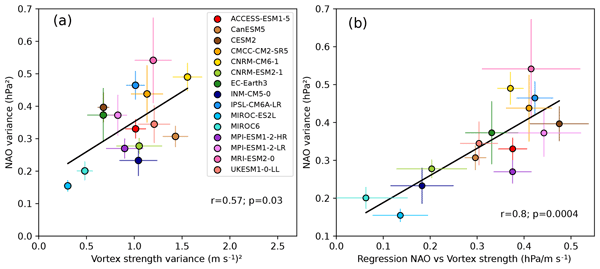
Climate models underestimate multidecadal winter North Atlantic Oscillation (NAO) variability. Understanding the origin of this weak variability is important for making reliable climate projections. We use multi-model climate simulations to explore statistical relationships with drivers that may contribute to NAO variability. We find a relationship between modelled stratosphere–troposphere coupling and multidecadal NAO variability, offering an avenue to improve the simulation of NAO variability.

Robert Vautard, Geert Jan van Oldenborgh, Rémy Bonnet, Sihan Li, Yoann Robin, Sarah Kew, Sjoukje Philip, Jean-Michel Soubeyroux, Brigitte Dubuisson, Nicolas Viovy, Markus Reichstein, Friederike Otto, and Iñaki Garcia de Cortazar-Atauri
Nat. Hazards Earth Syst. Sci., 23, 1045–1058, https://doi.org/10.5194/nhess-23-1045-2023, https://doi.org/10.5194/nhess-23-1045-2023, 2023
Short summary
Short summary
A deep frost occurred in early April 2021, inducing severe damages in grapevine and fruit trees in France. We found that such extreme frosts occurring after the start of the growing season such as those of April 2021 are currently about 2°C colder [0.5 °C to 3.3 °C] in observations than in preindustrial climate. This observed intensification of growing-period frosts is attributable, at least in part, to human-caused climate change, making the 2021 event 50 % more likely [10 %–110 %].
Sjoukje Y. Philip, Sarah F. Kew, Geert Jan van Oldenborgh, Faron S. Anslow, Sonia I. Seneviratne, Robert Vautard, Dim Coumou, Kristie L. Ebi, Julie Arrighi, Roop Singh, Maarten van Aalst, Carolina Pereira Marghidan, Michael Wehner, Wenchang Yang, Sihan Li, Dominik L. Schumacher, Mathias Hauser, Rémy Bonnet, Linh N. Luu, Flavio Lehner, Nathan Gillett, Jordis S. Tradowsky, Gabriel A. Vecchi, Chris Rodell, Roland B. Stull, Rosie Howard, and Friederike E. L. Otto
Earth Syst. Dynam., 13, 1689–1713, https://doi.org/10.5194/esd-13-1689-2022, https://doi.org/10.5194/esd-13-1689-2022, 2022
Short summary
Short summary
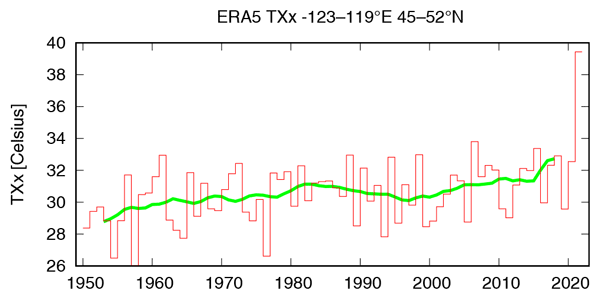
In June 2021, the Pacific Northwest of the US and Canada saw record temperatures far exceeding those previously observed. This attribution study found such a severe heat wave would have been virtually impossible without human-induced climate change. Assuming no nonlinear interactions, such events have become at least 150 times more common, are about 2 °C hotter and will become even more common as warming continues. Therefore, adaptation and mitigation are urgently needed to prepare society.
Claudia Voigt, Christine Vallet-Coulomb, Clément Piel, Joana Sauze, Ilja M. Reiter, Jean-Philippe Orts, Françoise Chalié, Christophe Cassou, Irène Xueref-Remy, and Anne Alexandre
Atmos. Chem. Phys., 26, 9295–9335, https://doi.org/10.5194/acp-26-9295-2026, https://doi.org/10.5194/acp-26-9295-2026, 2026
Short summary
Short summary
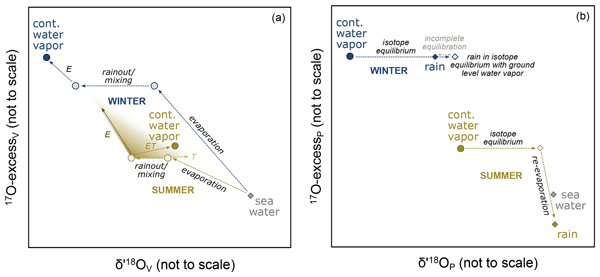
Triple oxygen isotopes (17O-excess) are an upcoming tool in hydrological studies. We present the first one-year high-resolution record of 17O-excess in atmospheric water vapor from a Mediterranean forest site. The dataset provides insights into the processes driving variability of 17O-excess in atmospheric water vapor and precipitation across seasonal, diurnal, and event scales. These findings support model validation efforts and enhance the interpretation of paleoclimate archives.
Piers M. Forster, Tristram Walsh, Chris Smith, William F. Lamb, Robin Lamboll, Christophe Cassou, Mathias Hauser, Zeke Hausfather, June-Yi Lee, Matthew D. Palmer, Karina von Schuckmann, Aimée B. A. Slangen, Sophie Szopa, Blair Trewin, Jeongeun Yun, Nathan P. Gillett, Stuart Jenkins, H. Damon Matthews, Krishnan Raghavan, Aurélien Ribes, Joeri Rogelj, Debbie Rosen, Xuebin Zhang, Myles Allen, Robbie M. Andrew, Chris Atkinson, Richard A. Betts, Antonio Bombelli, Samantha N. Burgess, Lijing Cheng, Helen E. Claxton, Pierre Friedlingstein, Thomas L. Frölicher, Catia M. Domingues, Thomas Gasser, Catherine H. Gregory, Rachel M. Hoesly, Daniel Huppmann, Masayoshi Ishii, Christopher Kadow, Alexia Karwat, John Kennedy, Rachel E. Killick, Mahesh V. M. Kovilakam, Paul B. Krummel, Xin Lan, Jean-François Lamarque, Aurélien Liné, Belén Martín-Míguez, Didier P. Monselesan, Colin Morice, Jens Mühle, Pino Mussak, Glen P. Peters, Anna Pirani, Julia Pongratz, Matthew Rigby, Robert Rohde, Abhishek Savita, Sonia I. Seneviratne, Steven J. Smith, Ghassan Taha, Caterina Tassone, Peter Thorne, Christopher Wells, Luke M. Western, Guido R. van der Werf, Susan E. Wijffels, Marco Zecchetto, Junting Zhong, Xiao-Ye Zhang, Valérie Masson-Delmotte, and Panmao Zhai
Earth Syst. Sci. Data, 18, 3889–3933, https://doi.org/10.5194/essd-18-3889-2026, https://doi.org/10.5194/essd-18-3889-2026, 2026
Short summary
Short summary
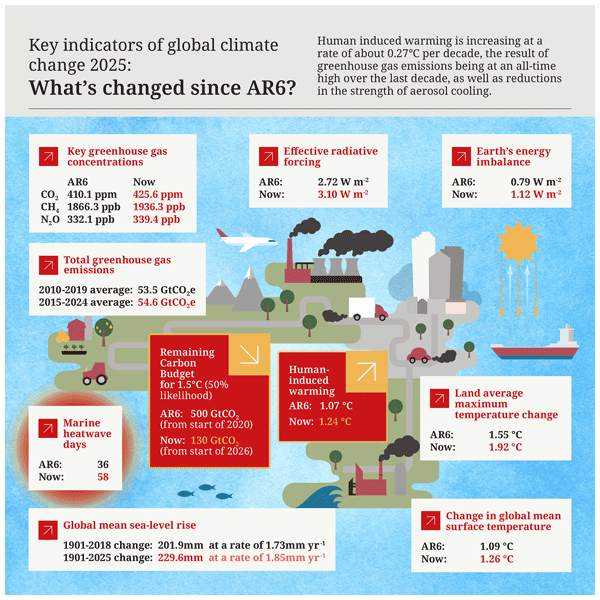
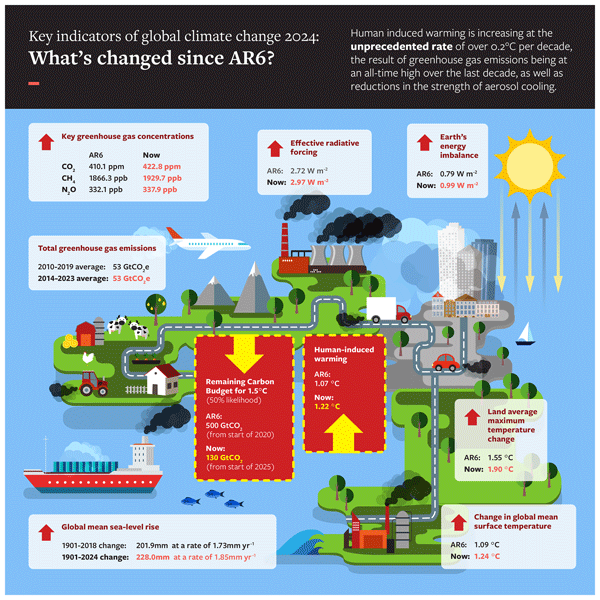
We give our annual update of key climate indicators. Our work quantifies the human contribution to global warming and the pace of climate change. This represents a large effort by the international community akin to an Intergovernmental Panel on Climate Change (IPCC) report.
Peter W. Thorne, John M. Nicklas, John J. Kennedy, Bruce Calvert, Baylor Fox-Kemper, Mark T. Richardson, Adrian Simmons, Ed Hawkins, Robert Rhode, Kathryn Cowtan, Nerilie J. Abram, Axel Andersson, Simon Noone, Phillipe Marbaix, Nathan Lenssen, Dirk Olonscheck, Tristram Walsh, Stephen Outten, Ingo Bethke, Bjorn H. Samset, Chris Smith, Anna Pirani, Jan Fuglestvedt, Lavanya Rajamani, Richard A. Betts, Elizabeth C. Kent, Blair Trewin, Colin Morice, Tim Osborn, Samantha N. Burgess, Oliver Geden, Andrew Parnell, Piers M. Forster, Chris Hewitt, Zeke Hausfather, Valerie Masson-Delmotte, Jochem Marotzke, Nathan Gillett, Sonia I. Seneviratne, Gavin A. Schmidt, Duo Chan, Stefan Brönnimann, Andy Reisinger, Matthew Menne, Maisa Rojas Corradi, Christopher Kadow, Peter Huybers, David B. Stephenson, Emily Wallis, Joeri Rogelj, Andrew Schurer, Karen McKinnon, Panmao Zhai, Fatima Driouech, Wilfran Moufouma Okia, Saeed Vazifehkhah, Sophie Szopa, Christopher J. Merchant, Shoji Hirahara, Masayoshi Ishii, Francois A. Engelbrecht, Qingxiang Li, June-Yi Lee, Alex J. Cannon, Christophe Cassou, Karina von Schuckmann, Amir H. Delju, and Ellie Murtagh
Earth Syst. Sci. Data Discuss., https://doi.org/10.5194/essd-2025-825, https://doi.org/10.5194/essd-2025-825, 2026
Preprint under review for ESSD
Short summary
Short summary
We reassess the basis for determining the present level of long-term global warming. Unbiased estimates of both realised warming and anthropogenic warming are possible that approximate a 20-year retrospective mean. Our resulting estimates of 1.40 [1.23–1.58] °C (realised) and 1.34 [1.18–1.50] °C (anthropogenic) as at end of 2024 highlight the urgency of immediate, far-reaching and sustained climate mitigation actions if we are to meet the long term temperature goal of the Paris Agreement.
Piers M. Forster, Chris Smith, Tristram Walsh, William F. Lamb, Robin Lamboll, Christophe Cassou, Mathias Hauser, Zeke Hausfather, June-Yi Lee, Matthew D. Palmer, Karina von Schuckmann, Aimée B. A. Slangen, Sophie Szopa, Blair Trewin, Jeongeun Yun, Nathan P. Gillett, Stuart Jenkins, H. Damon Matthews, Krishnan Raghavan, Aurélien Ribes, Joeri Rogelj, Debbie Rosen, Xuebin Zhang, Myles Allen, Lara Aleluia Reis, Robbie M. Andrew, Richard A. Betts, Alex Borger, Jiddu A. Broersma, Samantha N. Burgess, Lijing Cheng, Pierre Friedlingstein, Catia M. Domingues, Marco Gambarini, Thomas Gasser, Johannes Gütschow, Masayoshi Ishii, Christopher Kadow, John Kennedy, Rachel E. Killick, Paul B. Krummel, Aurélien Liné, Didier P. Monselesan, Colin Morice, Jens Mühle, Vaishali Naik, Glen P. Peters, Anna Pirani, Julia Pongratz, Jan C. Minx, Matthew Rigby, Robert Rohde, Abhishek Savita, Sonia I. Seneviratne, Peter Thorne, Christopher Wells, Luke M. Western, Guido R. van der Werf, Susan E. Wijffels, Valérie Masson-Delmotte, and Panmao Zhai
Earth Syst. Sci. Data, 17, 2641–2680, https://doi.org/10.5194/essd-17-2641-2025, https://doi.org/10.5194/essd-17-2641-2025, 2025
Short summary
Short summary
In a rapidly changing climate, evidence-based decision-making benefits from up-to-date and timely information. Here we compile monitoring datasets to track real-world changes over time. To make our work relevant to policymakers, we follow methods from the Intergovernmental Panel on Climate Change (IPCC). Human activities are increasing the Earth's energy imbalance and driving faster sea-level rise compared to the IPCC assessment.
Rémy Bonnet, Christine M. McKenna, and Amanda C. Maycock
Weather Clim. Dynam., 5, 913–926, https://doi.org/10.5194/wcd-5-913-2024, https://doi.org/10.5194/wcd-5-913-2024, 2024
Short summary
Short summary
Climate models underestimate multidecadal winter North Atlantic Oscillation (NAO) variability. Understanding the origin of this weak variability is important for making reliable climate projections. We use multi-model climate simulations to explore statistical relationships with drivers that may contribute to NAO variability. We find a relationship between modelled stratosphere–troposphere coupling and multidecadal NAO variability, offering an avenue to improve the simulation of NAO variability.
Robert Vautard, Geert Jan van Oldenborgh, Rémy Bonnet, Sihan Li, Yoann Robin, Sarah Kew, Sjoukje Philip, Jean-Michel Soubeyroux, Brigitte Dubuisson, Nicolas Viovy, Markus Reichstein, Friederike Otto, and Iñaki Garcia de Cortazar-Atauri
Nat. Hazards Earth Syst. Sci., 23, 1045–1058, https://doi.org/10.5194/nhess-23-1045-2023, https://doi.org/10.5194/nhess-23-1045-2023, 2023
Short summary
Short summary
A deep frost occurred in early April 2021, inducing severe damages in grapevine and fruit trees in France. We found that such extreme frosts occurring after the start of the growing season such as those of April 2021 are currently about 2°C colder [0.5 °C to 3.3 °C] in observations than in preindustrial climate. This observed intensification of growing-period frosts is attributable, at least in part, to human-caused climate change, making the 2021 event 50 % more likely [10 %–110 %].
Sjoukje Y. Philip, Sarah F. Kew, Geert Jan van Oldenborgh, Faron S. Anslow, Sonia I. Seneviratne, Robert Vautard, Dim Coumou, Kristie L. Ebi, Julie Arrighi, Roop Singh, Maarten van Aalst, Carolina Pereira Marghidan, Michael Wehner, Wenchang Yang, Sihan Li, Dominik L. Schumacher, Mathias Hauser, Rémy Bonnet, Linh N. Luu, Flavio Lehner, Nathan Gillett, Jordis S. Tradowsky, Gabriel A. Vecchi, Chris Rodell, Roland B. Stull, Rosie Howard, and Friederike E. L. Otto
Earth Syst. Dynam., 13, 1689–1713, https://doi.org/10.5194/esd-13-1689-2022, https://doi.org/10.5194/esd-13-1689-2022, 2022
Short summary
Short summary
In June 2021, the Pacific Northwest of the US and Canada saw record temperatures far exceeding those previously observed. This attribution study found such a severe heat wave would have been virtually impossible without human-induced climate change. Assuming no nonlinear interactions, such events have become at least 150 times more common, are about 2 °C hotter and will become even more common as warming continues. Therefore, adaptation and mitigation are urgently needed to prepare society.
Constantin Ardilouze, Damien Specq, Lauriane Batté, and Christophe Cassou
Weather Clim. Dynam., 2, 1033–1049, https://doi.org/10.5194/wcd-2-1033-2021, https://doi.org/10.5194/wcd-2-1033-2021, 2021
Short summary
Short summary
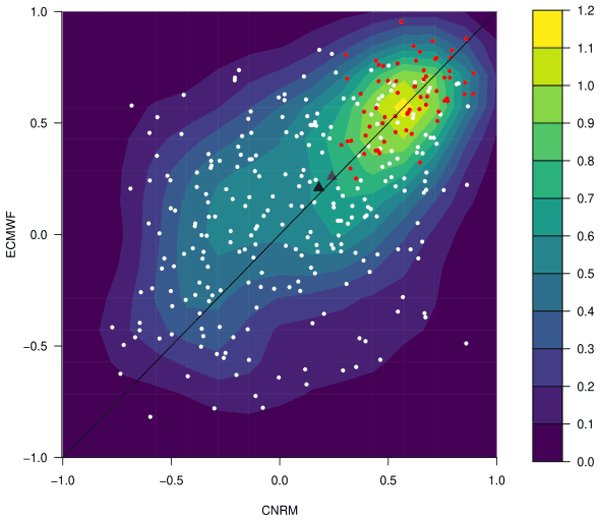
Forecasting temperature patterns beyond 2 weeks is very challenging, although occasionally, forecasts show more skill over Europe. Our study indicates that the level of skill varies concurrently for two distinct forecast systems. It also shows that higher skill occurs when forecasts are issued during specific patterns of atmospheric circulation that tend to be particularly persistent.
These results could help forecasters estimate a priori how trustworthy extended-range forecasts will be.
Cited articles
Acosta Navarro, J. C., Aranyossy, A., De Luca, P., Donat, M. G., Hrast Essenfelder, A., Mahmood, R., Toreti, A., and Volpi, D.: Seamless seasonal to multi-annual predictions of temperature and Standardized Precipitation Index by constraining transient climate model simulations, Earth Syst. Dynam., 16, 1723–1737, https://doi.org/10.5194/esd-16-1723-2025, 2025.
Alfieri, L., Pappenberger, F., Wetterhall, F., Haiden, T., Richardson, D., and Salamon, P.: Evaluation of ensemble streamflow predictions in Europe, J. Hydrol., 517, 913–922, https://doi.org/10.1016/j.jhydrol.2014.06.035, 2014.
Ambaum, M. H., Hoskins, B. J., and Stephenson, D. B.: Arctic oscillation or North Atlantic oscillation?, J. Climate, 14, 3495–3507, https://doi.org/10.1175/1520-0442(2001)014<3495:AOONAO>2.0.CO;2, 2001.
Athanasiadis, P. J., Yeager, S., Kwon, Y. O., Bellucci, A., Smith, D. W., and Tibaldi, S.: Decadal predictability of North Atlantic blocking and the NAO, NPJ Climate and Atmospheric Science, 3, 20, https://doi.org/10.1038/s41612-020-0120-6, 2020.
Baker, L. H., Shaffrey, L. C., Sutton, R. T., Weisheimer, A., and Scaife, A. A.: An intercomparison of skill and overconfidence/underconfidence of the wintertime North Atlantic Oscillation in multimodel seasonal forecasts, Geophys. Res. Lett., 45, 7808–7817, https://doi.org/10.1029/2018GL078838, 2018.
Befort, D. J., O'Reilly, C. H., and Weisheimer, A.: Constraining projections using decadal predictions, Geophys. Res. Lett., 47, e2020GL087900, https://doi.org/10.1029/2020GL087900, 2020.
Befort, D., Brunner, L., Borchert, L., O'Reilly, C., Mignot, J., Ballinger, A., Hegerl, G., Murphy, J., and Weisheimer, A.: Combination of decadal predictions and climate projections in time: Challenges and potential solutions, Geophys. Res. Lett., 49, e2022GL098568, https://doi.org/10.1029/2022GL098568, 2022.
Boer, G. J., Smith, D. M., Cassou, C., Doblas-Reyes, F., Danabasoglu, G., Kirtman, B., Kushnir, Y., Kimoto, M., Meehl, G. A., Msadek, R., Mueller, W. A., Taylor, K. E., Zwiers, F., Rixen, M., Ruprich-Robert, Y., and Eade, R.: The Decadal Climate Prediction Project (DCPP) contribution to CMIP6, Geosci. Model Dev., 9, 3751–3777, https://doi.org/10.5194/gmd-9-3751-2016, 2016.
Bonnet, R., Swingedouw, D., Gastineau, G., Boucher, O., Deshayes, J., Hourdin, F., Mignot, J., Servonnat, J., and Sima, A.: Increased risk of near term global warming due to a recent AMOC weakening, Nat. Commun., 12, 6108, https://doi.org/10.1038/s41467-021-26370-0, 2021.
Bonnet, R., McKenna, C. M., and Maycock, A. C.: Model spread in multidecadal North Atlantic Oscillation variability connected to stratosphere–troposphere coupling, Weather Clim. Dynam., 5, 913–926, https://doi.org/10.5194/wcd-5-913-2024, 2024.
Brune, S., Düsterhus, A., Pohlmann, H., Müller, W. A., and Baehr, J.: Time dependency of the prediction skill for the North Atlantic subpolar gyre in initialized decadal hindcasts, Clim. Dynam., 51, 1947–1970, https://doi.org/10.1007/s00382-017-3991-4, 2018.
Cassou, C., Kushnir, Y., Hawkins, E., Pirani, A., Kucharski, F., Kang, I. S., and Caltabiano, N.: Decadal climate variability and predictability: Challenges and opportunities, B. Am. Meteorol. Soc., 99, 479–490, https://doi.org/10.1175/BAMS-D-16-0286.1, 2018.
Cos, P., Marcos-Matamoros, R., Donat, M., Mahmood, R., and Doblas-Reyes, F. J.: Near-term Mediterranean summer temperature climate projections: a comparison of constraining methods, J. Climate, 37, 4367–4388, https://doi.org/10.1175/JCLI-D-23-0494.1, 2024.
Dommenget, D. and Latif, M.: A cautionary note on the interpretation of EOFs, J. Climate, 15, 216–225, https://doi.org/10.1175/1520-0442(2002)015<0216:ACNOTI>2.0.CO;2, 2002.
Donat, M., Mahmood, R., Cos, J., Ortega, P., and Doblas-Reyes, F. J.: Improving the forecast quality of near-term climate projections by constraining internal variability based on decadal predictions and observations, Environmental Research: Climate, https://doi.org/10.1088/2752-5295/ad5463, 2024.
Enfield, D. B., Mestas-Nuñez, A. M., and Trimble, P. J.: The Atlantic multidecadal oscillation and its relation to rainfall and river flows in the continental US, Geophys. Res. Lett., 28, 2077–2080, https://doi.org/10.1029/2000GL012745, 2001.
Eyring, V., Bony, S., Meehl, G. A., Senior, C. A., Stevens, B., Stouffer, R. J., and Taylor, K. E.: Overview of the Coupled Model Intercomparison Project Phase 6 (CMIP6) experimental design and organization, Geosci. Model Dev., 9, 1937–1958, https://doi.org/10.5194/gmd-9-1937-2016, 2016.
Eyring, V., Gillett, N. P., Achuta Rao, K. M., Barimalala, R., Barreiro Parrillo, M., Bellouin, N., Cassou, C., Durack, P. J., Kosaka, Y., McGregor, S., Min, S., Morgenstern, O., and Sun, Y.: Human Influence on the Climate System, in: Climate Change 2021: The Physical Science Basis. Contribution of Working Group I to the Sixth Assessment Report of the Intergovernmental Panel on Climate Change, edited by: Masson-Delmotte, V., Zhai, P., Pirani, A., Connors, S. L., Péan, C., Berger, S., Caud, N., Chen, Y., Goldfarb, L., Gomis, M. I., Huang, M., Leitzell, K., Lonnoy, E., Matthews, J. B. R., Maycock, T. K., Waterfield, T., Yelekçi, O., Yu, R., and Zhou, B., Cambridge University Press, Cambridge, United Kingdom and New York, NY, USA, 423–552, https://doi.org/10.1017/9781009157896.005, 2021.
García-Serrano, J., Guemas, V., and Doblas-Reyes, F. J.: Added-value from initialization in predictions of Atlantic multi-decadal variability, Clim. Dynam., 44, 2539–2555, https://doi.org/10.1007/s00382-014-2370-7, 2015.
Goddard, L., Kumar, A., Solomon, A., Smith, D., Boer, G., Gonzalez, P., Kharin, V., Merryfield, W., Deser, C., Mason, S. J., Kirtman, B. P., Msadek, R., Sutton, R., Hawkins, E., Fricker, T., Hegerl, G., Ferro, C. A. T., Stephenson, D. B., Meehl, G. A., Stockdale, T., Burgman, R., Greene, A. M., Kushnir, Y., Newman, M., Carton, J., Fukumori, I., and Delworth, T.: A verification framework for interannual-to-decadal predictions experiments, Clim. Dynam., 40, 245–272, https://doi.org/10.1007/s00382-012-1481-2, 2013.
Hermanson, L., Eade, R., Robinson, N. H., Dunstone, N. J., Andrews, M. B., Knight, J. R., Scaife, A. A., and Smith, D. M.: Forecast cooling of the Atlantic subpolar gyre and associated impacts, Geophys. Res. Lett., 41, 5167–5174, https://doi.org/10.1002/2014GL060420, 2014.
Hersbach, H., Bell, B., Berrisford, P., Hirahara, S., Horányi, A., Muñoz-Sabater, J., Nicolas, J., Peubey, C., Radu, R., Schepers, D., Simmons, A., Soci, C., Abdalla, S., Abellan, X., Balsamo, G., Bechtold, P., Biavati, G., Bidlot, J., Bonavita, M., De Chiara, G., Dahlgren, P., Dee, D., Diamantakis, M., Dragani, R., Flemming, J., Forbes, R., Fuentes, M., Geer, A., Haimberger, L., Healy, S., Hogan, R. J., Hólm, E., Janisková, M., Keeley, S., Laloyaux, P., Lopez, P., Lupu, C., Radnoti, G., de Rosnay, P., Rozum, I., Vamborg, F., Villaume, S., and Thépaut, J.-N. : The ERA5 global reanalysis, Q. J. Roy. Meteor. Soc., 146, 1999–2049, https://doi.org/10.1002/qj.3803, 2020.
Hersbach, H., Bell, B., Berrisford, P., Biavati, G., Horányi, A., Muñoz Sabater, J., Nicolas, J., Peubey, C., Radu, R., Rozum, I., Schepers, D., Simmons, A., Soci, C., Dee, D., and Thépaut, J.-N.: ERA5 hourly data on single levels from 1940 to present, Copernicus Climate Change Service (C3S) Climate Data Store (CDS) [data set], https://doi.org/10.24381/cds.adbb2d47, 2023.
Huang, B., Thorne, P. W., Banzon, V. F., Boyer, T., Chepurin, G., Lawrimore, J. H., Menne, M. J., Smith, T. M., Vose, R. S., and Zhang, H.-M.: Extended Reconstructed Sea Surface Temperature, Version 5 (ERSSTv5): Upgrades, Validations, and Intercomparisons, J. Climate, 30, 8179–8205, https://doi.org/10.1175/JCLI-D-16-0836.1, 2017.
Hurrell, J. W., Kushnir, Y., Ottersen, G., and Visbeck, M.: An overview of the North Atlantic oscillation, Geophysical Monograph – American Geophysical Union, 134, 1–36, https://doi.org/10.1029/134GM01, 2003.
Iles, C. and Hegerl, G.: Role of the North Atlantic Oscillation in decadal temperature trends, Environ. Res. Lett., 12, 114010, https://doi.org/10.1088/1748-9326/aa9152, 2017.
Iturbide, M., Gutiérrez, J. M., Alves, L. M., Bedia, J., Cerezo-Mota, R., Cimadevilla, E., Cofiño, A. S., Di Luca, A., Faria, S. H., Gorodetskaya, I. V., Hauser, M., Herrera, S., Hennessy, K., Hewitt, H. T., Jones, R. G., Krakovska, S., Manzanas, R., Martínez-Castro, D., Narisma, G. T., Nurhati, I. S., Pinto, I., Seneviratne, S. I., van den Hurk, B., and Vera, C. S.: An update of IPCC climate reference regions for subcontinental analysis of climate model data: definition and aggregated datasets, Earth Syst. Sci. Data, 12, 2959–2970, https://doi.org/10.5194/essd-12-2959-2020, 2020.
Kushnir, Y., Scaife, A. A., Arritt, R., Balsamo, G., Boer, G., Doblas-Reyes, F., Hawkins, E., Kimoto, M., Kolli, R. K., Kumar, A., Matei, D., Matthes, K., Müller, W. A., O'Kane, T., Perlwitz, J., Power, S., Raphael, M., Shimpo, A., Smith, D., Tuma, M., and Wu, B.: Towards operational predictions of the near-term climate, Nat. Clim. Change, 9, 94–101, https://doi.org/10.1038/s41558-018-0359-7, 2019.
Lehner, F., Deser, C., Maher, N., Marotzke, J., Fischer, E. M., Brunner, L., Knutti, R., and Hawkins, E.: Partitioning climate projection uncertainty with multiple large ensembles and CMIP5/6, Earth Syst. Dynam., 11, 491–508, https://doi.org/10.5194/esd-11-491-2020, 2020.
Liné, A., Cassou, C., Msadek, R., and Parey, S.: Modulation of Northern Europe near-term anthropogenic warming and wettening assessed through internal variability storylines, NPJ Climate and Atmospheric Science, 7, 272, https://doi.org/10.1038/s41612-024-00759-2, 2024.
Mahmood, R., Donat, M. G., Ortega, P., Doblas-Reyes, F. J., and Ruprich-Robert, Y.: Constraining decadal variability yields skillful projections of near-term climate change, Geophys. Res. Lett., 48, e2021GL094915, https://doi.org/10.1029/2021GL094915, 2021.
Mahmood, R., Donat, M. G., Ortega, P., Doblas-Reyes, F. J., Delgado-Torres, C., Samsó, M., and Bretonnière, P.-A.: Constraining low-frequency variability in climate projections to predict climate on decadal to multi-decadal timescales – a poor man's initialized prediction system, Earth Syst. Dynam., 13, 1437–1450, https://doi.org/10.5194/esd-13-1437-2022, 2022.
Mariotti, A. and Dell'Aquila, A.: Decadal climate variability in the Mediterranean region: roles of large-scale forcings and regional processes, Clim. Dynam., 38, 1129–1145, https://doi.org/10.1007/s00382-011-1056-7, 2012.
Matei, D., Pohlmann, H., Jungclaus, J., Müller, W., Haak, H., and Marotzke, J.: Two tales of initializing decadal climate prediction experiments with the ECHAM5/MPI-OM model, J. Climate, 25, 8502–8523, https://doi.org/10.1175/JCLI-D-11-00633.1, 2012.
Meehl, G. A., Richter, J. H., Teng, H., Capotondi, A., Cobb, K., Doblas-Reyes, F., Donat, M. G., England, M. H., Fyfe, J. C., Han, W., Kim, H., Kirtman, B. P., Kushnir, Y., Lovenduski, N. S., Mann, M. E., Merryfield, W. J., Nieves, V., Pegion, K., Rosenbloom, N., Sanchez, S. C., Scaife, A. A., Smith, D., Subramanian, A. C., Sun, L., Thompson, D., Ummenhofer, C. C., and Xie, S.-P.: Initialized Earth System prediction from subseasonal to decadal timescales, Nat. Rev. Earth Environ., 2, 340–357, https://doi.org/10.1038/s43017-021-00155-x, 2021.
Menary, M. B., Mignot, J., and Robson, J.: Skilful decadal predictions of subpolar North Atlantic SSTs using CMIP model-analogues, Environ. Res. Lett., 16, 064090, https://doi.org/10.1088/1748-9326/ac06fb, 2021.
Murphy, A. H.: Skill scores based on the mean square error and their relationships to the correlation coefficient, Mon. Weather Rev., 116, 2417–2424, https://doi.org/10.1175/1520-0493(1988)116<2417:SSBOTM>2.0.CO;2, 1988.
Nissan, H., Goddard, L., de Perez, E. C., Furlow, J., Baethgen, W., Thomson, M. C., and Mason, S. J.:. On the use and misuse of climate change projections in international development, WIRes Clim. Change, 10, e579, https://doi.org/10.1002/wcc.579, 2019.
Qasmi, S., Cassou, C., and Boé, J.: Teleconnection processes linking the intensity of the Atlantic multidecadal variability to the climate impacts over Europe in boreal winter, J. Climate, 33, 2681–2700, https://doi.org/10.1175/JCLI-D-19-0428.1, 2020.
Robson, J., Polo, I., Hodson, D. L., Stevens, D. P., and Shaffrey, L. C.: Decadal prediction of the North Atlantic subpolar gyre in the HiGEM high-resolution climate model, Clim. Dynam., 50, 921–937, https://doi.org/10.1007/s00382-017-3649-2, 2018.
Sanchez-Gomez, E., Cassou, C., Ruprich-Robert, Y., Fernandez, E., and Terray, L.: Drift dynamics in a coupled model initialized for decadal forecasts, Clim. Dynam., 46, 1819–1840, https://doi.org/10.1007/s00382-015-2678-y, 2016.
Schlesinger, M. E. and Ramankutty, N.: An oscillation in the global climate system of period 65–70 years, Nature, 367, 723–726, https://doi.org/10.1038/367723a0, 1994.
Smith, D. M., Eade, R., Scaife, A. A., Caron, L.-P., Danabasoglu, G., DelSole, T. M., Delworth, T., Doblas-Reyes, F. J., Dunstone, N. J., Hermanson, L., Kharin, V., Kimoto, M., Merryfield, W. J., Mochizuki, T., Müller, W. A., Pohlmann, H., Yeager, S., and Yang, X.: Robust skill of decadal climate predictions, Npj Climate and Atmospheric Science, 2, 13, https://doi.org/10.1038/s41612-019-0071-y, 2019.
Solaraju-Murali, B., Caron, L. P., Gonzalez-Reviriego, N., and Doblas-Reyes, F. J.: Multi-year prediction of European summer drought conditions for the agricultural sector, Environ. Res. Lett., 14, 124014, https://doi.org/10.1088/1748-9326/ab5043, 2019.
Stephenson, D. B., Pavan, V., Collins, M. M. J. M., Junge, M. M., Quadrelli, R., and Participating CMIP2 Modelling Groups: North Atlantic Oscillation response to transient greenhouse gas forcing and the impact on European winter climate: a CMIP2 multi-model assessment, Clim. Dynam., 27, 401–420, https://doi.org/10.1007/s00382-006-0140-x, 2006.
Sutton, R. T. and Dong, B.: Atlantic Ocean influence on a shift in European climate in the 1990s, Nat. Geosci., 5, 788–792, https://doi.org/10.1038/ngeo1595, 2012.
Trenberth, K. E. and Shea, D. J.: Atlantic hurricanes and natural variability in 2005, Geophys. Res. Lett., 33, L12704, https://doi.org/10.1029/2006GL026894, 2006.
Wilks, D. S.: Forecast verification, in: International Geophysics, Vol. 100, 301–394, Academic Press, https://doi.org/10.1016/B978-0-12-385022-5.00008-7, 2011.
Yeager, S. G. and Robson, J. I.: Recent progress in understanding and predicting Atlantic decadal climate variability, Current Climate Change Reports, 3, 112–127, https://doi.org/10.1007/s40641-017-0064-z, 2017.
Yeager, S. G., Danabasoglu, G., Rosenbloom, N. A., Strand, W., Bates, S. C., Meehl, G. A., Karspeck, A. R., Lindsay, K., Long, M. C., Teng, H., and Lovenduski, N. S.: Predicting Near-Term Changes in the Earth System: A Large Ensemble of Initialized Decadal Prediction Simulations Using the Community Earth System Model, B. Am. Meteorol. Soc., 99, 1867–1886, https://doi.org/10.1175/BAMS-D-17-0098.1, 2018.
Zhang, R., Delworth, T. L., and Held, I. M.: Can the Atlantic Ocean drive the observed multidecadal variability in Northern Hemisphere mean temperature?, Geophys. Res. Lett., 34, https://doi.org/10.1029/2006GL028683, 2007.
Short summary
Near-term climate change projections are strongly affected by the uncertainty from internal climate variability. Here, we present a novel approach to reduce this uncertainty by combining information from both observations and decadal predictions to constrain climate projections. This new method can outperform decadal predictions and unconstrained ensemble temperature forecasts in some regions. This improved regional climate information could support more near-term targeted adaptation strategies.
Near-term climate change projections are strongly affected by the uncertainty from internal...


Altmetrics
Final-revised paper
Preprint