
Articles | Volume 17, issue 3
https://doi.org/10.5194/esd-17-673-2026
© Author(s) 2026. This work is distributed under
the Creative Commons Attribution 4.0 License.
the Creative Commons Attribution 4.0 License.
Special issue:
https://doi.org/10.5194/esd-17-673-2026
© Author(s) 2026. This work is distributed under
the Creative Commons Attribution 4.0 License.
the Creative Commons Attribution 4.0 License.
Research article
| 
01 Jun 2026
Research article |
| 01 Jun 2026
| 01 Jun 2026
Quantifying resilience in non-autonomous and stochastic Earth system dynamics with application to glacial-interglacial cycles

Potsdam Institute for Climate Impact Research, Member of the Leibniz Association, Telegrafenberg A 31, 14473 Potsdam, Germany
Institute for Physics and Astronomy, University of Potsdam, Karl-Liebknecht-Str. 24/25, 14476 Potsdam-Golm, Germany
Nico Wunderling
Potsdam Institute for Climate Impact Research, Member of the Leibniz Association, Telegrafenberg A 31, 14473 Potsdam, Germany
Center for Critical Computational Studies, Goethe University Frankfurt, Theodor-W.-Adorno-Platz 1, 60323 Frankfurt am Main, Germany
Senckenberg Research Institute and Natural History Museum, Senckenberganlage 25, 60325 Frankfurt am Main, Germany
Jonathan F. Donges
CORRESPONDING AUTHOR
Potsdam Institute for Climate Impact Research, Member of the Leibniz Association, Telegrafenberg A 31, 14473 Potsdam, Germany
Department of Integrative Earth System Science, Max Planck Institute of Geoanthropology, Kahlaische Strasse 10, 07745 Jena, Germany
Stockholm Resilience Centre, Stockholm University, Albanovägen 28, 106 91 Stockholm, Sweden
Related authors
Kobe De Maeyer, Jakob Harteg, Jonathan F. Donges, Ricarda Winkelmann, and Sina Loriani
EGUsphere, https://doi.org/10.5194/egusphere-2026-3389, https://doi.org/10.5194/egusphere-2026-3389, 2026
Short summary
Short summary
Understanding Earth system dynamics requires comparing outputs from many models and variables. Yet identifying where and when datasets agree on significant changes remains a challenge. We developed methods that combine detected signals across models and variables into shared patterns in space and time, providing robust signals from large model ensembles. Applied to Amazon rainforest simulations, we show that conclusions about Earth system change depend critically on how evidence is synthesised.
Jakob Harteg, Lukas Röhrich, Kobe De Maeyer, Julius Garbe, Boris Sakschewski, Ann Kristin Klose, Jonathan F. Donges, Ricarda Winkelmann, and Sina Loriani
EGUsphere, https://doi.org/10.5194/egusphere-2026-356, https://doi.org/10.5194/egusphere-2026-356, 2026
Short summary
Short summary
Climate systems can undergo abrupt, potentially irreversible changes with major impacts on ecosystems and societies, yet consistent tools to detect these transitions across different models are lacking. We present an open-source software package for systematically detecting where and when such changes occur in climate simulations and quantifying variation in transition timing. This enables robust comparison of abrupt changes across models and contributes to assessing climate-tipping risks.
Hannah Prawitz, Luana Schwarz, Wolfram Barfuss, Sibel Eker, Johannes Halbe, and Jonathan Friedemann Donges
EGUsphere, https://doi.org/10.5194/egusphere-2026-3862, https://doi.org/10.5194/egusphere-2026-3862, 2026
This preprint is open for discussion and under review for Earth System Dynamics (ESD).
Short summary
Short summary
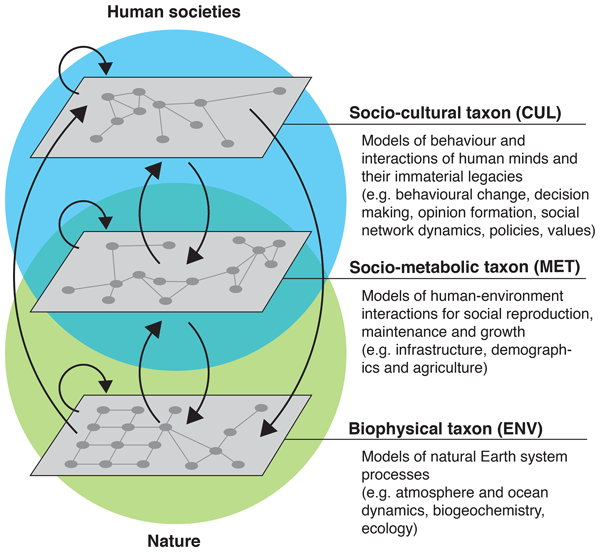
Human societies and the natural environment constantly shape one another, yet researchers usually study and model them separately. We reviewed 314 studies on global, two-way coupled social-environmental models and propose a typology to structure the field. While we find clear differences between the groups, models overall could be improved by better representing social-cultural dynamics, agent heterogeneity, diverse feedback loops, endogenous tipping dynamics, and cross-scale interactions.
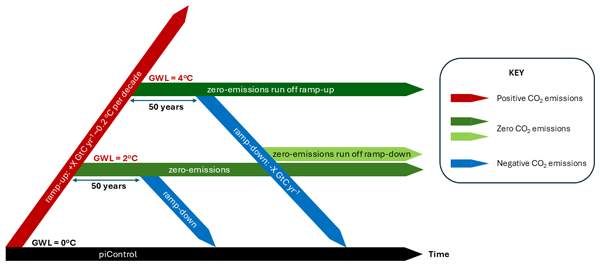
Colin Jones, Isaline Bossert, Donovan P. Dennis, Hazel A. Jeffery, Chris D. Jones, Torben Koenigk, Sina Loriani, Benjamin Sanderson, Roland Séférian, Klaus Wyser, Shuting Yang, Manabu Abe, Sebastian Bathiany, Pascale Braconnot, Victor Brovkin, Friedrich A. Burger, Patrica Cadule, Frederic S. Castruccio, Gokhan Danabasoglu, Andrea Dittus, Jonathan F. Donges, Friederike Fröb, Thomas L. Frölicher, Goran Georgievski, Chuncheng Guo, Aixue Hu, Peter Lawrence, Paul Lerner, José Licón-Saláiz, Bette Otto-Bliesner, Anastasia Romanou, Elena Shevliakova, Yona Silvy, Didier Swingedouw, Jerry Tjiputra, Jeremy Walton, Andy Wiltshire, Ricarda Winkelmann, Richard Wood, Tokuta Yokohata, and Tilo Ziehn
Geosci. Model Dev., 19, 6941–6966, https://doi.org/10.5194/gmd-19-6941-2026, https://doi.org/10.5194/gmd-19-6941-2026, 2026
Short summary
Short summary
We introduce a new Earth system model experiment protocol to help researchers understand how Earth might respond to positive, zero, and negative carbon emissions. This protocol enables different models to be compared following similar warming and cooling rates. Researchers use the models to explore how the Earth reacts to different climate futures, including the risk of tipping points being exceeded and whether changes can be reversed. The results will support improved long-term climate policy.
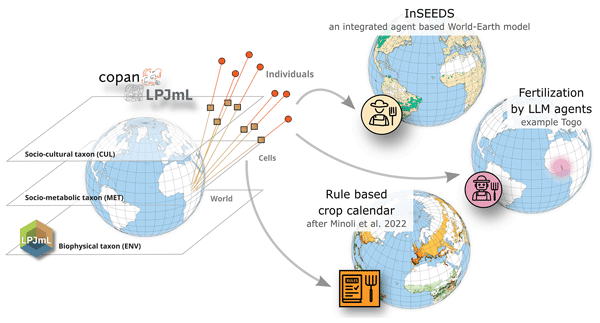
Jannes Breier, Luana Schwarz, Hannah Prawitz, Werner von Bloh, Christoph Müller, Stephen Björn Wirth, Max Bechthold, Dieter Gerten, and Jonathan F. Donges
Geosci. Model Dev., 19, 6829–6855, https://doi.org/10.5194/gmd-19-6829-2026, https://doi.org/10.5194/gmd-19-6829-2026, 2026
Short summary
Short summary
We present a new modelling framework that combines simulations of environmental change and human decision-making in an integrated approach. It allows researchers to explore how farming decisions affect land, water, and climate, and how these environmental changes influence future decisions. By connecting people and nature, it helps investigate food security, climate adaptation, and sustainability challenges, and supports the development of more realistic scenarios of future environmental change.
Kobe De Maeyer, Jakob Harteg, Jonathan F. Donges, Ricarda Winkelmann, and Sina Loriani
EGUsphere, https://doi.org/10.5194/egusphere-2026-3389, https://doi.org/10.5194/egusphere-2026-3389, 2026
Short summary
Short summary
Understanding Earth system dynamics requires comparing outputs from many models and variables. Yet identifying where and when datasets agree on significant changes remains a challenge. We developed methods that combine detected signals across models and variables into shared patterns in space and time, providing robust signals from large model ensembles. Applied to Amazon rainforest simulations, we show that conclusions about Earth system change depend critically on how evidence is synthesised.
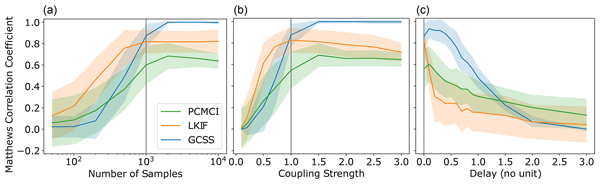
Niki Lohmann, David Strahl, Annika Högner, Willem Huiskamp, Matthias Boehm, and Nico Wunderling
Nonlin. Processes Geophys., 33, 313–334, https://doi.org/10.5194/npg-33-313-2026, https://doi.org/10.5194/npg-33-313-2026, 2026
Short summary
Short summary
Causal inference methods could be used to study the interaction of climate tipping elements, which may degrade abruptly due to climate change. We compare three of these methods to determine their reliability and apply two of them to the Arctic summer sea ice and the Atlantic Meridional Overturning Circulation (AMOC). Our results imply that a weaker AMOC would stabilize Arctic summer sea ice, and that a loss of Arctic summer sea ice would likely stabilize the AMOC in the short term.
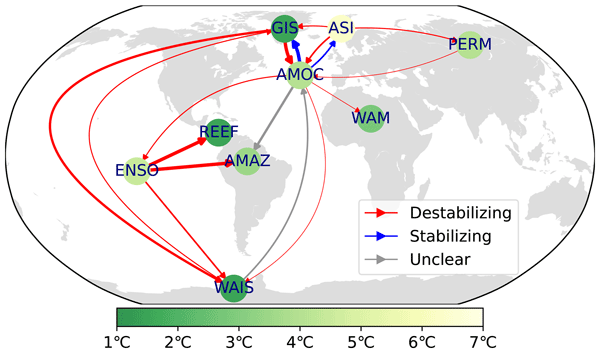
Jacques Bara, Nico Wunderling, and Wolfram Barfuss
Earth Syst. Dynam., 17, 333–352, https://doi.org/10.5194/esd-17-333-2026, https://doi.org/10.5194/esd-17-333-2026, 2026
Short summary
Short summary
When one tipping element collapses the likelihood of another collapsing may be significantly affected. Using our simplified network model, we find that on the whole these interactions destabilise the Earth system, both in the short term and at equilibrium, though the effects are most noticeable after the year 2100. We find that to minimise tipping risks, it is essential to keep temperatures as close as possible to 1.5 °C in the short term and below 1 °C in the longer run.
Didier Swingedouw, Laura Jackson, Aixue Hu, Anastasia Romanou, Nicole C. Laureanti, Wilbert Weijer, Sina Loriani, Bette Otto-Bliesner, Ayako Abe-Ouchi, Lucas Almeida, Alessio Bellucci, Reyk Börner, Gokhan Danabasoglu, Donovan P. Dennis, Marion Devilliers, Sybren Drijfhout, Jonathan Donges, Friederike Fröb, Thomas L. Frölicher, Guillaume Gastineau, Heiko Goelzer, Chuncheng Guo, Urs Hofmann, Anna Höse, Colin Jones, Torben Koenigk, Ann Kristin Klose, Valerio Lembo, Jose Licon-Salaiz, Ken Mankoff, Virna Meccia, Irina Melnikova, Oliver Mehling, Laurie Menviel, Juliette Mignot, Jon I. Robson, Gavin A. Schmidt, Robin Smith, Yuchen Sun, Irene Trombini, Matteo Willeit, Richard Wood, Fanghua Wu, Lin Zhaohui, and Ricarda Winkelmann
EGUsphere, https://doi.org/10.5194/egusphere-2026-1698, https://doi.org/10.5194/egusphere-2026-1698, 2026
Short summary
Short summary
This study presents a plan for climate model experiments to better understand how changes in freshwater in the North Atlantic affect major ocean currents. We designed coordinated simulations to test their response to warming, added freshwater, and possible recovery after weakening. Comparing results across models and past climate evidence helps improve confidence in projections and assess risks of large ocean circulation changes.
Bastian Ott, Jonathan F. Donges, and Johan Rockström
EGUsphere, https://doi.org/10.5194/egusphere-2026-79, https://doi.org/10.5194/egusphere-2026-79, 2026
Short summary
Short summary
Climate adaptation is crucial but its impacts on the Earth system are not well understood. Our study finds climate adaptation contributes ~26 % of annual greenhouse gas emissions, ~74 % of human freshwater withdrawals, and even affects the ozone layer. While some of these impacts are driven by climate change, the majority is likely fuelled by economic, demographic, and technological developments. These findings highlight the need to balance adaptation with respect for Earth system resilience.
Nils Bochow, Jonathan Krönke, Julius Garbe, and Nico Wunderling
EGUsphere, https://doi.org/10.5194/egusphere-2026-614, https://doi.org/10.5194/egusphere-2026-614, 2026
Short summary
Short summary
We provide a simple, updateable tool that turns comprehensive simulations into fast dynamical models for the three major tipping elements; the Greenland Ice Sheet, the West Antarctic Ice Sheet, and the Atlantic Meridional Overturning circulation. By fitting our framework to existing comprehensive simulations, it matches both short-term change and long-term stable states. This helps produce more consistent, policy-ready risk estimates as new simulations arrive.
John M. Anderies, Max Bechthold, Jonathan F. Donges, Ingo Fetzer, Nico Wunderling, Wolfram Barfuss, and Johan Rockström
EGUsphere, https://doi.org/10.5194/egusphere-2025-6345, https://doi.org/10.5194/egusphere-2025-6345, 2026
Short summary
Short summary
This paper explores a new approach to understanding human-Earth system resilience. It introduces a measure that estimates how likely a system is to reach a safe and just state. Available knowledge about how the system works, its boundaries, and potential disruptions centrally constrain the measure. It could help decision-makers strike a balance between gaining knowledge, building capacity to act, and taking practical measures to improve resilience in many different types of systems.

Florian Ulrich Jehn, James Mulhall, Simon Blouin, Łukasz G. Gajewski, and Nico Wunderling
Earth Syst. Dynam., 17, 151–166, https://doi.org/10.5194/esd-17-151-2026, https://doi.org/10.5194/esd-17-151-2026, 2026
Short summary
Short summary
Large crop failures happen regularly around the world, threatening food security. We analyzed sixty years of global crop production data and found that every country has experienced major crop losses. Climate events like droughts cause most severe disruptions, with some African nations losing up to eighty percent of production. While global crop shocks above five percent are rare, regional disruptions occur frequently. These findings show our food system faces regular large-scale threats.
Jakob Harteg, Lukas Röhrich, Kobe De Maeyer, Julius Garbe, Boris Sakschewski, Ann Kristin Klose, Jonathan F. Donges, Ricarda Winkelmann, and Sina Loriani
EGUsphere, https://doi.org/10.5194/egusphere-2026-356, https://doi.org/10.5194/egusphere-2026-356, 2026
Short summary
Short summary
Climate systems can undergo abrupt, potentially irreversible changes with major impacts on ecosystems and societies, yet consistent tools to detect these transitions across different models are lacking. We present an open-source software package for systematically detecting where and when such changes occur in climate simulations and quantifying variation in transition timing. This enables robust comparison of abrupt changes across models and contributes to assessing climate-tipping risks.
E. Keith Smith, Carl Folke, Niklas Kitzmann, Manjana Milkoreit, Per Olsson, Ricarda Winkelmann, Anne-Sophie Crépin, Christina Eder, Niklas Harring, Jobst Heitzig, Alexia Katsanidou, Timothy M. Lenton, Franz Mauelshagen, Kelton Minor, Ilona M. Otto, Armon Rezai, Jürgen Scheffran, Isabelle Stadelmann-Steffen, Rick van der Ploeg, Nico Wunderling, and Jonathan F. Donges
EGUsphere, https://doi.org/10.5194/egusphere-2026-177, https://doi.org/10.5194/egusphere-2026-177, 2026
This preprint is open for discussion and under review for Geoscientific Model Development (GMD).
Short summary
Short summary
Achieving climate and sustainability goals requires rapid, large-scale change. We introduce criticality – the likelihood a system is near a social tipping point – and critical agency – the capacity to shape those conditions. Our framework shows how coalitions and policies can trigger desired shifts and avoid harmful ones, linking complex systems theory with evidence to guide policymakers and practitioners.
Sina Loriani, Yevgeny Aksenov, David I. Armstrong McKay, Govindasamy Bala, Andreas Born, Cristiano Mazur Chiessi, Henk A. Dijkstra, Jonathan F. Donges, Sybren Drijfhout, Matthew H. England, Alexey V. Fedorov, Laura C. Jackson, Kai Kornhuber, Gabriele Messori, Francesco S. R. Pausata, Stefanie Rynders, Jean-Baptiste Sallée, Bablu Sinha, Steven C. Sherwood, Didier Swingedouw, and Thejna Tharammal
Earth Syst. Dynam., 16, 1611–1653, https://doi.org/10.5194/esd-16-1611-2025, https://doi.org/10.5194/esd-16-1611-2025, 2025
Short summary
Short summary
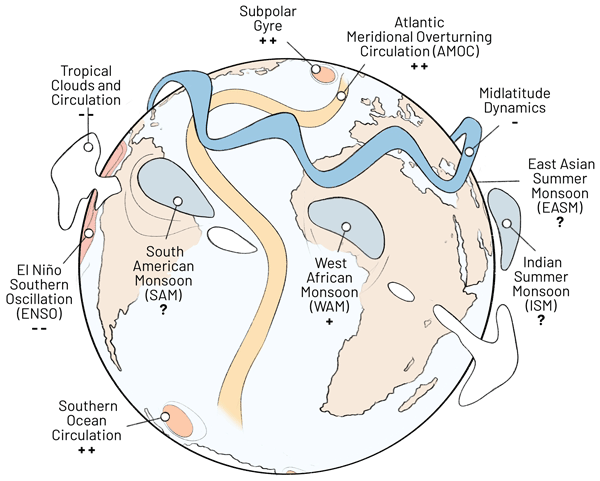
In this work, we draw on palaeo-records, observations, and modelling studies to review tipping points in the ocean overturning circulations, monsoon systems, and global atmospheric circulations. We find indications for tipping in the ocean overturning circulations and the West African monsoon, with potentially severe impacts on the Earth system and humans. Tipping in the other considered systems is regarded as conceivable but is currently not sufficiently supported by evidence.
Luana Schwarz, Jannes Breier, Hannah Prawitz, Max Bechthold, Werner von Bloh, Sara M. Constantino, Dieter Gerten, Jobst Heitzig, Ronja Hotz, Leander John, Christoph Müller, Johan Rockström, and Jonathan F. Donges
EGUsphere, https://doi.org/10.5194/egusphere-2025-4079, https://doi.org/10.5194/egusphere-2025-4079, 2025
Short summary
Short summary
We present a novel global model that links farmer decisions with ecological processes to explore how agricultural systems co-evolve. Unlike previous tools, it captures feedbacks between society and nature at up-to planetary scale. We find that conservation practices can restore soil health and support stable harvests. Adoption spreads through learning and norms, showing how regeneration at the farm scale can ripple outward, contributing to global sustainability and Earth system resilience.
Florian Ulrich Jehn, Łukasz G. Gajewski, Johanna Hedlund, Constantin W. Arnscheidt, Lili Xia, Nico Wunderling, and David Denkenberger
Earth Syst. Dynam., 16, 1585–1603, https://doi.org/10.5194/esd-16-1585-2025, https://doi.org/10.5194/esd-16-1585-2025, 2025
Short summary
Short summary
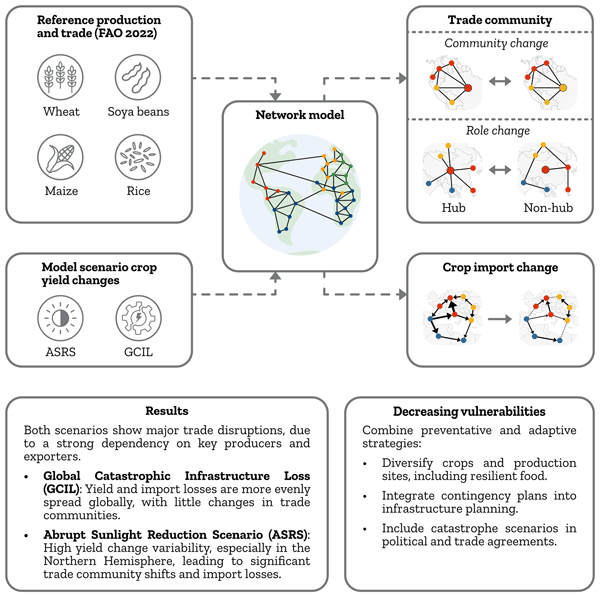
The global food trade system can handle small disturbances, but large disasters could cause major disruptions. We looked at how nuclear war or severe infrastructure loss would affect global trade in key crops. Both would be catastrophic, but a nuclear war would cause more severe disruptions, with many countries losing most of their food imports. Both scenarios highlight the need for better preparation to protect global food security.
Max Bechthold, Wolfram Barfuss, André Butz, Jannes Breier, Sara M. Constantino, Jobst Heitzig, Luana Schwarz, Sanam N. Vardag, and Jonathan F. Donges
Earth Syst. Dynam., 16, 1365–1390, https://doi.org/10.5194/esd-16-1365-2025, https://doi.org/10.5194/esd-16-1365-2025, 2025
Short summary
Short summary
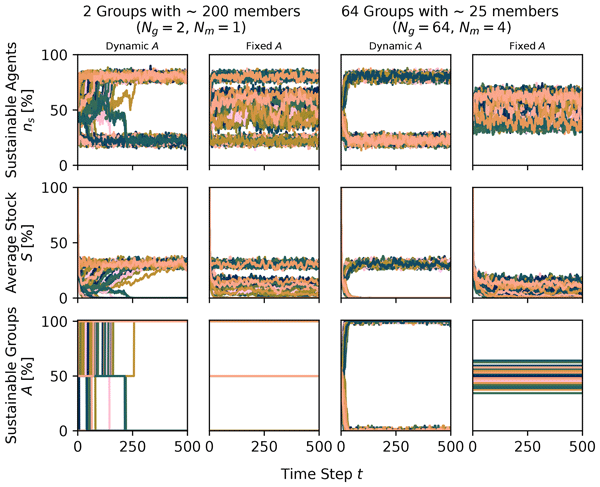
Social norms are a major influence on human behaviour. In natural resource use models, norms are often included in a simplistic way leading to “black or white” sustainability outcomes. We find that a dynamic representation of norms, including social groups, determines more nuanced states of the environment in a stylised model of resource use while also defining the success of attempts to manage the system, suggesting the importance of representing both aspects well in coupled models.
Ricarda Winkelmann, Donovan P. Dennis, Jonathan F. Donges, Sina Loriani, Ann Kristin Klose, Jesse F. Abrams, Jorge Alvarez-Solas, Torsten Albrecht, David Armstrong McKay, Sebastian Bathiany, Javier Blasco Navarro, Victor Brovkin, Eleanor Burke, Gokhan Danabasoglu, Reik V. Donner, Markus Drüke, Goran Georgievski, Heiko Goelzer, Anna B. Harper, Gabriele Hegerl, Marina Hirota, Aixue Hu, Laura C. Jackson, Colin Jones, Hyungjun Kim, Torben Koenigk, Peter Lawrence, Timothy M. Lenton, Hannah Liddy, José Licón-Saláiz, Maxence Menthon, Marisa Montoya, Jan Nitzbon, Sophie Nowicki, Bette Otto-Bliesner, Francesco Pausata, Stefan Rahmstorf, Karoline Ramin, Alexander Robinson, Johan Rockström, Anastasia Romanou, Boris Sakschewski, Christina Schädel, Steven Sherwood, Robin S. Smith, Norman J. Steinert, Didier Swingedouw, Matteo Willeit, Wilbert Weijer, Richard Wood, Klaus Wyser, and Shuting Yang
EGUsphere, https://doi.org/10.5194/egusphere-2025-1899, https://doi.org/10.5194/egusphere-2025-1899, 2025
Short summary
Short summary
The Tipping Points Modelling Intercomparison Project (TIPMIP) is an international collaborative effort to systematically assess tipping point risks in the Earth system using state-of-the-art coupled and stand-alone domain models. TIPMIP will provide a first global atlas of potential tipping dynamics, respective critical thresholds and key uncertainties, generating an important building block towards a comprehensive scientific basis for policy- and decision-making.
E. Keith Smith, Marc Wiedermann, Jonathan F. Donges, Jobst Heitzig, and Ricarda Winkelmann
Earth Syst. Dynam., 16, 545–564, https://doi.org/10.5194/esd-16-545-2025, https://doi.org/10.5194/esd-16-545-2025, 2025
Short summary
Short summary
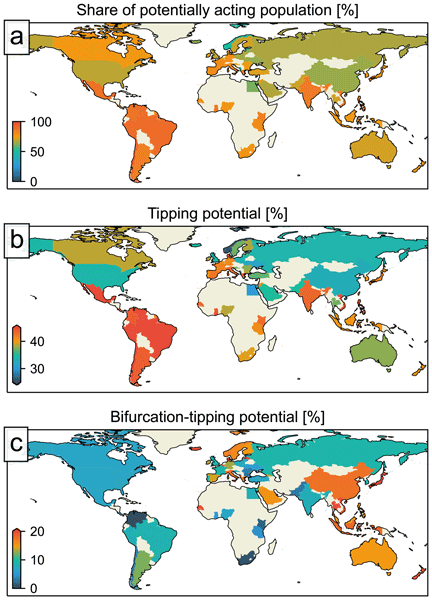
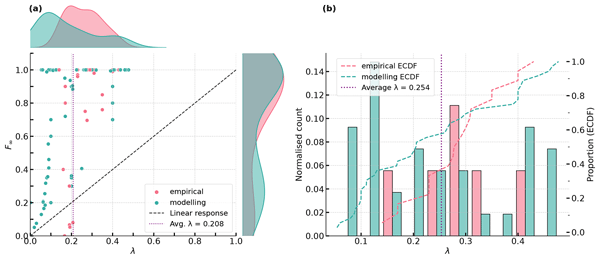
Social tipping dynamics have received recent attention as a potential mechanism for effective climate actions – yet how such tipping dynamics could unfold remains largely unquantified. We explore how social tipping processes can develop by enabling necessary conditions (exemplified by climate change concern) and increased perceptions of localized impacts (sea level rise). The likelihood of social tipping varies regionally, mostly along areas with the highest exposure to persistent risks.
Jordan P. Everall, Fabian Tschofenig, Jonathan F. Donges, and Ilona M. Otto
Earth Syst. Dynam., 16, 189–214, https://doi.org/10.5194/esd-16-189-2025, https://doi.org/10.5194/esd-16-189-2025, 2025
Short summary
Short summary
A social tipping process is a large change in a social group that can be started by few people. Does the 80/20 rule apply here? We see if this is the case for human social groups. We find that, if the social conditions allow, change occurs when around 25 % of people engage. While tipping can happen between 10 % and 43 %, most cases tip by 40 %. However, tipping is not guaranteed: when people are resistant, trusted friend groups and context-appropriate messaging help the process along.
Viktoria Spaiser, Sirkku Juhola, Sara M. Constantino, Weisi Guo, Tabitha Watson, Jana Sillmann, Alessandro Craparo, Ashleigh Basel, John T. Bruun, Krishna Krishnamurthy, Jürgen Scheffran, Patricia Pinho, Uche T. Okpara, Jonathan F. Donges, Avit Bhowmik, Taha Yasseri, Ricardo Safra de Campos, Graeme S. Cumming, Hugues Chenet, Florian Krampe, Jesse F. Abrams, James G. Dyke, Stefanie Rynders, Yevgeny Aksenov, and Bryan M. Spears
Earth Syst. Dynam., 15, 1179–1206, https://doi.org/10.5194/esd-15-1179-2024, https://doi.org/10.5194/esd-15-1179-2024, 2024
Short summary
Short summary
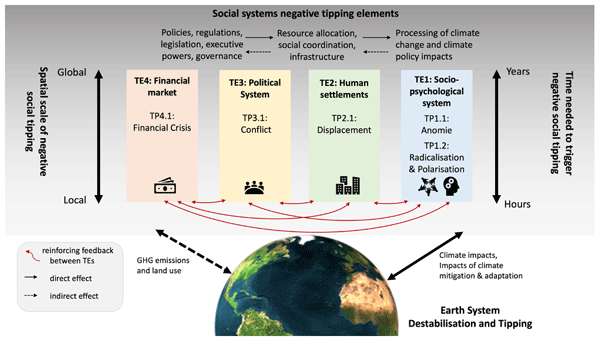
In this paper, we identify potential negative social tipping points linked to Earth system destabilization and draw on related research to understand the drivers and likelihood of these negative social tipping dynamics, their potential effects on human societies and the Earth system, and the potential for cascading interactions and contribution to systemic risks.
Ann Kristin Klose, Jonathan F. Donges, Ulrike Feudel, and Ricarda Winkelmann
Earth Syst. Dynam., 15, 635–652, https://doi.org/10.5194/esd-15-635-2024, https://doi.org/10.5194/esd-15-635-2024, 2024
Short summary
Short summary
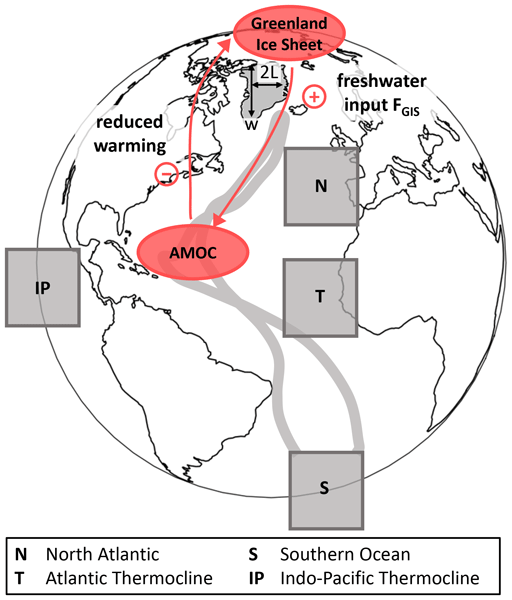
We qualitatively study the long-term stability of the Greenland Ice Sheet and AMOC as tipping elements in the Earth system, which is largely unknown given their interaction in a positive–negative feedback loop. Depending on the timescales of ice loss and the position of the AMOC’s state relative to its critical threshold, we find distinct dynamic regimes of cascading tipping. These suggest that respecting safe rates of environmental change is necessary to mitigate potential domino effects.
Nico Wunderling, Anna S. von der Heydt, Yevgeny Aksenov, Stephen Barker, Robbin Bastiaansen, Victor Brovkin, Maura Brunetti, Victor Couplet, Thomas Kleinen, Caroline H. Lear, Johannes Lohmann, Rosa Maria Roman-Cuesta, Sacha Sinet, Didier Swingedouw, Ricarda Winkelmann, Pallavi Anand, Jonathan Barichivich, Sebastian Bathiany, Mara Baudena, John T. Bruun, Cristiano M. Chiessi, Helen K. Coxall, David Docquier, Jonathan F. Donges, Swinda K. J. Falkena, Ann Kristin Klose, David Obura, Juan Rocha, Stefanie Rynders, Norman Julius Steinert, and Matteo Willeit
Earth Syst. Dynam., 15, 41–74, https://doi.org/10.5194/esd-15-41-2024, https://doi.org/10.5194/esd-15-41-2024, 2024
Short summary
Short summary
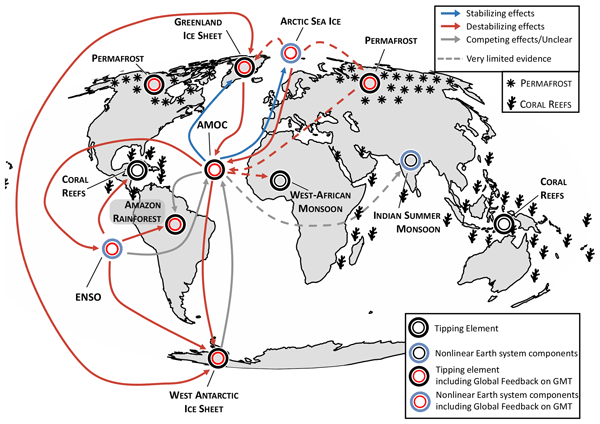
This paper maps out the state-of-the-art literature on interactions between tipping elements relevant for current global warming pathways. We find indications that many of the interactions between tipping elements are destabilizing. This means that tipping cascades cannot be ruled out on centennial to millennial timescales at global warming levels between 1.5 and 2.0 °C or on shorter timescales if global warming surpasses 2.0 °C.
Maria Zeitz, Jan M. Haacker, Jonathan F. Donges, Torsten Albrecht, and Ricarda Winkelmann
Earth Syst. Dynam., 13, 1077–1096, https://doi.org/10.5194/esd-13-1077-2022, https://doi.org/10.5194/esd-13-1077-2022, 2022
Short summary
Short summary
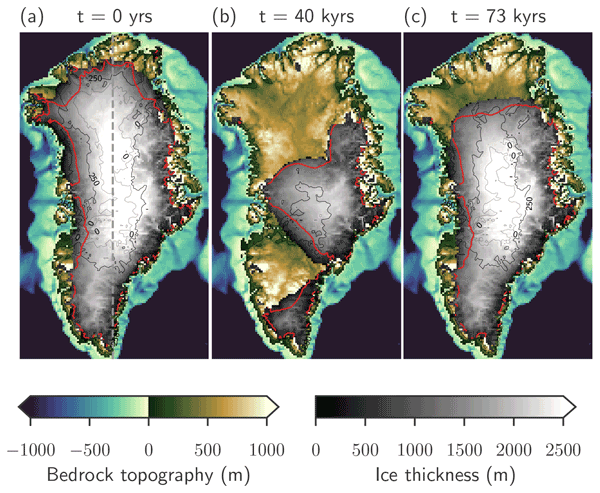
The stability of the Greenland Ice Sheet under global warming is crucial. Here, using PISM, we study how the interplay of feedbacks between the ice sheet, the atmosphere and solid Earth affects the long-term response of the Greenland Ice Sheet under constant warming. Our findings suggest four distinct dynamic regimes of the Greenland Ice Sheet on the route to destabilization under global warming – from recovery via quasi-periodic oscillations in ice volume to ice sheet collapse.
Jonathan F. Donges, Wolfgang Lucht, Sarah E. Cornell, Jobst Heitzig, Wolfram Barfuss, Steven J. Lade, and Maja Schlüter
Earth Syst. Dynam., 12, 1115–1137, https://doi.org/10.5194/esd-12-1115-2021, https://doi.org/10.5194/esd-12-1115-2021, 2021
Cited articles
Abe-Ouchi, A., Saito, F., Kawamura, K., Raymo, M. E., Okuno, J., Takahashi, K., and Blatter, H.: Insolation-driven 100,000-year glacial cycles and hysteresis of ice-sheet volume, Nature, 500, 190–193, https://doi.org/10.1038/nature12374, 2013. a
Anderies, J. M., Folke, C., Walker, B., and Ostrom, E.: Aligning key concepts for global change policy: robustness, resilience, and sustainability, Ecol. Soc., 18, https://doi.org/10.5751/es-05178-180208, 2013. a
Anderies, J. M., Barfuss, W., Donges, J. F., Fetzer, I., Heitzig, J., and Rockström, J.: A modeling framework for World-Earth system resilience: exploring social inequality and Earth system tipping points, Environ. Res. Lett., 18, 095001, https://doi.org/10.1088/1748-9326/ace91d, 2023. a, b, c
Berger, A., Crucifix, M., Hodell, D., Mangili, C., McManus, J., Otto-Bliesner, B., Pol, K., Raynaud, D., Skinner, L., Tzedakis, P., Wolff, E., Yin, Q., Abe-Ouchi, A., Barbante, C., Brovkin, V., Cacho, I., Capron, E., Ferretti, P., Ganopolski, A., Grimalt, J., Grimm, R., Hansson, M., Huybrechts, P., Landais, A., Loutre, M. F., Masson-Delmotte, V., Nisancioglu, K., Otto, S., Parekh, A., Petit, J. R., Rasmussen, S. O., Raymo, M. E., Ruddiman, W., Sime, L., Stocker, T. F., Vimeux, F., and Wilhelms, F.: Interglacials of the last 800,000 years, Rev. Geophys., 54, 162–219, https://doi.org/10.1002/2015RG000482, hal-03245836, 2016. a, b
Brienen, R. J. W., Phillips, O. L., Feldpausch, T. R., Gloor, E., Baker, T. R., Lloyd, J., Lopez-Gonzalez, G., Monteagudo-Mendoza, A., Malhi, Y., Lewis, S. L., Vásquez Martinez, R., Alexiades, M., Álvarez Dávila, E., Alvarez-Loayza, P., Andrade, A., Aragão, L. E. O. C., Araujo-Murakami, A., Arets, E. J. M. M., Arroyo, L., Aymard C., G. A., Bánki, O. S., Baraloto, C., Barroso, J., Bonal, D., Boot, R. G. A., Camargo, J. L. C., Castilho, C. V., Chama, V., Chao, K. J., Chave, J., Comiskey, J. A., Cornejo Valverde, F., da Costa, L., de Oliveira, E. A., Di Fiore, A., Erwin, T. L., Fauset, S., Forsthofer, M., Galbraith, D. R., Grahame, E. S., Groot, N., Hërault, B., Higuchi, N., Honorio Coronado, E. N., Keeling, H., Killeen, T. J., Laurance, W. F., Laurance, S., Licona, J., Magnussen, W. E., Marimon, B. S., Marimon-Junior, B. H., Mendoza, C., Neill, D. A., Nogueira, E. M., Núñez, P., Pallqui Camacho, N. C., Parada, A., Pardo-Molina, G., Peacock, J., Peña-Claros, M., Pickavance, G. C., Pitman, N. C. A., Poorter, L., Prieto, A., Quesada, C. A., Ramírez, F., Ramírez-Angulo, H., Restrepo, Z., Roopsind, A., Rudas, A., Salomão, R. P., Schwarz, M., Silva, N., Silva-Espejo, J. E., Silveira, M., Stropp, J., Talbot, J., ter Steege, H., Teran-Aguilar, J., Terborgh, J., Thomas-Caesar, R., Toledo, M., Torello-Raventos, M., Umetsu, R. K., van der Heijden, G. M. F., van der Hout, P., Guimarães Vieira, I. C., Vieira, S. A., Vilanova, E., Vos, V. A., and Zagt, R. J.: Long-term decline of the Amazon carbon sink, Nature, 519, 344–348, https://doi.org/10.1038/nature14283, 2015. a
Caesar, L., Sakschewski, B., Andersen, L. S., Beringer, T., Braun, J., Dennis, D., Gerten, D., Heilemann, A., Kaiser, J., Kitzmann, N. H., Loriani, S., Lucht, W., Ludescher, J., Martin, M., Mathesius, S., Paolucci, A., te Wierik, S., and Rockström, J.: Planetary Health Check Report 2024, Tech. rep., Potsdam Institute for Climate Impact Research, Potsdam, Germany, https://publications.pik-potsdam.de/pubman/item/item_30275 (last access: 26 May 2026), 2024. a
Dakos, V., Scheffer, M., van Nes, E. H., Brovkin, V., Petoukhov, V., and Held, H.: Slowing down as an early warning signal for abrupt climate change, P. Natl. Acad. Sci. USA, 105, 14308–14312, https://doi.org/10.1073/pnas.0802430105, 2008. a, b
Dansgaard, W., White, J. W. C., and Johnsen, S. J.: The abrupt termination of the Younger Dryas climate event, Nature, 339, 532–534, https://doi.org/10.1038/339532a0, 1989. a
De Saedeleer, B., Crucifix, M., and Wieczorek, S.: Is the astronomical forcing a reliable and unique pacemaker for climate? A conceptual model study, Clim. Dynam., 40, 273–294, https://doi.org/10.1007/s00382-012-1316-1, 2013. a, b
Folke, C., Carpenter, S. R., Walker, B., Scheffer, M., Chapin, T., and Rockström, J.: Resilience thinking: integrating resilience, adaptability and transformability, Ecol. Soc., 15, https://doi.org/10.5751/es-03610-150420, 2010. a
Froyland, G., Lloyd, S., and Santitissadeekorn, N.: Coherent sets for nonautonomous dynamical systems, Phys. D, 239, 1527–1541, https://doi.org/10.1016/j.physd.2010.03.009, 2010. a
Ganopolski, A.: Toward generalized Milankovitch theory (GMT), Climate of the Past, 20, 151–185, https://doi.org/10.5194/cp-20-151-2024, 2024. a, b
Ganopolski, A., Winkelmann, R., and Schellnhuber, H. J.: Critical insolation – CO2 relation for diagnosing past and future glacial inception, Nature, 529, 200–203, https://doi.org/10.1038/nature18452, 2016. a
Gatti, L. V., Basso, L. S., Miller, J. B., Gloor, M., Gatti Domingues, L., Cassol, H. L. G., Tejada, G., Aragão, L. E. O. C., Nobre, C., Peters, W., Marani, L., Arai, E., Sanches, A. H., Corrêa, S. M., Anderson, L., Von Randow, C., Correia, C. S. C., Crispim, S. P., and Neves, R. A. L.: Amazonia as a carbon source linked to deforestation and climate change, Nature, 595, 388–393, https://doi.org/10.1038/s41586-021-03629-6, 2021. a
Ghil, M. and Lucarini, V.: The physics of climate variability and climate change, Rev. Mod. Phys., 92, 035002, https://doi.org/10.1103/revmodphys.92.035002, 2020. a
Goosse, H., Brovkin, V., Fichefet, T., Haarsma, R., Huybrechts, P., Jongma, J., Mouchet, A., Selten, F., Barriat, P.-Y., Campin, J.-M., Deleersnijder, E., Driesschaert, E., Goelzer, H., Janssens, I., Loutre, M.-F., Morales Maqueda, M. A., Opsteegh, T., Mathieu, P.-P., Munhoven, G., Pettersson, E. J., Renssen, H., Roche, D. M., Schaeffer, M., Tartinville, B., Timmermann, A., and Weber, S. L.: Description of the Earth system model of intermediate complexity LOVECLIM version 1.2, Geosci. Model Dev., 3, 603–633, https://doi.org/10.5194/gmd-3-603-2010, 2010. a
Harteg, J.: Glacial Cycle Resilience, Zenodo [code], https://doi.org/10.5281/zenodo.16603222, 2026. a, b
Hasselmann, K.: Stochastic climate models part I. Theory, Tellus, 28, 473–485, https://doi.org/10.1111/j.2153-3490.1976.tb00696.x, 1976. a, b, c
Hastings, W. K.: Monte Carlo sampling methods using Markov chains and their applications, Biometrika, 57, 97–109, https://doi.org/10.2307/2334940, 1970. a
Heinrich, H.: Origin and consequences of cyclic ice rafting in the northeast Atlantic Ocean during the past 130,000 years, Quaternary Res., 29, 142–152, https://doi.org/10.1016/0033-5894(88)90057-9, 1988. a
Holling, C. S.: Resilience and stability of ecological systems, Annu. Rev. Ecol. Syst., 4, 1–23, https://doi.org/10.1146/annurev.es.04.110173.000245, 1973. a, b
Holling, C. S.: Engineering resilience versus ecological resilience, Engineering within Ecological Constraints, 31, 32, https://doi.org/10.2307/jj.41003648.7, 1996. a
Imbrie, J., Berger, A., Boyle, E. A., Clemens, S. C., Duffy, A., Howard, W. R., Kukla, G., Kutzbach, J., Martinson, D. G., McIntyre, A., Mix, A. C., Molfino, B., Morley, J. J., Peterson, L. C., Pisias, N. G., Prell, W. L., Raymo, M. E., Shackleton, N. J., and Toggweiler, J. R.: On the structure and origin of major glaciation cycles 2. The 100,000-year cycle, Paleoceanography, 8, 699–735, https://doi.org/10.1029/93pa02751, 1993. a
Jackson, C. S. and Broccoli, A. J.: Orbital forcing of Arctic climate: mechanisms of climate response and implications for continental glaciation, Clim. Dynam., 21, 539–557, https://doi.org/10.1007/s00382-003-0351-3, 2003. a
Kaufhold, C., Willeit, M., Talento, S., Ganopolski, A., and Rockström, J.: Interplay between climate and carbon cycle feedbacks could substantially enhance future warming, Environ. Res. Lett., 20, 044027, https://doi.org/10.1088/1748-9326/adb6be, 2025. a
Ke, P., Ciais, P., Sitch, S., Li, W., Bastos, A., Liu, Z., Xu, Y., Gui, X., Bian, J., Goll, D. S., Xi, Y., Li, W., O'Sullivan, M., Goncalves De Souza, J., Friedlingstein, P., and Chevallier, F.: Low latency carbon budget analysis reveals a large decline of the land carbon sink in 2023, Nat. Sci. Rev., 11, nwae367, https://doi.org/10.1093/nsr/nwae367, 2024. a
Krakovská, H., Kuehn, C., and Longo, I. P.: Resilience of dynamical systems, Eur. J. Appl. Math., 35, 155–200, https://doi.org/10.1017/s0956792523000141, 2024. a, b, c, d
Lisiecki, L. E. and Raymo, M. E.: A Pliocene-Pleistocene stack of 57 globally distributed benthic δ18O records, Paleoceanography, 20, https://doi.org/10.1029/2004pa001071, 2005. a, b
Livina, V. N., Kwasniok, F., Lohmann, G., Kantelhardt, J. W., and Lenton, T. M.: Changing climate states and stability: from Pliocene to present, Clim. Dynam., 37, 2437–2453, https://doi.org/10.1007/s00382-010-0980-2, 2011. a, b
Lucarini, V. and Chekroun, M. D.: Theoretical tools for understanding the climate crisis from Hasselmann's programme and beyond, Nature Reviews Physics, 5, 744–765, https://doi.org/10.1038/s42254-023-00650-8, 2023. a, b, c
Maruyama, G:. Continuous Markov processes and stochastic equations, Rend. Circ. Mat. Palermo 4, 48–90, https://doi.org/10.1007/BF02846028, 1959. a
Medeiros, L. P., Allesina, S., Dakos, V., Sugihara, G., and Saavedra, S.: Ranking species based on sensitivity to perturbations under non-equilibrium community dynamics, Ecol. Lett., 26, 170–183, https://doi.org/10.1111/ele.14131, 2023. a
Milankovitch, M.: Theorie Mathematique des Phenomenes Thermiques Produits par la Radiation Solaire, Gauthier Villars, Paris, 1920. a
Rehfeld, K., Münch, T., Ho, S. L., and Laepple, T.: Global patterns of declining temperature variability from the Last Glacial Maximum to the Holocene, Nature, 554, 356–359, https://doi.org/10.1038/nature25454, 2018. a
Richardson, K., Steffen, W., Lucht, W., Bendtsen, J., Cornell, S. E., Donges, J. F., Drüke, M., Fetzer, I., Bala, G., von Bloh, W., Feulner, G., Fiedler, S., Gerten, D., Gleeson, T., Hofmann, M., Huiskamp, W., Kummu, M., Mohan, C., Noguës-Bravo, D., Petri, S., Porkka, M., Rahmstorf, S., Schaphoff, S., Thonicke, K., Tobian, A., Virkki, V., Wang-Erlandsson, L., Weber, L., and Rockström, J.: Earth beyond six of nine planetary boundaries, Science Advances, 9, eadh2458, https://doi.org/10.1126/sciadv.adh2458, 2023. a
Rockström, J., Beringer, T., Hole, D., Griscom, B., Mascia, M. B., Folke, C., and Creutzig, F.: We need biosphere stewardship that protects carbon sinks and builds resilience, P. Natl. Acad. Sci. USA, 118, e2115218118, https://doi.org/10.1073/pnas.2115218118, 2021. a
Rockström, J., Donges, J. F., Fetzer, I., Martin, M. A., Wang-Erlandsson, L., and Richardson, K.: Planetary Boundaries guide humanity’s future on Earth, Nature Reviews Earth & Environment, 5, 773–788, https://doi.org/10.1038/s43017-024-00597-z, 2024. a
Setty, S., Cramwinckel, M. J., van Nes, E. H., van de Leemput, I. A., Dijkstra, H. A., Lourens, L. J., Scheffer, M., and Sluijs, A.: Loss of Earth system resilience during early Eocene transient global warming events, Science Advances, 9, eade5466, https://doi.org/10.1126/sciadv.ade5466, 2023. a
Steffen, W., Rockström, J., Richardson, K., Lenton, T. M., Folke, C., Liverman, D., Summerhayes, C. P., Barnosky, A. D., Cornell, S. E., Crucifix, M., Donges, J. F., Fetzer, I., Lade, S. J., Scheffer, M., Winkelmann, R., and Schellnhuber, H. J.: Trajectories of the Earth System in the Anthropocene, P. Nal. Acad. Sci. USA, 115, 8252–8259, https://doi.org/10.1073/pnas.1810141115, 2018. a
Summerhayes, C. P., Zalasiewicz, J., Head, M. J., Syvitski, J., Barnosky, A. D., Cearreta, A., Fiałkiewicz-Kozieł, B., Grinevald, J., Leinfelder, R., McCarthy, F. M. G., McNeill, J. R., Saito, Y., Wagreich, M., Waters, C. N., Williams, M., and Zinke, J.: The future extent of the Anthropocene epoch: A synthesis, Global Planet. Change, 242, 104568, https://doi.org/10.1016/j.gloplacha.2024.104568, 2024. a
Talento, S.: Data: Reduced-complexity model for the impact of anthropogenic CO2 emissions on future glacial cycles, OSF [data set], https://doi.org/10.17605/OSF.IO/KB76G, 2021. a, b
Tamberg, L. A., Heitzig, J., and Donges, J. F.: A modeler’s guide to studying the resilience of social-technical-environmental systems, Environ. Res. Lett., 17, 055005, https://doi.org/10.1088/1748-9326/ac60d9, 2022. a
Westerhold, T., Marwan, N., Drury, A. J., Liebrand, D., Agnini, C., Anagnostou, E., Barnet, J. S. K., Bohaty, S. M., De Vleeschouwer, D., Florindo, F., Frederichs, T., Hodell, D. A., Holbourn, A. E., Kroon, D., Lauretano, V., Littler, K., Lourens, L. J., Lyle, M., Pälike, H., Röhl, U., Tian, J., Wilkens, R. H., Wilson, P. A., and Zachos, J. C.: An astronomically dated record of Earth's climate and its predictability over the last 66 million years, Science, 369, 1383–1387, https://doi.org/10.1126/science.aba6853, 2020. a
Willeit, M., Ganopolski, A., Calov, R., and Brovkin, V.: Mid-Pleistocene transition in glacial cycles explained by declining CO2 and regolith removal, Science Advances, 5, eaav7337, https://doi.org/10.1126/sciadv.aav7337, 2019. a
Willeit, M., Ganopolski, A., Robinson, A., and Edwards, N. R.: The Earth system model CLIMBER-X v1.0 – Part 1: Climate model description and validation, Geosci. Model Dev., 15, 5905–5948, https://doi.org/10.5194/gmd-15-5905-2022, 2022. a, b
Willeit, M., Ilyina, T., Liu, B., Heinze, C., Perrette, M., Heinemann, M., Dalmonech, D., Brovkin, V., Munhoven, G., Börker, J., Hartmann, J., Romero-Mujalli, G., and Ganopolski, A.: The Earth system model CLIMBER-X v1.0 – Part 2: The global carbon cycle, Geosci. Model Dev., 16, 3501–3534, https://doi.org/10.5194/gmd-16-3501-2023, 2023. a, b
Wunderling, N., von der Heydt, A. S., Aksenov, Y., Barker, S., Bastiaansen, R., Brovkin, V., Brunetti, M., Couplet, V., Kleinen, T., Lear, C. H., Lohmann, J., Roman-Cuesta, R. M., Sinet, S., Swingedouw, D., Winkelmann, R., Anand, P., Barichivich, J., Bathiany, S., Baudena, M., Bruun, J. T., Chiessi, C. M., Coxall, H. K., Docquier, D., Donges, J. F., Falkena, S. K. J., Klose, A. K., Obura, D., Rocha, J., Rynders, S., Steinert, N. J., and Willeit, M.: Climate tipping point interactions and cascades: a review, Earth Syst. Dynam., 15, 41–74, https://doi.org/10.5194/esd-15-41-2024, 2024. a
Yi, C., Dakos, V., Ritchie, P. D. L., Sillmann, J., Rocha, J. C., Milkoreit, M., and Quinn, C.: Earth system resilience and tipping behavior, Environ. Res. Lett., 19, 070201, https://doi.org/10.1088/1748-9326/ad5741, 2024. a
Short summary
We investigate how resilient Earth’s climate system is to disturbances by analysing glacial-interglacial cycles using a simple climate model. By simulating small and large shocks to ice volume, we show that Earth’s climate more easily returns to its natural path during warm periods. These results improve our understanding of how Earth resilience varies over time in systems driven by external forces.
We investigate how resilient Earth’s climate system is to disturbances by analysing...


Special issue
Altmetrics
Final-revised paper
Preprint