
Articles | Volume 17, issue 1
https://doi.org/10.5194/esd-17-181-2026
© Author(s) 2026. This work is distributed under
the Creative Commons Attribution 4.0 License.
the Creative Commons Attribution 4.0 License.
https://doi.org/10.5194/esd-17-181-2026
© Author(s) 2026. This work is distributed under
the Creative Commons Attribution 4.0 License.
the Creative Commons Attribution 4.0 License.
Review
| 
10 Feb 2026
Review |
| 10 Feb 2026
| 10 Feb 2026
A global perspective on past and future change in regional seasonal cycle shape
Eva Holtanová
CORRESPONDING AUTHOR

Department of Atmospheric Physics, Faculty of Mathematics and Physics, Charles University, V Holešovičkách 2, Prague, 180 00, Czech Republic
Jan Koláček
Department of Mathematics and Statistics, Faculty of Science, Masaryk University, Kotlářská 267/2, 611 37, Brno, Czech Republic
Lukas Brunner
CORRESPONDING AUTHOR
Research Unit Sustainability and Climate Risk, Center for Earth System Research and Sustainability (CEN), University of Hamburg, Hamburg, Germany
Related authors
Herijaona Hani-Roge Hundilida Randriatsara, Eva Holtanová, and Jiří Mikšovský
EGUsphere, https://doi.org/10.5194/egusphere-2026-1341, https://doi.org/10.5194/egusphere-2026-1341, 2026
Short summary
Short summary
This study aims to compare different datasets and methods to estimate Internal climate variability (ICV) magnitudes from seasonal and annual mean near-surface air temperature that could serve as benchmarks for assessing regional climate simulations over Europe. Additionally, the spatio-temporal characteristics of ICV estimates were assessed and discussed over Europe during both historical (1971–2000) and future period (2070–2099).
This article is included in the Encyclopedia of Geosciences
Herijaona Hani-Roge Hundilida Randriatsara, Eva Holtanova, Karim Rizwan, Hassen Babaousmail, Mirindra Finaritra Tanteliniaina Rabezanahary, Kokou Romaric Posset, Donnata Alupot, and Brian Odhiambo Ayugi
Nat. Hazards Earth Syst. Sci., 25, 2939–2961, https://doi.org/10.5194/nhess-25-2939-2025, https://doi.org/10.5194/nhess-25-2939-2025, 2025
Short summary
Short summary
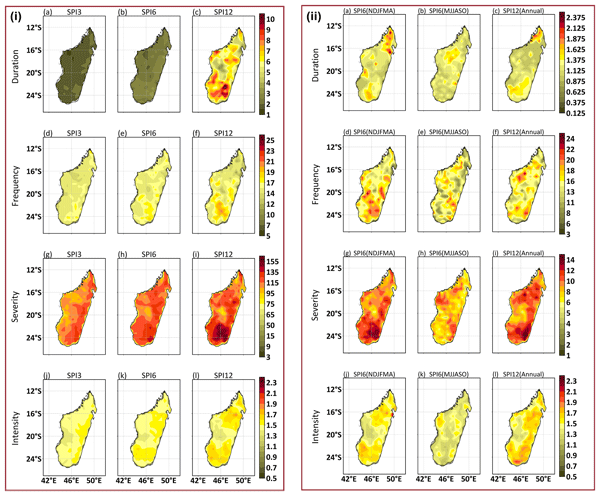
This study aims to analyze the spatiotemporal characteristics of drought (duration, frequency, severity, intensity) over Madagascar during 1981–2022 by using the Standardized Precipitation Index (SPI-3, SPI-6, and SPI-12). Additionally, impacts of drought on vegetation over the studied area were assessed based on an evaluation of the relationship between SPI and the Normalized Difference Vegetation Index (NDVI) during 2000–2022.
This article is included in the Encyclopedia of Geosciences
Benjamin Poschlod, Lukas Brunner, and Jana Sillmann
EGUsphere, https://doi.org/10.5194/egusphere-2026-4014, https://doi.org/10.5194/egusphere-2026-4014, 2026
Short summary
Short summary
Scientists often measure drought by counting the longest run of days without meaningful rain. Comparing high-resolution climate models, radar, and station data across Germany, we found that fine-scale maps show sharp, patchy patterns, because a small shower can break the dry streak in one place but not the next. The high-resolution climate model matches what radar observes, but yearly counts are so sensitive to chance rainfall that they are an unreliable basis for tracking drought.
This article is included in the Encyclopedia of Geosciences
Herijaona Hani-Roge Hundilida Randriatsara, Eva Holtanová, and Jiří Mikšovský
EGUsphere, https://doi.org/10.5194/egusphere-2026-1341, https://doi.org/10.5194/egusphere-2026-1341, 2026
Short summary
Short summary
This study aims to compare different datasets and methods to estimate Internal climate variability (ICV) magnitudes from seasonal and annual mean near-surface air temperature that could serve as benchmarks for assessing regional climate simulations over Europe. Additionally, the spatio-temporal characteristics of ICV estimates were assessed and discussed over Europe during both historical (1971–2000) and future period (2070–2099).
This article is included in the Encyclopedia of Geosciences

Arim Yoon, Cathy Hohenegger, Jiawei Bao, and Lukas Brunner
Earth Syst. Dynam., 17, 167–179, https://doi.org/10.5194/esd-17-167-2026, https://doi.org/10.5194/esd-17-167-2026, 2026
Short summary
Short summary
We studied how removing the Amazon rainforest impacts extreme weather by using an advanced global model that resolves convection. Our results show deforestation significantly intensifies short but severe rainfall, leading to more frequent droughts and flooding. Temperatures rise sharply, creating dangerous heat conditions harmful to human health and productivity. Wind speeds drastically increase. These findings provide a stark warning of the effects of continuing deforestation of the Amazon.
This article is included in the Encyclopedia of Geosciences
Natalia Castillo Bautista, Marco Gaetani, Leonard F. Borchert, Benjamin Poschlod, Lukas Brunner, Jana Sillmann, and Mario L. V. Martina
EGUsphere, https://doi.org/10.5194/egusphere-2025-5073, https://doi.org/10.5194/egusphere-2025-5073, 2025
Short summary
Short summary
When hot temperatures and drought occur together (compound events), they can cause harmful impacts on crops and society. Using six decades of climate data, we show that such compound events repeatedly occurred in three breadbaskets of the Northern Hemisphere. These events are linked to atmospheric circulation patterns that favor heat and dryness, which in turn interact to amplify the impact. Our study contributes to understand the drivers of these events to support climate impact assessment.
This article is included in the Encyclopedia of Geosciences
Hans Segura, Xabier Pedruzo-Bagazgoitia, Philipp Weiss, Sebastian K. Müller, Thomas Rackow, Junhong Lee, Edgar Dolores-Tesillos, Imme Benedict, Matthias Aengenheyster, Razvan Aguridan, Gabriele Arduini, Alexander J. Baker, Jiawei Bao, Swantje Bastin, Eulàlia Baulenas, Tobias Becker, Sebastian Beyer, Hendryk Bockelmann, Nils Brüggemann, Lukas Brunner, Suvarchal K. Cheedela, Sushant Das, Jasper Denissen, Ian Dragaud, Piotr Dziekan, Madeleine Ekblom, Jan Frederik Engels, Monika Esch, Richard Forbes, Claudia Frauen, Lilli Freischem, Diego García-Maroto, Philipp Geier, Paul Gierz, Álvaro González-Cervera, Katherine Grayson, Matthew Griffith, Oliver Gutjahr, Helmuth Haak, Ioan Hadade, Kerstin Haslehner, Shabeh ul Hasson, Jan Hegewald, Lukas Kluft, Aleksei Koldunov, Nikolay Koldunov, Tobias Kölling, Shunya Koseki, Sergey Kosukhin, Josh Kousal, Peter Kuma, Arjun U. Kumar, Rumeng Li, Nicolas Maury, Maximilian Meindl, Sebastian Milinski, Kristian Mogensen, Bimochan Niraula, Jakub Nowak, Divya Sri Praturi, Ulrike Proske, Dian Putrasahan, René Redler, David Santuy, Domokos Sármány, Reiner Schnur, Patrick Scholz, Dmitry Sidorenko, Dorian Spät, Birgit Sützl, Daisuke Takasuka, Adrian Tompkins, Alejandro Uribe, Mirco Valentini, Menno Veerman, Aiko Voigt, Sarah Warnau, Fabian Wachsmann, Marta Wacławczyk, Nils Wedi, Karl-Hermann Wieners, Jonathan Wille, Marius Winkler, Yuting Wu, Florian Ziemen, Janos Zimmermann, Frida A.-M. Bender, Dragana Bojovic, Sandrine Bony, Simona Bordoni, Patrice Brehmer, Marcus Dengler, Emanuel Dutra, Saliou Faye, Erich Fischer, Chiel van Heerwaarden, Cathy Hohenegger, Heikki Järvinen, Markus Jochum, Thomas Jung, Johann H. Jungclaus, Noel S. Keenlyside, Daniel Klocke, Heike Konow, Martina Klose, Szymon Malinowski, Olivia Martius, Thorsten Mauritsen, Juan Pedro Mellado, Theresa Mieslinger, Elsa Mohino, Hanna Pawłowska, Karsten Peters-von Gehlen, Abdoulaye Sarré, Pajam Sobhani, Philip Stier, Lauri Tuppi, Pier Luigi Vidale, Irina Sandu, and Bjorn Stevens
Geosci. Model Dev., 18, 7735–7761, https://doi.org/10.5194/gmd-18-7735-2025, https://doi.org/10.5194/gmd-18-7735-2025, 2025
Short summary
Short summary
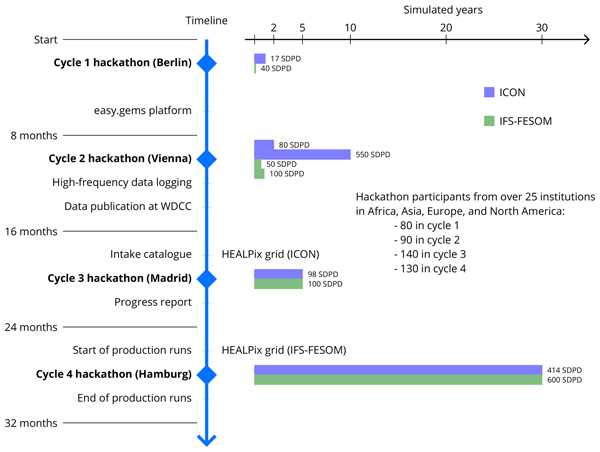
The Next Generation of Earth Modeling Systems project (nextGEMS) developed two Earth system models that use horizontal grid spacing of 10 km and finer, giving more fidelity to the representation of local phenomena, globally. In its fourth cycle, nextGEMS simulated the Earth System climate over the 2020–2049 period under the SSP3-7.0 scenario. Here, we provide an overview of nextGEMS, insights into the model development, and the realism of multi-decadal, kilometer-scale simulations.
This article is included in the Encyclopedia of Geosciences
Nicola Maher, Adam S. Phillips, Clara Deser, Robert C. Jnglin Wills, Flavio Lehner, John Fasullo, Julie M. Caron, Lukas Brunner, Urs Beyerle, and Jemma Jeffree
Geosci. Model Dev., 18, 6341–6365, https://doi.org/10.5194/gmd-18-6341-2025, https://doi.org/10.5194/gmd-18-6341-2025, 2025
Short summary
Short summary
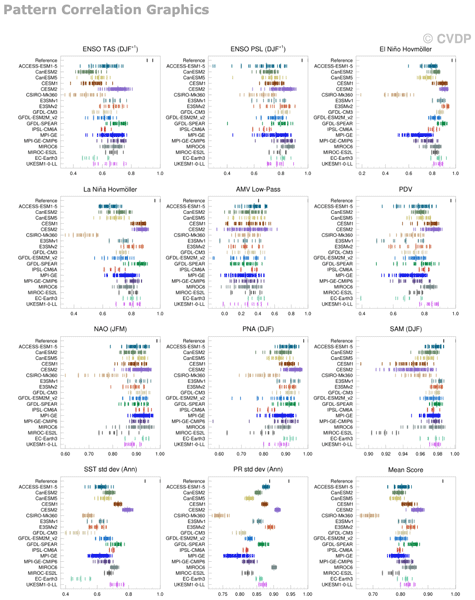
We present the new Multi-Model Large Ensemble Archive (MMLEAv2) and introduce the newly updated Climate Variability Diagnostics Package version 6 (CVDPv6), which is designed specifically for use with large ensembles. For highly variable quantities, we demonstrate that a model might perform evaluation poorly or favourably compared to the single realisation of the world that the observations represent, highlighting the need for large ensembles for model evaluation.
This article is included in the Encyclopedia of Geosciences
Herijaona Hani-Roge Hundilida Randriatsara, Eva Holtanova, Karim Rizwan, Hassen Babaousmail, Mirindra Finaritra Tanteliniaina Rabezanahary, Kokou Romaric Posset, Donnata Alupot, and Brian Odhiambo Ayugi
Nat. Hazards Earth Syst. Sci., 25, 2939–2961, https://doi.org/10.5194/nhess-25-2939-2025, https://doi.org/10.5194/nhess-25-2939-2025, 2025
Short summary
Short summary
This study aims to analyze the spatiotemporal characteristics of drought (duration, frequency, severity, intensity) over Madagascar during 1981–2022 by using the Standardized Precipitation Index (SPI-3, SPI-6, and SPI-12). Additionally, impacts of drought on vegetation over the studied area were assessed based on an evaluation of the relationship between SPI and the Normalized Difference Vegetation Index (NDVI) during 2000–2022.
This article is included in the Encyclopedia of Geosciences
Viet Dung Nguyen, Sergiy Vorogushyn, Katrin Nissen, Lukas Brunner, and Bruno Merz
Adv. Stat. Clim. Meteorol. Oceanogr., 10, 195–216, https://doi.org/10.5194/ascmo-10-195-2024, https://doi.org/10.5194/ascmo-10-195-2024, 2024
Short summary
Short summary
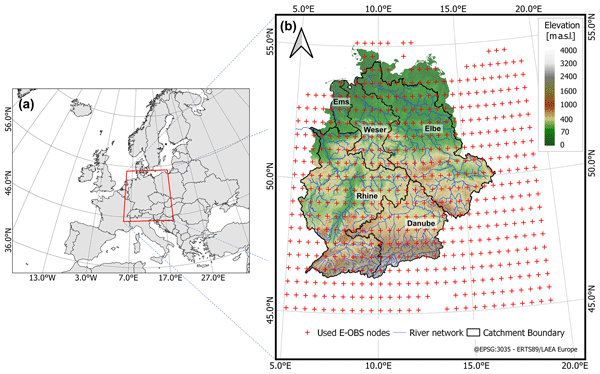
We present a novel stochastic weather generator conditioned on circulation patterns and regional temperature, accounting for dynamic and thermodynamic atmospheric changes. We extensively evaluate the model for the central European region. It statistically downscales precipitation for future periods, generating long, spatially and temporally consistent series. Results suggest an increase in extreme precipitation over the region, offering key benefits for hydrological impact studies.
This article is included in the Encyclopedia of Geosciences
Anna L. Merrifield, Lukas Brunner, Ruth Lorenz, Vincent Humphrey, and Reto Knutti
Geosci. Model Dev., 16, 4715–4747, https://doi.org/10.5194/gmd-16-4715-2023, https://doi.org/10.5194/gmd-16-4715-2023, 2023
Short summary
Short summary
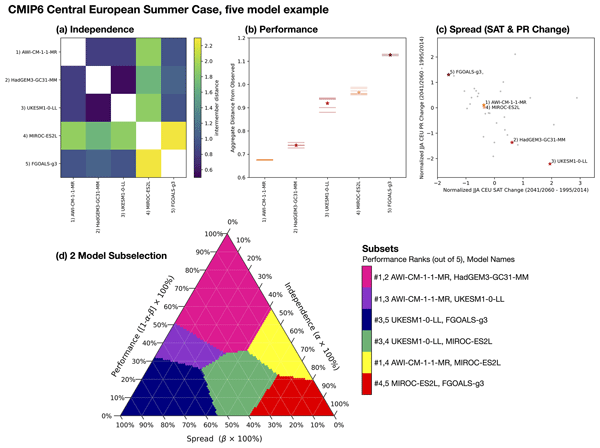
Using all Coupled Model Intercomparison Project (CMIP) models is unfeasible for many applications. We provide a subselection protocol that balances user needs for model independence, performance, and spread capturing CMIP’s projection uncertainty simultaneously. We show how sets of three to five models selected for European applications map to user priorities. An audit of model independence and its influence on equilibrium climate sensitivity uncertainty in CMIP is also presented.
This article is included in the Encyclopedia of Geosciences
Tamzin E. Palmer, Carol F. McSweeney, Ben B. B. Booth, Matthew D. K. Priestley, Paolo Davini, Lukas Brunner, Leonard Borchert, and Matthew B. Menary
Earth Syst. Dynam., 14, 457–483, https://doi.org/10.5194/esd-14-457-2023, https://doi.org/10.5194/esd-14-457-2023, 2023
Short summary
Short summary
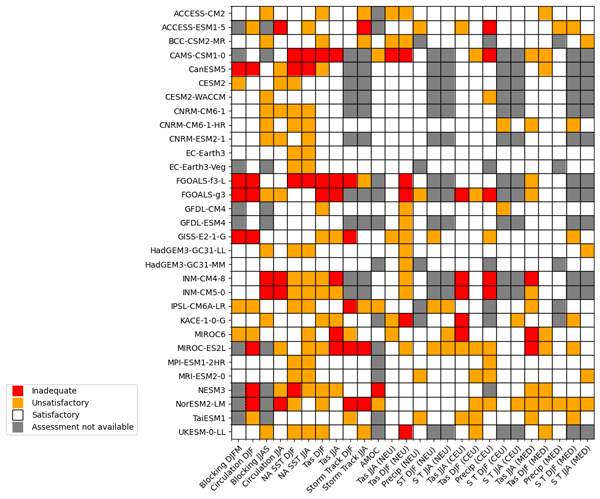
We carry out an assessment of an ensemble of general climate models (CMIP6) based on the ability of the models to represent the key physical processes that are important for representing European climate. Filtering the models with the assessment leads to more models with less global warming being removed, and this shifts the lower part of the projected temperature range towards greater warming. This is in contrast to the affect of weighting the ensemble using global temperature trends.
This article is included in the Encyclopedia of Geosciences
Cited articles
Abramowitz, G., Herger, N., Gutmann, E., Hammerling, D., Knutti, R., Leduc, M., Lorenz, R., Pincus, R., and Schmidt, G. A.: ESD Reviews: Model dependence in multi-model climate ensembles: weighting, sub-selection and out-of-sample testing, Earth Syst. Dynam., 10, 91–105, https://doi.org/10.5194/esd-10-91-2019, 2019.
Bell, B., Hersbach, H., Simmons, A., Berrisford, P., Dahlgren, P., Horányi, A., Muñoz-Sabater, J., Nicolas, J., Radu, R., Schepers, D., Soci,C., Villaume, S., Bidlot, J.-R., Haimberger, L., Woollen, J., Buontempo, C., and Thépaut, J.-N.: The ERA5 global reanalysis: Preliminary extension to 1950, Q. J. R. Meteorol. Soc., 147, 4186–4227,https://doi.org/10.1002/qj.4174, 2021.
Bock, L., Lauer, A., Schlund, M., Barreiro, M., Bellouin, N., Jones, C., Meehl, G. A., Predoi, V., Roberts, M. J., and Eyring, V.: Quantifying progress across different CMIP phases with the ESMValTool, J. Geophys. Res.-Atmos., 125, e2019JD032321, https://doi.org/10.1029/2019JD032321, 2020.
Bordoni, S., Kang, S. M., Shaw, T. A., Simpson, I. R., and Zanna, L.: The futures of climate modeling, npj Clim. Atmos. Sci., 8, 1, https://doi.org/10.1038/s41612-025-00955-8, 2025.
Brunner, L. and Voigt, A.: Pitfalls in diagnosing temperature extremes, Nat. Commun., 15, 2087, https://doi.org/10.1038/s41467-024-46349-x, 2024.
Brunner, L., Hauser, M., Lorenz, R., and Beyerle, U.: The ETH Zurich CMIP6 next generation archive: technical documentation, Zenodo, https://doi.org/10.5281/zenodo.3734128, 2020.
Brunner, L., Ghosh, R. , Haimberger, L., Hohenegger, C., Putrasahan, D., Rackow, T., Knutti R., and Voigt, A.: Three decades of simulating global temperatures with coupled global climate models, Communications Earth & Environment, submitted, 2025.
Casado, M., Hébert, R., Faranda, D., and Landais, A.: The quandary of detecting the signature of climate change in Antarctica, Nat. Clim. Change, 13, 1082–1088, https://doi.org/10.1038/s41558-023-01791-5, 2023.
Chen, J., Dai, A., and Zhang, Y.: Projected changes in daily variability and seasonal cycle of near-surface air temperature over the globe during the twenty-first century, Journal of Climate, 32, 8537–8561, https://doi.org/10.1175/JCLI-D-19-0438.1, 2019.
Cornes, R. C., Jones, P. D., and Qian, C.: Twentieth-century trends in the annual cycle of temperature across the Northern Hemisphere, Journal of Climate, 30, 5755–5773, https://doi.org/10.1175/JCLI-D-16-0315.1, 2017.
Deng, Q. and Fu, Z.: Regional changes of surface air temperature annual cycle in the Northern Hemisphere land areas, Int. J. Climatol., 43, 2238–2249, https://doi.org/10.1002/joc.7972, 2023.
Dwyer, J. G., Biasutti, M., and Sobel, A. H.: Projected changes in the seasonal cycle of surface temperature, Journal of Climate, 25, 6359–6374, https://doi.org/10.1175/JCLI-D-11-00741.1, 2012.
Eyring, V., Bony, S., Meehl, G. A., Senior, C. A., Stevens, B., Stouffer, R. J., and Taylor, K. E.: Overview of the Coupled Model Intercomparison Project Phase 6 (CMIP6) experimental design and organization, Geosci. Model Dev., 9, 1937–1958, https://doi.org/10.5194/gmd-9-1937-2016, 2016.
Gulev, S. K., Thorne, P. W., Ahn, J., Dentener, F. J., Domingues, C. M., Gerland, S., Gong, D., Kaufman, D. S., Nnamchi, H. C., Quaas, J., Rivera, J. A., Sathyendranath, S., Smith, S. L., Trewin, B., von Schuckmann, K., and Vose, R. S.: Changing State of the Climate System, in: Climate Change 2021: The Physical Science Basis. Contribution of Working Group I to the Sixth Assessment Report of the Intergovernmental Panel on Climate Change, edited by: Masson-Delmotte, V., Zhai, P., Pirani, A., Connors, S. L., Péan, C., Berger, S., Caud, N., Chen, Y., Goldfarb, L., Gomis, M. I., Huang, M., Leitzell, K., Lonnoy, E., Matthews, J. B. R., Maycock, T. K., Waterfield, T., Yelekçi, O., Yu, R., and Zhou, B., Cambridge University Press, Cambridge, United Kingdom and New York, NY, USA, 287–422, https://doi.org/10.1017/9781009157896.004, 2021.
Hekmatzadeh, A. A., Kaboli, S., and Torabi Haghighi, A.: New indices for assessing changes in seasons and in timing characteristics of air temperature, Theor. Appl. Climatol., 140, 1247–1261, https://doi.org/10.1007/s00704-020-03156-w, 2020.
Hersbach, H., Bell, B., Berrisford, P., Hirahara, S., Horányi, A., Muñoz-Sabater, J., Nicolas, J., Peubey, C., Radu, R., Schepers, D., Simmons, A., Soci, C., Abdalla, S., Abellan, X., Balsamo, G., Bechtold, P., Biavati,G., Bidlot, J., Bonavita, M., De Chiara, G., Dahlgren, P., Dee, D., Diamantakis, M., Dragani, R., Flemming, J., Forbes, R., Fuentes, M., Geer, A., Haimberger, L., Healy, S., Hogan, R.J., Hólm, E., Janisková, M., Keeley, S., Laloyaux, P., Lopez, P., Lupu, C., Radnoti, G., de Rosnay, P., Rozum, I., Vamborg, F., Villaume, S., and Thépaut, J.-N.: The ERA5 global reanalysis, Q. J. R. Meteorol. Soc., 146, 1999–2049, https://doi.org/10.1002/qj.3803, 2020.
Holtanová, E.: Underlying data and processing code accompanying the paper Holtanova et al., 2025: Quantifying changes in seasonal temperature variations using a functional data analysis approach, Zenodo [code and data set], https://doi.org/10.5281/zenodo.15866119, 2025.
Holtanová, E., Mendlik, T., Koláček, J., Horová, I., and Mikšovský, J.: Similarities within a multi-model ensemble: functional data analysis framework, Geosci. Model Dev., 12, 735–747, https://doi.org/10.5194/gmd-12-735-2019, 2019.
Horváth, L. and Kokoszka, P.: Inference for functional data with applications, Vol. 200, Springer Sci. Bus. Media, ISBN 978-1-4614-3654-6, 2012.
IPCC: Summary for Policymakers, in: Clim. Change 2021: Phys. Sci. Basis, Cambridge Univ. Press, pp. 3–32, https://doi.org/10.1017/9781009157896.001, 2021.
Iturbide, M., Gutiérrez, J. M., Alves, L. M., Bedia, J., Cerezo-Mota, R., Cimadevilla, E., Cofiño, A. S., Di Luca, A., Faria, S. H., Gorodetskaya, I. V., Hauser, M., Herrera, S., Hennessy, K., Hewitt, H. T., Jones, R. G., Krakovska, S., Manzanas, R., Martínez-Castro, D., Narisma, G. T., Nurhati, I. S., Pinto, I., Seneviratne, S. I., van den Hurk, B., and Vera, C. S.: An update of IPCC climate reference regions for subcontinental analysis of climate model data: definition and aggregated datasets, Earth Syst. Sci. Data, 12, 2959–2970, https://doi.org/10.5194/essd-12-2959-2020, 2020.
Kang, S. M., Ceppi, P., Yu, Y., and Kang, I.-S.: Recent global climate feedback controlled by Southern Ocean cooling, Nat. Geosci., 16, 775–780, https://doi.org/10.1038/s41561-023-01256-6, 2023.
Kokoszka, P., and Reimherr, M.: Introduction to functional data analysis, Chapman Hall/CRC, ISBN 9781032096599, 2017.
Laloyaux, P., de Boisseson, E., Balmaseda, M., Bidlot, J.-R., Broennimann, S., Buizza, R., Dahlgren, P., Dee, D., Haimberger, L., Hersbach, H., Kosaka, Y., Martin, M., Poli, P., Rayner, N., Rustemeier, E., and Schepers, D.: CERA-20C: A coupled reanalysis of the twentieth century, J. Adv. Model. Earth Syst., 10, 1172–1195, https://doi.org/10.1029/2018MS001273, 2018.
Liu, F., Song, F., and Luo, Y.: Human-induced intensified seasonal cycle of sea surface temperature, Nat. Commun., 15, 3948, https://doi.org/10.1038/s41467-024-48381-3, 2024.
López de la Franca, N., Sánchez, E., and Domínguez, M.: Changes in the onset and length of seasons from an ensemble of regional climate models over Spain for future climate conditions, Theor. Appl. Climatol., 114, 635–642, https://doi.org/10.1007/s00704-013-0868-2, 2013.
López-Franca, N., Sanchez, E., Menéndez, C., Carril, A. F., Zaninelli, P. G., and Flombaum, P.: Characterization of seasons over the extratropics based on the annual daily mean temperature cycle, Int. J. Climatol., 42, 5570–5585, 2022.
Lynch, C., Seth, A., and Thibeault, J.: Recent and projected annual cycles of temperature and precipitation in the Northeast United States from CMIP5, Journal of Climate, 29, 347–365, https://doi.org/10.1175/JCLI-D-14-00781.1, 2016.
Marvel, K., Cook, B. I., Bonfils, C., Smerdon, J. E., Williams, A. P., and Liu, H.: Projected changes to hydroclimate seasonality in the continental United States, Earths Future, 9, e2021EF002019, https://doi.org/10.1029/2021EF002019, 2021.
McDonnell, A., Bauer, A. M., and Proistosescu, C.: To What Extent Does Discounting `Hot' Climate Models Improve the Predictive Skill of Climate Model Ensembles?, Earths Future, 12, e2024EF004844, 2024.
McKinnon, K. A. and Huybers, P.: Inferring Northern Hemisphere continental warming patterns from the amplitude and phase of the seasonal cycle in surface temperature, Journal of Climate, 37, 475–485, https://doi.org/10.1175/JCLI-D-22-0773.1, 2024.
McKinnon, K. A., Simpson, I. R., and Williams, A. P.: The pace of change of summertime temperature extremes, Proc. Natl. Acad. Sci. USA, 121, e2406143121, https://doi.org/10.1073/pnas.2406143121, 2024.
Meehl, G. A., Senior, C. A., Eyring, V., Flato, G., Lamarque, J. F., Stouffer, R. J., Taylor, K. E., and Schlund, M.: Context for interpreting equilibrium climate sensitivity and transient climate response from the CMIP6 Earth system models, Science Advances, 6, eaba1981, https://doi.org/10.1126/sciadv.aba1981, 2020.
Merrifield, A. L., Brunner, L., Lorenz, R., Humphrey, V., and Knutti, R.: Climate model Selection by Independence, Performance, and Spread (ClimSIPS v1.0.1) for regional applications, Geosci. Model Dev., 16, 4715–4747, https://doi.org/10.5194/gmd-16-4715-2023, 2023.
Nigam, S., Thomas, N. P., Ruiz-Barradas, A., and Weaver, S. J.: Striking seasonality in the secular warming of the northern continents: Structure and mechanisms, Journal of Climate, 30, 6521–6541, https://doi.org/10.1175/JCLI-D-16-0757.1, 2017.
Palmer, T. E., McSweeney, C. F., Booth, B. B. B., Priestley, M. D. K., Davini, P., Brunner, L., Borchert, L., and Menary, M. B.: Performance-based sub-selection of CMIP6 models for impact assessments in Europe, Earth Syst. Dynam., 14, 457–483, https://doi.org/10.5194/esd-14-457-2023, 2023.
Paluš, M., Novotná, D., and Tichavský, P.: Shifts of seasons at the European mid-latitudes: Natural fluctuations correlated with the North Atlantic Oscillation, Geophys. Res. Lett., 32, L12703, https://doi.org/10.1029/2005GL022838, 2005.
Park, B. J., Kim, Y. H., Min, S. K., and Lim, E. P.: Anthropogenic and natural contributions to the lengthening of the summer season in the Northern Hemisphere, Journal of Climate, 31, 6803–6819, https://doi.org/10.1175/JCLI-D-17-0643.1, 2018.
Peña-Ortiz, C., Barriopedro, D., and García-Herrera, R.: Multidecadal variability of the summer length in Europe, Journal of Climate, 28, 5375–5388, https://doi.org/10.1175/JCLI-D-14-00429.1, 2015.
Previdi, M., Smith, K. L., and Polvani, L. M.: Arctic amplification of climate change: A review of underlying mechanisms, Environ. Res. Lett., 16, https://doi.org/10.1088/1748-9326/ac1c29, 2021.
Rahimpour Asenjan, M., Brissette, F., Martel, J.-L., and Arsenault, R.: Understanding the influence of “hot” models in climate impact studies: a hydrological perspective, Hydrol. Earth Syst. Sci., 27, 4355–4367, https://doi.org/10.5194/hess-27-4355-2023, 2023.
Ramsay, J. O. and Silverman, B. W.: Functional data analysis, second edn., Springer, New York, ISBN 978-0-387-40080-8, 2005.
Randall, D. A., Bitz, C. M., Danabasoglu, G., Denning, A. S., Gent, P. R., Gettelman, A., Griffies, S. M., Lynch, P., Morrison, H., Pincus, R., and Thuburn, J.: 100 Years of Earth System Model Development, Meteorol. Monogr., 59, 12.1–12.66, https://doi.org/10.1175/amsmonographs-d-18-0018.1, 2019.
Ruosteenoja, K., Markkanen, T., and Räisänen, J.: Thermal seasons in northern Europe in projected future climate, Journal of Climate, 40, 4444–4462, https://doi.org/10.1002/joc.6466, 2020.
Santer, B. D., Po-Chedley, S., Zelinka, M. D., Cvijanovic, I., Bonfils, C., Durack, P. J., Fu, Q., Kiehl, J., Mears, C., Painter, J., Pallotta, G., Solomon, S., Wentz, F. J., and Zou, C. Z.: Human influence on the seasonal cycle of tropospheric temperature, Science, 361, https://doi.org/10.1126/science.aas8806, 2018.
Santer, B. D., Po-Chedley, S., Feldl, N., Fyfe, J. C., Fu, Q., Solomon, S., England, M., Rodgers, K. B., Stuecker, M. F., Mears, C., Zou, C.-Z., Bonfils, C. J. W., Pallotta, G., Zelinka, M. D., Rosenbloom, N., and Edwards, J.: Robust anthropogenic signal identified in the seasonal cycle of tropospheric temperature, Journal of Climate, 35, 6075–6100, https://doi.org/10.1175/JCLI-D-21-0766.1, 2022.
Shaw, T. A. and Stevens, B.: The other climate crisis, Nature, 639, 877–887, https://doi.org/10.1038/s41586-025-08680-1, 2025.
Snyder, A., Prime, N., Tebaldi, C., and Dorheim, K.: Uncertainty-informed selection of CMIP6 Earth system model subsets for use in multisectoral and impact models, Earth Syst. Dynam., 15, 1301–1318, https://doi.org/10.5194/esd-15-1301-2024, 2024.
Stine, A. R. and Huybers, P.: Changes in the seasonal cycle of temperature and atmospheric circulation, Journal of Climate, 25, 7362–7380, https://doi.org/10.1175/JCLI-D-11-00470.1, 2012.
Stine, A. R., Huybers, P., and Fung, I. Y.: Changes in the phase of the annual cycle of surface temperature, Nature, 457, 435–440, https://doi.org/10.1038/nature07675, 2009.
Stuecker, M. F., Bitz, C. M., Armour, K. C., Proistosescu, C., Kang, S. M., Xie, S. P., Kim, D., McGregor, S., Zhang, W., Zhao, S., Cai, W., Dong, Y., and Jin, F. F.: Polar amplification dominated by local forcing and feedbacks, Nat. Clim. Change, 8, 1076–1081, https://doi.org/10.1038/s41558-018-0339-y, 2018.
Sutton, R. T., Dong, B., and Gregory, J. M.: Land/sea warming ratio in response to climate change: IPCC AR4 model results and comparison with observations, Geophys. Res. Lett., 34, L02701, https://doi.org/10.1029/2006GL028164, 2007.
Swaminathan, R., Schewe, J., Walton, J., Zimmermann, K., Jones, C., Betts, R. A., Burton, C., Jones, C. D., Mengel, M., Reyer, C. P. O., Turner, A. G., and Weigel, K.: Regional Impacts Poorly Constrained by Climate Sensitivity, Earths Future, 12, https://doi.org/10.1029/2024EF004901, 2024.
Tebaldi, C., Debeire, K., Eyring, V., Fischer, E., Fyfe, J., Friedlingstein, P., Knutti, R., Lowe, J., O'Neill, B., Sanderson, B., van Vuuren, D., Riahi, K., Meinshausen, M., Nicholls, Z., Tokarska, K. B., Hurtt, G., Kriegler, E., Lamarque, J.-F., Meehl, G., Moss, R., Bauer, S. E., Boucher, O., Brovkin, V., Byun, Y.-H., Dix, M., Gualdi, S., Guo, H., John, J. G., Kharin, S., Kim, Y., Koshiro, T., Ma, L., Olivié, D., Panickal, S., Qiao, F., Rong, X., Rosenbloom, N., Schupfner, M., Séférian, R., Sellar, A., Semmler, T., Shi, X., Song, Z., Steger, C., Stouffer, R., Swart, N., Tachiiri, K., Tang, Q., Tatebe, H., Voldoire, A., Volodin, E., Wyser, K., Xin, X., Yang, S., Yu, Y., and Ziehn, T.: Climate model projections from the Scenario Model Intercomparison Project (ScenarioMIP) of CMIP6, Earth Syst. Dynam., 12, 253–293, https://doi.org/10.5194/esd-12-253-2021, 2021.
Wang, G., and Dillon, M. E.: Recent geographic convergence in diurnal and annual temperature cycling flattens global thermal profiles, Nat. Clim. Change, 4, 988–992, https://doi.org/10.1038/nclimate2339, 2014.
Wang, J., Guan, Y., Wu, L., Guan, X., Cai, W., Huang, J., Dong, W., and Zhang, B.: Changing Lengths of the Four Seasons by Global Warming, Geophys. Res. Lett., 48, https://doi.org/10.1029/2020GL091753, 2021.
Xie, A., Zhu, J., Kang, S., Qin, X., Xu, B., and Wang, Y.: Polar amplification comparison among Earth's three poles under different socioeconomic scenarios from CMIP6 surface air temperature, Sci. Rep., 12, https://doi.org/10.1038/s41598-022-21060-3, 2022.
Yettella, V. and England, M. R.: The Role of Internal Variability in Twenty-First-Century Projections of the Seasonal Cycle of Northern Hemisphere Surface Temperature, J. Geophys. Res.-Atmos., 123, 13149–13167, https://doi.org/10.1029/2018JD029066, 2018.
Zhang, C., Wu, G., and Zhao, R.: Changes in the annual cycle of surface air temperature over China in the 21st century simulated by CMIP6 models, Sci. Rep., 15, 13661, https://doi.org/10.1038/s41598-025-98672-y, 2025.
Zhang, Y., Kong, Y., Yang, S., and Hu, X.: Asymmetric Arctic and Antarctic Warming and Its Intermodel Spread in CMIP6, Journal of Climate, 36, 8299–8310, https://doi.org/10.1175/JCLI-D-23-0118.1, 2023.
Zhao, R., Wang, K., Wu, G., and Zhou, C.: Temperature annual cycle variations and responses to surface solar radiation in China between 1960 and 2016, Int. J. Climatol., 41, E2959–E2978, https://doi.org/10.1002/joc.7460, 2021.
Download
- Article
(10508 KB) - Full-text XML
Short summary
We introduce Functional Data Analysis (FDA) as a new approach to diagnose changes in the temperature seasonal cycle. FDA allows the analysis without needing any prior assumptions about the cycle shape. We evaluate past and future changes based on two reanalyses and five CMIP6 models. We discuss regions of robust changes with datasets’ agreement, e.g., a delayed maximum in the south and east of Europe, while highlighting areas of larger dataset differences, mainly in polar and equatorial regions.
We introduce Functional Data Analysis (FDA) as a new approach to diagnose changes in the...


Altmetrics
Final-revised paper
Preprint