
Articles | Volume 17, issue 1
https://doi.org/10.5194/esd-17-167-2026
© Author(s) 2026. This work is distributed under
the Creative Commons Attribution 4.0 License.
the Creative Commons Attribution 4.0 License.
https://doi.org/10.5194/esd-17-167-2026
© Author(s) 2026. This work is distributed under
the Creative Commons Attribution 4.0 License.
the Creative Commons Attribution 4.0 License.
Research article
| 
04 Feb 2026
Research article |
| 04 Feb 2026
| 04 Feb 2026
Extreme events in the Amazon after deforestation

Max Planck Institute for Meteorology, Bundesstraße 53, 20146 Hamburg, Germany
International Max Planck Research School on Earth System Modeling (IMPRS-ESM), Bundesstraße 53, 20146 Hamburg, Germany
Cathy Hohenegger
Max Planck Institute for Meteorology, Bundesstraße 53, 20146 Hamburg, Germany
Jiawei Bao
Institute of Science and Technology Austria, Am Campus 1, 3400 Klosterneuburg, Austria
Lukas Brunner
Research Unit Sustainability and Climate Risk, Center for Earth System Research and Sustainability (CEN), University of Hamburg, Hamburg, Germany
Related authors
No articles found.
Benjamin Poschlod, Lukas Brunner, and Jana Sillmann
EGUsphere, https://doi.org/10.5194/egusphere-2026-4014, https://doi.org/10.5194/egusphere-2026-4014, 2026
Short summary
Short summary
Scientists often measure drought by counting the longest run of days without meaningful rain. Comparing high-resolution climate models, radar, and station data across Germany, we found that fine-scale maps show sharp, patchy patterns, because a small shower can break the dry streak in one place but not the next. The high-resolution climate model matches what radar observes, but yearly counts are so sensitive to chance rainfall that they are an unreliable basis for tracking drought.
Junhong Lee and Cathy Hohenegger
EGUsphere, https://doi.org/10.5194/egusphere-2026-1493, https://doi.org/10.5194/egusphere-2026-1493, 2026
Short summary
Short summary
Older climate models often simulate constant, light drizzle instead of short, heavy rainstorms. This persistent cloud cover blocks sunlight, making it appear that plants absorb less carbon dioxide. By using a highly detailed model over Europe that correctly simulates brief, intense storms, we found plants actually get more sunlight on rainy days. This extra sunshine lets vegetation absorb more carbon, revealing how weather patterns directly impact nature's ability to clean our atmosphere.
Jin-Song von Storch, Dian Putrasahan, and Cathy Hohenegger
EGUsphere, https://doi.org/10.5194/egusphere-2026-1168, https://doi.org/10.5194/egusphere-2026-1168, 2026
Short summary
Short summary
Using a suite of time-slice and fixed-season experiments, we investigate the effect of the representation of convection for the Hadley Circulation (HC). Regarding its time-mean state, the HC is significantly weaker and the deep convection is significantly reduced in the case when convection is resolved than parametrized. Regarding to its response to a 4 K global warming, the HC becomes broader, deeper, and weaker, no matter whether convection is resolved or parameterized.
Eva Holtanová, Jan Koláček, and Lukas Brunner
Earth Syst. Dynam., 17, 181–198, https://doi.org/10.5194/esd-17-181-2026, https://doi.org/10.5194/esd-17-181-2026, 2026
Short summary
Short summary
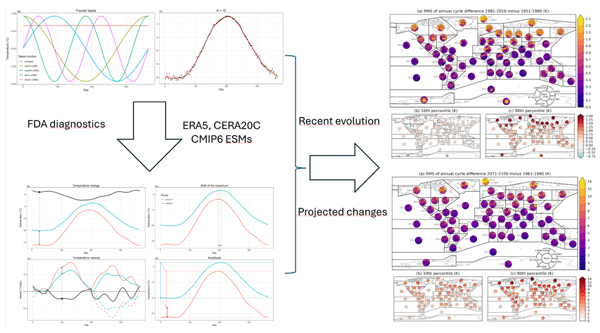
We introduce Functional Data Analysis (FDA) as a new approach to diagnose changes in the temperature seasonal cycle. FDA allows the analysis without needing any prior assumptions about the cycle shape. We evaluate past and future changes based on two reanalyses and five CMIP6 models. We discuss regions of robust changes with datasets’ agreement, e.g., a delayed maximum in the south and east of Europe, while highlighting areas of larger dataset differences, mainly in polar and equatorial regions.
Natalia Castillo Bautista, Marco Gaetani, Leonard F. Borchert, Benjamin Poschlod, Lukas Brunner, Jana Sillmann, and Mario L. V. Martina
EGUsphere, https://doi.org/10.5194/egusphere-2025-5073, https://doi.org/10.5194/egusphere-2025-5073, 2025
Short summary
Short summary
When hot temperatures and drought occur together (compound events), they can cause harmful impacts on crops and society. Using six decades of climate data, we show that such compound events repeatedly occurred in three breadbaskets of the Northern Hemisphere. These events are linked to atmospheric circulation patterns that favor heat and dryness, which in turn interact to amplify the impact. Our study contributes to understand the drivers of these events to support climate impact assessment.
Hans Segura, Xabier Pedruzo-Bagazgoitia, Philipp Weiss, Sebastian K. Müller, Thomas Rackow, Junhong Lee, Edgar Dolores-Tesillos, Imme Benedict, Matthias Aengenheyster, Razvan Aguridan, Gabriele Arduini, Alexander J. Baker, Jiawei Bao, Swantje Bastin, Eulàlia Baulenas, Tobias Becker, Sebastian Beyer, Hendryk Bockelmann, Nils Brüggemann, Lukas Brunner, Suvarchal K. Cheedela, Sushant Das, Jasper Denissen, Ian Dragaud, Piotr Dziekan, Madeleine Ekblom, Jan Frederik Engels, Monika Esch, Richard Forbes, Claudia Frauen, Lilli Freischem, Diego García-Maroto, Philipp Geier, Paul Gierz, Álvaro González-Cervera, Katherine Grayson, Matthew Griffith, Oliver Gutjahr, Helmuth Haak, Ioan Hadade, Kerstin Haslehner, Shabeh ul Hasson, Jan Hegewald, Lukas Kluft, Aleksei Koldunov, Nikolay Koldunov, Tobias Kölling, Shunya Koseki, Sergey Kosukhin, Josh Kousal, Peter Kuma, Arjun U. Kumar, Rumeng Li, Nicolas Maury, Maximilian Meindl, Sebastian Milinski, Kristian Mogensen, Bimochan Niraula, Jakub Nowak, Divya Sri Praturi, Ulrike Proske, Dian Putrasahan, René Redler, David Santuy, Domokos Sármány, Reiner Schnur, Patrick Scholz, Dmitry Sidorenko, Dorian Spät, Birgit Sützl, Daisuke Takasuka, Adrian Tompkins, Alejandro Uribe, Mirco Valentini, Menno Veerman, Aiko Voigt, Sarah Warnau, Fabian Wachsmann, Marta Wacławczyk, Nils Wedi, Karl-Hermann Wieners, Jonathan Wille, Marius Winkler, Yuting Wu, Florian Ziemen, Janos Zimmermann, Frida A.-M. Bender, Dragana Bojovic, Sandrine Bony, Simona Bordoni, Patrice Brehmer, Marcus Dengler, Emanuel Dutra, Saliou Faye, Erich Fischer, Chiel van Heerwaarden, Cathy Hohenegger, Heikki Järvinen, Markus Jochum, Thomas Jung, Johann H. Jungclaus, Noel S. Keenlyside, Daniel Klocke, Heike Konow, Martina Klose, Szymon Malinowski, Olivia Martius, Thorsten Mauritsen, Juan Pedro Mellado, Theresa Mieslinger, Elsa Mohino, Hanna Pawłowska, Karsten Peters-von Gehlen, Abdoulaye Sarré, Pajam Sobhani, Philip Stier, Lauri Tuppi, Pier Luigi Vidale, Irina Sandu, and Bjorn Stevens
Geosci. Model Dev., 18, 7735–7761, https://doi.org/10.5194/gmd-18-7735-2025, https://doi.org/10.5194/gmd-18-7735-2025, 2025
Short summary
Short summary
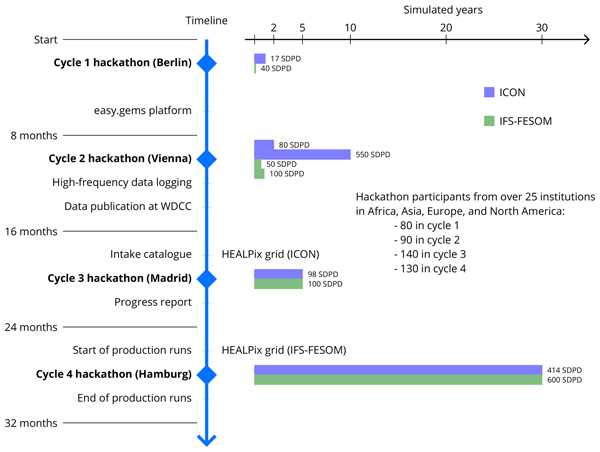
The Next Generation of Earth Modeling Systems project (nextGEMS) developed two Earth system models that use horizontal grid spacing of 10 km and finer, giving more fidelity to the representation of local phenomena, globally. In its fourth cycle, nextGEMS simulated the Earth System climate over the 2020–2049 period under the SSP3-7.0 scenario. Here, we provide an overview of nextGEMS, insights into the model development, and the realism of multi-decadal, kilometer-scale simulations.
Nicola Maher, Adam S. Phillips, Clara Deser, Robert C. Jnglin Wills, Flavio Lehner, John Fasullo, Julie M. Caron, Lukas Brunner, Urs Beyerle, and Jemma Jeffree
Geosci. Model Dev., 18, 6341–6365, https://doi.org/10.5194/gmd-18-6341-2025, https://doi.org/10.5194/gmd-18-6341-2025, 2025
Short summary
Short summary
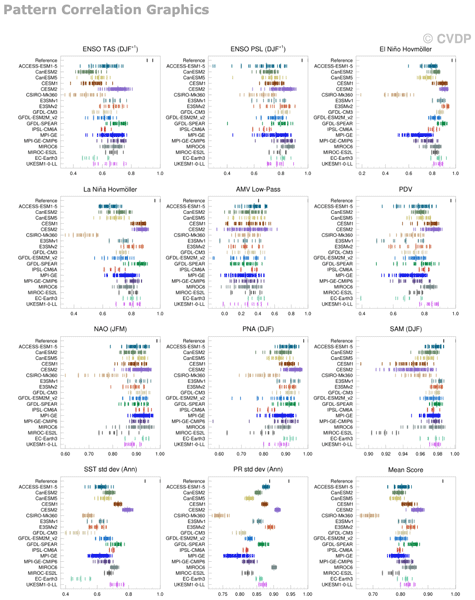
We present the new Multi-Model Large Ensemble Archive (MMLEAv2) and introduce the newly updated Climate Variability Diagnostics Package version 6 (CVDPv6), which is designed specifically for use with large ensembles. For highly variable quantities, we demonstrate that a model might perform evaluation poorly or favourably compared to the single realisation of the world that the observations represent, highlighting the need for large ensembles for model evaluation.
Abisha Mary Gnanaraj, Jiawei Bao, and Hauke Schmidt
Weather Clim. Dynam., 6, 489–503, https://doi.org/10.5194/wcd-6-489-2025, https://doi.org/10.5194/wcd-6-489-2025, 2025
Short summary
Short summary
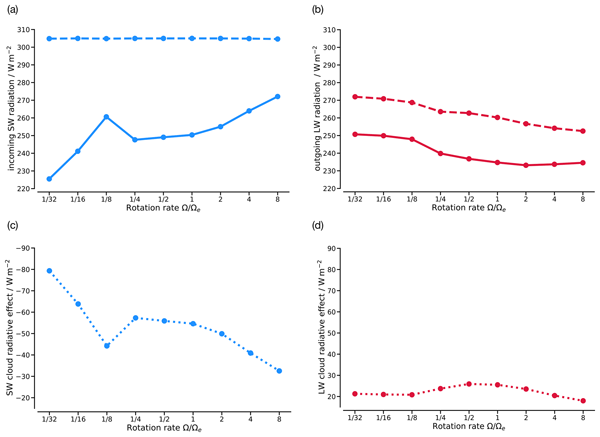
We study how the Coriolis force caused by a planet's rotation affects its energy budget and habitability. Using an atmospheric general circulation model in a simplified water-covered planet setup, we analyse how rotation rates both slower and faster than Earth affect the amount of water vapour and clouds in the atmosphere. Our results suggest that rotation slower than Earth's makes the planet colder and drier, while faster rotation makes it warmer and moister, reducing its habitability.
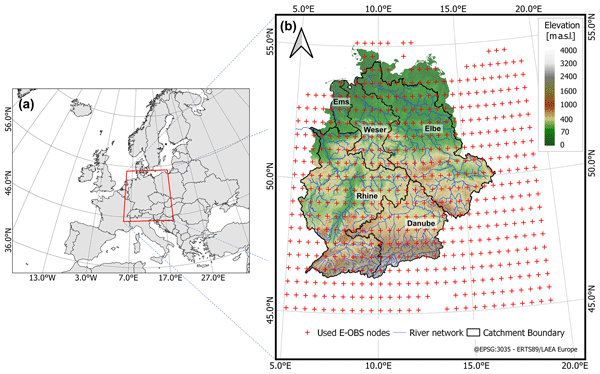
Viet Dung Nguyen, Sergiy Vorogushyn, Katrin Nissen, Lukas Brunner, and Bruno Merz
Adv. Stat. Clim. Meteorol. Oceanogr., 10, 195–216, https://doi.org/10.5194/ascmo-10-195-2024, https://doi.org/10.5194/ascmo-10-195-2024, 2024
Short summary
Short summary
We present a novel stochastic weather generator conditioned on circulation patterns and regional temperature, accounting for dynamic and thermodynamic atmospheric changes. We extensively evaluate the model for the central European region. It statistically downscales precipitation for future periods, generating long, spatially and temporally consistent series. Results suggest an increase in extreme precipitation over the region, offering key benefits for hydrological impact studies.
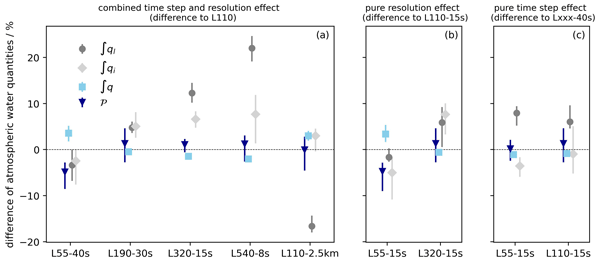
Hauke Schmidt, Sebastian Rast, Jiawei Bao, Amrit Cassim, Shih-Wei Fang, Diego Jimenez-de la Cuesta, Paul Keil, Lukas Kluft, Clarissa Kroll, Theresa Lang, Ulrike Niemeier, Andrea Schneidereit, Andrew I. L. Williams, and Bjorn Stevens
Geosci. Model Dev., 17, 1563–1584, https://doi.org/10.5194/gmd-17-1563-2024, https://doi.org/10.5194/gmd-17-1563-2024, 2024
Short summary
Short summary
A recent development in numerical simulations of the global atmosphere is the increase in horizontal resolution to grid spacings of a few kilometers. However, the vertical grid spacing of these models has not been reduced at the same rate as the horizontal grid spacing. Here, we assess the effects of much finer vertical grid spacings, in particular the impacts on cloud quantities and the atmospheric energy balance.
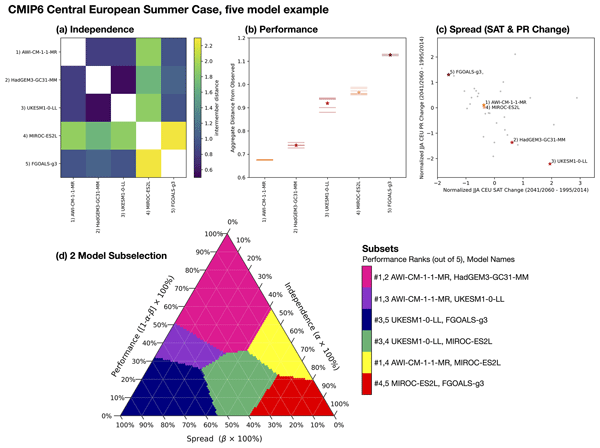
Anna L. Merrifield, Lukas Brunner, Ruth Lorenz, Vincent Humphrey, and Reto Knutti
Geosci. Model Dev., 16, 4715–4747, https://doi.org/10.5194/gmd-16-4715-2023, https://doi.org/10.5194/gmd-16-4715-2023, 2023
Short summary
Short summary
Using all Coupled Model Intercomparison Project (CMIP) models is unfeasible for many applications. We provide a subselection protocol that balances user needs for model independence, performance, and spread capturing CMIP’s projection uncertainty simultaneously. We show how sets of three to five models selected for European applications map to user priorities. An audit of model independence and its influence on equilibrium climate sensitivity uncertainty in CMIP is also presented.
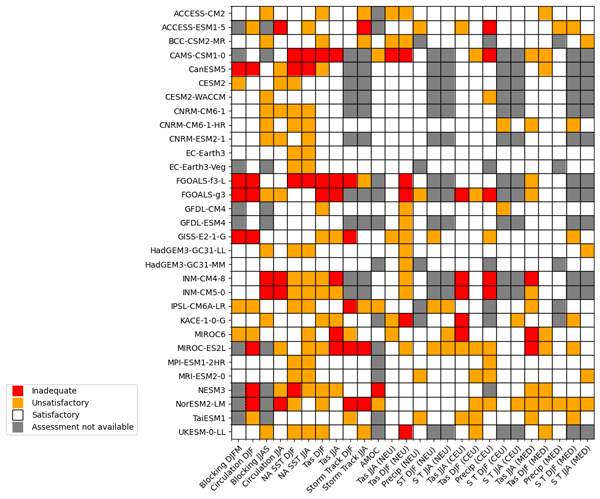
Tamzin E. Palmer, Carol F. McSweeney, Ben B. B. Booth, Matthew D. K. Priestley, Paolo Davini, Lukas Brunner, Leonard Borchert, and Matthew B. Menary
Earth Syst. Dynam., 14, 457–483, https://doi.org/10.5194/esd-14-457-2023, https://doi.org/10.5194/esd-14-457-2023, 2023
Short summary
Short summary
We carry out an assessment of an ensemble of general climate models (CMIP6) based on the ability of the models to represent the key physical processes that are important for representing European climate. Filtering the models with the assessment leads to more models with less global warming being removed, and this shifts the lower part of the projected temperature range towards greater warming. This is in contrast to the affect of weighting the ensemble using global temperature trends.
Leonore Jungandreas, Cathy Hohenegger, and Martin Claussen
Clim. Past, 19, 637–664, https://doi.org/10.5194/cp-19-637-2023, https://doi.org/10.5194/cp-19-637-2023, 2023
Short summary
Short summary
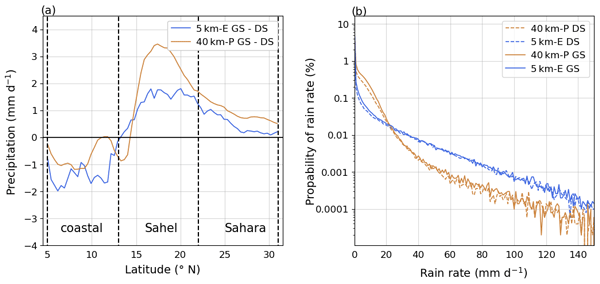
Increasing the vegetation cover over mid-Holcocene North Africa expands the West African monsoon ∼ 4–5° further north. This northward shift of monsoonal precipitation is caused by interactions of the land surface with large-scale monsoon circulation and the coupling of soil moisture to precipitation. We highlight the importance of considering not only how soil moisture influences precipitation but also how different precipitation characteristics alter the soil hydrology via runoff generation.
Cathy Hohenegger, Peter Korn, Leonidas Linardakis, René Redler, Reiner Schnur, Panagiotis Adamidis, Jiawei Bao, Swantje Bastin, Milad Behravesh, Martin Bergemann, Joachim Biercamp, Hendryk Bockelmann, Renate Brokopf, Nils Brüggemann, Lucas Casaroli, Fatemeh Chegini, George Datseris, Monika Esch, Geet George, Marco Giorgetta, Oliver Gutjahr, Helmuth Haak, Moritz Hanke, Tatiana Ilyina, Thomas Jahns, Johann Jungclaus, Marcel Kern, Daniel Klocke, Lukas Kluft, Tobias Kölling, Luis Kornblueh, Sergey Kosukhin, Clarissa Kroll, Junhong Lee, Thorsten Mauritsen, Carolin Mehlmann, Theresa Mieslinger, Ann Kristin Naumann, Laura Paccini, Angel Peinado, Divya Sri Praturi, Dian Putrasahan, Sebastian Rast, Thomas Riddick, Niklas Roeber, Hauke Schmidt, Uwe Schulzweida, Florian Schütte, Hans Segura, Radomyra Shevchenko, Vikram Singh, Mia Specht, Claudia Christine Stephan, Jin-Song von Storch, Raphaela Vogel, Christian Wengel, Marius Winkler, Florian Ziemen, Jochem Marotzke, and Bjorn Stevens
Geosci. Model Dev., 16, 779–811, https://doi.org/10.5194/gmd-16-779-2023, https://doi.org/10.5194/gmd-16-779-2023, 2023
Short summary
Short summary
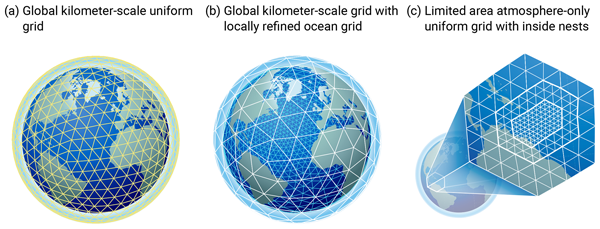
Models of the Earth system used to understand climate and predict its change typically employ a grid spacing of about 100 km. Yet, many atmospheric and oceanic processes occur on much smaller scales. In this study, we present a new model configuration designed for the simulation of the components of the Earth system and their interactions at kilometer and smaller scales, allowing an explicit representation of the main drivers of the flow of energy and matter by solving the underlying equations.
Bastian Kirsch, Cathy Hohenegger, Daniel Klocke, Rainer Senke, Michael Offermann, and Felix Ament
Earth Syst. Sci. Data, 14, 3531–3548, https://doi.org/10.5194/essd-14-3531-2022, https://doi.org/10.5194/essd-14-3531-2022, 2022
Short summary
Short summary
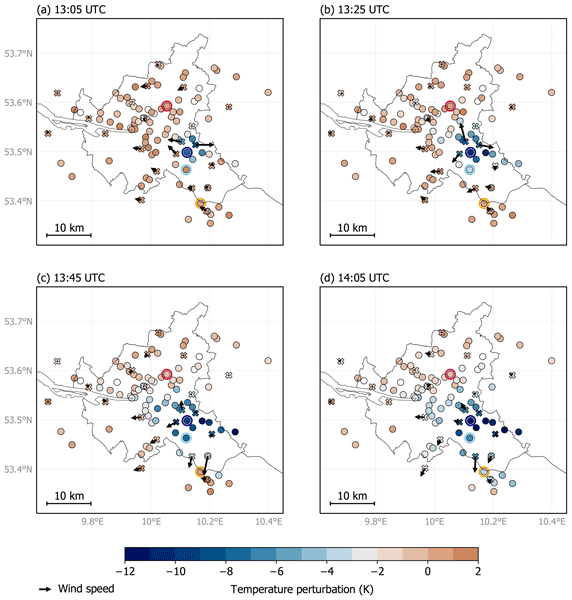
Conventional observation networks are too coarse to resolve the horizontal structure of kilometer-scale atmospheric processes. We present the FESST@HH field experiment that took place in Hamburg (Germany) during summer 2020 and featured a dense network of 103 custom-built, low-cost weather stations. The data set is capable of providing new insights into the structure of convective cold pools and the nocturnal urban heat island and variations of local temperature fluctuations.
Cited articles
Abramian, S., Muller, C., and Risi, C.: Extreme precipitation in tropical squall lines, Journal of Advances in Modeling Earth Systems, 15, e2022MS003477, https://doi.org/10.1029/2022MS003477, 2023. a
Allan, R. P. and Soden, B. J.: Atmospheric warming and the amplification of precipitation extremes, Science, 321, 1481–1484, 2008. a
Alves de Oliveira, B. F., Bottino, M. J., Nobre, P., and Nobre, C. A.: Deforestation and climate change are projected to increase heat stress risk in the Brazilian Amazon, Communications Earth & Environment, 2, 207, https://doi.org/10.1038/s43247-021-00275-8, 2021. a
Back, L. E. and Bretherton, C. S.: On the relationship between SST gradients, boundary layer winds, and convergence over the tropical oceans, Journal of Climate, 22, 4182–4196, 2009. a
Baldocchi, D. and Ma, S.: How will land use affect air temperature in the surface boundary layer? Lessons learned from a comparative study on the energy balance of an oak savanna and annual grassland in California, USA, Tellus B: Chemical and Physical Meteorology, 65, 19994, https://doi.org/10.3402/tellusb.v65i0.19994, 2013. a
Barnett, A., Tong, S., and Clements, A. C.: What measure of temperature is the best predictor of mortality?, Environmental Research, 110, 604–611, 2010. a
Bolton, D.: The computation of equivalent potential temperature, Monthly Weather Review, 108, 1046–1053, 1980. a
Bonan, G. B.: Forests and climate change: forcings, feedbacks, and the climate benefits of forests, Science, 320, 1444–1449, 2008. a
Bottino, M. J., Nobre, P., Giarolla, E., da Silva Junior, M. B., Capistrano, V. B., Malagutti, M., Tamaoki, J. N., De Oliveira, B. F. A., and Nobre, C. A.: Amazon savannization and climate change are projected to increase dry season length and temperature extremes over Brazil, Scientific Reports, 14, 5131, https://doi.org/10.1038/s41598-024-55176-5, 2024. a
Bröde, P., Fiala, D., Błażejczyk, K., Holmér, I., Jendritzky, G., Kampmann, B., Tinz, B., and Havenith, G.: Deriving the operational procedure for the Universal Thermal Climate Index (UTCI), International Journal of Biometeorology, 56, 481–494, 2012. a
Burkart, K., Schneider, A., Breitner, S., Khan, M. H., Krämer, A., and Endlicher, W.: The effect of atmospheric thermal conditions and urban thermal pollution on all-cause and cardiovascular mortality in Bangladesh, Environmental Pollution, 159, 2035–2043, 2011. a
Butt, E. W., Baker, J. C., Bezerra, F. G. S., von Randow, C., Aguiar, A. P., and Spracklen, D. V.: Amazon deforestation causes strong regional warming, Proceedings of the National Academy of Sciences, 120, e2309123120, https://doi.org/10.1073/pnas.2309123120, 2023. a
Crook, N. A. and Moncrieff, M. W.: The effect of large-scale convergence on the generation and maintenance of deep moist convection, Journal of the Atmospheric Sciences, 45, 3606–3624, 1988. a
Dai, A. and Trenberth, K. E.: The diurnal cycle and its depiction in the Community Climate System Model, Journal of Climate, 17, 930–951, 2004. a
Davies, L., Jakob, C., May, P., Kumar, V., and Xie, S.: Relationships between the large-scale atmosphere and the small-scale convective state for Darwin, Australia, Journal of Geophysical Research: Atmospheres, 118, 11534–11545, https://doi.org/10.1002/jgrd.50645, 2013. a, b, c
Duveiller, G., Hooker, J., and Cescatti, A.: The mark of vegetation change on Earth’s surface energy balance, Nature Communications, 9, 679, https://doi.org/10.1038/s41467-017-02810-8, 2018. a
Emori, S. and Brown, S.: Dynamic and thermodynamic changes in mean and extreme precipitation under changed climate, Geophysical Research Letters, 32, https://doi.org/10.1029/2005GL023272, 2005. a
Fowler, H. J., Ali, H., Allan, R. P., Ban, N., Barbero, R., Berg, P., Blenkinsop, S., Cabi, N. S., Chan, S., Dale, M., and Dunn, R. J.: Towards advancing scientific knowledge of climate change impacts on short-duration rainfall extremes, Philosophical Transactions of the Royal Society A, 379, 20190542, https://doi.org/10.1098/rsta.2019.0542, 2021. a
Gao, L., Huang, J., Chen, X., Chen, Y., and Liu, M.: Contributions of natural climate changes and human activities to the trend of extreme precipitation, Atmospheric Research, 205, 60–69, 2018. a
Garstang, M., White, S., Shugart, H., and Halverson, J.: Convective cloud downdrafts as the cause of large blowdowns in the Amazon rainforest, Meteorology and Atmospheric Physics, 67, 199–212, 1998. a
Ge, J., Liu, Q., Zan, B., Lin, Z., Lu, S., Qiu, B., and Guo, W.: Deforestation intensifies daily temperature variability in the northern extratropics, Nature Communications, 13, 5955, https://doi.org/10.1038/s41467-022-33622-0, 2022. a
Gedney, N. and Valdes, P. J.: The effect of Amazonian deforestation on the northern hemisphere circulation and climate, Geophysical Research Letters, 27, 3053–3056, 2000. a
Good, P., Lowe, J. A., Collins, M., and Moufouma-Okia, W.: An objective tropical Atlantic sea surface temperature gradient index for studies of south Amazon dry-season climate variability and change, Philosophical Transactions of the Royal Society B: Biological Sciences, 363, 1761–1766, 2008. a
Guerreiro, S. B., Blenkinsop, S., Lewis, E., Pritchard, D., Green, A., and Fowler, H. J.: Unravelling the complex interplay between daily and sub-daily rainfall extremes in different climates, Weather and Climate Extremes, 100735, https://doi.org/10.1016/j.wace.2024.100735, 2024. a
Heisler-White, J. L., Blair, J. M., Kelly, E. F., Harmoney, K., and Knapp, A. K.: Contingent productivity responses to more extreme rainfall regimes across a grassland biome, Global Change Biology, 15, 2894–2904, 2009. a
Hirota, M., Oyama, M. D., and Nobre, C.: Concurrent climate impacts of tropical South America land-cover change, Atmospheric Science Letters, 12, 261–267, 2011. a
Hohenegger, C., Korn, P., Linardakis, L., Redler, R., Schnur, R., Adamidis, P., Bao, J., Bastin, S., Behravesh, M., Bergemann, M., Biercamp, J., Bockelmann, H., Brokopf, R., Brüggemann, N., Casaroli, L., Chegini, F., Datseris, G., Esch, M., George, G., Giorgetta, M., Gutjahr, O., Haak, H., Hanke, M., Ilyina, T., Jahns, T., Jungclaus, J., Kern, M., Klocke, D., Kluft, L., Kölling, T., Kornblueh, L., Kosukhin, S., Kroll, C., Lee, J., Mauritsen, T., Mehlmann, C., Mieslinger, T., Naumann, A. K., Paccini, L., Peinado, A., Praturi, D. S., Putrasahan, D., Rast, S., Riddick, T., Roeber, N., Schmidt, H., Schulzweida, U., Schütte, F., Segura, H., Shevchenko, R., Singh, V., Specht, M., Stephan, C. C., von Storch, J.-S., Vogel, R., Wengel, C., Winkler, M., Ziemen, F., Marotzke, J., and Stevens, B.: ICON-Sapphire: simulating the components of the Earth system and their interactions at kilometer and subkilometer scales, Geoscientific Model Development, 16, 779–811, https://doi.org/10.5194/gmd-16-779-2023, 2023. a
Janzen, D. H.: Why mountain passes are higher in the tropics, the American Naturalist, 101, 233–249, 1967. a
Johns, R. H. and Doswell III, C. A.: Severe local storms forecasting, Weather and Forecasting, 7, 588–612, 1992. a
Karl, T. R., Knight, R. W., and Plummer, N.: Trends in high-frequency climate variability in the twentieth century, Nature, 377, 217–220, 1995. a
Kendon, E. J., Ban, N., Roberts, N. M., Fowler, H. J., Roberts, M. J., Chan, S. C., Evans, J. P., Fosser, G., and Wilkinson, J. M.: Do convection-permitting regional climate models improve projections of future precipitation change?, Bulletin of the American Meteorological Society, 98, 79–93, 2017. a
King, G. P., Portabella, M., Lin, W., and Stoffelen, A.: Correlating extremes in wind divergence with extremes in rain over the tropical Atlantic, Remote Sensing, 14, 1147, https://doi.org/10.3390/rs14051147, 2022. a
Kotz, M., Wenz, L., Stechemesser, A., Kalkuhl, M., and Levermann, A.: Day-to-day temperature variability reduces economic growth, Nature Climate Change, 11, 319–325, 2021. a
Lawrence, D. and Vandecar, K.: Effects of tropical deforestation on climate and agriculture, Nature Climate Change, 5, 27–36, 2015. a
Leite-Filho, A. T., Costa, M. H., and Fu, R.: The southern Amazon rainy season: the role of deforestation and its interactions with large-scale mechanisms, International Journal of Climatology, 40, 2328–2341, 2020. a
Lemes, M. R., Sampaio, G., Garcia-Carreras, L., Fisch, G., Alves, L. M., Bassett, R., Betts, R., Maksic, J., Shimizu, M. H., Torres, R. R., and Guatura, M.: Impacts on South America moisture transport under Amazon deforestation and 2 °C global warming, Science of the Total Environment, 905, 167407, https://doi.org/10.1016/j.scitotenv.2023.167407, 2023. a
Lenderink, G. and Attema, J.: A simple scaling approach to produce climate scenarios of local precipitation extremes for the Netherlands, Environmental Research Letters, 10, 085001, https://doi.org/10.1088/1748-9326/10/8/085001, 2015. a
Lenderink, G. and Van Meijgaard, E.: Increase in hourly precipitation extremes beyond expectations from temperature changes, Nature Geoscience, 1, 511–514, 2008. a
Liu, S. C., Fu, C., Shiu, C.-J., Chen, J.-P., and Wu, F.: Temperature dependence of global precipitation extremes, Geophysical Research Letters, 36, https://doi.org/10.1029/2009GL040218, 2009. a
Llopart, M., Reboita, M. S., Coppola, E., Giorgi, F., Da Rocha, R. P., and De Souza, D. O.: Land use change over the Amazon Forest and its impact on the local climate, Water, 10, 149, https://doi.org/10.3390/w10020149, 2018. a, b
Malhi, Y., Aragão, L. E., Galbraith, D., Huntingford, C., Fisher, R., Zelazowski, P., Sitch, S., McSweeney, C., and Meir, P.: Exploring the likelihood and mechanism of a climate-change-induced dieback of the Amazon rainforest, Proceedings of the National Academy of Sciences, 106, 20610–20615, 2009. a
Marengo, J. A.: Interannual variability of surface climate in the Amazon basin, International Journal of Climatology, 12, 853–863, 1992. a
May, R. M., Goebbert, K. H., Thielen, J. E., Leeman, J. R., Camron, M. D., Bruick, Z., Bruning, E. C., Manser, R. P., Arms, S. C., and Marsh, P. T.: MetPy: A meteorological Python library for data analysis and visualization, Bulletin of the American Meteorological Society, 103, E2273–E2284, 2022. a
Medvigy, D., Walko, R. L., and Avissar, R.: Effects of deforestation on spatiotemporal distributions of precipitation in South America, Journal of Climate, 24, 2147–2163, 2011. a
Morabito, M., Crisci, A., Messeri, A., Capecchi, V., Modesti, P. A., Gensini, G. F., and Orlandini, S.: Environmental temperature and thermal indices: What is the most effective predictor of heat-related mortality in different geographical contexts?, the Scientific World Journal, 2014, 961750, https://doi.org/10.1155/2014/961750, 2014. a
Mu, Y., Biggs, T. W., and Jones, C.: Importance in shifting circulation patterns for dry season moisture sources in the Brazilian Amazon, Geophysical Research Letters, 50, e2023GL103167, https://doi.org/10.1029/2023GL103167, 2023. a
Nobre, C. A., Sellers, P. J., and Shukla, J.: Amazonian deforestation and regional climate change, Journal of Climate, 4, 957–988, 1991. a
Paccini, L. and Stevens, B.: Assessing precipitation over the Amazon basin as simulated by a storm-resolving model, Journal of Geophysical Research: Atmospheres, 128, e2022JD037436, https://doi.org/10.1029/2022JD037436, 2023. a
Perez, T. M., Stroud, J. T., and Feeley, K. J.: Thermal trouble in the tropics, Science, 351, 1392–1393, 2016. a
Perugini, L., Caporaso, L., Marconi, S., Cescatti, A., Quesada, B., de Noblet-Ducoudré, N., House, J. I., and Arneth, A.: Biophysical effects on temperature and precipitation due to land cover change, Environmental Research Letters, 12, 053002, https://doi.org/10.1088/1748-9326/aa6b3f, 2017. a
Pires, G. F. and Costa, M. H.: Deforestation causes different subregional effects on the Amazon bioclimatic equilibrium, Geophysical Research Letters, 40, 3618–3623, 2013. a
Prein, A. F., Langhans, W., Fosser, G., Ferrone, A., Ban, N., Goergen, K., Keller, M., Tölle, M., Gutjahr, O., Feser, F., and Brisson, E.: A review on regional convection-permitting climate modeling: Demonstrations, prospects, and challenges, Reviews of Geophysics, 53, 323–361, 2015. a
Quine, C. P. and Gardiner, B. A.: Understanding how the interaction of wind and trees results in windthrow, stem breakage, and canopy gap formation, The process and the response, 103–155, 2007. a
RAISG: Deforestación total RAISG, https://apublica.org/wp-content/uploads/2022/09/amazonia-contra-o-relogio-um-diagnostico-regional-sobre-onde-e-como-proteger-80-ate-2025.pdf (last access: 19 August 2025), 2022. a
Reboita, M. S., Ambrizzi, T., Silva, B. A., Pinheiro, R. F., and Da Rocha, R. P.: The South Atlantic subtropical anticyclone: present and future climate, Frontiers in Earth Science, 7, 8, https://doi.org/10.3389/feart.2019.00008, 2019. a
Sampaio, G., Nobre, C., Costa, M. H., Satyamurty, P., Soares-Filho, B. S., and Cardoso, M.: Regional climate change over eastern Amazonia caused by pasture and soybean cropland expansion, Geophysical Research Letters, 34, https://doi.org/10.1029/2007GL030612, 2007. a
Schaefer, J. and Doswell III, C.: The theory and practical application of antitriptic balance, Monthly Weather Review, 108, 746–756, 1980. a
Schmitt, A. U., Ament, F., de Araújo, A. C., Sá, M., and Teixeira, P.: Modeling atmosphere–land interactions at a rainforest site – a case study using Amazon Tall Tower Observatory (ATTO) measurements and reanalysis data, Atmospheric Chemistry and Physics, 23, 9323–9346, https://doi.org/10.5194/acp-23-9323-2023, 2023. a
Schultz, N. M., Lawrence, P. J., and Lee, X.: Global satellite data highlights the diurnal asymmetry of the surface temperature response to deforestation, Journal of Geophysical Research: Biogeosciences, 122, 903–917, 2017. a
Schumacher, R. S. and Rasmussen, K. L.: The formation, character and changing nature of mesoscale convective systems, Nature Reviews Earth & Environment, 1, 300–314, 2020. a
Schwingshackl, C., Sillmann, J., Vicedo-Cabrera, A. M., Sandstad, M., and Aunan, K.: Heat stress indicators in CMIP6: estimating future trends and exceedances of impact-relevant thresholds, Earth's Future, 9, e2020EF001885, https://doi.org/10.1029/2020EF001885, 2021. a, b, c, d
Smith, M. D.: An ecological perspective on extreme climatic events: a synthetic definition and framework to guide future research, Journal of Ecology, 99, 656–663, 2011. a
Spangler, K. R., Liang, S., and Wellenius, G. A.: Wet-bulb globe temperature, universal thermal climate index, and other heat metrics for US Counties, 2000–2020, Scientific Data, 9, 326, https://doi.org/10.1038/s41597-022-01405-3, 2022. a
Stein, U. and Alpert, P.: Factor separation in numerical simulations, Journal of Atmospheric Sciences, 50, 2107–2115, 1993. a
Sud, Y., Shukla, J., and Mintz, Y.: Influence of land surface roughness on atmospheric circulation and precipitation: A sensitivity study with a general circulation model, Journal of Applied Meteorology, 27, 1036–1054, 1988. a
Swann, A. L., Longo, M., Knox, R. G., Lee, E., and Moorcroft, P. R.: Future deforestation in the Amazon and consequences for South American climate, Agricultural and Forest Meteorology, 214, 12–24, 2015. a
Thompson, R. M., Beardall, J., Beringer, J., Grace, M., and Sardina, P.: Means and extremes: building variability into community-level climate change experiments, Ecology Letters, 16, 799–806, 2013. a
Tiedtke, M.: A comprehensive mass flux scheme for cumulus parameterization in large-scale models, Monthly Weather Review, 117, 1779–1800, 1989. a
Trenberth, K. E.: Conceptual framework for changes of extremes of the hydrological cycle with climate change, Climatic Change, 42, 327–339, 1999. a
Viscardi, L. A. M., Torri, G., Adams, D. K., and Barbosa, H. D. M. J.: Environmental controls on isolated convection during the Amazonian wet season, Atmospheric Chemistry and Physics, 24, 8529–8548, https://doi.org/10.5194/acp-24-8529-2024, 2024. a
Voldoire, A. and Royer, J.: Tropical deforestation and climate variability, Climate Dynamics, 22, 857–874, 2004. a
Wang, K., Wang, L., Wei, Y.-M., and Ye, M.: Beijing storm of July 21, 2012: observations and reflections, Natural Hazards, 67, 969–974, 2013. a
Winckler, J., Reick, C. H., Bright, R. M., and Pongratz, J.: Importance of surface roughness for the local biogeophysical effects of deforestation, Journal of Geophysical Research: Atmospheres, 124, 8605–8618, 2019. a
Windmiller, J., Bao, J., Sherwood, S., Schanzer, T., and Fuchs, D.: Predicting convective downdrafts from updrafts and environmental conditions in a global storm resolving simulation, Journal of Advances in Modeling Earth Systems, 15, e2022MS003048, https://doi.org/10.1029/2022MS003048, 2023. a, b
Wright, S. J., MULLER-LANDAU, H. C., and Schipper, J.: The future of tropical species on a warmer planet, Conservation Biology, 23, 1418–1426, 2009. a
Yoon, A.: Scripts for processing data and plotting figures for “Extreme events in the Amazon after deforestation”, Edmond Open Research Data Repository [data set], https://doi.org/10.17617/3.NYLGAN, 2025. a
Zhan, Z., Zhao, Y., Pang, S., Zhong, X., Wu, C., and Ding, Z.: Temperature change between neighboring days and mortality in United States: a nationwide study, Science of the Total Environment, 584, 1152–1161, 2017. a
Short summary
We studied how removing the Amazon rainforest impacts extreme weather by using an advanced global model that resolves convection. Our results show deforestation significantly intensifies short but severe rainfall, leading to more frequent droughts and flooding. Temperatures rise sharply, creating dangerous heat conditions harmful to human health and productivity. Wind speeds drastically increase. These findings provide a stark warning of the effects of continuing deforestation of the Amazon.
We studied how removing the Amazon rainforest impacts extreme weather by using an advanced...


Altmetrics
Final-revised paper
Preprint