
Articles | Volume 17, issue 5
https://doi.org/10.5194/esd-17-1551-2026
© Author(s) 2026. This work is distributed under
the Creative Commons Attribution 4.0 License.
the Creative Commons Attribution 4.0 License.
https://doi.org/10.5194/esd-17-1551-2026
© Author(s) 2026. This work is distributed under
the Creative Commons Attribution 4.0 License.
the Creative Commons Attribution 4.0 License.
Research article
| 
20 Oct 2026
Research article |
| 20 Oct 2026
| 20 Oct 2026
Benchmarking conditioners in Liang–Kleeman Information Flow: application to land–atmosphere interactions in humid forests
Fareeha Siddique
School of Remote Sensing and Geomatics Engineering, Nanjing University of Information Science and Technology, 210044 Nanjing, Jiangsu, China
Daniel Fiifi Tawia Hagan
Hydro-Climate Extreme Lab, Ghent University, 9000 Ghent, Belgium

School of Remote Sensing and Geomatics Engineering, Nanjing University of Information Science and Technology, 210044 Nanjing, Jiangsu, China
David Docquier
Dynamical Meteorology and Climatology Unit, Royal Meteorological Institute of Belgium, Avenue Circulaire, 3, 1180 Brussels, Belgium
Stéphane Vannitsem
School of Physical and Mathematical Sciences, Nanyang Technological University, Singapore
The Asian School of the Environment, Nanyang Technological University, Singapore
Related authors
Rukhshinda Aftab, Daniel Fiifi Tawia Hagan, Guojie Wang, Baoying Shan, Syed Husnain Shah, Zhou Chensi, Wei Xikun, Fareeha Siddique, Ali Hasan Jaffry, and Emmanuel Yeboah
Earth Syst. Sci. Data Discuss., https://doi.org/10.5194/essd-2026-313, https://doi.org/10.5194/essd-2026-313, 2026
Revised manuscript accepted for ESSD
Short summary
Short summary
This study provides a daily global compound dry–hot index and a companion event catalogue that records individual events, covering 1961 to 2023 at 0.1° resolution. Based on soil moisture and temperature, these datasets reveal that compound dry–hot extremes have become more frequent and longer lasting in many regions, especially in recent decades. This work improves global monitoring of climate risks and their possible impacts on water, ecosystems, and agriculture.
Martin Bonte, Lesley De Cruz, Fabian Debal, and Stéphane Vannitsem
Weather Clim. Dynam., 7, 1837–1852, https://doi.org/10.5194/wcd-7-1837-2026, https://doi.org/10.5194/wcd-7-1837-2026, 2026
Short summary
Short summary
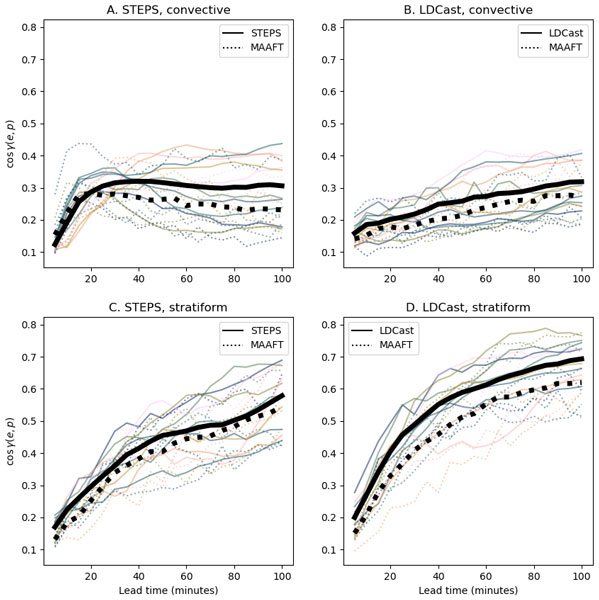
The predictability of the generative AI-based nowcasting model LDCast is evaluated over Belgium, together with the pysteps implementation of the nowcasting algorithm STEPS. It appears that the ensembles of both models correctly estimate the error size through their spread, but fail at spatially representing the error. The analysis is done for two dynamically different types of events, showing how the models adapt their ensembles depending on the situation.
Stéphane Vannitsem and Jonathan Demaeyer
EGUsphere, https://doi.org/10.5194/egusphere-2026-3631, https://doi.org/10.5194/egusphere-2026-3631, 2026
Short summary
Short summary
The tropical atmosphere is found to be more predictable than other regions in the world. In the present paper, however, we show that predictability is considerably limited when considering simplified versions of the atmospheric dynamics, contrasting with the common idea. These results open therefore new questions on the specific sources of higher predictability in the tropical atmosphere.
Rukhshinda Aftab, Daniel Fiifi Tawia Hagan, Guojie Wang, Baoying Shan, Syed Husnain Shah, Zhou Chensi, Wei Xikun, Fareeha Siddique, Ali Hasan Jaffry, and Emmanuel Yeboah
Earth Syst. Sci. Data Discuss., https://doi.org/10.5194/essd-2026-313, https://doi.org/10.5194/essd-2026-313, 2026
Revised manuscript accepted for ESSD
Short summary
Short summary
This study provides a daily global compound dry–hot index and a companion event catalogue that records individual events, covering 1961 to 2023 at 0.1° resolution. Based on soil moisture and temperature, these datasets reveal that compound dry–hot extremes have become more frequent and longer lasting in many regions, especially in recent decades. This work improves global monitoring of climate risks and their possible impacts on water, ecosystems, and agriculture.
Benjamin Richaud, François Massonnet, Thierry Fichefet, Dániel Topál, Antoine Barthélemy, and David Docquier
The Cryosphere, 20, 791–810, https://doi.org/10.5194/tc-20-791-2026, https://doi.org/10.5194/tc-20-791-2026, 2026
Short summary
Short summary
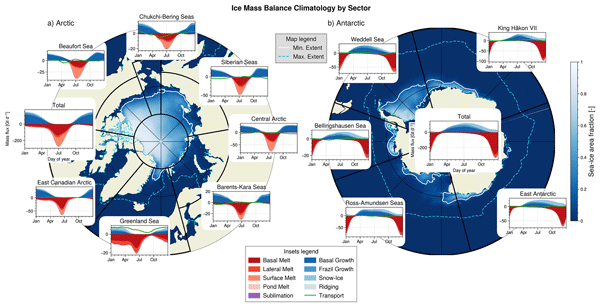
Sea ice covers in the Arctic and Antarctic experienced intense reduction during specific recent years. Using an ocean-sea ice model, we found similarities between hemispheres and years to explain the ice reduction, such as ice melt (or lack of growth) at the ice-ocean interface. Differences between years and regions are also evident, such as increased ice transport or snow precipitation. Our analysis highlights the importance of the ice-ocean interface to understand the sea ice mass budget.
Elke Debrie, Jonathan Demaeyer, and Stéphane Vannitsem
Earth Syst. Sci. Data, 17, 6405–6421, https://doi.org/10.5194/essd-17-6405-2025, https://doi.org/10.5194/essd-17-6405-2025, 2025
Short summary
Short summary
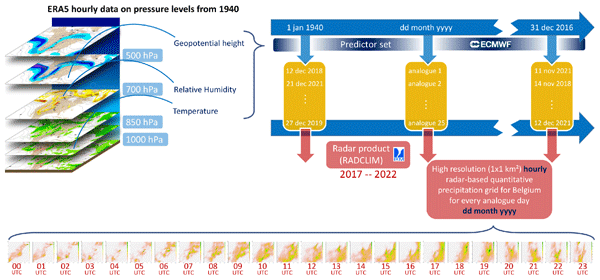
In this project, we developed a gridded hourly precipitation dataset for Belgium, covering over 70 years (1940–2016). The data has a spatial resolution of one kilometer, which means it provides highly localized precipitation information. To estimate precipitation for a specific day in the past, we searched for days in the recent radar data period with similar weather patterns, known as the analog method. The median of the produced dataset is available for public use and can be found on Zenodo.
Annelies Sticker, François Massonnet, Thierry Fichefet, Patricia DeRepentigny, Alexandra Jahn, David Docquier, Christopher Wyburn-Powell, Daphne Quint, Erica Shivers, and Makayla Ortiz
The Cryosphere, 19, 3259–3277, https://doi.org/10.5194/tc-19-3259-2025, https://doi.org/10.5194/tc-19-3259-2025, 2025
Short summary
Short summary
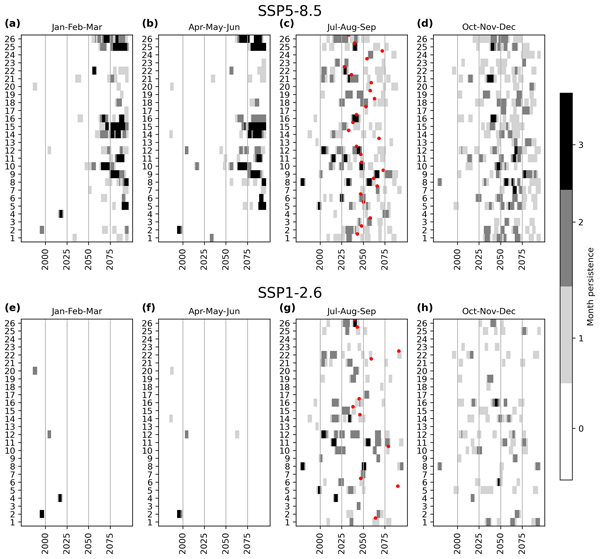
Our study analyzes rapid ice loss events (RILEs) in the Arctic, which are significant reductions in sea ice extent. RILEs are expected throughout the year, varying in frequency and duration with the seasons. Our research gives a year-round analysis of their characteristics in climate models and suggests that summer RILEs could begin before the middle of the century. Understanding these events is crucial as they can have profound impacts on the Arctic environment.
Martin Bonte and Stéphane Vannitsem
Nonlin. Processes Geophys., 32, 139–165, https://doi.org/10.5194/npg-32-139-2025, https://doi.org/10.5194/npg-32-139-2025, 2025
Short summary
Short summary
In recent years, there have been more and more floods due to intense precipitation, such as the July 2021 event in Belgium. Predicting precipitation is a difficult task, even just for the next few hours. This study focuses on a tool that assesses whether a given situation is stable or not (i.e., whether it is likely to stay as it is or could evolve in an unpredictable manner).
Stéphane Vannitsem, X. San Liang, and Carlos A. Pires
Earth Syst. Dynam., 16, 703–719, https://doi.org/10.5194/esd-16-703-2025, https://doi.org/10.5194/esd-16-703-2025, 2025
Short summary
Short summary
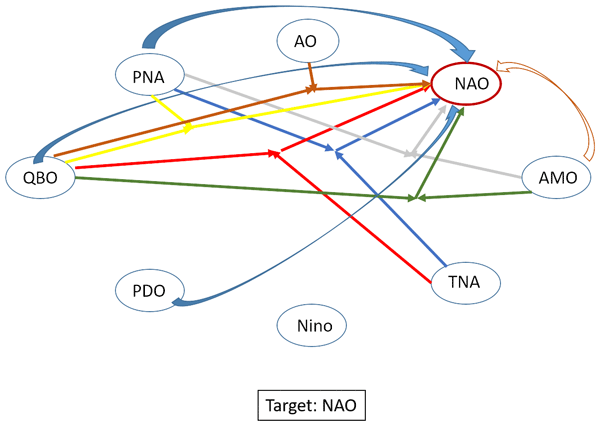
Large-scale modes of variability are present in the climate system. These modes are known to have influences on each other but are usually viewed as linear influences. The nonlinear connections among a set of key climate indices are explored here using tools from information theory, which allow us to characterize the causality between indices. It was found that quadratic nonlinear dependencies between climate indices are present at low frequencies, reflecting the complex nature of their dynamics.
Anupama K. Xavier, Jonathan Demaeyer, and Stéphane Vannitsem
Earth Syst. Dynam., 15, 893–912, https://doi.org/10.5194/esd-15-893-2024, https://doi.org/10.5194/esd-15-893-2024, 2024
Short summary
Short summary
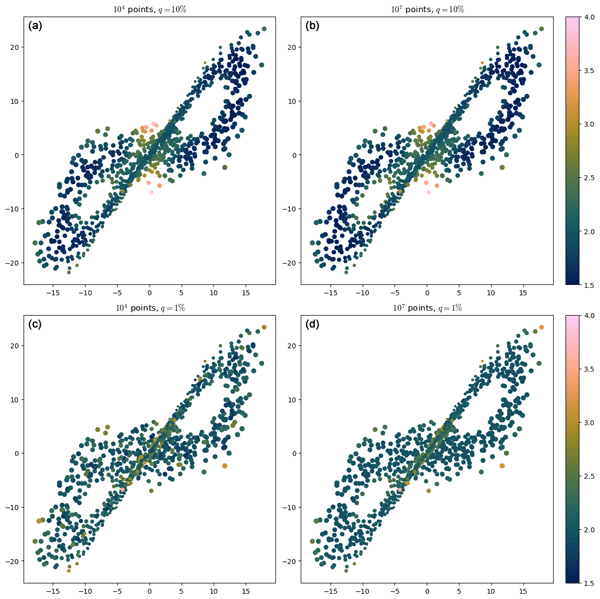
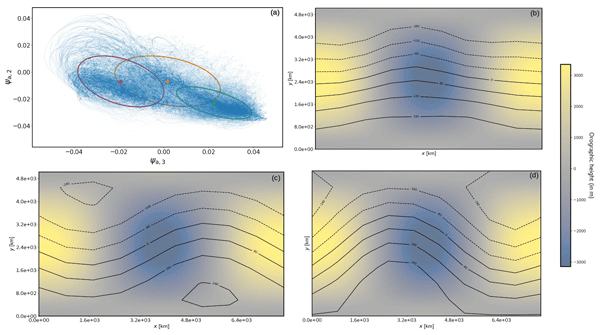
This research focuses on understanding different atmospheric patterns like blocking, zonal, and transition regimes and analyzing their predictability. We used an idealized land–atmosphere coupled model to simulate Earth's atmosphere. Then we identified these blocking, zonal, and transition regimes using Gaussian mixture clustering and studied their predictability using Lyapunov exponents.
David Docquier, Giorgia Di Capua, Reik V. Donner, Carlos A. L. Pires, Amélie Simon, and Stéphane Vannitsem
Nonlin. Processes Geophys., 31, 115–136, https://doi.org/10.5194/npg-31-115-2024, https://doi.org/10.5194/npg-31-115-2024, 2024
Short summary
Short summary
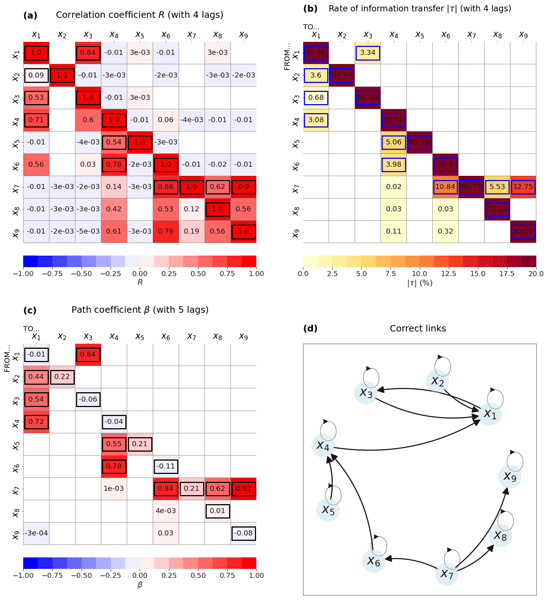
Identifying causes of specific processes is crucial in order to better understand our climate system. Traditionally, correlation analyses have been used to identify cause–effect relationships in climate studies. However, correlation does not imply causation, which justifies the need to use causal methods. We compare two independent causal methods and show that these are superior to classical correlation analyses. We also find some interesting differences between the two methods.
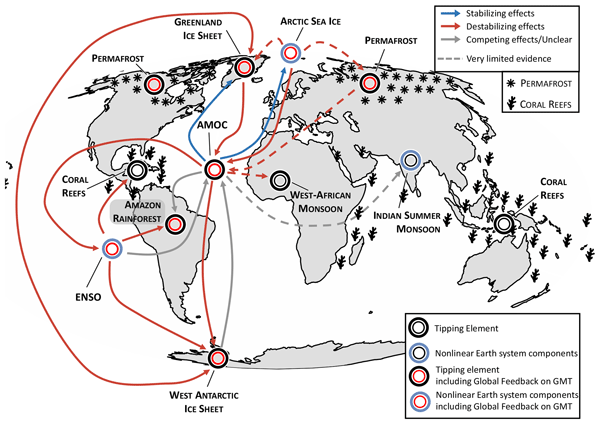
Nico Wunderling, Anna S. von der Heydt, Yevgeny Aksenov, Stephen Barker, Robbin Bastiaansen, Victor Brovkin, Maura Brunetti, Victor Couplet, Thomas Kleinen, Caroline H. Lear, Johannes Lohmann, Rosa Maria Roman-Cuesta, Sacha Sinet, Didier Swingedouw, Ricarda Winkelmann, Pallavi Anand, Jonathan Barichivich, Sebastian Bathiany, Mara Baudena, John T. Bruun, Cristiano M. Chiessi, Helen K. Coxall, David Docquier, Jonathan F. Donges, Swinda K. J. Falkena, Ann Kristin Klose, David Obura, Juan Rocha, Stefanie Rynders, Norman Julius Steinert, and Matteo Willeit
Earth Syst. Dynam., 15, 41–74, https://doi.org/10.5194/esd-15-41-2024, https://doi.org/10.5194/esd-15-41-2024, 2024
Short summary
Short summary
This paper maps out the state-of-the-art literature on interactions between tipping elements relevant for current global warming pathways. We find indications that many of the interactions between tipping elements are destabilizing. This means that tipping cascades cannot be ruled out on centennial to millennial timescales at global warming levels between 1.5 and 2.0 °C or on shorter timescales if global warming surpasses 2.0 °C.
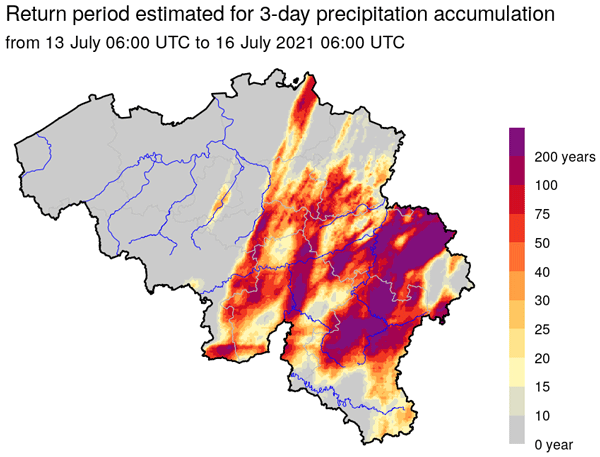
Michel Journée, Edouard Goudenhoofdt, Stéphane Vannitsem, and Laurent Delobbe
Hydrol. Earth Syst. Sci., 27, 3169–3189, https://doi.org/10.5194/hess-27-3169-2023, https://doi.org/10.5194/hess-27-3169-2023, 2023
Short summary
Short summary
The exceptional flood of July 2021 in central Europe impacted Belgium severely. This study aims to characterize rainfall amounts in Belgium from 13 to 16 July 2021 based on observational data (i.e., rain gauge data and a radar-based rainfall product). The spatial and temporal distributions of rainfall during the event aredescribed. In order to document such a record-breaking event as much as possible, the rainfall data are shared with the scientific community on Zenodo for further studies.
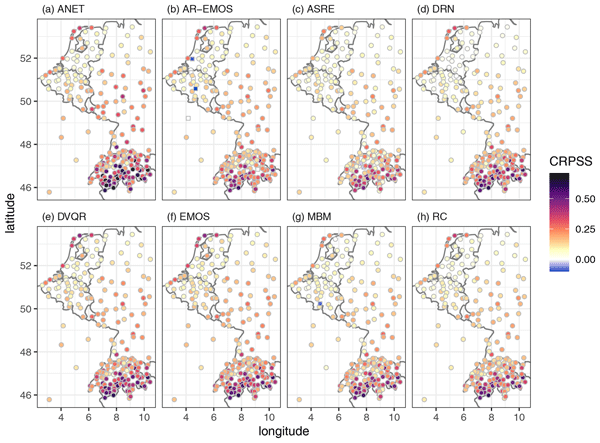
Jonathan Demaeyer, Jonas Bhend, Sebastian Lerch, Cristina Primo, Bert Van Schaeybroeck, Aitor Atencia, Zied Ben Bouallègue, Jieyu Chen, Markus Dabernig, Gavin Evans, Jana Faganeli Pucer, Ben Hooper, Nina Horat, David Jobst, Janko Merše, Peter Mlakar, Annette Möller, Olivier Mestre, Maxime Taillardat, and Stéphane Vannitsem
Earth Syst. Sci. Data, 15, 2635–2653, https://doi.org/10.5194/essd-15-2635-2023, https://doi.org/10.5194/essd-15-2635-2023, 2023
Short summary
Short summary
A benchmark dataset is proposed to compare different statistical postprocessing methods used in forecasting centers to properly calibrate ensemble weather forecasts. This dataset is based on ensemble forecasts covering a portion of central Europe and includes the corresponding observations. Examples on how to download and use the data are provided, a set of evaluation methods is proposed, and a first benchmark of several methods for the correction of 2 m temperature forecasts is performed.
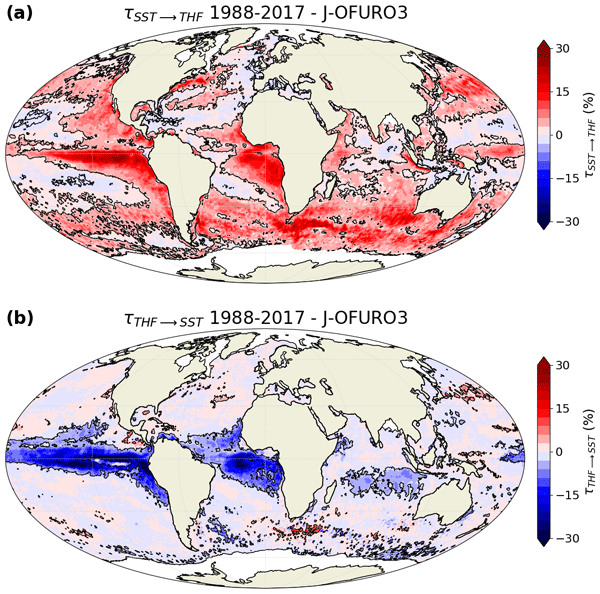
David Docquier, Stéphane Vannitsem, and Alessio Bellucci
Earth Syst. Dynam., 14, 577–591, https://doi.org/10.5194/esd-14-577-2023, https://doi.org/10.5194/esd-14-577-2023, 2023
Short summary
Short summary
The climate system is strongly regulated by interactions between the ocean and atmosphere. However, many uncertainties remain in the understanding of these interactions. Our analysis uses a relatively novel approach to quantify causal links between the ocean surface and lower atmosphere based on satellite observations. We find that both the ocean and atmosphere influence each other but with varying intensity depending on the region, demonstrating the power of causal methods.

Stéphane Vannitsem
Nonlin. Processes Geophys., 30, 1–12, https://doi.org/10.5194/npg-30-1-2023, https://doi.org/10.5194/npg-30-1-2023, 2023
Short summary
Short summary
The impact of climate change on weather pattern dynamics over the North Atlantic is explored through the lens of information theory. These tools allow the predictability of the succession of weather patterns and the irreversible nature of the dynamics to be clarified. It is shown that the predictability is increasing in the observations, while the opposite trend is found in model projections. The irreversibility displays an overall increase in time in both the observations and the model runs.
David Docquier, Stéphane Vannitsem, Alessio Bellucci, and Claude Frankignoul
EGUsphere, https://doi.org/10.5194/egusphere-2022-1340, https://doi.org/10.5194/egusphere-2022-1340, 2022
Preprint withdrawn
Short summary
Short summary
Understanding whether variations in ocean heat content are driven by air-sea heat fluxes or by ocean dynamics is of crucial importance to enhance climate projections. We use a relatively novel causal method to quantify interactions between ocean heat budget terms based on climate models. We find that low-resolution models overestimate the influence of ocean dynamics in the upper ocean, and that changes in ocean heat content are dominated by air-sea fluxes at high resolution.
Steve Delhaye, Thierry Fichefet, François Massonnet, David Docquier, Rym Msadek, Svenya Chripko, Christopher Roberts, Sarah Keeley, and Retish Senan
Weather Clim. Dynam., 3, 555–573, https://doi.org/10.5194/wcd-3-555-2022, https://doi.org/10.5194/wcd-3-555-2022, 2022
Short summary
Short summary
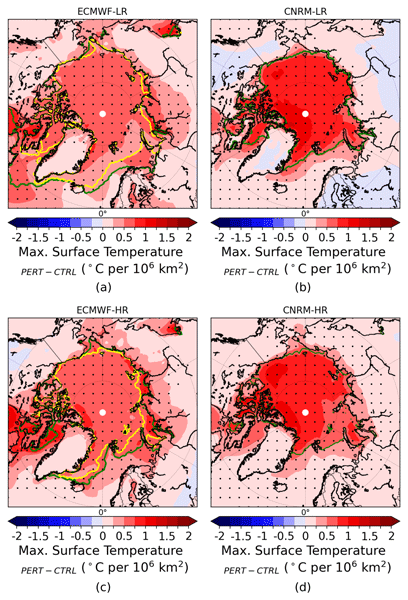
It is unclear how the atmosphere will respond to a retreat of summer Arctic sea ice. Much attention has been paid so far to weather extremes at mid-latitude and in winter. Here we focus on the changes in extremes in surface air temperature and precipitation over the Arctic regions in summer during and following abrupt sea ice retreats. We find that Arctic sea ice loss clearly shifts the extremes in surface air temperature and precipitation over terrestrial regions surrounding the Arctic Ocean.
Nicolas Ghilain, Stéphane Vannitsem, Quentin Dalaiden, Hugues Goosse, Lesley De Cruz, and Wenguang Wei
Earth Syst. Sci. Data, 14, 1901–1916, https://doi.org/10.5194/essd-14-1901-2022, https://doi.org/10.5194/essd-14-1901-2022, 2022
Short summary
Short summary
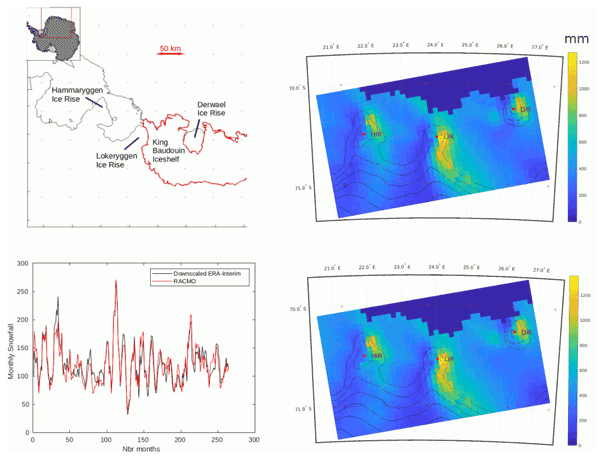
Modeling the climate at high resolution is crucial to represent the snowfall accumulation over the complex orography of the Antarctic coast. While ice cores provide a view constrained spatially but over centuries, climate models can give insight into its spatial distribution, either at high resolution over a short period or vice versa. We downscaled snowfall accumulation from climate model historical simulations (1850–present day) over Dronning Maud Land at 5.5 km using a statistical method.
Ralf Döscher, Mario Acosta, Andrea Alessandri, Peter Anthoni, Thomas Arsouze, Tommi Bergman, Raffaele Bernardello, Souhail Boussetta, Louis-Philippe Caron, Glenn Carver, Miguel Castrillo, Franco Catalano, Ivana Cvijanovic, Paolo Davini, Evelien Dekker, Francisco J. Doblas-Reyes, David Docquier, Pablo Echevarria, Uwe Fladrich, Ramon Fuentes-Franco, Matthias Gröger, Jost v. Hardenberg, Jenny Hieronymus, M. Pasha Karami, Jukka-Pekka Keskinen, Torben Koenigk, Risto Makkonen, François Massonnet, Martin Ménégoz, Paul A. Miller, Eduardo Moreno-Chamarro, Lars Nieradzik, Twan van Noije, Paul Nolan, Declan O'Donnell, Pirkka Ollinaho, Gijs van den Oord, Pablo Ortega, Oriol Tintó Prims, Arthur Ramos, Thomas Reerink, Clement Rousset, Yohan Ruprich-Robert, Philippe Le Sager, Torben Schmith, Roland Schrödner, Federico Serva, Valentina Sicardi, Marianne Sloth Madsen, Benjamin Smith, Tian Tian, Etienne Tourigny, Petteri Uotila, Martin Vancoppenolle, Shiyu Wang, David Wårlind, Ulrika Willén, Klaus Wyser, Shuting Yang, Xavier Yepes-Arbós, and Qiong Zhang
Geosci. Model Dev., 15, 2973–3020, https://doi.org/10.5194/gmd-15-2973-2022, https://doi.org/10.5194/gmd-15-2973-2022, 2022
Short summary
Short summary
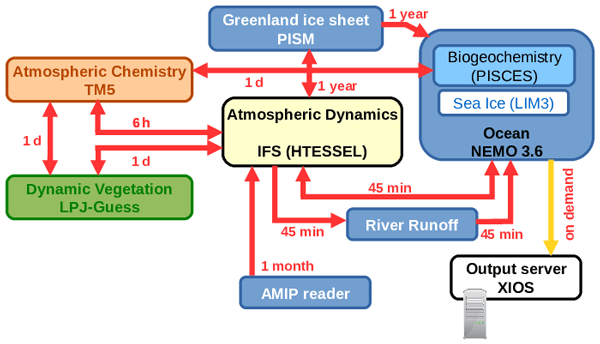
The Earth system model EC-Earth3 is documented here. Key performance metrics show physical behavior and biases well within the frame known from recent models. With improved physical and dynamic features, new ESM components, community tools, and largely improved physical performance compared to the CMIP5 version, EC-Earth3 represents a clear step forward for the only European community ESM. We demonstrate here that EC-Earth3 is suited for a range of tasks in CMIP6 and beyond.
Cited articles
Benjamini, Y. and Hochberg, Y.: Controlling the false discovery rate: A practical and powerful approach to multiple testing, J. R. Stat. Soc., 57, 289–300, http://www.jstor.org/stable/2346101 (last access: 10 September 2026), 1995.
Cui, J., Piao, S., Huntingford, C., Wang, X., Lian, X., Chevuturi, A., Turner, A. G., and Kooperman, G. J.: Vegetation forcing modulates global land monsoon and water resources in a CO2-enriched climate, Nat. Commun., 11, 1–11, https://doi.org/10.1038/s41467-020-18992-7, 2020.
Docquier, D., Vannitsem, S., and Bellucci, A.: The rate of information transfer as a measure of ocean–atmosphere interactions, Earth Syst. Dynam., 14, 577–591, https://doi.org/10.5194/esd-14-577-2023, 2023.
Docquier, D., Di Capua, G., Donner, R. V., Pires, C. A. L., Simon, A., and Vannitsem, S.: A comparison of two causal methods in the context of climate analyses, Nonlin. Processes Geophys., 31, 115–136, https://doi.org/10.5194/npg-31-115-2024, 2024.
D'Orangeville, L., Houle, D., Duchesne, L., Phillips, R. P., Bergeron, Y., and Kneeshaw, D.: Beneficial effects of climate warming on boreal tree growth may be transitory, Nat. Commun., 9, 3213, https://doi.org/10.1038/s41467-018-05705-4, 2018.
Dubey, N. and Ghosh, S.: The relative role of soil moisture and vapor pressure deficit in affecting the Indian vegetation productivity, Environ. Res. Lett., 18, 064012, https://doi.org/10.1088/1748-9326/acd2ef, 2023.
Feldpausch, T. R., Phillips, O. L., Brienen, R. J. W., Gloor, E., Lloyd, J., Lopez-Gonzalez, G., Monteagudo-Mendoza, A., Malhi, Y., Alarcón, A., Álvarez Dávila, E., Alvarez-Loayza, P., Andrade, A., Aragao, L. E. O. C., Arroyo, L., Aymard C., G. A., Baker, T. R., Baraloto, C., Barroso, J., Bonal, D., Castro, W., Chama, V., Chave, J., Domingues, T. F., Fauset, S., Groot, N., Honorio Coronado, E., Laurance, S., Laurance, W. F., Lewis, S. L., Licona, J. C., Marimon, B. S., Marimon-Junior, B. H., Mendoza Bautista, C., Neill, D. A., Oliveira, E. A., Oliveira dos Santos, C., Pallqui Camacho, N. C., Pardo-Molina, G., Prieto, A., Quesada, C. A., Ramírez, F., Ramírez-Angulo, H., Réjou-Méchain, M., Rudas, A., Saiz, G., Salomão, R. P., Silva-Espejo, J. E., Silveira, M., ter Steege, H., Stropp, J., Terborgh, J., Thomas-Caesar, R., van der Heijden, G. M. F., Vásquez Martinez, R., Vilanova, E., and Vos, V. A.: Amazon forest response to repeated droughts, Global Biogeochem. Cy., 30, 964–982, https://doi.org/10.1002/2015GB005133, 2016.
Ficklin, D. L. and Novick, K. A.: Historic and projected changes in vapor pressure deficit suggest a continental-scale drying of the United States atmosphere, J. Geophys. Res.-Atmos., 122, 2061–2079, https://doi.org/10.1002/2016JD025855, 2017.
Fu, Z., Ciais, P., Prentice, I. C., Gentine, P., Makowski, D., Bastos, A., Luo, X., Green, J. K., Stoy, P. C., Yang, H., and Hajima, T.: Atmospheric dryness reduces photosynthesis along a large range of soil water deficits, Nat. Commun., 13, 989, https://doi.org/10.1038/s41467-022-28652-7, 2022.
Green, J. K., Konings, A. G., Alemohammad, S. H., Berry, J., Entekhabi, D., Kolassa, J., Lee, J. E., and Gentine, P.: Regionally strong feedbacks between the atmosphere and terrestrial biosphere, Nat. Geosci., 10, 410–414, https://doi.org/10.1038/ngeo2957, 2017.
Green, J. K., Seneviratne, S. I., Berg, A. M., Findell, K. L., Hagemann, S., Lawrence, D. M., and Gentine, P.: Large influence of soil moisture on long-term terrestrial carbon uptake, Nature, 565, 476–479, https://doi.org/10.1038/s41586-018-0848-x, 2019.
Hagan, D. F. T., Wang, G., Liang, X. S., and Dolman, H. A. J.: A time-varying causality formalism based on the Liang-Kleeman information flow for analyzing directed interactions in nonstationary climate systems, J. Climate, 32, 7521–7537, https://doi.org/10.1175/JCLI-D-18-0881.1, 2019.
Krich, C., Runge, J., Miralles, D. G., Migliavacca, M., Perez-Priego, O., El-Madany, T., Carrara, A., and Mahecha, M. D.: Estimating causal networks in biosphere–atmosphere interaction with the PCMCI approach, Biogeosciences, 17, 1033–1061, https://doi.org/10.5194/bg-17-1033-2020, 2020.
Liang, X. S.: The Liang–Kleeman information flow: Theory and applications, Entropy, 15, 327–360, https://doi.org/10.3390/e15010327, 2013.
Liang, X. S.: Unraveling the cause–effect relation between time series, Phys. Rev. E, 90, 052150, https://doi.org/10.1103/PhysRevE.90.052150, 2014.
Liang, X. S.: Information flow and causality as rigorous notions ab initio, Phys. Rev. E, 94, 052201, https://doi.org/10.1103/PhysRevE.94.052201, 2016.
Liang, X. S.: Normalized multivariate time series causality analysis and causal graph reconstruction, Entropy, 23, 679, https://doi.org/10.3390/e23060679, 2021.
Liang, S., Cheng, J., Jia, K., Jiang, B., Liu, Q., Xiao, Z., Yao, Y., Yuan, W., Zhang, X., Zhao, X., and Zhou, J.: The global land surface satellite (GLASS) product suite, B. Am. Meteorol. Soc., 102, E323–E337, https://doi.org/10.1175/BAMS-D-18-0341.1, 2021.
Liu, J. and Pu, Z.: Does soil moisture have an influence on near-surface temperature?, J. Geophys. Res.-Atmos., 124, 6444–6466, https://doi.org/10.1029/2018JD029750, 2019.
Liu, L., Gudmundsson, L., Hauser, M., Qin, D., Li, S., and Seneviratne, S. I.: Soil moisture dominates dryness stress on ecosystem production globally, Nat. Commun., 11, 1–10, https://doi.org/10.1038/s41467-020-18631-1, 2020.
Novick, K. A., Ficklin, D. L., Stoy, P. C., Williams, C. A., Bohrer, G., Oishi, A. C., Papuga, S. A., Blanken, P. D., Noormets, A., Sulman, B. N., Scott, R. L., Wang, L., and Phillips, R. P.: The increasing importance of atmospheric demand for ecosystem water and carbon fluxes, Nat. Clim. Change, 6, 1023–1027, https://doi.org/10.1038/nclimate3114, 2016.
Papagiannopoulou, C., Miralles, D. G., Dorigo, W. A., Verhoest, N. E. C., Depoorter, M., and Waegeman, W.: Vegetation anomalies caused by antecedent precipitation in most of the world, Environ. Res. Lett., 12, 074016, https://doi.org/10.1088/1748-9326/aa7145, 2017.
Piao, S., Wang, X., Park, T., Chen, C., Lian, X., He, Y., Bjerke, J. W., Chen, A., Ciais, P., Tømmervik, H., Nemani, R. R., and Myneni, R. B.: Characteristics, drivers and feedbacks of global greening, Nat. Rev. Earth Environ., 1, 14–27, https://doi.org/10.1038/s43017-019-0001-x, 2020.
Pires, C. A., Docquier, D., and Vannitsem, S.: A general theory to estimate information transfer in nonlinear systems, Physica D, 458, 133988, https://doi.org/10.1016/j.physd.2023.133988, 2024.
Ruddell, B. L. and Kumar, P.: Ecohydrologic process networks: 1. Identification, Water Resour. Res., 45, W03419, https://doi.org/10.1029/2008WR007279, 2009.
Shao, Y., Hagan, D. F. T., Li, S., Zhou, F., Zou, X., and Cabral, P.: The many shades of the vegetation–climate causality: A multimodel causal appreciation, Forests, 15, 81430, https://doi.org/10.3390/f15081430, 2024.
Siddique, F.: Conditioners-LKIF, version 1.0.0, Zenodo [code], https://doi.org/10.5281/zenodo.23409186, 2026.
Sperry, J. S., Venturas, M. D., Anderegg, W. R. L., Mencuccini, M., Mackay, D. S., Wang, Y., and Love, D. M.: Predicting stomatal responses to the environment from the optimization of photosynthetic gain and hydraulic cost, Plant Cell Environ., 40, 816–830, https://doi.org/10.1111/pce.12852, 2017.
Stips, A., Macias, D., Coughlan, C., Garcia-Gorriz, E., and Liang, X. S.: On the causal structure between CO2 and global temperature, Sci. Rep., 6, 21691, https://doi.org/10.1038/srep21691, 2016.
Sun, C. and Yang, S.: Persistent severe drought in southern China during winter–spring 2011: Large-scale circulation patterns and possible impacting factors, J. Geophys. Res.-Atmos., 117, D10112, https://doi.org/10.1029/2012JD017500, 2012.
Sun, J., Yang, K., He, X., Wang, G., Wang, Y., Yu, Y., and Lu, H.: Causal pathways underlying global soil moisture–precipitation coupling, Nat. Commun., 16, 893, https://doi.org/10.1038/s41467-025-63999-7, 2025.
Takaya, Y., Ganeshi, N. G., Kosaka, Y., Liang, X. S., and Sato, T.: Influence of soil moisture on surface air temperature in monsoons, Geophys. Res. Lett., 52, e2025GL115760, https://doi.org/10.1029/2025GL115760, 2025.
Upreti, H. and Ojha, C. S. P.: Estimation of relative humidity and dew point temperature using limited meteorological data, J. Irrig. Drain. Eng., 143, 04017034, https://doi.org/10.1061/(ASCE)IR.1943-4774.0001225, 2017.
Vannitsem, S., Pires, C. A., and Docquier, D.: Causal dependencies and Shannon entropy budget: Analysis of a reduced-order atmospheric model, Q. J. Roy. Meteor. Soc., 150, 4066–4085, https://doi.org/10.1002/qj.4805, 2024.
Vannitsem, S., Liang, X. S., and Pires, C. A.: Nonlinear causal dependencies as a signature of the complexity of the climate dynamics, Earth Syst. Dynam., 16, 703–719, https://doi.org/10.5194/esd-16-703-2025, 2025.
Van Passel, J., Bernardino, P. N., Lhermitte, S., Rius, B. F., Hirota, M., Conradi, T., de Keersmaecker, W., Van Meerbeek, K., and Somers, B.: Critical slowing down of the Amazon forest after increased drought occurrence, P. Natl. Acad. Sci. USA, 121, e2316924121, https://doi.org/10.1073/pnas.2316924121, 2024.
Wilks, D. S.: The Stippling Shows Statistically Significant Grid Points: How Research Results are Routinely Overstated and Overinterpreted, and What to Do about It, B. Am. Meteorol. Soc., 97, 2263–2273, https://doi.org/10.1175/BAMS-D-15-00267.1, 2016.
Xie, J., Yin, G., Xie, Q., Wu, C., Yuan, W., Zeng, Y., Verger, A., Descals, A., Filella, I., and Peñuelas, J.: Shifts in Climatic limitations on Global vegetation productivity unveiled by Shapley Additive Explanation: Reduced Temperature but increased water limitations, J. Geophys. Res.-Biogeo., 129, e2024JG008354, https://doi.org/10.1029/2024JG008354, 2024.
Yuan, W., Zheng, Y., Piao, S., Ciais, P., Lombardozzi, D., Wang, Y., Ryu, Y., Chen, G., Dong, W., Hu, Z., Jain, A. K., Jiang, C., Kato, E., Li, S., Lienert, S., Liu, S., Nabel, J. E. M. S., Qin, Z., Quine, T., Sitch, S., Smith, W. K., Wang, F., Wu, C., Xiao, Z., and Yang, S.: Increased atmospheric vapor pressure deficit reduces global vegetation growth, Sci. Adv., 5, eaax1396, https://doi.org/10.1126/sciadv.aax1396, 2019.
Zhong, Z., He, B., Wang, Y.-P., Chen, H. W., Chen, D., Fu, Y. H., Chen, Y., Guo, L., Deng, Y., Huang, L., Yuan, W., Hao, X., Tang, R., Liu, H., Sun, L., Xie, X., and Zhang, Y.: Disentangling the effects of vapor pressure deficit on northern terrestrial vegetation productivity, Sci. Adv., 9, adf3166, https://doi.org/10.1126/sciadv.adf3166, 2023.
Zhou, F., Hagan, D. F. T., Wang, G., Liang, X. S., Li, S., Shao, Y., Yeboah, E., and Wei, X.: Estimating time-dependent structures in a multivariate causality for land–atmosphere interactions, J. Climate, 37, 1853–1876, https://doi.org/10.1175/JCLI-D-23-0207.1, 2024.
Zhou, S., Williams, A. P., Berg, A. M., Cook, B. I., Zhang, Y., Hagemann, S., Lorenz, R., Seneviratne, S. I., and Gentine, P.: Land–atmosphere feedbacks exacerbate concurrent soil drought and atmospheric aridity, P. Natl. Acad. Sci. USA, 116, 18848–18853, https://doi.org/10.1073/pnas.1904955116, 2019.
Short summary
Understanding causality in Earth-system processes is challenging because multiple drivers act simultaneously and can distort causal estimates. We develop a diagnostic framework using controlled experiments and real land–atmosphere data to identify when external drivers affect how one variable influences another (via Liang–Kleeman Information Flow). This influence depends on system stress, guiding when multivariate conditioning is necessary.
Understanding causality in Earth-system processes is challenging because multiple drivers act...


Altmetrics
Final-revised paper
Preprint