
Articles | Volume 17, issue 1
https://doi.org/10.5194/esd-17-107-2026
© Author(s) 2026. This work is distributed under
the Creative Commons Attribution 4.0 License.
the Creative Commons Attribution 4.0 License.
https://doi.org/10.5194/esd-17-107-2026
© Author(s) 2026. This work is distributed under
the Creative Commons Attribution 4.0 License.
the Creative Commons Attribution 4.0 License.
Research article
| 
16 Jan 2026
Research article |
| 16 Jan 2026
| 16 Jan 2026
A theoretical framework to understand sources of error in Earth System Model emulation

Department of Aeronautics and Astronautics, Massachusetts Institute of Technology, Cambridge, MA, USA
Center for Sustainability Science and Strategy, Massachusetts Institute of Technology, Cambridge, MA, USA
Glenn Flierl
Department of Earth, Atmospheric, and Planetary Sciences, Massachusetts Institute of Technology, Cambridge, MA, USA
Shahine Bouabid
Department of Earth, Atmospheric, and Planetary Sciences, Massachusetts Institute of Technology, Cambridge, MA, USA
Andre N. Souza
Department of Earth, Atmospheric, and Planetary Sciences, Massachusetts Institute of Technology, Cambridge, MA, USA
Paolo Giani
Center for Sustainability Science and Strategy, Massachusetts Institute of Technology, Cambridge, MA, USA
Department of Earth, Atmospheric, and Planetary Sciences, Massachusetts Institute of Technology, Cambridge, MA, USA
Sebastian D. Eastham
Brahmal Vasudevan Institute for Sustainable Aviation, Department of Aeronautics, Imperial College London, London, UK
Center for Sustainability Science and Strategy, Massachusetts Institute of Technology, Cambridge, MA, USA
Department of Earth, Atmospheric, and Planetary Sciences, Massachusetts Institute of Technology, Cambridge, MA, USA
Institute for Data, Systems, and Society, Massachusetts Institute of Technology, Cambridge, MA, USA
Related authors
No articles found.
Caleb Akhtar Martínez, Annemarie Lottermoser, Simon Unterstrasser, Sebastian D. Eastham, and Jerome P. Jarrett
EGUsphere, https://doi.org/10.5194/egusphere-2026-5576, https://doi.org/10.5194/egusphere-2026-5576, 2026
This preprint is open for discussion and under review for Atmospheric Chemistry and Physics (ACP).
Short summary
Short summary
We study how different computer models predict the climate impact of contrails, the ice clouds that form behind aircraft. Efforts to reduce their impact depend on these models. By comparing simpler and more detailed models under the same weather conditions, we find that modelling choices can lead to substantially different results, even when comparing models of similar complexity. This suggests that contrail mitigation decisions should be made in a way that is robust to modelling differences.
Sebastian David Eastham, Hamid Reza Abbasi, Marc E. J. Stettler, Tristan Abbott, and Zebediah Engberg
EGUsphere, https://doi.org/10.5194/egusphere-2026-4489, https://doi.org/10.5194/egusphere-2026-4489, 2026
This preprint is open for discussion and under review for Geoscientific Model Development (GMD).
Short summary
Short summary
Aircraft condensation trails (contrails) have been estimated as being responsible for up to half of aviation's overall climate impacts, but this is subject to high uncertainty and few contrail models are fast enough to support rapid exploration of the parameter space. We present CLAMP, a new contrail model designed to simulate a 12-hour contrail in less than a minute while providing results similar to higher-fidelity approaches.
Anthony Y. H. Wong, Sebastian D. Eastham, Erwan Monier, and Noelle E. Selin
Geosci. Model Dev., 19, 3335–3360, https://doi.org/10.5194/gmd-19-3335-2026, https://doi.org/10.5194/gmd-19-3335-2026, 2026
Short summary
Short summary
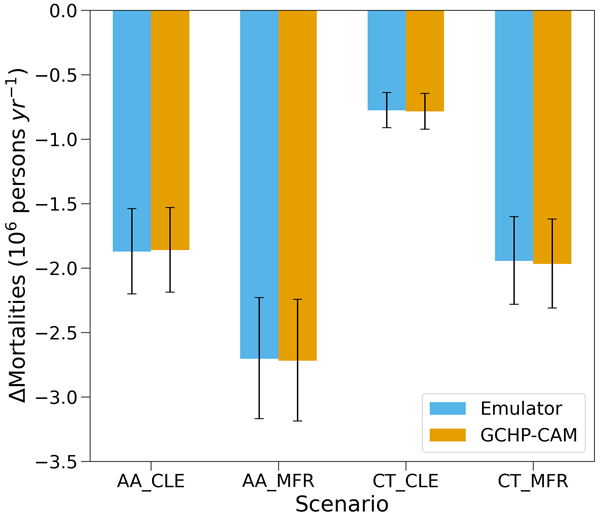
We developed a fast and accurate computer tool that predicts how air pollution will change around the world under different climate and policy choices. Using machine learning and real model data, our tool can estimate changes in harmful fine particulate pollution in seconds instead of thousands of hours. This makes it easier for researchers and policymakers to explore future air quality and health impacts under a wide range of scenarios.
Charikleia Gournia, Noelle E. Selin, and Aryeh Feinberg
Atmos. Chem. Phys., 26, 5039–5061, https://doi.org/10.5194/acp-26-5039-2026, https://doi.org/10.5194/acp-26-5039-2026, 2026
Short summary
Short summary
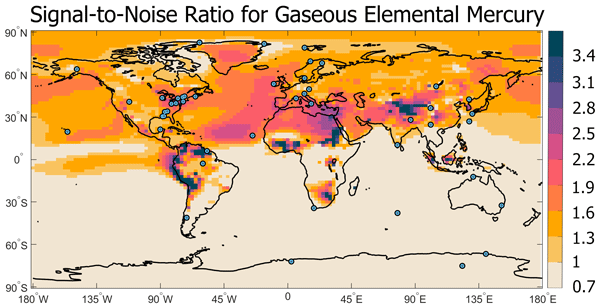
Human activities release mercury into the air, but current estimates of these emissions vary widely. Our study examines how the uncertainty in global anthropogenic mercury emission estimates impacts the model's ability to reproduce observations. We found that differences in emissions inventories significantly change results, especially in Asia. The work highlights where increased monitoring is needed to improve estimates and better inform global mercury reduction policies.
Gosha Geogdzhayev, Andre N. Souza, Glenn R. Flierl, and Raffaele Ferrari
Earth Syst. Dynam., 17, 235–263, https://doi.org/10.5194/esd-17-235-2026, https://doi.org/10.5194/esd-17-235-2026, 2026
Short summary
Short summary
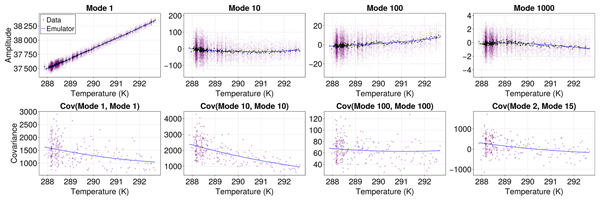
Climate models serve as good guesses of how humans affect the climate, but they cannot explore all possible future scenarios of interest. We develop a method that can serve as a fast and cheap stand-in to evaluate likely changes in variables like surface temperature and relative humidity at a regional scale in arbitrary future climates. Crucially, our method captures relationships between different geographic areas and predicts both average values and likely ranges using a unified framework.
Caleb Akhtar Martínez, Sebastian D. Eastham, and Jerome P. Jarrett
Atmos. Chem. Phys., 25, 12875–12891, https://doi.org/10.5194/acp-25-12875-2025, https://doi.org/10.5194/acp-25-12875-2025, 2025
Short summary
Short summary
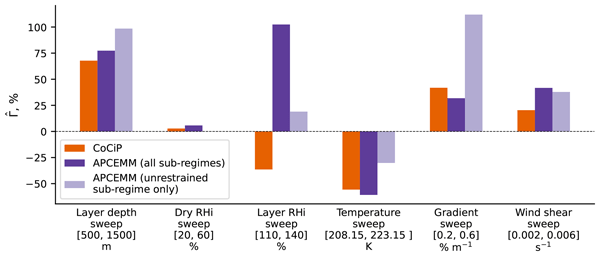
Contrails are clouds that form behind aircraft and can warm the atmosphere as much as carbon dioxide emissions from those planes. This work compares two contrail models of different complexities to understand their lifecycle and impact. The models differ in how contrails evolve over time, implying that we may be significantly underestimating their climate impact. This highlights the need for model diversity and more evaluation against observations of long-lived contrails.
William J. Collins, Fiona M. O'Connor, Rachael E. Byrom, Øivind Hodnebrog, Patrick Jöckel, Mariano Mertens, Gunnar Myhre, Matthias Nützel, Dirk Olivié, Ragnhild Bieltvedt Skeie, Laura Stecher, Larry W. Horowitz, Vaishali Naik, Gregory Faluvegi, Ulas Im, Lee T. Murray, Drew Shindell, Kostas Tsigaridis, Nathan Luke Abraham, and James Keeble
Atmos. Chem. Phys., 25, 9031–9060, https://doi.org/10.5194/acp-25-9031-2025, https://doi.org/10.5194/acp-25-9031-2025, 2025
Short summary
Short summary
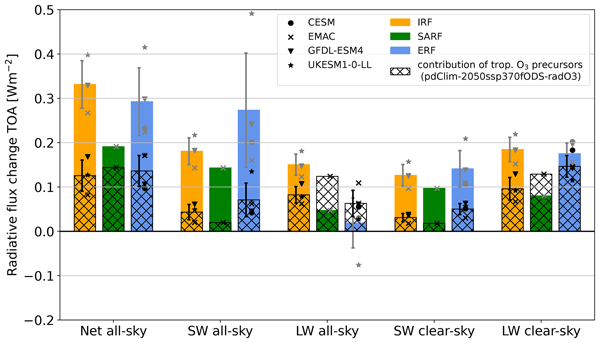
We used 7 climate models that include atmospheric chemistry and find that in a scenario with weak controls on air quality, the warming effects (over 2015 to 2050) of decreases in ozone-depleting substances and increases in air quality pollutants are approximately equal and would make ozone the second highest contributor to warming over this period. We find that for stratospheric ozone recovery, the standard measure of climate effects underestimates a more comprehensive measure.
Ashu Dastoor, Hélène Angot, Johannes Bieser, Flora Brocza, Brock Edwards, Aryeh Feinberg, Xinbin Feng, Benjamin Geyman, Charikleia Gournia, Yipeng He, Ian M. Hedgecock, Ilia Ilyin, Jane Kirk, Che-Jen Lin, Igor Lehnherr, Robert Mason, David McLagan, Marilena Muntean, Peter Rafaj, Eric M. Roy, Andrei Ryjkov, Noelle E. Selin, Francesco De Simone, Anne L. Soerensen, Frits Steenhuisen, Oleg Travnikov, Shuxiao Wang, Xun Wang, Simon Wilson, Rosa Wu, Qingru Wu, Yanxu Zhang, Jun Zhou, Wei Zhu, and Scott Zolkos
Geosci. Model Dev., 18, 2747–2860, https://doi.org/10.5194/gmd-18-2747-2025, https://doi.org/10.5194/gmd-18-2747-2025, 2025
Short summary
Short summary
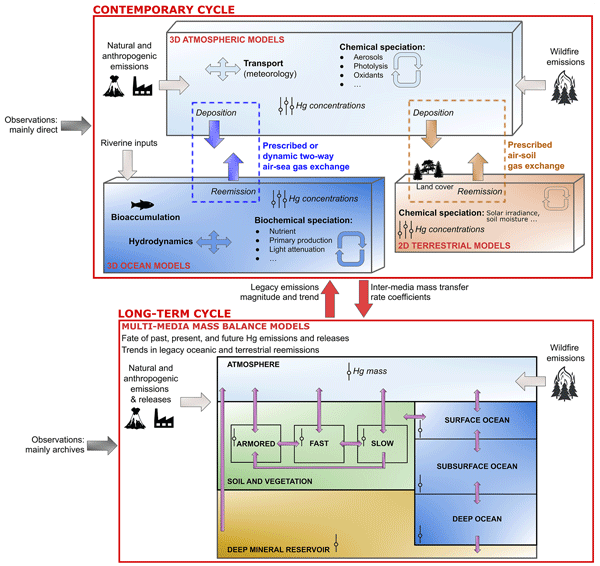
This paper introduces the Multi-Compartment Mercury (Hg) Modeling and Analysis Project (MCHgMAP) aimed at informing the effectiveness evaluations of two multilateral environmental agreements: the Minamata Convention on Mercury and the Convention on Long-Range Transboundary Air Pollution. The experimental design exploits a variety of models (atmospheric, land, oceanic ,and multimedia mass balance models) to assess the short- and long-term influences of anthropogenic Hg releases into the environment.
Vincent R. Meijer, Sebastian D. Eastham, Ian A. Waitz, and Steven R. H. Barrett
Atmos. Meas. Tech., 17, 6145–6162, https://doi.org/10.5194/amt-17-6145-2024, https://doi.org/10.5194/amt-17-6145-2024, 2024
Short summary
Short summary
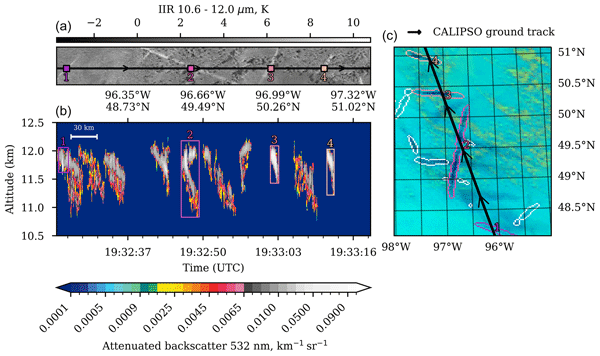
Aviation's climate impact is partly due to contrails: the clouds that form behind aircraft and which can linger for hours under certain atmospheric conditions. Accurately forecasting these conditions could allow aircraft to avoid forming these contrails and thus reduce their environmental footprint. Our research uses deep learning to identify three-dimensional contrail locations in two-dimensional satellite imagery, which can be used to assess and improve these forecasts.
Haipeng Lin, Louisa K. Emmons, Elizabeth W. Lundgren, Laura Hyesung Yang, Xu Feng, Ruijun Dang, Shixian Zhai, Yunxiao Tang, Makoto M. Kelp, Nadia K. Colombi, Sebastian D. Eastham, Thibaud M. Fritz, and Daniel J. Jacob
Atmos. Chem. Phys., 24, 8607–8624, https://doi.org/10.5194/acp-24-8607-2024, https://doi.org/10.5194/acp-24-8607-2024, 2024
Short summary
Short summary
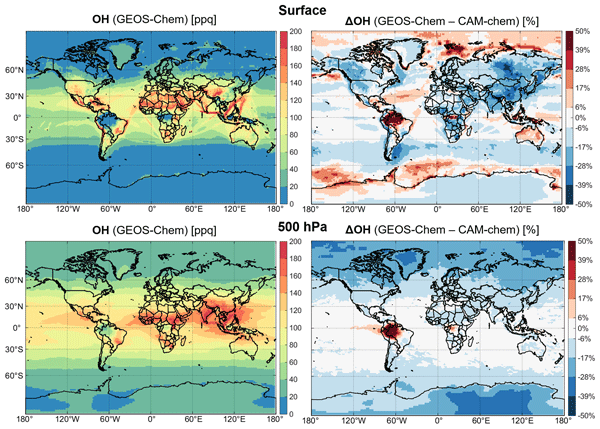
Tropospheric ozone is a major air pollutant, a greenhouse gas, and a major indicator of model skill. Global atmospheric chemistry models show large differences in simulations of tropospheric ozone, but isolating sources of differences is complicated by different model environments. By implementing the GEOS-Chem model side by side to CAM-chem within a common Earth system model, we identify and evaluate specific differences between the two models and their impacts on key chemical species.
Irene C. Dedoussi, Daven K. Henze, Sebastian D. Eastham, Raymond L. Speth, and Steven R. H. Barrett
Geosci. Model Dev., 17, 5689–5703, https://doi.org/10.5194/gmd-17-5689-2024, https://doi.org/10.5194/gmd-17-5689-2024, 2024
Short summary
Short summary
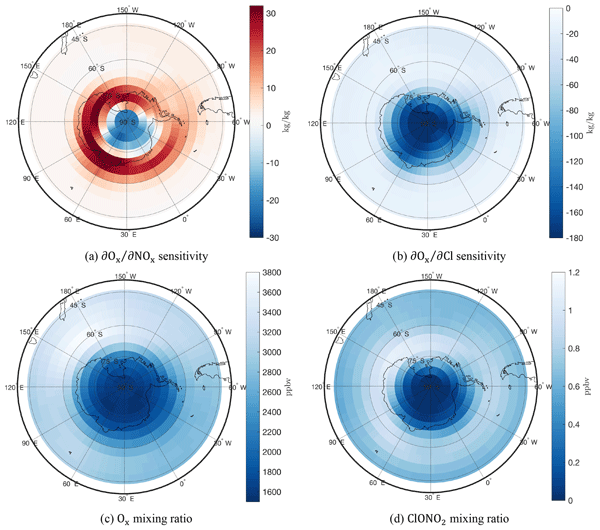
Atmospheric model gradients provide a meaningful tool for better understanding the underlying atmospheric processes. Adjoint modeling enables computationally efficient gradient calculations. We present the adjoint of the GEOS-Chem unified chemistry extension (UCX). With this development, the GEOS-Chem adjoint model can capture stratospheric ozone and other processes jointly with tropospheric processes. We apply it to characterize the Antarctic ozone depletion potential of active halogen species.
Sebastian D. Eastham, Guillaume P. Chossière, Raymond L. Speth, Daniel J. Jacob, and Steven R. H. Barrett
Atmos. Chem. Phys., 24, 2687–2703, https://doi.org/10.5194/acp-24-2687-2024, https://doi.org/10.5194/acp-24-2687-2024, 2024
Short summary
Short summary
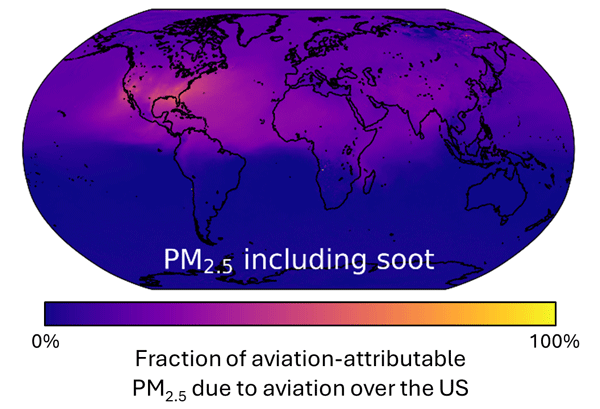
Emissions from aircraft are known to cause air quality impacts worldwide, but the scale and mechanisms of this impact are not well understood. This work uses high-resolution computational modeling of the atmosphere to show that air pollution changes from aviation are mostly the result of emissions during cruise (high-altitude) operations, that these impacts are related to how much non-aviation pollution is present, and that prior regional assessments have underestimated these impacts.
Ruijun Dang, Daniel J. Jacob, Viral Shah, Sebastian D. Eastham, Thibaud M. Fritz, Loretta J. Mickley, Tianjia Liu, Yi Wang, and Jun Wang
Atmos. Chem. Phys., 23, 6271–6284, https://doi.org/10.5194/acp-23-6271-2023, https://doi.org/10.5194/acp-23-6271-2023, 2023
Short summary
Short summary
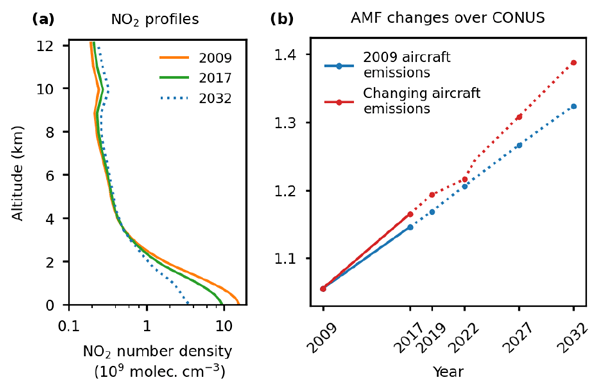
We use the GEOS-Chem model to better understand the magnitude and trend in free tropospheric NO2 over the contiguous US. Model underestimate of background NO2 is largely corrected by considering aerosol nitrate photolysis. Increase in aircraft emissions affects satellite retrievals by altering the NO2 shape factor, and this effect is expected to increase in future. We show the importance of properly accounting for the free tropospheric background in interpreting NO2 observations from space.
Fangqun Yu, Gan Luo, Arshad Arjunan Nair, Sebastian Eastham, Christina J. Williamson, Agnieszka Kupc, and Charles A. Brock
Atmos. Chem. Phys., 23, 1863–1877, https://doi.org/10.5194/acp-23-1863-2023, https://doi.org/10.5194/acp-23-1863-2023, 2023
Short summary
Short summary
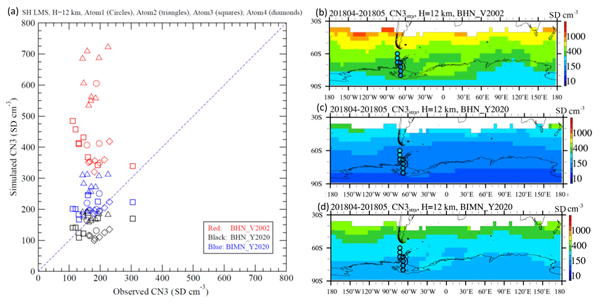
Particle number concentrations and size distributions in the stratosphere are studied through model simulations and comparisons with measurements. The nucleation scheme used in most of the solar geoengineering modeling studies overpredicts the nucleation rates and particle number concentrations in the stratosphere. The model based on updated nucleation schemes captures reasonably well some aspects of particle size distributions but misses some features. The possible reasons are discussed.
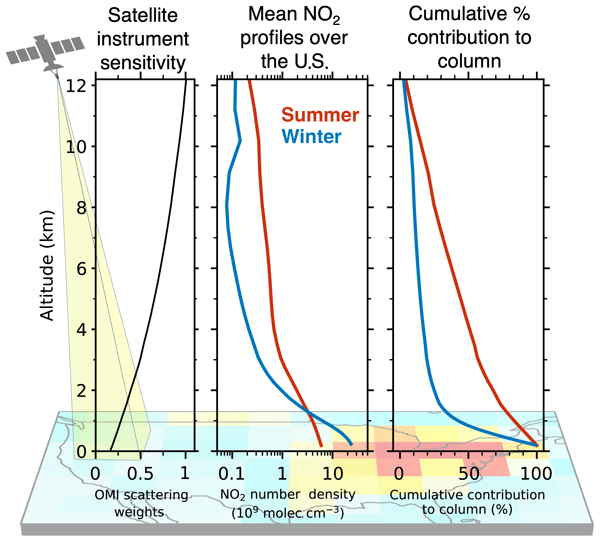
Viral Shah, Daniel J. Jacob, Ruijun Dang, Lok N. Lamsal, Sarah A. Strode, Stephen D. Steenrod, K. Folkert Boersma, Sebastian D. Eastham, Thibaud M. Fritz, Chelsea Thompson, Jeff Peischl, Ilann Bourgeois, Ilana B. Pollack, Benjamin A. Nault, Ronald C. Cohen, Pedro Campuzano-Jost, Jose L. Jimenez, Simone T. Andersen, Lucy J. Carpenter, Tomás Sherwen, and Mat J. Evans
Atmos. Chem. Phys., 23, 1227–1257, https://doi.org/10.5194/acp-23-1227-2023, https://doi.org/10.5194/acp-23-1227-2023, 2023
Short summary
Short summary
NOx in the free troposphere (above 2 km) affects global tropospheric chemistry and the retrieval and interpretation of satellite NO2 measurements. We evaluate free tropospheric NOx in global atmospheric chemistry models and find that recycling NOx from its reservoirs over the oceans is faster than that simulated in the models, resulting in increases in simulated tropospheric ozone and OH. Over the U.S., free tropospheric NO2 contributes the majority of the tropospheric NO2 column in summer.
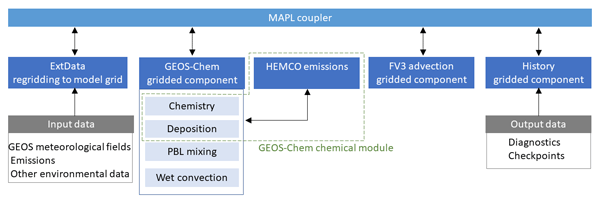
Randall V. Martin, Sebastian D. Eastham, Liam Bindle, Elizabeth W. Lundgren, Thomas L. Clune, Christoph A. Keller, William Downs, Dandan Zhang, Robert A. Lucchesi, Melissa P. Sulprizio, Robert M. Yantosca, Yanshun Li, Lucas Estrada, William M. Putman, Benjamin M. Auer, Atanas L. Trayanov, Steven Pawson, and Daniel J. Jacob
Geosci. Model Dev., 15, 8731–8748, https://doi.org/10.5194/gmd-15-8731-2022, https://doi.org/10.5194/gmd-15-8731-2022, 2022
Short summary
Short summary
Atmospheric chemistry models must be able to operate both online as components of Earth system models and offline as standalone models. The widely used GEOS-Chem model operates both online and offline, but the classic offline version is not suitable for massively parallel simulations. We describe a new generation of the offline high-performance GEOS-Chem (GCHP) that enables high-resolution simulations on thousands of cores, including on the cloud, with improved access, performance, and accuracy.
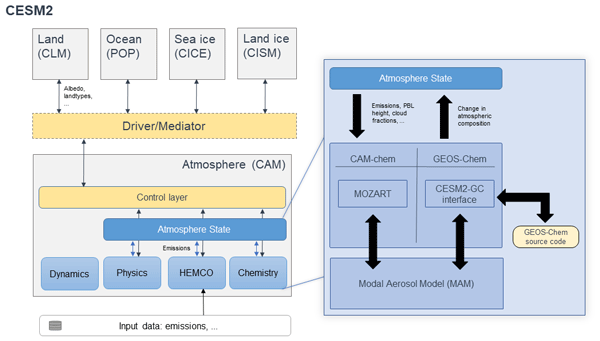
Thibaud M. Fritz, Sebastian D. Eastham, Louisa K. Emmons, Haipeng Lin, Elizabeth W. Lundgren, Steve Goldhaber, Steven R. H. Barrett, and Daniel J. Jacob
Geosci. Model Dev., 15, 8669–8704, https://doi.org/10.5194/gmd-15-8669-2022, https://doi.org/10.5194/gmd-15-8669-2022, 2022
Short summary
Short summary
We bring the state-of-the-science chemistry module GEOS-Chem into the Community Earth System Model (CESM). We show that some known differences between results from GEOS-Chem and CESM's CAM-chem chemistry module may be due to the configuration of model meteorology rather than inherent differences in the model chemistry. This is a significant step towards a truly modular Earth system model and allows two strong but currently separate research communities to benefit from each other's advances.

William Atkinson, Sebastian D. Eastham, Y.-H. Henry Chen, Jennifer Morris, Sergey Paltsev, C. Adam Schlosser, and Noelle E. Selin
Geosci. Model Dev., 15, 7767–7789, https://doi.org/10.5194/gmd-15-7767-2022, https://doi.org/10.5194/gmd-15-7767-2022, 2022
Short summary
Short summary
Understanding policy effects on human-caused air pollutant emissions is key for assessing related health impacts. We develop a flexible scenario tool that combines updated emissions data sets, long-term economic modeling, and comprehensive technology pathways to clarify the impacts of climate and air quality policies. Results show the importance of both policy levers in the future to prevent long-term emission increases from offsetting near-term air quality improvements from existing policies.
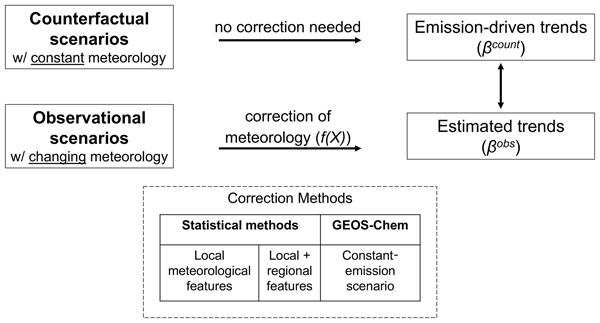
Minghao Qiu, Corwin Zigler, and Noelle E. Selin
Atmos. Chem. Phys., 22, 10551–10566, https://doi.org/10.5194/acp-22-10551-2022, https://doi.org/10.5194/acp-22-10551-2022, 2022
Short summary
Short summary
Evaluating impacts of emission changes on air quality requires accounting for meteorological variability. Many studies use simple regression methods to correct for meteorology, but little is known about their performance. Using cases in the US and China, we show that widely used regression models do not perform well and can lead to biased estimates of emission-driven trends. We propose a novel machine learning method with lower bias and provide recommendations to policymakers and researchers.
Mara Freilich, Alexandre Mignot, Glenn Flierl, and Raffaele Ferrari
Biogeosciences, 18, 5595–5607, https://doi.org/10.5194/bg-18-5595-2021, https://doi.org/10.5194/bg-18-5595-2021, 2021
Short summary
Short summary
Observations reveal that in some regions phytoplankton biomass increases during the wintertime when growth conditions are sub-optimal, which has been attributed to a release from grazing during mixed layer deepening. Measurements of grazer populations to support this theory are lacking. We demonstrate that a release from grazing when the winter mixed layer is deepening holds only for certain grazing models, extending the use of phytoplankton observations to make inferences about grazer dynamics.
Cited articles
Addison, H., Kendon, E., Ravuri, S., Aitchison, L., and Watson, P. A.: Machine learning emulation of precipitation from km-scale regional climate simulations using a diffusion model, arXiv [preprint], arXiv:2407.14158, https://doi.org/10.48550/arXiv.2407.14158, 2024. a
Armour, K. C., Bitz, C. M., and Roe, G. H.: Time-Varying Climate Sensitivity from Regional Feedbacks, J. Climate, 26, 4518–4534, https://doi.org/10.1175/JCLI-D-12-00544.1, 2013. a, b
Bassetti, S., Hutchinson, B., Tebaldi, C., and Kravitz, B.: DiffESM: Conditional Emulation of Temperature and Precipitation in Earth System Models With 3D Diffusion Models, J. Adv. Model. Earth Sy., 16, e2023MS004194, https://doi.org/10.1029/2023MS004194, 2024. a, b, c
Beusch, L., Gudmundsson, L., and Seneviratne, S. I.: Emulating Earth system model temperatures with MESMER: from global mean temperature trajectories to grid-point-level realizations on land, Earth Syst. Dynam., 11, 139–159, https://doi.org/10.5194/esd-11-139-2020, 2020. a, b
Blanusa, M. L., López-Zurita, C. J., and Rasp, S.: Internal variability plays a dominant role in global climate projections of temperature and precipitation extremes, Clim. Dynam., 61, 1931–1945, https://doi.org/10.1007/s00382-023-06664-3, 2023. a
Bloch-Johnson, J., Rugenstein, M. A. A., Alessi, M. J., Proistosescu, C., Zhao, M., Zhang, B., Williams, A. I. L., Gregory, J. M., Cole, J., Dong, Y., Duffy, M. L., Kang, S. M., and Zhou, C.: The Green's Function Model Intercomparison Project (GFMIP) Protocol, J. Adv. Model. Earth Sy., 16, e2023MS003700, https://doi.org/10.1029/2023MS003700, 2024. a, b
Bouabid, S., Sejdinovic, D., and Watson-Parris, D.: FaIRGP: A Bayesian Energy Balance Model for Surface Temperatures Emulation, J. Adv. Model. Earth Sy., 16, e2023MS003926, https://doi.org/10.1029/2023MS003926, 2024. a, b
Bouabid, S., Souza, A. N., and Ferrari, R.: Score-based generative emulation of impact-relevant Earth system model outputs, arXiv:2510.04358 [physics], https://doi.org/10.48550/arXiv.2510.04358, 2025. a, b
Caldeira, K. and Myhrvold, N. P.: Projections of the pace of warming following an abrupt increase in atmospheric carbon dioxide concentration, Environ. Res. Lett., 8, 034039, https://doi.org/10.1088/1748-9326/8/3/034039, 2013. a
Cao, L., Bala, G., Zheng, M., and Caldeira, K.: Fast and slow climate responses to CO2 and solar forcing: A linear multivariate regression model characterizing transient climate change, J. Geophys. Res.-Atmos., 120, 12037–12053, https://doi.org/10.1002/2015JD023901, 2015. a, b
Castruccio, S., McInerney, D. J., Stein, M. L., Crouch, F. L., Jacob, R. L., and Moyer, E. J.: Statistical Emulation of Climate Model Projections Based on Precomputed GCM Runs, J. Climate, 27, 1829–1844, https://doi.org/10.1175/JCLI-D-13-00099.1, 2014. a
Cimoli, L., Gebbie, G., Purkey, S. G., and Smethie, W. M.: Annually Resolved Propagation of CFCs and SF6 in the Global Ocean Over Eight Decades, J. Geophys. Res.-Oceans, 128, e2022JC019337, https://doi.org/10.1029/2022JC019337, 2023. a, b
Cooper, F. C. and Haynes, P. H.: Climate Sensitivity via a Nonparametric Fluctuation–Dissipation Theorem, J. Atmos. Sci., 68, 937–953, https://doi.org/10.1175/2010JAS3633.1, 2011. a
Crameri, F.: Scientific colour maps, Zenodo [code], https://doi.org/10.5281/zenodo.8409685, 2023. a
Denisov, S. I., Horsthemke, W., and Hänggi, P.: Generalized Fokker-Planck equation: Derivation and exact solutions, The European Physical Journal B, 68, 567–575, https://doi.org/10.1140/epjb/e2009-00126-3, 2009. a
Dix, M., Bi, D., Dobrohotoff, P., Fiedler, R., Harman, I., Law, R., Mackallah, C., Marsland, S., O'Farrell, S., Rashid, H., Srbinovsky, J., Sullivan, A., Trenham, C., Vohralik, P., Watterson, I., Williams, G., Woodhouse, M., Bodman, R., Dias, F. B., Domingues, C. M., Hannah, N., Heerdegen, A., Savita, A., Wales, S., Allen, C., Druken, K., Evans, B., Richards, C., Ridzwan, S. M., Roberts, D., Smillie, J., Snow, K., Ward, M., and Yang, R.: CSIRO-ARCCSS ACCESS-CM2 model output prepared for CMIP6 CMIP piControl, World Data Center for Climate [data set], https://www.wdc-climate.de/ui/entry?acronym=C6_4381092 (last access: 25 July 2025), 2023. a
Eyring, V., Bony, S., Meehl, G. A., Senior, C. A., Stevens, B., Stouffer, R. J., and Taylor, K. E.: Overview of the Coupled Model Intercomparison Project Phase 6 (CMIP6) experimental design and organization, Geosci. Model Dev., 9, 1937–1958, https://doi.org/10.5194/gmd-9-1937-2016, 2016. a
Farley, J., MacMartin, D. G., Visioni, D., Kravitz, B., Bednarz, E., Duffey, A., and Henry, M.: A Climate Intervention Dynamical Emulator (CIDER) for Scenario Space Exploration, EGUsphere [preprint], https://doi.org/10.5194/egusphere-2025-1830, 2025. a
Flato, G. M.: Earth system models: an overview, WIREs Climate Change, 2, 783–800, https://doi.org/10.1002/wcc.148, 2011. a
Franzke, C. L. E., Gugole, F., and Juricke, S.: Systematic multi-scale decomposition of ocean variability using machine learning, Chaos: An Interdisciplinary Journal of Nonlinear Science, 32, https://doi.org/10.1063/5.0090064, 2022. a, b
Fredriksen, H.-B., Rugenstein, M., and Graversen, R.: Estimating Radiative Forcing With a Nonconstant Feedback Parameter and Linear Response, J. Geophys. Res.-Atmos., 126, e2020JD034145, https://doi.org/10.1029/2020JD034145, 2021. a, b, c, d
Fredriksen, H.-B., Smith, C. J., Modak, A., and Rugenstein, M.: 21st Century Scenario Forcing Increases More for CMIP6 Than CMIP5 Models, Geophys. Res. Lett., 50, e2023GL102916, https://doi.org/10.1029/2023GL102916, 2023. a, b, c
Geogdzhayev, G., Souza, A. N., Flierl, G. R., and Ferrari, R.: An EOF-Based Emulator of Means and Covariances of Monthly Climate Fields, EGUsphere [preprint], https://doi.org/10.5194/egusphere-2025-3768, 2025. a
Gillett, N. P., Shiogama, H., Funke, B., Hegerl, G., Knutti, R., Matthes, K., Santer, B. D., Stone, D., and Tebaldi, C.: The Detection and Attribution Model Intercomparison Project (DAMIP v1.0) contribution to CMIP6, Geosci. Model Dev., 9, 3685–3697, https://doi.org/10.5194/gmd-9-3685-2016, 2016. a
Giorgini, L. T., Bischoff, T., and Souza, A. N.: Statistical Parameter Calibration with the Generalized Fluctuation Dissipation Theorem and Generative Modeling, https://arxiv.org/abs/2509.19660 (last access: 24 September 2025), 2025a. a
Gottwald, G. A. and Gugole, F.: Detecting Regime Transitions in Time Series Using Dynamic Mode Decomposition, J. Stat. Phys., 179, 1028–1045, https://doi.org/10.1007/s10955-019-02392-3, 2020. a, b, c
Haseli, M. and Cortés, J.: Approximating the Koopman Operator using Noisy Data: Noise-Resilient Extended Dynamic Mode Decomposition, in: 2019 American Control Conference (ACC), 5499–5504, https://doi.org/10.23919/ACC.2019.8814684, 2019. a
Hasselmann, K.: Stochastic climate models Part I. Theory, Tellus, 28, 473–485, https://doi.org/10.1111/j.2153-3490.1976.tb00696.x, 1976. a, b
Hasselmann, K.: 1.27 – Optimizing Long-Term Climate Management, in: Global Biogeochemical Cycles in the Climate System, edited by: Schulze, E.-D., Heimann, M., Harrison, S., Holland, E., Lloyd, J., Prentice, I. C., and Schimel, D., 333–343, Academic Press, San Diego, ISBN 978-0-12-631260-7, https://doi.org/10.1016/B978-012631260-7/50029-7, 2001. a
Hasselmann, K., Hasselmann, S., Giering, R., Ocana, V., and Storch, H. V.: Sensitivity Study of Optimal CO2 Emission Paths Using a Simplified Structural Integrated Assessment Model (SIAM), Clim. Change, 37, 345–386, https://doi.org/10.1023/A:1005339625015, 1997. a, b
Hasselmann, K., Latif, M., Hooss, G., Azar, C., Edenhofer, O., Jaeger, C. C., Johannessen, O. M., Kemfert, C., Welp, M., and Wokaun, A.: The Challenge of Long-Term Climate Change, Science, 302, 1923–1925, https://doi.org/10.1126/science.1090858, 2003. a
Henze, D. K., Hakami, A., and Seinfeld, J. H.: Development of the adjoint of GEOS-Chem, Atmos. Chem. Phys., 7, 2413–2433, https://doi.org/10.5194/acp-7-2413-2007, 2007. a
Herger, N., Sanderson, B. M., and Knutti, R.: Improved pattern scaling approaches for the use in climate impact studies, Geophys. Res. Lett., 42, 3486–3494, https://doi.org/10.1002/2015GL063569, 2015. a, b, c, d
Huntingford, C. and Cox, P. M.: An analogue model to derive additional climate change scenarios from existing GCM simulations, Clim. Dynam., 16, 575–586, https://doi.org/10.1007/s003820000067, 2000. a, b
Joos, F. and Bruno, M.: Pulse response functions are cost-efficient tools to model the link between carbon emissions, atmospheric CO2 and global warming, Phys. Chem. Earth, 21, 471–476, https://doi.org/10.1016/S0079-1946(97)81144-5, 1996. a, b, c
Joos, F., Roth, R., Fuglestvedt, J. S., Peters, G. P., Enting, I. G., von Bloh, W., Brovkin, V., Burke, E. J., Eby, M., Edwards, N. R., Friedrich, T., Frölicher, T. L., Halloran, P. R., Holden, P. B., Jones, C., Kleinen, T., Mackenzie, F. T., Matsumoto, K., Meinshausen, M., Plattner, G.-K., Reisinger, A., Segschneider, J., Shaffer, G., Steinacher, M., Strassmann, K., Tanaka, K., Timmermann, A., and Weaver, A. J.: Carbon dioxide and climate impulse response functions for the computation of greenhouse gas metrics: a multi-model analysis, Atmos. Chem. Phys., 13, 2793–2825, https://doi.org/10.5194/acp-13-2793-2013, 2013. a
Kaiser, E., Kutz, J. N., and Brunton, S. L.: Data-driven approximations of dynamical systems operators for control, arXiv, arXiv:1902.10239 [math], https://doi.org/10.48550/arXiv.1902.10239, 2019. a
King, A. D., Borowiak, A. R., Brown, J. R., Frame, D. J., Harrington, L. J., Min, S.-K., Pendergrass, A., Rugenstein, M., Sniderman, J. M. K., and Stone, D. A.: Transient and Quasi-Equilibrium Climate States at 1.5°C and 2°C Global Warming, Earth's Future, 9, e2021EF002274, https://doi.org/10.1029/2021EF002274, 2021. a
Klus, S., Koltai, P., and Schütte, C.: On the numerical approximation of the Perron-Frobenius and Koopman operator, J. Comput. Dynam., 3, 1–12, https://doi.org/10.3934/jcd.2016003, 2016. a
Klus, S., Nüske, F., Koltai, P., Wu, H., Kevrekidis, I., Schütte, C., and Noé, F.: Data-Driven Model Reduction and Transfer Operator Approximation, Journal of Nonlinear Science, 28, 985–1010, https://doi.org/10.1007/s00332-017-9437-7, 2018. a
Kochkov, D., Yuval, J., Langmore, I., Norgaard, P., Smith, J., Mooers, G., Klöwer, M., Lottes, J., Rasp, S., Düben, P., Hatfield, S., Battaglia, P., Sanchez-Gonzalez, A., Willson, M., Brenner, M. P., and Hoyer, S.: Neural general circulation models for weather and climate, Nature, 632, 1060–1066, https://doi.org/10.1038/s41586-024-07744-y, 2024. a
Kravitz, B., Lynch, C., Hartin, C., and Bond-Lamberty, B.: Exploring precipitation pattern scaling methodologies and robustness among CMIP5 models, Geosci. Model Dev., 10, 1889–1902, https://doi.org/10.5194/gmd-10-1889-2017, 2017. a
Kutz, J. N., Fu, X., and Brunton, S. L.: Multiresolution Dynamic Mode Decomposition, SIAM Journal on Applied Dynamical Systems, 15, 713–735, https://doi.org/10.1137/15M1023543, 2016. a, b, c
Leach, N. J., Jenkins, S., Nicholls, Z., Smith, C. J., Lynch, J., Cain, M., Walsh, T., Wu, B., Tsutsui, J., and Allen, M. R.: FaIRv2.0.0: a generalized impulse response model for climate uncertainty and future scenario exploration, Geosci. Model Dev., 14, 3007–3036, https://doi.org/10.5194/gmd-14-3007-2021, 2021. a
Lewis, J., Bodeker, G. E., Kremser, S., and Tait, A.: A method to encapsulate model structural uncertainty in ensemble projections of future climate: EPIC v1.0, Geosci. Model Dev., 10, 4563–4575, https://doi.org/10.5194/gmd-10-4563-2017, 2017. a
Lorenz, E. N.: Deterministic Nonperiodic Flow, Journal of the Atmospheric Sciences, 20, 130–141, https://doi.org/10.1175/1520-0469(1963)020<0130:DNF>2.0.CO;2, 1963. a
Lorenz, E. N.: Predictability – a problem partly solved, in: Predictability of Weather and Climate, edited by: Palmer, T. and Hagedorn, R., pp. 40–58, Cambridge University Press, 1st edn., ISBN 978-0-521-84882-4, 978-0-511-61765-2 978-1-107-41485-3, https://doi.org/10.1017/CBO9780511617652.004, 2006. a
Lorenz, E. N.: Deterministic Nonperiodic Flow, J. Atmos. Sci, 20, 130–141 , https://doi.org/10.1175/1520-0469(1963)020<0130:DNF>2.0.CO;2, 1963. a, b
Lucarini, V. and Chekroun, M. D.: Detecting and Attributing Change in Climate and Complex Systems: Foundations, Green's Functions, and Nonlinear Fingerprints, Phys. Rev. Lett., 133, 244201, https://doi.org/10.1103/PhysRevLett.133.244201, 2024. a
Lucarini, V., Gutierrez, M. S., Moroney, J., and Zagli, N.: A General Framework for Linking Free and Forced Fluctuations via Koopmanism, https://arxiv.org/abs/2506.16446 (last access: 19 June 2025), 2025. a
Lyu, G., Köhl, A., Matei, I., and Stammer, D.: Adjoint-Based Climate Model Tuning: Application to the Planet Simulator, J. Adv. Model. Earth Sy., 10, 207–222, https://doi.org/10.1002/2017MS001194, 2018. a
Maher, N., Milinski, S., Suarez-Gutierrez, L., Botzet, M., Dobrynin, M., Kornblueh, L., Kröger, J., Takano, Y., Ghosh, R., Hedemann, C., Li, C., Li, H., Manzini, E., Notz, D., Putrasahan, D., Boysen, L., Claussen, M., Ilyina, T., Olonscheck, D., Raddatz, T., Stevens, B., and Marotzke, J.: The Max Planck Institute Grand Ensemble: Enabling the Exploration of Climate System Variability, J. Adv. Model. Earth Sy., 11, 2050–2069, https://doi.org/10.1029/2019MS001639, 2019. a
Mankovich, N., Bouabid, S., Nowack, P., Bassotto, D., and Camps-Valls, G.: Analyzing climate scenarios using dynamic mode decomposition with control, Environ. Data Sci., 4, e16, https://doi.org/10.1017/eds.2025.8, 2025. a, b, c, d
Marconi, U. M. B., Puglisi, A., Rondoni, L., and Vulpiani, A.: Fluctuation–dissipation: Response theory in statistical physics, Physics Reports, 461, 111–195, https://doi.org/10.1016/j.physrep.2008.02.002, 2008. a
Mathison, C., Burke, E. J., Munday, G., Jones, C. D., Smith, C. J., Steinert, N. J., Wiltshire, A. J., Huntingford, C., Kovacs, E., Gohar, L. K., Varney, R. M., and McNeall, D.: A rapid-application emissions-to-impacts tool for scenario assessment: Probabilistic Regional Impacts from Model patterns and Emissions (PRIME), Geosci. Model Dev., 18, 1785–1808, https://doi.org/10.5194/gmd-18-1785-2025, 2025. a
Meinshausen, M., Raper, S. C. B., and Wigley, T. M. L.: Emulating coupled atmosphere-ocean and carbon cycle models with a simpler model, MAGICC6 – Part 1: Model description and calibration, Atmos. Chem. Phys., 11, 1417–1456, https://doi.org/10.5194/acp-11-1417-2011, 2011. a
Metzler, H., Müller, M., and Sierra, C. A.: Transit-time and age distributions for nonlinear time-dependent compartmental systems, P. Natl. Acad. Sci. USA, 115, 1150–1155, https://doi.org/10.1073/pnas.1705296115, 2018. a
Mezić, I.: Analysis of Fluid Flows via Spectral Properties of the Koopman Operator, Annu. Rev. Fluid Mech., 45, 357–378, https://doi.org/10.1146/annurev-fluid-011212-140652, 2013. a, b
Mitchell, T. D.: Pattern Scaling: An Examination of the Accuracy of the Technique for Describing Future Climates, Clim. Change, 60, 217–242, https://doi.org/10.1023/A:1026035305597, 2003. a, b, c
Müller, W. A., Jungclaus, J. H., Mauritsen, T., Baehr, J., Bittner, M., Budich, R., Bunzel, F., Esch, M., Ghosh, R., Haak, H., Ilyina, T., Kleine, T., Kornblueh, L., Li, H., Modali, K., Notz, D., Pohlmann, H., Roeckner, E., Stemmler, I., Tian, F., and Marotzke, J.: A Higher-resolution Version of the Max Planck Institute Earth System Model (MPI-ESM1.2-HR), J. Adv. Model. Earth Sy., 10, 1383–1413, https://doi.org/10.1029/2017MS001217, 2018. a
Navarra, A., Tribbia, J., Klus, S., and Lorenzo-Sánchez, P.: Variability of SST through Koopman Modes, J. Climate, 37, 4095–4114, https://doi.org/10.1175/JCLI-D-23-0335.1, 2024. a, b, c, d
Netto, M., Susuki, Y., Krishnan, V., and Zhang, Y.: On analytical construction of observable functions in extended dynamic mode decomposition for nonlinear estimation and prediction, in: 2021 American Control Conference (ACC), 4190–4195, https://doi.org/10.23919/ACC50511.2021.9482747, 2021. a
O'Neill, B. C., Tebaldi, C., van Vuuren, D. P., Eyring, V., Friedlingstein, P., Hurtt, G., Knutti, R., Kriegler, E., Lamarque, J.-F., Lowe, J., Meehl, G. A., Moss, R., Riahi, K., and Sanderson, B. M.: The Scenario Model Intercomparison Project (ScenarioMIP) for CMIP6, Geosci. Model Dev., 9, 3461–3482, https://doi.org/10.5194/gmd-9-3461-2016, 2016. a, b
Orbe, C., Yang, H., Waugh, D. W., Zeng, G., Morgenstern , O., Kinnison, D. E., Lamarque, J.-F., Tilmes, S., Plummer, D. A., Scinocca, J. F., Josse, B., Marecal, V., Jöckel, P., Oman, L. D., Strahan, S. E., Deushi, M., Tanaka, T. Y., Yoshida, K., Akiyoshi, H., Yamashita, Y., Stenke, A., Revell, L., Sukhodolov, T., Rozanov, E., Pitari, G., Visioni, D., Stone, K. A., Schofield, R., and Banerjee, A.: Large-scale tropospheric transport in the Chemistry–Climate Model Initiative (CCMI) simulations, Atmos. Chem. Phys., 18, 7217–7235, https://doi.org/10.5194/acp-18-7217-2018, 2018. a, b, c
Otto, S. E. and Rowley, C. W.: Koopman Operators for Estimation and Control of Dynamical Systems, Annual Review of Control, Robotics, and Autonomous Systems, 4, 59–87, https://doi.org/10.1146/annurev-control-071020-010108, 2021. a, b
Pathak, J., Subramanian, S., Harrington, P., Raja, S., Chattopadhyay, A., Mardani, M., Kurth, T., Hall, D., Li, Z., Azizzadenesheli, K., Hassanzadeh, P., Kashinath, K., and Anandkumar, A.: FourCastNet: A Global Data-driven High-resolution Weather Model using Adaptive Fourier Neural Operators, arXiv:2202.11214 [physics], https://doi.org/10.48550/arXiv.2202.11214, 2022. a
Proctor, J. L., Brunton, S. L., and Kutz, J. N.: Dynamic Mode Decomposition with Control, SIAM Journal on Applied Dynamical Systems, 15, 142–161, https://doi.org/10.1137/15M1013857, 2016. a
Schlesinger, M. E., Malyshev, S., Rozanov, E. V., Yang, F., Andronova, N. G., De Vries, B., Grübler, A., Jiang, K., Masui, T., Morita, T., Penner, J., Pepper, W., Sankovski, A., and Zhang, Y.: Geographical Distributions of Temperature Change for Scenarios of Greenhouse Gas and Sulfur Dioxide Emissions, Technological Forecasting and Social Change, 65, 167–193, https://doi.org/10.1016/S0040-1625(99)00114-6, 2000. a
Slawinska, J., Szekely, E., and Giannakis, D.: Data-Driven Koopman Analysis of Tropical Climate Space-Time Variability, arXiv:1711.02526 [physics], https://doi.org/10.48550/arXiv.1711.02526, 2017. a
Souza, A. N.: Representing turbulent statistics with partitions of state space. Part 2. The compressible Euler equations, J. Fluid Mech., 997, A2, https://doi.org/10.1017/jfm.2024.657, 2024a. a
Souza, A. N.: Representing turbulent statistics with partitions of state space. Part 1. Theory and methodology, J. Fluid Mech., 997, A1, https://doi.org/10.1017/jfm.2024.658, 2024b. a
Souza, A. N. and Doering, C. R.: Maximal transport in the Lorenz equations, Phys. Lett. A, 379, 518–523, https://doi.org/10.1016/j.physleta.2014.10.050, 2015. a
Souza, A. N. and Silvestri, S.: A Modified Bisecting K-Means for Approximating Transfer Operators: Application to the Lorenz Equations, https://arxiv.org/abs/2412.03734 (last access: 4 December 2024), 2024. a
Stevens, B., Sherwood, S. C., Bony, S., and Webb, M. J.: Prospects for narrowing bounds on Earth's equilibrium climate sensitivity, Earth's Future, 4, 512–522, https://doi.org/10.1002/2016EF000376, 2016. a
Sudakow, I., Pokojovy, M., and Lyakhov, D.: Statistical mechanics in climate emulation: Challenges and perspectives, Environ. Data Sci., 1, e16, https://doi.org/10.1017/eds.2022.15, 2022. a
Tatebe, H. and Watanabe, M.: MIROC MIROC6 model output prepared for CMIP6 CMIP piControl, World Data Center for Climate [data set], https://www.wdc-climate.de/ui/entry?acronym=C6_5208751 (last access: 25 July 2025), 2023. a
Tebaldi, C. and Arblaster, J. M.: Pattern scaling: Its strengths and limitations, and an update on the latest model simulations, Clim. Change, 122, 459–471, https://doi.org/10.1007/s10584-013-1032-9, 2014. a, b, c
Tebaldi, C. and Knutti, R.: Evaluating the accuracy of climate change pattern emulation for low warming targets, Environ. Res. Lett., 13, 055 006, https://doi.org/10.1088/1748-9326/aabef2, 2018. a, b
Thuburn, J.: Climate sensitivities via a Fokker–Planck adjoint approach, Q. J. Roy. Meteor. Soc., 131, 73–92, https://doi.org/10.1256/qj.04.46, 2005. a
Tu, J. H., Rowley, C. W., Luchtenburg, D. M., Brunton, S. L., and Kutz, J. N.: On Dynamic Mode Decomposition: Theory and Applications, J. Comput. Dynam., 1, 391–421, https://doi.org/10.3934/jcd.2014.1.391, 2014. a
van Vuuren, D., O'Neill, B., Tebaldi, C., Chini, L., Friedlingstein, P., Hasegawa, T., Riahi, K., Sanderson, B., Govindasamy, B., Bauer, N., Eyring, V., Fall, C., Frieler, K., Gidden, M., Gohar, L., Jones, A., King, A., Knutti, R., Kriegler, E., Lawrence, P., Lennard, C., Lowe, J., Mathison, C., Mehmood, S., Prado, L., Zhang, Q., Rose, S., Ruane, A., Schleussner, C.-F., Seferian, R., Sillmann, J., Smith, C., Sörensson, A., Panickal, S., Tachiiri, K., Vaughan, N., Vishwanathan, S., Yokohata, T., and Ziehn, T.: The Scenario Model Intercomparison Project for CMIP7 (ScenarioMIP-CMIP7) , EGUsphere [preprint], https://doi.org/10.5194/egusphere-2024-3765, 2025. a
Watson-Parris, D., Rao, Y., Olivié, D., Seland, Ø., Nowack, P., Camps-Valls, G., Stier, P., Bouabid, S., Dewey, M., Fons, E., Gonzalez, J., Harder, P., Jeggle, K., Lenhardt, J., Manshausen, P., Novitasari, M., Ricard, L., and Roesch, C.: ClimateBench v1.0: A Benchmark for Data-Driven Climate Projections, J. Adv. Model. Earth Sy., 14, e2021MS002954, https://doi.org/10.1029/2021MS002954, 2022. a, b
Wieners, K.-H., Giorgetta, M., Jungclaus, J., Reick, C., Esch, M., Bittner, M., Legutke, S., Schupfner, M., Wachsmann, F., Gayler, V., Haak, H., de Vrese, P., Raddatz, T., Mauritsen, T., von Storch, J.-S., Behrens, J., Brovkin, V., Claussen, M., Crueger, T., Fast, I., Fiedler, S., Hagemann, S., Hohenegger, C., Jahns, T., Kloster, S., Kinne, S., Lasslop, G., Kornblueh, L., Marotzke, J., Matei, D., Meraner, K., Mikolajewicz, U., Modali, K., Müller, W., Nabel, J., Notz, D., Peters-von Gehlen, K., Pincus, R., Pohlmann, H., Pongratz, J., Rast, S., Schmidt, H., Schnur, R., Schulzweida, U., Six, K., Stevens, B., Voigt, A., and Roeckner, E.: MPI-M MPI-ESM1.2-LR model output prepared for CMIP6 CMIP piControl, World Data Center for Climate [data set], https://hdl.handle.net/21.14106/e8f47f002749a0c617d25fee63fd6db0b96a0c04 (last access: 25 July 2025), 2023. a
Wilcox, L. J., Allen, R. J., Samset, B. H., Bollasina, M. A., Griffiths, P. T., Keeble, J., Lund, M. T., Makkonen, R., Merikanto, J., O'Donnell, D., Paynter, D. J., Persad, G. G., Rumbold, S. T., Takemura, T., Tsigaridis, K., Undorf, S., and Westervelt, D. M.: The Regional Aerosol Model Intercomparison Project (RAMIP), Geosci. Model Dev., 16, 4451–4479, https://doi.org/10.5194/gmd-16-4451-2023, 2023. a
Womack, C.: Source code for A theoretical framework to understand sources of error in Earth System Model emulation, Zenodo [code], https://doi.org/10.5281/zenodo.17572065, 2025. a
Yeung, W.-K. and Kong, F.-N.: Time domain deconvolution when the kernal has no spectral inverse, IEEE Transactions on Acoustics, Speech, and Signal Processing, 34, 912–918, 1986. a
Zagli, N., Colbrook, M., Lucarini, V., Mezić, I., and Moroney, J.: Bridging the Gap between Koopmanism and Response Theory: Using Natural Variability to Predict Forced Response, arXiv [preprint], arXiv:2410.01622, https://doi.org/10.48550/arXiv.2410.01622, 2024. a, b, c
Zazula, D. and Gyergyek, L.: Direct frequency-domain deconvolution when the signals have no spectral inverse, IEEE Transactions on Signal Processing, 41, 977–981, 1993. a
Short summary
Climate emulators allow for rapid projections without the computational costs associated with full-scale climate models. Here, we outline a framework to compare a variety of emulation techniques both theoretically and practically through a series of stress tests that expose common sources of emulator error. Our results help clarify which emulators are best suited for different tasks and show how future climate scenarios can be used to support emulator design.
Climate emulators allow for rapid projections without the computational costs associated with...


Altmetrics
Final-revised paper
Preprint