Articles | Volume 17, issue 2
https://doi.org/10.5194/esd-17-291-2026
Research article
 | 
16 Mar 2026
Research article |  | 16 Mar 2026

Emerging global freshwater challenges unveiled through observation-constrained projections

Fei Huo, Yanping Li, and Zhenhua Li

Related authors

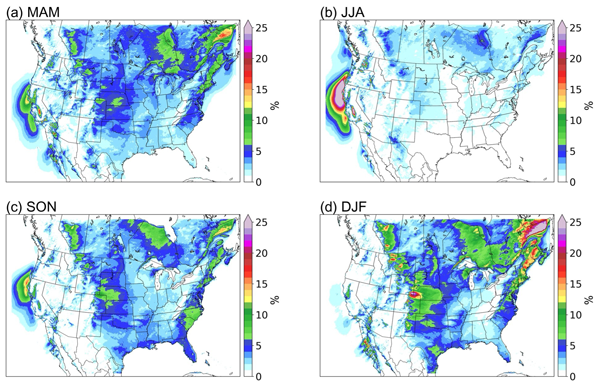
Convection-permitting projections of North American low-level jets and their mechanistic responses to climate change
Xiao Ma, Yanping Li, Fei Huo, and Zhenhua Li
EGUsphere, https://doi.org/10.5194/egusphere-2026-360,https://doi.org/10.5194/egusphere-2026-360, 2026
This preprint is open for discussion and under review for Atmospheric Chemistry and Physics (ACP).
Short summary
Investigation of the characteristics of low-level jets over North America in a convection-permitting Weather Research and Forecasting simulation
Xiao Ma, Yanping Li, Zhenhua Li, and Fei Huo
Atmos. Chem. Phys., 24, 12013–12030, https://doi.org/10.5194/acp-24-12013-2024,https://doi.org/10.5194/acp-24-12013-2024, 2024
Short summary
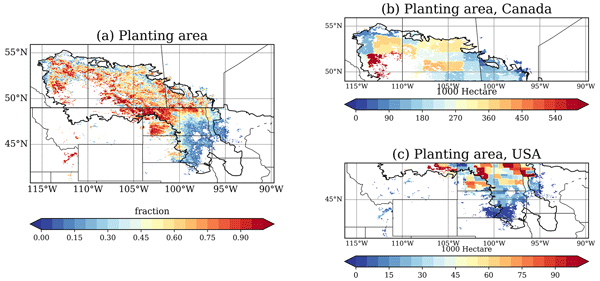
Developing spring wheat in the Noah-MP land surface model (v4.4) for growing season dynamics and responses to temperature stress
Zhe Zhang, Yanping Li, Fei Chen, Phillip Harder, Warren Helgason, James Famiglietti, Prasanth Valayamkunnath, Cenlin He, and Zhenhua Li
Geosci. Model Dev., 16, 3809–3825, https://doi.org/10.5194/gmd-16-3809-2023,https://doi.org/10.5194/gmd-16-3809-2023, 2023
Short summary
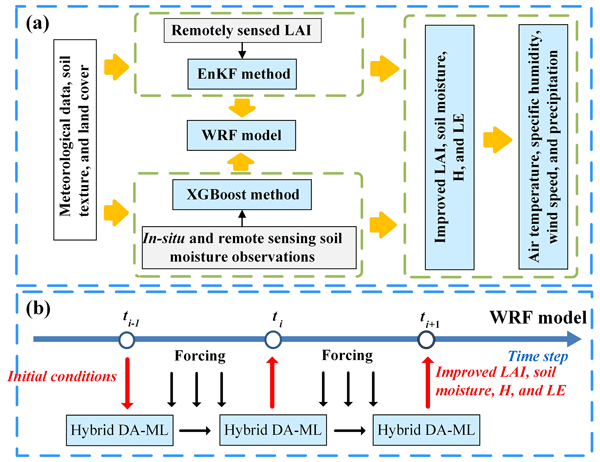
Improving regional climate simulations based on a hybrid data assimilation and machine learning method
Xinlei He, Yanping Li, Shaomin Liu, Tongren Xu, Fei Chen, Zhenhua Li, Zhe Zhang, Rui Liu, Lisheng Song, Ziwei Xu, Zhixing Peng, and Chen Zheng
Hydrol. Earth Syst. Sci., 27, 1583–1606, https://doi.org/10.5194/hess-27-1583-2023,https://doi.org/10.5194/hess-27-1583-2023, 2023
Short summary
Summary and synthesis of Changing Cold Regions Network (CCRN) research in the interior of western Canada – Part 2: Future change in cryosphere, vegetation, and hydrology
Chris M. DeBeer, Howard S. Wheater, John W. Pomeroy, Alan G. Barr, Jennifer L. Baltzer, Jill F. Johnstone, Merritt R. Turetsky, Ronald E. Stewart, Masaki Hayashi, Garth van der Kamp, Shawn Marshall, Elizabeth Campbell, Philip Marsh, Sean K. Carey, William L. Quinton, Yanping Li, Saman Razavi, Aaron Berg, Jeffrey J. McDonnell, Christopher Spence, Warren D. Helgason, Andrew M. Ireson, T. Andrew Black, Mohamed Elshamy, Fuad Yassin, Bruce Davison, Allan Howard, Julie M. Thériault, Kevin Shook, Michael N. Demuth, and Alain Pietroniro
Hydrol. Earth Syst. Sci., 25, 1849–1882, https://doi.org/10.5194/hess-25-1849-2021,https://doi.org/10.5194/hess-25-1849-2021, 2021
Short summary

Cited articles

Bowman, K. W., Cressie, N., Qu, X., and Hall, A.: A Hierarchical Statistical Framework for Emergent Constraints: Application to Snow-Albedo Feedback, Geophys. Res. Lett., 45, 13050–13059, https://doi.org/10.1029/2018GL080082, 2018. 
Brient, F.: Reducing Uncertainties in Climate Projections with Emergent Constraints: Concepts, Examples and Prospects, Adv. Atmos. Sci., 37, 1–15, https://doi.org/10.1007/s00376-019-9140-8, 2020. 
Brient, F. and Schneider, T.: Constraints on Climate Sensitivity from Space-Based Measurements of Low-Cloud Reflection, J. Climate, 29, 5821–5835, https://doi.org/10.1175/JCLI-D-15-0897.s1, 2016. 
Cai, Z., You, Q., Screen, J. A., Chen, H. W., Zhang, R., Zuo, Z., Chen, D., Cohen, J., Kang, S., and Zhang, R.: Lessened projections of Arctic warming and wetting after correcting for model errors in global warming and sea ice cover, Sci. Adv., 11, 6413, https://doi.org/10.1126/sciadv.adr6413, 2025. 
Caldwell, P. M., Bretherton, C. S., Zelinka, M. D., Klein, S. A., Santer, B. D., and Sanderson, B. M.: Statistical significance of climate sensitivity predictors obtained by data mining, Geophys. Res. Lett., 41, 1803–1808, https://doi.org/10.1002/2014GL059205, 2014. 
Download
Short summary
In this study, we find that global freshwater storage on land (excluding Greenland and Antarctica) will likely decrease much more than raw models suggest – about 83 millimeters less water by 2100. This means that earlier studies may have overestimated future water availability. When we correct the models using observations, the results consistently show significant declines in freshwater, which could worsen water stress worldwide if demand continues to grow.
Share
Altmetrics
Final-revised paper
Preprint