
Articles | Volume 17, issue 2
https://doi.org/10.5194/esd-17-209-2026
© Author(s) 2026. This work is distributed under
the Creative Commons Attribution 4.0 License.
the Creative Commons Attribution 4.0 License.
https://doi.org/10.5194/esd-17-209-2026
© Author(s) 2026. This work is distributed under
the Creative Commons Attribution 4.0 License.
the Creative Commons Attribution 4.0 License.
Research article
| 
04 Mar 2026
Research article |
| 04 Mar 2026
| 04 Mar 2026
Past, present, and future variability of Atlantic meridional overturning circulation in CMIP6 ensembles
Arthur Coquereau
CORRESPONDING AUTHOR
Laboratoire d'Océanographie Physique et Spatiale, Univ Brest CNRS IRD Ifremer, Brest, France
Florian Sévellec
Laboratoire d'Océanographie Physique et Spatiale, Univ Brest CNRS IRD Ifremer, Brest, France
Thierry Huck
Laboratoire d'Océanographie Physique et Spatiale, Univ Brest CNRS IRD Ifremer, Brest, France
Joël J.-M. Hirschi
Marine Systems Modelling, National Oceanography Centre, Southampton, SO14 3ZH, UK
Quentin Jamet
SHOM, Service Hydrologique et Océanographique de la Marine, Brest, France
Related authors
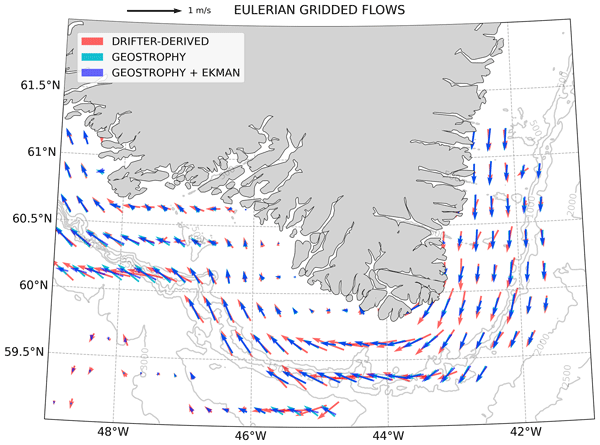
Arthur Coquereau and Nicholas P. Foukal
Ocean Sci., 19, 1393–1411, https://doi.org/10.5194/os-19-1393-2023, https://doi.org/10.5194/os-19-1393-2023, 2023
Short summary
Short summary
Understanding meltwater circulation around Greenland is crucial as it could influence climate variability but difficult as data are scarce. Here, we use 34 surface drifters to evaluate satellite-derived surface currents and show that satellite data recover the general structure of the flow and can recreate the pathways of particles around the southern tip of Greenland. This result permits a wide range of work to proceed looking at long-term changes in the circulation of the region since 1993.
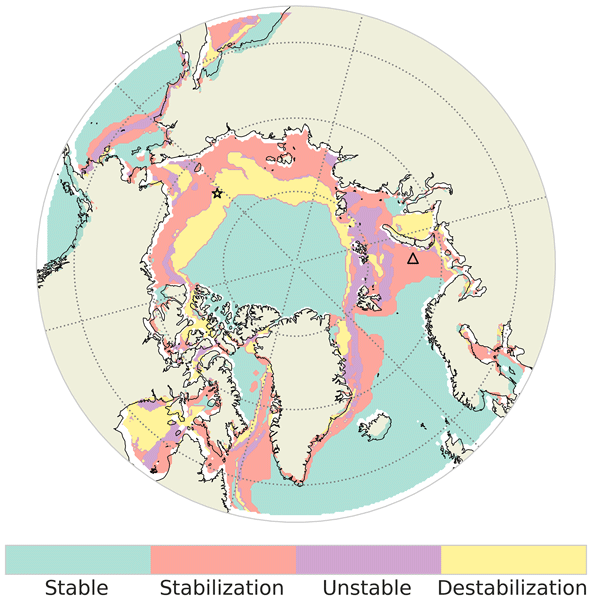
Amélie Simon, Pierre Tandeo, Florian Sévellec, and Camille Lique
The Cryosphere, 19, 6639–6658, https://doi.org/10.5194/tc-19-6639-2025, https://doi.org/10.5194/tc-19-6639-2025, 2025
Short summary
Short summary
Through a machine learning technique based on seasonal cycles of sea-ice concentration from satellite data over the last 4 decades, our research shows that four regions are sufficient to best regionalize the Arctic. These regions are mainly organized into latitudinal bands and evolve in time and space. The descriptor proposed to monitor Arctic sea-ice changes is the probability to belong to each region. The probability to belong to the permanent sea-ice regions has decreased by 3.1 % per decade.
Stephen E. Darby, Ivan D. Haigh, Melissa Wood, Bui Duong, Tien Le Thuy Du, Thao Phuong Bui, Justin Sheffield, Hal Voepel, and Joël J.-M. Hirschi
EGUsphere, https://doi.org/10.5194/egusphere-2025-3506, https://doi.org/10.5194/egusphere-2025-3506, 2025
Short summary
Short summary
We use model simulations to see what changes have been occurring to Mekong and Red River flows, 1970–2019, due to changes in tropical cyclone (TC)-linked precipitation. Results suggest that the highest river flows in multiple sub-catchments have been increasing over time, with coastal zones most intensely affected due to the combination of TC track and wet soils from prior rainfall. Climate change may exacerbate this TC-linked risk in the future making it a topic of strategic importance.
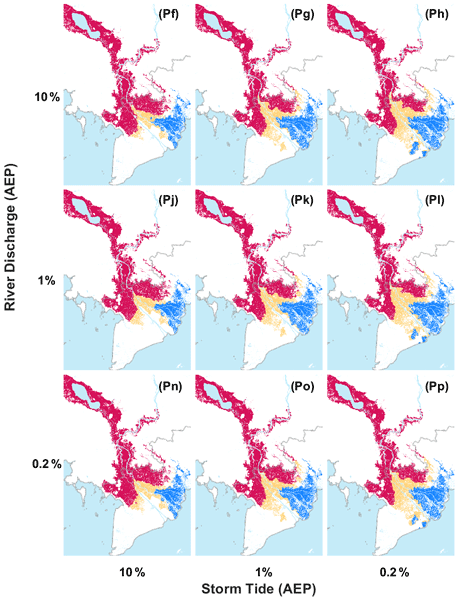
Melissa Wood, Ivan D. Haigh, Quan Quan Le, Hung Nghia Nguyen, Hoang Ba Tran, Stephen E. Darby, Robert Marsh, Nikolaos Skliris, and Joël J.-M. Hirschi
Nat. Hazards Earth Syst. Sci., 24, 3627–3649, https://doi.org/10.5194/nhess-24-3627-2024, https://doi.org/10.5194/nhess-24-3627-2024, 2024
Short summary
Short summary
We look at how compound flooding from the combination of river flooding and storm tides (storm surge and astronomical tide) may be changing over time due to climate change, with a case study of the Mekong River delta. We found that future compound flooding has the potential to flood the region more extensively and be longer lasting than compound floods today. This is useful to know because it means managers of deltas such as the Mekong can assess options for improving existing flood defences.
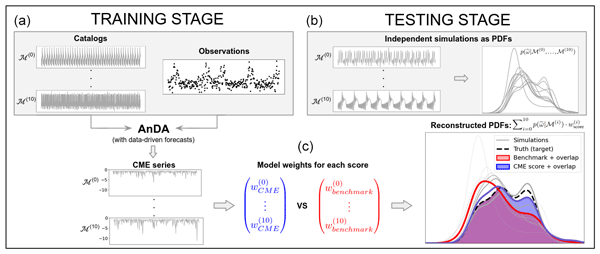
Pierre Le Bras, Florian Sévellec, Pierre Tandeo, Juan Ruiz, and Pierre Ailliot
Nonlin. Processes Geophys., 31, 303–317, https://doi.org/10.5194/npg-31-303-2024, https://doi.org/10.5194/npg-31-303-2024, 2024
Short summary
Short summary
The goal of this paper is to weight several dynamic models in order to improve the representativeness of a system. It is illustrated using a set of versions of an idealized model describing the Atlantic Meridional Overturning Circulation. The low-cost method is based on data-driven forecasts. It enables model performance to be evaluated on their dynamics. Taking into account both model performance and codependency, the derived weights outperform benchmarks in reconstructing a model distribution.
Arthur Coquereau and Nicholas P. Foukal
Ocean Sci., 19, 1393–1411, https://doi.org/10.5194/os-19-1393-2023, https://doi.org/10.5194/os-19-1393-2023, 2023
Short summary
Short summary
Understanding meltwater circulation around Greenland is crucial as it could influence climate variability but difficult as data are scarce. Here, we use 34 surface drifters to evaluate satellite-derived surface currents and show that satellite data recover the general structure of the flow and can recreate the pathways of particles around the southern tip of Greenland. This result permits a wide range of work to proceed looking at long-term changes in the circulation of the region since 1993.
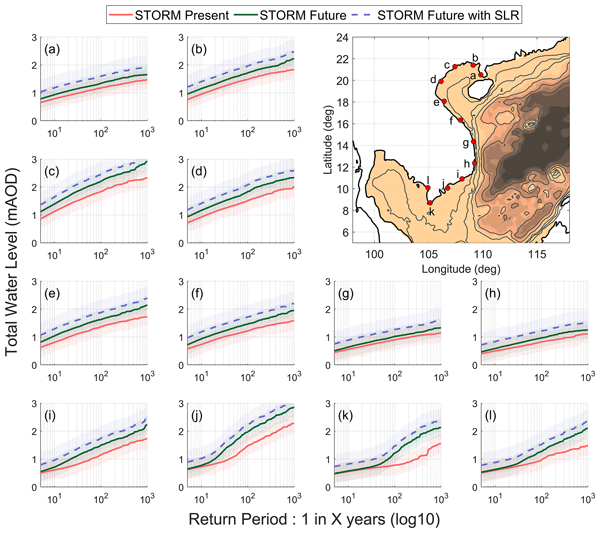
Melissa Wood, Ivan D. Haigh, Quan Quan Le, Hung Nghia Nguyen, Hoang Ba Tran, Stephen E. Darby, Robert Marsh, Nikolaos Skliris, Joël J.-M. Hirschi, Robert J. Nicholls, and Nadia Bloemendaal
Nat. Hazards Earth Syst. Sci., 23, 2475–2504, https://doi.org/10.5194/nhess-23-2475-2023, https://doi.org/10.5194/nhess-23-2475-2023, 2023
Short summary
Short summary
We used a novel database of simulated tropical cyclone tracks to explore whether typhoon-induced storm surges present a future flood risk to low-lying coastal communities around the South China Sea. We found that future climate change is likely to change tropical cyclone behaviour to an extent that this increases the severity and frequency of storm surges to Vietnam, southern China, and Thailand. Consequently, coastal flood defences need to be reviewed for resilience against this future hazard.
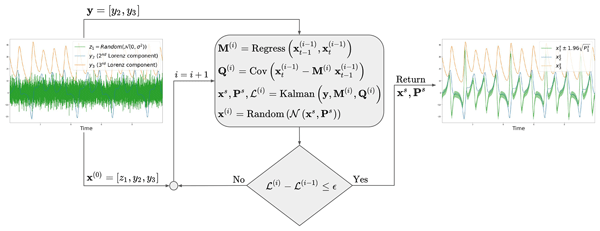
Pierre Tandeo, Pierre Ailliot, and Florian Sévellec
Nonlin. Processes Geophys., 30, 129–137, https://doi.org/10.5194/npg-30-129-2023, https://doi.org/10.5194/npg-30-129-2023, 2023
Short summary
Short summary
The goal of this paper is to obtain probabilistic predictions of a partially observed dynamical system without knowing the model equations. It is illustrated using the three-dimensional Lorenz system, where only two components are observed. The proposed data-driven procedure is low-cost, is easy to implement, uses linear and Gaussian assumptions and requires only a small amount of data. It is based on an iterative linear Kalman smoother with a state augmentation.

Stephanie Leroux, Jean-Michel Brankart, Aurélie Albert, Laurent Brodeau, Jean-Marc Molines, Quentin Jamet, Julien Le Sommer, Thierry Penduff, and Pierre Brasseur
Ocean Sci., 18, 1619–1644, https://doi.org/10.5194/os-18-1619-2022, https://doi.org/10.5194/os-18-1619-2022, 2022
Short summary
Short summary
The goal of the study is to evaluate the predictability of the ocean circulation
at a kilometric scale, in order to anticipate the requirements of the future operational forecasting systems. For that purpose, ensemble experiments have been performed with a regional model for the Western Mediterranean (at 1/60° horizontal resolution). From these ensemble experiments, we show that it is possible to compute targeted predictability scores, which depend on initial and model uncertainties.
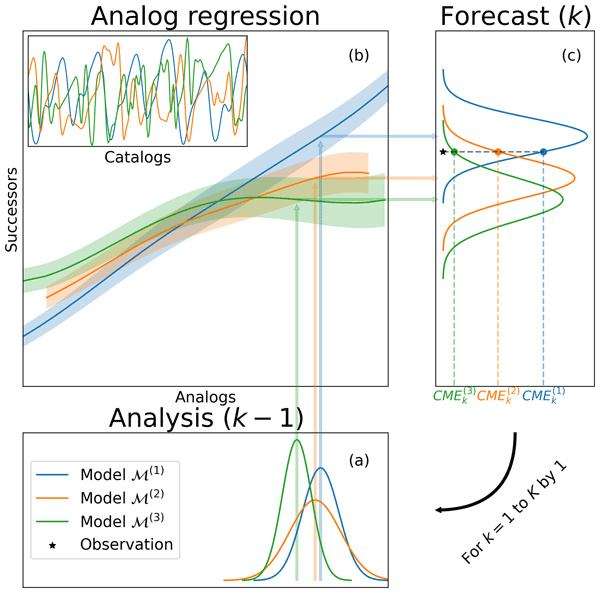
Juan Ruiz, Pierre Ailliot, Thi Tuyet Trang Chau, Pierre Le Bras, Valérie Monbet, Florian Sévellec, and Pierre Tandeo
Geosci. Model Dev., 15, 7203–7220, https://doi.org/10.5194/gmd-15-7203-2022, https://doi.org/10.5194/gmd-15-7203-2022, 2022
Short summary
Short summary
We present a new approach to validate numerical simulations of the current climate. The method can take advantage of existing climate simulations produced by different centers combining an analog forecasting approach with data assimilation to quantify how well a particular model reproduces a sequence of observed values. The method can be applied with different observations types and is implemented locally in space and time significantly reducing the associated computational cost.
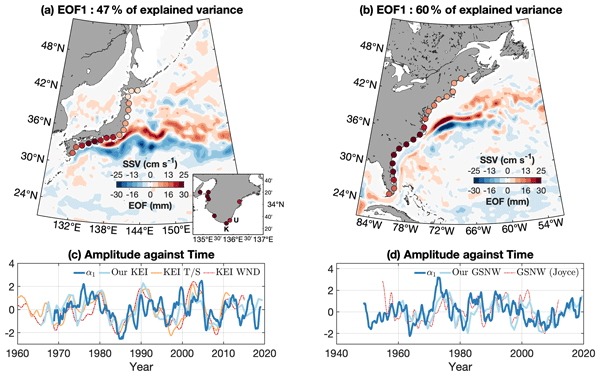
Samuel Tiéfolo Diabaté, Didier Swingedouw, Joël Jean-Marie Hirschi, Aurélie Duchez, Philip J. Leadbitter, Ivan D. Haigh, and Gerard D. McCarthy
Ocean Sci., 17, 1449–1471, https://doi.org/10.5194/os-17-1449-2021, https://doi.org/10.5194/os-17-1449-2021, 2021
Short summary
Short summary
The Gulf Stream and the Kuroshio are major currents of the North Atlantic and North Pacific, respectively. They transport warm water northward and are key components of the Earth climate system. For this study, we looked at how they affect the sea level of the coasts of Japan, the USA and Canada. We found that the inshore sea level
co-varies with the north-to-south shifts of the Gulf Stream and Kuroshio. In the paper, we discuss the physical mechanisms that could explain the agreement.
Cited articles
Arguez, A. and Vose, R. S.: The Definition of the Standard WMO Climate Normal: The Key to Deriving Alternative Climate Normals, B. Am. Meteorol. Soc., 92, 699–704, 2011. a
Armstrong McKay, D. I., Staal, A., Abrams, J. F., Winkelmann, R., Sakschewski, B., Loriani, S., Fetzer, I., Cornell, S. E., Rockström, J., and Lenton, T. M.: Exceeding 1.5 °C global warming could trigger multiple climate tipping points, Science, 377, eabn7950, https://doi.org/10.1126/science.abn7950, 2022. a
Baker, J. A., Bell, M. J., Jackson, L. C., Renshaw, R., Vallis, G. K., Watson, A. J., and Wood, R. A.: Overturning Pathways Control AMOC Weakening in CMIP6 Models, Geophys. Res. Lett., 50, e2023GL103381, https://doi.org/10.1029/2023GL103381, 2023. a, b
Berrington de González, A. and Cox, D. R.: Interpretation of interaction: A review, Ann. Appl. Stat., 1, 371–385, https://doi.org/10.1214/07-AOAS124, 2007. a
Böhm, E., Lippold, J., Gutjahr, M., Frank, M., Blaser, P., Antz, B., Fohlmeister, J., Frank, N., Andersen, M. B., and Deininger, M.: Strong and deep Atlantic meridional overturning circulation during the last glacial cycle, Nature, 517, 73–76, https://doi.org/10.1038/nature14059, 2015. a
Bonnet, R., Swingedouw, D., Gastineau, G., Boucher, O., Deshayes, J., Hourdin, F., Mignot, J., Servonnat, J., and Sima, A.: Increased risk of near term global warming due to a recent AMOC weakening, Nat. Commun., 12, 6108, https://doi.org/10.1038/s41467-021-26370-0, 2021. a
Boucher, O., Servonnat, J., Albright, A. L., Aumont, O., Balkanski, Y., Bastrikov, V., Bekki, S., Bonnet, R., Bony, S., Bopp, L., Braconnot, P., Brockmann, P., Cadule, P., Caubel, A., Cheruy, F., Codron, F., Cozic, A., Cugnet, D., D'Andrea, F., Davini, P., de Lavergne, C., Denvil, S., Deshayes, J., Devilliers, M., Ducharne, A., Dufresne, J.-L., Dupont, E., Éthé, C., Fairhead, L., Falletti, L., Flavoni, S., Foujols, M.-A., Gardoll, S., Gastineau, G., Ghattas, J., Grandpeix, J.-Y., Guenet, B., Guez, L. E., Guilyardi, E., Guimberteau, M., Hauglustaine, D., Hourdin, F., Idelkadi, A., Joussaume, S., Kageyama, M., Khodri, M., Krinner, G., Lebas, N., Levavasseur, G., Lévy, C., Li, L., Lott, F., Lurton, T., Luyssaert, S., Madec, G., Madeleine, J.-B., Maignan, F., Marchand, M., Marti, O., Mellul, L., Meurdesoif, Y., Mignot, J., Musat, I., Ottlé, C., Peylin, P., Planton, Y., Polcher, J., Rio, C., Rochetin, N., Rousset, C., Sepulchre, P., Sima, A., Swingedouw, D., Thiéblemont, R., Traore, A. K., Vancoppenolle, M., Vial, J., Vialard, J., Viovy, N., and Vuichard, N.: Presentation and evaluation of the IPSL-CM6A-LR climate model, J. Adv. Model. Earth Sy., 12, https://doi.org/10.1029/2019MS002010, 2020. a
Buckley, M. W. and Marshall, J.: Observations, inferences, and mechanisms of the Atlantic Meridional Overturning Circulation: A review, Rev. Geophys., 54, 5–63, https://doi.org/10.1002/2015RG000493, 2016. a
Cheng, J., Liu, Z., Zhang, S., Liu, W., Dong, L., Liu, P., and Li, H.: Reduced interdecadal variability of Atlantic Meridional Overturning Circulation under global warming, P. Natl. Acad. Sci. USA, 113, 3175–3178, https://doi.org/10.1073/pnas.1519827113, 2016. a, b
Coquereau, A.: coquereau/ANOVA_4way: Release of v1.0 (v1.0), Zenodo [code], https://doi.org/10.5281/zenodo.18835920, 2026. a
Coquereau, A., Sévellec, F., Huck, T., Hirschi, J. J., and Hochet, A.: Anthropogenic Changes in Interannual-to-Decadal Climate Variability in CMIP6 Multiensemble Simulations, J. Climate, 37, 3723–3739, https://doi.org/10.1175/JCLI-D-23-0606.1, 2024. a, b
Coquereau, A., Sévellec, F., Huck, T., and Fedorov, A. V.: Increase in ENSO frequency and intensity under 20th and 21st century warming: Insights from CMIP6 large ensembles, Geophys. Res. Lett., 52, e2025GL116541, https://doi.org/10.1029/2025GL116541, 2025. a
Danabasoglu, G., Lamarque, J.-F., Bacmeister, J., Bailey, D. A., DuVivier, A. K., Edwards, J., Emmons, L. K., Fasullo, J., Garcia, R., Gettelman, A., Hannay, C., Holland, M. M., Large, W. G., Lauritzen, P. H., Lawrence, D. M., Lenaerts, J. T. M., Lindsay, K., Lipscomb, W. H., Mills, M. J., Neale, R., Oleson, K. W., Otto-Bliesner, B., Phillips, A. S., Sacks, W., Tilmes, S., van Kampenhout, L., Vertenstein, M., Bertini, A., Dennis, J., Deser, C., Fischer, C., Fox-Kemper, B., Kay, J. E., Kinnison, D., Kushner, P. J., Larson, V. E., Long, M. C., Mickelson, S., Moore, J. K., Nienhouse, E., Polvani, L., Rasch, P. J., and Strand, W. G.: The Community Earth System Model Version 2 (CESM2), J. Adv. Model. Earth Sy., 12, https://doi.org/10.1029/2019MS001916, 2020. a
Dansgaard, W., Johnsen, S. J., clausen, H. B., Dahl-Jensen, D., Gundestrup, N. S., Hammer, C. U., Hvldberg, C. S., Steffensen, J. P., Sveinbjörnsdóttir, A. E., Jouzel, J., and Bond, G.: Evidence for general instability of past climate from a 250-kyr ice-core record, Nature, 364, 218–220, 1993. a
Deser, C., Phillips, A. S., Simpson, I. R., Rosenbloom, N., Coleman, D., Lehner, F., Pendergrass, A. G., DiNezio, P., and Stevenson, S.: Isolating the Evolving Contributions of Anthropogenic Aerosols and Greenhouse Gases: A New CESM1 Large Ensemble Community Resource, J. Climate, 33, 7835–7858, https://doi.org/10.1175/JCLI-D-20-0123.1, 2020. a
Eyring, V., Bony, S., Meehl, G. A., Senior, C. A., Stevens, B., Stouffer, R. J., and Taylor, K. E.: Overview of the Coupled Model Intercomparison Project Phase 6 (CMIP6) experimental design and organization, Geosci. Model Dev., 9, 1937–1958, https://doi.org/10.5194/gmd-9-1937-2016, 2016. a
Fox-Kemper, B., Adcroft, A., Böning, C. W., Chassignet, E. P., Curchitser, E., Danabasoglu, G., Eden, C., England, M. H., Gerdes, R., Greatbatch, R. J., Griffies, S. M., Hallberg, R. W., Hanert, E., Heimbach, P., Hewitt, H. T., Hill, C. N., Komuro, Y., Legg, S., Le Sommer, J., Masina, S., Marsland, S. J., Penny, S. G., Qiao, F., Ringler, T. D., Treguier, A. M., Tsujino, H., Uotila, P., and Yeager, S. G.: Challenges and Prospects in Ocean Circulation Models, Front. Mar. Sci., 6, https://doi.org/10.3389/fmars.2019.00065, 2019. a
Ganachaud, A. and Wunsch, C.: Improved estimates of global ocean circulation, heat transport and mixing from hydrographic data, Nature, 408, 453–457, https://doi.org/10.1038/35044048, 2000. a
Gierz, P., Lohmann, G., and Wei, W.: Response of Atlantic overturning to future warming in a coupled atmosphere-ocean-ice sheet model, Geophys. Res. Lett., 42, 6811–6818, https://doi.org/10.1002/2015GL065276, 2015. a
Gou, R., Lohmann, G., and Wu, L.: Atlantic Meridional Overturning Circulation Decline: Tipping Small Scales under Global Warming, Phys. Rev. Lett., 133, 034201, https://doi.org/10.1103/PhysRevLett.133.034201, 2024. a, b, c, d
Hasselmann, K.: Stochastic climate models Part I. Theory, Tellus, 28, 473–485, https://doi.org/10.1111/j.2153-3490.1976.tb00696.x, 1976. a, b
Hawkins, E. and Sutton, R.: The potential to narrow uncertainty in projections of regional precipitation change, Clim. Dynam., 37, 407–418, https://doi.org/10.1007/s00382-010-0810-6, 2011. a, b, c
Hawkins, E., Smith, R. S., Gregory, J. M., and Stainforth, D. A.: Irreducible uncertainty in near-term climate projections, Clim. Dynam., 46, 3807–3819, 2016. a
Henry, L. G., McManus, J. F., Curry, W. B., Roberts, N. L., Piotrowski, A. M., and Keigwin, L. D.: North Atlantic ocean circulation and abrupt climate change during the last glaciation, Science, 353, 470–474, https://doi.org/10.1126/science.aaf5529, 2016. a
Hewitt, H., Fox-Kemper, B., Pearson, B., Roberts, M., and Klocke, D.: The small scales of the ocean may hold the key to surprises, Nat. Clim. Change, 12, 496–499, https://doi.org/10.1038/s41558-022-01386-6, 2022. a
Hingray, B. and Saïd, M.: Partitioning Internal Variability and Model Uncertainty Components in a Multimember Multimodel Ensemble of Climate Projections, J. Climate, 27, 6779–6798, https://doi.org/10.1175/JCLI-D-13-00629.1, 2014. a
Hingray, B., Mezghani, A., and Buishand, T. A.: Development of probability distributions for regional climate change from uncertain global mean warming and an uncertain scaling relationship, Hydrol. Earth Syst. Sci., 11, 1097–1114, https://doi.org/10.5194/hess-11-1097-2007, 2007. a, b
Hirschi, J. J.-M., Barnier, B., Böning, C., Biastoch, A., Blaker, A. T., Coward, A., Danilov, S., Drijfhout, S., Getzlaff, K., Griffies, S. M., Hasumi, H., Hewitt, H., Iovino, D., Kawasaki, T., Kiss, A. E., Koldunov, N., Marzocchi, A., Mecking, J. V., Moat, B., Molines, J.-M., Myers, P. G., Penduff, T., Roberts, M., Treguier, A.-M., Sein, D. V., Sidorenko, D., Small, J., Spence, P., Thompson, L., Weijer, W., and Xu, X.: The Atlantic meridional overturning circulation in high-resolution models, J. Geophys. Res.-Oceans, 125, e2019JC015522, https://doi.org/10.1029/2019JC015522, 2020. a, b, c
Jackson, L. C., Hewitt, H. T., Bruciaferri, D., Calvert, D., Graham, T., Guiavarc’h, C., Menary, M. B., New, A. L., Roberts, M., and Storkey, D.: Challenges simulating the AMOC in climate models, Philos. T. R. Soc. A, 381, 20220187, https://doi.org/10.1098/rsta.2022.0187, 2023. a, b, c, d, e, f, g, h, i
Jackson, L. C., Chassignet, E. P., Danabasoglu, G., Treguier, A., and Zhang, R.: Toward Improving Representation of the Atlantic Meridional Overturning Circulation in Climate Models, B. Am. Meteorol. Soc., 106, E1032–E1036, https://doi.org/10.1175/BAMS-D-25-0078.1, 2025. a
Johns, W. E., Elipot, S., Smeed, D. A., Moat, B., King, B., Volkov, D. L., and Smith, R. H.: Towards two decades of Atlantic Ocean mass and heat transports at 26.5° N, Philos. T. R. Soc. A, 381, 20220188, https://doi.org/10.1098/rsta.2022.0188, 2023. a
Knight, J. R., Folland, C. K., and Scaife, A. A.: Climate impacts of the Atlantic Multidecadal Oscillation, Geophys. Res. Lett., 33, L17706, https://doi.org/10.1029/2006GL026242, 2006. a
Lee, J.-Y., Marotzke, J., Bala, G., Cao, L., Corti, S., Dunne, J., Engelbrecht, F., Fischer, E., Fyfe, J., Jones, C., Maycock, A., Mutemi, J., Ndiaye, O., Panickal, S., , and Zhou, T.: Future Global Climate: Scenario-based Projections and Near-term Information, in: Climate Change 2021 – The Physical Science Basis: Working Group I Contribution to the Sixth Assessment Report of the Intergovernmental Panel on Climate Change, Intergovernmental Panel on Climate Change (IPCC), Cambridge University Press, Cambridge, 553–672, ISBN 978-1-00-915788-9, https://doi.org/10.1017/9781009157896.006, 2021. a
Lehner, F., Deser, C., Maher, N., Marotzke, J., Fischer, E. M., Brunner, L., Knutti, R., and Hawkins, E.: Partitioning climate projection uncertainty with multiple large ensembles and CMIP5/6, Earth Syst. Dynam., 11, 491–508, https://doi.org/10.5194/esd-11-491-2020, 2020. a, b, c
Lenton, T. M., Held, H., Kriegler, E., Hall, J. W., Lucht, W., Rahmstorf, S., and Schellnhuber, H. J.: Tipping elements in the Earth's climate system, P. Natl. Acad. Sci., 105, 1786–1793, https://doi.org/10.1073/pnas.0705414105, 2008. a
Lobelle, D., Beaulieu, C., Livina, V., Sévellec, F., and Frajka-Williams, E.: Detectability of an AMOC decline in current and projected climate changes, Geophys. Res. Lett., 47, e2020GL089974, https://doi.org/10.1029/2020GL089974, 2020. a
MacMartin, D. G., Zanna, L., and Tziperman, E.: Suppression of Atlantic Meridional Overturning Circulation Variability at Increased CO2, J. Climate, 29, 4155–4164, https://doi.org/10.1175/JCLI-D-15-0533.1, 2016. a, b
McManus, J. F., Francois, R., Gherardi, J.-M., Keigwin, L. D., and Brown-Leger, S.: Collapse and rapid resumption of Atlantic meridional circulation linked to deglacial climate changes, Nature, 428, 834–837, https://doi.org/10.1038/nature02494, 2004. a
Menary, M. B., Roberts, C. D., Palmer, M. D., Halloran, P. R., Jackson, L., Wood, R. A., Müller, W. A., Matei, D., and Lee, S.-K.: Mechanisms of aerosol-forced AMOC variability in a state of the art climate model, J. Geophys. Res.-Oceans, 118, 2087–2096, https://doi.org/10.1002/jgrc.20178, 2013. a, b
Menary, M. B., Robson, J., Allan, R. P., Booth, B. B. B., Cassou, C., and Gastineau, G.: Aerosol-forced AMOC changes in CMIP6 historical simulations, Geophys. Res. Lett., 47, e2020GL088166, https://doi.org/10.1029/2020GL088166, 2020. a, b, c, d
Olonscheck, D., Suarez-Gutierrez, L., Milinski, S., Beobide-Arsuaga, G., Baehr, J., Fröb, F., Ilyina, T., Kadow, C., Krieger, D., Li, H., Marotzke, J., Plésiat, É., Schupfner, M., Wachsmann, F., Wallberg, L., Wieners, K.-H., and Brune, S.: The New Max Planck Institute Grand Ensemble with CMIP6 forcing and high-frequency model output, J. Adv. Model. Earth Sy., 15, e2023MS003790, https://doi.org/10.1029/2023MS003790, 2023. a
O'Neill, B. C., Tebaldi, C., van Vuuren, D. P., Eyring, V., Friedlingstein, P., Hurtt, G., Knutti, R., Kriegler, E., Lamarque, J.-F., Lowe, J., Meehl, G. A., Moss, R., Riahi, K., and Sanderson, B. M.: The Scenario Model Intercomparison Project (ScenarioMIP) for CMIP6, Geosci. Model Dev., 9, 3461–3482, https://doi.org/10.5194/gmd-9-3461-2016, 2016. a, b, c, d
Rind, D., Orbe, C., Jonas, J., Nazarenko, L., Zhou, T., Kelley, M., Lacis, A., Shindell, D., Faluvegi, G., Romanou, A., Russell, G., Tausnev, N., Bauer, M., and Schmidt, G.: GISS Model E2.2: A climate model optimized for the middle atmosphere – Model structure, climatology, variability, and climate sensitivity, J. Geophys. Res.-Atmos., 125, https://doi.org/10.1029/2019JD032204, 2020. a
Robson, J., Menary, M. B., Sutton, R. T., Mecking, J., Gregory, J. M., Jones, C., Sinha, B., Stevens, D. P., and Wilcox, L. J.: The Role of Anthropogenic Aerosol Forcing in the 1850–1985 Strengthening of the AMOC in CMIP6 Historical Simulations, J. Climate, 35, 6843–6863, https://doi.org/10.1175/JCLI-D-22-0124.1, 2022. a, b, c, d
Sellar, A. A., Jones, C. G., Mulcahy, J. P., Tang, Y., Yool, A., Wiltshire, A., O'Connor, F. M., Stringer, M., Hill, R., Palmieri, J., Woodward, S., de Mora, L., Kuhlbrodt, T., Rumbold, S. T., Kelley, D. I., Ellis, R., Johnson, C. E., Walton, J., Abraham, N. L., Andrews, M. B., Andrews, T., Archibald, A. T., Berthou, S., Burke, E., Blockley, E., Carslaw, K., Dalvi, M., Edwards, J., Folberth, G. A., Gedney, N., Griffiths, P. T., Harper, A. B., Hendry, M. A., Hewitt, A. J., Johnson, B., Jones, A., Jones, C. D., Keeble, J., Liddicoat, S., Morgenstern, O., Parker, R. J., Predoi, V., Robertson, E., Siahaan, A., Smith, R. S., Swaminathan, R., Woodhouse, M. T., Zeng, G., and Zerroukat, M.: UKESM1: Description and evaluation of the U.K. Earth System Model, J. Adv. Model. Earth Sy., 11, 4513–4558, https://doi.org/10.1029/2019MS001739, 2019. a
Sévellec, F. and Sinha, B.: Predictability of Decadal Atlantic Meridional Overturning Circulation Variations, in: Oxford Encyclopedia of Climate Science, Oxford University Press, Oxford University Press, https://doi.org/10.1093/acrefore/9780190228620.013.81, 2018. a
Srokosz, M., Baringer, M., Bryden, H., Cunningham, S., Delworth, T., Lozier, S., Marotzke, J., and Sutton, R.: Past, Present, and Future Changes in the Atlantic Meridional Overturning Circulation, B. Am. Meteorological Society, 93, 1663–1676, https://doi.org/10.1175/BAMS-D-11-00151.1, 2012. a
Stommel, H.: Thermohaline Convection with Two Stable Regimes of Flow, Tellus, 13, 224–230, https://doi.org/10.1111/j.2153-3490.1961.tb00079.x, 1961. a
Swart, N. C., Cole, J. N. S., Kharin, V. V., Lazare, M., Scinocca, J. F., Gillett, N. P., Anstey, J., Arora, V., Christian, J. R., Hanna, S., Jiao, Y., Lee, W. G., Majaess, F., Saenko, O. A., Seiler, C., Seinen, C., Shao, A., Sigmond, M., Solheim, L., von Salzen, K., Yang, D., and Winter, B.: The Canadian Earth System Model version 5 (CanESM5.0.3), Geosci. Model Dev., 12, 4823–4873, https://doi.org/10.5194/gmd-12-4823-2019, 2019. a
Sévellec, F. and Fedorov, A. V.: Millennial Variability in an Idealized Ocean Model: Predicting the AMOC Regime Shifts, J. Climate, 27, 3551–3564, https://doi.org/10.1175/JCLI-D-13-00450.1, 2014. a
Tatebe, H., Ogura, T., Nitta, T., Komuro, Y., Ogochi, K., Takemura, T., Sudo, K., Sekiguchi, M., Abe, M., Saito, F., Chikira, M., Watanabe, S., Mori, M., Hirota, N., Kawatani, Y., Mochizuki, T., Yoshimura, K., Takata, K., O'ishi, R., Yamazaki, D., Suzuki, T., Kurogi, M., Kataoka, T., Watanabe, M., and Kimoto, M.: Description and basic evaluation of simulated mean state, internal variability, and climate sensitivity in MIROC6, Geosci. Model Dev., 12, 2727–2765, https://doi.org/10.5194/gmd-12-2727-2019, 2019. a
Trenberth, K. E. and Fasullo, J. T.: Atlantic meridional heat transports computed from balancing Earth's energy locally, Geophys. Res. Lett., 44, 1919–1927, https://doi.org/10.1002/2016GL072475, 2017. a
Voldoire, A., Saint-Martin, D., Sénési, S., Decharme, B., Alias, A., Chevallier, M., Colin, J., Guérémy, J.-F., Michou, M., Moine, M.-P., Nabat, P., Roehrig, R., Salas y Mélia, D., Séférian, R., Valcke, S., Beau, I., Belamari, S., Berthet, S., Cassou, C., Cattiaux, J., Deshayes, J., Douville, H., Ethé, C., Franchistéguy, L., Geoffroy, O., Lévy, C., Madec, G., Meurdesoif, Y., Msadek, R., Ribes, A., Sanchez-Gomez, E., Terray, L., and Waldman, R.: Evaluation of CMIP6 DECK experiments with CNRM-CM6-1, J. Adv. Model. Earth Sy., 11, 2177–2213, https://doi.org/10.1029/2019MS001683, 2019. a
Yates, F.: Orthogonal Functions and Tests of Significance in the Analysis of Variance, Supplement to the Journal of the Royal Statistical Society, 5, 177–180, https://doi.org/10.2307/2983655, 1938. a
Yip, S., Ferro, C. A. T., Stephenson, D. B., and Hawkins, E.: A Simple, Coherent Framework for Partitioning Uncertainty in Climate Predictions, J. Climate, 24, 4634–4643, https://doi.org/10.1175/2011JCLI4085.1, 2011. a, b, c
Yukimoto, S., Kawai, H., Koshiro, T., Oshima, N., Yoshida, K., Urakawa, S., Tsujino, H., Deushi, M., Tanaka, T., Hosaka, M., Yabu, S., Yoshimura, H., Shindo, E., Mizuta, R., Obata, A., Adachi, Y., and Ishii, M.: The Meteorological Research Institute Earth System Model Version 2.0, MRI-ESM2.0: Description and Basic Evaluation of the Physical Component, J. Meteorol. Soc. Jpn. Ser. II, 97, 931–965, https://doi.org/10.2151/jmsj.2019-051, 2019. a
Zickfeld, K., Eby, M., and Weaver, A. J.: Carbon-cycle feedbacks of changes in the Atlantic meridional overturning circulation under future atmospheric CO2, Global Biogeochem. Cy., 22, GB3024, https://doi.org/10.1029/2007GB003118, 2008. a
Ziehn, T., Chamberlain, M. A., Law, R. M., Lenton, A., Bodman, R. W., Dix, M., Stevens, L., Wang, Y.-P., and Srbinovsky, J.: The Australian Earth System Model: ACCESS-ESM1.5, Journal of Southern Hemisphere Earth Systems Science, 70, 193–214, https://doi.org/10.1071/ES19035, 2020. a
Zwiers, F.: Interannual variability and predictability in an ensemble of AMIP climate simulations conducted with the CCC GCM2, Clim. Dynam., 12, 825–847, https://doi.org/10.1007/s003820050146, 1996. a, b
Short summary
Using statistical methods and a set of ensemble climate models, we decompose the sources of Atlantic Meridional Overturning Circulation (AMOC) variance. Three distinct phases of physical variability are identified: from 1850 to 1990, internal variability dominates; from 1990 to 2050, dynamical adjustment related to AMOC decline takes over; after 2050, differences between forcing scenarios become dominant. Beyond these physical factors, model variability remains a major source of uncertainty.
Using statistical methods and a set of ensemble climate models, we decompose the sources of...


Altmetrics
Final-revised paper
Preprint