
the Creative Commons Attribution 4.0 License.
the Creative Commons Attribution 4.0 License.
 | 07 Oct 2026
Impacts of simulated coastal ocean alkalinity enhancement on the seasonal carbon cycle in European waters under a low- and a high-emission scenario

Neha Mehendale
Tronje P. Kemena
Sandy Avrutin
David P. Keller
One potentially scalable method to remove CO2 from the air is ocean alkalinity enhancement (OAE), which works to lower the ocean's CO2 partial pressure (pCO2) and accelerate CO2 sequestration and durable storage. This study explores how OAE might affect the seasonal carbon cycle, which plays a key role in the ocean's annual CO2 uptake. By analysing Earth System Model simulations of OAE implemented continuously at the European coastline under low and high emissions, it was found that: (a) due to surface alkalinity retention, OAE reduces ocean pCO2 most strongly in summer, turning the region into a year-round carbon sink; (b) the strongest air-sea CO2 uptake enhancement takes place in winter; (c) the ocean's carbon sink is increased more strongly in SSP3-7.0 than in SSP1-2.6 due to a lower buffering capacity.
- Article
(3487 KB) - Full-text XML
- BibTeX
- EndNote


-
Ocean Alkalinity Enhancement (OAE) aims to increase the ocean's potential to sequester and store atmospheric CO2
-
Due to summer retention, surface OAE reverses the seasonal cycle of alkalinity and it decreases the surface ocean partial pressure of CO2, turning the system into a year-round carbon sink
-
OAE drives the strongest CO2 uptake enhancement in winter, while a scenario with higher greenhouse gas emissions amplifies this signal
The ocean constitutes a valuable resource for climate stabilisation, absorbing much of the earth's excess heat and storing vast amounts of carbon in its interior and deep waters (Friedlingstein et al., 2022; Scott-Buechler and Greene, 2019). Thus, research on marine carbon dioxide removal (mCDR) has been expanding, focusing on the use of wetlands, continental shelves and the open ocean to enhance natural CO2 removal processes. One mCDR method under investigation is ocean alkalinity enhancement (OAE), which aims to accelerate the ocean's CO2 uptake, as carbon has the potential to be stored in the ocean for a long time. Specifically, OAE would enhance natural weathering, namely the breakdown of rocks and minerals by water-induced chemical reactions that consume atmospheric CO2. OAE can be realised by releasing alkaline minerals or solutions at the ocean surface, which would chemically convert aqueous CO2 (CO2(aq)) into stable bicarbonate (HCO) and carbonate (CO) ions, that together constitute the dissolved inorganic carbon (DIC) pool. This process would lower the ocean's CO2 partial pressure (pCO2) and allow for additional CO2 uptake from the atmosphere to restore the altered equilibrium. Furthermore, by increasing the ocean's ability to neutralise acidity, OAE would have the additional benefit of temporarily reducing seawater acidification.
CO2 seasonality is a major contributor to the annual net ocean flux, mainly controlled by sea surface temperature (SST), its thermal component, and DIC, its biophysical component. Variations in SST act on the chemical solubility of gases in seawater, favouring CO2 dissolution in winter and CO2 outgassing in summer (Fassbender et al., 2022). Conversely, variations in DIC drive CO2 loss in winter, when enhanced vertical mixing and organic matter respiration increase carbon content at the top layer, and CO2 uptake in summer, when organic matter production prevails and reduces surface DIC. As SST and DIC are counteracting drivers (Lerner et al., 2021; Gallego et al., 2018; Takahashi et al., 2002), the one that dominates determines the ocean's role as either a net annual CO2 source or sink at a given location.
OAE could have several impacts on seasonal carbon dynamics, depending on the selected mode and site of alkalinity addition. For example, the rate at which alkalinity is added could produce different magnitudes and timing of CO2 uptake within the annual cycle, causing asymmetrical or phase shifts to the air-sea CO2 flux, or altering seasonal extrema. The location of OAE deployment may be affected by the seasonal drivers of the air-sea CO2 flux as well as by physical properties, like bathymetry or regional ocean circulation. Furthermore, adding alkalinity at the ocean's surface, already supersaturated with respect to calcite and aragonite (Hartmann et al., 2023), may surpass critical thresholds, which could in turn affect the ocean's net annual uptake and potentially harm local ecosystems, as other components of the carbonate system would respond accordingly. Lastly, as the ocean's pCO2 seasonal cycle is expected to increase due to rising atmospheric CO2 concentrations (Gallego et al., 2018), studying the influence of background emissions would help understand the role of different climate mitigation pathways on OAE deployment.
So far, few studies have investigated the impacts of OAE on the seasonal carbon cycle, mostly at present day conditions. Using a global circulation model, Zhou et al. (2025) simulated pulsed alkalinity addition at different locations and in different seasons, finding that it is generally more efficient to inject alkalinity in summer, as winter mixing quickly removes alkalinity from the ocean surface. Similarly, Wang et al. (2023) found that, under continuous OAE deployment simulated using a regional ocean model, alkalinity accumulation is largest in summer due to the lower water transport outside the injection site. With a coupled circulation-dissolution model, Wang et al. (2025) studied the detectability and risk exposure of various alkalinity feedstocks, injection locations and seasons of addition, concluding that excess alkalinity is most detectable in summer, when the mean residence time of water is longest, while the risk potential of negative impacts also increases. However, an analysis that explores the effects of continuous coastal OAE deployment on the seasonal carbonate system under different emission pathways has been missing. Here we focus on seasonal carbon dynamics using output data from an Earth System Model (ESM) that simulated OAE along the European coastline under a low- and a high-emission Shared Socio-economic Pathway (SSP) (SSP1-2.6 and SSP3-7.0, respectively).
2.1 Earth System Model
The simulations used in this manuscript were run using the Flexible Ocean and Climate Infrastructure (FOCI) ESM (Matthes et al., 2020). FOCI consists of an atmosphere–ocean–sea ice general circulation model with a surface land component, coupling the Nucleus for European Modelling of the Ocean (NEMO3.6, Madec and the NEMO Team, 2015) for ocean and sea-ice, the Jena Scheme for Biosphere–Atmosphere Coupling in Hamburg (JSBACH; Brovkin et al., 2013) for the land, and ECHAM6.3-HAM2.3-MOZ1.0 (ECHAM6-HAMMOZ; Schultz et al., 2018) for the atmosphere. The ocean is divided into 46 vertical layers with a horizontal resolution of 0.5° and the atmosphere is composed of 95 vertical layers with a horizontal resolution of ∼ 1.8°.
In addition to simulating the land carbon cycle, FOCI incorporates the Model of Oceanic Pelagic Stoichiometry (MOPS) (Kriest and Oschlies, 2015) to enable the representation of marine biogeochemical processes and the ocean carbon cycle. MOPS resolves biological dynamics such as phytoplankton carbon uptake and remineralisation, calcite formation and dissolution (Chien et al., 2022). Alkalinity is a prognostic tracer simulated as a combination of biological sources and sinks, including: nitrate and phosphate supply as sinks, calcium carbonate production and dissolution as sink and source, respectively, and organic matter production and remineralisation as sink and source, respectively (Chien et al., 2022). In FOCI-MOPS, the ocean biogeochemical state, including DIC and alkalinity, is calculated on the NEMO-MOPS ocean grid, while the coupled air–sea CO2 flux information is transferred through OASIS3-MCT from the ORCA05 ocean grid to the coarser atmospheric T63 grid. The CO2 flux is then calculated in the atmospheric component of FOCI and subsequently remapped conservatively back to the ocean grid, where it is applied as the surface DIC boundary flux (Matthes et al., 2020). Since the CO2 flux calculation is performed on the less resolved atmospheric grid, sub-atmospheric-grid oceanic gradients are smoothed before the flux is calculated.
2.2 Experimental design
A 1500-year spin-up was carried out with “physics-only” FOCI, followed by a 500-year spin-up including MOPS (Chien et al., 2022). Then, historical simulations were run from 1850 to 2014, when the SSPs begin (Riahi et al., 2017). All spin-ups, control runs and forcings adhered to the CMIP6 protocol (O'Neill et al., 2016; Eyring et al., 2016). To investigate the role of the climate scenario on OAE application, a low- and high-emission SSP have been selected, namely SSP1-2.6 and SSP3-7.0. Simulations were run in emission-driven mode, such that atmospheric carbon is exchanged with the ocean and the terrestrial biosphere.
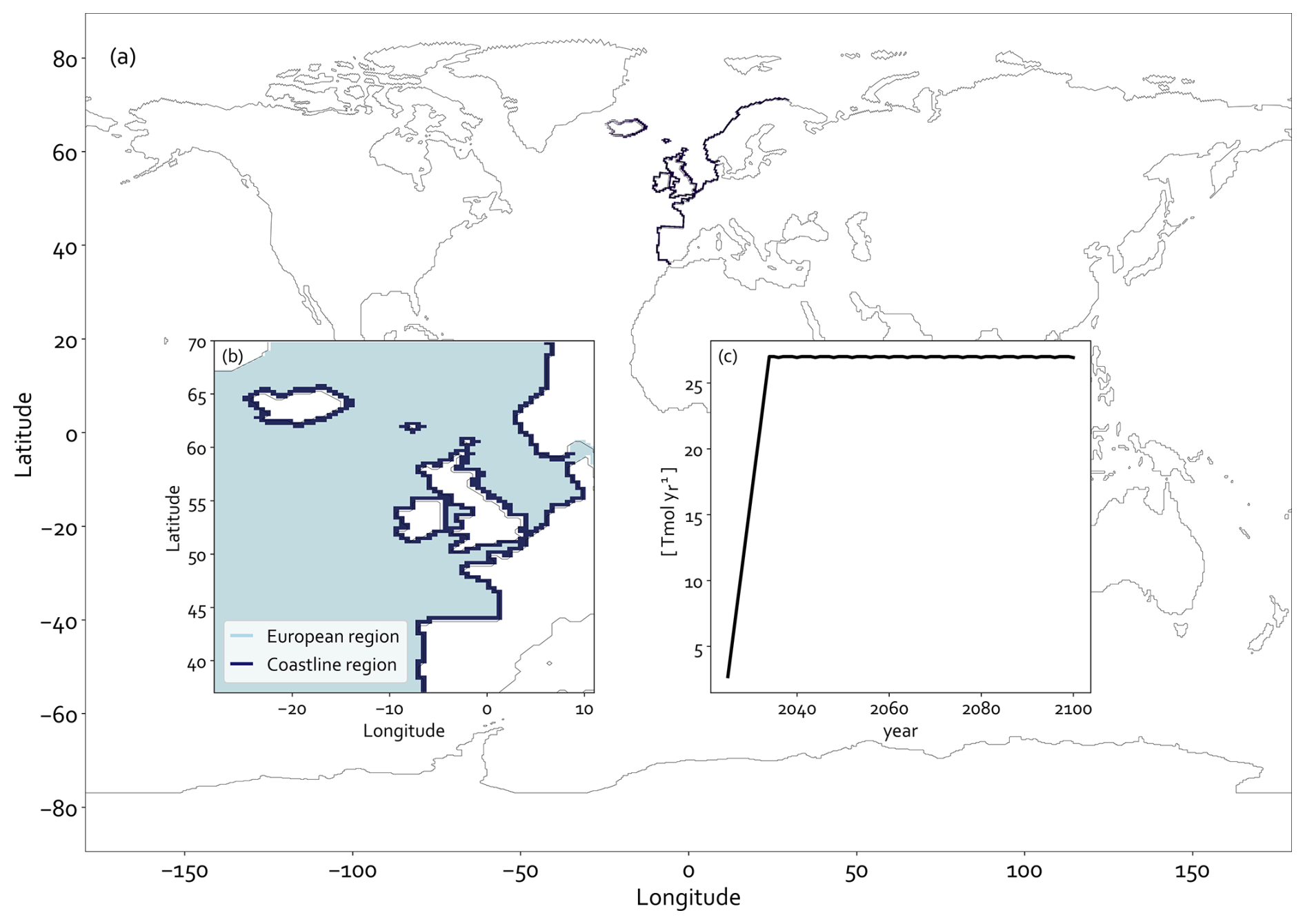
Figure 1(a) shows the spatial distribution of alkalinity addition along the European coastline (excluding the Mediterranean and the Baltic seas); (b) zooms into the regional domain, highlighting the “European region” in light blue and the “coastline region” in dark blue; (c) shows the time series of coastline alkalinity addition in units of Tmol yr1 from 2025 to 2100.
In the OAE runs, alkalinity is introduced continuously and evenly into the surface layer of the coastal grid cells outlined by the coloured line in Fig. 1a, spanning a vertical depth of roughly 3 m. As the model runs with a horizontal resolution of 0.5°, this corresponds to approximately 55 km in the meridional direction and 45 km zonally in southern Europe, decreasing to about 30 km in northern Europe. OAE is applied from 2025 to 2100, with a linear increase over the first decade of addition (2025–2034), until the equivalent of 1 Gt yr1 of fast-reacting calcium hydroxide (Ca(OH)2) is reached. From 2035, this amount, which equals 27 Tmol yr1 of alkalinity (or 44 mol m2 yr1), is held constant until the end of the century (Fig. 1c). Theoretically, Ca(OH)2 consumes two moles of atmospheric CO2, and it produces one mole of calcium (Ca2+) and two moles of bicarbonate, therefore increasing alkalinity by a factor of two (Eq. 1) (Chien et al., 2022):
2.3 Regional model validation
At the global scale, both alkalinity and DIC in FOCI-MOPS agree well with observations, while still showing a positive bias at the surface and a negative bias below 3000 m of depth. However, model fidelity lowers towards the coasts, which are less resolved with a 0.5° resolution. Though this is a common bias in global models that has been highlighted in Chien et al. (2022), here we validate FOCI-MOPS in the region where alkalinity is added using GLODAPv2 observations (Lauvset et al., 2016; Key et al., 2015) (Fig. 2).
For coastal sea surface temperature, FOCI-MOPS agrees well with GLODAPv2, with slightly lower values near the continental shelf. Towards the North Atlantic, FOCI-MOPS shows a prominent cold bias (Fig. 2c), which was already observed in previous model validation studies (Chien et al., 2022; Matthes et al., 2020). Such a feature is likely due to the lack of mesoscale dynamics, which affects the Gulf Stream path compared to an eddy-resolving ocean model (Matthes et al., 2020; Ojha et al., 2026).
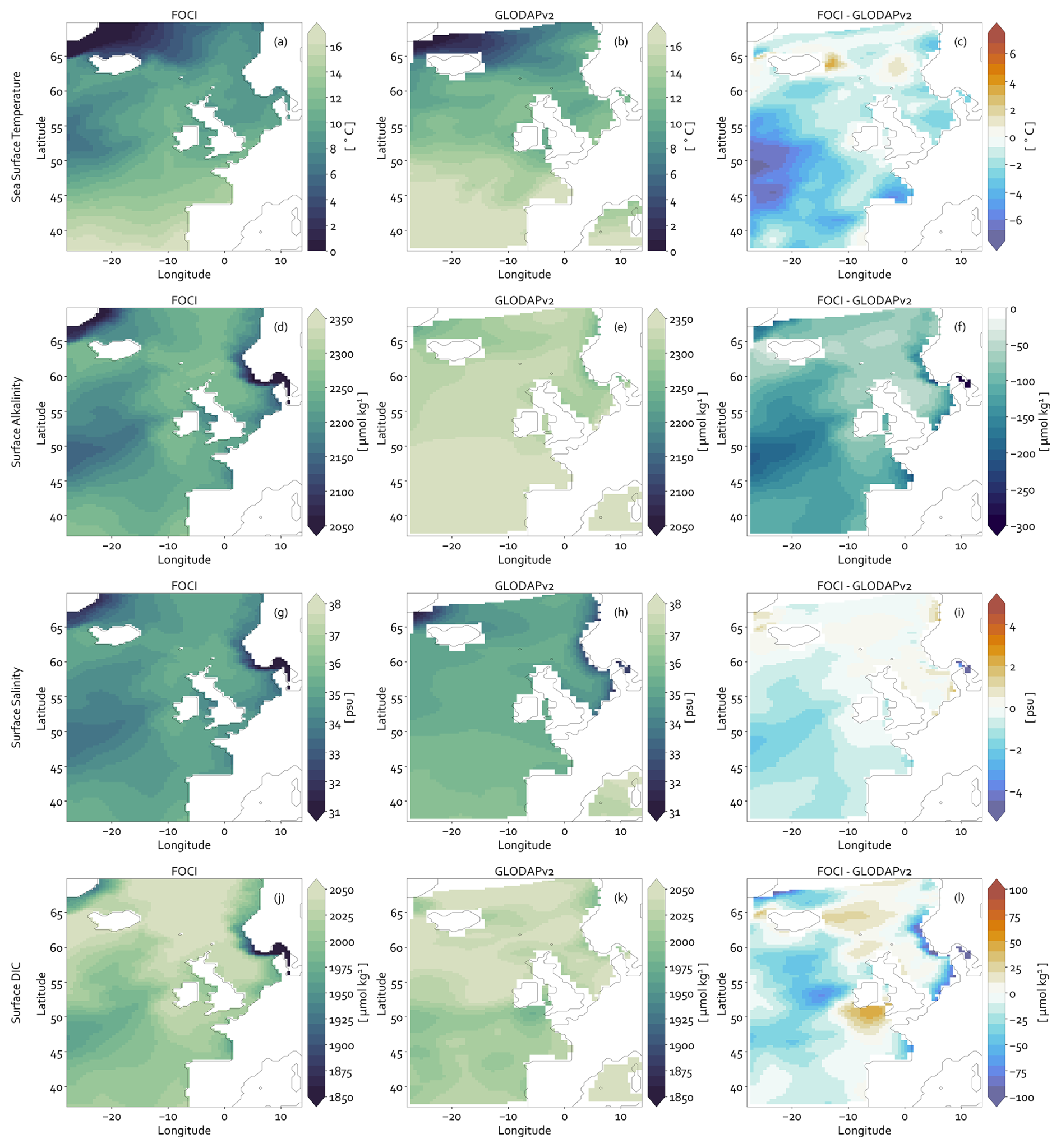
Figure 2Comparison of FOCI-MOPS mean fields (1972–2013) and 2021 GLODAPv2 observations, along with their differences, for sea surface temperature (a, b, c), surface alkalinity (d, e, f), surface salinity (g, h, i), and surface DIC (j, k, l).
Generally, surface alkalinity has a minor negative bias compared to the GLODAPv2 dataset, which increases off the coasts of Norway and towards the open ocean (Fig. 2f). DIC fields in FOCI-MOPS agree well with observations, while showing a negative bias in the North Atlantic and a positive bias south of the Irish coasts. Importantly, by the Norwegian shelf and in the southern North Sea, the strong negative bias may have an impact on the background carbonate system under OAE application. A bias toward colder, lower-alkalinity conditions also reflects the fresh bias shown in Fig. 2i, which is stronger in the North Atlantic but absent towards the coast.
While FOCI-MOPS shows good agreement with GLODAPv2 observations, we recognise that the use of a lower-resolution model may limit the accuracy of absolute values in our simulations. However, we emphasise that our analysis focuses on differences between simulations (i.e. between an OAE run and a control run, or between SSPs), such that systematic errors are expected to affect experiments similarly and therefore largely cancel.
2.4 Data processing
Our analysis focuses on the comparison between two regions: the “coastline region”, which corresponds to the shelf grid cells highlighted by the dark blue line in Fig. 1b, offers details on regime shifts that take place at the epicenter of the domain; the “European region”, which corresponds to the light blue region in Fig. 1b, measures how the European system as a whole might respond to OAE. As Palmiéri and Yool (2024) showed that half of the OAE-driven carbon uptake can happen far from the injection region, this approach helps maintain some focus beyond the coastline of alkalinity addition without risking to dilute the OAE signal.
Assuming that the most visible control-to-OAE differences are detected towards the end of the century, the annual cycle averaged over the last simulation decade (2090–2099) is considered here. While ocean pCO2 and the CO2 flux are calculated only for the surface, alkalinity is represented over all 46 FOCI ocean layers. Thus, the variable was vertically averaged over a seasonally- and scenario-dependent mixed layer depth (MLD) (also a FOCI output variable defined from potential density), which is the region in direct contact with the atmosphere. The alkalinity that is subducted below the MLD is assumed not to induce CO2 uptake by the ocean on short timescales (He and Tyka, 2023). Importantly, the CO2 flux outputs shown in the Results section are taken from the coarser atmospheric grid.
In our analysis, we define the “seasonal amplitude” as the difference between the annual maximum and the annual minimum value in a given simulation, and seasons are defined as follows: winter (December, January, February), spring (March, April, May), summer (June, July, August), and autumn (September, October, November). Additionally, we present results for the OAE seasonal carbon sequestration potential, defined as the ratio of the seasonal change in CO2 flux between a run with OAE and a run without OAE, and the amount of monthly added alkalinity carbon equivalent.
3.1 The seasonal state in the control run
As a continental shelf pump, the European region plays an important role in carbon uptake dynamics by transferring atmospheric CO2 into interior coastal waters and ultimately to the open ocean in the North Atlantic. As outlined above, the CO2 flux seasonality is mainly driven by SST, which affects its chemical solubility, and biological processes, whereby carbon is used to sustain photosynthesis. Thus, to provide context for interpreting the results of our OAE runs, we analyse the SSP1-2.6 control seasonal state in the European region and in the coastline region for the CO2 flux (Fig. 3b, g) and for some of its driving variables: SST (Fig. 3c, h), MLD-integrated NPP (Fig. 3d, i), and MLD (Fig. 3e, j).
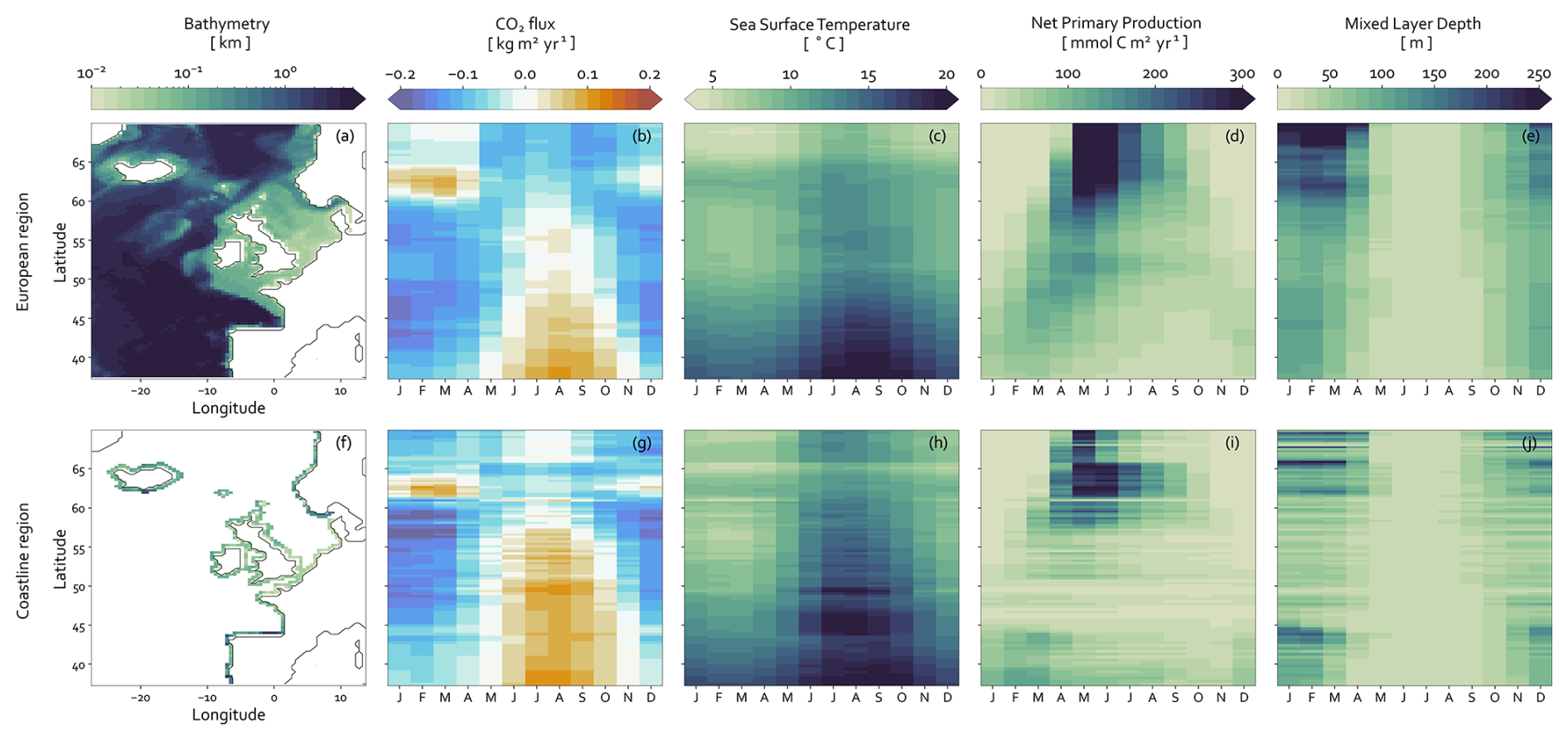
Figure 3Hovmöller diagram of the zonally averaged European region (top) and coastline region (bottom) for bathymetry (a, f), the CO2 flux (b, g), sea surface temperature (c, h), MLD-integrated net primary production (d, i), and the mixed layer depth (e, j) over the 2090–2099 mean. In the CO2 flux plot, negative values indicate ocean uptake.
For the air-sea CO2 flux, the European region and the coastline region show two opposing biogeochemical geographies. Up to about 60° N, the seasonal carbon cycle is driven by temperature (Fig. 3c, h), as the largest ocean CO2 uptake happens in winter, when CO2 solubility is strongest, while outgassing takes place in summer, when warm temperatures inhibit chemical dissolution. In contrast, between 60 and 65° N, seasonality is driven by biological productivity: carbon escapes to the atmosphere over the cold months, when NPP is limited by sunlight and nutrient availability, whereas, from April to October, increasing productivity consumes CO2 and ingassing is favoured.
Though this pattern is generally homogeneous throughout the two regions, localised divergences emerge. For example, north of 65°, a deeper mixed layer in the European region (Fig. 3e) seems to neutralise CO2 outgassing, while in the coastline region, where the MLD remains relatively shallower (Fig. 3j) and SST increases relatively more (Fig. 3h), the air-sea CO2 flux is driven by chemical solubility and the largest CO2 uptake takes place in winter. This behaviour may be because a shallow MLD year-round does not replenish the surface ocean with sub-surface nutrient-rich waters. Additionally, temperature seasonality is stronger in the coastline region than in the European region, especially between 50 and 60° N, resulting in a relatively more pronounced CO2 uptake (outgassing) in winter (summer).
3.2 OAE-driven modifications to the seasonal carbon cycle
Below, we present results on the OAE-driven seasonal changes in alkalinity, surface ocean pCO2 and the CO2 flux, focusing on their temporal evolution over the 2090–2099 decade (Fig. 4) as well as on their spatial differences, both vertically (Fig. 5) and horizontally (Fig. 6). Average values for the main carbonate variables are summarised in Table 1.
Table 1Annual minimum and annual maximum values averaged over 2090–2099 for alkalinity, surface ocean pCO2, the air-sea CO2 flux, and the mixed layer depth. Values are presented for the European region and the coastline region under both emission scenarios in the control and OAE runs. Note that air-sea CO2 flux negative values indicate uptake by the ocean.
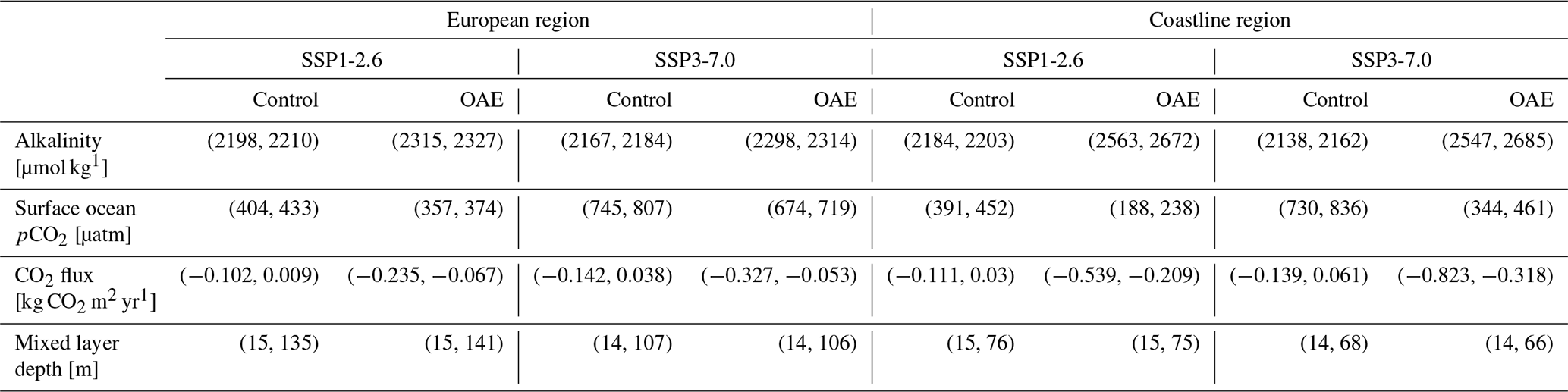
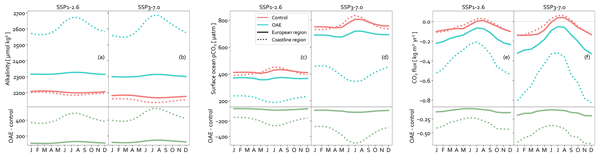
In the European region (Fig. 4a, b), surface alkalinity in the control run has lowest values in summer and highest values in winter, with respective extremes of 2198 and 2210 µmol kg1 in SSP1-2.6, and of 2167 and 2184 µmol kg1 in SSP3-7.0. Seasonal alkalinity follows MLD seasonality, whereby winter mixing deepens the mixed layer, replenishing the surface with high-alkalinity sub-surface waters. In the OAE runs, alkalinity increases in all seasons. While control values in SSP1-2.6 are higher than in SSP3-7.0, OAE increases surface alkalinity relatively less under lower emissions. In summer, when OAE enhances alkalinity the most in both scenarios, values increase by 117 µmol kg1 and by 130 µmol kg1 for the low- and high-emission scenario, respectively.
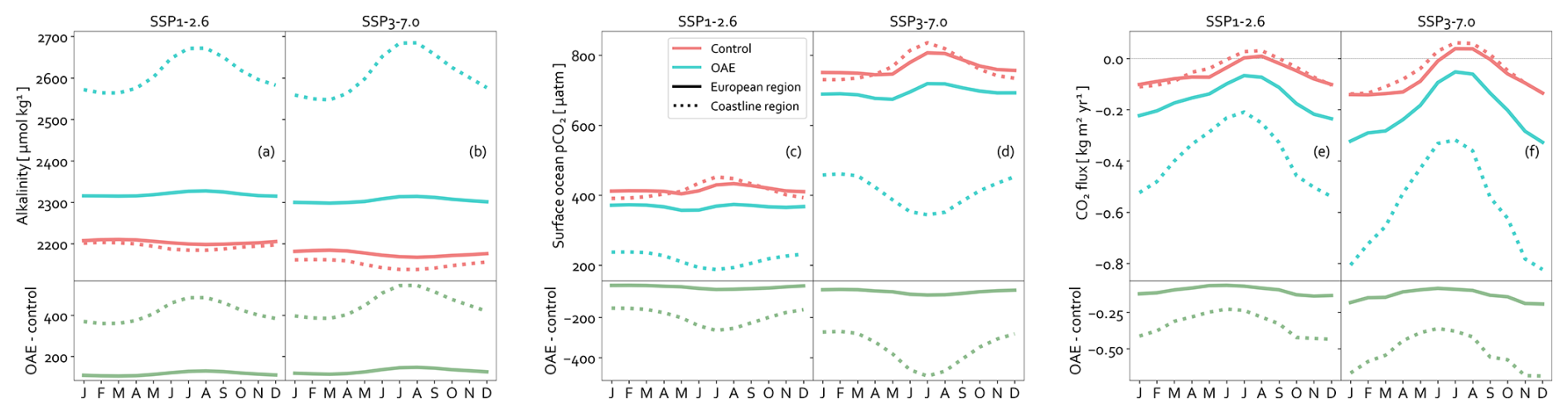
Figure 4Seasonal cycle averaged over 2090–2099 for surface alkalinity in SSP1-2.6 (a) and in SSP3-7.0 (b), for surface ocean pCO2 in SSP1-2.6 (c) and in SSP3-7.0 (d), and for the CO2 flux in SSP1-2.6 (e) and in SSP3-7.0 (f), with the respective difference depicted by the green line. Continuous lines represent the European region and dashed lines represent the coastline region. In the CO2 flux plots, negative values indicate ocean uptake.
In the coastline region (Fig. 4a, b), where control alkalinity is similarly highest in winter and lowest in summer, OAE increases surface values up to 2672 µmol kg1 in SSP1-2.6 and to 2685 µmol kg1 in SSP3-7.0, both in summer. Furthermore, the amplitude of the seasonal cycle increases greatly compared to the control runs, shifting from about 19 to 109 µmol kg1 and from 24 to 138 µmol kg1 in the low- and high-emission scenario, respectively. As increasing emissions favour surface warming, higher surface alkalinity in SSP3-7.0 is the result of enhanced vertical stratification, whereby more of the added alkalinity is retained at the top layer.
Importantly, under both emission scenarios and in both the European and the coastline regions, alkalinity addition reverses its surface seasonal cycle, with summer values exceeding winter values. This reversed pattern is highlighted in Fig. 5, where seasonal alkalinity is shown as a function of depth. Under natural conditions, alkalinity increases with depth and winter mixing helps replenish the upper ocean from deeper layers. However, in the OAE simulations, alkalinity is added at the surface in our simulations, and stronger vertical stratification in summer leads to greater alkalinity retention, favoured by a shallower MLD.
In all OAE runs, while alkalinity mostly accumulates in the first ocean layer (top row in Fig. 5), the rest of the mixed layer (bottom row in Fig. 5) also reflects an alkalinity increase, which is higher in summer than in winter, leading to the seasonal shift that is observed in Fig. 4a, b. Surface alkalinity accumulation is higher in the coastline region, compared to the European region, due to a much higher alkalinity input in the region of addition, and in SSP3-7.0, compared to SSP1-2.6.
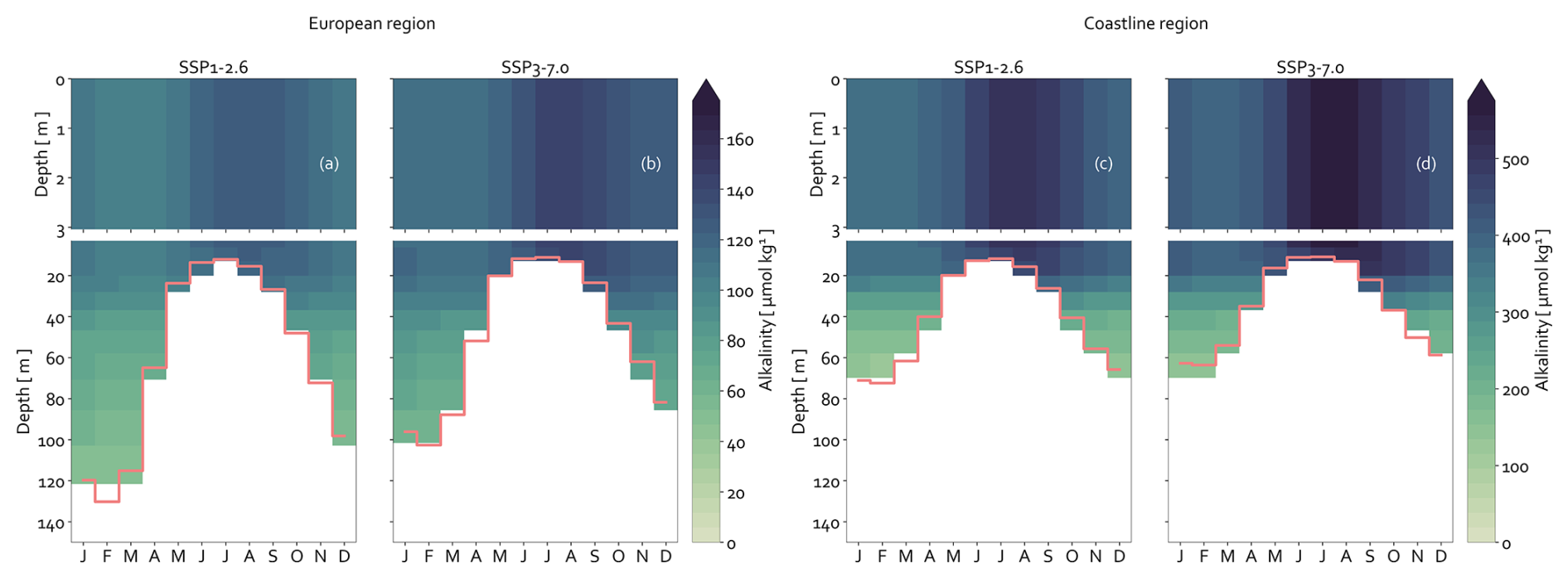
Figure 5Hovmöller diagram of the zonally averaged alkalinity change (OAE minus control run) as a function of depth over the first model layer (top) and over the mixed layer (bottom). The left panels (a, b) represent the European region and the right panels (c, d) represent the coastline region. The red line corresponds to the mixed layer depth in the control run.
Spatially, under both SSPs in the OAE runs, the seasonal amplitude change of MLD-averaged alkalinity reveals strongest variation in the southern North Sea as well as by the UK coastline, where it increases by about 400 µmol kg1. No clear amplitude change is visible in the remaining coastline region like off the coasts of Iceland, Spain and Norway. In SSP3-7.0 (Fig. 6d), the seasonal amplitude signal extends over a slightly wider area than in SSP1-2.6 (Fig. 6a), and the Norwegian and Icelandic coastlines show a small increase of the alkalinity seasonal amplitude.
Regarding the surface ocean pCO2, the European region (Fig. 4c, d) is characterised by lowest values of 404 µatm (745 µatm) in May and highest values of 433 µatm (807 µatm) in August under SSP1-2.6 (SSP3-7.0). Minima are registered in spring because of phytoplankton bloom and consequent high NPP (Fig. 3d), whereby carbon is consumed in photosynthetic fixation. In the OAE run, surface ocean pCO2 decreases for all seasons and spring values remain lowest, dropping to 357 µatm in SSP1-2.6 and to 674 µatm in SSP3-7.0. The seasonal amplitude decreases from 29 to 17 µatm in SSP1-2.6 and from 62 to 45 µatm in SSP3-7.0, with minimum values still detected over spring. While in the European region pCO2 exhibits the same seasonality in both OAE and baseline simulations, in the coastline region, surface ocean pCO2 is directly influenced by the OAE-driven reversal of the alkalinity seasonal cycle: highest (lowest) summer (winter) values in the control run become lowest (highest) in the OAE run. In SSP1-2.6 (Fig. 4c), the seasonal amplitude of the ocean pCO2 decreases from 61 to 50 µatm, while in SSP3-7.0 (Fig. 4d) the amplitude increases from 106 to 117 µatm because OAE drives an even stronger reduction of summer values.
OAE reduces surface ocean pCO2 in both the European region and in the coastline region, and under both emission scenarios. The largest change occurs in summer, when OAE-driven surface alkalinity has increased the most. This behaviour indicates that, in our simulations, alkalinity addition produces the greatest pCO2 decline during periods of naturally high CO2 outgassing, resulting in a seasonal pCO2 amplitude damping that is relatively more pronounced under low emissions: in the European region, the seasonal amplitude is reduced by 41 % (27 %) in SSP1-2.6 (SSP3-7.0); in the coastline region, the amplitude is reduced (enhanced) by 18 % (10 %) in SSP1-2.6 (SSP3-7.0).
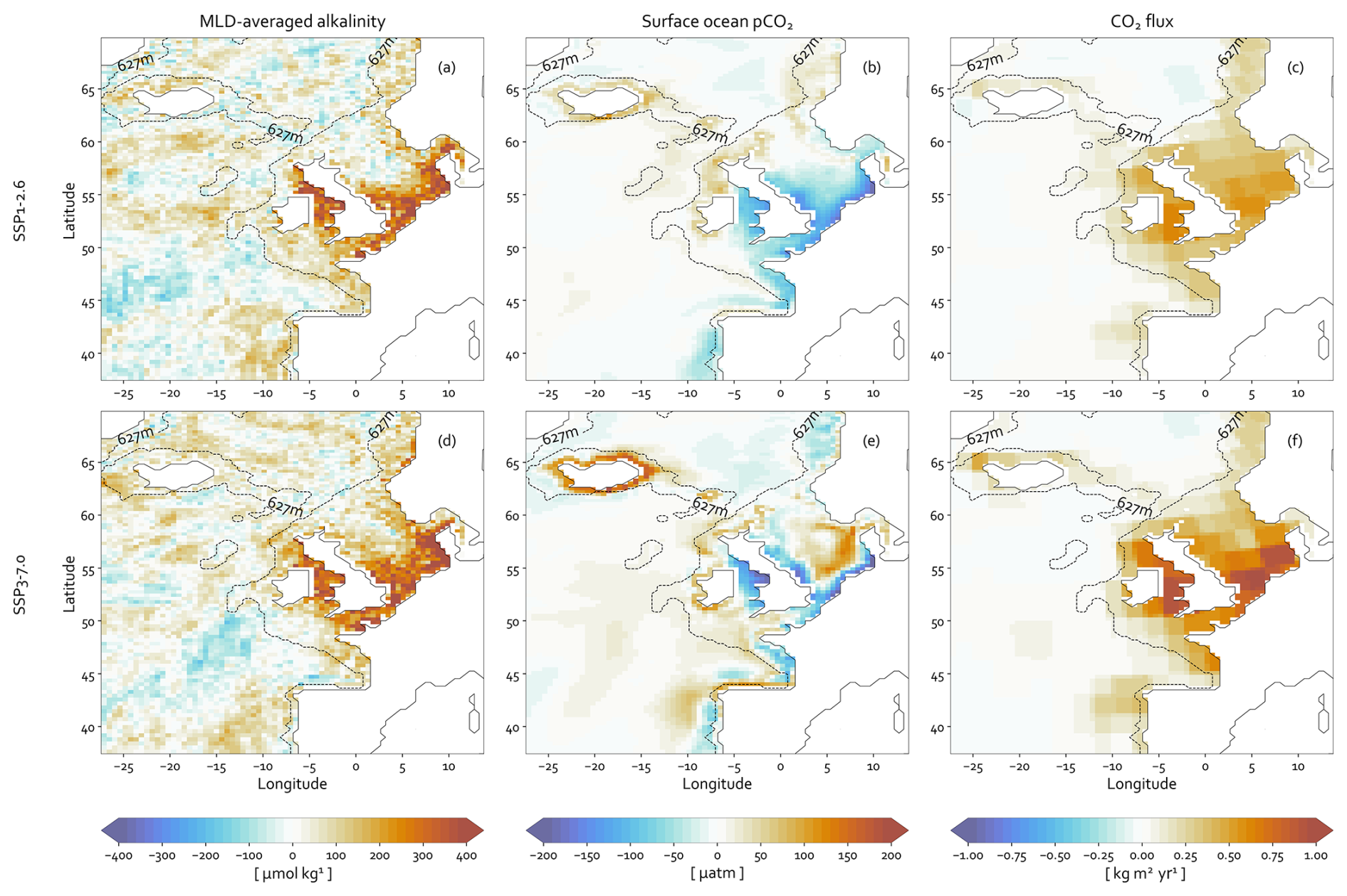
Figure 6Seasonal amplitude change (OAE minus control run) averaged over 2090–2099 for MLD-averaged alkalinity (a, d), for surface ocean pCO2 (b, e) and for the air-sea CO2 flux (c, f). The top row shows SSP1-2.6 and the bottom row shows SSP3-7.0. CO2 flux calculations are performed on the atmospheric component of FOCI, which has a coarser resolution than the ocean component. The dashed line represents the shelf break set at the 627 m isobath.
In the SSP1-2.6 scenario (Fig. 6b), a distinct spatial pattern of pCO2 seasonal amplitude change driven by OAE is identified: at higher latitudes, including off the coasts of Iceland, as well as by the Norwegian and British North-West coastline, the seasonal amplitude slightly increases compared to the control; conversely, at lower latitudes, namely near the continental shelf and by the central-to-southern UK coasts, the seasonal cycle is strongly reduced. In SSP3-7.0 (Fig. 6e), results are amplified in Iceland, in the Southern North Sea, in the UK and Irish coasts. Exceptions are found in the central North Sea and Northern Spain, where strong seasonal amplification is displayed, and off the coasts of Norway, where the ocean pCO2 seasonal cycle is reduced.
Such a strong latitudinal and scenario divergence in the seasonal amplitude of surface ocean pCO2 may be due to different factors. North of 60° N, where the air-sea CO2 flux is driven by its biological component (Fig. 3d), the seasonal cycle could respond differently from the European region and the coastline region, where the CO2 flux is controlled by SST. At lower latitudes in SSP3-7.0, the increasing seasonal amplitude of surface ocean pCO2, which is spatially confined to the coastal shelves, is probably driven by an even stronger OAE-induced pCO2 decline over summer, as it is the case for the coastline region in Fig. 4d.
Regarding the CO2 flux, seasonality is overall driven by temperature in our regional domain: the system outgasses (takes up) CO2 in summer (winter), at lowest (highest) chemical solubility, and the largest CO2 release happens between July and August. This pattern follows MLD seasonality, whereby summer warming shoals the mixed layer, reducing CO2 uptake, and winter mixing deepens the mixed layer, enhancing the CO2 flux (Jones et al., 2014). Under SSP1-2.6, the European region ranges from an uptake of 0.102 kg CO2 m2 yr1 between December and January and an outgassing of 0.009 kg CO2 m2 yr1 between July and August, while in SSP3-7.0, values are slightly more extreme: 0.142 kg CO2 m2 yr1 uptake in winter and 0.038 kg CO2 m2 yr1 outgassing in summer.
In the European region, with OAE deployment the ocean's CO2 uptake potential is enhanced at all seasons: it ranges from 0.235 (0.327) kg CO2 m2 yr1 in winter to 0.067 (0.053) kg CO2 m2 yr1 in summer under SSP1-2.6 (SSP3-7.0). As OAE drives largest CO2 drawdown during winter, it enhances the seasonal CO2 flux, with a new amplitude of 0.168 kg CO2 m2 yr1 in SSP1-2.6 and 0.274 kg CO2 m2 yr1 in SSP3-7.0, compared to their respective controls (0.111 and 0.18 kg CO2 m2 yr1). This results in a seasonal amplitude enhancement of 51 % and of 52 % in the low- and high-emission scenario, respectively. In the coastline region, the signal is larger than in the European region: the CO2 flux seasonal amplitude is 0.33 kg CO2 m2 yr1, therefore almost tripling the amplitude in the control run, which amounts to 0.114 kg CO2 m2 yr1. With an amplitude of 0.505 kg CO2 m2 yr1, the OAE seasonal CO2 flux in SSP3-7.0 is more than 2.5 times larger than the control (0.2 kg CO2 m2 yr1).
Importantly, in the OAE runs in both the European region and coastline region, excess surface alkalinity accumulates during summer, prompting a stronger reduction of surface ocean pCO2 which, due to fast air-sea gas exchange, turns net summer outgassing into a year-round carbon sink. OAE drives the largest excess CO2 uptake in winter, as the seasonal air-sea CO2 flux remains in phase with the MLD cycle, regardless of seasonal variations in alkalinity (Nagwekar et al., 2024). In the coastline region, a shallow bathymetry favours year-round mixing and stronger CO2 uptake than in the European region. As for the role of the emission scenario, SSP3-7.0 drives an even stronger carbon uptake in winter, while maintaining summer values similar to SSP1-2.6, which further increases the CO2 flux seasonal amplitude. As it will be described later, this behaviour is due to the lowering buffering capacity of the ocean under higher emissions.
Spatially, in SSP1-2.6, OAE amplifies the CO2 seasonal amplitude along the European coastline, and the signal remains strong until the connection with the open ocean (Fig. 6c). This boundary is set by the 627 m isobath, which separates the region with a strong signal from the open ocean, where changes are almost absent. The only exception is found off the Atlantic coasts of Spain, where the signal persists beyond the selected isobath, which may be resulting from ocean circulation dynamics that keep alkalinity at the surface and drive strong winter CO2 uptake. The seasonal cycle is further amplified under high emissions (Fig. 6f), especially by the coasts of the southern North Sea, the UK and North-West Iceland.
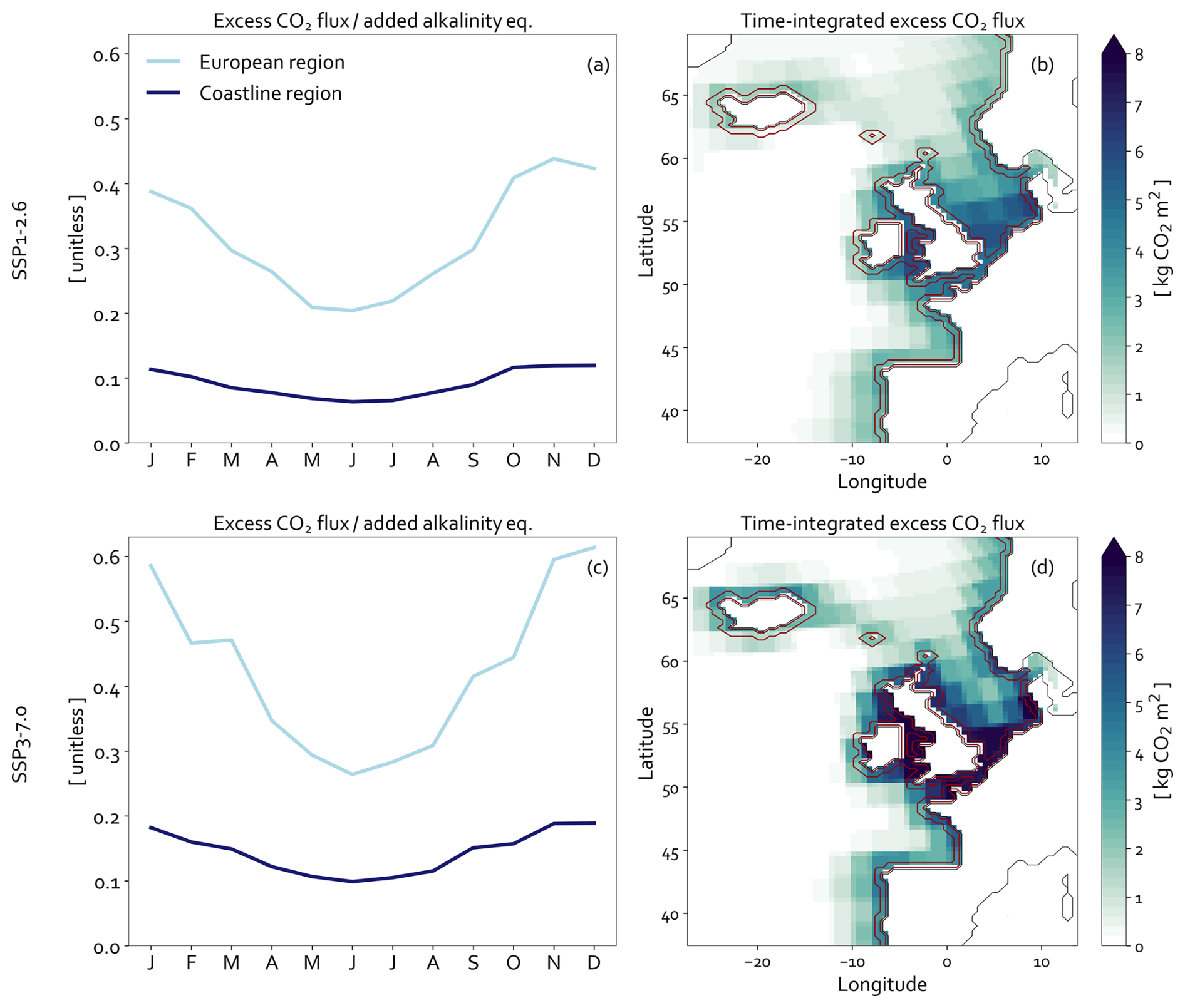
Figure 7The OAE seasonal carbon sequestration potential, defined as the ratio between the change in CO2 flux and the added alkalinity carbon equivalent averaged over 2090–2099 (a, c), and the 2090–2099 time-integrated excess CO2 flux (OAE minus control run) (b, d). The red contour line in (b) and (d) represents the region of alkalinity addition.
The effects of OAE on carbonate seasonality are reflected in the seasonal carbon sequestration potential. While both in SSP1-2.6 and SSP3-7.0 the seasonal potential grows over the winter months and decreases over the summer months, spatial differences are present: the European region is characterised by larger variability, with values ranging between 0.2 and 0.44 (0.26, 0.61) in SSP1-2.6 (SSP3-7.0); in the coastline region values are more constant, ranging between 0.06 and 0.12 (0.1 and 0.19) in SSP1-2.6 (SSP3-7.0). Additionally, high emissions drive a larger carbon uptake potential: this is related to the scenario-dependent chemical efficiency of OAE whereby, per unit of added alkalinity, higher atmospheric CO2 concentrations increase the air-sea disequilibrium and decrease the ocean's buffering capacity (Schwinger et al., 2024; Nagwekar et al., 2024, 2026).
Other than being more variable in the European region than in the coastline region, values are much higher in the former than in the latter, which is explained by the fact that excess carbon uptake is not confined to the place of alkalinity addition. This aspect is highlighted in panels (b) and (d): while most additional air-sea CO2 flux takes place near the coastal shelves, with little increase over the open ocean, this excess downward flux extends beyond the region of OAE deployment (Palmiéri and Yool, 2024). Furthermore, compared to SSP1-2.6, high emissions strengthen the ocean carbon sink for the same amount of added alkalinity and within the same spatial extent, due to a lower buffer factor in a high-CO2 world (Nagwekar et al., 2024).
This study provides an assessment of OAE-driven impacts on the seasonal carbonate system. OAE was simulated as a continuous surface alkalinity injection to a coastal strip in the European coastline, under a low- and a high-emission scenario. This formulation allowed us to investigate the location- and scenario-dependency of OAE effects, drawing some key findings. First, adding alkalinity at the surface reverses its seasonal cycle, as temperature-induced vertical stratification in summer retains excess alkalinity at the top, while dilution with low alkalinity sub-surface water is favoured in winter. This outcome is especially relevant in the context of monitoring, reporting and verification (MRV) protocols, as measuring seasonal shifts could be an opportunity to establish metrics on OAE detectability. At the same time, surface alkalinity in the coastal region increases by more than 500 µmol kg1 during summer, potentially exceeding critical thresholds for parameters such as pH and aragonite saturation state, thereby adversely affecting local biota. Potential negative side-effects could be partially mitigated by choosing the optimal alkalinity feedstock tailored to the time, rate and place of addition (Wang et al., 2025).
Secondly, continuous OAE deployment induces surface ocean pCO2 reduction in all seasons, but most strongly when the associated seasonal driver reduces the ocean CO2 sink potential, which is during the summer in the temperature-driven European region. In the coastline region, this phase shift of surface alkalinity drives the reversal of ocean pCO2 seasonality, though the CO2 uptake, and the OAE-driven uptake increase, remains largest during winter, whereby colder months decrease SST, deepen the MLD and favour CO2 dissolution in seawater. This leads to two main conclusions: on the one hand, increasing ocean disequilibrium with the overlying atmosphere turns summer outgassing into net uptake year-round due to fast air-sea gas exchange; on the other hand, the CO2 seasonal cycle keeps following MLD seasonality, independent of changes in alkalinity. In the coastline region, the MLD largely corresponds to the depth of the bathymetry for most of the year (Fig. 3), which implies that a shallow, well-mixed compartment may support surface alkalinity retention throughout the year and sustain fast air-sea gas exchange. This finding may however be closely tied to the mode of OAE deployment, that allows the surface ocean to be continuously replenished with alkalinity and drive the atmosphere-ocean disequilibrium.
The seasonal carbon sequestration potential of OAE (Fig. 7) reflects the seasonal trend of the CO2 flux, whereby uptake increases in winter and it decreases in summer in both the European region and the coastline region, and under both emission scenarios. Importantly, the potential is much larger in the European region than in the coastline region, and under higher emissions than under lower emissions, given that excess CO2 uptake happens further than the region of alkalinity addition and that it is enhanced in SSP3-7.0 (Fig. 7b, d). This finding is relevant for country-level accountability of OAE deployment, as measurements that are limited to national or regional boundaries may not fully reflect the extent of OAE-driven impacts and therefore underestimate the carbon sequestration potential.
To highlight the relevance of these findings, we place our results in the context of previous research that investigated OAE-induced seasonal changes under varying background emissions. Starting from the mode of OAE deployment, which has a strong impact on carbonate changes, most studies, including ours, have focused on surface alkalinity addition: at the coastline (Feng et al., 2017; Moustakis et al., 2025), throughout the global ocean (González and Ilyina, 2016; González et al., 2018), or at specific locations to explore regional dynamics (Ilyina et al., 2013; Nagwekar et al., 2024). Similarly, our simulations explored the addition of a fast-reacting material, assuming rapid dissolution at the ocean surface. Importantly, Palmiéri and Yool (2024) simulated the addition of about 29 Teq yr1 alkalinity equivalent to the global shelves at the seafloor, finding that the depth of application has a minor impact on the carbon sequestration potential. Furthermore, regarding the rate of alkalinity addition, we apply continuous OAE deployment, which implies a constant replenishment of surface alkalinity to drive air-sea disequilibrium. This approach differs from studies that investigated pulsed addition (He and Tyka, 2023; Zhou et al., 2025), which is likely to become a more realistic strategy in future deployment schemes.
In agreement with previous studies (Wang et al., 2023; Nagwekar et al., 2024; Guo et al., 2025; Wang et al., 2025), surface retention of excess alkalinity is better achieved in summer, as shallow, vertically stratified waters allow for alkalinity not to be lost due to subduction to deeper layers or advection to the open ocean. Concerning the phase shift of seasonal surface alkalinity, Liu et al. (2025) showed that, by applying OAE to three sites in the southern North Sea, excess MLD-integrated alkalinity seasonality becomes out of phase compared to the whole water column, though the peak is detected during winter. Thus, as seasonal shifts to upper alkalinity can vary based on regional features, side changes to the carbonate system and to the local biota would also be site-specific, urging for comprehensive MRV protocols that synthesise signal detectability and ecological risk prevention.
In agreement with Schwinger (2022), OAE in our simulations amplifies the CO2 seasonal flux under both SSPs, prompting greatest carbon uptake during winter, as OAE is found to amplify the seasonal cycle when highest CO2 drawdown occurs naturally. Importantly, our results show that increased summer alkalinity leads to the strongest decrease in ocean pCO2, causing summer conditions to shift from net outgassing to net uptake as a result of rapid air–sea re-equilibration. This change effectively turns the European region and the coastline region into year-round CO2 sinks, while Schwinger (2022) found that, in their runs, seasonal amplification happens in both directions, therefore increasing outgassing as well as uptake. Additionally, in our OAE runs, the CO2 flux follows alkalinity addition, maintaining the largest CO2 uptake over winter. This finding agrees with Nagwekar et al. (2024), where it was found that seasonal shifts of the air-sea CO2 flux are irrespective of seasonal alkalinity variations, remaining in phase with MLD seasonality.
With regard to the seasonal carbon sequestration potential, as CO2 uptake is higher in winter than in summer, efficiency follows the same seasonal trajectory, which seems to contradict previous findings (Zhou et al., 2025; Anderson et al., 2025) that found larger efficiency during summer. Zhou et al. (2025) performed pulsed alkalinity addition in various seasons, while Anderson et al. (2025) performed 90 d long simulations where alkalinity is continuously added over winter and over summer. However, pulsed addition is expected to have different outcomes from continuously replenishing the ocean's surface with alkalinity, as is the case of our simulations. In contrast, by simulating continuous OAE over a 10-year simulation in the Bering Strait, Wang et al. (2023) found that warming summer conditions decrease the carbon sequestration potential. These findings imply that results on efficiency are closely tied to simulation-specific features like the time and rate of alkalinity addition, as well as the definition of efficiency itself. For example, if efficiency is defined in relation to changes to DIC, the type, and resolution, of the model deployed is also relevant, as biogeochemical processes that affect DIC sinks and sources would affect pool estimates.
Lastly, we investigate the role of the background scenario on OAE impacts. In our simulations the ocean's carbon sink is increased more strongly in SSP3-7.0 than in SSP1-2.6, as surface alkalinity reaches similar levels in the two scenarios (Fig. 4a, b) but surface DIC increases more under high emissions (not shown). This finding agrees with Schwinger et al. (2024), who showed that increasing emissions drive an even further ocean uptake of anthropogenic CO2 compared to a non-transient OAE simulation, due to elevated surface DIC concentrations and a decreasing ocean's buffering capacity. Similarly, Nagwekar et al. (2026) found that, in SSP3-7.0, a higher air-sea partial pressure difference compared to SSP1-2.6 increases the size of the carbonate system response to alkalinity addition, driving larger additional CO2 uptake. This same result was previously highlighted by Nagwekar et al. (2024), where OAE efficiency was higher in SSP3-7.0 (compared to SSP1-2.6) due to higher background atmospheric CO2 and, most importantly, due to a decreasing buffer factor. However, it is important to emphasise that, other than enhancing OAE efficiency, higher atmospheric CO2 would increase surface temperatures, and thus ocean verification stratification, preventing the entrainment of sequestered carbon to deeper layers (Nagwekar et al., 2024), which is an essential aspect to long-term OAE efficiency.
Some limitations and future recommendations can be drawn from this study. With regard to FOCI-MOPS, the ESM represents coastal biogeochemical processes less well compared to the open ocean (Chien et al., 2022), which may affect the accuracy of absolute values in the region of alkalinity addition. While model results are mostly in agreement with GLODAPv2 observations, some of the biases may affect the truthfulness of output values. Alkalinity in the Baltic Sea, for example, is poorly resolved by FOCI, which could have an impact on the North Sea boundary conditions. However, since our analysis focuses on relative differences between runs, the main conclusions in this manuscript would be less affected by such structural biases, as these are expected to affect both simulations similarly. Furthermore, while freshwater input from rivers is modelled in FOCI, riverine alkalinity is not accounted for. As river runoff has a strong seasonal cycle, implementing such processes in the model would improve the accuracy of OAE simulations.
Another limitation is that our analysis does not separate the CO2 flux into its thermal and biological element, therefore missing the capability to discern the influence that each of these elements has in altering the CO2 seasonal cycle. Given the impacts of temperature and NPP at lower and higher latitude, respectively, in our domain, calculating both terms individually could provide further insight into their seasonal role under OAE deployment. Lastly, this manuscript does not address alkalised water that is subducted before air-sea equilibration is complete, and uncertainty remains on whether that water could resurface to drive CO2 uptake elsewhere. In Palmiéri and Yool (2024), for example, it was estimated that about 50 % of CO2 uptake favoured by global coastal OAE happened remotely from the alkalinity injection sites, as is partially shown in Fig. 7.
The present study addressed the changes to the seasonal carbon cycle driven by coastal OAE application under a low- and a high-emission scenario. It was found that, when addition takes place at the top layer, excess alkalinity accumulates more strongly in summer, as a shallow mixed layer retains alkalised water at the surface. This has the consequence of reversing, as well as amplifying, the seasonal cycle of surface alkalinity. Additionally, OAE reduces ocean pCO2 more strongly in summer, when it is naturally highest, which, thanks to fast air-sea re-equilibration, turns summer net CO2 outgassing into net uptake year-round. However, OAE drives the strongest CO2 uptake enhancement in winter, when it is naturally strongest, as air-sea CO2 flux remains in phase with the MLD seasonal cycle.
This study contributes to the understanding of OAE-driven CO2 intra-annual variability in a continental shelf. While the design of our OAE runs mimics an idealised application, which is unlikely to become a real-world case, coastal OAE implementation is expected to become one of the more feasible approaches, due to proximity with existing coastal infrastructures. Nevertheless, such interventions could create additional pressures on local communities and ecosystems. Thus, drawing from the results highlighted in this study, other coastal methods like pulsed or point-source experiments should be explored to ensure safe large-scale OAE deployment.
The datasets used in this manuscript are available at this Zenodo link (https://doi.org/10.5281/zenodo.13935197, Ciscato, 2026a).
The code underlying this study is openly available at the following GitHub repository: https://github.com/chiaraciscato/2026_ciscato_oae_seasonality (last access: August 2026; DOI: https://doi.org/10.5281/zenodo.21874675, Ciscato, 2026b).
Conceptualisation: C. C., D. P. K.; Performing model simulations: T. P. K.; Data curation: C. C., D. P. K.; Formal analysis: C. C.; Investigation: C. C.; Methodology: D. P. K., T. P. K.; Supervision: D. P. K.; Validation: D. P. K.; Visualisation: C. C.; Writing – original draft: C. C.; Writing – review & editing: C. C., D. P. K., N. M., T. P. K., S. A.
The contact author has declared that none of the authors has any competing interests.
Publisher's note: Copernicus Publications remains neutral with regard to jurisdictional claims made in the text, published maps, institutional affiliations, or any other geographical representation in this paper. The authors bear the ultimate responsibility for providing appropriate place names. Views expressed in the text are those of the authors and do not necessarily reflect the views of the publisher.
C. C. acknowledges funding from the German Federal Ministry of Education and Research, Grant No. 03F0895, Project RETAKE, and from the European Union’s Horizon Europe research and innovation programme, Grant No. 101056939, Project RESCUE. This is a contribution to the CDRmare research mission funded by the German Alliance for Marine Research (DAM). D. P. K. acknowledges funding from the European Union’s Horizon research and innovation programme, Grant No. 869357, Project OceanNETs. S. A. acknowledges funding from the European Union’s Horizon Europe research and innovation programme, Grant No. 101081362, Project SEAO2-CDR.
The authors sincerely thank the anonymous reviewers for their constructive feedback. The authors acknowledge the use of Python for analysis and graphics in this paper, and the computing time made available on the high-performance computer “Lise” at the NHR center NHR@ZIB (former HLRN). This center is jointly supported by the Federal Ministry of Education and Research and the state governments participating in the NHR.
This research was supported by the German Federal Ministry of Education and Research under Grant No. 03F0895 (RETAKE), and by the European Union’s Horizon Europe research and innovation programme under Grant No. 101056939 (RESCUE), 869357 (OceanNETs), 101081362 (SEAO2-CDR).
The article processing charges for this open-access publication were covered by the HE RESCUE project, funded by the CMCC foundation under Grant Agreement No. 101056939.
This paper was edited by Parvadha Suntharalingam and reviewed by two anonymous referees.
Anderson, H. J., Mongin, M., and Matear, R. J.: Ocean alkalinity enhancement in a coastal channel: simulating localised dispersion, carbon sequestration and ecosystem impact, Environmental Research Communications, 7, 041012, https://doi.org/10.1088/2515-7620/adce5a, 2025.
Brovkin, V., Boysen, L., Raddatz, T., Gayler, V., Loew, A., and Claussen, M.: Evaluation of vegetation cover and land-surface albedo in MPI-ESM CMIP5 simulations, J. Adv. Model. Earth Sy., 5, 48–57, https://doi.org/10.1029/2012MS000169, 2013.
Chien, C.-T., Durgadoo, J. V., Ehlert, D., Frenger, I., Keller, D. P., Koeve, W., Kriest, I., Landolfi, A., Patara, L., Wahl, S., and Oschlies, A.: FOCI-MOPS v1 – integration of marine biogeochemistry within the Flexible Ocean and Climate Infrastructure version 1 (FOCI 1) Earth system model, Geosci. Model Dev., 15, 5987–6024, https://doi.org/10.5194/gmd-15-5987-2022, 2022.
Ciscato, C.: Datasets referring to the paper titled 'Impacts of Simulated Coastal Ocean Alkalinity Enhancement on the Seasonal Cycle of CO2 Air-Sea Gas Exchange and Ocean pCO2 in European Waters under Low- and High-Emission Scenarios', Zenodo [data set], https://doi.org/10.5281/zenodo.13935197, 2026a.
Ciscato, C.: Jupyter Notebooks referring to the paper titled 'Impacts of simulated coastal ocean alkalinity enhancement on the seasonal carbon cycle in European waters under a low- and a high-emission scenario', Zenodo [software], https://doi.org/10.5281/zenodo.21874675, 2026b.
Eyring, V., Bony, S., Meehl, G. A., Senior, C. A., Stevens, B., Stouffer, R. J., and Taylor, K. E.: Overview of the Coupled Model Intercomparison Project Phase 6 (CMIP6) experimental design and organization, Geosci. Model Dev., 9, 1937–1958, https://doi.org/10.5194/gmd-9-1937-2016, 2016.
Fassbender, A. J., Schlunegger, S., Rodgers, K. B., and Dunne, J. P.: Quantifying the role of seasonality in the marine carbon cycle feedback: An ESM2M case study, Global Biogeochem. Cy., 36, e2021GB007018, https://doi.org/10.1029/2021GB007018, 2022.
Feng, E. Y., Koeve, W., Keller, D. P., and Oschlies, A.: Model-based assessment of the CO2 sequestration potential of coastal ocean alkalinization, Earth's Future, 5, 1252–1266, https://doi.org/10.1002/2017EF000659, 2017.
Friedlingstein, P., O'Sullivan, M., Jones, M. W., Andrew, R. M., Gregor, L., Hauck, J., Le Quéré, C., Luijkx, I. T., Olsen, A., Peters, G. P., Peters, W., Pongratz, J., Schwingshackl, C., Sitch, S., Canadell, J. G., Ciais, P., Jackson, R. B., Alin, S. R., Alkama, R., Arneth, A., Arora, V. K., Bates, N. R., Becker, M., Bellouin, N., Bittig, H. C., Bopp, L., Chevallier, F., Chini, L. P., Cronin, M., Evans, W., Falk, S., Feely, R. A., Gasser, T., Gehlen, M., Gkritzalis, T., Gloege, L., Grassi, G., Gruber, N., Gürses, Ö., Harris, I., Hefner, M., Houghton, R. A., Hurtt, G. C., Iida, Y., Ilyina, T., Jain, A. K., Jersild, A., Kadono, K., Kato, E., Kennedy, D., Klein Goldewijk, K., Knauer, J., Korsbakken, J. I., Landschützer, P., Lefèvre, N., Lindsay, K., Liu, J., Liu, Z., Marland, G., Mayot, N., McGrath, M. J., Metzl, N., Monacci, N. M., Munro, D. R., Nakaoka, S.-I., Niwa, Y., O'Brien, K., Ono, T., Palmer, P. I., Pan, N., Pierrot, D., Pocock, K., Poulter, B., Resplandy, L., Robertson, E., Rödenbeck, C., Rodriguez, C., Rosan, T. M., Schwinger, J., Séférian, R., Shutler, J. D., Skjelvan, I., Steinhoff, T., Sun, Q., Sutton, A. J., Sweeney, C., Takao, S., Tanhua, T., Tans, P. P., Tian, X., Tian, H., Tilbrook, B., Tsujino, H., Tubiello, F., van der Werf, G. R., Walker, A. P., Wanninkhof, R., Whitehead, C., Willstrand Wranne, A., Wright, R., Yuan, W., Yue, C., Yue, X., Zaehle, S., Zeng, J., and Zheng, B.: Global Carbon Budget 2022, Earth Syst. Sci. Data, 14, 4811–4900, https://doi.org/10.5194/essd-14-4811-2022, 2022.
Gallego, M. A., Timmermann, A., Friedrich, T., and Zeebe, R. E.: Drivers of future seasonal cycle changes in oceanic pCO2, Biogeosciences, 15, 5315–5327, https://doi.org/10.5194/bg-15-5315-2018, 2018.
González, M. and Ilyina, T.: Impacts of artificial ocean alkalinization on the carbon cycle and climate in Earth system simulations, Biogeosciences, 13, 6417–6432, https://doi.org/10.1002/2016GL068576, 2016.
González, M. F., Ilyina, T., Sonntag, S., and Schmidt, H.: Enhanced rates of regional warming and ocean acidification after termination of large-scale ocean alkalinization, Geophys. Res. Lett., 45, 7120–7129, https://doi.org/10.1029/2018GL077847, 2018.
Guo, Y., Chen, K., Subhas, A. V., Rheuban, J. E., Wang, Z. A., McCorkle, D. C., Michel, A., and Kim, H. H.: Site selection for ocean alkalinity enhancement informed by passive tracer simulations, Communications Earth & Environment, 6, 535, https://doi.org/10.1038/s43247-025-02480-1, 2025.
Hartmann, J., Suitner, N., Lim, C., Schneider, J., Marín-Samper, L., Arístegui, J., Renforth, P., Taucher, J., and Riebesell, U.: Stability of alkalinity in ocean alkalinity enhancement (OAE) approaches – consequences for durability of CO2 storage, Biogeosciences, 20, 781–802, https://doi.org/10.5194/bg-20-781-2023, 2023.
He, J. and Tyka, M. D.: Limits and CO2 equilibration of near-coast alkalinity enhancement, Biogeosciences, 20, 27–43, https://doi.org/10.5194/bg-20-27-2023, 2023.
Ilyina, T., Wolf-Gladrow, D., Munhoven, G., and Heinze, C.: Assessing the potential of calcium-based artificial ocean alkalinization to mitigate rising atmospheric CO2 and ocean acidification, Geophys. Res. Lett., 40, 5909–5914, https://doi.org/10.1002/2013GL057981, 2013.
Jones, D. C., Ito, T., Takano, Y., and Hsu, W. C.: Spatial and seasonal variability of the air-sea equilibration timescale of carbon dioxide, Global Biogeochem. Cy., 28, 1163–1178, https://doi.org/10.1002/2014GB004813, 2014.
Key, R. M., Olsen, A., van Heuven, S., Lauvset, S. K., Velo, A., Lin, X., Schirnick, C., Kozyr, A., Tanhua, T., Hoppema, M., Jutterström, S., Steinfeldt, R., Jeansson, E., Ishii, M., Pérez, F. F., and Suzuki, T.: Global Ocean Data Analysis Project, Version 2 (GLODAPv2), NOAA National Centers for Environmental Information [data set], https://doi.org/10.3334/CDIAC/OTG.NDP093_GLODAPv2, 2015.
Kriest, I. and Oschlies, A.: MOPS-1.0: towards a model for the regulation of the global oceanic nitrogen budget by marine biogeochemical processes, Geosci. Model Dev., 8, 2929–2957, https://doi.org/10.5194/gmd-8-2929-2015, 2015.
Lauvset, S. K., Key, R. M., Olsen, A., van Heuven, S., Velo, A., Lin, X., Schirnick, C., Kozyr, A., Tanhua, T., Hoppema, M., Jutterström, S., Steinfeldt, R., Jeansson, E., Ishii, M., Perez, F. F., Suzuki, T., and Watelet, S.: A new global interior ocean mapped climatology: the 1°× 1° GLODAP version 2, Earth Syst. Sci. Data, 8, 325–340, https://doi.org/10.5194/essd-8-325-2016, 2016.
Lerner, P., Romanou, A., Kelley, M., Romanski, J., Ruedy, R., and Russell, G.: Drivers of air–sea CO2 flux seasonality and its long-term changes in the NASA-GISS model CMIP6 submission, J. Adv. Model. Earth Sy., 13, e2019MS002028, https://doi.org/10.1029/2019MS002028, 2021.
Liu, F., Daewel, U., Kossack, J., Demir, K. T., Thomas, H., and Schrum, C.: Evaluating ocean alkalinity enhancement as a carbon dioxide removal strategy in the North Sea, Biogeosciences, 22, 3699–3719, https://doi.org/10.5194/bg-22-3699-2025, 2025.
Madec, G. and the NEMO Team: NEMO ocean engine (Version 3.6 stable), Note du Pôle de modélisation de l'Institut Pierre-Simon Laplace, No. 27, Zenodo, https://doi.org/10.5281/zenodo.1464816, 2015.
Matthes, K., Biastoch, A., Wahl, S., Harlaß, J., Martin, T., Brücher, T., Drews, A., Ehlert, D., Getzlaff, K., Krüger, F., Rath, W., Scheinert, M., Schwarzkopf, F. U., Bayr, T., Schmidt, H., and Park, W.: The Flexible Ocean and Climate Infrastructure version 1 (FOCI1): mean state and variability, Geosci. Model Dev., 13, 2533–2568, https://doi.org/10.5194/gmd-13-2533-2020, 2020.
Moustakis, Y., Wey, H.-W., Nützel, T., Oschlies, A., and Pongratz, J.: No compromise in efficiency from the co-application of a marine and a terrestrial CDR method, Communications Earth & Environment, 5, https://doi.org/10.1038/s41467-025-59982-x, 2025.
Nagwekar, T., Nissen, C., and Hauck, J.: Ocean alkalinity enhancement in deep water formation regions under low and high emission pathways, Earth's Future, 12, e2023EF004213, https://doi.org/10.1029/2023EF004213, 2024.
Nagwekar, T., Danek, C., Seifert, M., and Hauck, J.: Alkalinity enhancement in subduction regions and the global ocean: efficiency, earth system feedbacks, and scenario sensitivity, Environ. Res. Lett., 21, 014031, https://doi.org/10.1088/1748-9326/ae293b, 2026.
Ojha, S., Kjellsson, J., Martin, T., Chafik, L., Maisonnave, E., and Park, W.: Meridional heat transport in the North Atlantic: Effects of ocean and atmosphere grid resolutions in FOCI-OpenIFS-AGRIF 3.0, EGUsphere [preprint], https://doi.org/10.5194/egusphere-2026-1481, 2026.
O'Neill, B. C., Tebaldi, C., van Vuuren, D. P., Eyring, V., Friedlingstein, P., Hurtt, G., Knutti, R., Kriegler, E., Lamarque, J.-F., Lowe, J., Meehl, G. A., Moss, R., Riahi, K., and Sanderson, B. M.: The Scenario Model Intercomparison Project (ScenarioMIP) for CMIP6, Geosci. Model Dev., 9, 3461–3482, https://doi.org/10.5194/gmd-9-3461-2016, 2016.
Palmiéri, J. and Yool, A.: Global-scale evaluation of coastal ocean alkalinity enhancement in a fully coupled Earth system model, Earth's Future, 12, e2023EF004018, https://doi.org/10.1029/2023EF004018, 2024.
Riahi, K., van Vuuren, D. P., Kriegler, E., Edmonds, J., O’Neill, B. C., Fujimori, S., Bauer, N., Calvin, K., Dellink, R., Fricko, O., Lutz, W., Popp, A., Cuaresma, J. C., KC, S., Leimbach, M., Jiang, L., Kram, T., Rao, S., Emmerling, J., Ebi, K., Hasegawa, T., Havlik, P., Humpenöder, F., Da Silva, L. A., Smith, S., Stehfest, E., Bosetti, V., Eom, J., Gernaat, D., Masui, T., Rogelj, J., Strefler, J., Drouet, L., Krey, V., Luderer, G., Harmsen, M., Takahashi, K., Baumstark, L., Doelman, J. C., Kainuma, M., Klimont, Z., Marangoni, G., Lotze-Campen, H., Obersteiner, M., Tabeau, A., and Tavoni, M.: The Shared Socioeconomic Pathways and their energy, land use, and greenhouse gas emissions implications: An overview, Global Environmental Change, 42, 153–168, https://doi.org/10.1016/j.gloenvcha.2016.05.009, 2017.
Schultz, M. G., Stadtler, S., Schröder, S., Taraborrelli, D., Franco, B., Krefting, J., Henrot, A., Ferrachat, S., Lohmann, U., Neubauer, D., Siegenthaler-Le Drian, C., Wahl, S., Kokkola, H., Kühn, T., Rast, S., Schmidt, H., Stier, P., Kinnison, D., Tyndall, G. S., Orlando, J. J., and Wespes, C.: The chemistry–climate model ECHAM6.3-HAM2.3-MOZ1.0, Geosci. Model Dev., 11, 1695–1723, https://doi.org/10.5194/gmd-11-1695-2018, 2018.
Schwinger, J.: Report on modifications of ocean carbon cycle feedbacks under ocean alkalinization, Report, OceanNets Deliverable, D4.2, OceanNETs, Kiel, Germany, 19 pp., https://doi.org/10.3289/oceannets_d4.2, 2022.
Schwinger, J., Bourgeois, T., and Rickels, W.: On the emission-path dependency of the efficiency of ocean alkalinity enhancement, Environ. Res. Lett., 19, 074067, https://doi.org/10.1088/1748-9326/ad5a27, 2024.
Scott-Buechler, C. M. and Greene, C. H.: Role of the ocean in climate stabilization, in: Bioenergy with Carbon Capture and Storage, 109–130, https://doi.org/10.1016/B978-0-12-816229-3.00006-5, 2019.
Takahashi, T., Sutherland, S. C., Sweeney, C., Poisson, A., Metzl, N., Tilbrook, B., Bates, N., Wanninkhof, R., Feely, R. A., Sabine, C., Olafsson, J., and Nojiri, Y.: Global sea–air CO2 flux based on climatological surface ocean pCO2 and seasonal biological and temperature effects, Deep-Sea Res. Pt. II, 49, 1601–1622, https://doi.org/10.1016/S0967-0645(02)00003-6, 2002.
Wang, H., Pilcher, D. J., Kearney, K. A., Cross, J. N., Shugart, O. M., Eisaman, M. D., and Carter, B. R.: Simulated impact of ocean alkalinity enhancement on atmospheric CO2 removal in the Bering Sea, Earth's Future, 11, e2022EF002816, https://doi.org/10.1029/2022EF002816, 2023.
Wang, B., Laurent, A., Pei, Q., Sheng, J., Atamanchuk, D., and Fennel, K.: Maximizing the detectability of ocean alkalinity enhancement (OAE) while minimizing its exposure risks: Insights from a numerical study, Earth's Future, 13, e2024EF005463, https://doi.org/10.1029/2024EF005463, 2025.
Zhou, M., Tyka, M. D., Ho, D. T., Yankovsky, E., Bachman, S., Nicholas, T., Karspeck, A. R., and Long, M. C.: Mapping the global variation in the efficiency of ocean alkalinity enhancement for carbon dioxide removal, Nat. Clim. Change, 15, 59–65, https://doi.org/10.1038/s41558-024-02179-9, 2025.