
Articles | Volume 17, issue 4
https://doi.org/10.5194/esd-17-1061-2026
© Author(s) 2026. This work is distributed under
the Creative Commons Attribution 4.0 License.
the Creative Commons Attribution 4.0 License.
https://doi.org/10.5194/esd-17-1061-2026
© Author(s) 2026. This work is distributed under
the Creative Commons Attribution 4.0 License.
the Creative Commons Attribution 4.0 License.
Research article
| Highlight paper
| 
07 Aug 2026
Research article | Highlight paper |
| 07 Aug 2026
| 07 Aug 2026
New insights into decadal climate variability in the North Atlantic revealed by data-driven dynamical models
Andrew J. Nicoll
CORRESPONDING AUTHOR

Department of Physics, University of Oxford, Oxford, UK
Hannah M. Christensen
Department of Physics, University of Oxford, Oxford, UK
Chris Huntingford
Centre for Ecology and Hydrology, Wallingford, UK
Doug Smith
Met Office Hadley Centre, Exeter, UK
Related authors
Chris Huntingford, Andrew J. Nicoll, Cornelia Klein, and Jawairia A. Ahmad
Earth Syst. Dynam., 16, 475–495, https://doi.org/10.5194/esd-16-475-2025, https://doi.org/10.5194/esd-16-475-2025, 2025
Short summary
Short summary
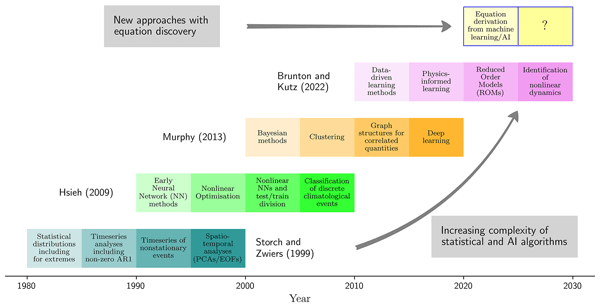
AI is impacting science, providing key data insights, but most algorithms are statistical requiring cautious "out-of-sample" extrapolation. Yet climate research concerns predicting future climatic states. We consider a new method of AI-led equation discovery. Equations offer process interpretation and more robust predictions. We recommend this method for climate analysis, suggesting illustrative application to atmospheric convection, land–atmosphere CO2 flux, and global ocean circulation models.
Simon L. L. Michel, Kristian Strommen, and Hannah M. Christensen
EGUsphere, https://doi.org/10.5194/egusphere-2026-5397, https://doi.org/10.5194/egusphere-2026-5397, 2026
This preprint is open for discussion and under review for Earth System Dynamics (ESD).
Short summary
Short summary
Uncertainty reduction methods for climate projections usually treat natural climate variability as noise to remove, which makes future uncertainty overconfident. We instead use deep learning to learn from the recent observed temperature trajectory and predict future local climate while retaining this variability. The method reduces total uncertainty in future warming and gives spatially resolved predictions from the 2030s to the 2090s, including at regional scales relevant for adaptation.
Chris Huntingford, Rebecca J. Oliver, Lina M. Mercado, Stephen A. Sitch, Douglas B. Clark, Annikki Mäkelä, Carolina Mayoral, and Richard J. Norby
EGUsphere, https://doi.org/10.5194/egusphere-2026-4392, https://doi.org/10.5194/egusphere-2026-4392, 2026
This preprint is open for discussion and under review for Biogeosciences (BG).
Short summary
Short summary
Understanding carbon allocation among land-surface components in a changing climate is important, but it remains poorly understood. As a surrogate for missing knowledge and related equations, optimal allocation hypotheses are proposed. Makela et al. (2008) propose foliage nitrogen adjusted to maximise gross primary productivity. We add to that framework models of photosynthesis and respiration, creating an optimal structure that responds to different near-surface meteorological conditions.
Chris Huntingford, Paul D. L. Ritchie, and Joseph Clarke
Nonlin. Processes Geophys., 33, 385–399, https://doi.org/10.5194/npg-33-385-2026, https://doi.org/10.5194/npg-33-385-2026, 2026
Short summary
Short summary
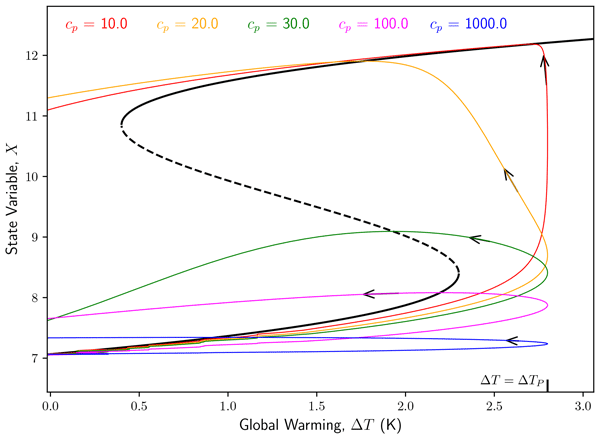
The risk of climate change triggering tipping points is a concern. While Earth System Models (ESMs) predict these points, their timing often varies. Equations of nonlinear dynamical systems can model tipping, hysteresis, and inertia, enabling comparison with ESMs. We propose a method to map tipping timing estimates onto a dynamical system that simulates a full hysteresis loop. We focus on solutions to the equation under overshoot forcing in global temperature and different inertia levels.
Yvonne Anderson, Amanda C. Maycock, Juliane Schwendike, Thomas J. Bracegirdle, Simon A. Josey, and Doug M. Smith
EGUsphere, https://doi.org/10.5194/egusphere-2026-4140, https://doi.org/10.5194/egusphere-2026-4140, 2026
Short summary
Short summary
This study assessed how well climate models represent relationships between the North Atlantic ocean and atmosphere in autumn and winter. While models simulate observed relationships in autumn and winter, they fail to capture them in the transition between seasons. The results suggest the link between autumn sea surface temperatures and the winter atmosphere is driven mainly by atmospheric rather than ocean processes, highlighting important model biases that may limit seasonal forecast skill.
Chaim I. Garfinkel, David Avisar, Scott M. Osprey, Doug Smith, Jian Rao, and Jonathon S. Wright
Weather Clim. Dynam., 7, 1133–1152, https://doi.org/10.5194/wcd-7-1133-2026, https://doi.org/10.5194/wcd-7-1133-2026, 2026
Short summary
Short summary
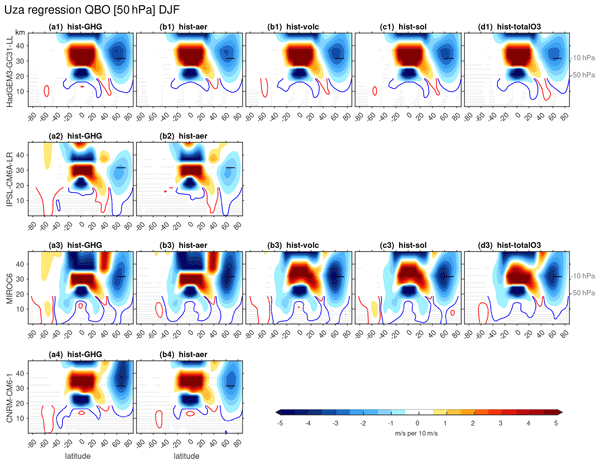
The Quasi-biennial Oscillation (QBO) dominates variability in the tropical stratosphere, & it impacts surface climate in several parts of the world. However, climate models have been shown to systematically under-estimate the influence of the QBO. Here, we re-evaluate this finding using much larger ensemble sizes than have been previously available based on four separate models. We find that the models are comparatively more successful in capturing QBO influences than reported by previous work.
Patric J. L. Boardman, Joseph Clarke, Peter M. Cox, Chris Huntingford, Chris D. Jones, and Mark S. Williamson
Earth Syst. Dynam., 17, 829–841, https://doi.org/10.5194/esd-17-829-2026, https://doi.org/10.5194/esd-17-829-2026, 2026
Short summary
Short summary
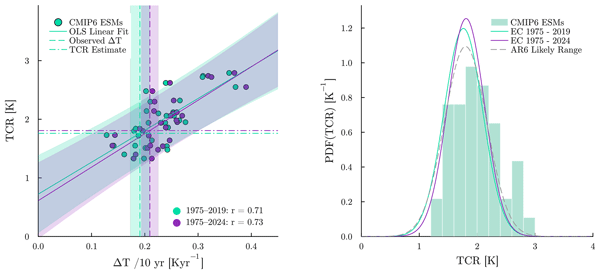
Climate sensitivity quantifies how much Earth warms for a given radiative forcing, and is often described by the Transient Climate Response (TCR) value. Although the Intergovernmental Panel on Climate Change (IPCC) estimates the most likely TCR to be 1.8 K, some models predict values >2.4 K. Record warmth in 2023–2024 raises questions as to whether the TCR may be larger than previously suggested. Using up-to-date data, we estimate the TCR to be ~1.8 K. We also show that future warming falls within the low–mid model range, making the 2°C Paris target still feasible.
Edward Groot, Hannah Christensen, Xia Sun, Kathryn Newman, Wahiba Lfarh, Romain Roehrig, Lisa Bengtsson, Julia Simonson, Keith Williams, and Hugo Lambert
EGUsphere, https://doi.org/10.5194/egusphere-2026-1445, https://doi.org/10.5194/egusphere-2026-1445, 2026
Short summary
Short summary
We analyse diagnostic variables associated with thunderstorm clouds potential (height) and precipitation in model uncertainty model intercomparison project, where multiple numerical submodels are pre-conditioned with each other. We quantify the adjustment rules that occur in vertical columns the climate simulations. The result is that low-level drying is important for the thunderstorm potential diagnostics, which strongly varies among the models, despite not relating to actual storm occurrence.
Emma Ford, Manuela I. Brunner, Hannah Christensen, and Louise Slater
Hydrol. Earth Syst. Sci., 30, 2135–2160, https://doi.org/10.5194/hess-30-2135-2026, https://doi.org/10.5194/hess-30-2135-2026, 2026
Short summary
Short summary
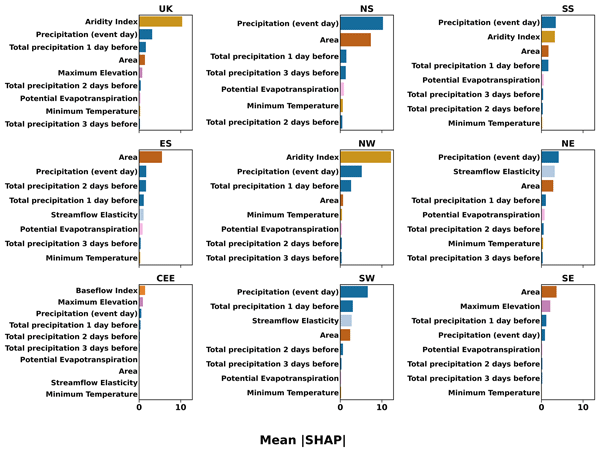
This study aims to improve prediction and understanding of extreme flood events in near-natural catchments across the United Kingdom. We develop a machine learning framework to assess the contribution of different features to flood magnitude estimation. We find weather patterns are weak predictors and stress the importance of evaluating model performance across and within catchments.
Joseph Clarke, Chris Huntingford, Paul D. L. Ritchie, Rebecca Varney, Mark S. Williamson, and Peter Cox
Earth Syst. Dynam., 16, 2087–2100, https://doi.org/10.5194/esd-16-2087-2025, https://doi.org/10.5194/esd-16-2087-2025, 2025
Short summary
Short summary
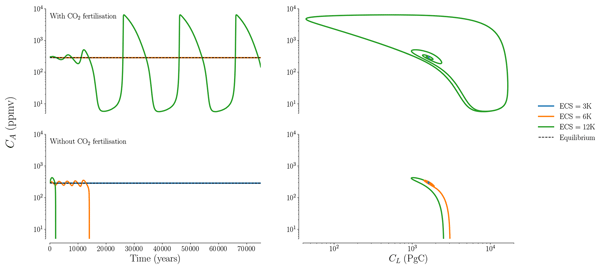
An increase in CO2 in the atmosphere warms the climate through the greenhouse effect, but also leads to uptake of CO2 by the land and ocean. However, the warming is also expected to suppress carbon uptake. If this suppression were strong enough, it could overwhelm the uptake of carbon, leading to a runaway feedback loop causing severe global warming. We find it is possible that this runaway could be relevant in complex climate models and even at the end of the last ice age.
Paul D. L. Ritchie, Chris Huntingford, and Peter M. Cox
Earth Syst. Dynam., 16, 1523–1526, https://doi.org/10.5194/esd-16-1523-2025, https://doi.org/10.5194/esd-16-1523-2025, 2025
Short summary
Short summary
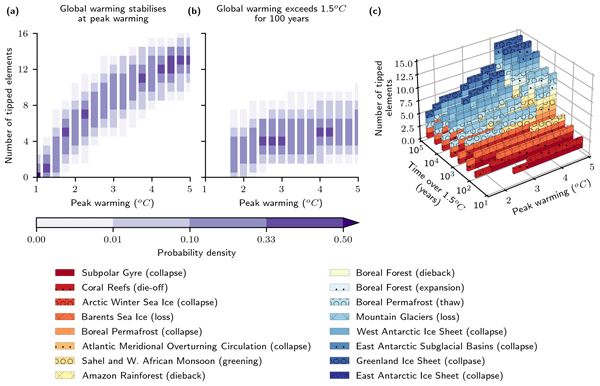
Climate tipping points are not committed upon crossing critical thresholds in global warming, as is often assumed. Instead, it is possible to temporarily overshoot a threshold without causing tipping, provided the duration of the overshoot is short. In this Idea, we demonstrate that restricting the time over 1.5 °C would considerably reduce tipping point risks.
Chris Huntingford, Andrew J. Nicoll, Cornelia Klein, and Jawairia A. Ahmad
Earth Syst. Dynam., 16, 475–495, https://doi.org/10.5194/esd-16-475-2025, https://doi.org/10.5194/esd-16-475-2025, 2025
Short summary
Short summary
AI is impacting science, providing key data insights, but most algorithms are statistical requiring cautious "out-of-sample" extrapolation. Yet climate research concerns predicting future climatic states. We consider a new method of AI-led equation discovery. Equations offer process interpretation and more robust predictions. We recommend this method for climate analysis, suggesting illustrative application to atmospheric convection, land–atmosphere CO2 flux, and global ocean circulation models.
Camilla Mathison, Eleanor J. Burke, Gregory Munday, Chris D. Jones, Chris J. Smith, Norman J. Steinert, Andy J. Wiltshire, Chris Huntingford, Eszter Kovacs, Laila K. Gohar, Rebecca M. Varney, and Douglas McNeall
Geosci. Model Dev., 18, 1785–1808, https://doi.org/10.5194/gmd-18-1785-2025, https://doi.org/10.5194/gmd-18-1785-2025, 2025
Short summary
Short summary
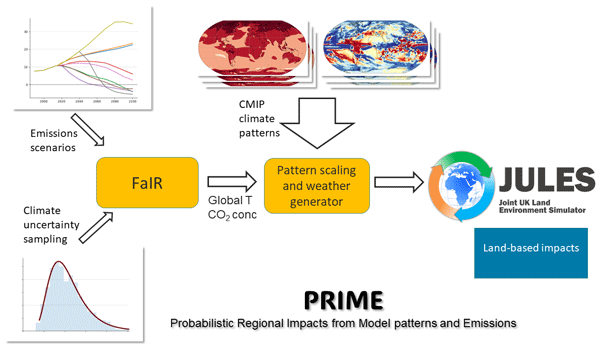
We present PRIME (Probabilistic Regional Impacts from Model patterns and Emissions), which is designed to take new emissions scenarios and rapidly provide regional impact information. PRIME allows large ensembles to be run on multi-centennial timescales, including the analysis of many important variables for impact assessments. Our evaluation shows that PRIME reproduces the climate response for known scenarios, providing confidence in using PRIME for novel scenarios.
Malcolm J. Roberts, Kevin A. Reed, Qing Bao, Joseph J. Barsugli, Suzana J. Camargo, Louis-Philippe Caron, Ping Chang, Cheng-Ta Chen, Hannah M. Christensen, Gokhan Danabasoglu, Ivy Frenger, Neven S. Fučkar, Shabeh ul Hasson, Helene T. Hewitt, Huanping Huang, Daehyun Kim, Chihiro Kodama, Michael Lai, Lai-Yung Ruby Leung, Ryo Mizuta, Paulo Nobre, Pablo Ortega, Dominique Paquin, Christopher D. Roberts, Enrico Scoccimarro, Jon Seddon, Anne Marie Treguier, Chia-Ying Tu, Paul A. Ullrich, Pier Luigi Vidale, Michael F. Wehner, Colin M. Zarzycki, Bosong Zhang, Wei Zhang, and Ming Zhao
Geosci. Model Dev., 18, 1307–1332, https://doi.org/10.5194/gmd-18-1307-2025, https://doi.org/10.5194/gmd-18-1307-2025, 2025
Short summary
Short summary
HighResMIP2 is a model intercomparison project focusing on high-resolution global climate models, that is, those with grid spacings of 25 km or less in the atmosphere and ocean, using simulations of decades to a century in length. We are proposing an update of our simulation protocol to make the models more applicable to key questions for climate variability and hazard in present-day and future projections and to build links with other communities to provide more robust climate information.
Mark S. Williamson, Peter M. Cox, Chris Huntingford, and Femke J. M. M. Nijsse
Earth Syst. Dynam., 15, 829–852, https://doi.org/10.5194/esd-15-829-2024, https://doi.org/10.5194/esd-15-829-2024, 2024
Short summary
Short summary
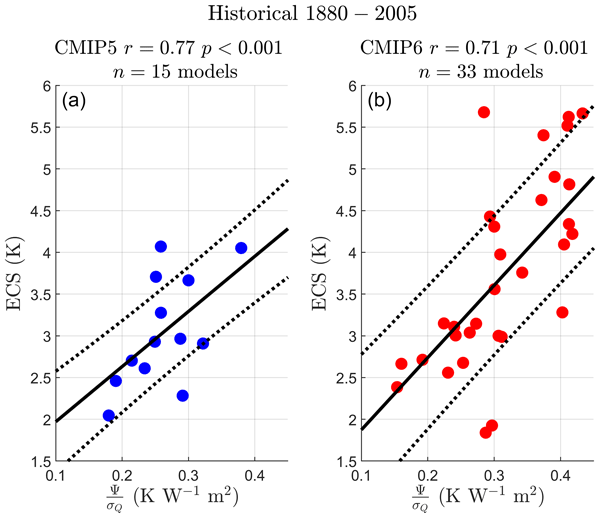
Emergent constraints on equilibrium climate sensitivity (ECS) have generally got statistically weaker in the latest set of state-of-the-art climate models (CMIP6) compared to past sets (CMIP5). We look at why this weakening happened for one particular study (Cox et al, 2018) and attribute it to an assumption made in the theory that when corrected for restores there is a stronger relationship between predictor and ECS.
Emma L. Robinson, Chris Huntingford, Valyaveetil Shamsudheen Semeena, and James M. Bullock
Earth Syst. Sci. Data, 15, 5371–5401, https://doi.org/10.5194/essd-15-5371-2023, https://doi.org/10.5194/essd-15-5371-2023, 2023
Short summary
Short summary
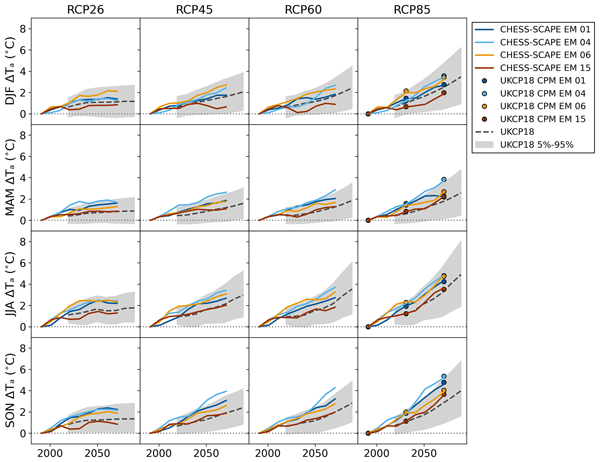
CHESS-SCAPE is a suite of high-resolution climate projections for the UK to 2080, derived from United Kingdom Climate Projections 2018 (UKCP18), designed to support climate impact modelling. It contains four realisations of four scenarios of future greenhouse gas levels (RCP2.6, 4.5, 6.0 and 8.5), with and without bias correction to historical data. The variables are available at 1 km resolution and a daily time step, with monthly, seasonal and annual means and 20-year mean-monthly time slices.
Raghul Parthipan, Hannah M. Christensen, J. Scott Hosking, and Damon J. Wischik
Geosci. Model Dev., 16, 4501–4519, https://doi.org/10.5194/gmd-16-4501-2023, https://doi.org/10.5194/gmd-16-4501-2023, 2023
Short summary
Short summary
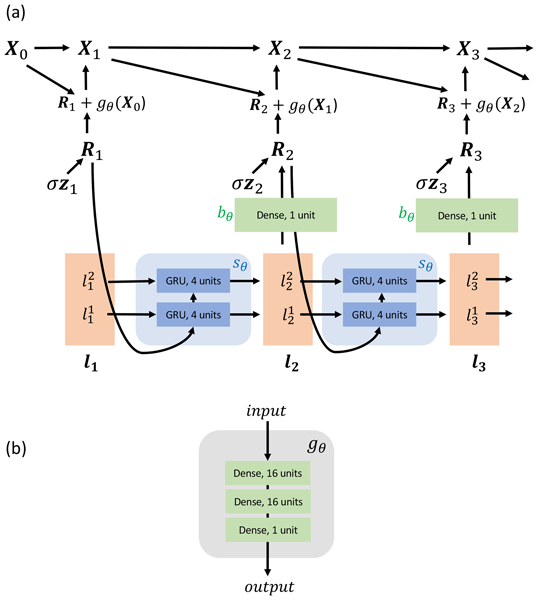
How can we create better climate models? We tackle this by proposing a data-driven successor to the existing approach for capturing key temporal trends in climate models. We combine probability, allowing us to represent uncertainty, with machine learning, a technique to learn relationships from data which are undiscoverable to humans. Our model is often superior to existing baselines when tested in a simple atmospheric simulation.

Andrew P. Schurer, Gabriele C. Hegerl, Hugues Goosse, Massimo A. Bollasina, Matthew H. England, Michael J. Mineter, Doug M. Smith, and Simon F. B. Tett
Clim. Past, 19, 943–957, https://doi.org/10.5194/cp-19-943-2023, https://doi.org/10.5194/cp-19-943-2023, 2023
Short summary
Short summary
We adopt an existing data assimilation technique to constrain a model simulation to follow three important modes of variability, the North Atlantic Oscillation, El Niño–Southern Oscillation and the Southern Annular Mode. How it compares to the observed climate is evaluated, with improvements over simulations without data assimilation found over many regions, particularly the tropics, the North Atlantic and Europe, and discrepancies with global cooling following volcanic eruptions are reconciled.
Katherine E. Turner, Doug M. Smith, Anna Katavouta, and Richard G. Williams
Biogeosciences, 20, 1671–1690, https://doi.org/10.5194/bg-20-1671-2023, https://doi.org/10.5194/bg-20-1671-2023, 2023
Short summary
Short summary
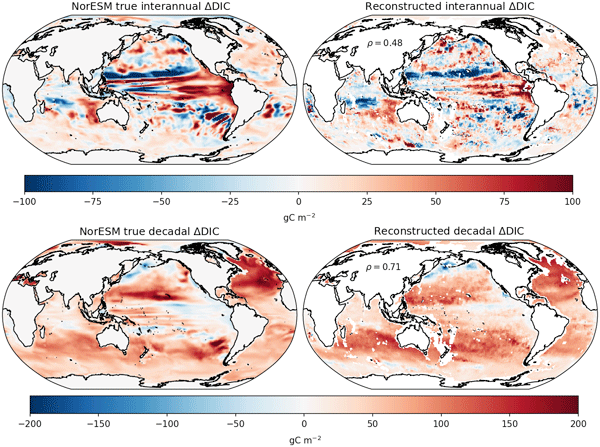
We present a new method for reconstructing ocean carbon using climate models and temperature and salinity observations. To test this method, we reconstruct modelled carbon using synthetic observations consistent with current sampling programmes. Sensitivity tests show skill in reconstructing carbon trends and variability within the upper 2000 m. Our results indicate that this method can be used for a new global estimate for ocean carbon content.

Chris Huntingford, Peter M. Cox, Mark S. Williamson, Joseph J. Clarke, and Paul D. L. Ritchie
Earth Syst. Dynam., 14, 433–442, https://doi.org/10.5194/esd-14-433-2023, https://doi.org/10.5194/esd-14-433-2023, 2023
Short summary
Short summary
Emergent constraints (ECs) reduce the spread of projections between climate models. ECs estimate changes to climate features impacting adaptation policy, and with this high profile, the method is under scrutiny. Asking
What is an EC?, we suggest they are often the discovery of parameters that characterise hidden large-scale equations that climate models solve implicitly. We present this conceptually via two examples. Our analysis implies possible new paths to link ECs and physical processes.
Gang Liu, Shushi Peng, Chris Huntingford, and Yi Xi
Geosci. Model Dev., 16, 1277–1296, https://doi.org/10.5194/gmd-16-1277-2023, https://doi.org/10.5194/gmd-16-1277-2023, 2023
Short summary
Short summary
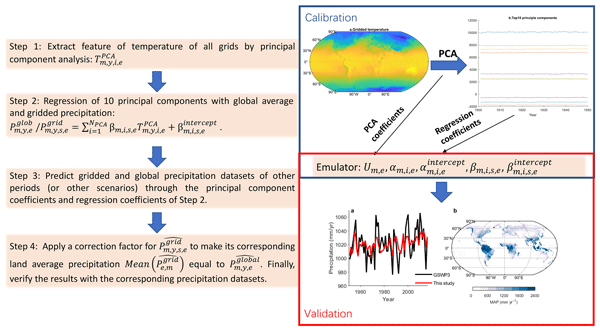
Due to computational limits, lower-complexity models (LCMs) were developed as a complementary tool for accelerating comprehensive Earth system models (ESMs) but still lack a good precipitation emulator for LCMs. Here, we developed a data-calibrated precipitation emulator (PREMU), a computationally effective way to better estimate historical and simulated precipitation by current ESMs. PREMU has potential applications related to land surface processes and their interactions with climate change.

Louise J. Slater, Chris Huntingford, Richard F. Pywell, John W. Redhead, and Elizabeth J. Kendon
Earth Syst. Dynam., 13, 1377–1396, https://doi.org/10.5194/esd-13-1377-2022, https://doi.org/10.5194/esd-13-1377-2022, 2022
Short summary
Short summary
This work considers how wheat yields are affected by weather conditions during the three main wheat growth stages in the UK. Impacts are strongest in years with compound weather extremes across multiple growth stages. Future climate projections are beneficial for wheat yields, on average, but indicate a high risk of unseen weather conditions which farmers may struggle to adapt to and mitigate against.
Rebecca J. Oliver, Lina M. Mercado, Doug B. Clark, Chris Huntingford, Christopher M. Taylor, Pier Luigi Vidale, Patrick C. McGuire, Markus Todt, Sonja Folwell, Valiyaveetil Shamsudheen Semeena, and Belinda E. Medlyn
Geosci. Model Dev., 15, 5567–5592, https://doi.org/10.5194/gmd-15-5567-2022, https://doi.org/10.5194/gmd-15-5567-2022, 2022
Short summary
Short summary
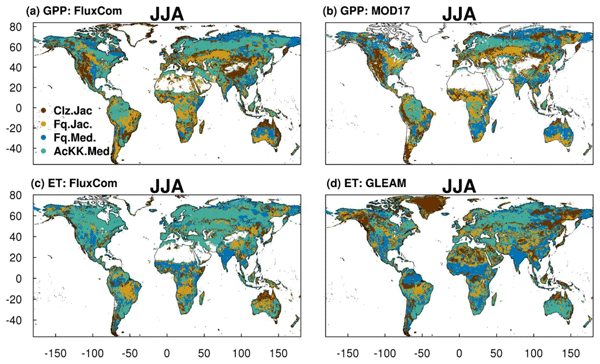
We introduce new representations of plant physiological processes into a land surface model. Including new biological understanding improves modelled carbon and water fluxes for the present in tropical and northern-latitude forests. Future climate simulations demonstrate the sensitivity of photosynthesis to temperature is important for modelling carbon cycle dynamics in a warming world. Accurate representation of these processes in models is necessary for robust predictions of climate change.
Cited articles
Adler, R. F., Huffman, G. J., Chang, A., Ferraro, R., Xie, P.-P., Janowiak, J., Rudolf, B., Schneider, U., Curtis, S., Bolvin, D., Gruber, A., Susskind, J., Arkin, P., and Nelkin, E.: The Version-2 Global Precipitation Climatology Project (GPCP) Monthly Precipitation Analysis (1979–Present), J. Hydrometeorol., 4, 1147–1167, https://doi.org/10.1175/1525-7541(2003)004<1147:TVGPCP>2.0.CO;2, 2003. a
Álvarez García, F., Latif, M., and Biastoch, A.: On Multidecadal and Quasi-Decadal North Atlantic Variability, J. Climate, 21, 3433–3452, https://doi.org/10.1175/2007JCLI1800.1, 2008. a
Årthun, M., Wills, R. C. J., Johnson, H. L., Chafik, L., and Langehaug, H. R.: Mechanisms of Decadal North Atlantic Climate Variability and Implications for the Recent Cold Anomaly, J. Climate, 34, 3421–3439, https://doi.org/10.1175/JCLI-D-20-0464.1, 2021. a
Athanasiadis, P., Yeager, S., Kwon, Y.-O., Bellucci, A., Smith, D., and Tibaldi, S.: Decadal predictability of North Atlantic blocking and the NAO, npj Climate and Atmospheric Science, 3, https://doi.org/10.1038/s41612-020-0120-6, 2020. a, b
Bellomo, K., Murphy, L., Cane, M., Clement, A., and Polvani, L.: Historical forcings as main drivers of the Atlantic multidecadal variability in the CESM large ensemble, Clim. Dynam., 50, 3687–3698, https://doi.org/10.1007/s00382-017-3834-3, 2018. a
Bjerknes, J.: Atlantic Air-Sea Interaction, in: Atlantic Air-Sea Interaction, edited by Landsberg, H. and Van Mieghem, J., vol. 10 of Advances in Geophysics, 1–82, Elsevier, https://doi.org/10.1016/S0065-2687(08)60005-9, 1964. a
Bojariu, R. and Reverdin, G.: Large-scale variability modes of freshwater flux and precipitation over the Atlantic, Clim. Dynam., 18, 369–381, https://doi.org/10.1007/s003820100182, 2002. a
Booth, B., Dunstone, N., Halloran, P., Andrews, T., and Bellouin, N.: Aerosols implicated as a prime driver of twentieth-century North Atlantic climate variability, Nature, 484, 228–32, https://doi.org/10.1038/nature10946, 2012. a
Borchert, L. F., Düsterhus, A., Brune, S., Müller, W. A., and Baehr, J.: Forecast-Oriented Assessment of Decadal Hindcast Skill for North Atlantic SST, Geophys. Res. Lett., 46, 11444–11454, https://doi.org/10.1029/2019GL084758, 2019. a
Brunton, S. L., Proctor, J. L., and Kutz, J. N.: Discovering governing equations from data by sparse identification of nonlinear dynamical systems, P. Natl. Acad. Sci. USA, 113, 3932–3937, https://doi.org/10.1073/pnas.1517384113, 2016. a, b, c
Cane, M. A., Clement, A. C., Murphy, L. N., and Bellomo, K.: Low-Pass Filtering, Heat Flux, and Atlantic Multidecadal Variability, J. Climate, 30, 7529–7553, https://doi.org/10.1175/JCLI-D-16-0810.1, 2017. a
Cheng, W., Bleck, R., and Rooth, C.: Multi-decadal thermohaline variability in an ocean-atmosphere general circulation model, Clim. Dynam., 22, 573–590, https://doi.org/10.1007/s00382-004-0400-6, 2004. a
Chylek, P., Folland, C. K., Dijkstra, H. A., Lesins, G., and Dubey, M. K.: Ice-core data evidence for a prominent near 20 year time-scale of the Atlantic Multidecadal Oscillation, Geophys. Res. Lett., 38, https://doi.org/10.1029/2011GL047501, 2011. a
Clement, A., Bellomo, K., Murphy, L., Cane, M., Mauritsen, T., Rädel, G., and Stevens, B.: The Atlantic Multidecadal Oscillation without a role for ocean circulation, Science, 350, 320–324, https://doi.org/10.1126/science.aab3980, 2015. a
Clement, A., Cane, M. A., Murphy, L. N., Bellomo, K., Mauritsen, T., and Stevens, B.: Response to Comment on “The Atlantic Multidecadal Oscillation without a role for ocean circulation”, Science, 352, 1527–1527, https://doi.org/10.1126/science.aaf2575, 2016. a
Costa, E. D. D. and Verdiere, A. C. D.: The 7.7-year North Atlantic Oscillation, Q. J. Roy. Meteor. Soc., 128, 797–817, https://doi.org/10.1256/0035900021643692, 2002. a
Czaja, A. and Frankignoul, C.: Influence of the North Atlantic SST on the atmospheric circulation, Geophys. Res. Lett., 26, 2969–2972, https://doi.org/10.1029/1999GL900613, 1999. a
Czaja, A. and Frankignoul, C.: Observed Impact of Atlantic SST Anomalies on the North Atlantic Oscillation, J. Climate, 15, https://doi.org/10.1175/1520-0442(2002)015<0606:OIOASA>2.0.CO;2, 2002. a
DelSole, T., Jia, L., and Tippett, M. K.: Decadal prediction of observed and simulated sea surface temperatures, Geophys. Res. Lett., 40, 2773–2778, 2013. a
Delworth, T., Manabe, S., and Stouffer, R. J.: Interdecadal Variations of the Thermohaline Circulation in a Coupled Ocean-Atmosphere Model, J. Climate, 6, 1993–2011, https://doi.org/10.1175/1520-0442(1993)006<1993:IVOTTC>2.0.CO;2, 1993. a
Delworth, T. L. and Zeng, F.: The Impact of the North Atlantic Oscillation on Climate through Its Influence on the Atlantic Meridional Overturning Circulation, J. Climate, 29, 941–962, https://doi.org/10.1175/JCLI-D-15-0396.1, 2016. a
Delworth, T. L., Zeng, F., Zhang, L., Zhang, R., Vecchi, G. A., and Yang, X.: The Central Role of Ocean Dynamics in Connecting the North Atlantic Oscillation to the Extratropical Component of the Atlantic Multidecadal Oscillation, J. Climate, 30, 3789–3805, https://doi.org/10.1175/JCLI-D-16-0358.1, 2017. a, b
Dong, B. and Sutton, R. T.: Mechanism of Interdecadal Thermohaline Circulation Variability in a Coupled Ocean–Atmosphere GCM, J. Climate, 18, 1117–1135, https://doi.org/10.1175/JCLI3328.1, 2005. a
Dunstone, N., Smith, D., Scaife, A., Hermanson, L., Eade, R., Robinson, N., Andrews, M., and Knight, J.: Skilful predictions of the winter North Atlantic Oscillation one year ahead, Nat. Geosci., 9, https://doi.org/10.1038/ngeo2824, 2016. a
Ebisuzaki, W.: A method to estimate the statistical significance of a correlation when the data are serially correlated, J. Climate, 10, 2147–2153, 1997. a
Eden, C. and Willebrand, J.: Mechanism of Interannual to Decadal Variability of the North Atlantic Circulation, J. Climate, 14, 2266–2280, https://doi.org/10.1175/1520-0442(2001)014<2266:MOITDV>2.0.CO;2, 2001. a
European Centre for Medium-Range Weather Forecasts: ERA-20C Project (ECMWF Atmospheric Reanalysis of the 20th Century), Research Data Archive at the National Center for Atmospheric Research, Computational and Information Systems Laboratory [data set], https://doi.org/10.5065/D6VQ30QG, 2014. a
Frankcombe, L. M., von der Heydt, A., and Dijkstra, H. A.: North Atlantic Multidecadal Climate Variability: An Investigation of Dominant Time Scales and Processes, J. Climate, 23, 3626–3638, https://doi.org/10.1175/2010JCLI3471.1, 2010. a
Frierson, D., Hwang, Y.-T., Fuckar, N., Seager, R., Kang, S., Donohoe, A., Maroon, E., Liu, X., and Battisti, D.: Contribution of ocean overturning circulation to tropical rainfall peak in the Northern Hemisphere, Nat. Geosci., 6, 940–944, https://doi.org/10.1038/ngeo1987, 2013. a
García-Serrano, J., Prodhomme, C., Bellprat, O., Davini, P., and Drijfhout, S.: Sensitivity of winter North Atlantic-European climate to resolved atmosphere and ocean dynamics, Sci. Rep., 9, https://doi.org/10.1038/s41598-019-49865-9, 2019. a
Goldenberg, S., Landsea, C., Mestas-Nunez, A., and Gray, W.: The Recent Increase in Atlantic Hurricane Activity: Causes and Implication, Science, 293, 474–479, https://doi.org/10.1126/science.1060040, 2001. a
Hardiman, S., Dunstone, N., Scaife, A., Smith, D., Comer, R., Nie, Y., and Ren, H.: Missing eddy feedback may explain weak signal-to-noise ratios in climate predictions, npj Climate and Atmospheric Science, 5, 57, https://doi.org/10.1038/s41612-022-00280-4, 2022. a
Hersbach, H., Bell, B., Berrisford, P., Hirahara, S., Horányi, A., Muñoz-Sabater, J., Nicolas, J., Peubey, C., Radu, R., Schepers, D., Simmons, A., Soci, C., Abdalla, S., Abellan, X., Balsamo, G., Bechtold, P., Biavati, G., Bidlot, J., Bonavita, M., De Chiara, G., Dahlgren, P., Dee, D., Diamantakis, M., Dragani, R., Flemming, J., Forbes, R., Fuentes, M., Geer, A., Haimberger, L., Healy, S., Hogan, R. J., Hólm, E., Janisková, M., Keeley, S., Laloyaux, P., Lopez, P., Lupu, C., Radnoti, G., de Rosnay, P., Rozum, I., Vamborg, F., Villaume, S., and Thépaut, J.-N.: The ERA5 global reanalysis, Q. J. Roy. Meteor. Soc., 146, 1999–2049, https://doi.org/10.1002/qj.3803, 2020. a, b
Hersbach, H., Bell, B., Berrisford, P., Biavati, G., Horányi, A., Muñoz Sabater, J., Nicolas, J., Peubey, C., Radu, R., Rozum, I., Schepers, D., Simmons, A., Soci, C., Dee, D., and Thépaut, J.-N.: ERA5 monthly averaged data on single levels from 1940 to present, Copernicus Climate Change Service (C3S) Climate Data Store (CDS) [data set], https://doi.org/10.24381/cds.f17050d7, 2023. a
Huntingford, C., Nicoll, A. J., Klein, C., and Ahmad, J. A.: Potential for equation discovery with AI in the climate sciences, Earth Syst. Dynam., 16, 475–495, https://doi.org/10.5194/esd-16-475-2025, 2025. a
Hurrell, J.: Decadal trends in the North Atlantic Oscillation – regional temperatures and precipitation, Science, 269, 676–679, https://doi.org/10.1126/science.269.5224.676, 1995. a, b
Hurrell, J., Kushnir, Y., Ottersen, G., and Visbeck, M.: The North Atlantic Oscillation: Climatic Significance and Environmental Impact, Geophys. Monogr. Ser., 134, https://doi.org/10.1029/GM134, 2003. a, b
Hurrell, J. W. and Deser, C.: North Atlantic climate variability: The role of the North Atlantic Oscillation, J. Marine Syst., 79, 231–244, https://doi.org/10.1016/j.jmarsys.2009.11.002, 2010. a
Josey, S. A. and Marsh, R.: Surface freshwater flux variability and recent freshening of the North Atlantic in the eastern subpolar gyre, J. Geophys. Res.-Oceans, 110, https://doi.org/10.1029/2004JC002521, 2005. a, b, c
Joshi, M., Hall, R. A., Stevens, D. P., and Hawkins, E.: The modelled climatic response to the 18.6-year lunar nodal cycle and its role in decadal temperature trends, Earth Syst. Dynam., 14, 443–455, https://doi.org/10.5194/esd-14-443-2023, 2023. a
Kerr, R. A.: A North Atlantic Climate Pacemaker for the Centuries, Science, 288, 1984–1985, https://doi.org/10.1126/science.288.5473.1984, 2000. a
Khatri, H., Williams, R. G., Woollings, T., and Smith, D. M.: Fast and Slow Subpolar Ocean Responses to the North Atlantic Oscillation: Thermal and Dynamical Changes, Geophys. Res. Lett., 49, e2022GL101480, https://doi.org/10.1029/2022GL101480, 2022. a, b
Khatri, H., Williams, R. G., Woollings, T., and Smith, D. M.: An Ocean Memory Perspective: Disentangling Atmospheric Control of Decadal Variability in the North Atlantic Ocean, Geophys. Res. Lett., 51, e2024GL110333, https://doi.org/10.1029/2024GL110333, 2024. a
Knight, J. R., Folland, C. K., and Scaife, A. A.: Climate impacts of the Atlantic Multidecadal Oscillation, Geophys. Res. Lett., 33, https://doi.org/10.1029/2006GL026242, 2006. a
Kushnir, Y.: Interdecadal Variations in North Atlantic Sea Surface Temperature and Associated Atmospheric Conditions, J. Climate, 7, 141–157, https://doi.org/10.1175/1520-0442(1994)007<0141:IVINAS>2.0.CO;2, 1994. a
Lau, N.-C.: Variability of the Observed Midlatitude Storm Tracks in Relation to Low-Frequency Changes in the Circulation Pattern, J. Atmos. Sci., 45, 2718–2743, https://doi.org/10.1175/1520-0469(1988)045<2718:VOTOMS>2.0.CO;2, 1988. a
Li, J., Sun, C., and Jin, F.-F.: NAO implicated as a predictor of Northern Hemisphere mean temperature multidecadal variability, Geophys. Res. Lett., 40, 5497–5502, https://doi.org/10.1002/2013GL057877, 2013. a
Lorenz, E. N.: Deterministic Nonperiodic Flow, J. Atmos. Sci., 20, 130–141, https://doi.org/10.1175/1520-0469(1963)020<0130:DNF>2.0.CO;2, 1963. a
Mariotti, A. and Arkin, P.: The North Atlantic Oscillation and oceanic precipitation variability, Clim. Dynam., 28, 35–51, https://doi.org/10.1007/s00382-006-0170-4, 2007. a
Marsh, R.: Recent Variability of the North Atlantic Thermohaline Circulation Inferred from Surface Heat and Freshwater Fluxes, J. Climate, 13, 3239–3260, https://doi.org/10.1175/1520-0442(2000)013<3239:RVOTNA>2.0.CO;2, 2000. a, b, c
McCarthy, G., Haigh, I., Hirschi, J., Grist, J., and Smeed, D.: Ocean impact on decadal Atlantic climate variability revealed by sea-level observations, Nature, 521, 508–510, https://doi.org/10.1038/nature14491, 2015. a
Mehling, O., Bellomo, K., Angeloni, M., Pasquero, C., and Hardenberg, J.: High-latitude precipitation as a driver of multicentennial variability of the AMOC in a climate model of intermediate complexity, Clim. Dynam., 61, https://doi.org/10.1007/s00382-022-06640-3, 2022. a
Menary, M. B., Hodson, D. L. R., Robson, J. I., Sutton, R. T., and Wood, R. A.: A Mechanism of Internal Decadal Atlantic Ocean Variability in a High-Resolution Coupled Climate Model, J. Climate, 28, 7764–7785, https://doi.org/10.1175/JCLI-D-15-0106.1, 2015. a, b
Mosedale, T. J., Stephenson, D. B., Collins, M., and Mills, T. C.: Granger Causality of Coupled Climate Processes: Ocean Feedback on the North Atlantic Oscillation, J. Climate, 19, 1182–1194, https://doi.org/10.1175/JCLI3653.1, 2006. a
Myers, P. G., Josey, S. A., Wheler, B., and Kulan, N.: Interdecadal variability in Labrador Sea precipitation minus evaporation and salinity, Prog. Oceanogr., 73, 341–357, https://doi.org/10.1016/j.pocean.2006.06.003, 2007. a, b
Nicoll, A.: Data-driven dynamical models of the North Atlantic, Zenodo [code], https://doi.org/10.5281/zenodo.17856484, 2025. a
Nigam, S., Ruiz-Barradas, A., and Chafik, L.: Gulf Stream excursions and sectional detachments generate the decadal pulses in the Atlantic multidecadal oscillation, J. Climate, 31, 2853–2870, 2018. a
O’Reilly, C. H., Zanna, L., and Woollings, T.: Assessing External and Internal Sources of Atlantic Multidecadal Variability Using Models, Proxy Data, and Early Instrumental Indices, J. Climate, 32, 7727–7745, https://doi.org/10.1175/JCLI-D-19-0177.1, 2019. a, b
Peng, S., Robinson, W. A., and Li, S.: Mechanisms for the NAO Responses to the North Atlantic SST Tripole, J. Climate, 16, 1987–2004, https://doi.org/10.1175/1520-0442(2003)016<1987:MFTNRT>2.0.CO;2, 2003. a
Poli, P., Hersbach, H., Dee, D. P., Berrisford, P., Simmons, A. J., Vitart, F., Laloyaux, P., Tan, D. G. H., Peubey, C., Thépaut, J.-N., Trémolet, Y., Hólm, E. V., Bonavita, M., Isaksen, L., and Fisher, M.: ERA-20C: An Atmospheric Reanalysis of the Twentieth Century, J. Climate, 29, 4083–4097, https://doi.org/10.1175/JCLI-D-15-0556.1, 2016. a, b, c
Robson, J., Menary, M., Sutton, R., Mecking, J., Gregory, J., Jones, C., Sinha, B., Stevens, D., and Wilcox, L.: The Role of Anthropogenic Aerosol Forcing in the 1850–1985 Strengthening of the AMOC in CMIP6 Historical Simulations, J. Climate, 35, 1–48, https://doi.org/10.1175/JCLI-D-22-0124.1, 2022. a
Rodwell, M., Rowell, D., and Folland, C.: Oceanic Forcing of the Wintertime North Atlantic Oscillation and European Climate, Nature, 398, 320–323, https://doi.org/10.1038/18648, 1999. a, b
Ruiz-Barradas, A., Chafik, L., Nigam, S., and Häkkinen, S.: Recent subsurface North Atlantic cooling trend in context of Atlantic decadal-to-multidecadal variability, Tellus, 70, 1–19, 2018. a
Scaife, A. A., Arribas, A., Blockley, E., Brookshaw, A., Clark, R. T., Dunstone, N., Eade, R., Fereday, D., Folland, C. K., Gordon, M., Hermanson, L., Knight, J. R., Lea, D. J., MacLachlan, C., Maidens, A., Martin, M., Peterson, A. K., Smith, D., Vellinga, M., Wallace, E., Waters, J., and Williams, A.: Skillful long-range prediction of European and North American winters, Geophys. Res. Lett., 41, 2514–2519, https://doi.org/10.1002/2014GL059637, 2014. a
Seager, R., Liu, H., Kushnir, Y., Osborn, T. J., Simpson, I. R., Kelley, C. R., and Nakamura, J.: Mechanisms of Winter Precipitation Variability in the European–Mediterranean Region Associated with the North Atlantic Oscillation, J. Climate, 33, 7179–7196, https://doi.org/10.1175/JCLI-D-20-0011.1, 2020. a
Smith, D., Scaife, A., Eade, R., Athanasiadis, P., Bellucci, A., Bethke, I., Bilbao, R., Borchert, L., Caron, L., Counillon, F., Danabasoglu, G., Delworth, T., Doblas, F., Dunstone, N., Estella-Perez, V., Flavoni, S., Hermanson, L., Keenlyside, N., Kharin, V., and Zhang, L.: North Atlantic climate far more predictable than models imply, Nature, 583, 796–800, https://doi.org/10.1038/s41586-020-2525-0, 2020. a, b
Smith, D., Dunstone, N., Eade, R., Hardiman, S., Hermanson, L., Scaife, A., and Seabrook, M.: Mitigation needed to avoid unprecedented multi-decadal North Atlantic Oscillation magnitude, Nat. Clim. Change, 15, 403–410, https://doi.org/10.1038/s41558-025-02277-2, 2025. a
Strommen, K., Woollings, T., Davini, P., Ruggieri, P., and Simpson, I. R.: Predictable decadal forcing of the North Atlantic jet speed by sub-polar North Atlantic sea surface temperatures, Weather Clim. Dynam., 4, 853–874, https://doi.org/10.5194/wcd-4-853-2023, 2023. a, b
Sun, C., Li, J., and Jin, F.-F.: A delayed oscillator model for the quasi-periodic multidecadal variability of the NAO, Clim. Dynam., 45, https://doi.org/10.1007/s00382-014-2459-z, 2015. a, b
Sun, C., Li, J., Ding, R., and Jin, Z.: Cold season Africa–Asia multidecadal teleconnection pattern and its relation to the Atlantic multidecadal variability, Clim. Dynam., 48, https://doi.org/10.1007/s00382-016-3309-y, 2017. a
Sutton, R. T. and Hodson, D. L.: Atlantic Ocean forcing of North American and European summer climate, Science, 309, 115–118, https://doi.org/10.1126/science.1109496, 2005. a
Swingedouw, D., Ortega, P., Mignot, J., Guilyardi, E., Masson-Delmotte, V., Butler, P., Khodri, M., and Séférian, R.: Bidecadal North Atlantic Ocean circulation variability controlled by timing of volcanic eruptions, Nat. Commun., 6, https://doi.org/10.1038/ncomms7545, 2015. a
Timmermann, A., Latif, M., Voss, R., and Grötzner, A.: Northern Hemispheric Interdecadal Variability: A Coupled Air–Sea Mode, J. Climate, 11, 1906–1931, https://doi.org/10.1175/1520-0442(1998)011<1906:NHIVAC>2.0.CO;2, 1998. a
Trenary, L. and DelSole, T.: Does the Atlantic Multidecadal Oscillation Get Its Predictability from the Atlantic Meridional Overturning Circulation?, J. Climate, 29, 5267–5280, https://doi.org/10.1175/JCLI-D-16-0030.1, 2016. a
Trenberth, K. E. and Shea, D. J.: Atlantic hurricanes and natural variability in 2005, Geophys. Res. Lett., 33, https://doi.org/10.1029/2006GL026894, 2006. a, b, c
Vannitsem, S. and Ghil, M.: Evidence of coupling in ocean-atmosphere dynamics over the North Atlantic, Geophys. Res. Lett., 44, 2016–2026, https://doi.org/10.1002/2016GL072229, 2017. a
Vannitsem, S., Liang, X. S., and Pires, C. A.: Nonlinear causal dependencies as a signature of the complexity of the climate dynamics, Earth Syst. Dynam., 16, 703–719, https://doi.org/10.5194/esd-16-703-2025, 2025. a, b
Van Oldenborgh, G. J., Doblas, F., Wouters, B., and Hazeleger, W.: Decadal prediction skill in a multi-model ensemble, Clim. Dynam., 38, https://doi.org/10.1007/s00382-012-1313-4, 2012. a
Walsh, J. E. and Portis, D. H.: Variations of precipitation and evaporation over the North Atlantic Ocean, 1958–1997, J. Geophys. Res.-Atmos., 104, 16613–16631, https://doi.org/10.1029/1999JD900189, 1999. a, b
Walter, K. and Graf, H.-F.: On the changing nature of the regional connection between the North Atlantic Oscillation and sea surface temperature, J. Geophys. Res.-Atmos., 107, ACL 7–1–ACL 7–13, https://doi.org/10.1029/2001JD000850, 2002. a, b
Wills, R. C. J., Armour, K. C., Battisti, D. S., and Hartmann, D. L.: Ocean–Atmosphere Dynamical Coupling Fundamental to the Atlantic Multidecadal Oscillation, J. Climate, 32, 251–272, https://doi.org/10.1175/JCLI-D-18-0269.1, 2019. a
Zanna, L.: Forecast Skill and Predictability of Observed Atlantic Sea Surface Temperatures, J. Climate, 25, 5047–5056, https://doi.org/10.1175/JCLI-D-11-00539.1, 2012. a
Zhang, R. and Delworth, T. L.: Impact of Atlantic multidecadal oscillations on India/Sahel rainfall and Atlantic hurricanes, Geophys. Res. Lett., 33, https://doi.org/10.1029/2006GL026267, 2006. a
Zhang, R., Sutton, R., Danabasoglu, G., Kwon, Y.-O., Marsh, R., Yeager, S. G., Amrhein, D. E., and Little, C. M.: A Review of the Role of the Atlantic Meridional Overturning Circulation in Atlantic Multidecadal Variability and Associated Climate Impacts, Rev. Geophys., 57, 316–375, https://doi.org/10.1029/2019RG000644, 2019. a, b
Zhao, B., Reichler, T., Strong, C., and Penland, C.: Simultaneous Evolution of Gyre and Atlantic Meridional Overturning Circulation Anomalies as an Eigenmode of the North Atlantic System, J. Climate, 30, 6737–6755, https://doi.org/10.1175/JCLI-D-16-0751.1, 2017. a, b
Zhao, H., Li, J., Iu, U., Delarme, E., and Wang, N.: Multidecadal Variability from Ocean to Atmosphere in the North Atlantic: Perturbation Potential Energy as the Bridge, J. Climate, 37, 5187–5206, https://doi.org/10.1175/JCLI-D-24-0025.1, 2024. a, b
Editorial statement
This paper presents data-driven equation discovery as a powerful scientific method to study climate variability, and thereby exemplifies how machine-learning methods do not only work as black boxes, but can also help us better understand complex Earth system dynamics.
This paper presents data-driven equation discovery as a powerful scientific method to study...
Short summary
We use artificial intelligence to learn simple equations from historical climate data that describe how North Atlantic ocean temperature, air pressure and rainfall vary and influence each other over decades. Analysing the model's behaviour and equation terms, we find rainfall strongly feeds back on both the ocean and the atmosphere. These interactions are well captured by the models and allow rainfall to be predicted over the ocean, and nearby regions such as Europe over coming decades.
We use artificial intelligence to learn simple equations from historical climate data that...


Altmetrics
Final-revised paper
Preprint