
Articles | Volume 17, issue 3
https://doi.org/10.5194/esd-17-695-2026
© Author(s) 2026. This work is distributed under
the Creative Commons Attribution 4.0 License.
the Creative Commons Attribution 4.0 License.
https://doi.org/10.5194/esd-17-695-2026
© Author(s) 2026. This work is distributed under
the Creative Commons Attribution 4.0 License.
the Creative Commons Attribution 4.0 License.
Research article
| Highlight paper
| 
12 Jun 2026
Research article | Highlight paper |
| 12 Jun 2026
| 12 Jun 2026
Atmospheric river trajectories organise along a global transport network
Tobias Braun
CORRESPONDING AUTHOR

Institute for Earth System Science and Remote Sensing, Leipzig University, 04103 Leipzig, Germany
Potsdam Institute for Climate Impact Research (PIK), Member of the Leibniz Association, 14473 Potsdam, Germany
Sara M. Vallejo-Bernal
Institute for Earth System Science and Remote Sensing, Leipzig University, 04103 Leipzig, Germany
Potsdam Institute for Climate Impact Research (PIK), Member of the Leibniz Association, 14473 Potsdam, Germany
Norbert Marwan
Potsdam Institute for Climate Impact Research (PIK), Member of the Leibniz Association, 14473 Potsdam, Germany
Institute of Geoscience, University of Potsdam, 14476 Potsdam, Germany
Juergen Kurths
Potsdam Institute for Climate Impact Research (PIK), Member of the Leibniz Association, 14473 Potsdam, Germany
Johannes Quaas
Institute of Meteorology, Leipzig University, 04103 Leipzig, Germany
Albert Díaz-Guilera
Departament de Física de la Matèria Condensada, Universitat de Barcelona, 08028 Barcelona, Spain
Universitat de Barcelona Institute of Complex Systems (UBICS), Universitat de Barcelona, 08028 Barcelona, Spain
Luis Gimeno
Centro de Investigación Mariña, Universidade de Vigo, Environmental Physics Laboratory (EPhysLab), Campus da Auga, 32004 Ourense, Spain
Miguel D. Mahecha
Institute for Earth System Science and Remote Sensing, Leipzig University, 04103 Leipzig, Germany
German Centre for Integrative Biodiversity Research (iDiv) Halle–Jena–Leipzig, 04103 Leipzig, Germany
Helmholtz Centre for Environmental Research, 04318 Leipzig, Germany
Related authors
No articles found.
David Montero, César Aybar, Miguel D. Mahecha, and Luis Gómez-Chova
Int. Arch. Photogramm. Remote Sens. Spatial Inf. Sci., L-4-W1-2026, 167–174, https://doi.org/10.5194/isprs-archives-L-4-W1-2026-167-2026, https://doi.org/10.5194/isprs-archives-L-4-W1-2026-167-2026, 2026
Sajedeh Marjani, Sina Mehrdad, and Johannes Quaas
Atmos. Chem. Phys., 26, 10695–10725, https://doi.org/10.5194/acp-26-10695-2026, https://doi.org/10.5194/acp-26-10695-2026, 2026
Short summary
Short summary
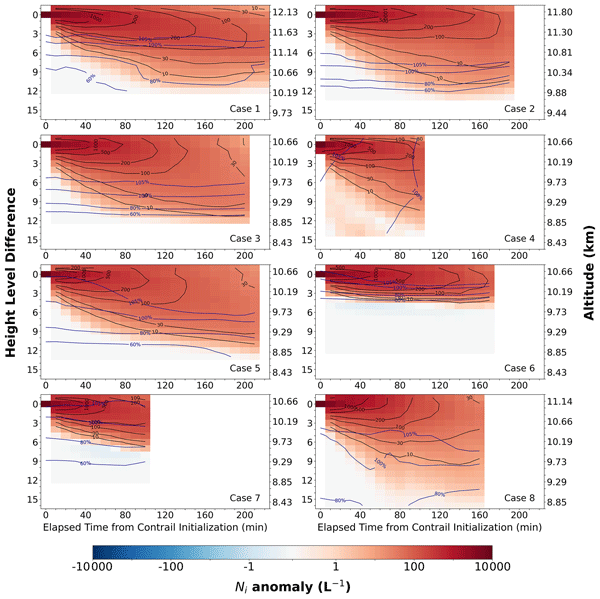
A large part of aviation's climate impact comes from persistent contrails, not just carbon dioxide. This study examined how they evolve under different ice-supersaturated conditions, usually with background clouds. Using high-resolution simulations, we found that contrail growth depends on both the thickness of the supersaturated layer and available water vapor. Contrails can alter surrounding clouds and contribute to warming. Simple thresholds are not enough to predict their impact.
Hailing Jia, David Neubauer, Yusuf Bhatti, Duncan Watson-Parris, Philip Stier, Johannes Quaas, Daniel Partridge, Ardit Arifi, Anne Kubin, Athanasios Nenes, Muhammed Irfan, Ulas Im, Carl Svenhag, Nick Schutgens, Bastiaan van Diedenhoven, Sylvaine Ferrachat, Ulrike Lohmann, Ina Tegen, Alice Henkes, Guangliang Fu, and Otto Hasekamp
EGUsphere, https://doi.org/10.5194/egusphere-2026-3275, https://doi.org/10.5194/egusphere-2026-3275, 2026
Short summary
Short summary
Tiny aerosol particles affect Earth’s climate by interacting with clouds and sunlight, but their impact remains uncertain. Combining climate model simulations and emulators, we explored millions of model variants across different aerosol and cloud settings to identify the causes of the uncertainty. We found that aerosol emissions and cloud convection are key contributors. Our work suggests that better integration of existing observations could help reduce these uncertainties in the future.
Maximilian Söchting and Miguel D. Mahecha
Earth Syst. Dynam., 17, 687–693, https://doi.org/10.5194/esd-17-687-2026, https://doi.org/10.5194/esd-17-687-2026, 2026
Short summary
Short summary
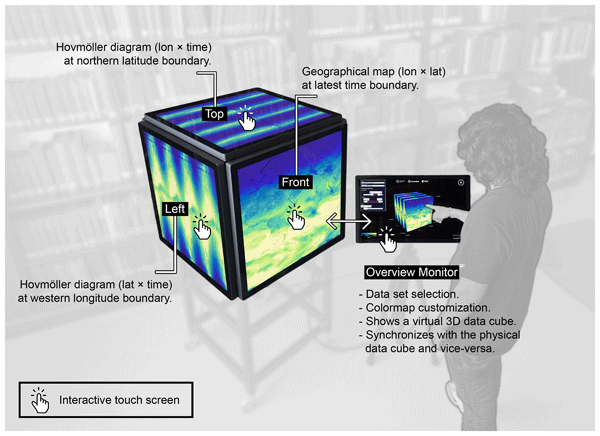
As the amount of data collected by satellites and generated by climate models to monitor Earth's climate and environment continues to expand in size and complexity, it becomes increasingly difficult for non-experts to explore these type of data sets. We present an interactive physical exhibit in the shape of a cube that enables anyone to explore these large environmental data sets across space, time, and variables, independent of their technical knowledge, through direct physical interaction.
Sudhakar Dipu, Johannes Mülmenstädt, and Johannes Quaas
Atmos. Chem. Phys., 26, 7917–7931, https://doi.org/10.5194/acp-26-7917-2026, https://doi.org/10.5194/acp-26-7917-2026, 2026
Short summary
Short summary
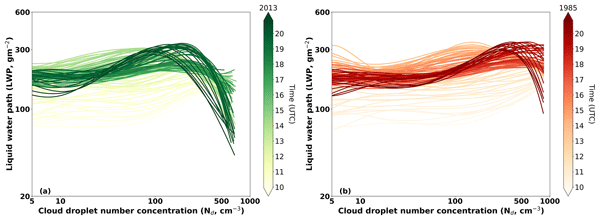
High-resolution Large-Eddy Simulations (LES) are used to examine how aerosols affect liquid water path (LWP) sensitivity in non-precipitating liquid clouds. Two cases, 1985 (high aerosol) and 2013 (low aerosol), show a non-linear Nd–LWP relationship with a shift from positive to negative sensitivity at higher Nd under high aerosol loading. Enhanced cloud-top entrainment, evaporation, and heating drive this shift, highlighting aerosol impact on cloud microphysics and thermodynamics.
Julien Lenhardt, Johannes Quaas, Dino Sejdinovic, and Daniel Klocke
Atmos. Chem. Phys., 26, 5447–5475, https://doi.org/10.5194/acp-26-5447-2026, https://doi.org/10.5194/acp-26-5447-2026, 2026
Short summary
Short summary
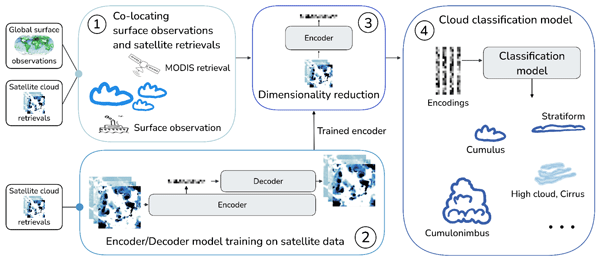
Clouds come in various shapes and sizes and constitute a fundamental element of the Earth's climate system. Different cloud types show variable impacts on climate change. We present a new cloud type classification method called CloudViT (Cloud Vision Transformer) relying on spatial patterns of cloud properties obtained from satellite data using machine learning. We can thus help understanding the effects of different cloud types on climate change.
Yannick Emanuel Anders, Karoline Block, Mira Pöhlker, and Johannes Quaas
EGUsphere, https://doi.org/10.5194/egusphere-2026-1404, https://doi.org/10.5194/egusphere-2026-1404, 2026
Short summary
Short summary
Particles in the atmosphere can trigger the formation of cloud droplets, affecting cloud properties and climate. This study evaluates a new global dataset of these particles with measurements from 25 sites around the world. The variability in time and space and their conditional formation behaviour is analysed. The authors identify systematic biases and introduce a simple correction based on observations that greatly improves the dataset’s accuracy.
Na Li, Sebastian Sippel, Nora Linscheid, Miguel D. Mahecha, Markus Reichstein, and Ana Bastos
Biogeosciences, 23, 767–792, https://doi.org/10.5194/bg-23-767-2026, https://doi.org/10.5194/bg-23-767-2026, 2026
Short summary
Short summary
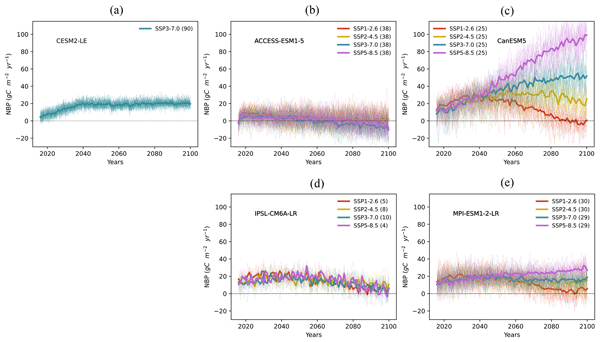
We study when anthropogenic signal becomes detectable in the global land carbon sink, which has risen since the 1950s due to CO₂ fertilization and mid- to high-latitude warming. The signal emerges earlier at the global than at regional scales. Future scenarios (2016–2100) take longer to detect than the historical period (1851–2014) because the signal is weaker relative to larger natural variability. Removing circulation-induced variability with dynamical adjustment shortens the detection time.
Jianqi Zhao, Xiaoyan Ma, Johannes Quaas, and Tong Yang
Atmos. Chem. Phys., 25, 17701–17723, https://doi.org/10.5194/acp-25-17701-2025, https://doi.org/10.5194/acp-25-17701-2025, 2025
Short summary
Short summary
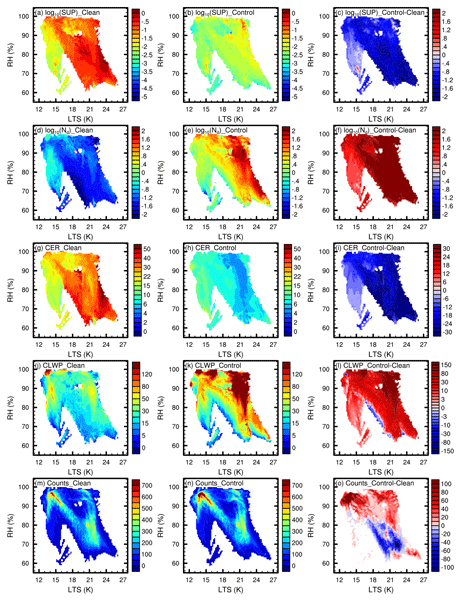
We use the chemistry version of the Weather Research and Forecasting model coupled with spectral bin microphysics to investigate how meteorological conditions impact aerosol–cloud interactions (ACI) under different pollution regimes. Our findings highlight the changes in aerosol effects on clouds and precipitation under varying thermodynamic conditions, as well as the sensitivity of ACI to meteorological conditions under different pollution regimes, which help to clarify the mechanisms behind the nonlinear variation of ACI with environmental conditions.
Mélanie Weynants, Chaonan Ji, Nora Linscheid, Ulrich Weber, Miguel D. Mahecha, and Fabian Gans
Earth Syst. Sci. Data, 17, 6621–6645, https://doi.org/10.5194/essd-17-6621-2025, https://doi.org/10.5194/essd-17-6621-2025, 2025
Short summary
Short summary
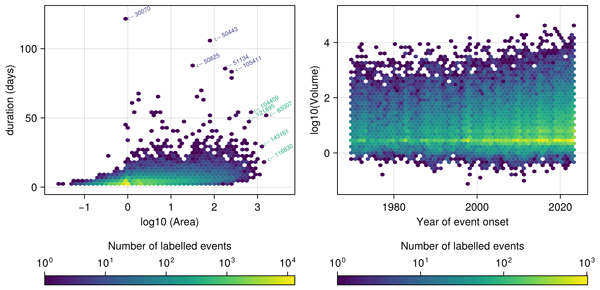
The impacts of climate extremes such as heatwaves and droughts can be made worse when they happen at the same time. Dheed is a global database of dry and hot compound extreme events from 1950 to 2023. It can be combined with other data to study the impacts of those events on terrestrial ecosystems, specific species or human societies. Dheed's analysis confirms that extremely dry and hot days have become more common on all continents in recent decades, especially in Europe and Africa.
Charlotte Lange and Johannes Quaas
Atmos. Chem. Phys., 25, 10337–10359, https://doi.org/10.5194/acp-25-10337-2025, https://doi.org/10.5194/acp-25-10337-2025, 2025
Short summary
Short summary
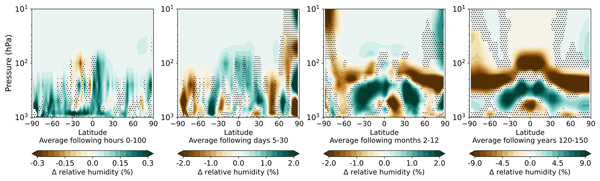
We studied how the Earth’s climate system adjusts to sudden changes in the energy budget by analysing data of four climate models, which simulated a 4 % reduction in incoming solar energy. We found rapid cooling of the atmosphere and shifts in cloud cover and atmospheric circulation patterns like land–sea circulation. Our research helps to better understand cloud adjustments, which are a major source of uncertainty in climate models. This can improve future climate predictions.
Irewola Aaron Oludehinwa, Andrei Velichko, Olasunkanmi Isaac Olusola, Olawale Segun Bolaji, Norbert Marwan, Babalola Olasupo Ogunsua, Abdullahi Ndzi Njah, and Timothy Oluwaseyi Ologun
Nonlin. Processes Geophys., 32, 225–242, https://doi.org/10.5194/npg-32-225-2025, https://doi.org/10.5194/npg-32-225-2025, 2025
Short summary
Short summary
The contributing influence of SSWs (sudden stratospheric warming) on regional ionosphere through chaos theory is examined. We find that ionospheric chaos is more pronounced in the European sector compared to the African sector during an SSW. Evidence of orderliness behavior in regional ionosphere of African sector is observed. Finally, we notice that after the peak phase of an SSW, ionospheric chaos is found to be more pronounced.
Juan A. Añel, Juan-Carlos Antuña-Marrero, Antonio Cid Samamed, Celia Pérez-Souto, Laura de la Torre, Maria Antonia Valente, Yuri Brugnara, Alfonso Saiz-Lopez, and Luis Gimeno
Earth Syst. Sci. Data, 17, 2437–2446, https://doi.org/10.5194/essd-17-2437-2025, https://doi.org/10.5194/essd-17-2437-2025, 2025
Short summary
Short summary
Ozone (discovered in 1837) was first measured in 1847 using paper strips that reacted with ozone, providing an indication of its concentration based on colour changes. Here, we present the data, covering over 60 years of daily observations conducted along the eastern Atlantic coast, spanning from the tropics to the northern extratropics.
Adarsh Jojo Thomas, Jürgen Kurths, and Daniel Schertzer
Nonlin. Processes Geophys., 32, 131–138, https://doi.org/10.5194/npg-32-131-2025, https://doi.org/10.5194/npg-32-131-2025, 2025
Short summary
Short summary
We have developed a systematic approach to study the climate system at multiple scales using climate networks, which have been previously used to study correlations between time series in space at only a single scale. This new approach is used to upscale precipitation climate networks to study the Indian summer monsoon and to analyze strong dependencies between spatial regions, which change with changing scales.
Patricia Coll-Hidalgo, Raquel Nieto, Alexandre Ramos, Patrick Ludwig, and Luis Gimeno
EGUsphere, https://doi.org/10.5194/egusphere-2025-1775, https://doi.org/10.5194/egusphere-2025-1775, 2025
Preprint withdrawn
Short summary
Short summary
This study uses Lagrangian moisture tracking and high-resolution weather simulations to trace moisture sources for Storm Ianos (Sept 2020). The analysis identified the Ionian Basin and southwestern Balkans as the primary sources, with secondary contributions from the surrounding seas. Large transport moisture traveled via three main pathways, with the Marmara-Black Sea route most significant. For record-breaking rainfall local evaporation over Greece and the Ionian Sea dominated moisture uptake.
Goutam Choudhury, Karoline Block, Mahnoosh Haghighatnasab, Johannes Quaas, Tom Goren, and Matthias Tesche
Atmos. Chem. Phys., 25, 3841–3856, https://doi.org/10.5194/acp-25-3841-2025, https://doi.org/10.5194/acp-25-3841-2025, 2025
Short summary
Short summary
Aerosol particles in the atmosphere increase cloud reflectivity, thereby cooling the Earth. Accurate global measurements of these particles are crucial for estimating this cooling effect. This study compares and harmonizes two newly developed global aerosol datasets, offering insights for their future use and refinement. We identify pristine oceans as a significant source of uncertainty in the datasets and, therefore, in quantifying the role of aerosols in Earth's climate.
Brieuc Thomas, Jose Carlos Fernández-Alvarez, Xurxo Costoya, Maite deCastro, Raquel Nieto, David Carvalho, Luis Gimeno, and Moncho Gómez-Gesteira
EGUsphere, https://doi.org/10.5194/egusphere-2025-1339, https://doi.org/10.5194/egusphere-2025-1339, 2025
Preprint archived
Short summary
Short summary
Understanding climate change is crucial, but global models lack fine detail for local assessments. Regional climate models improve accuracy by simulating climate at higher resolution. This study compares two approaches: one continuous and one resetting daily to reduce errors and speed up processing. Both perform well and similarly, but the reinitialized method is 30 times more efficient. Its lower cost makes it a promising option for high-resolution climate modelling and regional predictions.
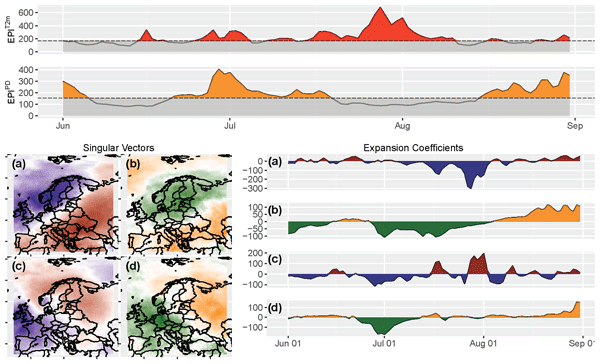
Elena Xoplaki, Florian Ellsäßer, Jens Grieger, Katrin M. Nissen, Joaquim G. Pinto, Markus Augenstein, Ting-Chen Chen, Hendrik Feldmann, Petra Friederichs, Daniel Gliksman, Laura Goulier, Karsten Haustein, Jens Heinke, Lisa Jach, Florian Knutzen, Stefan Kollet, Jürg Luterbacher, Niklas Luther, Susanna Mohr, Christoph Mudersbach, Christoph Müller, Efi Rousi, Felix Simon, Laura Suarez-Gutierrez, Svenja Szemkus, Sara M. Vallejo-Bernal, Odysseas Vlachopoulos, and Frederik Wolf
Nat. Hazards Earth Syst. Sci., 25, 541–564, https://doi.org/10.5194/nhess-25-541-2025, https://doi.org/10.5194/nhess-25-541-2025, 2025
Short summary
Short summary
Europe frequently experiences compound events, with major impacts. We investigate these events’ interactions, characteristics, and changes over time, focusing on socio-economic impacts in Germany and central Europe. Highlighting 2018’s extreme events, this study reveals impacts on water, agriculture, and forests and stresses the need for impact-focused definitions and better future risk quantification to support adaptation planning.
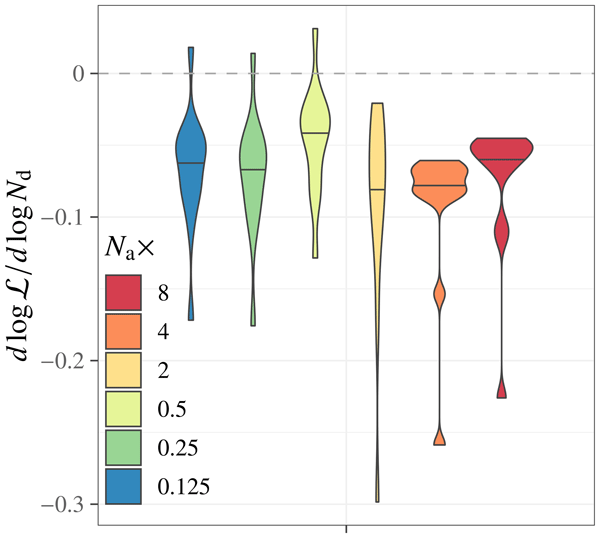
Johannes Mülmenstädt, Andrew S. Ackerman, Ann M. Fridlind, Meng Huang, Po-Lun Ma, Naser Mahfouz, Susanne E. Bauer, Susannah M. Burrows, Matthew W. Christensen, Sudhakar Dipu, Andrew Gettelman, L. Ruby Leung, Florian Tornow, Johannes Quaas, Adam C. Varble, Hailong Wang, Kai Zhang, and Youtong Zheng
Atmos. Chem. Phys., 24, 13633–13652, https://doi.org/10.5194/acp-24-13633-2024, https://doi.org/10.5194/acp-24-13633-2024, 2024
Short summary
Short summary
Stratocumulus clouds play a large role in Earth's climate by reflecting incoming solar energy back to space. Turbulence at stratocumulus cloud top mixes in dry, warm air, which can lead to cloud dissipation. This process is challenging for coarse-resolution global models to represent. We show that global models nevertheless agree well with our process understanding. Global models also think the process is less important for the climate than other lines of evidence have led us to conclude.
Jianqi Zhao, Xiaoyan Ma, and Johannes Quaas
EGUsphere, https://doi.org/10.5194/egusphere-2024-3662, https://doi.org/10.5194/egusphere-2024-3662, 2024
Preprint archived
Short summary
Short summary
We conduct a comparative analysis of aerosol-cloud responses in liquid-phase clouds under different aerosol and meteorological conditions based on simulations using the WRF-Chem-SBM model. Our findings highlight the different effects of aerosols on clouds and precipitation, as well as variations in the roles of aerosol and meteorological factors influencing aerosol-cloud interactions, in different environment.
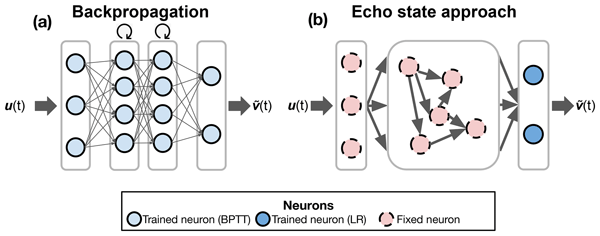
Francesco Martinuzzi, Miguel D. Mahecha, Gustau Camps-Valls, David Montero, Tristan Williams, and Karin Mora
Nonlin. Processes Geophys., 31, 535–557, https://doi.org/10.5194/npg-31-535-2024, https://doi.org/10.5194/npg-31-535-2024, 2024
Short summary
Short summary
We investigated how machine learning can forecast extreme vegetation responses to weather. Examining four models, no single one stood out as the best, though "echo state networks" showed minor advantages. Our results indicate that while these tools are able to generally model vegetation states, they face challenges under extreme conditions. This underlines the potential of artificial intelligence in ecosystem modeling, also pinpointing areas that need further research.
Iris Papakonstantinou-Presvelou and Johannes Quaas
EGUsphere, https://doi.org/10.5194/egusphere-2024-3293, https://doi.org/10.5194/egusphere-2024-3293, 2024
Preprint archived
Short summary
Short summary
As the Arctic warms and the sea ice retreats, more open ocean is exposed, changing how aerosols impact clouds. Our previous 10-year satellite analysis found higher ice crystal numbers over sea ice than over ocean. Using model simulations and aircraft observations we identify here two factors as potential causes at colder temperatures; ice nucleating particles over sea ice and blowing snow. With further sea ice loss, these processes may weaken, leading to fewer ice particles in the future.
Anca Anghelea, Ewelina Dobrowolska, Gunnar Brandt, Martin Reinhardt, Miguel Mahecha, Tejas Morbagal Harish, and Stephan Meissl
Int. Arch. Photogramm. Remote Sens. Spatial Inf. Sci., XLVIII-4-2024, 13–18, https://doi.org/10.5194/isprs-archives-XLVIII-4-2024-13-2024, https://doi.org/10.5194/isprs-archives-XLVIII-4-2024-13-2024, 2024
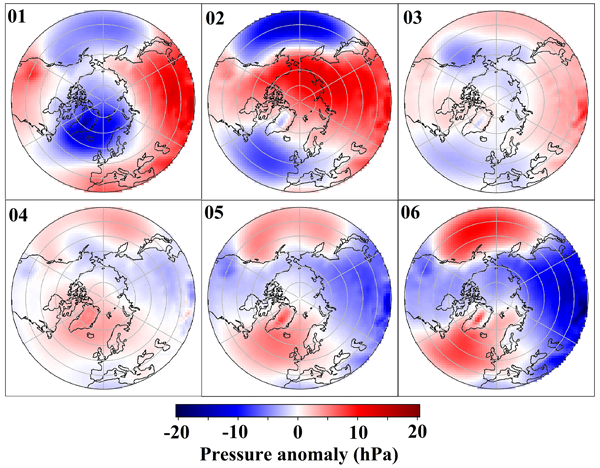
Sina Mehrdad, Dörthe Handorf, Ines Höschel, Khalil Karami, Johannes Quaas, Sudhakar Dipu, and Christoph Jacobi
Weather Clim. Dynam., 5, 1223–1268, https://doi.org/10.5194/wcd-5-1223-2024, https://doi.org/10.5194/wcd-5-1223-2024, 2024
Short summary
Short summary
This study introduces a novel deep learning (DL) approach to analyze how regional radiative forcing in Europe impacts the Arctic climate. By integrating atmospheric poleward energy transport with DL-based clustering of atmospheric patterns and attributing anomalies to specific clusters, our method reveals crucial, nuanced interactions within the climate system, enhancing our understanding of intricate climate dynamics.
Julien Lenhardt, Johannes Quaas, and Dino Sejdinovic
Atmos. Meas. Tech., 17, 5655–5677, https://doi.org/10.5194/amt-17-5655-2024, https://doi.org/10.5194/amt-17-5655-2024, 2024
Short summary
Short summary
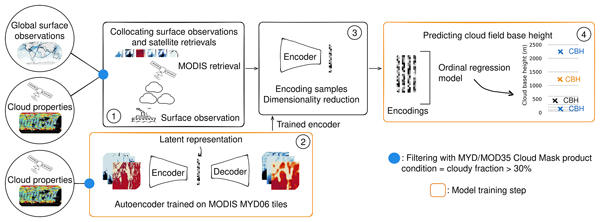
Clouds play a key role in the regulation of the Earth's climate. Aspects like the height of their base are of essential interest to quantify their radiative effects but remain difficult to derive from satellite data. In this study, we combine observations from the surface and satellite retrievals of cloud properties to build a robust and accurate method to retrieve the cloud base height, based on a computer vision model and ordinal regression.
Miguel D. Mahecha, Guido Kraemer, and Fabio Crameri
Earth Syst. Dynam., 15, 1153–1159, https://doi.org/10.5194/esd-15-1153-2024, https://doi.org/10.5194/esd-15-1153-2024, 2024
Short summary
Short summary
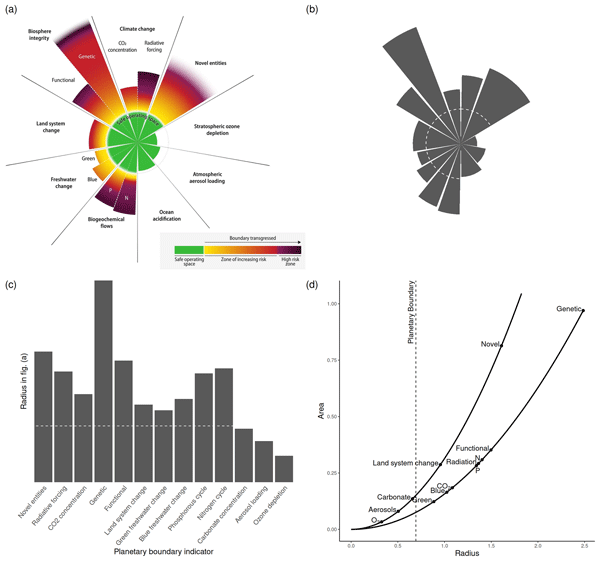
Our paper examines the visual representation of the planetary boundary concept, which helps convey Earth's capacity to sustain human life. We identify three issues: exaggerated impact sizes, confusing color patterns, and inaccessibility for colour-vision deficiency. These flaws can lead to overstating risks. We suggest improving these visual elements for more accurate and accessible information for decision-makers.
Jianqi Zhao, Xiaoyan Ma, Johannes Quaas, and Hailing Jia
Atmos. Chem. Phys., 24, 9101–9118, https://doi.org/10.5194/acp-24-9101-2024, https://doi.org/10.5194/acp-24-9101-2024, 2024
Short summary
Short summary
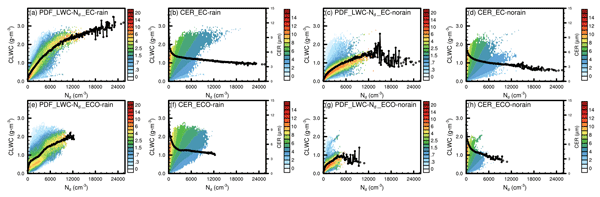
We explore aerosol–cloud interactions in liquid-phase clouds over eastern China and its adjacent ocean in winter based on the WRF-Chem–SBM model, which couples a spectral-bin microphysics scheme and an online aerosol module. Our study highlights the differences in aerosol–cloud interactions between land and ocean and between precipitation clouds and non-precipitation clouds, and it differentiates and quantifies their underlying mechanisms.
Johannes Mülmenstädt, Edward Gryspeerdt, Sudhakar Dipu, Johannes Quaas, Andrew S. Ackerman, Ann M. Fridlind, Florian Tornow, Susanne E. Bauer, Andrew Gettelman, Yi Ming, Youtong Zheng, Po-Lun Ma, Hailong Wang, Kai Zhang, Matthew W. Christensen, Adam C. Varble, L. Ruby Leung, Xiaohong Liu, David Neubauer, Daniel G. Partridge, Philip Stier, and Toshihiko Takemura
Atmos. Chem. Phys., 24, 7331–7345, https://doi.org/10.5194/acp-24-7331-2024, https://doi.org/10.5194/acp-24-7331-2024, 2024
Short summary
Short summary
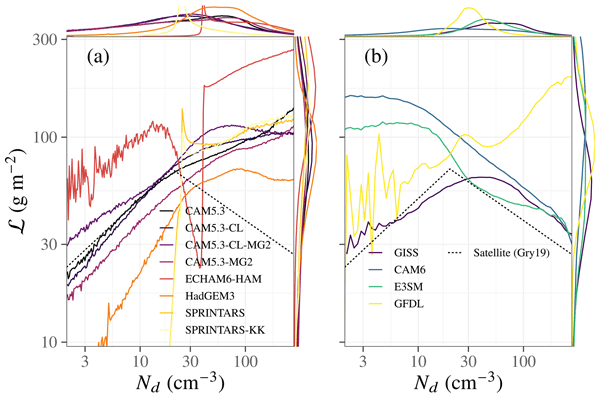
Human activities release copious amounts of small particles called aerosols into the atmosphere. These particles change how much sunlight clouds reflect to space, an important human perturbation of the climate, whose magnitude is highly uncertain. We found that the latest climate models show a negative correlation but a positive causal relationship between aerosols and cloud water. This means we need to be very careful when we interpret observational studies that can only see correlation.
Francesco Martinuzzi, Miguel D. Mahecha, David Montero, Lazaro Alonso, and Karin Mora
Int. Arch. Photogramm. Remote Sens. Spatial Inf. Sci., XLVIII-4-W12-2024, 89–95, https://doi.org/10.5194/isprs-archives-XLVIII-4-W12-2024-89-2024, https://doi.org/10.5194/isprs-archives-XLVIII-4-W12-2024-89-2024, 2024
David Montero, Miguel D. Mahecha, César Aybar, Clemens Mosig, and Sebastian Wieneke
Int. Arch. Photogramm. Remote Sens. Spatial Inf. Sci., XLVIII-4-W12-2024, 105–112, https://doi.org/10.5194/isprs-archives-XLVIII-4-W12-2024-105-2024, https://doi.org/10.5194/isprs-archives-XLVIII-4-W12-2024-105-2024, 2024
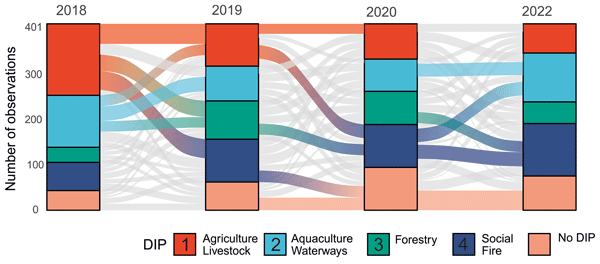
Jan Sodoge, Christian Kuhlicke, Miguel D. Mahecha, and Mariana Madruga de Brito
Nat. Hazards Earth Syst. Sci., 24, 1757–1777, https://doi.org/10.5194/nhess-24-1757-2024, https://doi.org/10.5194/nhess-24-1757-2024, 2024
Short summary
Short summary
We delved into the socio-economic impacts of the 2018–2022 drought in Germany. We derived a dataset covering the impacts of droughts in Germany between 2000 and 2022 on sectors such as agriculture and forestry based on newspaper articles. Notably, our study illustrated that the longer drought had a wider reach and more varied effects. We show that dealing with longer droughts requires different plans compared to shorter ones, and it is crucial to be ready for the challenges they bring.
Bjorn Stevens, Stefan Adami, Tariq Ali, Hartwig Anzt, Zafer Aslan, Sabine Attinger, Jaana Bäck, Johanna Baehr, Peter Bauer, Natacha Bernier, Bob Bishop, Hendryk Bockelmann, Sandrine Bony, Guy Brasseur, David N. Bresch, Sean Breyer, Gilbert Brunet, Pier Luigi Buttigieg, Junji Cao, Christelle Castet, Yafang Cheng, Ayantika Dey Choudhury, Deborah Coen, Susanne Crewell, Atish Dabholkar, Qing Dai, Francisco Doblas-Reyes, Dale Durran, Ayoub El Gaidi, Charlie Ewen, Eleftheria Exarchou, Veronika Eyring, Florencia Falkinhoff, David Farrell, Piers M. Forster, Ariane Frassoni, Claudia Frauen, Oliver Fuhrer, Shahzad Gani, Edwin Gerber, Debra Goldfarb, Jens Grieger, Nicolas Gruber, Wilco Hazeleger, Rolf Herken, Chris Hewitt, Torsten Hoefler, Huang-Hsiung Hsu, Daniela Jacob, Alexandra Jahn, Christian Jakob, Thomas Jung, Christopher Kadow, In-Sik Kang, Sarah Kang, Karthik Kashinath, Katharina Kleinen-von Königslöw, Daniel Klocke, Uta Kloenne, Milan Klöwer, Chihiro Kodama, Stefan Kollet, Tobias Kölling, Jenni Kontkanen, Steve Kopp, Michal Koran, Markku Kulmala, Hanna Lappalainen, Fakhria Latifi, Bryan Lawrence, June Yi Lee, Quentin Lejeun, Christian Lessig, Chao Li, Thomas Lippert, Jürg Luterbacher, Pekka Manninen, Jochem Marotzke, Satoshi Matsouoka, Charlotte Merchant, Peter Messmer, Gero Michel, Kristel Michielsen, Tomoki Miyakawa, Jens Müller, Ramsha Munir, Sandeep Narayanasetti, Ousmane Ndiaye, Carlos Nobre, Achim Oberg, Riko Oki, Tuba Özkan-Haller, Tim Palmer, Stan Posey, Andreas Prein, Odessa Primus, Mike Pritchard, Julie Pullen, Dian Putrasahan, Johannes Quaas, Krishnan Raghavan, Venkatachalam Ramaswamy, Markus Rapp, Florian Rauser, Markus Reichstein, Aromar Revi, Sonakshi Saluja, Masaki Satoh, Vera Schemann, Sebastian Schemm, Christina Schnadt Poberaj, Thomas Schulthess, Cath Senior, Jagadish Shukla, Manmeet Singh, Julia Slingo, Adam Sobel, Silvina Solman, Jenna Spitzer, Philip Stier, Thomas Stocker, Sarah Strock, Hang Su, Petteri Taalas, John Taylor, Susann Tegtmeier, Georg Teutsch, Adrian Tompkins, Uwe Ulbrich, Pier-Luigi Vidale, Chien-Ming Wu, Hao Xu, Najibullah Zaki, Laure Zanna, Tianjun Zhou, and Florian Ziemen
Earth Syst. Sci. Data, 16, 2113–2122, https://doi.org/10.5194/essd-16-2113-2024, https://doi.org/10.5194/essd-16-2113-2024, 2024
Short summary
Short summary
To manage Earth in the Anthropocene, new tools, new institutions, and new forms of international cooperation will be required. Earth Virtualization Engines is proposed as an international federation of centers of excellence to empower all people to respond to the immense and urgent challenges posed by climate change.
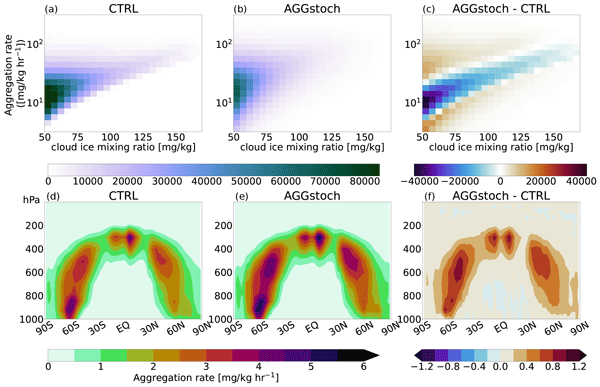
Sabine Doktorowski, Jan Kretzschmar, Johannes Quaas, Marc Salzmann, and Odran Sourdeval
Geosci. Model Dev., 17, 3099–3110, https://doi.org/10.5194/gmd-17-3099-2024, https://doi.org/10.5194/gmd-17-3099-2024, 2024
Short summary
Short summary
Especially over the midlatitudes, precipitation is mainly formed via the ice phase. In this study we focus on the initial snow formation process in the ICON-AES, the aggregation process. We use a stochastical approach for the aggregation parameterization and investigate the influence in the ICON-AES. Therefore, a distribution function of cloud ice is created, which is evaluated with satellite data. The new approach leads to cloud ice loss and an improvement in the process rate bias.
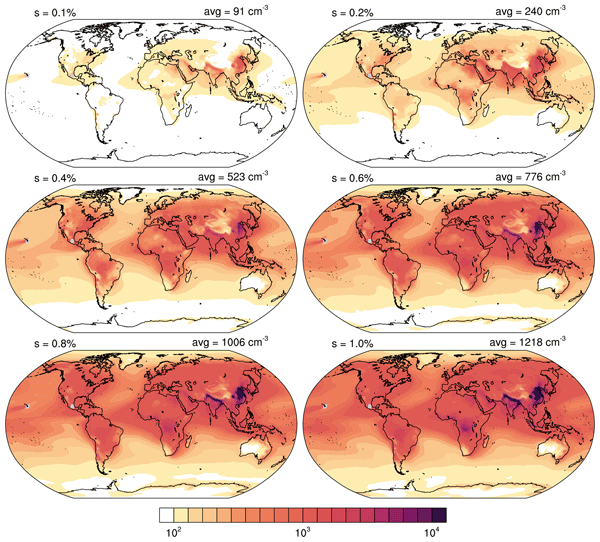
Karoline Block, Mahnoosh Haghighatnasab, Daniel G. Partridge, Philip Stier, and Johannes Quaas
Earth Syst. Sci. Data, 16, 443–470, https://doi.org/10.5194/essd-16-443-2024, https://doi.org/10.5194/essd-16-443-2024, 2024
Short summary
Short summary
Aerosols being able to act as condensation nuclei for cloud droplets (CCNs) are a key element in cloud formation but very difficult to determine. In this study we present a new global vertically resolved CCN dataset for various humidity conditions and aerosols. It is obtained using an atmospheric model (CAMS reanalysis) that is fed by satellite observations of light extinction (AOD). We investigate and evaluate the abundance of CCNs in the atmosphere and their temporal and spatial occurrence.
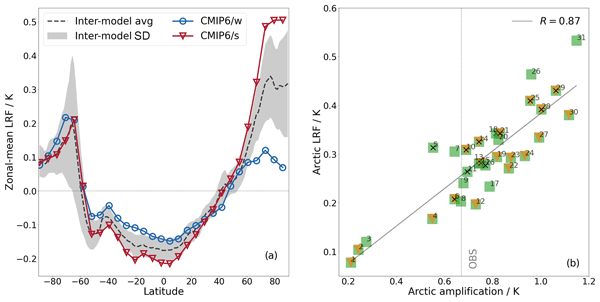
Olivia Linke, Johannes Quaas, Finja Baumer, Sebastian Becker, Jan Chylik, Sandro Dahlke, André Ehrlich, Dörthe Handorf, Christoph Jacobi, Heike Kalesse-Los, Luca Lelli, Sina Mehrdad, Roel A. J. Neggers, Johannes Riebold, Pablo Saavedra Garfias, Niklas Schnierstein, Matthew D. Shupe, Chris Smith, Gunnar Spreen, Baptiste Verneuil, Kameswara S. Vinjamuri, Marco Vountas, and Manfred Wendisch
Atmos. Chem. Phys., 23, 9963–9992, https://doi.org/10.5194/acp-23-9963-2023, https://doi.org/10.5194/acp-23-9963-2023, 2023
Short summary
Short summary
Lapse rate feedback (LRF) is a major driver of the Arctic amplification (AA) of climate change. It arises because the warming is stronger at the surface than aloft. Several processes can affect the LRF in the Arctic, such as the omnipresent temperature inversion. Here, we compare multimodel climate simulations to Arctic-based observations from a large research consortium to broaden our understanding of these processes, find synergy among them, and constrain the Arctic LRF and AA.
Hao Luo, Johannes Quaas, and Yong Han
Atmos. Chem. Phys., 23, 8169–8186, https://doi.org/10.5194/acp-23-8169-2023, https://doi.org/10.5194/acp-23-8169-2023, 2023
Short summary
Short summary
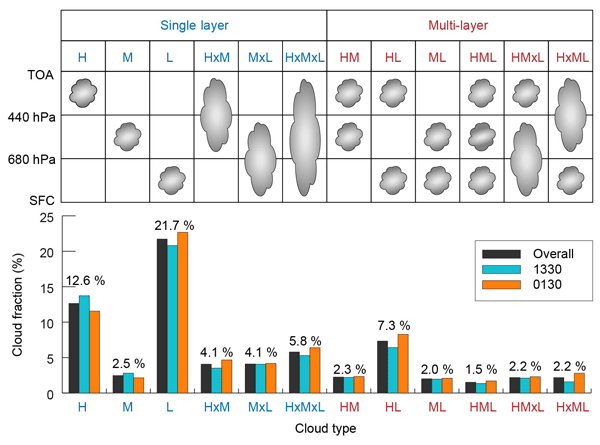
Clouds exhibit a wide range of vertical structures with varying microphysical and radiative properties. We show a global survey of spatial distribution, vertical extent and radiative effect of various classified cloud vertical structures using joint satellite observations from the new CCCM datasets during 2007–2010. Moreover, the long-term trends in CVSs are investigated based on different CMIP6 future scenarios to capture the cloud variations with different, increasing anthropogenic forcings.
Sara M. Vallejo-Bernal, Frederik Wolf, Niklas Boers, Dominik Traxl, Norbert Marwan, and Jürgen Kurths
Hydrol. Earth Syst. Sci., 27, 2645–2660, https://doi.org/10.5194/hess-27-2645-2023, https://doi.org/10.5194/hess-27-2645-2023, 2023
Short summary
Short summary
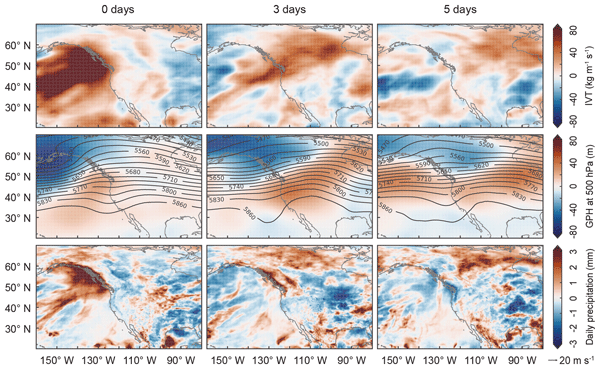
Employing event synchronization and complex networks analysis, we reveal a cascade of heavy rainfall events, related to intense atmospheric rivers (ARs): heavy precipitation events (HPEs) in western North America (NA) that occur in the aftermath of land-falling ARs are synchronized with HPEs in central and eastern Canada with a delay of up to 12 d. Understanding the effects of ARs in the rainfall over NA will lead to better anticipating the evolution of the climate dynamics in the region.
Domenico Giaquinto, Warner Marzocchi, and Jürgen Kurths
Nonlin. Processes Geophys., 30, 167–181, https://doi.org/10.5194/npg-30-167-2023, https://doi.org/10.5194/npg-30-167-2023, 2023
Short summary
Short summary
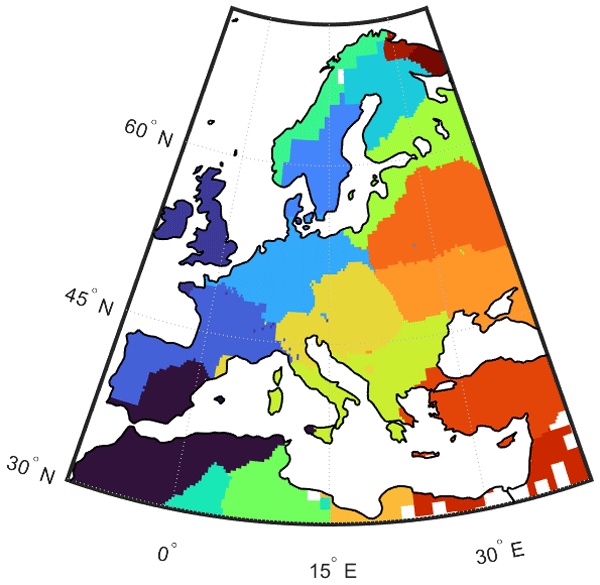
Despite being among the most severe climate extremes, it is still challenging to assess droughts’ features for specific regions. In this paper we study meteorological droughts in Europe using concepts derived from climate network theory. By exploring the synchronization in droughts occurrences across the continent we unveil regional clusters which are individually examined to identify droughts’ geographical propagation and source–sink systems, which could potentially support droughts’ forecast.
Samuel Kwakye, Heike Kalesse-Los, Maximilian Maahn, Patric Seifert, Roel van Klink, Christian Wirth, and Johannes Quaas
Atmos. Meas. Tech. Discuss., https://doi.org/10.5194/amt-2023-69, https://doi.org/10.5194/amt-2023-69, 2023
Publication in AMT not foreseen
Short summary
Short summary
Insect numbers in the atmosphere can be calculated using polarimetric weather radar but they have to be identified and separated from other echoes, especially weather phenomena. Here, the separation is demonstrated using three machine-learning algorithms and insect count data from suction traps and the nature of radar measurements of different radar echoes is revealed. Random forest is the best separating algorithm and insect echoes radar measurements are distinct.
Jianqi Zhao, Xiaoyan Ma, Johannes Quaas, and Hailing Jia
EGUsphere, https://doi.org/10.5194/egusphere-2023-331, https://doi.org/10.5194/egusphere-2023-331, 2023
Preprint archived
Short summary
Short summary
We improve the ability of WRF-Chem model to simulate aerosol-cloud physical and chemical processes by coupling a spectral-bin cloud microphysics scheme and online aerosol module, and consequently explore the aerosol-cloud interactions over eastern China and its adjacent ocean in boreal winter. Our study highlights the differences in aerosol-cloud interactions between land and ocean, precipitation clouds and non-precipitation clouds, and differentiates and quantifies their underlying mechanisms.
Marine Bonazzola, Hélène Chepfer, Po-Lun Ma, Johannes Quaas, David M. Winker, Artem Feofilov, and Nick Schutgens
Geosci. Model Dev., 16, 1359–1377, https://doi.org/10.5194/gmd-16-1359-2023, https://doi.org/10.5194/gmd-16-1359-2023, 2023
Short summary
Short summary
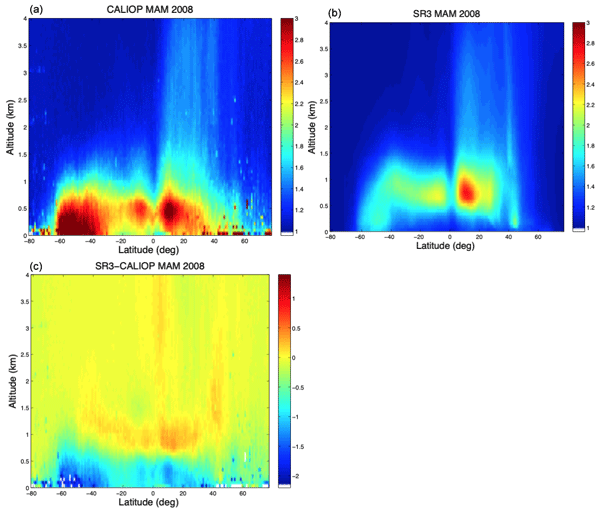
Aerosol has a large impact on climate. Using a lidar aerosol simulator ensures consistent comparisons between modeled and observed aerosol. We present a lidar aerosol simulator that applies a cloud masking and an aerosol detection threshold. We estimate the lidar signals that would be observed at 532 nm by the Cloud-Aerosol Lidar with Orthogonal Polarization overflying the atmosphere predicted by a climate model. Our comparison at the seasonal timescale shows a discrepancy in the Southern Ocean.
Renee van Dongen, Dirk Scherler, Dadiyorto Wendi, Eric Deal, Luca Mao, Norbert Marwan, and Claudio I. Meier
EGUsphere, https://doi.org/10.5194/egusphere-2022-1234, https://doi.org/10.5194/egusphere-2022-1234, 2022
Preprint archived
Short summary
Short summary
El Niño Southern Oscillation (ENSO) is a climatic phenomenon that causes abnormal climatic conditions in Chile. We investigated how ENSO affects catchment hydrology and found strong seasonal and spatial differences in the hydrological response to ENSO which was caused by different hydrological processes in catchments that are dominated by snowmelt-generated runoff or rainfall-generated runoff. These results are relevant for water resources management and ENSO mitigation in Chile.
Alberto Caldas-Alvarez, Markus Augenstein, Georgy Ayzel, Klemens Barfus, Ribu Cherian, Lisa Dillenardt, Felix Fauer, Hendrik Feldmann, Maik Heistermann, Alexia Karwat, Frank Kaspar, Heidi Kreibich, Etor Emanuel Lucio-Eceiza, Edmund P. Meredith, Susanna Mohr, Deborah Niermann, Stephan Pfahl, Florian Ruff, Henning W. Rust, Lukas Schoppa, Thomas Schwitalla, Stella Steidl, Annegret H. Thieken, Jordis S. Tradowsky, Volker Wulfmeyer, and Johannes Quaas
Nat. Hazards Earth Syst. Sci., 22, 3701–3724, https://doi.org/10.5194/nhess-22-3701-2022, https://doi.org/10.5194/nhess-22-3701-2022, 2022
Short summary
Short summary
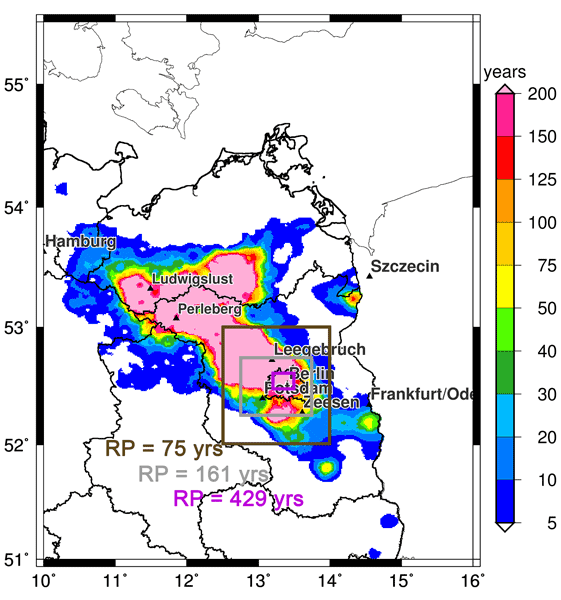
In a warming climate, extreme precipitation events are becoming more frequent. To advance our knowledge on such phenomena, we present a multidisciplinary analysis of a selected case study that took place on 29 June 2017 in the Berlin metropolitan area. Our analysis provides evidence of the extremeness of the case from the atmospheric and the impacts perspectives as well as new insights on the physical mechanisms of the event at the meteorological and climate scales.
Na Li, Sebastian Sippel, Alexander J. Winkler, Miguel D. Mahecha, Markus Reichstein, and Ana Bastos
Earth Syst. Dynam., 13, 1505–1533, https://doi.org/10.5194/esd-13-1505-2022, https://doi.org/10.5194/esd-13-1505-2022, 2022
Short summary
Short summary
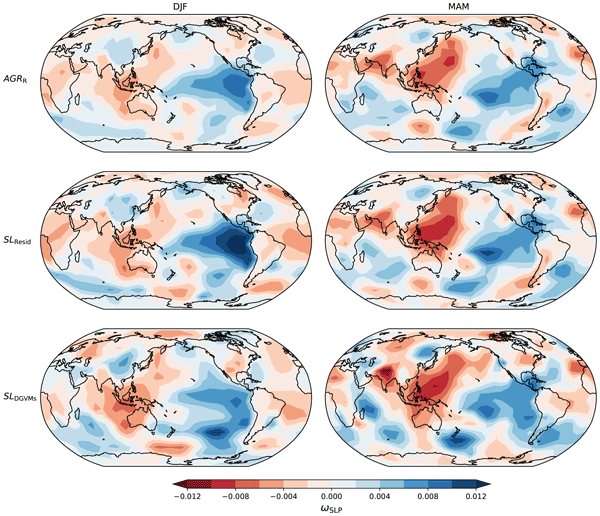
Quantifying the imprint of large-scale atmospheric circulation dynamics and associated carbon cycle responses is key to improving our understanding of carbon cycle dynamics. Using a statistical model that relies on spatiotemporal sea level pressure as a proxy for large-scale atmospheric circulation, we quantify the fraction of interannual variability in atmospheric CO2 growth rate and the land CO2 sink that are driven by atmospheric circulation variability.
Johannes Quaas, Hailing Jia, Chris Smith, Anna Lea Albright, Wenche Aas, Nicolas Bellouin, Olivier Boucher, Marie Doutriaux-Boucher, Piers M. Forster, Daniel Grosvenor, Stuart Jenkins, Zbigniew Klimont, Norman G. Loeb, Xiaoyan Ma, Vaishali Naik, Fabien Paulot, Philip Stier, Martin Wild, Gunnar Myhre, and Michael Schulz
Atmos. Chem. Phys., 22, 12221–12239, https://doi.org/10.5194/acp-22-12221-2022, https://doi.org/10.5194/acp-22-12221-2022, 2022
Short summary
Short summary
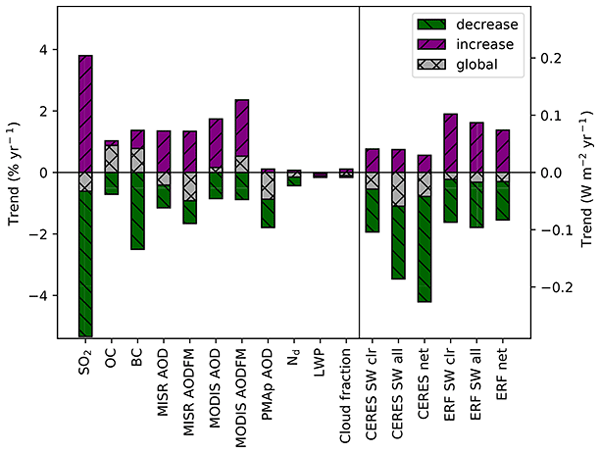
Pollution particles cool climate and offset part of the global warming. However, they are washed out by rain and thus their effect responds quickly to changes in emissions. We show multiple datasets to demonstrate that aerosol emissions and their concentrations declined in many regions influenced by human emissions, as did the effects on clouds. Consequently, the cooling impact on the Earth energy budget became smaller. This change in trend implies a relative warming.
D. Montero, C. Aybar, M. D. Mahecha, and S. Wieneke
Int. Arch. Photogramm. Remote Sens. Spatial Inf. Sci., XLVIII-4-W1-2022, 301–306, https://doi.org/10.5194/isprs-archives-XLVIII-4-W1-2022-301-2022, https://doi.org/10.5194/isprs-archives-XLVIII-4-W1-2022-301-2022, 2022
Ovid O. Krüger, Bruna A. Holanda, Sourangsu Chowdhury, Andrea Pozzer, David Walter, Christopher Pöhlker, Maria Dolores Andrés Hernández, John P. Burrows, Christiane Voigt, Jos Lelieveld, Johannes Quaas, Ulrich Pöschl, and Mira L. Pöhlker
Atmos. Chem. Phys., 22, 8683–8699, https://doi.org/10.5194/acp-22-8683-2022, https://doi.org/10.5194/acp-22-8683-2022, 2022
Short summary
Short summary
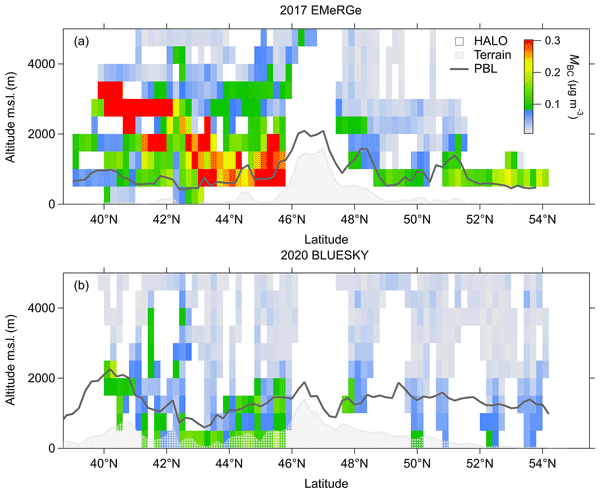
The abrupt reduction in human activities during the first COVID-19 lockdown created unprecedented atmospheric conditions. We took the opportunity to quantify changes in black carbon (BC) as a major anthropogenic air pollutant. Therefore, we measured BC on board a research aircraft over Europe during the lockdown and compared the results to measurements from 2017. With model simulations we account for different weather conditions and find a lockdown-related decrease in BC of 41 %.
Mahnoosh Haghighatnasab, Jan Kretzschmar, Karoline Block, and Johannes Quaas
Atmos. Chem. Phys., 22, 8457–8472, https://doi.org/10.5194/acp-22-8457-2022, https://doi.org/10.5194/acp-22-8457-2022, 2022
Short summary
Short summary
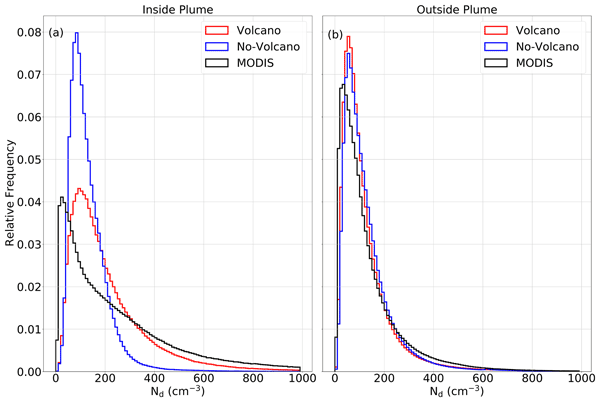
The impact of aerosols emitted by the Holuhraun volcanic eruption on liquid clouds was assessed from a pair of cloud-system-resolving simulations along with satellite retrievals. Inside and outside the plume were compared in terms of their statistical distributions. Analyses indicated enhancement for cloud droplet number concentration inside the volcano plume in model simulations and satellite retrievals, while there was on average a small effect on both liquid water path and cloud fraction.
Hailing Jia, Johannes Quaas, Edward Gryspeerdt, Christoph Böhm, and Odran Sourdeval
Atmos. Chem. Phys., 22, 7353–7372, https://doi.org/10.5194/acp-22-7353-2022, https://doi.org/10.5194/acp-22-7353-2022, 2022
Short summary
Short summary
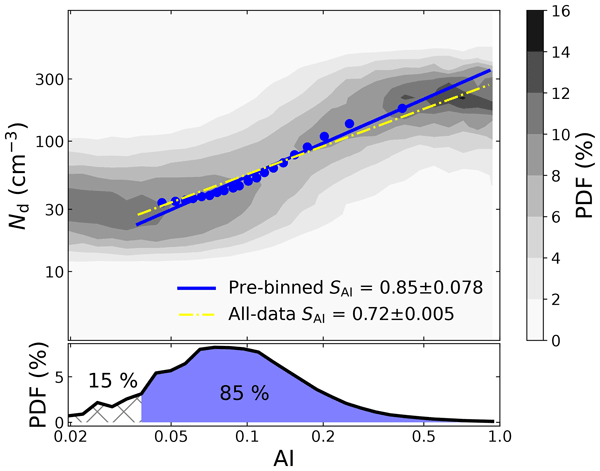
Aerosol–cloud interaction is the most uncertain component of the anthropogenic forcing of the climate. By combining satellite and reanalysis data, we show that the strength of the Twomey effect (S) increases remarkably with vertical velocity. Both the confounding effect of aerosol–precipitation interaction and the lack of vertical co-location between aerosol and cloud are found to overestimate S, whereas the retrieval biases in aerosol and cloud appear to underestimate S.
Po-Lun Ma, Bryce E. Harrop, Vincent E. Larson, Richard B. Neale, Andrew Gettelman, Hugh Morrison, Hailong Wang, Kai Zhang, Stephen A. Klein, Mark D. Zelinka, Yuying Zhang, Yun Qian, Jin-Ho Yoon, Christopher R. Jones, Meng Huang, Sheng-Lun Tai, Balwinder Singh, Peter A. Bogenschutz, Xue Zheng, Wuyin Lin, Johannes Quaas, Hélène Chepfer, Michael A. Brunke, Xubin Zeng, Johannes Mülmenstädt, Samson Hagos, Zhibo Zhang, Hua Song, Xiaohong Liu, Michael S. Pritchard, Hui Wan, Jingyu Wang, Qi Tang, Peter M. Caldwell, Jiwen Fan, Larry K. Berg, Jerome D. Fast, Mark A. Taylor, Jean-Christophe Golaz, Shaocheng Xie, Philip J. Rasch, and L. Ruby Leung
Geosci. Model Dev., 15, 2881–2916, https://doi.org/10.5194/gmd-15-2881-2022, https://doi.org/10.5194/gmd-15-2881-2022, 2022
Short summary
Short summary
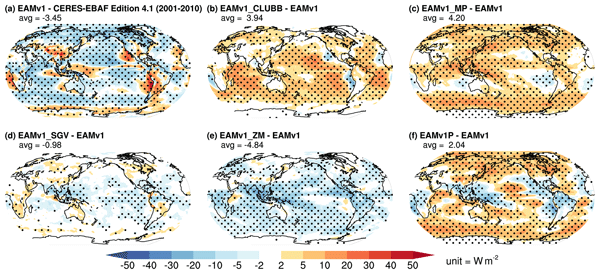
An alternative set of parameters for E3SM Atmospheric Model version 1 has been developed based on a tuning strategy that focuses on clouds. When clouds in every regime are improved, other aspects of the model are also improved, even though they are not the direct targets for calibration. The recalibrated model shows a lower sensitivity to anthropogenic aerosols and surface warming, suggesting potential improvements to the simulated climate in the past and future.
J. Pacheco-Labrador, U. Weber, X. Ma, M. D. Mahecha, N. Carvalhais, C. Wirth, A. Huth, F. J. Bohn, G. Kraemer, U. Heiden, FunDivEUROPE members, and M. Migliavacca
Int. Arch. Photogramm. Remote Sens. Spatial Inf. Sci., XLVI-1-W1-2021, 49–55, https://doi.org/10.5194/isprs-archives-XLVI-1-W1-2021-49-2022, https://doi.org/10.5194/isprs-archives-XLVI-1-W1-2021-49-2022, 2022
Cinthya Esther Nava Fernandez, Tobias Braun, Bethany Fox, Adam Hartland, Ola Kwiecien, Chelsea Pederson, Sebastian Hoepker, Stefano Bernasconi, Madalina Jaggi, John Hellstrom, Fernando Gázquez, Amanda French, Norbert Marwan, Adrian Immenhauser, and Sebastian Franz Martin Breitenbach
Clim. Past Discuss., https://doi.org/10.5194/cp-2021-172, https://doi.org/10.5194/cp-2021-172, 2022
Manuscript not accepted for further review
Short summary
Short summary
We provide a ca. 1000 year long (6.4–5.4 ka BP) stalagmite-based reconstruction of mid-Holocene rainfall variability in the tropical western Pacific. The annually laminated multi-proxy (δ13C, δ18O, X/Ca, gray values) record comes from Niue island and informs on El Nino-Southern Oscillation and South Pacific Convergence Zone dynamics. Our data suggest that ENSO was active and influenced rainfall seasonality over the covered time interval. Rainfall seasonality was subdued during active ENSO phases

Matthew W. Christensen, Andrew Gettelman, Jan Cermak, Guy Dagan, Michael Diamond, Alyson Douglas, Graham Feingold, Franziska Glassmeier, Tom Goren, Daniel P. Grosvenor, Edward Gryspeerdt, Ralph Kahn, Zhanqing Li, Po-Lun Ma, Florent Malavelle, Isabel L. McCoy, Daniel T. McCoy, Greg McFarquhar, Johannes Mülmenstädt, Sandip Pal, Anna Possner, Adam Povey, Johannes Quaas, Daniel Rosenfeld, Anja Schmidt, Roland Schrödner, Armin Sorooshian, Philip Stier, Velle Toll, Duncan Watson-Parris, Robert Wood, Mingxi Yang, and Tianle Yuan
Atmos. Chem. Phys., 22, 641–674, https://doi.org/10.5194/acp-22-641-2022, https://doi.org/10.5194/acp-22-641-2022, 2022
Short summary
Short summary
Trace gases and aerosols (tiny airborne particles) are released from a variety of point sources around the globe. Examples include volcanoes, industrial chimneys, forest fires, and ship stacks. These sources provide opportunistic experiments with which to quantify the role of aerosols in modifying cloud properties. We review the current state of understanding on the influence of aerosol on climate built from the wide range of natural and anthropogenic laboratories investigated in recent decades.
Silke Trömel, Clemens Simmer, Ulrich Blahak, Armin Blanke, Sabine Doktorowski, Florian Ewald, Michael Frech, Mathias Gergely, Martin Hagen, Tijana Janjic, Heike Kalesse-Los, Stefan Kneifel, Christoph Knote, Jana Mendrok, Manuel Moser, Gregor Köcher, Kai Mühlbauer, Alexander Myagkov, Velibor Pejcic, Patric Seifert, Prabhakar Shrestha, Audrey Teisseire, Leonie von Terzi, Eleni Tetoni, Teresa Vogl, Christiane Voigt, Yuefei Zeng, Tobias Zinner, and Johannes Quaas
Atmos. Chem. Phys., 21, 17291–17314, https://doi.org/10.5194/acp-21-17291-2021, https://doi.org/10.5194/acp-21-17291-2021, 2021
Short summary
Short summary
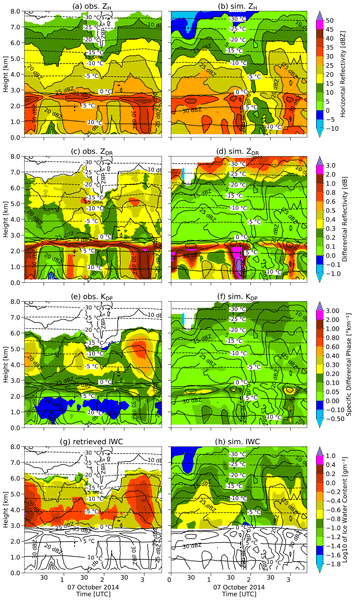
The article introduces the ACP readership to ongoing research in Germany on cloud- and precipitation-related process information inherent in polarimetric radar measurements, outlines pathways to inform atmospheric models with radar-based information, and points to remaining challenges towards an improved fusion of radar polarimetry and atmospheric modelling.
Cited articles
Algarra, I., Nieto, R., Ramos, A. M., Eiras-Barca, J., Trigo, R. M., and Gimeno, L.: Significant increase of global anomalous moisture uptake feeding landfalling Atmospheric Rivers, Nat. Commun., 11, 5082, https://doi.org/10.1038/s41467-020-18876-w, 2020. a
Benjamini, Y. and Hochberg, Y.: Controlling the false discovery rate: a practical and powerful approach to multiple testing, J. R. Stat. Soc. B, 57, 289–300, https://doi.org/10.1111/j.2517-6161.1995.tb02031.x, 1995. a
Boers, N., Goswami, B., Rheinwalt, A., Bookhagen, B., Hoskins, B., and Kurths, J.: Complex networks reveal global pattern of extreme-rainfall teleconnections, Nature, 566, 373–377, https://doi.org/10.1038/s41586-018-0872-x, 2019. a
Braun, T.: ARnetwork.py (v1.0.0), Zenodo [software], https://doi.org/10.5281/zenodo.20408192, 2026. a
Coscia, M.: The atlas for the aspiring network scientist, arXiv [preprint], https://doi.org/10.48550/arXiv.2101.00863, 2021. a, b, c, d
Crameri, F., Shephard, G. E., and Heron, P. J.: The misuse of colour in science communication, Nat. Commun., 11, 5444, https://doi.org/10.1038/s41467-020-19160-7, 2020. a
Dacre, H. F. and Clark, P. A.: A kinematic analysis of extratropical cyclones, warm conveyor belts and atmospheric rivers, npj Climate and Atmospheric Science, 8, 97, https://doi.org/10.1038/s41612-025-00942-z, 2025. a
De Petrillo, E., Fahrländer, S. F., Tuninetti, M., Andersen, L. S., Monaco, L., Ridolfi, L., and Laio, F.: Reconciling tracked atmospheric water flows to close the global freshwater cycle, Communications Earth & Environment, 6, 347, https://doi.org/10.1038/s43247-025-02289-y, 2025. a
Ding, Q. and Wang, B.: Circumglobal teleconnection in the Northern Hemisphere summer, J. Climate, 18, 3483–3505, https://doi.org/10.1175/JCLI3473.1, 2005. a
Edler, D., Holmgren, A., and Rosvall, M.: The MapEquation software package, https://mapequation.org (last access: 9 June 2026), 2025. a
Esfandiari, N. and Rezaei, M.: Automatic detection, classification, and long-term investigation of temporal–spatial changes of atmospheric rivers in the Middle East, Int. J. Climatol., 42, 7730–7750, https://doi.org/10.3390/w12102863, 2022. a
Francis, D., Fonseca, R., Bozkurt, D., Nelli, N., and Guan, B.: Atmospheric river rapids and their role in the extreme rainfall event of April 2023 in the Middle East, Geophys. Res. Lett., 51, e2024GL109446, https://doi.org/10.1029/2024GL109446, 2024. a
Garaboa-Paz, D., Eiras-Barca, J., and Pérez-Muñuzuri, V.: Climatology of Lyapunov exponents: the link between atmospheric rivers and large-scale mixing variability, Earth Syst. Dynam., 8, 865–873, https://doi.org/10.5194/esd-8-865-2017, 2017. a
Gelbrecht, M., Boers, N., and Kurths, J.: A complex network representation of wind flows, Chaos, 27, https://doi.org/10.1063/1.4977699, 2017. a
Giammarese, A., Brown, J., and Malik, N.: Reconfiguration of Amazon’s connectivity in the climate system, Chaos, 34, https://doi.org/10.1063/5.0165861, 2024. a
Gimeno, L., Nieto, R., Vázquez, M., and Lavers, D. A.: Atmospheric rivers: A mini-review, Frontiers in Earth Science, 2, 2, https://doi.org/10.3389/feart.2014.00002, 2014. a
Gimeno, L., Dominguez, F., Nieto, R., Trigo, R., Drumond, A., Reason, C. J., Taschetto, A. S., Ramos, A. M., Kumar, R., and Marengo, J.: Major mechanisms of atmospheric moisture transport and their role in extreme precipitation events, Annu. Rev. Env. Resour., 41, 117–141, https://doi.org/10.1146/annurev-environ-110615-085558, 2016. a, b, c, d, e
Gimeno, L., Vázquez, M., Eiras-Barca, J., Sorí, R., Stojanovic, M., Algarra, I., Nieto, R., Ramos, A. M., Durán-Quesada, A. M., and Dominguez, F.: Recent progress on the sources of continental precipitation as revealed by moisture transport analysis, Earth-Sci. Rev., 201, 103070, https://doi.org/10.1016/j.earscirev.2019.103070, 2020. a, b, c, d
Goyal, R., Jucker, M., Sen Gupta, A., Hendon, H. H., and England, M. H.: Zonal wave 3 pattern in the Southern Hemisphere generated by tropical convection, Nat. Geosci., 14, 732–738, https://doi.org/10.1038/s41561-021-00811-3, 2021. a
Guan, B.: [Data] Global Atmospheric Rivers Database, Version 4, UCLA Dataverse [data set], https://doi.org/10.25346/S6/ZSW7UN, 2024. a
Guan, B. and Waliser, D. E.: Tracking atmospheric rivers globally: Spatial distributions and temporal evolution of life cycle characteristics, J. Geophys. Res.-Atmos., 124, 12523–12552, https://doi.org/10.1029/2019JD031205, 2019. a, b, c, d
Guan, B. and Waliser, D. E.: A regionally refined quarter-degree global atmospheric rivers database based on ERA5, Scientific Data, 11, 440, https://doi.org/10.1038/s41597-024-03258-4, 2024. a, b
Guan, B., Waliser, D. E., and Ralph, F. M.: An intercomparison between reanalysis and dropsonde observations of the total water vapor transport in individual atmospheric rivers, J. Hydrometeorol., 19, 321–337, https://doi.org/10.1175/JHM-D-17-0114.1, 2018. a
Gupta, S., Boers, N., Pappenberger, F., and Kurths, J.: Complex network approach for detecting tropical cyclones, Clim. Dynam., 57, 3355–3364, https://doi.org/10.1007/s00382-021-05871-0, 2021. a
Haas, M., Goswami, B., and von Luxburg, U.: Pitfalls of climate network construction – a statistical perspective, J. Climate, 36, 3321–3342, https://doi.org/10.1175/JCLI-D-22-0549.1, 2023. a, b
Held, I. M. and Soden, B. J.: Robust responses of the hydrological cycle to global warming, J. Climate, 19, 5686–5699, https://doi.org/10.1175/JCLI3990.1, 2006. a
Hersbach, H., Bell, B., Berrisford, P., Hirahara, S., Horányi, A., Muñoz-Sabater, J., Nicolas, J., Peubey, C., Radu, R., Schepers, D., Simmons, A., Soci, C., Abdalla, S., Abellan, X., Balsamo, G., Bechtold, P., Biavati, G., Bidlot, J., Bonavita, M., De Chiara, G., Dahlgren, P., Dee, D., Diamantakis, M., Dragani, R., Flemming, J., Forbes, R., Fuentes, M., Geer, A., Haimberger, L., Healy, S., Hogan, R. J., Hólm, E., Janisková, M., Keeley, S., Laloyaux, P., Lopez, P., Lupu, C., Radnoti, G., de Rosnay, P., Rozum, I., Vamborg, F., Villaume, S., and Thépaut, J.-N.: The ERA5 global reanalysis, Q. J. Roy. Meteor. Soc., 146, 1999–2049, https://doi.org/10.1002/qj.3803, 2020. a
Hersbach, H., Bell, B., Berrisford, P., Biavati, G., Horányi, A., Muñoz-Sabater, J., Nicolas, J., Peubey, C., Radu, R., Rozum, I., Schepers, D., Simmons, A., Soci, C., Dee, D., and Thépaut, J.-N.: ERA5 hourly data on single levels from 1940 to present, Copernicus Climate Change Service (C3S) Climate Data Store (CDS) [data set], https://doi.org/10.24381/cds.adbb2d47, 2023. a
Hu, H., Dominguez, F., Wang, Z., Lavers, D. A., Zhang, G., and Ralph, F. M.: Linking atmospheric river hydrological impacts on the US West Coast to Rossby wave breaking, J. Climate, 30, 3381–3399, https://doi.org/10.1175/JCLI-D-16-0386.1, 2017. a
Jiang, W. and Luo, J.: Graph neural network for traffic forecasting: A survey, Expert Syst. Appl., 207, 117921, https://doi.org/10.1016/j.eswa.2022.117921, 2022. a
Lancaster, G., Iatsenko, D., Pidde, A., Ticcinelli, V., and Stefanovska, A.: Surrogate data for hypothesis testing of physical systems, Phys. Rep., 748, 1–60, https://doi.org/10.1016/j.physrep.2018.06.001, 2018. a
LeGrande, A. N., Booth, J. F., Naud, C. M., Ordaz, C., and Crespo, J.: Just How River-Like Are Atmospheric Rivers?, Geophys. Res. Lett., 51, e2023GL105828, https://doi.org/10.1029/2023GL105828, 2024. a
Li, K., Huang, Y., Liu, K., Wang, M., Cai, F., Zhang, J., and Boers, N.: Key propagation pathways of extreme precipitation events revealed by climate networks, npj Climate and Atmospheric Science, 7, 165, https://doi.org/10.1038/s41612-024-00701-6, 2024. a
Liang, K., Wang, J., Luo, H., and Yang, Q.: The role of atmospheric rivers in Antarctic sea ice variations, Geophys. Res. Lett., 50, e2022GL102588, https://doi.org/10.1029/2022GL102588, 2023. a
Liu, T., Chen, D., Yang, L., Meng, J., Wang, Z., Ludescher, J., Fan, J., Yang, S., Chen, D., Kurths, J., Chen, X., Havlin, S., and Schellnhuber, H. J.: Teleconnections among tipping elements in the Earth system, Nat. Clim. Change, 13, 67–74, https://doi.org/10.1038/s41558-022-01558-4, 2023. a
Ludescher, J., Martin, M., Boers, N., Bunde, A., Ciemer, C., Fan, J., Havlin, S., Kretschmer, M., Kurths, J., Runge, J., Stolbova, V., Surovyatkina, E., and Schellnhuber, H. J.: Network-based forecasting of climate phenomena, P. Natl. Acad. Sci. USA, 118, e1922872118, https://doi.org/10.1073/pnas.1922872118, 2021. a
Lyngwa, R. V., Nayak, M. A., and Azam, M. F.: Thermodynamics of extreme precipitation related to Atmospheric Rivers in two major Himalayan basins, Atmos. Res., 326, https://doi.org/10.1016/j.atmosres.2025.108265, 2025. a
Maclennan, M. L., Winters, A. C., Shields, C. A., Thaker, R., Barthelemy, L., Codron, F., and Wille, J. D.: Rising atmospheric moisture escalates the future impact of atmospheric rivers in the Antarctic climate system, Communications Earth & Environment, 6, 1–10, https://doi.org/10.1038/s43247-025-02333-x, 2025. a
Malik, N., Marwan, N., and Kurths, J.: Spatial structures and directionalities in Monsoonal precipitation over South Asia, Nonlin. Processes Geophys., 17, 371–381, https://doi.org/10.5194/npg-17-371-2010, 2010. a
Miralles, D. G., Vilà-Guerau de Arellano, J., McVicar, T. R., and Mahecha, M. D.: Vegetation–climate feedbacks across scales, Ann. NY Acad. Sci., https://doi.org/10.1111/nyas.15286, 2024. a
Molkenthin, N., Rehfeld, K., Marwan, N., and Kurths, J.: Networks from Flows – From Dynamics to Topology, Scientific Reports, 4, 1–5, https://doi.org/10.1038/srep04119, 2014. a
Pan, M. and Lu, M.: East Asia atmospheric river catalog: Annual cycle, transition mechanism, and precipitation, Geophys. Res. Lett., 47, e2020GL089477, https://doi.org/10.1029/2020GL089477, 2020. a, b
Pan, M., Lu, M., and Lall, U.: Diversity of cross-Pacific atmospheric river main routes, Communications Earth & Environment, 5, 378, https://doi.org/10.1038/s43247-024-01552-y, 2024. a, b, c
Park, C. and Son, S.-W.: Atmospheric rivers in East Asia summer as the continuum of extratropical and monsoonal moisture plumes, J. Climate, 37, 5055–5071, https://doi.org/10.1175/JCLI-D-23-0731.1, 2024. a, b
Park, C., Son, S.-W., and Guan, B.: Multiscale nature of atmospheric rivers, Geophys. Res. Lett., 50, e2023GL102784, https://doi.org/10.1029/2023GL102784, 2023. a, b, c, d
Payne, A. E. and Magnusdottir, G.: Dynamics of landfalling atmospheric rivers over the North Pacific in 30 years of MERRA reanalysis, J. Climate, 27, 7133–7150, https://doi.org/10.1175/JCLI-D-14-00034.1, 2014. a
Prein, A. F., Mooney, P. A., and Done, J. M.: The multi-scale interactions of atmospheric phenomenon in mean and extreme precipitation, Earth's Future, 11, e2023EF003534, https://doi.org/10.1029/2023EF003534, 2023. a, b, c
Ramos, A. M., Nieto, R., Tomé, R., Gimeno, L., Trigo, R. M., Liberato, M. L. R., and Lavers, D. A.: Atmospheric rivers moisture sources from a Lagrangian perspective, Earth Syst. Dynam., 7, 371–384, https://doi.org/10.5194/esd-7-371-2016, 2016. a
Ramos, A. M., Blamey, R. C., Algarra, I., Nieto, R., Gimeno, L., Tomé, R., Reason, C. J., and Trigo, R. M.: From Amazonia to southern Africa: Atmospheric moisture transport through low-level jets and atmospheric rivers, Ann. NY Acad. Sci., 1436, 217–230, https://doi.org/10.1111/nyas.13960, 2019. a
Rockström, J., Mazzucato, M., Andersen, L. S., Fahrländer, S. F., and Gerten, D.: Why we need a new economics of water as a common good, Nature, 615, 794–797, 2023. a
Rosvall, M. and Bergstrom, C. T.: Multilevel compression of random walks on networks reveals hierarchical organization in large integrated systems, PloS one, 6, e18209, https://doi.org/10.1371/journal.pone.0018209, 2011. a, b
Runge, J., Petoukhov, V., Donges, J. F., Hlinka, J., Jajcay, N., Vejmelka, M., Hartman, D., Marwan, N., Paluš, M., and Kurths, J.: Identifying causal gateways and mediators in complex spatio-temporal systems, Nat. Commun., 6, 8502, https://doi.org/10.1038/ncomms9502, 2015. a
Rutz, J. J., Shields, C. A., Lora, J. M., Payne, A. E., Guan, B., Ullrich, P., O'Brien, T., Leung, L. R., Ralph, F. M., Wehner, M., Brands, S., Collow, A., Goldenson, N., Gorodetskaya, I., Griffith, H., Kashinath, K., Kawzenuk, B., Krishnan, H., Kurlin, V., Lavers, D., Magnusdottir, G., Mahoney, K., McClenny, E., Muszynski, G., Nguyen, P. D., Prabhat, M., Qian, Y., Ramos, A. M., Sarangi, C., Sellars, S., Shulgina, T., Tome, R., Waliser, D., Walton, D., Wick, G., Wilson, A. M., and Viale, M.: The atmospheric river tracking method intercomparison project (ARTMIP): Quantifying uncertainties in atmospheric river climatology, J. Geophys. Res.-Atmos., 124, 13777–13802, https://doi.org/10.1029/2019JD030936, 2019. a, b, c, d
Ryoo, J.-M., Kaspi, Y., Waugh, D. W., Kiladis, G. N., Waliser, D. E., Fetzer, E. J., and Kim, J.: Impact of Rossby wave breaking on US West Coast winter precipitation during ENSO events, J. Climate, 26, 6360–6382, https://doi.org/10.1175/JCLI-D-12-00297.1, 2013. a
Ryoo, J.-M., Waliser, D. E., Waugh, D. W., Wong, S., Fetzer, E. J., and Fung, I.: Classification of atmospheric river events on the US West Coast using a trajectory model, J. Geophys. Res.-Atmos., 120, 3007–3028, https://doi.org/10.1002/2014JD022023, 2015. a, b
Scholz, S. R. and Lora, J. M.: Atmospheric rivers cause warm winters and extreme heat events, Nature, 636, 640–646, https://doi.org/10.1038/s41586-024-08238-7, 2024. a
Ser-Giacomi, E., Rossi, V., López, C., and Hernandez-Garcia, E.: Flow networks: A characterization of geophysical fluid transport, Chaos: An Interdisciplinary Journal of Nonlinear Science, 25, https://doi.org/10.1063/1.4908231, 2015a. a
Ser-Giacomi, E., Vasile, R., Hernández-García, E., and López, C.: Most probable paths in temporal weighted networks: An application to ocean transport, Phys. Rev. E, 92, 012818, https://doi.org/10.1103/PhysRevE.92.012818, 2015b. a
Ser-Giacomi, E., Vasile, R., Recuerda, I., Hernández-García, E., and López, C.: Dominant transport pathways in an atmospheric blocking event, Chaos, 25, https://doi.org/10.1063/1.4928704, 2015c. a, b
Shearer, E. J., Nguyen, P., Sellars, S. L., Analui, B., Kawzenuk, B., Hsu, K.-l., and Sorooshian, S.: Examination of global midlatitude atmospheric river lifecycles using an object-oriented methodology, J. Geophys. Res.-Atmos., 125, e2020JD033425, https://doi.org/10.1029/2020JD033425, 2020a. a
Shearer, E. J., Nguyen, P., Sellars, S. L., Analui, B., Kawzenuk, B., Hsu, K.-L., and Sorooshian, S.: The Atmospheric River-CONNected objECT (AR-CONNECT) algorithm applied to the National Aeronautics and Space Administration (NASA) Modern-Era Retrospective Analysis for Research and Applications, Version 2 (MERRA V2) – 1983 to 2016, UC San Diego Library Digital Collections [data set], https://doi.org/10.6075/J0D21W00, 2020b. a
Shields, C. A., Rutz, J. J., Leung, L.-Y., Ralph, F. M., Wehner, M., Kawzenuk, B., Lora, J. M., McClenny, E., Osborne, T., Payne, A. E., Ullrich, P., Gershunov, A., Goldenson, N., Guan, B., Qian, Y., Ramos, A. M., Sarangi, C., Sellars, S., Gorodetskaya, I., Kashinath, K., Kurlin, V., Mahoney, K., Muszynski, G., Pierce, R., Subramanian, A. C., Tome, R., Waliser, D., Walton, D., Wick, G., Wilson, A., Lavers, D., Prabhat, Collow, A., Krishnan, H., Magnusdottir, G., and Nguyen, P.: Atmospheric River Tracking Method Intercomparison Project (ARTMIP): project goals and experimental design, Geosci. Model Dev., 11, 2455–2474, https://doi.org/10.5194/gmd-11-2455-2018, 2018. a
Stohl, A. and James, P.: A Lagrangian analysis of the atmospheric branch of the global water cycle. Part I: Method description, validation, and demonstration for the August 2002 flooding in central Europe, J. Hydrometeorol., 5, 656–678, https://doi.org/10.1175/1525-7541(2004)005<0656:ALAOTA>2.0.CO;2, 2004. a, b
Tamarin-Brodsky, T. and Harnik, N.: The relation between Rossby wave-breaking events and low-level weather systems, Weather Clim. Dynam., 5, 87–108, https://doi.org/10.5194/wcd-5-87-2024, 2024. a
Tuinenburg, O. A. and Staal, A.: Tracking the global flows of atmospheric moisture and associated uncertainties, Hydrol. Earth Syst. Sci., 24, 2419–2435, https://doi.org/10.5194/hess-24-2419-2020, 2020. a, b
Vallejo-Bernal, S. M., Wolf, F., Boers, N., Traxl, D., Marwan, N., and Kurths, J.: The role of atmospheric rivers in the distribution of heavy precipitation events over North America, Hydrol. Earth Syst. Sci., 27, 2645–2660, https://doi.org/10.5194/hess-27-2645-2023, 2023. a, b, c
Vallejo-Bernal, S. M., Braun, T., Marwan, N., and Kurths, J.: PIKART: A comprehensive global catalog of atmospheric rivers, J. Geophys. Res.-Atmos., 130, e2024JD041869, https://doi.org/10.1029/2024JD041869, 2025a. a, b, c, d
Vallejo-Bernal, S. M., Braun, T., Marwan, N., and Kurths, J.: PIKART: A Comprehensive Global Catalog of Atmospheric Rivers (v1.0), Zenodo [software], https://doi.org/10.5281/zenodo.17109482, 2025b. a
Viale, M., Valenzuela, R., Garreaud, R. D., and Ralph, F. M.: Impacts of atmospheric rivers on precipitation in southern South America, J. Hydrometeorol., 19, 1671–1687, https://doi.org/10.1175/JHM-D-18-0006.1, 2018. a, b
Wang, Z., Ding, Q., Wu, R., Ballinger, T. J., Guan, B., Bozkurt, D., Nash, D., Baxter, I., Topál, D., Li, Z., Huang, G., Chen, W., Chen, S., Cao, X., and Chen, Z.: Role of atmospheric rivers in shaping long term Arctic moisture variability, Nat. Commun., 15, 5505, https://doi.org/10.1038/s41467-024-49857-y, 2024. a, b
Wunderling, N., Wolf, F., Tuinenburg, O. A., and Staal, A.: Network motifs shape distinct functioning of Earth’s moisture recycling hubs, Nat. Commun., 13, 6574, https://doi.org/10.1038/s41467-022-34229-1, 2022. a
Xu, G., Ma, X., Chang, P., and Wang, L.: Image-processing-based atmospheric river tracking method version 1 (IPART-1), Geosci. Model Dev., 13, 4639–4662, https://doi.org/10.5194/gmd-13-4639-2020, 2020a. a, b
Xu, G., MA, X., Chang, P., and Wang, L.: Image-Processing based Atmospheric River Tracking (IPART) algorithms version 1, Zenodo [software], https://doi.org/10.5281/zenodo.3864592, 2020b. a
Ye, C., Zhang, H., Moise, A., and Mo, R.: Atmospheric rivers in the Australia-Asian region: a BoM–CMA collaborative study, Journal of Southern Hemisphere Earth Systems Science, 70, 3–16, https://doi.org/10.1071/ES19025, 2020. a, b
Zavadoff, B. L. and Kirtman, B. P.: Dynamic and thermodynamic modulators of European atmospheric rivers, J. Climate, 33, 4167–4185, https://doi.org/10.1175/JCLI-D-19-0601.1, 2020. a
Zhang, W. and Villarini, G.: Uncovering the role of the East Asian jet stream and heterogeneities in atmospheric rivers affecting the western United States, P. Natl. Acad. Sci. USA, 115, 891–896, https://doi.org/10.1073/pnas.1717883115, 2018. a, b, c, d
Zhu, Y. and Newell, R. E.: Atmospheric rivers and bombs, Geophys. Res. Lett., 21, 1999–2002, https://doi.org/10.1029/94GL01710, 1994. a
Editorial statement
Atmospheric Rivers transport vast amounts of water vapor and are often associated with weather extremes. This paper shows that Atmospheric Rivers organise along a sparse set of preferred pathways, forming a global network. Such a perspective can lead to improved forecasts of extreme precipitation, droughts and polar ice melt under climate change.
Atmospheric Rivers transport vast amounts of water vapor and are often associated with weather...
Short summary
Atmospheric rivers (ARs) move vast amounts of water through the atmosphere and often cause weather extremes, yet they are usually studied as regional events. Using 84 years of mapped AR trajectories, we reveal the global "roadmap" of ARs, a transport network of high-activity hubs, sparse atmospheric highways & hierarchical basins. Our approach shows how water vapor is systematically channelled through an atmospheric transport network, offering new ways to study changes in the global water cycle.
Atmospheric rivers (ARs) move vast amounts of water through the atmosphere and often cause...


Altmetrics
Final-revised paper
Preprint