
the Creative Commons Attribution 4.0 License.
the Creative Commons Attribution 4.0 License.
 | 05 May 2026
Large-scale atmospheric circulation and its impact on the Baltic Sea region: controls, predictability and consequences
Itzel Ruvalcaba Baroni
Leonie Barghorn
Leonard Borchert
Bronwyn Cahill
Cyril Dutheil
Leonie Esters
Małgorzata Falarz
Helena L. Filipsson
Matthias Gröger
Jari Hänninen
Magnus Hieronymus
Erko Jakobson
Mehdi Pasha Karami
Karol Kuliński
Taavi Liblik
H. E. Markus Meier
Gabriele Messori
Lev Naumov
Thomas Neumann
Piia Post
Gregor Rehder
Anna Rutgersson
Georg Sebastian Voelker
Large-scale Euro-Atlantic variability, shaped by the polar jet stream, governs weather and climate in the Baltic Sea region, thereby impacting the physical and biogeochemical properties of the Baltic Sea ecosystem. This review synthesizes how key atmospheric circulation features and modes of climate variability, including the North Atlantic Oscillation, atmospheric blocking and the Atlantic Multidecadal Variability, influence the Baltic Sea region. By integrating evidence from the published literature, observational datasets, and both global and regional climate model simulations, we assess established as well as potential linkages to key climatic variables, including temperature, precipitation, and storm activity, across temporal scales ranging from synoptic events to multidecadal variability. We then evaluate how these climate controls cascade into ecosystem-relevant processes, namely oxygen dynamics, primary productivity and ocean acidification. Although physical links are already established, the pathways connecting large-scale atmospheric patterns to biogeochemistry are still poorly constrained, partly because dedicated field studies and targeted model experiments are limited. We outline priority research needs to enhance near-term predictability and reduce uncertainty in future projections for the Baltic Sea.
- Article
(13953 KB) - Full-text XML
- BibTeX
- EndNote


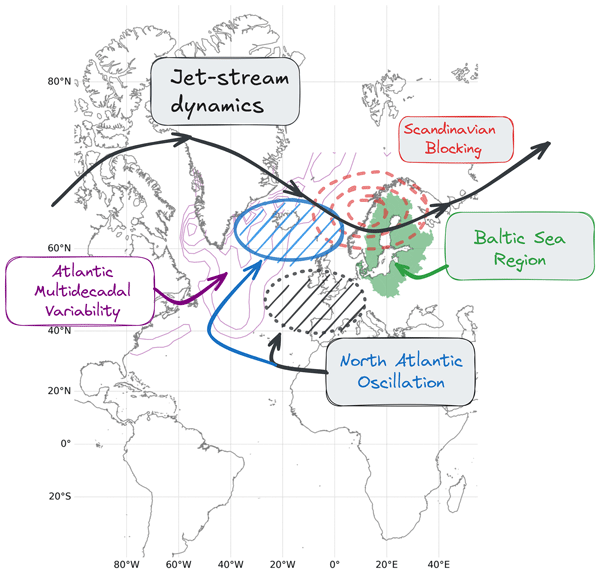
Home to more than 85 million people in its catchment area (see Fig. 1) and bordered by nine countries, the Baltic Sea faces intense anthropogenic pressures and ranks among the most socio-economically exploited and polluted marine systems in the world (Inácio et al., 2020). It is the second-largest brackish water body in the world with an average salinity of approximately 7.4 g kg−1 (Meier and Kauker, 2003). Many resident species already live close to species-specific salinity tolerance limits and are simultaneously exposed to multiple human stressors, making them highly sensitive to environmental change (e.g., HELCOM, 2023). Even small shifts in physical or biogeochemical conditions can substantially influence species abundance and growth. Superimposed onto these pressures, atmospheric variability in the Euro-Atlantic region further modulates the Baltic Sea's ecosystem across synoptic to multidecadal time scales (e.g., Kahru et al., 2020).
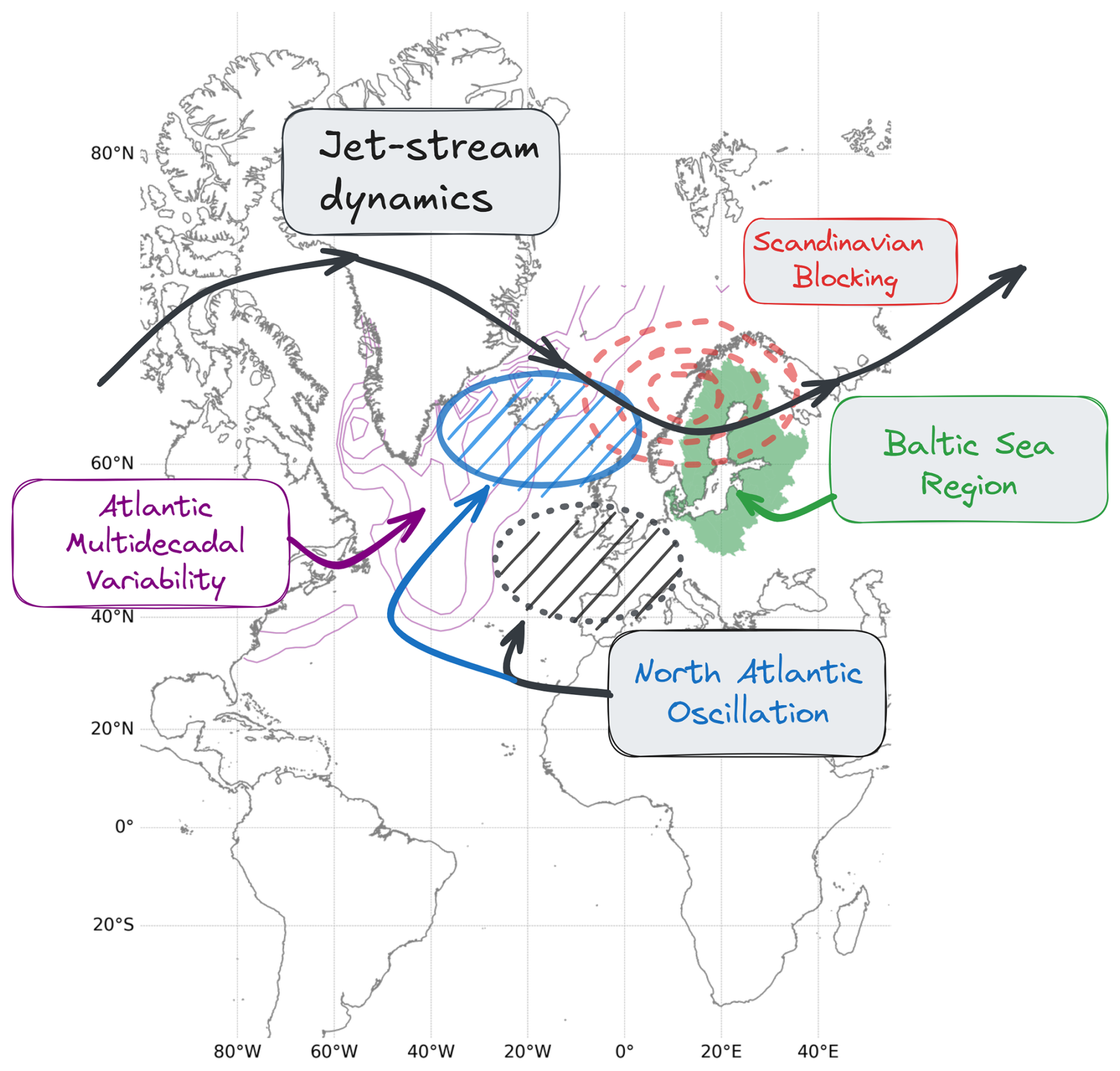
Figure 1Geographic extent of the Baltic Sea catchment (green) and schematic representation of the large-scale modes of climate variability influencing the Baltic Sea region: Atlantic Multidecadal Variability (AMV; purple), the North Atlantic Oscillation (NAO; blue/black), Scandinavian Blocking (SB; red), and jet-stream dynamics (black).
The Baltic Sea is shallow, with a mean depth of 53 m and a maximum depth of 459 m (e.g., Jakobsson et al., 2019). It is shaped by a unique topography comprising several sub-basins and is connected to the North Sea only via the narrow and shallow Danish straits, which severely restrict water exchange between the two seas (e.g., Meier et al., 2022). The result is an estuarine-like circulation with a fresher upper layer – sustained mainly by river runoff and, to a lesser extent, excess precipitation – that overlies more saline bottom waters which are renewed by intermittent saline inflows from the North Sea. This stratification suppresses vertical mixing and ventilation, increasing the vulnerability to hypoxic and eutrophic conditions.
Given this strongly stratified, weakly ventilated system, local atmospheric forcing dominates the Baltic Sea's hydrodynamic variability on short time scales. On longer time scales, however, large-scale Euro-Atlantic circulation variability shapes the statistics of that forcing, most clearly in winter, by modulating the prevalence and persistence of westerlies, cold-air outbreaks, and storm-track activity (Stigebrandt and Gustafsson, 2003). The regional climate reflects a sensitive balance between moist, relatively mild marine air from the North Atlantic and the Eurasian continental influence, resulting in transitions between maritime and subarctic conditions. Accordingly, the southern and western parts of the Baltic Sea belong to the central European mild climate zone governed by westerly winds, whereas the northern part is typically located north of the polar front with a winter climate that is cold and dry due to Arctic air outbreaks from the east (Meier et al., 2022).
Key large-scale modes influencing the Baltic Sea include the North Atlantic Oscillation (NAO; Hurrell et al., 2003), atmospheric blocking (Woollings et al., 2010a) and, on longer time scales, their interplay with the Atlantic Multidecadal Variability (AMV; Börgel et al., 2018). These modes are widely used because they can be linked to variability in the North Atlantic atmosphere (i.e., pressure and wind fields) and are associated with jet shifts. Together they explain a substantial fraction of observed variability over the Baltic Sea region (e.g., Meier and Kauker, 2003; Stockmayer and Lehmann, 2023; Kniebusch et al., 2019a; Börgel et al., 2020). Changes in the jet's position and strength shape storm-track activity and thereby influence regional atmospheric forcing over the Baltic Sea including the frequency and persistence of local circulation states. For example, Lehmann et al. (2002) relate the large-scale NAO to a Baltic Sea pressure-gradient pattern (their Baltic Sea Index) that co-varies with Baltic Sea filling level and exchange through the Danish Straits, illustrating how remote modes project onto the local forcing that directly drives Baltic Sea dynamics.
Together with high anthropogenic pressure (e.g., human-induced warming and nutrient inputs) and complex interactions among physical and biogeochemical processes across multiple spatiotemporal scales, variability in large-scale atmospheric circulation and the local atmospheric forcing contribute to the deterioration of the Baltic Sea's water quality (Jokinen et al., 2018; Meier et al., 2019; Krapf et al., 2022; Meier et al., 2022; Müller-Karulis et al., 2024; Ehrnsten et al., 2025). While episodic large saltwater inflows from the North Sea (so-called “Major Baltic Inflows”; MBIs) can temporarily oxygenate bottom waters (e.g., Moros et al., 2024), anoxia intensified in the deep basins of the central Baltic Sea during the 20th century, driven by increased anthropogenic nutrient loads and subsequent eutrophication. Since the 1980s, when nutrient levels were at their peak, anoxia has become largely permanent (e.g., Gustafsson et al., 2012; Carstensen et al., 2014; Meier et al., 2012, 2019; Papadomanolaki et al., 2018; Carstensen and Conley, 2019; Liblik et al., 2025). Despite substantial efforts to reduce nutrient inputs since the 1980s, the Baltic Sea has shown little improvement in its eutrophication status, and deep-water oxygen conditions have continued to deteriorate (Gustafsson et al., 2012; Almroth-Rosell et al., 2021; Hansson et al., 2020; Krapf et al., 2022).
Large-scale Euro-Atlantic circulation variability has been shown to impact the Baltic Sea ecosystem by modulating the statistics of local forcing (e.g., Hänninen et al., 2000; Dippner et al., 2019; Gröger et al., 2024b). However, the effects vary regionally as coastal and sub-basin dynamics respond differently to changes in local forcing (e.g., winds, heat fluxes, freshwater input, or vertical mixing) (Eremina et al., 2012; Lehtoranta et al., 2017; Dietze and Löptien, 2021; Gröger et al., 2021a; Stoicescu et al., 2022; Löptien and Dietze, 2022; Polyakov et al., 2023; Dabulevičienè and Servaitè, 2024). In the Baltic Sea, such differences can emerge as changes in coastal upwelling and cross-shore transport, shifts in riverine freshwater and nutrient supply, or altered stratification, deep-water ventilation, and oxygen depletion in the central basins. Disentangling these sources of internal variability from anthropogenic trends is therefore essential for understanding how regional biogeochemistry is linked to large-scale circulation variability. This review represents a first attempt to synthesize these links for the Baltic Sea region, identify key knowledge gaps, and clarify how large-scale circulation patterns and their variability influence both physical processes in the Baltic Sea and biogeochemical responses. Improved understanding of these links may also support future advances in predictability, although this prospect is currently much more developed for physical variables than for biogeochemical processes.
Despite being one of the most thoroughly studied basins in the world with exceptionally long-term observations, direct empirical evidence from field studies that link large-scale atmospheric and oceanic patterns to Baltic Sea variability is rare, and many implications remain theoretical, especially for biogeochemistry.
This review synthesizes current understanding of how large-scale atmospheric Euro-Atlantic circulation variability relates to local forcing over the Baltic Sea region (here defined as the Baltic Sea and its surrounding catchment area; Fig. 1) across time scales ranging from synoptic to multidecadal. It also examines how the resulting hydrodynamic variability is linked to oxygen dynamics, primary productivity and ocean acidification. We focus specifically on the recent evolution of the Baltic Sea, during which anthropogenic climate change has become the dominant long-term external driver. Against this background, we examine how variability in Euro-Atlantic circulation patterns governs local forcing over the region and critically assess how these large-scale atmospheric influences interact with ongoing climate change.
2.1 Atmospheric features originating in the North Atlantic and impacting the Baltic Sea region
2.1.1 North Atlantic Jet Stream, Baroclinicity and Planetary Waves
The dynamics of the tropospheric polar jet stream are a key control of weather and climate in the mid-latitudes. These dynamics arise from the interplay of baroclinic instability and large-scale wave patterns known as Rossby waves (Achatz, 2022; Lindzen, 1990). To zeroth order, these components are driven by meridional temperature gradients, the thermal wind relation and the Earth's rotation. In the North Atlantic region, the polar jet is often referred to as the North Atlantic jet.
The North Atlantic jet influences regional weather across Europe and the Baltic Sea region by modulating pressure systems, temperature advection, cloud cover, radiative processes and precipitation patterns (Woollings et al., 2010a, 2014; Hallam et al., 2022). More specifically, jet variability in the North Atlantic can be organized by time scale. On synoptic time scales, it primarily reflects baroclinic wave growth and downstream development that is tightly coupled with the storm track. On longer intraseasonal time scales, the dominant variability is captured by persistent flow patterns (weather regimes) (Vautard, 1990; Cassou et al., 2004; Cassou, 2008; Grams et al., 2017; Falkena et al., 2020). On seasonal to interannual scales, anomalies in the jet latitude and strength project onto canonical modes of climate variability such as the NAO or the East Atlantic pattern (Hurrell, 1995; Barnston and Livezey, 1987a; Woollings et al., 2010b; Woollings and Blackburn, 2012; Woollings et al., 2015; Perez et al., 2024). On decadal and longer time scales, coupled ocean-atmosphere variability in the North Atlantic can modulate the jet and storm track, providing a pathway for low-frequency variability to influence Northern Europe and the Baltic Sea region (O'Reilly et al., 2017; Simpson et al., 2019; Athanasiadis et al., 2020; Ruggieri et al., 2021; Börgel et al., 2020).
It should be noted that several localized processes further modulate this large-scale circulation and form the basis for typical synoptic-scale weather phenomena and dominant modes of climate variability affecting the Baltic Sea region. Factors such as orography, seasonal snow, ice cover, radiative processes, ocean heat transport and differences between land and ocean surfaces all contribute to a distinct thermal structure that drives a seasonal cycle. As a consequence, the jet stream follows a seasonally varying pattern with locally modified characteristics (Hallam et al., 2022; Woollings et al., 2010a).
Because the jet's latitude and strength vary seasonally, upstream Pacific circulation anomalies (Harnik, 2014; Messori et al., 2016; Franzke et al., 2004) as well as the state of the North Atlantic Ocean (Ruggieri et al., 2021), affect the jet differently in different seasons. Consequently, their downstream impacts over Europe and the Baltic Sea region are also season-dependent (Woollings et al., 2010a, 2014; Simpson et al., 2019; Börgel et al., 2020; Messori et al., 2022; Strommen et al., 2023; Ruggieri et al., 2021).
Changes in the structure, latitude and strength of the North Atlantic jet not only drive extreme weather in the mid-latitudes, such as heat waves, cold-air outbreaks and droughts, but also regulate moisture and precipitation (Gimeno, 2014). Close to 90 % of the poleward moisture transport occurs within atmospheric rivers (Gimeno et al., 2016; Gimeno, 2014), long, narrow corridors in the atmosphere characterized by strong horizontal water vapor transport. Atmospheric rivers are typically in the warm conveyor belt ahead of extratropical cyclones. By influencing cyclone growth and storm tracks, the North Atlantic jet sets the preferred corridors and landfall latitudes. Accordingly, atmospheric river occurrence, intensity and associated precipitation patterns over the Baltic Sea region are sensitive to shifts in the North Atlantic jet as well.
Pattern-based dimensionality reduction approaches are commonly used to assess this complexity, including canonical large-scale circulation patterns such as the NAO (Hurrell, 1995) or the Euro-Atlantic weather regimes (Vautard, 1990), which collapse jet and storm-track variability, Rossby-wave dynamics, and related regional modulation into a small number of reference states and display a systematic connection to jet characteristics (Madonna et al., 2017). These approaches provide an interpretable link between large-scale atmospheric circulation and its regional importance in the Baltic Sea region and allow a more detailed description of the local dynamics by describing their patterns and statistical properties. They are less suited to describe phenomena that are controlled by specific synoptic sequences rather than low-dimensional modes, such as MBIs, which depend on particular wind and pressure patterns (e.g., Matthäus and Franck, 1992).
2.1.2 Blocking patterns in the mid-latitudes
An atmospheric block is a long-lasting (days to a few weeks) weather pattern that occurs when persistent and quasi-stationary highs hinder the climatological westerly winds in the mid-latitudes (Liu, 1994). Dynamically, blocking is closely tied to the jet-stream and Rossby wave variability discussed in the previous section, as it reflects amplified planetary-wave patterns and is often accompanied by wave breaking and a deformation or splitting of the jet. This commonly leads to a deflected and strong zonal flow north and south of the blocking system (Michel et al., 2023) and prevents the usual progression of synoptic weather systems across large areas (Rex, 1950; Steinfeld et al., 2022). Blocking systems typically extend vertically across the whole troposphere and are associated with large high pressure systems at the surface. As a consequence of their tight coupling to the background flow, changes in the large-scale circulation states (and modes of climate variability) can modulate blocking statistics by shifting the jet and storm track and therefore also the region of dominant wave amplification and breaking.
In the mid-latitudes, blocking is frequently associated with extreme weather conditions, including heat waves (Pfahl and Wernli, 2012; Schielicke and Pfahl, 2022; Röthlisberger and Papritz, 2023b), cold spells (Buehler et al., 2011; Brunner et al., 2017; Röthlisberger and Papritz, 2023a), heavy rainfall (Lenggenhager and Martius, 2020) and compound weather events (Kautz et al., 2022). The type of extreme event also depends on the exact location of the blocking pattern. Moreover, a single blocking event can cause different surface extremes at different locations (Fig. 2). In general, blocking events are 7–10 d long and the most extreme events last 2–3 weeks. However, the societal relevance of these events is not solely defined by their persistence but also by the number of total blocking days and their seasonality (Brunner et al., 2018; Schaller et al., 2018; Kautz et al., 2022).
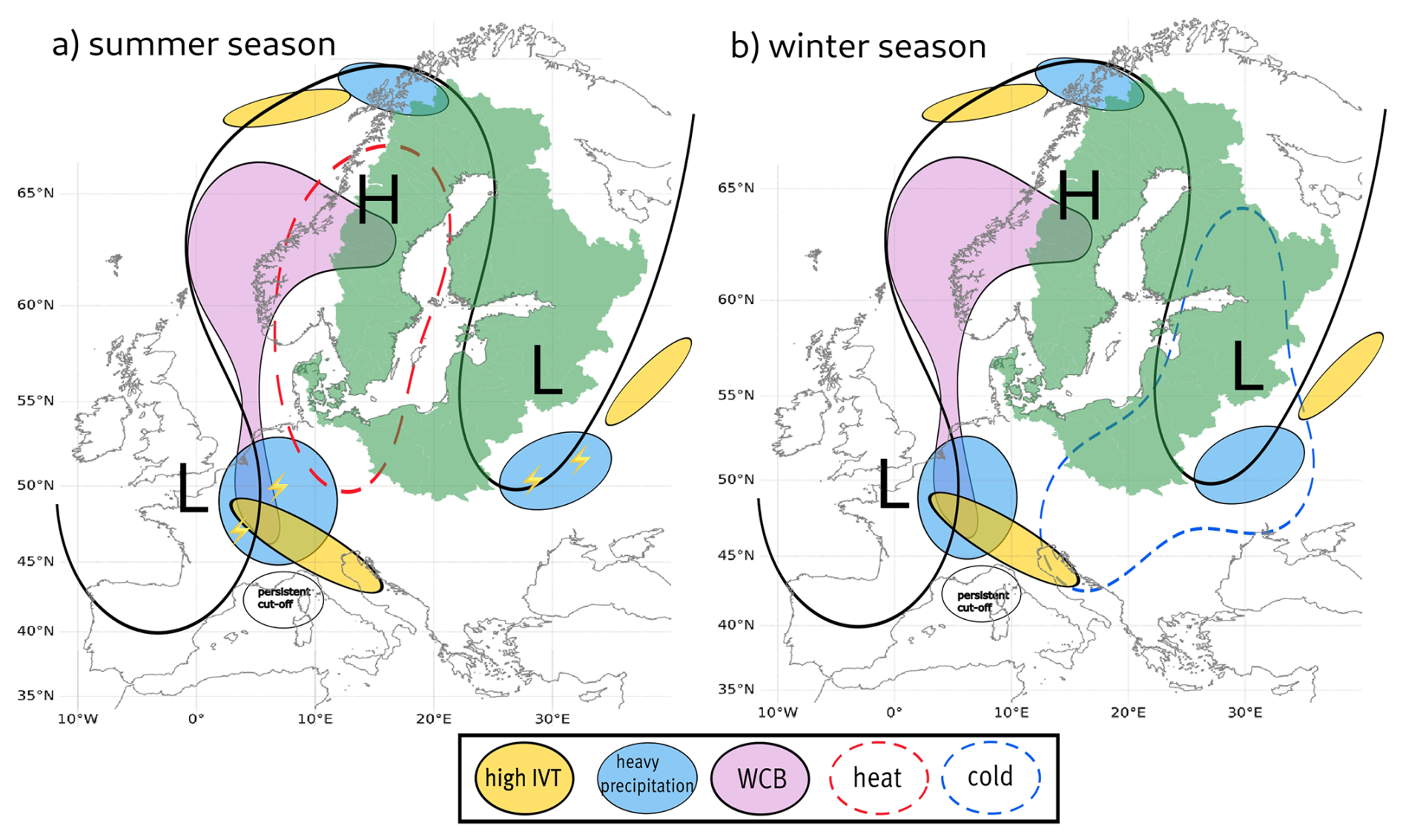
Figure 2Schematic illustration of the omega pattern (i.e., a blocking system) over the Baltic Sea region (black line, indicating a geopotential height or PV contour) and some associated surface extremes during (a) the warm season and (b) the cold season. Rossby wave breaking occurs on the flanks of the block, leading to (persistent) cutoff systems in this area. Areas with heavy precipitation are marked in light blue (poleward edge of the ridge and at both flanks). Areas with high integrated water vapor transport (IVT) are illustrated in orange. Thunderstorm activity is marked by yellow lightning bolt symbols. The position of a warm conveyor belt (WCB) appears in purple. Areas with temperature extremes are marked with dashed lines (red for heat waves and blue for cold spells) (after Kautz et al., 2022).
Figure 2 illustrates the potential extreme surface weather conditions in the Baltic Sea region associated with the Omega pattern: a blocking high with two cutoff lows on either side, with a high-pressure system squeezed in between. Panels (a) and (b) separate the impacts between the cold season (October to March) and the warm season (April to September), respectively. During the colder months, the eastern side of the blocking system may exhibit low-temperature anomalies. In contrast, the warmer months are prone to heat waves beneath the blocking system, occasionally coinciding with drought conditions. Additionally, the probability of thunderstorms increases at both the eastern and western flanks of the blocking system. Regardless of the season, heavy rainfall events – potentially leading to floods and associated with high integrated water vapor concentrations – are observed at the edges and near the poleward boundary of the blocking ridge.
2.2 Natural variability from synoptic to multidecadal time scales
Natural variability refers to climatic fluctuations that occur without any human influence, that is, internal variability (i.e. chaotically generated within the system) in isolation or in combination with natural external forcings such as volcanic eruptions or changes in solar activity (Arias et al., 2021). The natural variability of the North Atlantic climate system affects the Baltic Sea region across multiple temporal and spatial scales, ranging from individual extreme events such as storms and heat waves (Gröger et al., 2015, 2021b; Dutheil et al., 2023; Safonova et al., 2024) to multi-decadal shifts in precipitation intensity (Börgel et al., 2022). The impacts on society span various sectors, for instance affecting energy production, agriculture, forestry, traffic, biodiversity, fisheries, maritime activities and the livelihood of coastal communities (HELCOM, 2023). This section focuses on linking our current knowledge of natural variability and its impact at different time scales, unfolding from days to decades. More specifically, we address synoptic (1–7 d), intraseasonal (10–90 d), seasonal (1 year), interannual (1 to 9 years), decadal and multidecadal (10 years and longer) time scales.
In this review, we distinguish between different statistical methods to describe large-scale circulation patterns, such as the NAO derived from EOF-based analyses of sea-level pressure or geopotential-height anomalies, or weather regimes, which describe recurrent, quasi-stationary circulation patterns diagnosed from clustering methods on daily to sub-seasonal time scales. While these frameworks are related, weather regimes often project onto leading modes, and are not interchangeable.
2.2.1 Synoptic, intraseasonal and seasonal time scales
Atmospheric circulation variability over the Baltic Sea region spans a broad range of time scales, from synoptic to multidecadal, and reflects the interplay of atmospheric, oceanic, and terrestrial factors. At shorter time scales, departures from the climatological reference state often take the form of large-scale geopotential height anomalies that persist from several days to about two weeks (Kautz et al., 2022).
These recurrent disturbances are modulated by variations in the Euro-Atlantic atmospheric circulation and are well classified by the Euro-Atlantic weather regimes (Vautard, 1990; Falkena et al., 2020; Cassou et al., 2004). At their core, weather regimes represent a statistical description of persistent and recurrent circulation patterns, similar to attractors in non-linear dynamical systems (Corti et al., 1999; Palmer, 1999) that can be described in terms of their quasi-stationarity and frequency of occurrence. The regimes are identified objectively from daily large-scale circulation anomalies over the Euro-Atlantic sector: the seasonal cycle is removed and anomaly fields are normalized by their standard deviation, dimensionality is reduced using the leading EOFs (principal components), and k-means clustering is applied in this reduced phase space. This yields a daily sequence of regime occurrence, with some days assigned to one of the recurrent regimes and others classified as transition or “no regime” days (Grams et al., 2017). The regimes affect the Baltic Sea region by shaping the synoptic-scale pressure gradient over Northern Europe. They are closely linked to jet-stream variability and the associated characteristic flow patterns (Madonna et al., 2017). As a result, they modulate the prevalence and intensity of westerly flow into the Baltic Sea catchment versus blocking situations, as well as the position and strength of the storm tracks affecting the region.
Traditionally, the canonical Euro-Atlantic weather-regime classification refers to the four recurrent large-scale circulation regimes most robustly identified in boreal winter (Vautard, 1990; Cassou, 2008; Barrier et al., 2014; Falkena et al., 2020). In this manuscript, weather regimes refer to statistically identified, recurrent large-scale circulation states, rather than to individual synoptic weather patterns. The Zonal and Greenland-Blocking regimes are often described as NAO-like, in the sense that they project strongly onto the positive and negative phases of the NAO, respectively. Hence, the Zonal pattern (NAO+) corresponds to a central North Atlantic jet which brings mild and wet air masses as well as Atlantic cyclones into Northern Europe (Gómara et al., 2014). In contrast, Greenland Blocking (NAO-) represents a more southerly jet position, weakening the westerlies, favoring colder, drier conditions. The Atlantic Ridge describes a high pressure system over the Atlantic with a northward shift of the jet, leading to stable weather and potentially blocking the eastward progression of wet and windy conditions. The Scandinavian Blocking is a high pressure system over Scandinavia featuring a jet structure that tilts from southwest to northeast (Fig. 3).
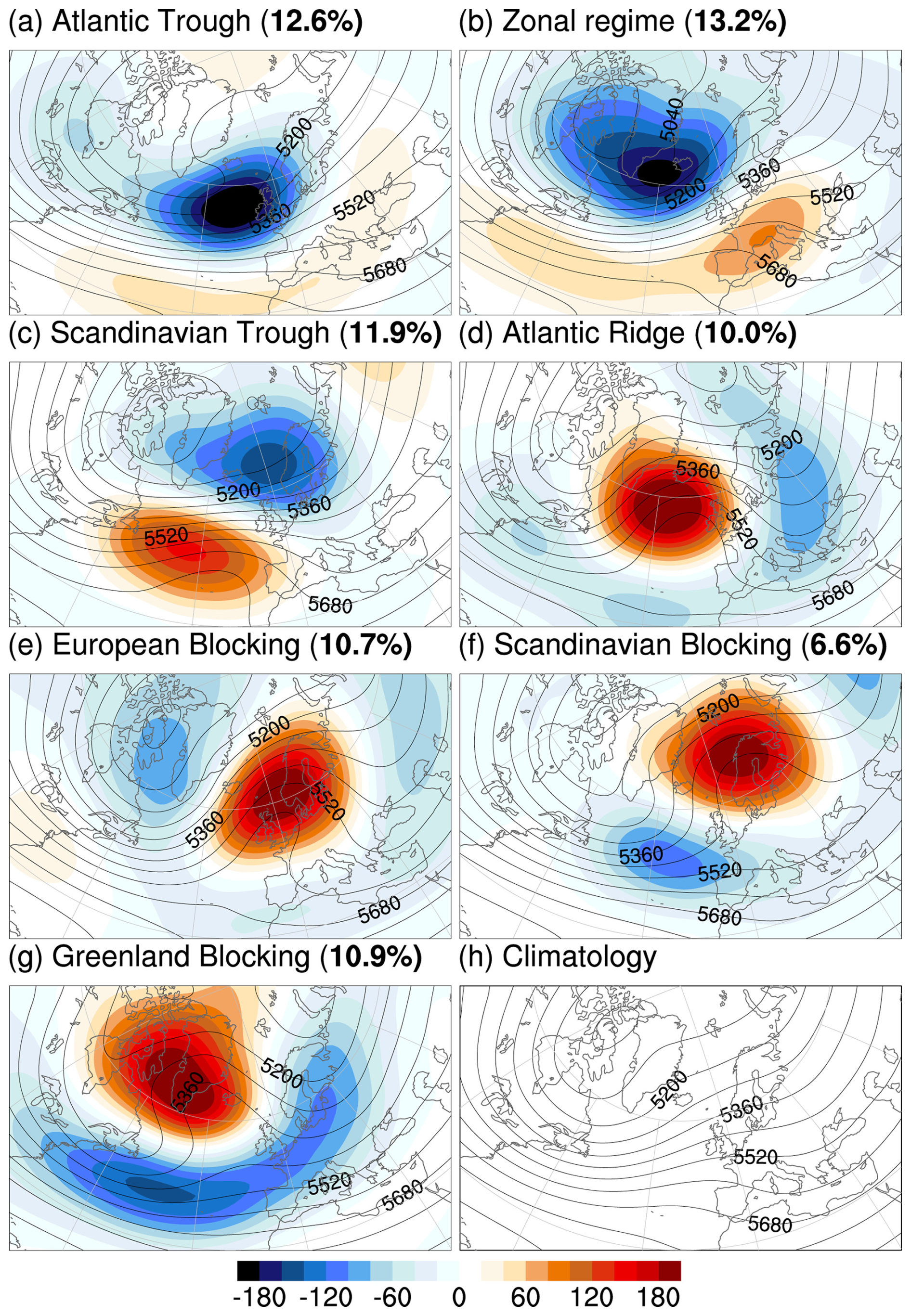
Figure 3Atlantic-European weather regimes in winter and their relative frequency of occurrence (in percent). (a–g) 500 hPa geopotential height mean composites (contours, every 80 geopotential meters (gpm)) and their anomalies (shading, every 20 gpm) with respect to the seasonal climatology (h) during active regime life cycles (the onset to decay period) in December, January, February of 1979–2019. The weather regimes considered are: (a) Atlantic Trough, (b) Zonal Regime (NAO+), (c) Scandinavian Trough, (d) Atlantic Ridge, (e) European Blocking, (f) Scandinavian Blocking, (g) Greenland Blocking (NAO-). Numbers in the subfigure titles indicate the frequencies of winter days attributed to the respective regime (a–g). The frequency of “no regime” days is 24.1 % (Hochman et al., 2021, their Fig. 1).
A year-round classification adds three more regimes (Fig. 3): the Scandinavian Trough, a low pressure system over Scandinavia, the Atlantic Trough, associated with a low pressure system over the North Atlantic, and European Blocking, marked by a high pressure system over western Europe that blocks the North Atlantic jet (Grams et al., 2017). In total, the seven weather regimes represent different types of zonal regimes (Atlantic Trough, Zonal, and Scandinavian Trough), responsible for the advection of warm (or cold) air masses from the North Atlantic region into the Baltic Sea region, as well as four regional blocking regimes (Atlantic Ridge, European Blocking, Scandinavian Blocking, and Greenland Blocking).
Depending on the season, zonal regimes are associated with wet and cool (warm) conditions in northern Europe during summer (winter). In contrast, the blocked regimes interrupt the mean flow and are often associated with hot and dry spells during summer and cold spells on their eastern flank during winter (Grams et al., 2017; Beerli and Grams, 2019; Domeisen, 2019; Mockert et al., 2023; Teubler et al., 2023).
The seven regimes (Fig. 3) occur with a similar frequency but have strong seasonal preferences. Zonal regimes (i.e. Atlantic Trough, Zonal/NAO+ and Scandinavian Trough) are more common in winter (November–March), with Zonal being particularly frequent. Summer (May–September) is dominated by blocked regimes (i.e. Atlantic Ridge, European Blocking, Scandinavian Blocking and Greenland Blocking), with Scandinavian Blocking occurring most often. Atlantic Trough occurs year round and European Blocking is the leading winter blocking pattern, while Scandinavian Blocking dominates summer (Grams et al., 2017).
Seasonal circulation variability over the Baltic Sea region differs markedly between winter and summer. Winter is dominated by zonal (NAO-like) patterns, enhanced baroclinicity and high internal variability. The latter is often weaker, with a poleward-shifted jet and a more barotropic background. Thermodynamic processes such as land-sea contrasts, soil-moisture feedbacks, and diabatic heating then play a larger role in shaping circulation variability and extremes (Jakobson and Jakobson, 2024; Liné et al., 2024; Gröger et al., 2024b; Dutheil et al., 2023). This suggests that large-scale atmospheric circulation variability exerts a stronger control on the Baltic Sea region in winter than in summer.
2.2.2 Interannual time scales
Interannual variability can be understood through the lens of the jet stream. Specifically, anomalies in the location and intensity of the jet stream during the winter season drive climate variability that can explain much of the observed interannual variability (Harnik, 2014). Good examples are the winters of 2009/10 and 2011/12 (Fig. 4), which exhibited opposite jet regimes: the former displayed an anomalously southerly, zonal jet, while the latter displayed an anomalously northerly jet (Santos et al., 2013). The first led to an anomalously cold winter in the Baltic Sea region, while the second led to an unusually warm winter.
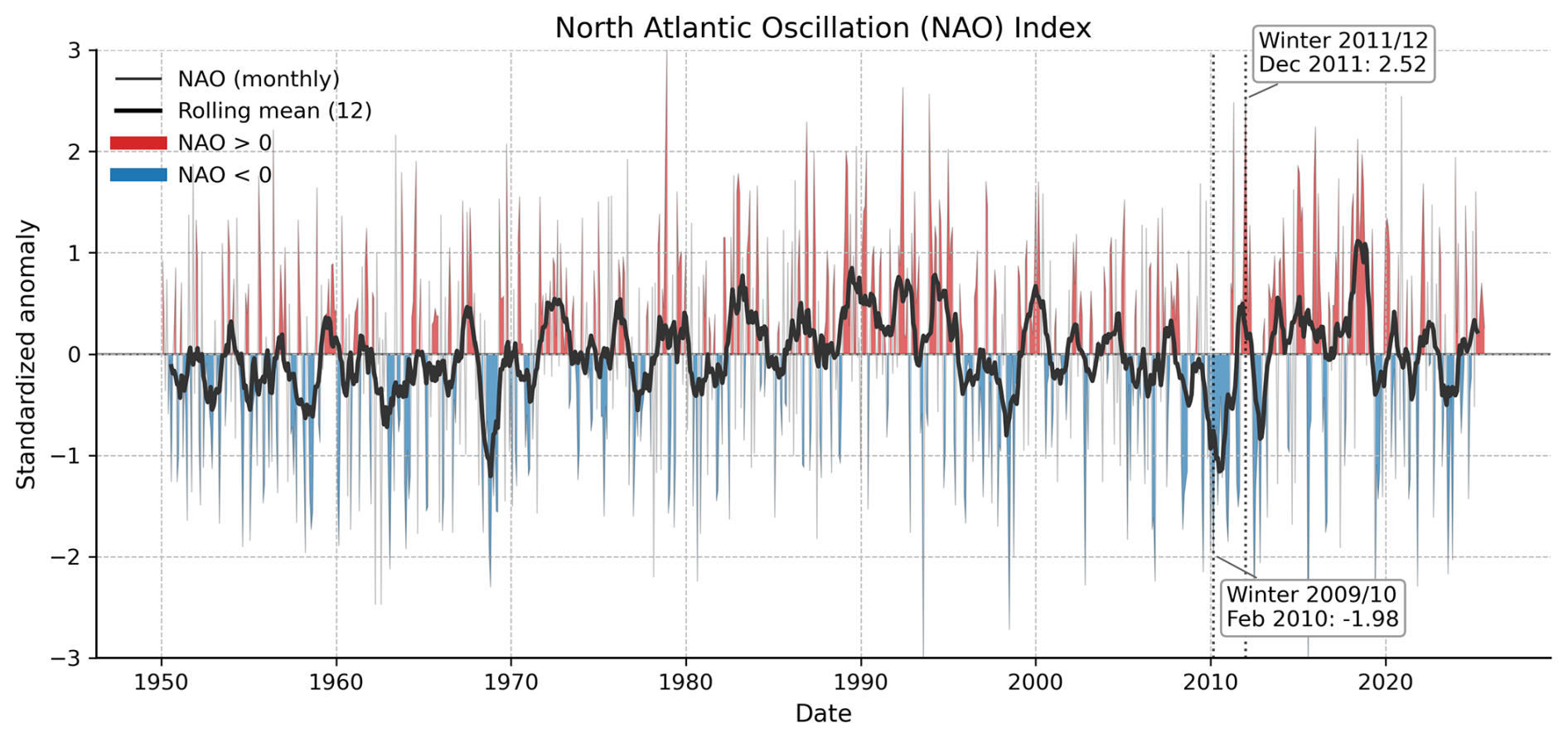
Figure 4North Atlantic Oscillation (NAO) index, monthly values (thin gray) with 12 month centered running mean (thick black). Months with NAO>0 are shaded red; NAO<0 are shaded blue. Vertical dashed lines mark winters 2009/10 and 2011/12. Data: NOAA CPC monthly standardized NAO (z500-based).
The NAO reflects a leading mode of observed interannual wintertime variability in North Atlantic-European atmospheric circulation and is tightly coupled to the zonal jet. Notably, both the intensity (NAO+ or NAO-; Fig. 4) and the geographic positioning of the NAO centers of action vary substantially year-to-year (Hilmer and Jung, 2000; Hurrell and Deser, 2009; Peterson et al., 2002, 2003; Luo and Gong, 2006; Luo et al., 2010a, b; Börgel et al., 2020). These spatial shifts of the NAO modify how strongly the NAO affects the Baltic Sea region, as changes in the pressure gradient orientation alter prevailing wind patterns (Lehmann et al., 2011; Börgel et al., 2020). This dynamic is likely linked to the interaction between the NAO and the jet stream (Woollings et al., 2015), which due to the zonal shift of the Icelandic Low aligns the westerly winds directly toward the Baltic Sea.
To relate this interannual perspective to the synoptic-to-intraseasonal weather-regime framework introduced above, we compare the characteristic circulation patterns associated with the main interannual climate-variability indices to the circulation patterns of the weather regimes. The positive East Atlantic pattern (Barnston and Livezey, 1987a) corresponds to a quasi-stationary ridge over the North Atlantic aligning with the Atlantic Ridge regime, while the negative East Atlantic pattern corresponds to the Atlantic Trough (Carvalho-Oliveira et al., 2024). Together with the NAO, the East Atlantic pattern can be used as a combined framework describing both climatological changes and interannual and multidecadal variability in the North Atlantic jet (Woollings et al., 2010b; Woollings and Blackburn, 2012; Perez et al., 2024). However, the NAO primarily describes shifts in the jet latitude, which tends to be more relevant for interannual time scales (Woollings et al., 2015). For the Baltic Sea region, this distinction implies that NAO-driven jet-latitude shifts dominate year-to-year variability in winter temperature, sea-ice and storminess, whereas changes linked with the East Atlantic pattern modulate multidecadal variability.
While the positive phase of the Scandinavian pattern (e.g., Kauker and Meier, 2003) resembles Scandinavian Blocking, its negative phase aligns with the Scandinavian Trough. After the NAO and East Atlantic pattern, it is the third most important winter sea level pressure pattern over the North Atlantic domain (Comas-Bru and McDermott, 2014) and in the Baltic Sea region, specifically, it is considered the second most important pattern (Kauker and Meier, 2003).
Since the Scandinavian pattern resembles the positive Scandinavian Blocking regime (Comas-Bru and McDermott, 2014), the question arises how it might be connected to the interannual variability of blocking occurrences. According to Bueh and Nakamura (2007), the anticyclonic center of the Scandinavian pattern lies in a region where the potential vorticity gradients are generally very low during the winter months, possibly favoring the development of a block. However, Rimbu et al. (2014) found that the dominant winter blocking patterns are connected to different large-scale circulation patterns, the Scandinavian pattern only being one of them. This could be different in the summer season where Scandinavian Blocking occurs more often. However, studies on summer modes of interannual variability are still scarce.
In summary, these interannual modes systematically alter the direction and strength of the flow over Northern Europe/Scandinavia, modulating winter advection, storminess, temperature, and sea-ice. Multiple other interannual circulation patterns in the Euro-Atlantic sector have been identified, for example the East Atlantic/West Russia pattern (Barnston and Livezey, 1987a; Kauker and Meier, 2003; Craig and Allan, 2022) or the Barents Sea Oscillation (Skeie, 2000; Tremblay, 2001). They all represent a statistical description of characteristic jet features. However, there is little literature specifically addressing their role in modulating the climate of the Baltic Sea region on interannual time scales.
2.2.3 Decadal and multidecadal time scales
On decadal time scales, atmospheric variability in Northern Europe is modulated by an interplay of the aforementioned atmospheric modes with the North Atlantic Ocean, shaping the statistics of local climate in the Baltic Sea region. The ocean's memory, especially through the Atlantic Meridional Overturning Circulation (AMOC), drives much of this decadal variability as it transports heat into higher latitudes, altering sea surface temperature (SST) patterns (e.g., Latif et al., 2022).
One central component of this variability is the AMV, which refers to basin-wide fluctuations in the North Atlantic SSTs over multidecadal periods (e.g., Enfield et al., 2001; Knight et al., 2006). The main driver of these fluctuations is likely a combination of internal variability that is coupled to AMOC variability (Robson et al., 2023; Wills et al., 2019; Deser and Phillips, 2021) and a response to external forcing (Mann et al., 2021). For the Baltic Sea region, large ensembles of global climate simulations suggest that the response to external forcing is more relevant than internal variability (Barghorn et al., 2025a).
Sea surface temperature anomalies that are advected along the North Atlantic current influence temperature variations in the Norwegian Sea (Langehaug et al., 2022; Fan et al., 2023) and over Norway (Årthun et al., 2017). These anomalies can often be traced back to oceanic advection of signals from the North Atlantic subpolar gyre (SPG) (Fan et al., 2023), which is one of the most predictable regions in the world on decadal to multidecadal time scales (Yeager and Robson, 2017; Borchert et al., 2021). This connection indicates a potential for successful near-term predictions of decadal climate variability in the Baltic Sea region.
Multidecadal SST variations in the North Atlantic have been shown to alter the atmospheric circulation in the North Atlantic and climate variability across Europe (Dong et al., 2013; Delworth and Zeng, 2016; Ruprich-Robert et al., 2017; Smith et al., 2020; O'Reilly et al., 2017; Ruggieri et al., 2021; O'Reilly et al., 2023) with further impacts on the Nordic Seas (Årthun et al., 2017; Koul et al., 2019; Fan et al., 2023) and the Baltic Sea (Börgel et al., 2018, 2020, 2022, 2023a; Barghorn et al., 2025a; Meier et al., 2023; Kniebusch et al., 2019b). One example of this influence is the modulation of a subpolar wave train, a large-scale atmospheric pattern that responds to SST anomalies and projects onto the European climate (Borchert et al., 2019; Monerie et al., 2021). This wave train is often centered over Northern Europe and transports oceanic signals from the North Atlantic into the Baltic Sea region.
Similar to the interannual time scale, in Northern Europe, decadal atmospheric variability in wintertime over the North Atlantic is dominated by the NAO (e.g., Paolini et al., 2022; Patrizio et al., 2023). More specifically, the decadal to multidecadal SST anomalies, linked to the AMV, influence both the position and strength of the NAO (Börgel et al., 2020) and the jet stream (Ruggieri et al., 2021; Athanasiadis et al., 2020). Hence, during wintertime, the AMV influences the advection of air masses from the North Atlantic, weakening the westerlies during its positive states. Negative AMV states are associated with increased westerlies, transporting moist air masses into the Baltic Sea region (Börgel et al., 2022). This coupling between the ocean and the atmosphere has been linked to the relative importance of the NAO for the Baltic Sea region (Omstedt and Chen, 2001) on multidecadal time scales (Börgel et al., 2020). During summer, subtropical North Atlantic SSTs excite an atmospheric Rossby wave which connects to decadal surface air temperature fluctuations in Europe, with an imprint on the Baltic Sea region (e.g., Müller et al., 2020).
On decadal to multidecadal time scales, the relevance of modes of climate variability such as the NAO arises from changes in the frequency and persistence of large-scale circulation states and from their coupling to slowly varying boundary conditions, especially North Atlantic SSTs and ocean circulation, rather than from direct analogies with individual synoptic systems (Müller et al., 2020). For example, besides its interplay with the AMV, one key feedback loop involves the NAO and the North Atlantic SST tripole pattern (Deser et al., 2010). The direction of this interaction is still under debate with studies illustrating an SST influence on the NAO (Rodwell et al., 1999; Reintges et al., 2017) and some showing NAO influence on SST (Athanasiadis et al., 2020). It was also shown that the location of the Gulf Stream front may imprint onto NAO on these time scales (Joyce et al., 2000). Recent research proposes a negative feedback loop: NAO-induced SST anomalies affect the AMOC, which in turn alters the SSTs which influence the NAO in the opposite direction (Patrizio et al., 2025). Some studies also indicate that a vertical component in the atmosphere is included in this feedback loop (Omrani et al., 2022). This feedback loop acts on decadal-to-multidecadal time scales and may give rise to important variability in Northern Europe as well (Börgel et al., 2020).
In this context, the representation of coupled North Atlantic ocean-atmosphere variability in global climate models has recently been questioned. In particular, Carvalho-Oliveira et al. (2024) showed that the observed link between spring North Atlantic SST variability and summer Euro-Atlantic circulation is temporally non-stationary and is generally not reproduced, or is too weakly reproduced, in the evaluated global model. More broadly, persistent deficiencies in the simulation of Euro-Atlantic jet and regime dynamics, including blocking, further limit the realism of atmosphere-ocean coupling pathways in models. This is also relevant for the Baltic Sea region, because many regional Baltic Sea models are still forced by prescribed atmospheric boundary conditions and therefore inherit biases in the large-scale circulation from their driving models.
Freshwater anomalies in the subpolar North Atlantic (SPG) may also influence European, and potentially Baltic Sea, climate through downstream circulation anomalies. Oltmanns et al. (2024) linked such anomalies – likely related to anomalous Arctic/sub-Arctic runoff and meltwater input – to a sharper winter SST front between the subpolar and subtropical North Atlantic and to associated large-scale atmospheric circulation anomalies. Overall, these hydrographic anomalies, modulated by SPG variability, contribute to multiyear predictability in both oceanic and atmospheric conditions (Koul et al., 2019; Holliday et al., 2020; Fan et al., 2023; Oltmanns et al., 2024).
Longer-range teleconnections which can modulate the North Atlantic climate, particularly from the Indian and Pacific Oceans, add further complexity to European climate variability (Cassou, 2008; Fletcher and Cassou, 2015; Ferster et al., 2023). One notable mode of Pacific variability is the Pacific Decadal Oscillation (PDO), the leading mode of North Pacific SST variability (EOF1 of SSTs over 20–70° N) (Mantua et al., 1997; Newman et al., 2016). While direct studies on the PDO's influence on the Baltic climate remain limited, its impact on the region is often mediated through its interactions with other modes of climate variability such as the NAO, El Niño-Southern Oscillation (ENSO) and Arctic sea ice variability. For instance, Simon et al. (2022) report PDO-related anomalies over the Baltic region, though they emphasize its modulation of broader sea ice effects. Additionally, the PDO has been shown to modulate ENSO's influence on the North Atlantic (Wang et al., 2014; Karami et al., 2023), further underscoring its indirect role in shaping atmospheric circulation patterns that can affect Northern Europe. This is because PDO-related shifts in the Aleutian Low and North Pacific jet reshape the North Pacific waveguide, steering ENSO-forced Rossby waves and altering their downstream projection into the North Atlantic (Maher et al., 2022). More broadly, such extratropical teleconnections are dependent on the climatological background flow (O'Reilly et al., 2019). This interconnectedness highlights the PDO's potential contribution to (multi)decadal variability in European climate.
2.3 Large-scale atmosphere–ocean controls on regional climate variability
The climate of the Baltic Sea region can be perceived as an interplay between the aforementioned large-scale circulation variability and regional features. In particular, one should recall the unique bathymetry of the Baltic Sea (see Fig. 5) which is characterized by a shallow mean depth, a suite of sub-basins and narrow and shallow connections to the open ocean.
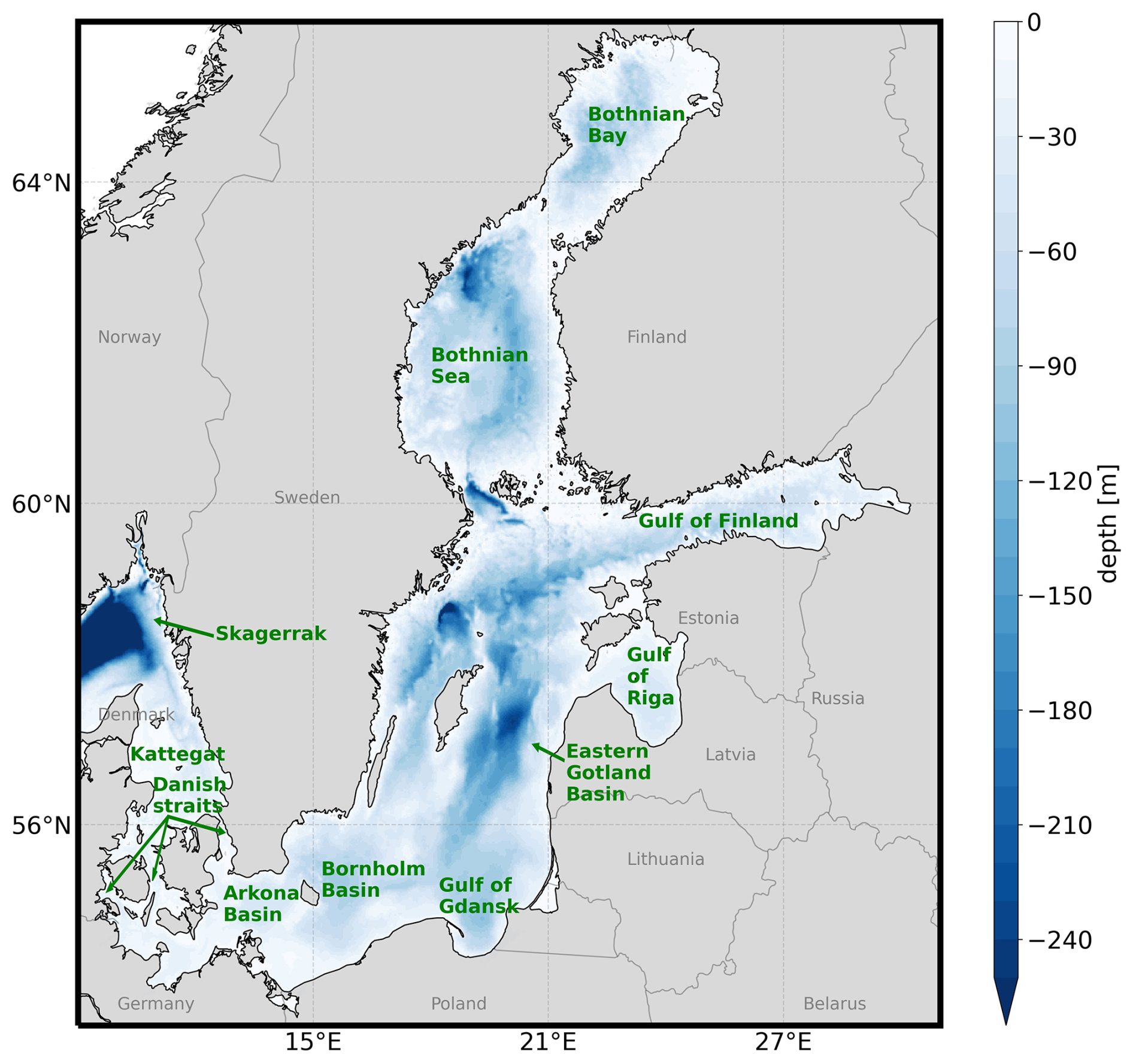
Figure 5Bathymetry of the Baltic Sea with labels indicating major sub-basins.
In this section, we describe the impacts of the large-scale atmosphere-ocean patterns on the natural variability of regional processes in the Baltic Sea, without assessing the effect of anthropogenic climate change.
2.3.1 Precipitation
Precipitation in the Baltic Sea region varies across time scales, with different mechanisms dominating at each scale. The best-established link is for wintertime variability, when large-scale North Atlantic circulation exerts a strong control on moisture transport and cyclone pathways into Northern Europe. On synoptic and intraseasonal time scales, precipitation anomalies are primarily associated with variations in the latitude and strength of the North Atlantic jet and the resulting shifts in storm-track activity, rather than with any specific weather regime. When the jet is stronger and displaced northward, cyclones and moisture transport more frequently reach Northern Europe and parts of the Baltic Sea catchment, favoring wetter conditions. In contrast, a more southerly jet or blocked circulation over Scandinavia tends to suppress precipitation over large parts of the region, while enhancing it along the flanks and poleward side of the block, where moisture transport and warm conveyor belts are concentrated (Kautz et al., 2022; Lenggenhager and Martius, 2020). On interannual time scales, the NAO is the most widely used index for precipitation variability in the Baltic Sea region, especially in winter, but its influence is not spatially uniform across the region (Hurrell, 1995; Hurrell et al., 2003; Wrzesiński and Paluszkiewicz, 2011). Positive NAO conditions are generally associated with strong westerly flow and wetter-than-average conditions over the northern and western parts of the Baltic Sea region, whereas negative NAO conditions tend to favor reduced precipitation there. However, the strength and even the sign of the precipitation response can vary within the Baltic catchment depending on the longitudinal position of the NAO centers of action and on the state of other circulation patterns (Börgel et al., 2020). In particular, the East Atlantic and Scandinavian patterns modulate both the spatial structure and the magnitude of precipitation anomalies over the Baltic Sea region (Cassou, 2008; Craig and Allan, 2022; Lehmann et al., 2011). On multidecadal time scales, the influence is more indirect. North Atlantic sea-surface temperature variability can alter the mean position of the jet and the associated sea-level pressure patterns, thereby changing the background likelihood of wet and dry conditions in the Baltic Sea region. Available evidence suggests relatively drier conditions during positive AMV phases and wetter conditions during negative AMV phases, although these relationships are less robust and more weakly constrained than the wintertime interannual links associated with the NAO (Ruggieri et al., 2021; Börgel et al., 2022). Potential influences from Arctic or Pacific sea-ice variability on Baltic precipitation remain uncertain, and their net effect on the region has not yet been robustly established (Screen et al., 2014; McKenna et al., 2018).
2.3.2 Storms
Variability in storminess in the Baltic Sea region is closely connected to the location and strength of the North Atlantic storm track, but the relative importance of associated large-scale circulation and locally driven dynamics depends on the time scale. On synoptic to intraseasonal time scales, the NAO and jet-stream configuration provide a useful framework for describing the regional likelihood, pathways, and clustering of storms reaching the Baltic Sea region (Lehmann et al., 2011; Börgel et al., 2020; Rutgersson et al., 2022). In this sense, large-scale circulation exerts a strong control on the statistics of storminess, especially in winter, whereas the realized near-surface winds and local impacts of individual events remain strongly shaped by local factors such as coastline orientation, basin geometry, bathymetry, and land-sea contrasts. Generally, a stronger and northward-shifted jet – such as during NAO+ or a positive East Atlantic pattern – favors enhanced storm-track activity and increased storminess over the Baltic Sea region. In contrast, blocked regimes (Atlantic Ridge and European/Scandinavian Blocking) tend to suppress storms locally beneath the ridge, while enhancing activity along the flanks. A positive NAO also increases extreme wind return levels along the southern Baltic Sea and downstream, indicating an elevated risk of storm surges (Priestley et al., 2023).
On interannual time scales, the influence of large-scale atmospheric variability is spatially heterogeneous across the Baltic region. The Scandinavian Pattern appears to be the strongest modulator of winter storm activity in the Baltic region, followed by the NAO and the Polar/Eurasian pattern – a pattern projecting onto a zonal/NAO+ regime during its positive phase, while the negative phase projects onto blocked regimes, mainly Greenland Blocking (NAO-) and sometimes Scandinavian Blocking. The East Atlantic pattern also plays an important role, especially for the forecasting skill of storm tracks into the Baltic Sea region (Degenhardt et al., 2023; Walz et al., 2018). Moreover, the positioning of the jet stream and the strength of the meridional pressure gradient in the North Atlantic can explain a large part of the decadal changes in 10 m wind speeds in northern Europe, with low windiness in winters of the 1980s and 2010s and high windiness in the 1990s (Laurila et al., 2021). On multidecadal time scales, the warm phase of the AMV corresponds to an equatorward-shifted jet and a storm track that is less extended poleward compared to the AMV cold phase (Ruggieri et al., 2021), favoring reduced storminess in the Baltic region.
2.3.3 Sea level
Sea level variability in the Baltic Sea is predominantly driven by the large-scale atmospheric circulation owing to small tidal amplitudes. On synoptic time scales, the Baltic Sea sea level is mainly driven by wind stress inside the basin, whereas on seasonal to multidecadal time scales the controlling signal originates from the adjacent basin Kattegat and thus ultimately from the North Atlantic (Samuelsson and Stigebrandt, 1996). This is because the Danish straits separating the Baltic Sea from the Kattegat act as a physical low-pass filter, essentially damping synoptic scale variability, while allowing seasonal and longer time scales to pass (Hieronymus et al., 2017).
Sea level in the Baltic Sea exhibits a seasonal cycle, with higher levels in autumn and winter than in spring and summer (Stramska, 2013). Against this seasonal background, interannual sea-level variability has been found to correlate with the NAO, especially in winter, although the strength of the relationship varies in time and across the Baltic Sea region. For example, Andersson (2002) reported a correlation of r=0.63 between the winter (JFM) NAO index and the winter mean Baltic Sea level over 1825–1997, increasing to r=0.74 for 1902–1997. Westerly winds over the area are typically stronger during the positive phase of the NAO which pushes water into the Baltic and raises the sea level (Johansson et al., 2001; Johansson and Kahma, 2016). The strength of the correlation between the NAO and mean sea level, however, varies between different basins and in time. The temporal variability can partly be explained by the interplay between the NAO, the East Atlantic and the Scandinavian patterns (Kauker and Meier, 2003; Chafik et al., 2017).
An index based on the sea level pressure difference between the Bay of Biscay and Tromsø has also been suggested as an alternative to the NAO (Karabil et al., 2018). This Baltic Sea and North Sea Oscillation (BANOS) index was introduced because the NAO–Baltic sea-level relationship is non-stationary in time and spatially heterogeneous, whereas BANOS is more stably linked to Baltic and North Sea sea-level variability. Karabil et al. (2018) showed that it explained locally up to 90 % of interannual sea-level variance in winter and up to 79 % in summer during 1993–2013. Decadal and multidecadal sea level variability is much less explored than interannual variability. Karabil et al. (2017) reported statistically significant links between decadal sea level variability and variations in sea level pressure and precipitation. In contrast, they found no robust connection to the AMV, as the strongest correlation reported for any season was only 0.2.
Not only mean sea level, but also sea level extremes in the Baltic Sea are correlated to the NAO (e.g., Marcos and Woodworth, 2018; Hieronymus and Kalén, 2020). However, this relationship is regionally heterogeneous and generally weaker than for mean sea level. In part, the relationship can be explained as a preconditioning, where storm surges occur from a higher baseline during positive NAO phases owing to its effect on the mean sea level, but there is likely an effect also on the surges themselves (Weisse et al., 2021). Yet, the magnitude of individual storm-surge events depends strongly on regional and event-specific wind forcing, coastline orientation, fetch, and basin geometry. This indicates that multiple time scales from synoptic to at least interannual could be contributing to this effect. Moreover, NAO variability extends to other flooding-relevant drivers. For example, along the southern coast of Sweden, total annual wave energy is positively correlated with the winter NAO (r=0.51) offshore, and this relationship is even stronger closer to the coast (Adell et al., 2023). Runoff has likewise been reported to show seasonally significant NAO correlations in parts of the Baltic catchment, although these relationships are more regionally heterogeneous than for mean sea level (Wrzesiński and Paluszkiewicz, 2011). Together, these links suggest that the risk of compound flooding may also be modulated by the NAO (e.g., Hieronymus et al., 2024).
2.3.4 Surface Air Temperature and Sea Temperatures
Surface air temperature (SAT) and sea-surface temperature (SST) in the Baltic Sea are tightly coupled. In summer, the surface mixed layer is typically 15–20 m deep, while in autumn-winter it often reaches the seabed in shallow areas or deepens to the halocline (40–80 m) in deeper basins. Consequently, daily SAT anomalies are reflected in SST with a lag of only a few days; in summer the lag rarely exceeds two weeks. Hence, more than 80 % of the monthly SST variance is explained by the combined sensible and latent heat fluxes that depend on SAT and incoming shortwave radiation (Kniebusch et al., 2019b).
Anomalously low winter SSTs in the Baltic Sea are associated with negative NAO phases and severe winters, whereas anomalously high SSTs are linked to positive NAO phases and mild winters (Schmidt et al., 2007; Kniebusch et al., 2019b), closely following the winter NAO-SAT relationship (Tinz, 1996). Most of the interannual winter SAT variability (87 % at Stockholm) is explained by the NAO (Meier and Kauker, 2003).
The properties of the cold intermediate layer are established during winter mixing, and this water mass persists in the water column until the following winter. Consequently, the interannual variability of cold intermediate layer temperature is strongly correlated with the severity of the preceding winter, which is largely determined by the winter NAO (Liblik and Lips, 2011; Hinrichsen et al., 2007; Mohrholz et al., 2006).
On decadal and longer time scales, positive AMV phases are associated with higher Baltic Sea SSTs, but this response is strongly seasonal and spatially heterogeneous rather than uniform throughout the year. Previous work estimated that about 58 % of the decadal Baltic SST variability can be linked to the AMV after removing the global warming signal (Kniebusch et al., 2019b). More recent work further showed that the linear annual-mean SST response to the AMV is relatively weak, on the order of 0.2 °C, whereas the influence is strongest in winter, when up to 40 % of regional SST variability can be associated with multidecadal variability closely linked to the AMV, corresponding locally to about 1.2 °C per standard deviation of the AMV(Börgel et al., 2023a). This influence is thought to be mediated partly through the NAO and partly through a subpolar atmospheric wave train that links North Atlantic SST anomalies to Northern European climate (Borchert et al., 2019; Monerie et al., 2021; Börgel et al., 2020). In the Baltic Sea region, this influence appears to be expressed primarily through changes in large-scale pressure patterns, westerly flow, and oceanic inertia (Börgel et al., 2023a) and aerosol forcing (Barghorn et al., 2025a).
Temperature variability on all time scales provides the baseline for marine heat waves (MHWs) in the Baltic Sea, which are predominantly linked to atmospheric modes (Gröger et al., 2024b; Bashiri et al., 2024). These MHWs very likely coincide with atmospheric heat waves although a dedicated comparison is missing. Gröger et al. (2024b) identified the dominant preconditions for MHWs on seasonal time scales. During summer, a prevailing stable high pressure system over Scandinavia supports anomalously high shortwave absorption and thus heat uptake in the upper water layer. The associated weak-wind regime further delimits mixing of heated surface waters with colder water from below resulting in a stable and shallow thermocline. Winter MHWs are mainly caused by external warm and humid air masses advected from the North Atlantic via the westerly wind regime (Gröger et al., 2024b). Consequently, atmospheric conditions resembling the positive phase of the NAO elevate the risk for winter MHWs in the Baltic Sea. The local processes are characterized by an anomalously low heat flux out of the sea. Here, reduced latent heat fluxes (due to the humid air masses) and reduced sensible heat fluxes (due to anomalously warm air) play the dominant roles.
2.3.5 Sea ice cover
Sea ice in the Baltic Sea shows pronounced interannual variability (Granskog et al., 2006). Over the past century, a shift toward milder ice winters has been observed, with reductions in both ice extent and thickness expected to continue in the present century (Meier et al., 2022; Haapala et al., 2015).
The variability is influenced by the NAO and the Arctic Oscillation (Vihma and Haapala, 2009; Vihma, 2014; Haapala et al., 2015; Uotila et al., 2015). Statistical modelling shows that zonal flow is the dominant circulation control on Baltic Sea ice extent, with the winter NAO accounting for about 29 % of the year-to-year variance in annual maximum ice extent, while meridional flow also contributes, particularly in November and January (Omstedt and Chen, 2001). Winters dominated by strong westerlies (NAO+) are typically associated with reduced sea ice cover in the Baltic Sea. Between January and March, negative NAO phases () are linked to substantially larger mean annual ice extent (259 000 km2), while positive phases () are associated with reduced ice extent (121 000 km2, Vihma and Haapala, 2009). The relationship between NAO and annual maximum ice extent is non-stationary and can vary across different time periods (Omstedt and Chen, 2001; Chen and Li, 2004), possibly linked to shifts in the NAO centers of action (Börgel et al., 2020).
In addition to the NAO and Arctic Oscillation, interannual variations in Baltic Sea ice parameters have also been found to correlate with the PDO (Uotila et al., 2015). The physical mechanisms underlying this connection remain unclear, but correlations can be of comparable magnitude to those of the North Atlantic Oscillation, although they are not temporally persistent (Vihma, 2014).
2.3.6 Salinity and Stratification
Salinity variations in the Baltic Sea are controlled by the interplay of freshwater input, mainly through river runoff and irregular saltwater inflows from the North Sea. The river runoff lowers the salinity in the surface layer of the Baltic Sea via direct dilution, accounting for 27 % of the salinity variations (Radtke et al., 2020). Consequently, the outflowing water through the Danish straits becomes fresher. This water partly mixes with the underlying saltier layer which decreases the salinity of subsequent saltwater inflows (Meier et al., 2023).
Saltwater inflows that shape the salinity of the deeper parts in the Baltic Sea occur under specific synoptic wind conditions and are connected to the passage of deep cyclones over the region (e.g., Matthäus and Franck, 1992; Schinke and Matthäus, 1998; Lehmann et al., 2017). Wind variations on synoptic time scales are reflected in salinity fluctuations in the rather shallow western Baltic Sea whereas the deeper basins of the central Baltic Sea act as a low-pass filter (e.g., Gräwe et al., 2015; Meier et al., 2006). Depending on their density, inflows spread at intermediate depths or form a deep layer that propagates along the bottom. Only large inflows (MBIs) can reach the deep basins of the Baltic Proper and settle at the bottom. While MBIs occur mainly in winter and only roughly a few times per decade, smaller inflows can happen throughout the year (Matthäus and Franck, 1992; Mohrholz et al., 2015; Mohrholz, 2018). MBIs are modulated by the accumulated freshwater supply over multidecadal time scales (Meier et al., 2023), whereas smaller inflows (Elken, 1996; Meier, 2005) show a strong dependence on interannual atmospheric forcing.
Directly linking NAO and salinity variations is challenging (Radtke et al., 2020; Schimanke and Meier, 2016) due to their differing dominant time scales: the NAO fluctuates mainly on 4–10 year periods (Meier et al., 2023), while the water balance of the Baltic Sea is characterized by multidecadal 30 year fluctuations (e.g., Meier and Kauker, 2003; Kniebusch et al., 2019b; Meier et al., 2023; Stockmayer and Lehmann, 2023). Longer periods with predominant NAO+ (i.e., persistent strong westerlies) elevate the mean sea level in the Baltic Sea, suppressing saltwater inflows and lowering bottom salinities (Lass and Matthäus, 1996; Schinke and Matthäus, 1998; Lehmann et al., 2017; Meier et al., 2023; Meier and Kauker, 2003).
On a multidecadal scale, the salinity of the Baltic Sea is correlated with the AMV. During the course of the last millennium, the dominant time scales were above 120 and 60–90 years during the Little Ice Age (Börgel et al., 2018, their Fig. 2) and were linked to salinity changes of about 0.7 g kg−1. For the 20th century, common spectral power was also found between 20 and 30 years (Radtke et al., 2020), resulting in changes of about 0.2 g kg−1. The dominance of 30 year fluctuations in the water cycle of the Baltic Sea has been a matter of discussion for a long time, given that neither the NAO nor the AMV have high spectral power in that period band. Recently, Meier et al. (2023) argued that the superposition of 60 year temperature fluctuations in the North Atlantic related to the AMV and the 60 year periodicity in the displacement of the NAO's centers of action evoked by, again, the AMV (Börgel et al., 2020) causes the 30 year variability in the water balance of the Baltic Sea.
2.3.7 Solar radiation
Changes in solar radiation, more specifically, shortwave irradiance, are affected by atmospheric processes altering the amount of sunlight which can be absorbed, reflected or scattered by atmospheric transparency, water vapour, cloud cover and albedo. In the 1950s to 1980s a decrease in shortwave irradiance (dimming) has been detected in many regions in Europe, followed by an increase (brightening) until present (Wild et al., 2009; Ohvril et al., 2009; Russak, 2009; Sanchez-Lorenzo et al., 2015; Parding et al., 2016; Post and Aun, 2020).
Several studies attribute brightening in Europe to a decline in aerosols (Ohvril et al., 2009; Wild et al., 2005). However, a recent investigation found a more subtle shift in attribution over the last four decades (Schilliger et al., 2024) supporting earlier results (Meier et al., 2022). While the aerosol effect was primarily responsible for brightening between 1983 and 2002, variability in cloud cover emerged as the predominant driver of observed brightening between 2001 and 2020. Post and Aun (2024) found a significant increase in solar radiation accompanied by a decrease in cloud cover in the Baltic Sea during the past half-century. They show that while anticyclonic (clear) circulation patterns have become more frequent, zonal (overcast) patterns are occurring less often with a significant negative trend. This can be partially explained by variations in the synoptic patterns over Scandinavia (Sect. 2.3.7) likely linked to a northward shift in the North Atlantic storm tracks which enter the Arctic, without passing Scandinavia, and promote the blocking over northwestern Europe (Knight et al., 2005; Folland et al., 2009; Dong et al., 2013; Parding et al., 2016).
The increase in surface solar radiation may also explain shifts in seasonality, especially to longer and earlier summers in the Baltic Sea (Post and Aun, 2024). Kahru et al. (2016) detected important seasonal shifts in a variety of physical and biological parameters, with e.g. the cumulative sum of 30 000 W m−2 of surface incoming shortwave irradiance being reached 23 d earlier in 2013 compared to 1983. The shift is highly correlated with earlier warming and later cooling of SST, which in turn also affects the availability of light in the water column (see also Sect. 2.2.1).
A recent modeling study suggested that the PDO accounts for about 20 %–40 % of the unforced year-to-year shortwave-flux variability in Northern Hemisphere continental averages, mainly through cloud redistribution. For Europe, the modeled response is weaker, with anomalies of about ±2 W m−2, and negative PDO phases are associated with reduced atmospheric shortwave reflectivity. However, the signal is strongest in spatially aggregated averages and is difficult to distinguish from atmospheric noise over most of Europe, so its relevance for the Baltic Sea region remains uncertain (Chtirkova et al., 2024).
3.1 Main biogeochemical processes
Although the biogeochemical functioning of the Baltic Sea system has been widely investigated – an extensive review is given by (Kuliński et al., 2022) – its modulation by the large-scale circulation variability remains understudied. As a first step towards linking biogeochemical processes to large-scale circulation patterns, we focus on three major biogeochemical processes, namely deoxygenation, primary productivity and ocean acidification in the Baltic Sea (e.g., Meier et al., 2006; Kuliński et al., 2022; Viitasalo and Bonsdorff, 2022). During the last decades, all three processes have undergone major changes primarily driven by regional pressures, in particular eutrophication. Here, however, we focus on the potential links between large-scale circulation variability and local biogeochemical functioning on different time scales. We start by briefly introducing the three key biogeochemical processes.
3.1.1 Deoxygenation
Oxygen concentrations in surface waters are determined by the exchange with the atmosphere, oxygen production during photosynthesis, sea surface temperatures, sea surface salinity and the supply of oxygen through vertical and lateral transport. Surface oxygen is then distributed to the rest of the water column. In the Baltic Sea, mechanisms controlling oxygenation in the interior differ per subbasin (hereafter following the subbasin names of Savchuk, 2018), largely depending on the presence/absence of a permanent halocline.
In the central and western Baltic Proper, below its permanent halocline, oxygen levels are controlled by MBIs, smaller inflows (both are often referred to as “intrusions” of oxygen-rich waters) (e.g., Mohrholz et al., 2015; Mohrholz, 2018; Meier et al., 2018; Holtermann et al., 2020; Barghorn et al., 2023, 2025b), vertical mixing (e.g., Reissmann et al., 2009), and oxygen consumption due to organic matter degradation. The latter is related to the temperature-dependent remineralization in both the water column and the sediments, and the supply of degradable organic matter (e.g., López-Urrutia et al., 2006; Laufkötter et al., 2017; Savchuk, 2018; Börgel et al., 2023b). Only large MBIs can ventilate the deeper parts of the central and western Baltic Proper (Kullenberg and Jacobsen, 1981; Matthäus, 1990). These subbasins are therefore prone to develop permanent bottom anoxia which has spread due to the rise of anthropogenic nutrient loads in the 1960s (Fig. 6).
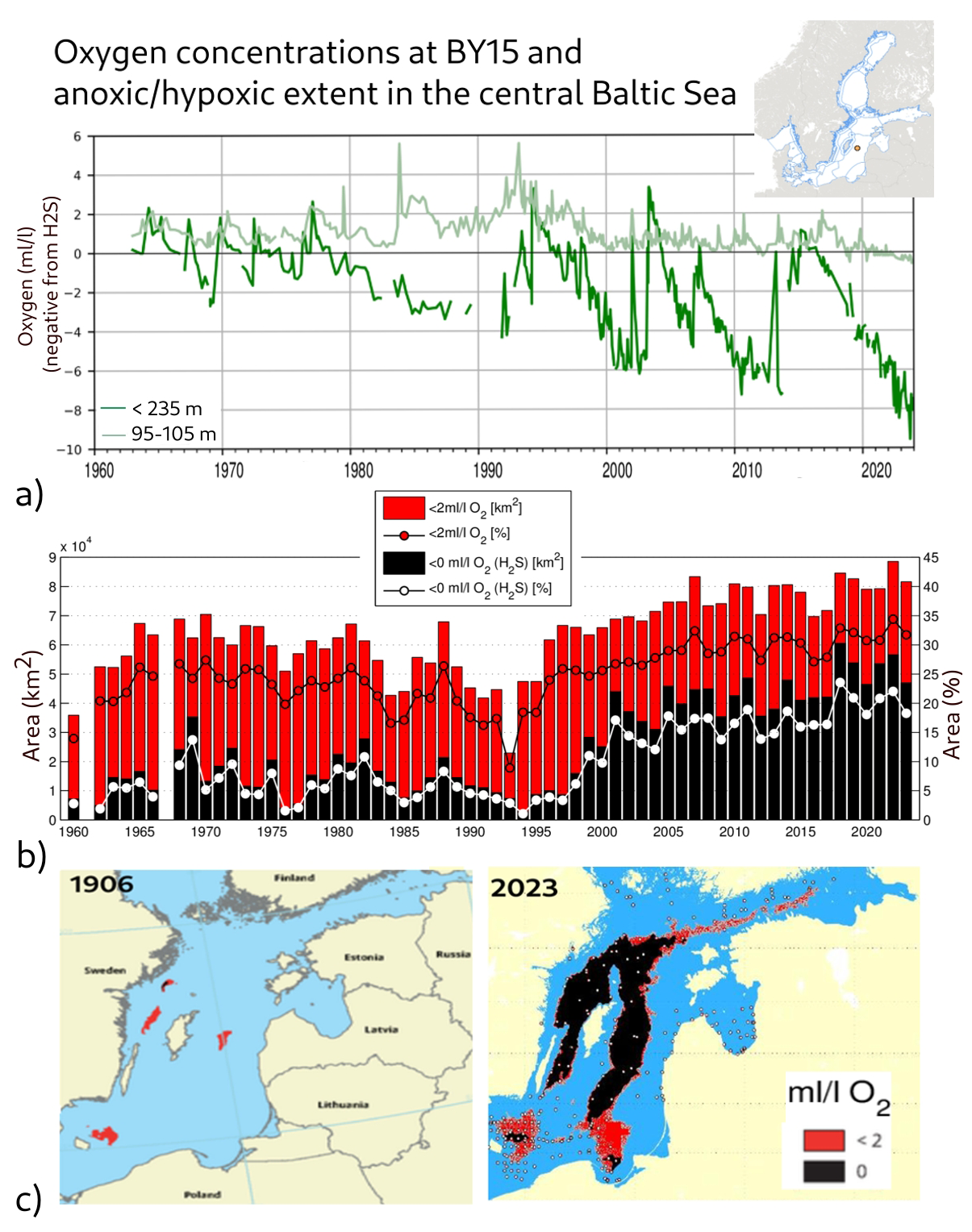
Figure 6(a) Observed oxygen concentrations in intermediate and bottom waters at BY15 (in the Baltic Proper) for the period 1960 to 2023, where H2S concentrations were converted to negative oxygen equivalent (). (b) Areal extent of anoxic () and hypoxic () conditions in the central Baltic Sea (Baltic Proper, Gulf of Finland and Gulf of Riga) from 1960 to 2023 estimated from observations (adapted from Hansson and Viktorsson, 2024). (c) Maps showing the extent of hypoxic and anoxic waters for the years 1906 and 2023, adapted from Carstensen et al. (2014) and Hansson and Viktorsson (2024).
The basins without permanent halocline, such as the eastern Gulf of Finland, Gulf of Bothnia, and Gulf of Riga, are largely impacted by atmospheric conditions which control the local stratification/mixing regime (Kuosa et al., 2017; Eremina et al., 2012; Stoicescu et al., 2022; Liblik et al., 2023; Polyakov et al., 2023). These basins are generally more oxygenated, but are not exempt from developing prolonged periods of deoxygenation and bottom anoxia.
Coastal deoxygenation in the Baltic Sea is also affected by additional processes, such as marine heat waves (MHWs; Sect. 2.3.4) (Safonova et al., 2024). The gradual decline of oxygen, the expansion (both vertically and horizontally) of oxygen deficit, and the increasing hydrogen sulfide inventory adding to the “oxygen debt” in the Baltic Proper (Fig. 6) increase the risk of exporting hypoxic waters to the Bothnian Sea and shallow coastal areas (Rolff et al., 2022; Polyakov et al., 2022).
3.1.2 Primary Productivity
Primary productivity – the rate at which marine autotrophs, mainly phytoplankton, convert inorganic carbon (CO2) into organic matter through photosynthesis – is heterogeneous in space and consistently enhanced by nutrient inputs in the Baltic Sea (Fig. 7). The high nutrient concentrations result from human-induced nutrient enrichment, long water residence times due to limited exchange with the North Sea, vertical mixing, and efficient benthic nutrient recycling (e.g., Carstensen et al., 2014; Carstensen and Conley, 2019).
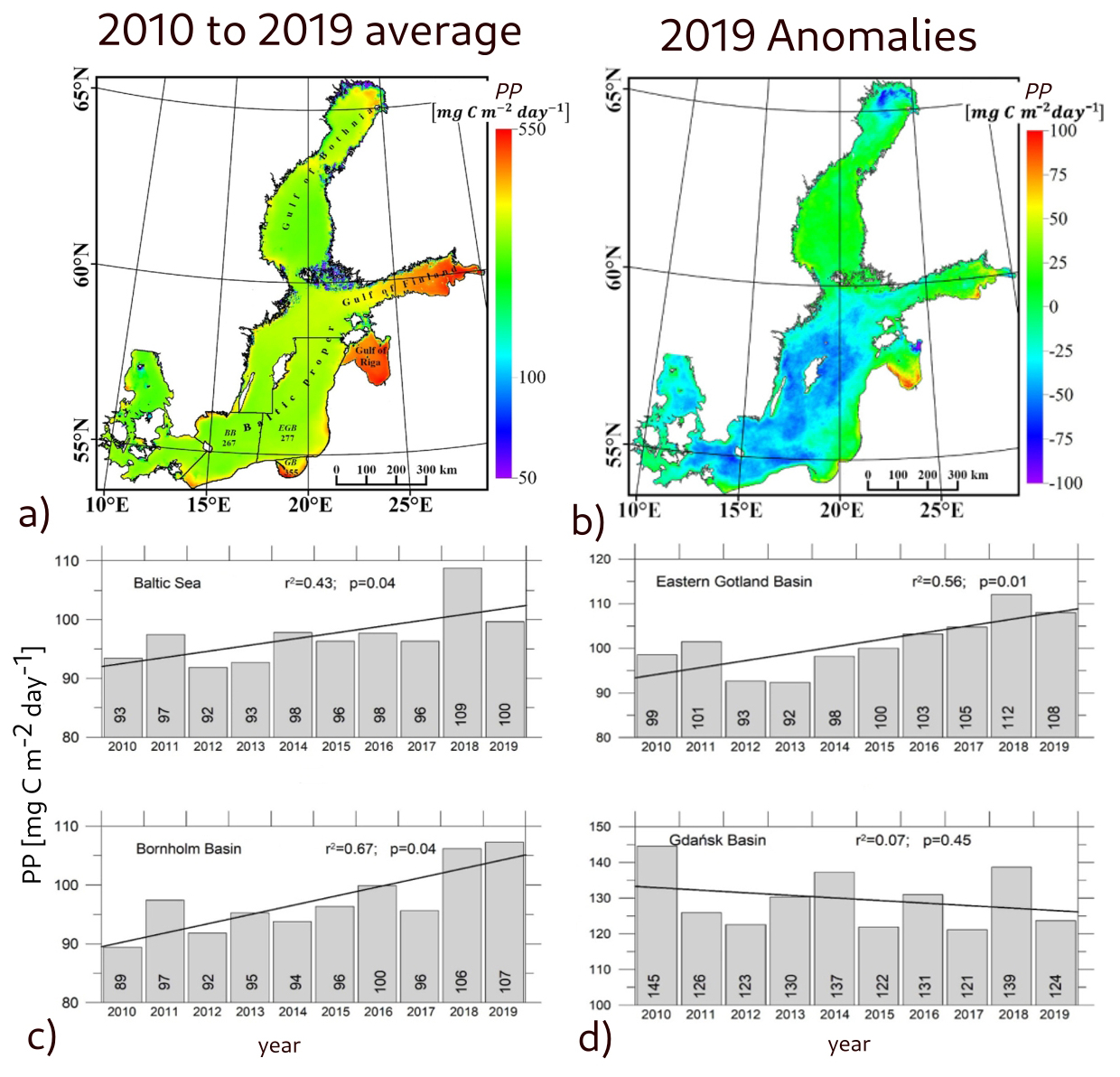
Figure 7Primary productivity (PP) in the Baltic Sea: (a) Daily PP of the Baltic Sea, the mean from the period of 2010–2019. The numbers represent mean values determined for the analyzed basins: the Bornholm Basin, the Eastern Gotland Basin (EGB), the Gdańsk Basin and for the entire Baltic Sea. (b) Anomalies of the Baltic Sea primary production determined as the difference between PP in 2019 and the average PP value from 2010 to 2019. The total yearly primary production for (c) the entire Baltic Sea and the Bornholm Basin and (d) the Eastern Gotland Basin and the Gdańsk Basin together with the trend line; determined based on the monthly means for particular years for the period 2010–2019 (data source: SatBałtyk System) (Ostrowska et al., 2022).
Natural fluctuations in nutrient and organic matter supply, closely linked to the hydrological cycle, regulate primary productivity. Other physical factors, such as the availability of incoming surface solar radiation, the penetration of light into the water column, the spectral quality of light in the euphotic zone, changes in freshwater supply, ocean mixing, sea surface temperature, and winds, likewise play a role in primary production. While the averaged primary productivity shows consistent patterns (an example for the period 2010–2019 is shown in Fig. 7a), significant differences can be found from year-to-year and from region to region. For example, anomaly analysis shows considerably elevated productivity in relation to the 10 year average in the Baltic Proper in 2019 (Fig. 7b; Ostrowska et al., 2022).
Since phytoplankton forms the dominant group of primary producers in the Baltic Sea, its growth directly reflects the combined effects of the aforementioned drivers. Light availability, which is further decreased by the presence of organic particles in the water column, is the main limiting factor for phytoplankton growth during autumn in the Baltic Sea (Olesen et al., 1999). In contrast, during spring and summer, light is not a limiting factor and allows phytoplankton growth, leading to seasonal peaks in primary production. While yearly primary production in the Baltic Sea shows a general slight increasing trend due to the response of phytoplankton to local drivers, primary productivity trends differ per basin (Fig. 7c and d; Ostrowska et al., 2022).
In winter, both temperature and light limit phytoplankton growth. In summer, thermal stratification is an additional factor regulating production dynamics as it forms a stable upper mixed layer that is shallower than the euphotic zone. Phytoplankton is then confined within this lighted surface layer allowing blooms to develop. However, stratification also suppresses mixing with deeper layers, gradually limiting the upward transport of nutrients to the surface and thus phytoplankton growth. Nitrate is usually fully depleted down to the halocline after the spring bloom period (Schneider and Müller, 2018). A second bloom of nitrogen-fixing primary producers (cyanobacteria) develops in summer, with timing of the onset and intensity subject to large interannual variability (Kahru et al., 2020, 2025).
In early spring, diatoms – a major group of phytoplankton characterized by their capacity of building silica-based cell walls – are the first to bloom, particularly in the southern Baltic Sea. In the central Baltic Sea (Baltic Proper, Gulf of Finland and Gulf of Riga), cold-water dinoflagellates may be dominant, especially after warmer winters, while mixotrophic dinoflagellates and occasionally ciliates are dominant in summer (e.g., Klais et al., 2011). Cyanobacteria in the Baltic Sea, which grow in low salinity (<10 g kg−1; Munkes et al., 2021) and are capable of fixing atmospheric nitrogen, form blooms in summer after nitrogen depletion in surface waters (Wasmund et al., 2008, 2011; Klais et al., 2011; Olli et al., 2011). However, phytoplankton dynamics in the Baltic Sea are changing, potentially due to changing seasonality of the cumulative surface incoming solar radiation (Kahru et al., 2016), reduced light penetration in the water column (so-called darkening), water temperatures and stratification (Jaanus et al., 1990; Dupont and Aksnes, 2013; Opdal et al., 2019; Wasmund et al., 2019).
3.1.3 Ocean acidification
Ocean acidification is a core indicator of the Global Climate Observing System, as rising surface-ocean CO2 partial pressure (pCO2) levels closely track rising atmospheric pCO2. When CO2 dissolves in seawater, it forms carbonic acid, releases hydrogen ions (H+), and lowers pH (e.g., Doney et al., 2009; Bates et al., 2012). In the open ocean, ocean acidification is traceable as a decreasing long-term pH trend since at least the 1980s (i.e., since observations have been available), clearly revealing against the background of seasonal pH variability related to photosynthesis and respiration (Ma et al., 2023). In the Baltic Sea (similar to most coastal and shelf waters), ocean acidification trends are less clear (Fig. 8), mainly due to changes related to eutrophication and variable total alkalinity which, next to CO2 dynamics, is a key driver for seawater pH (Carstensen and Conley, 2019; Kuliński et al., 2022).
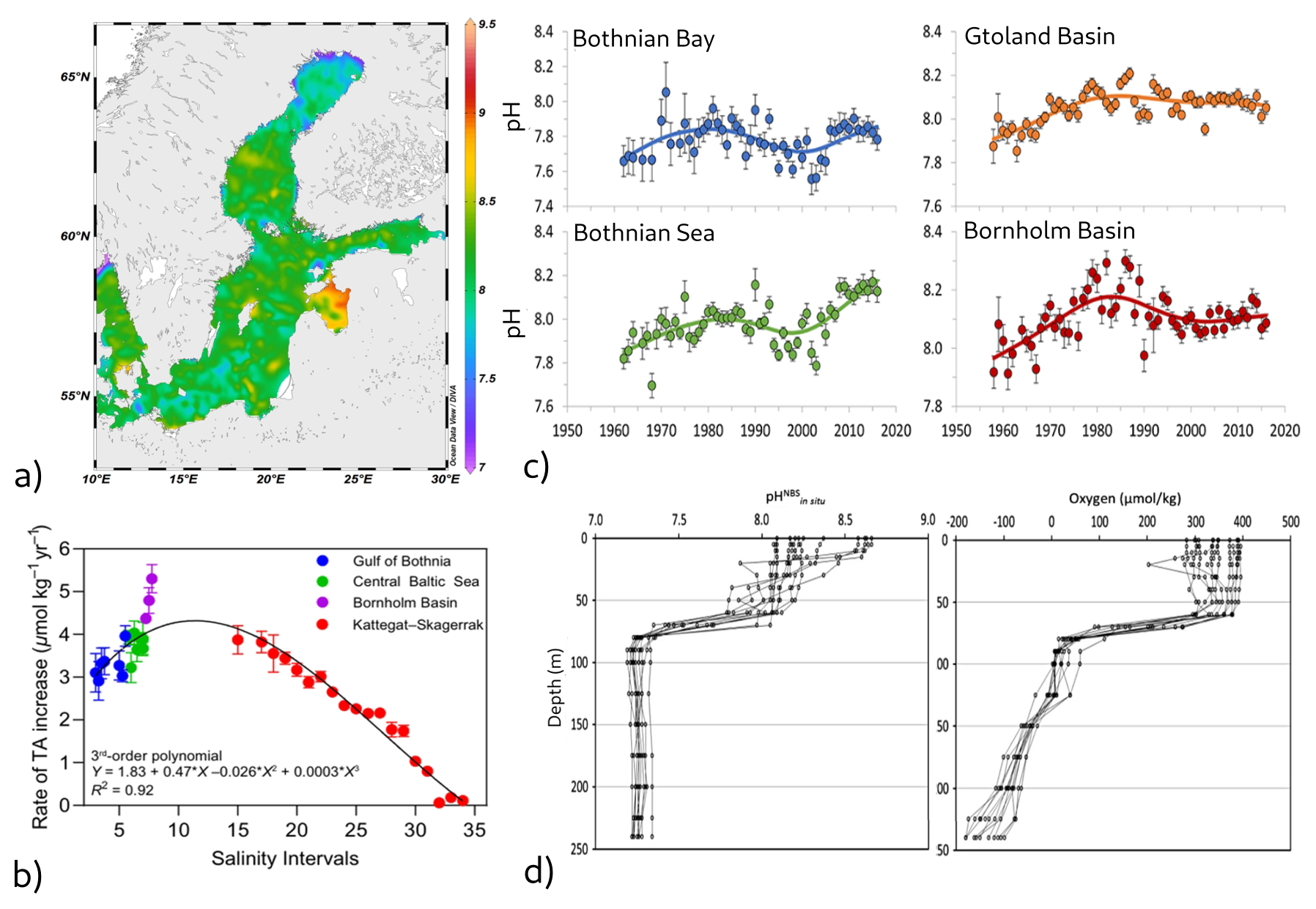
Figure 8(a) Long-term spatial distribution of pH in surface waters in the Baltic Sea showing the long-term mean over the period of 1911–2003 (Havenhand et al., 2019). (b) The rate of total alkalinity (TA) increases in surface waters of 4 different basins in the Baltic Sea, averaged over the period 1995 to 2021 (colored dots). The black line represents a third order polynomial regression (Cotovicz et al., 2024). (c) Changes of pH with time in 4 basins of the Baltic Sea (from Kuliński et al., 2022, based on Carstensen and Conley, 2019). (d) Monthly profiles of pH and oxygen in the Gotland Basin during 2008 (after Ulfsbo et al., 2011). Negative oxygen values show how much oxygen would be required to reoxidize the hydrogen sulphide to sulphate.
Total alkalinity is defined as an excess of proton acceptors over proton donors (or bases over acids) and is a measure of buffer capacity against ocean acidification (Dickson, 1992). Although total alkalinity is a conservative salinity-dependent parameter, its surface distribution in the Baltic Sea is complex. This is due to significant differences in the total alkalinity concentrations in river water across the Baltic Sea catchment, a phenomenon closely linked to variations in the geological structure of the surrounding land (Hammer et al., 2017; Kuliński et al., 2017). Generally, the Scandinavian rivers drain catchments underlain by granite bedrock and therefore have low total alkalinity concentrations. Rivers entering the Baltic Sea from the south and south-east flow through a catchment area rich in limestone and heavily agriculturally transformed, which makes these rivers an important net source of total alkalinity. Finally, the Baltic Proper acts as a mixing chamber where these various freshwater types mix with the salty (and therefore alkalinity-rich) water flowing into the Baltic from the North Sea (Kuliński et al., 2022).
The overall low alkalinity suggests that the Baltic Sea is prone to ocean acidification. However, total alkalinity in the Baltic Sea has shown an increase over the past three decades (Müller et al., 2016). The most recent data analysis by Cotovicz et al. (2024) shows that this increase is between 3.2 in the Gulf of Bothnia and 5.3 in the Bornholm Basin, which partially mitigates the pH drop in the Baltic Sea due to increasing pCO2 (Fig. 8b). The source of this increase remains unclear, but it is likely the result of a combination of different processes, such as a rise in total alkalinity loads from rivers, enhanced erosion, dissolution of carbonate deposits, and total alkalinity input due to the expansion of bottom anoxia and low redox conditions (Müller et al., 2016; Gustafsson et al., 2019; Wallmann et al., 2022).
Because both pCO2 and total alkalinity are key parameters to understand pH variability and ocean acidification, any processes and mechanisms affecting either of them should be considered in the context of teleconnections. This makes correlations between acidification and natural variability, large-scale atmospheric, and oceanic patterns difficult to detect in the Baltic Sea, leaving the response to changes across different time scales poorly understood.
3.2 Linkages between large-scale circulation patterns, physical drivers and biogeochemical processes across time scales
While dedicated studies assessing the effects of large-scale circulation variability on biogeochemical processes in the Baltic Sea are rare (see Neumann and Schernewski, 2008 and references therein), important links – often local – between biogeochemical and physical processes have been suggested in the literature. One example assessing the relative roles of physical parameters in modulating a biogeochemical parameter across different time scales is that of Kahru et al. (2020). Using Partial Least Squares analysis, they show that, in addition to biogeochemical properties (such as nutrient inputs), the temperature is a key driver for surface cyanobacteria accumulation (FCA) on decadal time scales (with R2>0.2). They also identify temperature, solar radiation and wind as major contributors on interannual time scales (Fig. 9). The occurrence and development of cyanobacterial blooms are thus among the few examples in the field of biogeochemistry where attempts have been made to explain natural variability on different time scales through physical drivers.
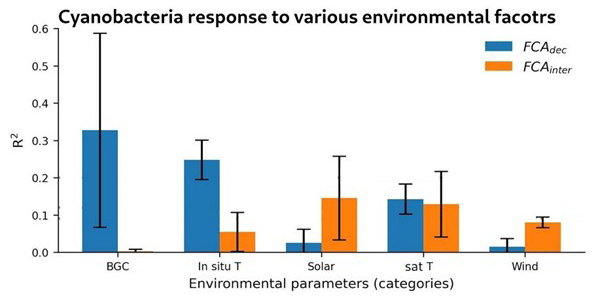
Figure 9Influence of various environmental factors on cyanobacteria surface accumulations (FCA) expressed as coefficient of determination (R2) on decadal (blue) and interannual (orange) time scales for the central Baltic Proper. The environmental categories include sea surface temperature derived from satellite (sat T) and measured in situ (In situ T) for 0 to 15 m, surface incoming shortwave radiation (Solar), various biogeochemical properties (BGC) and wind (Wind). Error bars highlight the variability within each category. The figure is adapted from Kahru et al. (2020).
In this section, we present a synthesis and analysis from relevant information found in the literature on how remote and local physical processes drive natural variability in deoxygenation, primary productivity, and ocean acidification, classifying their potential impacts across the time scales defined in Sect. 2.2.
3.2.1 Synoptic, intraseasonal and seasonal time scales
Most of the available biogeochemical observational data do not cover long-term periods with the time resolution to capture synoptic (1–7 d) and intraseasonal (10–90 d) time scales. In addition, atmospheric or oceanic data do not always have the same period, the same frequency or spatial coverage. Only due to the recent availability of satellite observations together with improved measurement techniques and numerical modeling has it become possible to obtain biogeochemical data with higher spatiotemporal resolution. Therefore, it is not surprising that biogeochemical parameters are not typically linked to weather systems on synoptic or intraseasonal time scales. However, the need for early warnings and short-term predictions for biogeochemical parameters (e.g., for risk assessments) demands more studies on the biogeochemistry responses to weather regimes or short-term events like storms.
A study by Post and Aun (2024) about solar radiation on synoptic time scales (Sect. 2.3.7) potentially explains the observed earlier onset of phytoplankton growth reported for the Baltic Sea (see Sect. 3.1.2). Kahru et al. (2025) recently suggested that the main controlling factors for the initiation of cyanobacteria blooms are the rate of change in SST due to surface irradiance and reduced vertical mixing due to lower wind speed, while SST itself was not correlated with bloom initiation. Similarly, Müller et al. (2020) observed the vertical carbon removal from the surface layer during a cyanobacterial event, and related the integrated cyanobacterial production to the heat uptake in the surface layer. Increased wind speed and resulting mixed layer deepening ended this productive episode. These findings link both the onset of cyanobacterial blooms and integrated production of individual bloom events to meteorological conditions with persistent low wind speed and reduced cloud cover. This parallels conditions fostering summer heat waves, with an apparent link to blocking regimes (Sect. 2.1.2). Yet, for the most part, a clear correlation between phytoplankton variability and weather regimes is still missing.
The shallow and brackish Baltic Sea is affected by marine heat waves (MHWs) on synoptic time scales (Sect. 2.3.4). Their impact can last from a couple of days to a few months and can reach the seabed at water depths of less than 20 m (Cahill et al., 2024), which has been shown to have led to a significant decrease in oxygen concentration during summer (Safonova et al., 2024; Göbeler, 2024; Vajedsamiei et al., 2024). As MHWs are projected to increase in intensity, duration and frequency in the future (Gröger et al., 2024a), the risk of hypoxic events in Baltic coastal waters is of growing concern (Safonova et al., 2024; Kauppi and Villnäs, 2022; Liblik et al., 2023). Kahru et al. (2020) suggested that MHWs can trigger extreme surface accumulations of cyanobacteria which, in turn, will further increase heating in the uppermost water layer due to increased light absorption and thus modulated air-sea heat fluxes. Kauppi and Villnäs (2022) studied the effect of MHWs on benthic ecosystems in the Baltic Sea and found that the seafloor functioning responds differently depending on the intensity of the heatwave. They suggest that a prolonged, moderate MHW enhances nutrient recycling by boosting benthic activity, while a strong heatwave reduces organic matter degradation and the nutrient cycling. Over time, both can lead to a build-up of organic matter on the seafloor and cause oxygen depletion (Kauppi and Villnäs, 2022). As bioturbation and related benthic fluxes alter the nutrient recycling and organic matter remineralization, benthic processes can also alter primary productivity.
Most physical parameters in the Baltic Sea, such as temperature, wind speed, cloudiness, runoff, evaporation, and precipitation have pronounced intraseasonal/seasonal variations, whose influence decreases with depth according to the bathymetry of each basin. Consequently, such signals are also reflected in most biogeochemical processes, but can be mitigated by other regional effects. For example, while intraseasonal/seasonal variations in oxygen are weak in most of the stratified areas of the Baltic Sea (Stockmayer and Lehmann, 2023), in the Gulf of Finland, bottom water conditions are dominated by seasonal variability as seasonal westerly winds can reverse the estuarine circulation, which deepens the halocline and increases the oxygen content in the near-bottom layer (Elken et al., 2003; Liblik et al., 2013; Lips et al., 2016).
Primary productivity in the entire Baltic Sea has a clear seasonal cycle mainly driven by temperature, light and nutrient availability (Sect. 3.1.2). Following changes in pCO2 caused by seasonal changes in the production and remineralization of organic matter, the pH of the Baltic surface waters also changes seasonally, with higher values observed in summer than in winter. Thus, natural variability of ocean acidification is closely related to that of primary production, but also to the buffering capacity, given by the total alkalinity. In addition, the CO2 flux at the air-sea interface is largely controlled by temperature, salinity and winds (Thor and Oliva, 2015; Thor and Dupont, 2018), which are directly impacted by the large-scale atmospheric variability across different time scales (Sect. 2.2). In deeper waters, the seasonal influence of teleconnections is less evident but may follow that of deoxygenation (Fig. 6), since pH is primarily controlled by CO2 accumulation and alkalinity release during redox processes (Kuliński et al., 2017). In the end, all of these processes are linked to seasonally affected physical parameters. The relative roles of such parameters in controlling the intraseasonal to seasonal variability of primary production and ocean acidification remain unclear and likely vary regionally.
3.2.2 Interannual time scales
Interannual variability (1–9 years) in Baltic Sea oxygen deficiency is strongly driven by atmospheric forcing through its effects on circulation, stratification, and vertical exchange, leading to changes in oxygen content.
Interannual variability below the halocline in the western and southern Baltic depends largely on the inflow of oxygenated water from the North Sea (Schmidt et al., 2021; Barghorn et al., 2025b; Löptien et al., 2025). In between MBI events, oxygen concentrations in the near bottom layer decline continuously although the frequent smaller inflows (Elken, 1996; Meier, 2005) oxygenate the subhalocline layer (≈100 m depth) at an interannual time scale. Consequently, year-to-year variability in the subhalocline layer is more closely linked to the large-scale atmospheric circulation than the deeper bottom layers in the central Baltic Sea.
The influence of atmospheric variability is particularly pronounced in the shallower basins of the Baltic Sea. A positive NAO with accompanying winds from southwest can alter or even reverse the advection of oxygen-depleted saline waters from the Baltic Proper to the Gulf of Finland and remove hypoxia in the whole gulf (Eremina et al., 2012; Liblik et al., 2013; Lips et al., 2016; Lehtoranta et al., 2017). A negative NAO, on the other hand, supports estuarine circulation and stronger oxygen deficiency. Lennartz et al. (2014) and Hepach et al. (2024) showed that oxygen depletion in the case of a warmer upper layer is not only intensified due to stronger stratification, but that enhanced oxygen consumption in higher temperatures also contributes to the interannual variability of deoxygenation in the shallow southern Baltic Sea.
Wind patterns and heat fluxes associated with high pressure systems during the European Blocking regime support the seasonal oxygen depletion occurring from year-to-year in the Gulf of Riga (Liblik et al., 2023; Stoicescu et al., 2022). North-easterly winds cause dense water transport from the Baltic Proper to the Gulf of Riga. Although this water is oxygenated, it also causes strong stratification and reduces oxygen transport by vertical mixing in the gulf. Strong heat fluxes during the prevailing European Blocking regime cause higher sea surface temperature and stratification, which could reduce downward oxygen transport and enhance deoxygenation of the deep layer (Stoicescu et al., 2022).
Besides low oxygen concentrations, seasonally increasing near-bottom water temperature seems to be the main factor controlling denitrification rates (Aigars et al., 2015). In turn, intensive denitrification and organic matter degradation under anoxic conditions are an important source of alkalinity and thus can affect the year-to-year acid-base system of the Baltic Proper (Gustafsson et al., 2014). Although the effect is usually reversed upon re-oxygenation, denitrification and the formation of vivianite and pyrite are permanent sources of alkalinity (Kuliński et al., 2017), potentially acting on longer time scales.
During 1860–1880 and 1980–2000, negative wavelet coherence between surface and bottom salinity at Gotland Deep and the NAO index is found in the period band between 5 and 10 years (Radtke et al., 2020), very likely affecting bottom oxygen concentration dynamics (e.g., Lehmann et al., 2022). Stockmayer and Lehmann (2023) found strong correlation between the positive phase of winter NAO and negative salinity and positive oxygen anomalies in the Baltic Proper during the period 1983 to 1990. This suggest that the positive phase of winter NAO (west wind anomaly) causes a salinity decline in the Gotland Basin and improved oxygen conditions. The mechanism is explained by Krauss and Brügge (1991) and confirmed by dynamic modeling (Meier and Kauker, 2003) and statistics (Zorita and Laine, 2000). Correlations between the NAO and the main factors controlling primary productivity, such as air/sea surface temperature, light and sea ice at interannual time scales are large (Sect. 2.3; Omstedt and Chen, 2001; Kniebusch et al., 2019b). Therefore, strong interannual signals are expected to modulate primary productivity in the Baltic Sea. Indeed, a study on primary productivity in the northeastern Baltic Sea and large-scale atmospheric variability found significant correlations between chlorophyll and the winter values of NAO, Scandinavian pattern and the annual Polar/Eurasian index, which suggests a potential effect on primary productivity (Golubkov and Golubkov, 2021). Solar radiation has been shown to affect cyanobacteria on interannual time scales rather than on decadal time scales. Wind conditions did not show a strong relationship with how often cyanobacteria blooms occurred, although winds mainly influenced variations from year-to-year (Kahru et al., 2020, their Fig. 9).
3.2.3 Decadal and multidecadal time scale
The Baltic Sea exhibits complex decadal to multidecadal-scale variability in oxygen dynamics, primary productivity and ocean acidification. By examining paleoenvironmental archives from sediment records, we can better understand shifts in core biogeochemical processes under conditions of no or minimal anthropogenic influence. Past widespread hypoxia in the Baltic Sea has occurred during the Holocene Thermal Maximum (8000–4800 years before present) and the Medieval Climate Anomaly (1000–700 years before present) (Zillén et al., 2008; Jilbert et al., 2015; Börgel et al., 2023b). These past hypoxic intervals generally coincided with warmer climatic conditions (Kabel et al., 2012) and elevated salinity, both of which favored higher primary productivity and increased organic matter flux to the seafloor. Sediment record studies show that, before major human influence, hypoxia in the Baltic Sea was largely a natural response to climate variability and changes in water exchange with the North Sea (Conley et al., 2009; Jilbert and Slomp, 2013).
Proxy records of hypoxia showed strong multidecadal oscillations likely driven by both the internal iron-phosphorus cycling and the Atlantic Multidecadal Variability (AMV) (Jilbert et al., 2021), in which temperature and salinity played a major role in modulating the remineralization of organic matter (Börgel et al., 2023b) and the timing of massive blooms (Andrén et al., 2020). In addition, oxygen concentration variations at multidecadal time scales have been identified to be negatively correlated with salinity in the major part of the water column, indicating improved ventilation during a fresher state of the Baltic Sea (e.g., Hansson and Gustafsson, 2011). Reduced salinity and consequent improved oxygen conditions have been linked to stronger zonal atmospheric circulation (Zorita and Laine, 2000).
Modern bottom oxygen concentrations in both the Baltic Proper and the western Gulf of Finland show strong decadal signals, mainly controlled by runoff and zonal wind stress (Väli et al., 2013). Similarly, Laine et al. (2006) reported an increase in oxygen concentrations in the late 1980s and early 1990s which they attributed to a decrease in salinity due to high runoff and a loss of stratification, thus related to more humid weather conditions.
Primary production has fluctuated over a range of spatial and temporal scales, increasing approximately 2–3-fold since the early-to-mid 20th century as a direct result of nutrient enrichment (Savchuk, 2018). However, multidecadal variability persists, superimposed on the anthropogenic trend. Model and field data show that wind forcing and shifts in atmospheric circulation play a crucial role in regulating primary production and biogeochemical regimes in the Baltic Sea (Andersson et al., 2015). For example, the AMV has been shown to account for a significant fraction (over 50 %) of decadal-scale variability in sea surface temperature in the Baltic Sea, indirectly influencing primary productivity through impacts on thermal stratification and nutrient availability (Kniebusch et al., 2019a).
Paleoceanographic evidence demonstrates that during the Medieval Climate Anomaly, periods of warmer temperatures promoted abundant cyanobacteria blooms in the Baltic Sea (Funkey et al., 2014) and increased diatom production, boosting organic matter export and contributing to hypoxia in deep basins (Bianchi et al., 2000). Furthermore, significant changes have occurred in net primary productivity from 1993 to the present (Fig. 7), which cannot solely be explained by nutrient distribution (Ostrowska et al., 2022). Still, nutrient loads from rivers, especially after industrialization, and nutrient recycling from sediments have become the dominant control on primary productivity (Savchuk, 2018), amplifying and modulating its magnitude rather than overriding its natural, climate-driven variability.
Long-term trends and variations of primary productivity in the Baltic Sea are difficult to study due to the lack of observations in both space and time, especially before the year 1996 (Ostrowska et al., 2022). Nevertheless, long seasonal trends in primary productivity have been identified in the Baltic Sea, especially in the Gulf of Gdansk (e.g., Zdun et al., 2021). As large-scale temperature, shortwave radiation, and cloudiness changes have been shown to affect phytoplankton growth, large-scale circulation variability on multidecadal time scales likely impacts primary productivity.
Kahru et al. (2020) showed that the frequency of cyanobacteria in the Baltic Proper at decadal time scales is primarily correlated with phosphorus abundance and bottom-water anoxia (Fig. 9). However, sea surface temperature and wind speed also play a significant role in modulating decadal cyanobacteria blooms and their initiation (Kahru et al., 2018, 2025). Yet, in the Baltic Sea, the links between large-scale circulation patterns and primary productivity remain poorly understood and largely unquantified; consequently, the relative importance of these links and the future response of productivity to accelerated warming are even less certain.
The recent multidecadal increase in total alkalinity has also been partially explained by changes in precipitation patterns and continental weathering driven by acidic rain (Müller et al., 2016) which are closely linked to the NAO and AMV (Sect. 2.3.1). The latter are expected to change by the end of the 21st century, likely leading to wetter conditions in the northern part of the Baltic Sea, mostly composed of granite, and drier conditions in the southern, limestone-rich Baltic Sea (Meier et al., 2022; Kuliński et al., 2022). The sources of the alkalinity increase are neither well understood nor quantified and are also highly linked to eutrophication and alkalinity production from anaerobic processes (Müller et al., 2016; Cotovicz et al., 2024). The teleconnections for total alkalinity production through anaerobic processes, though not yet directly investigated, should be similar to those for primary production and hypoxia/anoxia.
3.3 Large-scale circulation patterns and physical controls in key biogeochemical processes: Roles and knowledge gaps
Disentangling climate change from natural variability is essential for correctly attributing observed changes in the Earth system. Without separating internally generated fluctuations from externally forced trends, long-term shifts may be misinterpreted as short-term variability, or vice versa. Clear attribution improves projections, strengthens confidence in model simulations, and supports effective policy and management decisions by distinguishing persistent climate change-driven trends from temporary natural fluctuations. This is particularly valid for biogeochemical processes, as in the Baltic Sea achieving good environmental status is crucial and a priority in EU conventions. This requires up-to-date environmental information and improved predictability of key processes.
We have reviewed and gathered evidence from the literature linking the potential effects of large-scale circulation variability and local physical controls on three key biogeochemical processes. In this section, we synthesize relevant evidence from Sect. 3.2, placing it in the context of anthropogenic climate change and remaining knowledge gaps. We also identify, where possible, the relative roles and importance of remote and local physical controls for these biogeochemical processes. Our analysis, consistent with Neumann and Schernewski (2008), shows that ecosystem dynamics are influenced not only by temperature and salinity, but by a broader range of atmospheric and oceanic drivers.
The main causes of the recent oxygen decline in the Baltic Sea are the anthropogenic nutrient load from land (Meier et al., 2019), warming, and inflowing North Sea waters driven by climate change, which decreases oxygen solubility, increases mineralization rates and strengthens stratification (Barghorn et al., 2024; Naumov et al., 2023; Polyakov et al., 2022). However, the variability of oxygen is heavily modulated by regional effects of natural variability at different time scales (Sect. 3.2), but relative roles remain unclear.
The same is true for primary productivity. However, there are a number of uncertainties associated with changes in primary production. For example, the consequences of climate change (Viitasalo and Bonsdorff, 2022) or possible shifts in species diversity, patterns of species succession or responses to changes in hydrological patterns are largely unknown (e.g., Viitasalo and Bonsdorff, 2022; Łysiak-Pastuszak et al., 2004; Zdun et al., 2021; Stoń-Egiert and Ostrowska, 2022; Ostrowska et al., 2022). Further changes affecting primary productivity in the Baltic Sea are expected to continue but the specific phytoplankton response to the combined complexity of physical drivers and the related time scales, especially the contribution of natural variability, remains understudied and difficult to detect. In addition, harmful algal blooms (such as blooms of the prymesiophyte Prymnesium polylepis; Karlson et al., 2021) are recurrent phenomena, especially along the coast and the Kattegat-Skagerrak. Most of the harmful (toxic) phytoplankton species only constitute a small fraction of the phytoplankton biomass. However, they affect the composition and the spatio-seasonal distribution of the phytoplankton community. Their drivers are complex and not well understood, but they are clearly impacted by weather conditions (Roiha et al., 2010). Because primary productivity forms the base of the marine food web, understanding its link to natural variability and large-scale patterns is important to better predict its future and implications.
In addition, there is growing concern over the ecological impacts of coastal ocean darkening (Opdal et al., 2019; Frigstad et al., 2023; Davies and Smyth, 2025), given that some of the highest rates of darkening since 2003 have been recently observed in the Baltic Sea, in particular in the Gulf of Bothnia (Davies and Smyth, 2025). Climate change-driven alterations in precipitation, land use, and runoff are projected to intensify this darkening phenomenon through increased input of organic material and particulates, altering the penetration and spectral quality of light in the water column, with unknown consequences for photosynthesis, primary production, and species behavior (Dupont and Aksnes, 2013; Opdal et al., 2024). Identifying connections between North European precipitation patterns, temperature variability and decadal changes in underwater lightscapes is an emerging research topic.
Ocean acidification is the result of multiple combined drivers and there is still limited knowledge on several key processes and their relative contribution in the Baltic Sea. It is also poorly known how the ecosystems will respond to a combination of changing factors (e.g. nutrient loads, mixing/stagnation, and precipitation/evaporation), especially in the coastal ocean. Havenhand et al. (2019) identified as key priorities in future research to quantify the responses to dominant drivers (notably warming, eutrophication, hypoxia) and to determine the effects of diurnal and seasonal environmental fluctuations. In addition, to better understand the complex acid-base system of the Baltic Sea and its future, it is important to improve estimates of the relative contributions between seasonal/interannual and long-term atmospheric and hydrodynamic variability affecting carbon fixation rates, pH, and total alkalinity sinks and sources. Future research on this matter should at least include alterations in precipitation and runoff together with a good understanding of changes in the land use and in the rate of CO2-induced weathering of carbonate and silicate rocks.
A summary of confirmed remote and regional/local physical drivers directly affecting oxygen concentrations, primary productivity, and ocean acidification across the analyzed time scales is presented in Fig. 10. All regional physical effects on natural variability mentioned in Sect. 2.3 affect in some way these three main biogeochemical processes. However, most of the impacts remain poorly constrained or quantified and are therefore difficult to accurately implement in models, hindering the possibility of reducing uncertainties. The temperature (including SST), salinity and ocean stratification are likely the major factors modulating natural variability of deoxygenation. While natural variability of primary productivity is also largely affected by temperature, solar radiation and wind regimes also play major roles, likely also in determining the timing of the blooms. Links between physical drivers and ocean acidification are complex and may be more indirect than for other processes. For example, variations in runoff directly affect the nutrient supply, the salinity distribution, and the alkalinity.
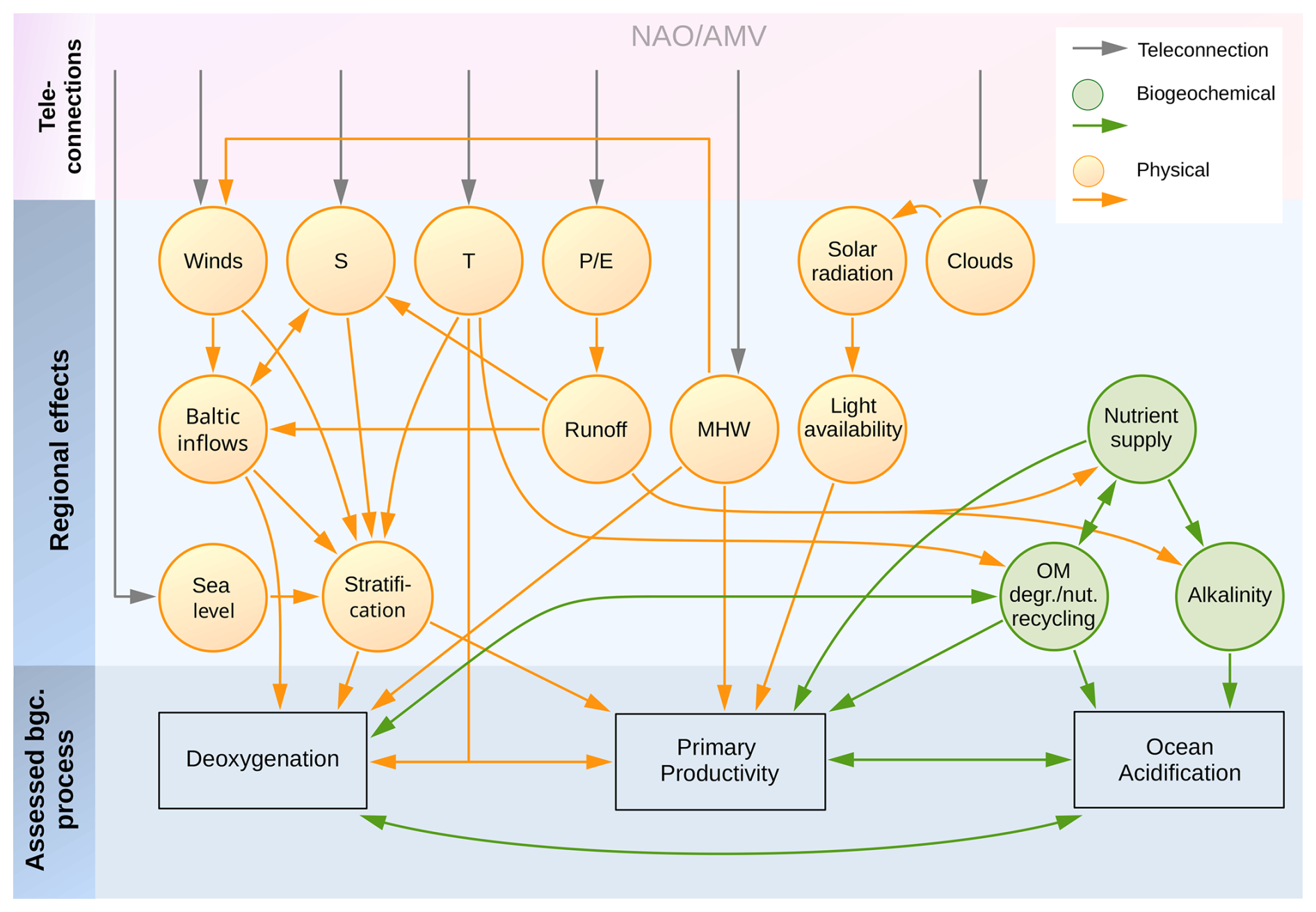
Figure 10Simplified diagram summarizing identified connections between physical patterns and deoxygenation, primary productivity, and ocean acidification acting in the Baltic Sea across the time scales examined in this study. Arrows only show confirmed links from the literature that are addressed in Sect. 3.2. Potential (unconfirmed) links are not shown. P/E, S, T and OM denote precipitation/evaporation, salinity, temperature, and organic matter, respectively.
The Baltic Sea is located at the confluence of Atlantic, Arctic and continental influences, with variability controlled primarily by large-scale atmospheric circulation over the North Atlantic-European sector, especially the North Atlantic jet and associated circulation patterns such as the NAO, East Atlantic, and Scandinavian patterns (e.g., Chafik et al., 2017; Comas-Bru and McDermott, 2014). Their impacts on the Baltic Sea region are substantial (e.g., Rutgersson et al., 2022). For example, in winter the NAO explains about 87 % of the surface air temperature variability at Stockholm (Meier and Kauker, 2003), accounts for about 29 % of the year-to-year variance in annual maximum Baltic Sea ice extent (Omstedt and Chen, 2001), and correlates strongly with winter mean Baltic Sea level (r=0.63 for 1825–1997 and r=0.74 for 1902–1997; Andersson, 2002). On longer time scales, coupled ocean–atmosphere interactions linked to the AMOC, the SPG, and the AMV exert additional control (Årthun et al., 2017; Börgel et al., 2023a; Yan et al., 2018): for instance, about 58 % of decadal Baltic Sea SST variability has been linked to the AMV after removing the long-term warming trend (Kniebusch et al., 2019b), and local winter SST responses can reach about 1.2 °C per standard deviation of AMV-related multidecadal variability (Börgel et al., 2023a). However, quantifying the effect of the NAO on the past and future climate of the Baltic Sea region remains a challenge (Hurrell et al., 2003).
Across time scales, the literature uses different frameworks to describe large-scale circulation patterns and their variability, but many of these can be related to the weather-regime framework. For example, the Zonal and Greenland Blocking regimes are commonly interpreted as NAO-like states (Cassou, 2008; Vautard, 1990; Barrier et al., 2014; Fabiano et al., 2021). Similarly, the East Atlantic pattern has been linked to Atlantic Ridge and Atlantic Trough-like circulation anomalies (Barnston and Livezey, 1987a; Carvalho-Oliveira et al., 2024), while the Scandinavian pattern resembles Scandinavian Blocking in its positive phase and Scandinavian Trough in its negative phase (Kauker and Meier, 2003; Comas-Bru and McDermott, 2014). Thus, apparent differences across studies often arise from the framework and time scale used, rather than from entirely distinct circulation dynamics (Vautard, 1990; Grams et al., 2017).
Our literature review highlights that, although still greatly underexplored, all three key biogeochemical parameters in the Baltic Sea are influenced by large-scale circulation patterns across all previously discussed time scales. These patterns affect biogeochemistry primarily by shaping the statistics of local physical processes such as stratification, water exchange, heat flux and advection, which then regulate nutrient availability, oxygen concentrations, species distributions, and phytoplankton abundance. However, quantitative and basin-wide evidence directly linking large-scale circulation variability to oxygenation, primary production, and ocean acidification in the Baltic Sea remains scarce. Important knowledge gaps persist, particularly regarding the spatial and temporal dynamics of total alkalinity (Kuliński et al., 2017). Likewise, although the physical controls on primary-production variability, especially for the summer cyanobacterial bloom, are partly linked to large-scale variability (Kahru et al., 2020, 2025), a substantial fraction of the annual variability remains unexplained (Kahru et al., 2025).
Similar to the physical controls, the NAO, the East Atlantic, and the Scandinavian pattern were identified as relevant. For example, a positive NAO can reverse the advection of oxygen-depleted water and remove hypoxia on interannual time scales in the Gulf of Finland, whereas strong heat fluxes during European Blocking can enhance stratification and exacerbate deep-water deoxygenation in the Gulf of Riga. Wind speed, light, and cloud cover have also been identified as potential triggers for initiating or ending phytoplankton blooms on synoptic scales. Importantly, the relative influence of these physical drivers varies with time scale. These findings underscore that understanding and predicting regional biogeochemical states requires explicit consideration of both large-scale atmospheric forcing and its time scale-dependent effects on the local physics.
This results in a system where large-scale circulation shapes the statistics of local processes. Yet, the attribution of their quantitative contributions, especially for biogeochemistry, remains challenging and understudied. Large-scale circulation patterns are non-stationary: their spatial structure and strength evolve with changes in the background climate, including, for example, Arctic amplification (Zappa and Shepherd, 2017), likely altering their relative importance for the Baltic Sea in the future. Thus, anthropogenic climate change as well as legacy nutrient loads set the stage for the biogeochemistry in the Baltic Sea upon which large-scale circulation patterns superimpose variability. Based on our review, we encourage future studies, in particular those on biogeochemistry, to include a more systematic quantification of dominant drivers, robust statistical assessments of relationships between connected processes, and a detailed analysis of time-scale dependence.
Robust attribution and causal disentanglement of large-scale circulation impacts on the Baltic Sea region remain difficult because externally forced signals and internal variability cannot easily be separated (e.g., Deser and Phillips, 2021). In addition, summer circulation patterns that drive variability on decadal and longer time scales are either less well resolved over Northern Europe or remain insufficiently studied. Possible predictability arising from the North Atlantic (e.g., SPG, AMV, AMOC) has not yet been systematically researched for the Baltic Sea region, as regional downscalings of decadal predictability experiments are not available. Finally, model fidelity is a limiting factor: common biases in jets, storm tracks, sea ice, subpolar gyre and the AMOC variability and likely incomplete coupling of physics and biogeochemistry do not yet allow for robust results (e.g., Palmer et al., 2023).
To advance our understanding of links between large-scale circulation patterns and local processes, we highlight the need for:
-
Regime-based diagnostics paired with in-depth process analysis to move beyond correlation. In addition, the nonstationarity of large-scale circulation patterns must be addressed, because their spatial structure and regional impacts may evolve over time. This can be investigated with coordinated multi-model ensembles, ideally complemented by initial-condition large ensembles which make it possible to separate internally generated variability from the externally forced response and to test the robustness of circulation–impact relationships across models and realizations.
-
Fully coupled regional Earth-system models that resolve the complex topography of the Baltic Sea and can represent regional feedbacks among atmosphere, ocean, sea ice, and biogeochemistry more consistently.
-
Targeted evaluation of the large-scale circulation and ocean state in the global parent model – including jets, storm tracks, the subpolar gyre, and the AMOC – because biases in these features can propagate into the regional model through the imposed boundary conditions and thereby affect the simulated Baltic Sea variability.
-
Event-based observing and modeling approaches for storms, atmospheric rivers and marine heat waves to quantify the biogeochemical responses on short time scales.
-
Sustained high-frequency measurements of temperature, salinity, oxygen and other biogeochemical variables from coasts to deep basins to understand the impact of large-scale circulation patterns on biogeochemistry.
The main barriers to robust attributions and predictions are their non-stationary nature and the limitation of currently available observations and models. Targeted observational, process-focused methods and fully coupled regional models together provide a credible route to near-term gains in understanding and to actionable guidance for the Baltic Sea region.
No proprietary software was used. The code used to generate the figure(s) in this paper is available from the authors upon reasonable request and relies exclusively on publicly available datasets.
The data analyzed in this study are derived from previously published, publicly available materials. No new measurements were generated as part of this work. Details on data access are provided through the corresponding references.
The co-corresponding authorship FB and IRB were responsible for designing, conceptualizing, coordinating, supervising and writing the manuscript. HEMM, LBa, LN, TL, GR and BC contributed in ensuring relevance and consistency. Each author contributed to discussions and writing, focusing on their areas of expertise.
At least one of the (co-)authors is a member of the editorial board of Earth System Dynamics. The peer-review process was guided by an independent editor, and the authors also have no other competing interests to declare.
Publisher's note: Copernicus Publications remains neutral with regard to jurisdictional claims made in the text, published maps, institutional affiliations, or any other geographical representation in this paper. The authors bear the ultimate responsibility for providing appropriate place names. Views expressed in the text are those of the authors and do not necessarily reflect the views of the publisher.
We sincerely thank the two anonymous reviewers for their thoughtful and constructive comments, which greatly helped us improve the manuscript.
The research presented in this study is part of the Baltic Earth program (Earth System Science for the Baltic Sea region; https://www.baltic.earth, last access: 30 April 2026) and contributes to the Baltic Earth Working Groups on (i) Teleconnections between the North Atlantic, Northern Europe and the Baltic Sea region, and (ii) Land-Sea Biogeochemical Linkages in the Baltic Sea region.
Lev Naumov is paid through funding by the grant number 67KIA4017A, belonging to the SEAGUARD, funded by the Federal Ministry for the Environment, Climate Action, Nature Conservation and Nuclear Safety (BMUNKN) on the basis of a resolution of the German Bundestag.
This paper was edited by Ira Didenkulova and reviewed by Ulrike Löptien and one anonymous referee.
Achatz, U.: Atmospheric Dynamics, Springer Berlin Heidelberg, 1st edn., https://link.springer.com/book/9783662639429 (last access: 30 April 2026), 2022. a
Adell, A., Almström, B., Kroon, A., Larson, M., Uvo, C. B., and Hallin, C.: Spatial and temporal wave climate variability along the south coast of Sweden during 1959–2021, Regional Studies in Marine Science, 63, 103011, https://doi.org/10.1016/j.rsma.2023.103011, 2023. a
Aigars, J., Poikāne, R., Dalsgaard, T., Eglīte, E., and Jansons, M.: Biogeochemistry of N, P and SI in the Gulf of Riga surface sediments: Implications of seasonally changing factors, Cont. Shelf Res., 105, 112–120, https://doi.org/10.1016/j.csr.2015.06.008, 2015. a
Almroth-Rosell, E., Wåhlström, I., Hansson, M., Väli, G., Eilola, K., Andersson, P., Viktorsson, L., Hieronymus, M., and Arneborg, L.: A Regime Shift Toward a More Anoxic Environment in a Eutrophic Sea in Northern Europe, Frontiers in Marine Science, 8, https://doi.org/10.3389/fmars.2021.799936, 2021. a
Andersson, A., Meier, H. M., Ripszam, M., Rowe, O., Wikner, J., Haglund, P., Eilola, K., Legrand, C., Figueroa, D., Paczkowska, J., Lindehoff, E., Tysklind, M., and Elmgren, R.: Projected future climate change and Baltic Sea ecosystem management, Ambio, 44, 345–356, https://doi.org/10.1007/s13280-015-0654-8, 2015. a
Andersson, H. C.: Influence of long-term regional and large-scale atmospheric circulation on the Baltic sea level, Tellus A, 54, 76–88, https://doi.org/10.3402/tellusa.v54i1.12125, 2002. a, b
Andrén, E., van Wirdum, F., Ivarsson, L. N., Lönn, M., Moros, M., and Andrén, T.: Medieval versus recent environmental conditions in the Baltic Proper, what was different a thousand years ago?, Palaeogeogr. Palaeocl., 555, 109878, https://doi.org/10.1016/j.palaeo.2020.109878, 2020. a
Arias, P., Bellouin, N., Coppola, E., Masson-Delmotte, V., Zhai, P., Pirani, A., Connors, S. L., Péan, C., Berger, S., Caud, N., Chen, Y., Goldfarb, L., Gomis, M. I., Huang, M., Leitzell, K., Lonnoy, E., Matthews, J. B. R., Maycock, T. K., Waterfield, T., Yelekçi, O., Yu, R., and Zhou, B.: Technical Summary, Cambridge University Press, Cambridge, United Kingdom and New York, NY, USA, 33–144, https://doi.org/10.1017/9781009157896.002, 2021. a
Årthun, M., Eldevik, T., Viste, E., Drange, H., Furevik, T., Johnson, H. L., and Keenlyside, N. S.: Skillful prediction of northern climate provided by the ocean, Nat. Commun., 8, 15875, https://doi.org/10.1038/ncomms15875, 2017. a, b, c
Athanasiadis, P. J., Yeager, S., Kwon, Y.-O., Bellucci, A., Smith, D. W., and Tibaldi, S.: Decadal predictability of North Atlantic blocking and the NAO, npj Climate and Atmospheric Science, 3, 20, https://doi.org/10.1038/s41612-020-0120-6, 2020. a, b, c
Barghorn, L., Meier, H. E. M., and Radtke, H.: Changes in Seasonality of Saltwater Inflows Caused Exceptional Warming Trends in the Western Baltic Sea, Geophys. Res. Lett., 50, e2023GL103853, https://doi.org/10.1029/2023GL103853, 2023. a
Barghorn, L., Meier, H. E. M., Radtke, H., Neumann, T., and Naumov, L.: Warm saltwater inflows strengthen oxygen depletion in the western Baltic Sea, Clim. Dynam., 63, 29, https://doi.org/10.1007/s00382-024-07501-x, 2024. a
Barghorn, L., Börgel, F., Gröger, M., and Meier, H. E. M.: Atlantic multidecadal variability control on European sea surface temperatures is mainly externally forced, Environ. Res. Lett., 20, 034044, https://doi.org/10.1088/1748-9326/adb6bf, 2025a. a, b, c
Barghorn, L., Meier, H. E. M., Radtke, H., Neumann, T., and Naumov, L.: Warm saltwater inflows strengthen oxygen depletion in the western Baltic Sea, Clim. Dynam., 63, 29, https://doi.org/10.1007/s00382-024-07501-x, 2025b. a, b
Barnston, A. G. and Livezey, R. E.: Classification, Seasonality and Persistence of Low-Frequency Atmospheric Circulation Patterns, Mon. Weather Rev., 115, 1083–1126, https://doi.org/10.1175/1520-0493(1987)115<1083:CSAPOL>2.0.CO;2, 1987a. a, b, c, d
Barrier, N., Cassou, C., Deshayes, J., and Treguier, A.-M.: Response of North Atlantic Ocean Circulation to Atmospheric Weather Regimes, J. Phys. Oceanogr., 44, 179–201, https://doi.org/10.1175/JPO-D-12-0217.1, 2014. a, b
Bashiri, B., Barzandeh, A., Männik, A., and Raudsepp, U.: Variability of marine heatwaves’ characteristics and assessment of their potential drivers in the Baltic Sea over the last 42 years, Sci. Rep.-UK, 14, 22419, https://doi.org/10.1038/s41598-024-74173-2, 2024. a
Bates, N. R., Best, M. H. P., Neely, K., Garley, R., Dickson, A. G., and Johnson, R. J.: Detecting anthropogenic carbon dioxide uptake and ocean acidification in the North Atlantic Ocean, Biogeosciences, 9, 2509–2522, https://doi.org/10.5194/bg-9-2509-2012, 2012. a
Beerli, R. and Grams, C. M.: Stratospheric modulation of the large-scale circulation in the Atlantic-European region and its implications for surface weather events, Q. J. Roy. Meteor. Soc., 145, 3732–3750, https://doi.org/10.1002/qj.3653, 2019. a
Bianchi, T. S., Johansson, B., and Elmgren, R.: Breakdown of phytoplankton pigments in Baltic sediments: effects of anoxia and loss of deposit-feeding macrofauna, J. Exp. Mar. Biol. Ecol., 251, 161–183, https://doi.org/10.1016/S0022-0981(00)00212-4, 2000. a
Borchert, L. F., Pohlmann, H., Baehr, J., Neddermann, N.-C., Suarez-Gutierrez, L., and Müller, W. A.: Decadal Predictions of the Probability of Occurrence for Warm Summer Temperature Extremes, Geophys. Res. Lett., 46, 14042–14051, https://doi.org/10.1029/2019GL085385, 2019. a, b
Borchert, L. F., Menary, M. B., Swingedouw, D., Sgubin, G., Hermanson, L., and Mignot, J.: Improved Decadal Predictions of North Atlantic Subpolar Gyre SST in CMIP6, Geophys. Res. Lett., 48, e2020GL091307, https://doi.org/10.1029/2020GL091307, 2021. a
Börgel, F., Frauen, C., Neumann, T., Schimanke, S., and Meier, H. E. M.: Impact of the Atlantic Multidecadal Oscillation on Baltic Sea Variability, Geophys. Res. Lett., 45, 9880–9888, https://doi.org/10.1029/2018GL078943, 2018. a, b, c
Börgel, F., Frauen, C., Neumann, T., and Markus Meier, H. E.: The Atlantic Multidecadal Oscillation controls the impact of the North Atlantic Oscillation on North European climate, Environ. Res. Lett., 15, 104025, https://doi.org/10.1088/1748-9326/aba925, 2020. a, b, c, d, e, f, g, h, i, j, k, l, m, n
Börgel, F., Meier, H. E. M., Gröger, M., Rhein, M., Dutheil, C., and Kaiser, J. M.: Atlantic multidecadal variability and the implications for North European precipitation, Environ. Res. Lett., 17, 044040, https://doi.org/10.1088/1748-9326/ac5ca1, 2022. a, b, c, d
Börgel, F., Gröger, M., Meier, H. E. M., Dutheil, C., Radtke, H., and Borchert, L.: The impact of Atlantic Multidecadal Variability on Baltic Sea temperatures limited to winter, npj Climate and Atmospheric Science, 6, 64, https://doi.org/10.1038/s41612-023-00373-8, 2023a. a, b, c, d, e
Börgel, F., Neumann, T., Rooze, J., Radtke, H., Barghorn, L., and Meier, H. E. M.: Deoxygenation of the Baltic Sea during the last millennium, Frontiers in Marine Science, 10, https://doi.org/10.3389/fmars.2023.1174039, 2023b. a, b, c
Brunner, L., Hegerl, G. C., and Steiner, A. K.: Connecting Atmospheric Blocking to European Temperature Extremes in Spring, J. Climate, 30, 585–594, https://doi.org/10.1175/JCLI-D-16-0518.1, 2017. a
Brunner, L., Schaller, N., Anstey, J., Sillmann, J., and Steiner, A. K.: Dependence of Present and Future European Temperature Extremes on the Location of Atmospheric Blocking, Geophys. Res. Lett., 45, 6311–6320, https://doi.org/10.1029/2018GL077837, 2018. a
Bueh, C. and Nakamura, H.: Scandinavian pattern and its climatic impact, Q. J. Roy. Meteor. Soc., 133, 2117–2131, https://doi.org/10.1002/qj.173, 2007. a
Buehler, T., Raible, C. C., and Stocker, T. F.: The relationship of winter season North Atlantic blocking frequencies to extreme cold or dry spells in the ERA-40, Tellus A, 63, 212–222, https://doi.org/10.1111/j.1600-0870.2010.00492.x, 2011. a
Cahill, B., Chrysagi, E., Vortmeyer-Kley, R., and Gräwe, U.: Deconstructing co-occurring marine heatwave and phytoplankton bloom events in the Arkona Sea in 2018, Frontiers in Marine Science, 11, https://doi.org/10.3389/fmars.2024.1323271, 2024. a
Carstensen, J. and Conley, D. J.: Baltic Sea Hypoxia Takes Many Shapes and Sizes, Limnology and Oceanography Bulletin, 28, 125–129, https://doi.org/10.1002/lob.10350, 2019. a, b, c, d
Carstensen, J., Andersen, J. H., Gustafsson, B. G., and Conley, D. J.: Deoxygenation of the Baltic Sea during the last century, P. Natl. Acad. Sci. USA, 111, 5628–5633, https://doi.org/10.1073/pnas.1323156111, 2014. a, b, c
Carvalho-Oliveira, J., Di Capua, G., Borchert, L. F., Donner, R. V., and Baehr, J.: Causal relationships and predictability of the summer East Atlantic teleconnection, Weather Clim. Dynam., 5, 1561–1578, https://doi.org/10.5194/wcd-5-1561-2024, 2024. a, b, c
Cassou, C.: Intraseasonal interaction between the Madden-Julian Oscillation and the North Atlantic Oscillation, Nature, 455, 523–527, https://doi.org/10.1038/nature07286, 2008. a, b, c, d, e
Cassou, C., Terray, L., Hurrell, J. W., and Deser, C.: North Atlantic Winter Climate Regimes: Spatial Asymmetry, Stationarity with Time, and Oceanic Forcing, J. Climate, 17, 1055–1068, https://doi.org/10.1175/1520-0442(2004)017<1055:NAWCRS>2.0.CO;2, 2004. a, b
Chafik, L., Nilsen, J. E. O., and Dangendorf, S.: Impact of North Atlantic Teleconnection Patterns on Northern European Sea Level, Journal of Marine Science and Engineering, 5, 43, https://doi.org/10.3390/jmse5030043, 2017. a, b
Chen, D. and Li, X.: Scale-dependent relationship between maximum ice extent in the Baltic Sea and atmospheric circulation, Global Planet. Change, 41, 275–283, https://doi.org/10.1016/j.gloplacha.2004.01.012, 2004. a
Chtirkova, B., Folini, D., Ferreira Correa, L., and Wild, M.: Shortwave radiative flux variability through the lens of the Pacific Decadal Oscillation, J. Geophys. Res.-Atmos., 129, e2023JD040520, https://doi.org/10.1029/2023JD040520, 2024. a
Comas-Bru, L. and McDermott, F.: Impacts of the EA and SCA patterns on the European twentieth century NAO–winter climate relationship, Q. J. Roy. Meteor. Soc., 140, 354–363, https://doi.org/10.1002/qj.2158, 2014. a, b, c, d
Conley, D. J., Paerl, H. W., Howarth, R. W., Boesch, D. F., Seitzinger, S. P., Havens, K. E., Lancelot, C., and Likens, G. E.: Controlling Eutrophication: Nitrogen and Phosphorus, Science, 323, 1014–1015, https://doi.org/10.1126/science.1167755, 2009. a
Corti, S., Molteni, F., and Palmer, T. N.: Signature of recent climate change in frequencies of natural atmospheric circulation regimes, Nature, 398, 799–802, https://doi.org/10.1038/19745, 1999. a
Cotovicz Jr., L. C., Cahill, B., Sabbaghzadeh, B., Lencina-Avila, J. M., and Rehder, G.: Increase in marginal sea alkalinity may impact air-sea carbon dioxide exchange and buffer acidification, Limnol. Oceanogr., 69, 2332–2347, https://doi.org/10.1002/lno.12672, 2024. a, b, c
Craig, P. M. and Allan, R. P.: The role of teleconnection patterns in the variability and trends of growing season indices across Europe, Int. J. Climatol., 42, 1072–1091, https://doi.org/10.1002/joc.7290, 2022. a, b
Dabulevičienè, T. and Servaitè, I.: Characteristics of Marine Heatwaves in the Southeastern Baltic Sea Based on Long-Term In Situ and Satellite Observations, Journal of Marine Science and Engineering, 12, 1109, https://doi.org/10.3390/jmse12071109, 2024. a
Davies, T. W. and Smyth, T.: Darkening of the Global Ocean, Glob. Change Biol., 31, e70227, https://doi.org/10.1111/gcb.70227, 2025. a
Degenhardt, L., Leckebusch, G. C., and Scaife, A. A.: Large-scale circulation patterns and their influence on European winter windstorm predictions, Clim. Dynam., 60, 3597–3611, https://doi.org/10.1007/s00382-022-06455-2, 2023. a
Delworth, T. L. and Zeng, F.: The Impact of the North Atlantic Oscillation on Climate through Its Influence on the Atlantic Meridional Overturning Circulation, J. Climate, 29, 941–962, https://doi.org/10.1175/JCLI-D-15-0396.1, 2016. a
Deser, C. and Phillips, A. S.: Defining the Internal Component of Atlantic Multidecadal Variability in a Changing Climate, Geophys. Res. Lett., 48, e2021GL095023, https://doi.org/10.1029/2021GL095023, 2021. a, b
Deser, C., Alexander, M. A., Xie, S.-P., and Phillips, A. S.: Sea Surface Temperature Variability: Patterns and Mechanisms, Annu. Rev. Mar. Sci., 2, 115–143, https://doi.org/10.1146/annurev-marine-120408-151453, 2010. a
Dickson, A. G.: The development of the alkalinity concept in marine chemistry, Mar. Chem., 40, 49–63, https://doi.org/10.1016/0304-4203(92)90047-E, 1992. a
Dietze, H. and Löptien, U.: Retracing hypoxia in Eckernförde Bight (Baltic Sea), Biogeosciences, 18, 4243–4264, https://doi.org/10.5194/bg-18-4243-2021, 2021. a
Dippner, J. W., Fründt, B., and Hammer, C.: Lake or Sea? The Unknown Future of Central Baltic Sea Herring, Frontiers in Ecology and Evolution, 7, https://doi.org/10.3389/fevo.2019.00143, 2019. a
Domeisen, D. I.: Estimating the Frequency of Sudden Stratospheric Warming Events From Surface Observations of the North Atlantic Oscillation, J. Geophys. Res.-Atmos., 124, 3180–3194, https://doi.org/10.1029/2018JD030077, 2019. a
Doney, S. C., Fabry, V. J., Feely, R. A., and Kleypas, J. A.: Ocean Acidification: The Other CO2 Problem, Annu. Rev. Mar. Sci., 1, 169–192, https://doi.org/10.1146/annurev.marine.010908.163834, 2009. a
Dong, B., Sutton, R. T., Woollings, T., and Hodges, K.: Variability of the North Atlantic summer storm track: mechanisms and impacts on European climate, Environ. Res. Lett., 8, 034037, https://doi.org/10.1088/1748-9326/8/3/034037, 2013. a, b
Dupont, N. and Aksnes, D. L.: Centennial changes in water clarity of the Baltic Sea and the North Sea, Estuar. Coast. Shelf S., 131, 282–289, https://doi.org/10.1016/j.ecss.2013.08.010, 2013. a, b
Dutheil, C., Meier, H. E. M., Gröger, M., and Börgel, F.: Warming of Baltic Sea water masses since 1850, Clim. Dynam., 61, 1311–1331, https://doi.org/10.1007/s00382-022-06628-z, 2023. a, b
Ehrnsten, E., Humborg, C., Gustafsson, E., and Gustafsson, B. G.: Disaster avoided: current state of the Baltic Sea without human intervention to reduce nutrient loads, Limnology and Oceanography Letters, 10, 318–328, https://doi.org/10.1002/lol2.10443, 2025. a
Elken, J. (Ed.): Deep water overflow, circulation and vertical exchange in the Baltic Proper, Estonian Marine Institute Report Series, No. 6, Estonian Marine Institute, Tallinn, Estonia, 91 pp., ISBN 9985-9058-5-7, 1996. a, b
Elken, J., Raudsepp, U., and Lips, U.: On the Estuarine Transport Reversal in Deep Layers of the Gulf of Finland, J. Sea. Res., 49, 267–274, https://doi.org/10.1016/S1385-1101(03)00018-2, 2003. a
Enfield, D. B., Mestas-Nuñez, A. M., and Trimble, P. J.: The Atlantic Multidecadal Oscillation and its relation to rainfall and river flows in the continental U.S., Geophys. Res. Lett., 28, 2077–2080, https://doi.org/10.1029/2000GL012745, 2001. a
Eremina, T. R., Maximov, A. A., and Voloshchuk, E. V.: The influence of the climate’s variability on the deep-water oxygen conditions in the east of the Gulf of Finland, Oceanology, 52, 771–779, https://doi.org/10.1134/S0001437012060045, 2012. a, b, c
Fabiano, F., Meccia, V. L., Davini, P., Ghinassi, P., and Corti, S.: A regime view of future atmospheric circulation changes in northern mid-latitudes, Weather Clim. Dynam., 2, 163–180, https://doi.org/10.5194/wcd-2-163-2021, 2021. a
Falkena, S. K., de Wiljes, J., Weisheimer, A., and Shepherd, T. G.: Revisiting the identification of wintertime atmospheric circulation regimes in the Euro-Atlantic sector, Q. J. Roy. Meteor. Soc., 146, 2801–2814, https://doi.org/10.1002/qj.3818, 2020. a, b, c
Fan, H., Borchert, L. F., Brune, S., Koul, V., and Baehr, J.: North Atlantic subpolar gyre provides downstream ocean predictability, npj Climate and Atmospheric Science, 6, 145, https://doi.org/10.1038/s41612-023-00469-1, 2023. a, b, c, d
Ferster, B. S., Borchert, L. F., Mignot, J., Menary, M. B., Cassou, C., and Fedorov, A. V.: Pantropical Indo–Atlantic temperature gradient modulates multi-decadal AMOC variability in models and observations, npj Climate and Atmospheric Science, 6, 165, https://doi.org/10.1038/s41612-023-00489-x, 2023. a
Fletcher, C. G. and Cassou, C.: The Dynamical Influence of Separate Teleconnections from the Pacific and Indian Oceans on the Northern Annular Mode, J. Climate, 28, 7985–8002, https://doi.org/10.1175/JCLI-D-14-00839.1, 2015. a
Folland, C. K., Knight, J., Linderholm, H. W., Fereday, D., Ineson, S., and Hurrell, J. W.: The summer North Atlantic Oscillation: past, present, and future, J. Climate, 22, 1082–1103, https://doi.org/10.1175/2008JCLI2459.1, 2009. a
Franzke, C., Lee, S., and Feldstein, S. B.: Is the North Atlantic Oscillation a Breaking Wave?, J. Atmos. Sci., 61, 145–160, https://doi.org/10.1175/1520-0469(2004)061<0145:ITNAOA>2.0.CO;2, 2004. a
Frigstad, H., Andersen, G. S., Trannum, H. C., McGovern, M., Naustvoll, L.-J., Kaste, Ø., Deininger, A., and Hjermann, D. Ø.: Three decades of change in the Skagerrak coastal ecosystem, shaped by eutrophication and coastal darkening, Estuar. Coast. Shelf S., 283, 108193, https://doi.org/10.1016/j.ecss.2022.108193, 2023. a
Funkey, C. P., Conley, D. J., Reuss, N. S., Humborg, C., Jilbert, T., and Slomp, C. P.: Hypoxia sustains cyanobacteria blooms in the Baltic Sea, Environ. Sci. Technol., 48, 2598–2602, https://doi.org/10.1021/es404395a, 2014. a
Gimeno, L.: Oceanic sources of continental precipitation, Water Resour. Res., 50, 3647–3649, https://doi.org/10.1002/2014WR015477, 2014. a, b
Gimeno, L., Dominguez, F., Nieto, R., Trigo, R., Drumond, A., Reason, C. J. C., Taschetto, A. S., Ramos, A. M., Kumar, R., and Marengo, J.: Major Mechanisms of Atmospheric Moisture Transport and Their Role in Extreme Precipitation Events, Annu. Rev. Env. Resour., 41, 117–141, https://doi.org/10.1146/annurev-environ-110615-085558, 2016. a
Göbeler, N.: The role of marine heatwaves for biodiversity and ecosystem functioning in coastal waters, PhD dissertation, University of Helsinki, http://hdl.handle.net/10138/587464 (last access: 30 April 2026), 2024. a
Golubkov, M. and Golubkov, S.: Relationships Between Northern Hemisphere Teleconnection Patterns and Phytoplankton Productivity in the Neva Estuary (Northeastern Baltic Sea), Frontiers in Marine Science, 8, https://doi.org/10.3389/fmars.2021.735790, 2021. a
Gómara, I., Rodríguez-Fonseca, B., Zurita-Gotor, P., and Pinto, J. G.: On the relation between explosive cyclones affecting Europe and the North Atlantic Oscillation, Geophys. Res. Lett., 41, 2182–2190, https://doi.org/10.1002/2014GL059647, 2014. a
Grams, C. M., Beerli, R., Pfenninger, S., Staffell, I., and Wernli, H.: Balancing Europe’s wind-power output through spatial deployment informed by weather regimes, Nat. Clim. Change, 7, 557–562, https://doi.org/10.1038/nclimate3338, 2017. a, b, c, d, e, f
Granskog, M., Kaartokallio, H., Kuosa, H., Thomas, D. N., and Vainio, J.: Sea ice in the Baltic Sea – A review, Estuar. Coast. Shelf S., 70, 145–160, https://doi.org/10.1016/j.ecss.2006.06.001, 2006. a
Gräwe, U., Naumann, M., Mohrholz, V., and Burchard, H.: Anatomizing one of the largest saltwater inflows into the Baltic Sea in December 2014, J. Geophys. Res.-Oceans, 120, 7676–7697, https://doi.org/10.1002/2015JC011269, 2015. a
Gröger, M., Dieterich, C., Meier, M. H. E., and Schimanke, S.: Thermal air-sea coupling in hindcast simulations for the North Sea and Baltic Sea on the NW European shelf, Tellus A, 67, 26911, https://doi.org/10.3402/tellusa.v67.26911, 2015. a
Gröger, M., Dieterich, C., Haapala, J., Ho-Hagemann, H. T. M., Hagemann, S., Jakacki, J., May, W., Meier, H. E. M., Miller, P. A., Rutgersson, A., and Wu, L.: Coupled regional Earth system modeling in the Baltic Sea region, Earth Syst. Dynam., 12, 939–973, https://doi.org/10.5194/esd-12-939-2021, 2021a. a
Gröger, M., Dieterich, C., and Meier, H. E. M.: Is interactive air sea coupling relevant for simulating the future climate of Europe?, Clim. Dynam., 56, 491–514, https://doi.org/10.1007/s00382-020-05489-8, 2021b. a
Gröger, M., Börgel, F., Karsten, S., Meier, H. E. M., Safonova, K., Dutheil, C., Receveur, A., and Polte, P.: Future climate change and marine heatwaves – Projected impact on key habitats for herring reproduction, Sci. Total Environ., 951, 175756, https://doi.org/10.1016/j.scitotenv.2024.175756, 2024a. a
Gröger, M., Dutheil, C., Börgel, F., and Meier, M. H. E.: Drivers of marine heatwaves in a stratified marginal sea, Clim. Dynam., 62, 3231–3243, https://doi.org/10.1007/s00382-023-07062-5, 2024b. a, b, c, d, e
Gustafsson, B. G., Schenk, F., Blenckner, T., Eilola, K., Meier, H. E. M., Müller-Karulis, B., Neumann, T., Ruoho-Airola, T., Savchuk, O. P., and Zorita, E.: Reconstructing the Development of Baltic Sea Eutrophication 1850–2006, Ambio, 41, 534–548, https://doi.org/10.1007/s13280-012-0318-x, 2012. a, b
Gustafsson, E., Wällstedt, T., Humborg, C., Mörth, C.-M., and Gustafsson, B. G.: External total alkalinity loads versus internal generation: The influence of nonriverine alkalinity sources in the Baltic Sea, Global Biogeochem. Cy., 28, 1358–1370, https://doi.org/10.1002/2014GB004888, 2014. a
Gustafsson, E., Hagens, M., Sun, X., Reed, D. C., Humborg, C., Slomp, C. P., and Gustafsson, B. G.: Sedimentary alkalinity generation and long-term alkalinity development in the Baltic Sea, Biogeosciences, 16, 437–456, https://doi.org/10.5194/bg-16-437-2019, 2019. a
Haapala, J. J., Ronkainen, I., Schmelzer, N., and Sztobryn, M.: Recent Change – Sea Ice, in: Second Assessment of Climate Change for the Baltic Sea Basin, edited by: The BACC II Author Team, Springer International Publishing, Cham, 145–153, https://doi.org/10.1007/978-3-319-16006-1_8, 2015. a, b
Hallam, S., Josey, S. A., McCarthy, G. D., and Hirschi, J. J.-M.: A regional (land-ocean) comparison of the seasonal to decadal variability of the Northern Hemisphere jet stream 1871–2011, Clim. Dynam., 59, 1897–1918, https://doi.org/10.1007/s00382-022-06185-5, 2022. a, b
Hammer, K., Schneider, B., Kuliński, K., and Schulz-Bull, D. E.: Acid-base properties of Baltic Sea dissolved organic matter, J. Marine Syst., 173, 114–121, https://doi.org/10.1016/j.jmarsys.2017.04.007, 2017. a
Hänninen, J., Vuorinen, I., and Hjelt, P.: Climatic factors in the Atlantic control the oceanographic and ecological changes in the Baltic Sea, Limnol. Oceanogr., 45, 703–710, https://doi.org/10.4319/lo.2000.45.3.0703, 2000. a
Hansson, D. and Gustafsson, E.: Salinity and hypoxia in the Baltic Sea since AD 1500, J. Geophys. Res.-Oceans, 116, https://doi.org/10.1029/2010JC006676, 2011. a
Hansson, M. and Viktorsson, L.: Oxygen Survey in the Baltic Sea 2023 – Extent of Anoxia and Hypoxia, 1960–2023, SMHI Report Oceanography no. 76, 2024, https://www.smhi.se/publikationer-fran-smhi/sok-publikationer/2024-05-23-oxygen-survey-in-the- baltic-sea-2023—extent-of-anoxia-and-hypoxia-1960-2023 (last access: 30 April 2026), 2024. a
Hansson, M., Viktorsson, L., and Andersson, L.: Oxygen Survey in the Baltic Sea 2019 – Extent of Anoxia and Hypoxia, 1960–2019, SMHI Report Oceanography no. 67, 2019, https://www.diva-portal.org/smash/record.jsf?pid=diva2%3A1413260&dswid=787 (last access: 30 April 2026), 2020. a
Harnik, N.: Extreme upper level cyclonic vorticity events in relation to the Southern Hemisphere jet stream, Geophys. Res. Lett., 41, 4373–4380, https://doi.org/10.1002/2014GL060009, 2014. a, b
Havenhand, J. N., Filipsson, H. L., Niiranen, S., Troell, M., Crépin, A.-S., Jagers, S., Langlet, D., Matti, S., Turner, D., Winder, M., de Wit, P., and Anderson, L. G.: Ecological and functional consequences of coastal ocean acidification: Perspectives from the Baltic-Skagerrak System, Ambio, 48, 831–854, https://doi.org/10.1007/s13280-018-1110-3, 2019. a, b
HELCOM: State of the Baltic Sea 2023; Third HELCOM holistic assessment 2016–2021 (HOLAS 3), HELCOM ministerial declaration, ISSN: 0357-2994, https://stateofthebalticsea.helcom.fi (last access: 30 April 2026), 2023. a
Hepach, H., Piontek, J., Bange, H. W., Barthelmeß, T., von Jackowski, A., and Engel, A.: Enhanced warming and bacterial biomass production as key factors for coastal hypoxia in the southwestern Baltic Sea, Sci. Rep.-UK, 14, 29442, https://doi.org/10.1038/s41598-024-80451-w, 2024. a
Hieronymus, M. and Kalén, O.: Sea-level rise projections for Sweden based on the new IPCC special report: The ocean and cryosphere in a changing climate, Ambio, 49, 1587–1600, https://doi.org/10.1007/s13280-019-01313-8, 2020. a
Hieronymus, M., Hieronymus, J., and Arneborg, L.: Sea level modelling in the Baltic and the North Sea: The respective role of different parts of the forcing, Ocean Model., 118, 59–72, https://doi.org/10.1016/j.ocemod.2017.08.007, 2017. a
Hieronymus, M., Berg, P., Ashraf, F. B., and Barquet, K.: Compound Flooding in Halmstad: Common Causes, Interannual Variability and the Effects of Climate Change, Tellus A, https://doi.org/10.16993/tellusa.4068, 2024. a
Hilmer, M. and Jung, T.: Evidence for a recent change in the link between the North Atlantic Oscillation and Arctic sea ice export through Fram Strait, Geophys. Res. Lett., 27, 989–992, https://doi.org/10.1029/1999GL010944, 2000. a
Hinrichsen, H.-H., Lehmann, A., Petereit, C., and Schmidt, J.: Correlation analyses of Baltic Sea winter water mass formation and its impact on secondary and tertiary production, 49, https://oceanrep.geomar.de/id/eprint/4661/ (last access: 30 April 2026), 2007. a
Hochman, A., Messori, G., Quinting, J. F., Pinto, J. G., and Grams, C. M.: Do Atlantic-European Weather Regimes Physically Exist?, Geophys. Res. Lett., 48, e2021GL095574, https://doi.org/10.1029/2021GL095574, 2021. a
Holliday, N. P., Bersch, M., Berx, B., Chafik, L., Cunningham, S., Florindo-López, C., Hátún, H., Johns, W., Josey, S. A., Larsen, K. M. H., Mulet, S., Oltmanns, M., Reverdin, G., Rossby, T., Thierry, V., Valdimarsson, H., and Yashayaev, I.: Ocean circulation causes the largest freshening event for 120 years in eastern subpolar North Atlantic, Nat. Commun., 11, 585, https://doi.org/10.1038/s41467-020-14474-y, 2020. a
Holtermann, P., Prien, R., Naumann, M., and Umlauf, L.: Interleaving of oxygenized intrusions into the Baltic Sea redoxcline, Limnol. Oceanogr., 65, 482–503, https://doi.org/10.1002/lno.11317, 2020. a
Hurrell, J. W.: Decadal Trends in the North Atlantic Oscillation: Regional Temperatures and Precipitation, Science, 269, 676–679, https://doi.org/10.1126/science.269.5224.676, 1995. a, b, c
Hurrell, J. W. and Deser, C.: North Atlantic climate variability: The role of the North Atlantic Oscillation, J. Marine Syst., 78, 28–41, https://doi.org/10.1016/j.jmarsys.2008.11.026, 2009. a
Hurrell, J. W., Kushnir, Y., Ottersen, G., and Visbeck, M.: An Overview of the North Atlantic Oscillation, American Geophysical Union (AGU), 1–35, https://doi.org/10.1029/134GM01, 2003. a, b, c
Inácio, M., Karnauskaité, D., Baltranaité, E., Kalinauskas, M., Bogdzevič, K., Gomes, E., and Pereira, P.: Ecosystem services of the Baltic Sea: An assessment and mapping perspective, Geography and Sustainability, 1, 256–265, https://doi.org/10.1016/j.geosus.2020.11.001, 2020. a
Jaanus, A., Andersson, A., Olenina, I., Toming, K., and Kaljurand, K.: Changes in phytoplankton communities along a north-south gradient in the Baltic Sea between 1990 and 2008, Boreal Environ. Res., 16, 191–208, 1990. a
Jakobson, E. and Jakobson, L.: Atmospheric teleconnections between the Arctic and the Baltic Sea region as simulated by CESM1-LE, Earth Syst. Dynam., 15, 155–165, https://doi.org/10.5194/esd-15-155-2024, 2024. a
Jakobsson, M., Stranne, C., O'Regan, M., Greenwood, S. L., Gustafsson, B., Humborg, C., and Weidner, E.: Bathymetric properties of the Baltic Sea, Ocean Sci., 15, 905–924, https://doi.org/10.5194/os-15-905-2019, 2019. a
Jilbert, T. and Slomp, C. P.: Rapid high-amplitude variability in Baltic Sea hypoxia during the Holocene, Geology, 41, 1183–1186, https://doi.org/10.1130/G34804.1, 2013. a
Jilbert, T., Conley, D. J., Gustafsson, B. G., Funkey, C. P., and Slomp, C. P.: Glacio-isostatic control on hypoxia in a high-latitude shelf basin, Geology, 43, 427–430, https://doi.org/10.1130/G36454.1, 2015. a
Jilbert, T., Gustafsson, B. G., Veldhuijzen, S., Reed, D. C., van Helmond, N. A., Hermans, M., and Slomp, C. P.: Iron-phosphorus feedbacks drive multidecadal oscillations in Baltic Sea hypoxia, Geophys. Res. Lett., 48, e2021GL095908, https://doi.org/10.1029/2021GL095908, 2021. a
Johansson, M., Boman, H., Kahma, K. K., and Launiainen, J.: Trends in sea level variability in the Baltic Sea, Boreal Environ. Res., 6, 159–179, 2001. a
Johansson, M. M. and Kahma, K. K.: On the statistical relationship between the geostrophic wind and sea level variations in the Baltic Sea, Boreal Environ. Res., 21, 25–43, https://doi.org/10.60910/28e3-mzf0, 2016. a
Jokinen, S. A., Virtasalo, J. J., Jilbert, T., Kaiser, J., Dellwig, O., Arz, H. W., Hänninen, J., Arppe, L., Collander, M., and Saarinen, T.: A 1500-year multiproxy record of coastal hypoxia from the northern Baltic Sea indicates unprecedented deoxygenation over the 20th century, Biogeosciences, 15, 3975–4001, https://doi.org/10.5194/bg-15-3975-2018, 2018. a
Joyce, T. M., Deser, C., and Spall, M. A.: The Relation between Decadal Variability of Subtropical Mode Water and the North Atlantic Oscillation, J. Climate, https://doi.org/10.1175/1520-0442(2000)013<2550:TRBDVO>2.0.CO;2, 2000. a
Kabel, K., Moros, M., Porsche, C., Neumann, T., Adolphi, F., Andersen, T. J., Siegel, H., Gerth, M., Leipe, T., Jansen, E., and Sinninghe Damsté, J. S.: Impact of climate change on the Baltic Sea ecosystem over the past 1000 years, Nat. Clim. Change, 2, 871–874, https://doi.org/10.1038/nclimate1595, 2012. a
Kahru, M., Elmgren, R., and Savchuk, O. P.: Changing seasonality of the Baltic Sea, Biogeosciences, 13, 1009–1018, https://doi.org/10.5194/bg-13-1009-2016, 2016. a, b
Kahru, M., Jacox, M. G., and Ohman, M. D.: CCE1: Decrease in the frequency of oceanic fronts and surface chlorophyll concentration in the California Current System during the 2014–2016 northeast Pacific warm anomalies, Deep-Sea Res. Pt. I, 140, 4–13, https://doi.org/10.1016/j.dsr.2018.04.007, 2018. a
Kahru, M., Elmgren, R., Kaiser, J., Wasmund, N., and Savchuk, O.: Cyanobacterial blooms in the Baltic Sea: Correlations with environmental factors, Harmful Algae, 92, 101739, https://doi.org/10.1016/j.hal.2019.101739, 2020. a, b, c, d, e, f, g, h
Kahru, M., Cahill, B., Elmgren, R., and Rehder, G.: What initiates cyanobacterial blooms in the Baltic Sea?, Harmful Algae, 148, 102924, https://doi.org/10.1016/j.hal.2025.102924, 2025. a, b, c, d, e
Karabil, S., Zorita, E., and Hünicke, B.: Mechanisms of variability in decadal sea-level trends in the Baltic Sea over the 20th century, Earth Syst. Dynam., 8, 1031–1046, https://doi.org/10.5194/esd-8-1031-2017, 2017. a
Karabil, S., Zorita, E., and Hünicke, B.: Contribution of atmospheric circulation to recent off-shore sea-level variations in the Baltic Sea and the North Sea, Earth Syst. Dynam., 9, 69–90, https://doi.org/10.5194/esd-9-69-2018, 2018. a, b
Karami, M. P., Koenigk, T., and Tremblay, B.: Variability modes of September Arctic sea ice: drivers and their contributions to sea ice trend and extremes, Environmental Research: Climate, 2, 025005, https://doi.org/10.1088/2752-5295/accbe3, 2023. a
Karlson, B., Andersen, P., Arneborg, L., Cembella, A., Eikrem, W., John, U., West, J. J., Klemm, K., Kobos, J., Lehtinen, S., Lundholm, N., Mazur-Marzec, H., Naustvoll, L., Poelman, M., Provoost, P., De Rijcke, M., and Suikkanen, S.: Harmful algal blooms and their effects in coastal seas of Northern Europe, Harmful Algae, 102, 101989, https://doi.org/10.1016/j.hal.2021.101989, 2021. a
Kauker, F. and Meier, H. E. M.: Modeling decadal variability of the Baltic Sea: 1. Reconstructing atmospheric surface data for the period 1902–1998, J. Geophys. Res.-Oceans, 108, 2003JC001797, https://doi.org/10.1029/2003JC001797, 2003. a, b, c, d, e
Kauppi, L. and Villnäs, A.: Marine heatwaves of differing intensities lead to distinct patterns in seafloor functioning, P. Roy. Soc. B-Biol. Sci., 289, 20221159, https://doi.org/10.1098/rspb.2022.1159, 2022. a, b, c
Kautz, L.-A., Martius, O., Pfahl, S., Pinto, J. G., Ramos, A. M., Sousa, P. M., and Woollings, T.: Atmospheric blocking and weather extremes over the Euro-Atlantic sector – a review, Weather Clim. Dynam., 3, 305–336, https://doi.org/10.5194/wcd-3-305-2022, 2022. a, b, c, d, e
Klais, R., Tamminen, T., Kremp, A., Spilling, K., and Olli, K.: Decadal-scale changes of dinoflagellates and diatoms in the anomalous Baltic Sea spring bloom, PloS one, 6, e21567, https://doi.org/10.1371/journal.pone.0021567, 2011. a, b
Kniebusch, M., Meier, H. M., Neumann, T., and Börgel, F.: Temperature Variability of the Baltic Sea Since 1850 and Attribution to Atmospheric Forcing Variables, J. Geophys. Res.-Oceans, 124, 4168–4187, https://doi.org/10.1029/2018JC013948, 2019a. a, b
Kniebusch, M., Meier, H. M., and Radtke, H.: Changing Salinity Gradients in the Baltic Sea As a Consequence of Altered Freshwater Budgets, Geophys. Res. Lett., 46, 9739–9747, https://doi.org/10.1029/2019GL083902, 2019b. a, b, c, d, e, f, g
Knight, J. R., Allan, R. J., Folland, C. K., Vellinga, M., and Mann, M. E.: A signature of persistent natural thermohaline circulation cycles in observed climate, Geophys. Res. Lett., 32, https://doi.org/10.1029/2005GL024233, 2005. a
Knight, J. R., Folland, C. K., and Scaife, A. A.: Climate impacts of the Atlantic Multidecadal Oscillation, Geophys. Res. Lett., 33, https://doi.org/10.1029/2006GL026242, 2006. a
Koul, V., Schrum, C., Düsterhus, A., and Baehr, J.: Atlantic Inflow to the North Sea Modulated by the Subpolar Gyre in a Historical Simulation with MPI-ESM, J. Geophys. Res.-Oceans, 124, 1807–1826, https://doi.org/10.1029/2018JC014738, 2019. a, b
Krapf, K., Naumann, M., Dutheil, C., and Meier, H. E. M.: Investigating Hypoxic and Euxinic Area Changes Based on Various Datasets From the Baltic Sea, Frontiers in Marine Science, 9, https://doi.org/10.3389/fmars.2022.823476, 2022. a, b
Krauss, W. and Brügge, B.: Wind-Produced Water Exchange between the Deep Basins of the Baltic Sea, J. Phys. Oceanogr., 21, 373–384, https://doi.org/10.1175/1520-0485(1991)021<0373:WPWEBT>2.0.CO;2, 1991. a
Kuliński, K., Schneider, B., Szymczycha, B., and Stokowski, M.: Structure and functioning of the acid–base system in the Baltic Sea, Earth Syst. Dynam., 8, 1107–1120, https://doi.org/10.5194/esd-8-1107-2017, 2017. a, b, c, d
Kuliński, K., Rehder, G., Asmala, E., Bartosova, A., Carstensen, J., Gustafsson, B., Hall, P. O. J., Humborg, C., Jilbert, T., Jürgens, K., Meier, H. E. M., Müller-Karulis, B., Naumann, M., Olesen, J. E., Savchuk, O., Schramm, A., Slomp, C. P., Sofiev, M., Sobek, A., Szymczycha, B., and Undeman, E.: Biogeochemical functioning of the Baltic Sea, Earth Syst. Dynam., 13, 633–685, https://doi.org/10.5194/esd-13-633-2022, 2022. a, b, c, d, e, f
Kullenberg, G. and Jacobsen, T.: The Baltic Sea: an outline of its physical oceanography, Mar. Pollut. Bull., 12, 183–186, https://doi.org/10.1016/0025-326X(81)90168-5, 1981. a
Kuosa, H., Fleming-Lehtinen, V., Lehtinen, S., Lehtiniemi, M., Nygård, H., Raateoja, M., Raitaniemi, J., Tuimala, J., Uusitalo, L., and Suikkanen, S.: A retrospective view of the development of the Gulf of Bothnia ecosystem, J. Marine Syst., 167, 78–92, https://doi.org/10.1016/j.jmarsys.2016.11.020, 2017. a
Laine, A. O., Mattila, J., and Lehikoinen, A.: First record of the brackish water dreissenid bivalve Mytilopsis leucophaeta in the northern Baltic Sea, Aquat. Invasions, 1, 38–41, https://doi.org/10.3391/ai.2006.1.1.9, 2006. a
Langehaug, H. R., Ortega, P., Counillon, F., Matei, D., Maroon, E., Keenlyside, N., Mignot, J., Wang, Y., Swingedouw, D., Bethke, I., Yang, S., Danabasoglu, G., Bellucci, A., Ruggieri, P., Nicolì, D., and Årthun, M.: Propagation of Thermohaline Anomalies and Their Predictive Potential along the Atlantic Water Pathway, J. Climate, 35, 2111–2131, https://doi.org/10.1175/JCLI-D-20-1007.1, 2022. a
Lass, H. U. and Matthäus, W.: On temporal wind variations forcing salt water inflows into the Baltic Sea, Tellus A, 48, 663, https://doi.org/10.3402/tellusa.v48i5.12163, 1996. a
Latif, M., Sun, J., Visbeck, M., and Hadi Bordbar, M.: Natural variability has dominated Atlantic Meridional Overturning Circulation since 1900, Nat. Clim. Change, 12, 455–460, https://doi.org/10.1038/s41558-022-01342-4, 2022. a
Laufkötter, C., John, J. G., Stock, C. A., and Dunne, J. P.: Temperature and oxygen dependence of the remineralization of organic matter, Global Biogeochem. Cy., 31, 1038–1050, https://doi.org/10.1002/2017GB005643, 2017. a
Laurila, T. K., Sinclair, V. A., and Gregow, H.: Climatology, variability, and trends in near-surface wind speeds over the North Atlantic and Europe during 1979–2018 based on ERA5, Int. J. Climatol., 41, 2253–2278, https://doi.org/10.1002/joc.6957, 2021. a
Lehmann, A., Krauss, W., and Hinrichsen, H.-H.: Effects of remote and local atmospheric forcing on circulation and upwelling in the Baltic Sea, Tellus, 54, https://doi.org/10.3402/tellusa.v54i3.12138, 2002. a
Lehmann, A., Getzlaff, K., and Harlaß, J.: Detailed assessment of climate variability in the Baltic Sea area for the period 1958 to 2009, Clim. Res., 46, 185–196, https://doi.org/10.3354/cr00876, 2011. a, b, c
Lehmann, A., Höflich, K., Post, P., and Myrberg, K.: Pathways of deep cyclones associated with large volume changes (LVCs) and major Baltic inflows (MBIs), J. Marine Syst., 167, 11–18, https://doi.org/10.1016/j.jmarsys.2016.10.014, 2017. a, b
Lehmann, A., Myrberg, K., Post, P., Chubarenko, I., Dailidiene, I., Hinrichsen, H.-H., Hüssy, K., Liblik, T., Meier, H. E. M., Lips, U., and Bukanova, T.: Salinity dynamics of the Baltic Sea, Earth Syst. Dynam., 13, 373–392, https://doi.org/10.5194/esd-13-373-2022, 2022. a
Lehtoranta, J., Savchuk, O. P., Elken, J., Dahlbo, K., Kuosa, H., Raateoja, M., Kauppila, P., Räike, A., and Pitkänen, H.: Atmospheric forcing controlling inter-annual nutrient dynamics in the open Gulf of Finland, J. Marine Syst., 171, 4–20, https://doi.org/10.1016/j.jmarsys.2017.02.001, 2017. a, b
Lenggenhager, S. and Martius, O.: Quantifying the link between heavy precipitation and Northern Hemisphere blocking – A Lagrangian analysis, Atmos. Sci. Lett., 21, e999, https://doi.org/10.1002/asl.999, 2020. a, b
Lennartz, S. T., Lehmann, A., Herrford, J., Malien, F., Hansen, H.-P., Biester, H., and Bange, H. W.: Long-term trends at the Boknis Eck time series station (Baltic Sea), 1957–2013: does climate change counteract the decline in eutrophication?, Biogeosciences, 11, 6323–6339, https://doi.org/10.5194/bg-11-6323-2014, 2014. a
Liblik, T. and Lips, U.: Characteristics and variability of the vertical thermohaline structure in the Gulf of Finland in summer, https://agris.fao.org/search/en/providers/125344/records/6748a0d97625988a371e97ee (last access: 30 April 2026), 2011. a
Liblik, T., Laanemets, J., Raudsepp, U., Elken, J., and Suhhova, I.: Estuarine circulation reversals and related rapid changes in winter near-bottom oxygen conditions in the Gulf of Finland, Baltic Sea, Ocean Sci., 9, 917–930, https://doi.org/10.5194/os-9-917-2013, 2013. a, b
Liblik, T., Stoicescu, S.-T., Buschmann, F., Lilover, M.-J., and Lips, U.: High-resolution characterization of the development and decay of seasonal hypoxia in the Gulf of Riga, Baltic Sea, Frontiers in Marine Science, 10, https://doi.org/10.3389/fmars.2023.1119515, 2023. a, b, c
Liblik, T., Siht, E., Buschmann, F., Kaljumäe, M., Kikas, V., Lips, U., Luik, S.-T., Maslova, D., Pärt, K., Salm, K., Samlas, O., Siiriä, S.-M., Sildever, S., Skudra, M., Tikka, K., and Tuomi, L.: Recent stagnation period and unprecedented deoxygenation in the Baltic Sea: causes and consequences, Front. Earth Sci., 13, 1638978, https://doi.org/10.3389/feart.2025.1638978, 2025. a
Lindzen, R. A.: Dynamics in Atmospheric Physics, Cambridge University Press, Cambridge, https://doi.org/10.1017/CBO9780511608285, 1990. a
Liné, A., Cassou, C., Msadek, R., and Parey, S.: Modulation of Northern Europe near-term anthropogenic warming and wettening assessed through internal variability storylines, npj Climate and Atmospheric Science, 7, 272, https://doi.org/10.1038/s41612-024-00759-2, 2024. a
Lips, U., Zhurbas, V., Skudra, M., and Väli, G.: A numerical study of circulation in the Gulf of Riga, Baltic Sea. Part II: Mesoscale features and freshwater transport pathways, Cont. Shelf Res., 115, 44–52, https://doi.org/10.1016/j.csr.2015.12.018, 2016. a, b
Liu, Q.: On the definition and persistence of blocking, Tellus A, 46, 286–298, https://doi.org/10.1034/j.1600-0870.1994.t01-2-00004.x, 1994. a
López-Urrutia, A., San Martin, E., Harris, R. P., and Irigoien, X.: Scaling the metabolic balance of the oceans, P. Natl. Acad. Sci. USA, 103, 8739–8744, https://doi.org/10.1073/pnas.0601137103, 2006. a
Löptien, U. and Dietze, H.: Retracing cyanobacteria blooms in the Baltic Sea, Sci. Rep.-UK, 12, 10873, https://doi.org/10.1038/s41598-022-14880-w, 2022. a
Löptien, U., Renz, M., and Dietze, H.: Major Baltic Inflows come in different flavours, Communications Earth & Environment, 6, 232, https://doi.org/10.1038/s43247-025-02209-0, 2025. a
Luo, D. and Gong, T.: A possible mechanism for the eastward shift of interannual NAO action centers in last three decades, Geophys. Res. Lett., 33, L24815, https://doi.org/10.1029/2006GL027860, 2006. a
Luo, D., Zhu, Z., Ren, R., Zhong, L., and Wang, C.: Spatial Pattern and Zonal Shift of the North Atlantic Oscillation. Part I: A Dynamical Interpretation, J. Atmos. Sci., 67, 2805–2826, https://doi.org/10.1175/2010JAS3345.1, 2010a. a
Luo, D., Zhong, L., Ren, R., and Wang, C.: Spatial Pattern and Zonal Shift of the North Atlantic Oscillation. Part II: Numerical Experiments, J. Atmos. Sci., 67, 2827–2853, https://doi.org/10.1175/2010JAS3340.1, 2010b. a
Ma, D., Gregor, L., and Gruber, N.: Four Decades of Trends and Drivers of Global Surface Ocean Acidification, Global Biogeochem. Cy., 37, e2023GB007765, https://doi.org/10.1029/2023GB007765, 2023. a
Łysiak-Pastuszak, E., Drgas, N., and Piątkowska, Z.: Eutrophication in the Polish coastal zone: the past, present status and future scenarios, Mar. Pollut. Bull., 49, 186–195, https://doi.org/10.1016/j.marpolbul.2004.02.007, 2004. a
Madonna, E., Li, C., Grams, C. M., and Woollings, T.: The link between eddy-driven jet variability and weather regimes in the North Atlantic-European sector, Q. J. Roy. Meteor. Soc., 143, 2960–2972, https://doi.org/10.1002/qj.3155, 2017. a, b
Maher, N., Kay, J. E., and Capotondi, A.: Modulation of ENSO teleconnections over North America by the Pacific decadal oscillation, Environ. Res. Lett., 17, 114005, https://doi.org/10.1088/1748-9326/ac9327, 2022. a
Mann, M. E., Steinman, B. A., Brouillette, D. J., and Miller, S. K.: Multidecadal climate oscillations during the past millennium driven by volcanic forcing, Science, 371, 1014–1019, https://doi.org/10.1126/science.abc5810, 2021. a
Mantua, N. J., Hare, S. R., Zhang, Y., Wallace, J. M., and Francis, R. C.: A Pacific interdecadal climate oscillation with impacts on salmon production, B. Am. Meteorol. Soc., 78, 1069–1079, https://doi.org/10.1175/1520-0477(1997)078<1069:APICOW>2.0.CO;2, 1997. a
Marcos, M. and Woodworth, P. L.: Changes in Extreme Sea Levels, CLIVAR Exchanges, 20–24, https://doi.org/10.5065/D6445K82, 2018. a
Matthäus, W.: Mixing across the primary Baltic halocline, Beitr. Meereskd., 61, 21–31, 1990. a
Matthäus, W. and Franck, H.: Characteristics of major Baltic inflows – a statistical analysis, Cont. Shelf Res., 12, 1375–1400, https://doi.org/10.1016/0278-4343(92)90060-W, 1992. a, b, c
McKenna, C. M., Bracegirdle, T. J., Shuckburgh, E. F., Haynes, P. H., and Joshi, M. M.: Arctic Sea Ice Loss in Different Regions Leads to Contrasting Northern Hemisphere Impacts, Geophys. Res. Lett., 45, 945–954, https://doi.org/10.1002/2017GL076433, 2018. a
Meier, H. E. M. and Kauker, F.: Modeling decadal variability of the Baltic Sea: 2. Role of freshwater inflow and large-scale atmospheric circulation for salinity, J. Geophys. Res.-Oceans, 108, 2003JC001799, https://doi.org/10.1029/2003JC001799, 2003. a, b, c, d, e, f, g
Meier, H. E. M., Andersson, H. C., Arheimer, B., Blenckner, T., Chubarenko, B., Donnelly, C., Eilola, K., Gustafsson, B. G., Hansson, A., Havenhand, J., Höglund, A., Kuznetsov, I., MacKenzie, B. R., Müller-Karulis, B., Neumann, T., Niiranen, S., Piwowarczyk, J., Raudsepp, U., Reckermann, M., Ruoho-Airola, T., Savchuk, O. P., Schenk, F., Schimanke, S., Väli, G., Weslawski, J.-M., and Zorita, E.: Comparing reconstructed past variations and future projections of the Baltic Sea ecosystem – first results from multi-model ensemble simulations, Environ. Res. Lett., 7, 034005, https://doi.org/10.1088/1748-9326/7/3/034005, 2012. a
Meier, H. E. M., Väli, G., Naumann, M., Eilola, K., and Frauen, C.: Recently Accelerated Oxygen Consumption Rates Amplify Deoxygenation in the Baltic Sea, J. Geophys. Res.-Oceans, 123, 3227–3240, https://doi.org/10.1029/2017JC013686, 2018. a
Meier, H. E. M., Eilola, K., Almroth-Rosell, E., Schimanke, S., Kniebusch, M., Höglund, A., Pemberton, P., Liu, Y., Väli, G., and Saraiva, S.: Disentangling the impact of nutrient load and climate changes on Baltic Sea hypoxia and eutrophication since 1850, Clim. Dynam., 53, 1145–1166, https://doi.org/10.1007/s00382-018-4296-y, 2019. a, b, c
Meier, H. E. M., Kniebusch, M., Dieterich, C., Gröger, M., Zorita, E., Elmgren, R., Myrberg, K., Ahola, M. P., Bartosova, A., Bonsdorff, E., Börgel, F., Capell, R., Carlén, I., Carlund, T., Carstensen, J., Christensen, O. B., Dierschke, V., Frauen, C., Frederiksen, M., Gaget, E., Galatius, A., Haapala, J. J., Halkka, A., Hugelius, G., Hünicke, B., Jaagus, J., Jüssi, M., Käyhkö, J., Kirchner, N., Kjellström, E., Kulinski, K., Lehmann, A., Lindström, G., May, W., Miller, P. A., Mohrholz, V., Müller-Karulis, B., Pavón-Jordán, D., Quante, M., Reckermann, M., Rutgersson, A., Savchuk, O. P., Stendel, M., Tuomi, L., Viitasalo, M., Weisse, R., and Zhang, W.: Climate change in the Baltic Sea region: a summary, Earth Syst. Dynam., 13, 457–593, https://doi.org/10.5194/esd-13-457-2022, 2022. a, b, c, d, e, f
Meier, H. M.: Modeling the age of Baltic Seawater masses: quantification and steady state sensitivity experiments, J. Geophys. Res.-Oceans, 110, https://doi.org/10.1029/2004JC002607, 2005. a, b
Meier, M., Feistel, R., Jan, P., Arneborg, L., Burchard, H., Volker, F., Nikolay, G., Natalia, K., Mohrholz, V., Christian, N., Paka, V., Stips, A., and Zhurbas, V.: Ventilation of the Baltic Sea deep water: A brief review of present knowledge from observations and models, Oceanologia, 48, 133–164, https://agro.icm.edu.pl/agro/element/bwmeta1.element.agro-article-f768b204-36f3-4a43-8f84-4d65f64a1f5c (last acess: 30 April 2026), 2006. a, b
Meier, M. H. E., Barghorn, L., Börgel, F., Gröger, M., Naumov, L., and Radtke, H.: Multidecadal climate variability dominated past trends in the water balance of the Baltic Sea watershed, npj Climate and Atmospheric Science, 6, 58, https://doi.org/10.1038/s41612-023-00380-9, 2023. a, b, c, d, e, f, g
Messori, G., Caballero, R., and Gaetani, M.: On cold spells in North America and storminess in western Europe, Geophys. Res. Lett., 43, 6620–6628, https://doi.org/10.1002/2016GL069392, 2016. a
Messori, G., Wu, M., Vico, G., and Galfi, V. M.: Atmospheric jet stream variability reflects vegetation activity in Europe, Agr. Forest Meteorol., 322, 109008, https://doi.org/10.1016/j.agrformet.2022.109008, 2022. a
Michel, S. L. L., von der Heydt, A. S., van Westen, R. M., Baatsen, M. L. J., and Dijkstra, H. A.: Increased wintertime European atmospheric blocking frequencies in General Circulation Models with an eddy-permitting ocean, npj Climate and Atmospheric Science, 6, 50, https://doi.org/10.1038/s41612-023-00372-9, 2023. a
Mockert, F., Grams, C. M., Brown, T., and Neumann, F.: Meteorological conditions during periods of low wind speed and insolation in Germany: The role of weather regimes, Meteorol. Appl., 30, e2141, https://doi.org/10.1002/met.2141, 2023. a
Mohrholz, V.: Major Baltic Inflow Statistics – Revised, Frontiers in Marine Science, 5, https://doi.org/10.3389/fmars.2018.00384, 2018. a, b
Mohrholz, V., Dutz, J., and Kraus, G.: The impact of exceptionally warm summer inflow events on the environmental conditions in the Bornholm Basin, J. Marine Syst., 60, 285–301, https://doi.org/10.1016/j.jmarsys.2005.10.002, 2006. a
Mohrholz, V., Naumann, M., Nausch, G., Krüger, S., and Gräwe, U.: Fresh oxygen for the Baltic Sea – An exceptional saline inflow after a decade of stagnation, J. Marine Syst., 148, 152–166, https://doi.org/10.1016/j.jmarsys.2015.03.005, 2015. a, b
Monerie, P.-A., Robson, J., Dong, B., and Hodson, D.: Role of the Atlantic Multidecadal Variability in Modulating East Asian Climate, Clim. Dynam., 56, 381–398, https://doi.org/10.1007/s00382-020-05477-y, 2021. a, b
Moros, M., Kotilainen, A. T., Snowball, I., Neumann, T., Perner, K., Meier, H. M., Papenmeier, S., Kolling, H., Leipe, T., Sinninghe Damste, J. S., and Schneider, R.: Giant saltwater inflow in AD 1951 triggered Baltic Sea hypoxia, Boreas, 53, 125–138, https://doi.org/10.1111/bor.12643, 2024. a
Müller, J. D., Schneider, B., and Rehder, G.: Long-term alkalinity trends in the Baltic Sea and their implications for CO2-induced acidification, Limnol. Oceanogr., 61, 1984–2002, https://doi.org/10.1002/lno.10349, 2016. a, b, c, d
Müller, W., Borchert, L., and Ghosh, R.: Observed Subdecadal Variations of European Summer Temperatures, Geophys. Res. Lett., 47, e2019GL086043, https://doi.org/10.1029/2019GL086043, 2020. a, b, c
Müller-Karulis, B., McCrackin, M. L., Dessirier, B., Gustafsson, B. G., and Humborg, C.: Legacy nutrients in the Baltic Sea drainage basin: How past practices affect eutrophication management, J. Environ. Manage., 370, 122478, https://doi.org/10.1016/j.jenvman.2024.122478, 2024. a
Munkes, B., Löptien, U., and Dietze, H.: Cyanobacteria blooms in the Baltic Sea: a review of models and facts, Biogeosciences, 18, 2347–2378, https://doi.org/10.5194/bg-18-2347-2021, 2021. a
Naumov, L., Meier, H. M., and Neumann, T.: Dynamics of oxygen sources and sinks in the Baltic Sea under different nutrient inputs, Frontiers in Marine Science, 10, 1233324, https://doi.org/10.3389/fmars.2023.1233324, 2023. a
Neumann, T. and Schernewski, G.: Eutrophication in the Baltic Sea and shifts in nitrogen fixation analyzed with a 3D ecosystem model, J. Marine Syst., 74, 592–602, https://doi.org/10.1016/j.jmarsys.2008.05.003, 2008. a, b
Newman, M., Alexander, M. A., Ault, T. R., Cobb, K. M., Deser, C., Lorenzo, E. D., Mantua, N. J., Miller, A. J., Minobe, S., Nakamura, H., Schneider, N., Vimont, D. J., Phillips, A. S., Scott, J. D., and Smith, C. A.: The Pacific Decadal Oscillation, Revisited, J. Climate, 29, 4399–4427, https://doi.org/10.1175/JCLI-D-15-0508.1, 2016. a
Ohvril, H., Teral, H., Neiman, L., Kannel, M., Uustare, M., Tee, M., Russak, V., Okulov, O., Jõeveer, A., Kallis, A., Ohvril, T., Terez, E. I., Terez, G. A., Gushchin, G. K., Abakumova, G. M., Gorbarenko, E. V., Tsvetkov, A. V., and Laulainen, N.: Global dimming and brightening versus atmospheric column transparency, Europe, 1906–2007, J. Geophys. Res.-Atmos., 114, https://doi.org/10.1029/2008JD010644, 2009. a, b
Olesen, C., Hald Steffensen, F., Lauge Nielsen, G., Jong-van den Berg, L., Olsen, J., Toft Sørensen, H., and The Euromap group: Drug use in first pregnancy and lactation: a population-based survey among Danish women, Eur. J. Clin. Pharmacol., 55, 139–144, https://doi.org/10.1007/s002280050608, 1999. a
Olli, K., Klais, R., Tamminen, T., Ptacnik, R., and Andersen, T.: Long term changes in the Baltic Sea phytoplankton community, Boreal Environ. Res., 16, 3–14, https://www.proquest.com/openview/65111d9ea27d5d1383e1d86f61859354/1?pq-origsite=gscholar&cbl=5500736 (last access: 30 April 2026) 2011. a
Oltmanns, M., Holliday, N. P., Screen, J., Moat, B. I., Josey, S. A., Evans, D. G., and Bacon, S.: European summer weather linked to North Atlantic freshwater anomalies in preceding years, Weather Clim. Dynam., 5, 109–132, https://doi.org/10.5194/wcd-5-109-2024, 2024. a, b
Omrani, N.-E., Keenlyside, N., Matthes, K., Boljka, L., Zanchettin, D., Jungclaus, J. H., and Lubis, S. W.: Coupled stratosphere-troposphere-Atlantic multidecadal oscillation and its importance for near-future climate projection, npj Climate and Atmospheric Science, 5, 59, https://doi.org/10.1038/s41612-022-00275-1, 2022. a
Omstedt, A. and Chen, D.: Influence of atmospheric circulation on the maximum ice extent in the Baltic Sea, J. Geophys. Res.-Oceans, 106, 4493–4500, https://doi.org/10.1029/1999JC000173, 2001. a, b, c, d, e
Opdal, A. F., Lindemann, C., and Aksnes, D. L.: Centennial decline in North Sea water clarity causes strong delay in phytoplankton bloom timing, Glob. Change Biol., 25, 3946–3953, https://doi.org/10.1111/gcb.14810, 2019. a, b
Opdal, A. F., Lindemann, C., Andersen, T., Hessen, D. O., Fiksen, Ø., and Aksnes, D. L.: Land use change and coastal water darkening drive synchronous dynamics in phytoplankton and fish phenology on centennial timescales, Glob. Change Biol., 30, e17308, https://doi.org/10.1111/gcb.17308, 2024. a
O'Reilly, C. H., Woollings, T., and Zanna, L.: The Dynamical Influence of the Atlantic Multidecadal Oscillation on Continental Climate, J. Climate, 30, 7213–7230, https://doi.org/10.1175/JCLI-D-16-0345.1, 2017. a, b
O'Reilly, C. H., Woollings, T., Zanna, L., and Weisheimer, A.: An interdecadal shift of the extratropical teleconnection from the tropical Pacific during boreal summer, Geophys. Res. Lett., 46, 13379–13388, https://doi.org/10.1029/2019GL084079, 2019. a
O'Reilly, C. H., Woollings, T., Zanna, L., Scaife, A. A., Osso, A., Smith, D. M., Dunstone, N., Yeager, S., Ruggieri, P., Deser, C., Lehner, F., Hirschi, J., and Robson, J.: Challenges with interpreting the impact of Atlantic Multidecadal Variability using SST-restoring experiments, npj Climate and Atmospheric Science, 6, 14, https://doi.org/10.1038/s41612-023-00335-0, 2023. a
Ostrowska, M., Ficek, D., Stoltmann, D., Stoń-Egiert, J., Zdun, A., Kowalewski, M., Zapadka, T., Majchrowski, R., Pawlik, M., and Dera, J.: Ten years of remote sensing and analyses of the Baltic Sea primary production (2010–2019), Remote Sensing Applications: Society and Environment, 26, 100715, https://doi.org/10.1016/j.rsase.2022.100715, 2022. a, b, c, d, e, f
Palmer, T. E., McSweeney, C. F., Booth, B. B. B., Priestley, M. D. K., Davini, P., Brunner, L., Borchert, L., and Menary, M. B.: Performance-based sub-selection of CMIP6 models for impact assessments in Europe, Earth Syst. Dynam., 14, 457–483, https://doi.org/10.5194/esd-14-457-2023, 2023. a
Palmer, T. N.: A Nonlinear Dynamical Perspective on Climate Prediction, J. Climate, https://doi.org/10.1175/1520-0442(1999)012<0575:ANDPOC>2.0.CO;2, 1999. a
Paolini, L. F., Athanasiadis, P. J., Ruggieri, P., and Bellucci, A.: The Atmospheric Response to Meridional Shifts of the Gulf Stream SST Front and Its Dependence on Model Resolution, J. Climate, https://doi.org/10.1175/JCLI-D-21-0530.1, 2022. a
Papadomanolaki, N. M., Dijkstra, N., van Helmond, N. A. G. M., Hagens, M., Bauersachs, T., Kotthoff, U., Sangiorgi, F., and Slomp, C. P.: Controls on the onset and termination of past hypoxia in the Baltic Sea, Palaeogeogr. Palaeocl., 490, 347–354, https://doi.org/10.1016/j.palaeo.2017.11.012, 2018. a
Parding, K. M., Liepert, B. G., Hinkelman, L. M., Ackerman, T. P., Dagestad, K.-F., and Olseth, J. A.: Influence of synoptic weather patterns on solar irradiance variability in northern Europe, J. Climate, 29, 4229–4250, https://doi.org/10.1175/JCLI-D-15-0476.1, 2016. a, b
Patrizio, C. R., Athanasiadis, P. J., Frankignoul, C., Iovino, D., Masina, S., Paolini, L. F., and Gualdi, S.: Improved Extratropical North Atlantic Atmosphere-Ocean Variability with Increasing Ocean Model Resolution, J. Climate, https://doi.org/10.1175/JCLI-D-23-0230.1, 2023. a
Patrizio, C. R., Athanasiadis, P. J., Smith, D. M., and Nicolì, D.: Ocean-atmosphere feedbacks key to NAO decadal predictability, npj Climate and Atmospheric Science, 8, 146, https://doi.org/10.1038/s41612-025-01027-7, 2025. a
Perez, J., Maycock, A. C., Griffiths, S. D., Hardiman, S. C., and McKenna, C. M.: A new characterisation of the North Atlantic eddy-driven jet using two-dimensional moment analysis, Weather Clim. Dynam., 5, 1061–1078, https://doi.org/10.5194/wcd-5-1061-2024, 2024. a, b
Peterson, K. A., Greatbatch, R. J., Lu, J., Lin, H., and Derome, J.: Hindcasting the NAO using diabatic forcing of a simple AGCM, Geophys. Res. Lett., 29, 1336, https://doi.org/10.1029/2001GL014502, 2002. a
Peterson, K. A., Lu, J., and Greatbatch, R. J.: Evidence of nonlinear dynamics in the eastward shift of the NAO, Geophys. Res. Lett., 30, 1030, https://doi.org/10.1029/2002GL015585, 2003. a
Pfahl, S. and Wernli, H.: Quantifying the relevance of atmospheric blocking for co-located temperature extremes in the Northern Hemisphere on (sub-)daily time scales, Geophys. Res. Lett., 39, https://doi.org/10.1029/2012GL052261, 2012. a
Polyakov, I. V., Tikka, K., Haapala, J., Alkire, M. B., Alenius, P., and Kuosa, H.: Depletion of oxygen in the Bothnian Sea since the mid-1950s, Frontiers in Marine Science, 9, 917879, https://doi.org/10.3389/fmars.2022.917879, 2022. a, b
Polyakov, I. V., Ingvaldsen, R. B., Pnyushkov, A. V., Bhatt, U. S., Francis, J. A., Janout, M., Kwok, R., and Skagseth, O.: Fluctuating Atlantic inflows modulate Arctic atlantification, Science, https://doi.org/10.1126/science.adh5158, 2023. a, b
Post, P. and Aun, M.: Changes in satellite-based cloud parameters in the Baltic Sea region during spring and summer (1982–2015), Adv. Sci. Res., 17, 219–225, https://doi.org/10.5194/asr-17-219-2020, 2020. a
Post, P. and Aun, M.: Changes in cloudiness contribute to changing seasonality in the Baltic Sea region, Oceanologia, 66, 91–98, https://doi.org/10.1016/j.oceano.2023.11.004, 2024. a, b
Priestley, M. D. K., Stephenson, D. B., Scaife, A. A., Bannister, D., Allen, C. J. T., and Wilkie, D.: Return levels of extreme European windstorms, their dependency on the North Atlantic Oscillation, and potential future risks, Nat. Hazards Earth Syst. Sci., 23, 3845–3861, https://doi.org/10.5194/nhess-23-3845-2023, 2023. a
Radtke, H., Brunnabend, S.-E., Gräwe, U., and Meier, H. E. M.: Investigating interdecadal salinity changes in the Baltic Sea in a 1850–2008 hindcast simulation, Clim. Past, 16, 1617–1642, https://doi.org/10.5194/cp-16-1617-2020, 2020. a, b, c, d
Reintges, A., Latif, M., and Park, W.: Sub-decadal North Atlantic Oscillation variability in observations and the Kiel Climate Model, Clim. Dynam., 48, 3475–3487, https://doi.org/10.1007/s00382-016-3279-0, 2017. a
Reissmann, J. H., Burchard, H., Feistel, R., Hagen, E., Lass, H. U., Mohrholz, V., Nausch, G., Umlauf, L., and Wieczorek, G.: Vertical mixing in the Baltic Sea and consequences for eutrophication – A review, Prog. Oceanogr., 82, 47–80, https://doi.org/10.1016/j.pocean.2007.10.004, 2009. a
Rex, D. F.: Blocking Action in the Middle Troposphere and its Effect upon Regional Climate, Tellus, 2, 275–301, https://doi.org/10.3402/tellusa.v2i4.8603, 1950. a
Rimbu, N., Lohmann, G., and Ionita, M.: Interannual to multidecadal Euro-Atlantic blocking variability during winter and its relationship with extreme low temperatures in Europe, J. Geophys. Res.-Atmos., 119, 13621–13636, https://doi.org/10.1002/2014JD021983, 2014. a
Robson, J., Sutton, R., Menary, M. B., and Lai, M. W. K.: Contrasting internally and externally generated Atlantic Multidecadal Variability and the role for AMOC in CMIP6 historical simulations, Philos. T. Roy. Soc. A, 381, 20220194, https://doi.org/10.1098/rsta.2022.0194, 2023. a
Rodwell, M. J., Rowell, D. P., and Folland, C. K.: Oceanic forcing of the wintertime North Atlantic Oscillation and European climate, Nature, 398, 320–323, https://doi.org/10.1038/18648, 1999. a
Roiha, P., Westerlund, A., Nummelin, A., and Stipa, T.: Ensemble forecasting of harmful algal blooms in the Baltic Sea, J. Marine Syst., 83, 210–220, https://doi.org/10.1016/j.jmarsys.2010.02.015, 2010. a
Rolff, C., Walve, J., Larsson, U., and Elmgren, R.: How oxygen deficiency in the Baltic Sea proper has spread and worsened: The role of ammonium and hydrogen sulphide, Ambio, 51, 2308–2324, https://doi.org/10.1007/s13280-022-01738-8, 2022. a
Röthlisberger, M. and Papritz, L.: A Global Quantification of the Physical Processes Leading to Near-Surface Cold Extremes, Geophys. Res. Lett., 50, e2022GL101670, https://doi.org/10.1029/2022GL101670, 2023a. a
Röthlisberger, M. and Papritz, L.: Quantifying the physical processes leading to atmospheric hot extremes at a global scale, Nat. Geosci., 16, 210–216, https://doi.org/10.1038/s41561-023-01126-1, 2023b. a
Ruggieri, P., Bellucci, A., Nicolí, D., Athanasiadis, P. J., Gualdi, S., Cassou, C., Castruccio, F., Danabasoglu, G., Davini, P., Dunstone, N., Eade, R., Gastineau, G., Harvey, B., Hermanson, L., Qasmi, S., Ruprich-Robert, Y., Sanchez-Gomez, E., Smith, D., Wild, S., and Zampieri, M.: Atlantic Multidecadal Variability and North Atlantic Jet: A Multimodel View from the Decadal Climate Prediction Project, J. Climate, 34, 347–360, https://doi.org/10.1175/JCLI-D-19-0981.1, 2021. a, b, c, d, e, f, g
Ruprich-Robert, Y., Msadek, R., Castruccio, F., Yeager, S. G., Delworth, T. L., and Danabasoglu, G.: Assessing the Climate Impacts of the Observed Atlantic Multidecadal Variability Using the GFDL CM2.1 and NCAR CESM1 Global Coupled Models, J. Climate, 30, 2785–2810, https://doi.org/10.1175/JCLI-D-16-0127.1, 2017. a
Russak, V.: Changes in solar radiation and their influence on temperature trend in Estonia (1955–2007), J. Geophys. Res.-Atmos., 114, https://doi.org/10.1029/2008JD010613, 2009. a
Rutgersson, A., Kjellström, E., Haapala, J., Stendel, M., Danilovich, I., Drews, M., Jylhä, K., Kujala, P., Larsén, X. G., Halsnæs, K., Lehtonen, I., Luomaranta, A., Nilsson, E., Olsson, T., Särkkä, J., Tuomi, L., and Wasmund, N.: Natural hazards and extreme events in the Baltic Sea region, Earth Syst. Dynam., 13, 251–301, https://doi.org/10.5194/esd-13-251-2022, 2022. a, b
Safonova, K., Meier, H. E. M., and Gröger, M.: Summer Heatwaves on the Baltic Sea Seabed Contribute to Oxygen Deficiency in Shallow Areas, Communications Earth & Environment, 5, 106, https://doi.org/10.1038/s43247-024-01268-z, 2024. a, b, c, d
Samuelsson, M. and Stigebrandt, A.: Main characteristics of the long-term sea level variability in the Baltic sea, Tellus A, https://doi.org/10.3402/tellusa.v48i5.12165, 1996. a
Sanchez-Lorenzo, A., Wild, M., Brunetti, M., Guijarro, J. A., Hakuba, M. Z., Calbó, J., Mystakidis, S., and Bartok, B.: Reassessment and update of long-term trends in downward surface shortwave radiation over Europe (1939–2012), J. Geophys. Res.-Atmos., 120, 9555–9569, https://doi.org/10.1002/2015JD023321, 2015. a
Santos, J. A., Woollings, T., and Pinto, J. G.: Are the Winters 2010 and 2012 Archetypes Exhibiting Extreme Opposite Behavior of the North Atlantic Jet Stream?, Mon. Weather Rev., https://doi.org/10.1175/MWR-D-13-00024.1, 2013. a
Savchuk, O. P.: Large-Scale Nutrient Dynamics in the Baltic Sea, 1970–2016, Frontiers in Marine Science, 5, https://doi.org/10.3389/fmars.2018.00095, 2018. a, b, c
Schaller, N., Sillmann, J., Anstey, J., Fischer, E. M., Grams, C. M., and Russo, S.: Influence of blocking on Northern European and Western Russian heatwaves in large climate model ensembles, Environ. Res. Lett., 13, 054015, https://doi.org/10.1088/1748-9326/aaba55, 2018. a
Schielicke, L. and Pfahl, S.: European heatwaves in present and future climate simulations: a Lagrangian analysis, Weather Clim. Dynam., 3, 1439–1459, https://doi.org/10.5194/wcd-3-1439-2022, 2022. a
Schilliger, L., Tetzlaff, A., Bourgeois, Q., Correa, L. F., and Wild, M.: An investigation on causes of the detected surface solar radiation brightening in Europe using satellite data, J. Geophys. Res.-Atmos., 129, e2024JD041101, https://doi.org/10.1029/2024JD041101, 2024. a
Schimanke, S. and Meier, H. E. M.: Decadal-to-Centennial Variability of Salinity in the Baltic Sea, J. Climate, 29, 7173–7188, https://doi.org/10.1175/JCLI-D-15-0443.1, 2016. a
Schinke, H. and Matthäus, W.: On the causes of major Baltic inflows – an analysis of long time series, Cont. Shelf Res., 18, 67–97, https://doi.org/10.1016/S0278-4343(97)00071-X, 1998. a, b
Schmidt, B., Wodzinowski, T., and Bulczak, A. I.: Long-term variability of near-bottom oxygen, temperature, and salinity in the Southern Baltic, J. Marine Syst., 213, 103462, https://doi.org/10.1016/j.jmarsys.2020.103462, 2021. a
Schmidt, J., Petereit, C., Lehmann, A., and Hinrichsen, H.-H.: Correlation analyses of Baltic Sea winter water mass formation and its impact on secondary and tertiary production, Oceanologia, 49, 381–395, 2007. a
Schneider, B. and Müller, J. D.: Biogeochemical Transformations in the Baltic Sea: Observations Through Carbon Dioxide Glasses, Springer Oceanography, Springer Cham, XII + 110 pp., https://doi.org/10.1007/978-3-319-61699-5, 2018. a
Screen, J. A., Deser, C., Simmonds, I., and Tomas, R.: Atmospheric impacts of Arctic sea-ice loss, 1979–2009: separating forced change from atmospheric internal variability, Clim. Dynam., 43, 333–344, https://doi.org/10.1007/s00382-013-1830-9, 2014. a
Simon, A., Gastineau, G., Frankignoul, C., Lapin, V., and Ortega, P.: Pacific Decadal Oscillation modulates the Arctic sea-ice loss influence on the midlatitude atmospheric circulation in winter, Weather Clim. Dynam., 3, 845–861, https://doi.org/10.5194/wcd-3-845-2022, 2022. a
Simpson, I. R., Yeager, S. G., McKinnon, K. A., and Deser, C.: Decadal predictability of late winter precipitation in western Europe through an ocean-jet stream connection, Nat. Geosci., 12, 613–619, https://doi.org/10.1038/s41561-019-0391-x, 2019. a, b
Skeie, P.: Meridional flow variability over the Nordic Seas in the Arctic Oscillation framework, Geophys. Res. Lett., 27, 2569–2572, https://doi.org/10.1029/2000GL011529, 2000. a
Smith, D. M., Scaife, A. A., Eade, R., Athanasiadis, P., Bellucci, A., Bethke, I., Bilbao, R., Borchert, L. F., Caron, L.-P., Counillon, F., Danabasoglu, G., DelSole, T., Dunstone, N., Estella-Perez, V., Hermanson, L., Keenlyside, N., Kharin, V., Kimoto, M., Merryfield, W. J., Ortega, P., Pankatz, K., Sospedra-Alfonso, R., Swingedouw, D., Wild, S., and Yeager, S. G.: North Atlantic climate far more predictable than models imply, Nature, 583, 796–800, https://doi.org/10.1038/s41586-020-2525-0, 2020. a
Steinfeld, D., Sprenger, M., Beyerle, U., and Pfahl, S.: Response of moist and dry processes in atmospheric blocking to climate change, Environ. Res. Lett., 17, 084020, https://doi.org/10.1088/1748-9326/ac81af, 2022. a
Stigebrandt, A. and Gustafsson, B. G.: Response of the Baltic Sea to climate change – theory and observations, J. Sea Res., 49, 243–256, https://doi.org/10.1016/S1385-1101(03)00021-2, 2003. a
Stockmayer, V. and Lehmann, A.: Variations of temperature, salinity and oxygen of the Baltic Sea for the period 1950 to 2020, Oceanologia, 65, 466–483, https://doi.org/10.1016/j.oceano.2023.02.002, 2023. a, b, c, d
Stoicescu, S.-T., Laanemets, J., Liblik, T., Skudra, M., Samlas, O., Lips, I., and Lips, U.: Causes of the extensive hypoxia in the Gulf of Riga in 2018, Biogeosciences, 19, 2903–2920, https://doi.org/10.5194/bg-19-2903-2022, 2022. a, b, c, d
Stoń-Egiert, J. and Ostrowska, M.: Long-term changes in phytoplankton pigment contents in the Baltic Sea: Trends and spatial variability during 20 years of investigations, Cont. Shelf Res., 236, 104666, https://doi.org/10.1016/j.csr.2022.104666, 2022. a
Stramska, M.: Temporal variability of the Baltic Sea level based on satellite observations, Estuar. Coast. Shelf S., 133, 244–250, https://doi.org/10.1016/j.ecss.2013.09.002, 2013. a
Strommen, K., Woollings, T., Davini, P., Ruggieri, P., and Simpson, I. R.: Predictable decadal forcing of the North Atlantic jet speed by sub-polar North Atlantic sea surface temperatures, Weather Clim. Dynam., 4, 853–874, https://doi.org/10.5194/wcd-4-853-2023, 2023. a
Teubler, F., Riemer, M., Polster, C., Grams, C. M., Hauser, S., and Wirth, V.: Similarity and variability of blocked weather-regime dynamics in the Atlantic–European region, Weather Clim. Dynam., 4, 265–285, https://doi.org/10.5194/wcd-4-265-2023, 2023. a
Thor, P. and Dupont, S.: Ocean Acidification, in: Handbook on Marine Environment Protection: Science, Impacts and Sustainable Management, edited by: Salomon, M. and Markus, T., Springer International Publishing, Cham, 375–394, https://doi.org/10.1007/978-3-319-60156-4_19, 2018. a
Thor, P. and Oliva, E. O.: Ocean acidification elicits different energetic responses in an Arctic and a boreal population of the copepod Pseudocalanus acuspes, Mar. Biol., 162, 799–807, https://doi.org/10.1007/s00227-015-2625-9, 2015. a
Tinz, B.: On the Relation Between Annual Maximum Extent of Ice Cover in the Baltic Sea and Sea Level Pressure as Well as Air Temperature Field, Geophysica, 32, 319–341, 1996. a
Tremblay, L.-B.: Can we consider the Arctic Oscillation independently from the Barents Oscillation?, Geophys. Res. Lett., 28, 4227–4230, https://doi.org/10.1029/2001GL013740, 2001. a
Ulfsbo, A., Hulth, S., and Anderson, L. G.: pH and biogeochemical processes in the Gotland Basin of the Baltic Sea, Mar. Chem., 20, 20–30, https://doi.org/10.1016/j.marchem.2011.07.004, 2011. a
Uotila, P., Vihma, T., and Haapala, J.: Atmospheric and oceanic conditions and the extremely low Bothnian Bay sea ice extent in 2014/2015, Geophys. Res. Lett., 42, 7740–7749, https://doi.org/10.1002/2015GL064901, 2015. a, b
Vajedsamiei, J., Warlo, N., Meier, H. E. M., and Melzner, F.: Predicting key ectotherm population mortality in response to dynamic marine heatwaves: A Bayesian-enhanced thermal tolerance landscape approach, Funct. Ecol., 38, 1875–1887, https://doi.org/10.1111/1365-2435.14620, 2024. a
Väli, G., Meier, H. E. M., and Elken, J.: Simulated halocline variability in the Baltic Sea and its impact on hypoxia during 1961–2007, J. Geophys. Res.-Oceans, 118, 6982–7000, https://doi.org/10.1002/2013JC009192, 2013. a
Vautard, R.: Multiple Weather Regimes over the North Atlantic: Analysis of Precursors and Successors, Mon. Weather Rev., 118, 2056–2081, https://doi.org/10.1175/1520-0493(1990)118<2056:MWROTN>2.0.CO;2, 1990. a, b, c, d, e, f
Vihma, T.: Effects of Arctic Sea Ice Decline on Weather and Climate: A Review, Surv. Geophys., 35, 1175–1214, https://doi.org/10.1007/s10712-014-9284-0, 2014. a, b
Vihma, T. and Haapala, J.: Geophysics of sea ice in the Baltic Sea: A review, Prog. Oceanogr., 80, 129–148, https://doi.org/10.1016/j.pocean.2009.02.002, 2009. a, b
Viitasalo, M. and Bonsdorff, E.: Global climate change and the Baltic Sea ecosystem: direct and indirect effects on species, communities and ecosystem functioning, Earth Syst. Dynam., 13, 711–747, https://doi.org/10.5194/esd-13-711-2022, 2022. a, b, c
Wallmann, K., Diesing, M., Scholz, F., Rehder, G., Dale, A. W., Fuhr, M., and Suess, E.: Erosion of carbonate-bearing sedimentary rocks may close the alkalinity budget of the Baltic Sea and support atmospheric CO2 uptake in coastal seas, Frontiers in Marine Science, 9, https://doi.org/10.3389/fmars.2022.968069, 2022. a
Walz, M. A., Befort, D. J., Kirchner-Bossi, N. O., Ulbrich, U., and Leckebusch, G. C.: Modelling serial clustering and inter-annual variability of European winter windstorms based on large-scale drivers, Int. J. Climatol., 38, 3044–3057, https://doi.org/10.1002/joc.5481, 2018. a
Wang, S., Huang, J., He, Y., and Guan, Y.: Combined effects of the Pacific Decadal Oscillation and El Niño–Southern Oscillation on global land dry–wet changes, Sci. Rep., 4, 6651, https://doi.org/10.1038/srep06651, 2014. a
Wasmund, N., Göbel, J., and Bodungen, B. v.: 100 years-changes in the phytoplankton community of Kiel Bight (Baltic Sea), J. Marine Syst., 73, 300–322, https://doi.org/10.1016/j.jmarsys.2006.09.009, 2008. a
Wasmund, N., Tuimala, J., Suikkanen, S., Vandepitte, L., and Kraberg, A.: Long-term trends in phytoplankton composition in the western and central Baltic Sea, J. Marine Syst., 87, 145–159, https://doi.org/10.1016/j.jmarsys.2011.03.010, 2011. a
Wasmund, N., Nausch, G., Gerth, M., Busch, S., Burmeister, C., Hansen, R., and Sadkowiak, B.: Extension of the growing season of phytoplankton in the western Baltic Sea in response to climate change, Mar. Ecol. Prog. Ser., 622, 1–16, https://doi.org/10.3354/meps12994, 2019. a
Weisse, R., Dailidienė, I., Hünicke, B., Kahma, K., Madsen, K., Omstedt, A., Parnell, K., Schöne, T., Soomere, T., Zhang, W., and Zorita, E.: Sea level dynamics and coastal erosion in the Baltic Sea region, Earth Syst. Dynam., 12, 871–898, https://doi.org/10.5194/esd-12-871-2021, 2021. a
Wild, M., Gilgen, H., Roesch, A., Ohmura, A., Long, C. N., Dutton, E. G., Forgan, B., Kallis, A., Russak, V., and Tsvetkov, A.: From dimming to brightening: Decadal changes in solar radiation at Earth's surface, Science, 308, 847–850, http://www.jstor.org/stable/3841939 (last access: 30 April 2026), 2005. a
Wild, M., Trüssel, B., Ohmura, A., Long, C. N., König-Langlo, G., Dutton, E. G., and Tsvetkov, A.: Global dimming and brightening: An update beyond 2000, J. Geophys. Res.-Atmos., 114, https://doi.org/10.1029/2008JD011382, 2009. a
Wills, R. C. J., Armour, K. C., Battisti, D. S., and Hartmann, D. L.: Ocean–Atmosphere Dynamical Coupling Fundamental to the Atlantic Multidecadal Oscillation, J. Climate, 32, 251–272, https://doi.org/10.1175/JCLI-D-18-0269.1, 2019. a
Woollings, T. and Blackburn, M.: The North Atlantic Jet Stream under Climate Change and Its Relation to the NAO and EA Patterns, J. Climate, 25, 886–902, https://doi.org/10.1175/JCLI-D-11-00087.1, 2012. a, b
Woollings, T., Hannachi, A., and Hoskins, B.: Variability of the North Atlantic eddy-driven jet stream, Q. J. Roy. Meteor. Soc., 136, 856–868, https://doi.org/10.1002/qj.625, 2010a. a, b, c, d
Woollings, T., Hannachi, A., Hoskins, B., and Turner, A.: A Regime View of the North Atlantic Oscillation and Its Response to Anthropogenic Forcing, J. Climate, 23, 1291–1307, https://doi.org/10.1175/2009JCLI3087.1, 2010b. a, b
Woollings, T., Czuchnicki, C., and Franzke, C.: Twentieth century North Atlantic jet variability, Q. J. Roy. Meteor. Soc., 140, 783–791, https://doi.org/10.1002/qj.2197, 2014. a, b
Woollings, T., Franzke, C., Hodson, D. L. R., Dong, B., Barnes, E. A., Raible, C. C., and Pinto, J. G.: Contrasting interannual and multidecadal NAO variability, Clim. Dynam., 45, 539–556, https://doi.org/10.1007/s00382-014-2237-y, 2015. a, b, c
Wrzesiński, D. and Paluszkiewicz, R.: Spatial differences in the impact of the North Atlantic Oscillation on the flow of rivers in Europe, Hydrol. Res., 42, 30–39, https://doi.org/10.2166/nh.2010.077, 2011. a, b
Yan, X., Zhang, R., and Knutson, T. R.: Underestimated AMOC Variability and Implications for AMV and Predictability in CMIP Models, Geophys. Res. Lett., 45, 4319–4328, https://doi.org/10.1029/2018GL077378, 2018. a
Yeager, S. G. and Robson, J. I.: Recent Progress in Understanding and Predicting Atlantic Decadal Climate Variability, Current Climate Change Reports, 3, 112–127, https://doi.org/10.1007/s40641-017-0064-z, 2017. a
Zappa, G. and Shepherd, T. G.: Storylines of Atmospheric Circulation Change for European Regional Climate Impact Assessment, J. Climate, https://doi.org/10.1175/JCLI-D-16-0807.1, 2017. a
Zdun, A., Stoń-Egiert, J., Ficek, D., and Ostrowska, M.: Seasonal and Spatial Changes of Primary Production in the Baltic Sea (Europe) Based on in situ Measurements in the Period of 1993–2018, Frontiers in Marine Science, 7, https://doi.org/10.3389/fmars.2020.604532, 2021. a, b
Zillén, L., Conley, D. J., Andrén, T., Andrén, E., and Björck, S.: Past occurrences of hypoxia in the Baltic Sea and the role of climate variability, environmental change and human impact, Earth-Sci. Rev., 91, 77–92, https://doi.org/10.1016/j.earscirev.2008.10.001, 2008. a
Zorita, E. and Laine, A.: Dependence of salinity and oxygen concentrations in the Baltic Sea on large-scale atmospheric circulation, Clim. Res., 14, 25–41, https://doi.org/10.3354/cr014025, 2000. a