
Articles | Volume 17, issue 2
https://doi.org/10.5194/esd-17-235-2026
© Author(s) 2026. This work is distributed under
the Creative Commons Attribution 4.0 License.
the Creative Commons Attribution 4.0 License.
https://doi.org/10.5194/esd-17-235-2026
© Author(s) 2026. This work is distributed under
the Creative Commons Attribution 4.0 License.
the Creative Commons Attribution 4.0 License.
Research article
| 
05 Mar 2026
Research article |
| 05 Mar 2026
| 05 Mar 2026
An EOF-Based Emulator of Means and Covariances of Monthly Climate Fields
Massachusetts Institute of Technology, Cambridge, MA, USA
now at: New York University, New York, NY, USA
Andre N. Souza
Massachusetts Institute of Technology, Cambridge, MA, USA
Glenn R. Flierl
Massachusetts Institute of Technology, Cambridge, MA, USA
Raffaele Ferrari
Massachusetts Institute of Technology, Cambridge, MA, USA
Related authors
No articles found.
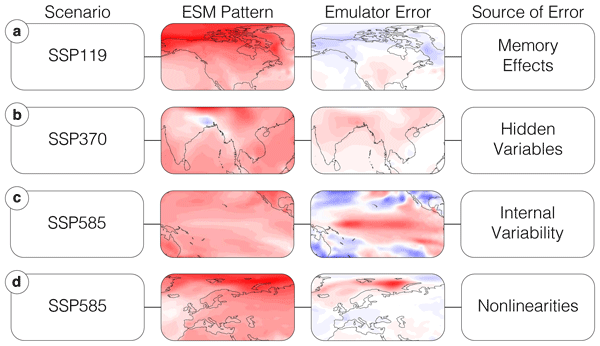
Christopher B. Womack, Glenn Flierl, Shahine Bouabid, Andre N. Souza, Paolo Giani, Sebastian D. Eastham, and Noelle E. Selin
Earth Syst. Dynam., 17, 107–139, https://doi.org/10.5194/esd-17-107-2026, https://doi.org/10.5194/esd-17-107-2026, 2026
Short summary
Short summary
Climate emulators allow for rapid projections without the computational costs associated with full-scale climate models. Here, we outline a framework to compare a variety of emulation techniques both theoretically and practically through a series of stress tests that expose common sources of emulator error. Our results help clarify which emulators are best suited for different tasks and show how future climate scenarios can be used to support emulator design.
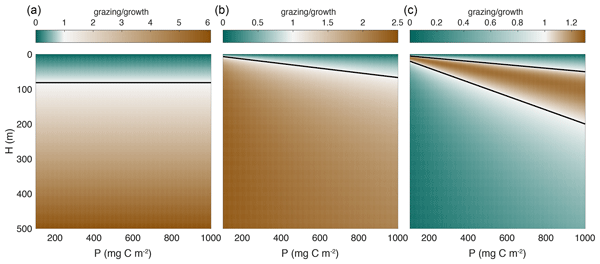
Mara Freilich, Alexandre Mignot, Glenn Flierl, and Raffaele Ferrari
Biogeosciences, 18, 5595–5607, https://doi.org/10.5194/bg-18-5595-2021, https://doi.org/10.5194/bg-18-5595-2021, 2021
Short summary
Short summary
Observations reveal that in some regions phytoplankton biomass increases during the wintertime when growth conditions are sub-optimal, which has been attributed to a release from grazing during mixed layer deepening. Measurements of grazer populations to support this theory are lacking. We demonstrate that a release from grazing when the winter mixed layer is deepening holds only for certain grazing models, extending the use of phytoplankton observations to make inferences about grazer dynamics.
Cited articles
Barnston, A. G. and Livezey, R. E.: Classification, Seasonality and Persistence of Low-Frequency Atmospheric Circulation Patterns, Monthly Weather Review, 115, 1083–1126, https://doi.org/10.1175/1520-0493(1987)115<1083:CSAPOL>2.0.CO;2, 1987a. a
Barnston, A. G. and Livezey, R. E.: Classification, seasonality and persistence of low-frequency atmospheric circulation patterns, Monthly Weather Review, 115, 1083–1126, 1987b. a
Beusch, L., Gudmundsson, L., and Seneviratne, S. I.: Emulating Earth system model temperatures with MESMER: from global mean temperature trajectories to grid-point-level realizations on land, Earth Syst. Dynam., 11, 139–159, https://doi.org/10.5194/esd-11-139-2020, 2020. a, b, c
Bouabid, S., Sejdinovic, D., and Watson-Parris, D.: FaIRGP: A Bayesian energy balance model for surface temperatures emulation, Journal of Advances in Modeling Earth Systems, 16, e2023MS003926, https://doi.org/10.1029/2023MS003926, 2024. a, b, c
Bouabid, S., Souza, A. N., and Ferrari, R.: Score-based generative emulation of impact-relevant Earth system model outputs, arXiv, https://arxiv.org/abs/2510.04358 (last access: 1 July 2025), 2025. a
Bradbury, J., Frostig, R., Hawkins, P., Johnson, M. J., Leary, C., Maclaurin, D., and Wanderman-Milne, S.: JAX: Composable transformations of Python+NumPy programs, GitHub, http://github.com/google/jax (last access: 1 July 2025), 2018. a
Bruckner, T., Hooss, G., Füssel, H.-M., and Hasselmann, K.: Climate system modeling in the framework of the tolerable windows approach: the ICLIPS climate model, Climatic Change, 56, 119–137, 2003. a
Byrne, M. P. and O'Gorman, P. A.: Understanding Decreases in Land Relative Humidity with Global Warming: Conceptual Model and GCM Simulations, Journal of Climate, 29, 9045–9061, https://doi.org/10.1175/JCLI-D-16-0351.1, 2016. a
Christensen, K., Otto, L., Bassetti, S., Tebaldi, C., and Hutchinson, B.: Diffusion-Based Joint Temperature and Precipitation Emulation of Earth System Models, arXiv [preprint], arXiv:2404.08797 (last access: 1 July 2025), 2024. a, b, c
Deser, C., Phillips, A., Bourdette, V., and Teng, H.: Uncertainty in climate change projections: the role of internal variability, Climate Dynamics, 38, 527–546, 2012. a
Dorheim, K., Gering, S., Gieseke, R., Hartin, C., Pressburger, L., Shiklomanov, A. N., Smith, S. J., Tebaldi, C., Woodard, D. L., and Bond-Lamberty, B.: Hector V3.2.0: functionality and performance of a reduced-complexity climate model, Geosci. Model Dev., 17, 4855–4869, https://doi.org/10.5194/gmd-17-4855-2024, 2024. a
Doury, A., Somot, S., Gadat, S., Ribes, A., and Corre, L.: Regional climate model emulator based on deep learning: Concept and first evaluation of a novel hybrid downscaling approach, Climate Dynamics, 60, 1751–1779, 2023. a
Eyring, V., Bony, S., Meehl, G. A., Senior, C. A., Stevens, B., Stouffer, R. J., and Taylor, K. E.: Overview of the Coupled Model Intercomparison Project Phase 6 (CMIP6) experimental design and organization, Geosci. Model Dev., 9, 1937–1958, https://doi.org/10.5194/gmd-9-1937-2016, 2016. a
Falasca, F., Perezhogin, P., and Zanna, L.: Data-driven dimensionality reduction and causal inference for spatiotemporal climate fields, Physical Review E, 109, 044202, https://doi.org/10.1103/PhysRevE.109.044202, 2024. a, b
Falasca, F., Basinski-Ferris, A., Zanna, L., and Zhao, M.: A Fluctuation–Dissipation Theorem Perspective on Radiative Responses to Temperature Perturbations, Journal of Climate, 38, 3239–3260, https://doi.org/10.1175/JCLI-D-24-0479.1, 2025. a, b
Gao, X., Sokolov, A., and Schlosser, C. A.: A Large Ensemble Global Dataset for Climate Impact Assessments, Scientific Data, 10, 801, https://doi.org/10.1038/s41597-023-02708-9, 2023. a
Geogdzhayev, G. and Souza, A.: EarthCovar, Zenodo, https://doi.org/10.5281/zenodo.18391766, 2026. a
Geogdzhayev, G., Souza, A. N., and Ferrari, R.: The evolving butterfly: Statistics in a changing attractor, Physica D: Nonlinear Phenomena, 462, 134107, https://doi.org/10.1016/j.physd.2024.134107, 2024. a
Giani, P., Fiore, A. M., Flierl, G., Ferrari, R., and Selin, N. E.: Origin and limits of invariant warming patterns in climate models, Journal of Climate, e240683, https://doi.org/10.1175/JCLI-D-24-0683.1, 2025. a
Giorgini, L. T., Deck, K., Bischoff, T., and Souza, A.: Response Theory via Generative Score Modeling, Phys. Rev. Lett., 133, 267302, https://doi.org/10.1103/PhysRevLett.133.267302, 2024. a
Gleckler, P. J., Taylor, K. E., and Doutriaux, C.: Performance metrics for climate models, Journal of Geophysical Research: Atmospheres, 113, https://doi.org/10.1029/2007JD008972, 2008. a
Goodwin, P., Leduc, M., Partanen, A.-I., Matthews, H. D., and Rogers, A.: A computationally efficient method for probabilistic local warming projections constrained by history matching and pattern scaling, demonstrated by WASP–LGRTC-1.0, Geosci. Model Dev., 13, 5389–5399, https://doi.org/10.5194/gmd-13-5389-2020, 2020. a
Griffies, S. M., Adcroft, A., and Hallberg, R. W.: A Primer on the Vertical Lagrangian-Remap Method in Ocean Models Based on Finite Volume Generalized Vertical Coordinates, Journal of Advances in Modeling Earth Systems, 12, e2019MS001954, https://doi.org/10.1029/2019MS001954, 2020. a
Guo, S., Wang, J., Xiong, L., Ying, A., and Li, D.: A macro-scale and semi-distributed monthly water balance model to predict climate change impacts in China, Journal of Hydrology, 268, 1–15, 2002. a
Hansen, J., Ruedy, R., Sato, M., and Lo, K.: Global surface temperature change, Reviews of Geophysics, 48, https://doi.org/10.1029/2010RG000345, 2010. a
Hansen, J., Sato, M., and Ruedy, R.: Perception of climate change, Proceedings of the National Academy of Sciences, 109, E2415–E2423, 2012. a
Hausfather, Z., Marvel, K., Schmidt, G. A., Nielsen-Gammon, J. W., and Zelinka, M.: Climate simulations: recognize the 'hot model' problem, Nature, 605, 26–29, 2022. a
Hawkins, E. and Sutton, R.: The potential to narrow uncertainty in regional climate predictions, Bulletin of the American Meteorological Society, 90, 1095–1108, 2009. a
Hawkins, E. and Sutton, R.: The potential to narrow uncertainty in projections of regional precipitation change, Climate Dynamics, 37, 407–418, https://doi.org/10.1007/s00382-010-0810-6, 2011. a
Hawkins, E. and Sutton, R.: Time of emergence of climate signals, Nature Climate Change, 2, 646–649, https://doi.org/10.1038/nclimate1585, 2012. a
Holden, P. B. and Edwards, N. R.: Dimensionally reduced emulation of an AOGCM for application to integrated assessment modelling, Geophysical Research Letters, 37, https://doi.org/10.1029/2010GL045137, 2010. a, b
Holden, P. B., Edwards, N. R., Garthwaite, P. H., and Wilkinson, R. D.: Emulation and interpretation of high-dimensional climate model outputs, Journal of Applied Statistics, 42, 2038–2055, 2015. a
Huntingford, C. and Cox, P.: An analogue model to derive additional climate change scenarios from existing GCM simulations, Climate Dynamics, 16, 575–586, 2000. a
Immorlano, F., Eyring, V., le Monnier de Gouville, T., Accarino, G., Elia, D., Mandt, S., Aloisio, G., and Gentine, P.: Transferring climate change physical knowledge, Proceedings of the National Academy of Sciences, 122, e2413503122, https://doi.org/10.1073/pnas.2413503122, 2025. a
Kingma, D. P. and Ba, J.: Adam: A Method for Stochastic Optimization, arXiv [preprint], arXiv:1412.6980 (last access: 1 July 2025), 2014. a
Kitsios, V., O'Kane, T. J., and Newth, D.: A machine learning approach to rapidly project climate responses under a multitude of net-zero emission pathways, Communications Earth & Environment, 4, 355, https://doi.org/10.1038/s43247-023-01011-0, 2023. a
Kravitz, B. and Snyder, A.: Pangeo-Enabled ESM Pattern Scaling (PEEPS): A customizable dataset of emulated Earth System Model output, PLOS Climate, 2, e0000159, https://doi.org/10.1371/journal.pclm.0000159, 2023. a, b
Kutzbach, J. E.: Empirical eigenvectors of sea-level pressure, surface temperature and precipitation complexes over North America, Journal of Applied Meteorology and Climatology, 6, 791–802, 1967. a
Lai, C.-Y., Hassanzadeh, P., Sheshadri, A., Sonnewald, M., Ferrari, R., and Balaji, V.: Machine Learning for Climate Physics and Simulations, Annual Review of Condensed Matter Physics, 16, 343–365, https://doi.org/10.1146/annurev-conmatphys-043024-114758, 2025. a
Leach, N. J., Jenkins, S., Nicholls, Z., Smith, C. J., Lynch, J., Cain, M., Walsh, T., Wu, B., Tsutsui, J., and Allen, M. R.: FaIRv2.0.0: a generalized impulse response model for climate uncertainty and future scenario exploration, Geosci. Model Dev., 14, 3007–3036, https://doi.org/10.5194/gmd-14-3007-2021, 2021. a
Legates, D. R.: An evaluation of procedures to estimate monthly precipitation probabilities, Journal of Hydrology, 122, 129–140, 1991. a
Lehner, F., Deser, C., Maher, N., Marotzke, J., Fischer, E. M., Brunner, L., Knutti, R., and Hawkins, E.: Partitioning climate projection uncertainty with multiple large ensembles and CMIP5/6, Earth Syst. Dynam., 11, 491–508, https://doi.org/10.5194/esd-11-491-2020, 2020. a
Lembo, V., Lucarini, V., and Ragone, F.: Beyond Forcing Scenarios: Predicting Climate Change through Response Operators in a Coupled General Circulation Model, Scientific Reports, 10, 8668, https://doi.org/10.1038/s41598-020-65297-2, 2020. a
Li, S., Rupp, D. E., Hawkins, L., Mote, P. W., McNeall, D., Sparrow, S. N., Wallom, D. C. H., Betts, R. A., and Wettstein, J. J.: Reducing climate model biases by exploring parameter space with large ensembles of climate model simulations and statistical emulation, Geosci. Model Dev., 12, 3017–3043, https://doi.org/10.5194/gmd-12-3017-2019, 2019. a
Link, R., Snyder, A., Lynch, C., Hartin, C., Kravitz, B., and Bond-Lamberty, B.: Fldgen v1.0: an emulator with internal variability and space–time correlation for Earth system models, Geosci. Model Dev., 12, 1477–1489, https://doi.org/10.5194/gmd-12-1477-2019, 2019. a, b, c
Lorenz, E. N.: Empirical orthogonal functions and statistical weather prediction, vol. 1, Massachusetts Institute of Technology, Department of Meteorology Cambridge, 1956. a
Masson-Delmotte, V., Zhai, P., Pirani, A., Connors, S. L., Péan, C., Berger, S., Caud, N., Chen, Y., Goldfarb, L., Gomis, M. I., Huang, M., Leitzell, K., Lonnoy, E., Matthews, J. B. R., Maycock, T. K., Waterfield, T., Yelekçi, O., Yu, R., and Zhou, B.: Summary for Policymakers, Contribution of Working Group I to the Sixth Assessment Report of the Intergovernmental Panel on Climate Change, Cambridge University Press, Cambridge, United Kingdom, https://www.ipcc.ch/report/ar6/wg1/downloads/report/IPCC_AR6_WGI_SPM.pdf (last access: 1 July 2025), 2021. a, b
Matthews, H. D., Gillett, N. P., Stott, P. A., and Zickfeld, K.: The proportionality of global warming to cumulative carbon emissions, Nature, 459, 829–832, 2009. a
Mauritsen, T., Bader, J., Becker, T., Behrens, J., Bittner, M., Brokopf, R., Brovkin, V., Claussen, M., Crueger, T., Esch, M., et al.: Developments in the MPI-M Earth System Model version 1.2 (MPI-ESM1.2) and its response to increasing CO2, Journal of Advances in Modeling Earth Systems, 11, 998–1038, 2019. a, b
McKinnon, K. A. and Deser, C.: Internal variability and regional climate trends in an observational large ensemble, Journal of Climate, 31, 6783–6802, 2018. a
Meinshausen, M., Raper, S. C. B., and Wigley, T. M. L.: Emulating coupled atmosphere-ocean and carbon cycle models with a simpler model, MAGICC6 – Part 1: Model description and calibration, Atmos. Chem. Phys., 11, 1417–1456, https://doi.org/10.5194/acp-11-1417-2011, 2011. a
Mishra, A. K. and Singh, V. P.: A review of drought concepts, Journal of Hydrology, 391, 202–216, 2010. a
Mitchell, T. D.: Pattern scaling: an examination of the accuracy of the technique for describing future climates, Climatic Change, 60, 217–242, 2003. a
Monahan, A. H., Fyfe, J. C., Ambaum, M. H., Stephenson, D. B., and North, G. R.: Empirical orthogonal functions: The medium is the message, Journal of Climate, 22, 6501–6514, 2009. a
Nath, S., Lejeune, Q., Beusch, L., Seneviratne, S. I., and Schleussner, C.-F.: MESMER-M: an Earth system model emulator for spatially resolved monthly temperature, Earth Syst. Dynam., 13, 851–877, https://doi.org/10.5194/esd-13-851-2022, 2022. a, b, c, d
Odjugo, P. A.: General overview of climate change impacts in Nigeria, Journal of Human Ecology, 29, 47–55, 2010. a
Olonscheck, D., Suarez-Gutierrez, L., Milinski, S., Beobide-Arsuaga, G., Baehr, J., Fröb, F., Ilyina, T., Kadow, C., Krieger, D., Li, H., et al.: The new Max Planck Institute grand ensemble with CMIP6 forcing and high-frequency model output, Journal of Advances in Modeling Earth Systems, 15, e2023MS003790, 2023. a, b
O'Neill, B. C., Tebaldi, C., van Vuuren, D. P., Eyring, V., Friedlingstein, P., Hurtt, G., Knutti, R., Kriegler, E., Lamarque, J.-F., Lowe, J., Meehl, G. A., Moss, R., Riahi, K., and Sanderson, B. M.: The Scenario Model Intercomparison Project (ScenarioMIP) for CMIP6, Geosci. Model Dev., 9, 3461–3482, https://doi.org/10.5194/gmd-9-3461-2016, 2016a. a
O'Neill, B. C., Tebaldi, C., van Vuuren, D. P., Eyring, V., Friedlingstein, P., Hurtt, G., Knutti, R., Kriegler, E., Lamarque, J.-F., Lowe, J., Meehl, G. A., Moss, R., Riahi, K., and Sanderson, B. M.: The Scenario Model Intercomparison Project (ScenarioMIP) for CMIP6, Geosci. Model Dev., 9, 3461–3482, https://doi.org/10.5194/gmd-9-3461-2016, 2016b. a
O'Neill, B. C., M Done, J., Gettelman, A., Lawrence, P., Lehner, F., Lamarque, J.-F., Lin, L., J Monaghan, A., Oleson, K., Ren, X., et al.: The benefits of reduced anthropogenic climate change (BRACE): a synthesis, Climatic Change, 146, 287–301, 2018. a
Osborn, T. J., Wallace, C. J., Harris, I. C., and Melvin, T. M.: Pattern scaling using ClimGen: monthly-resolution future climate scenarios including changes in the variability of precipitation, Climatic Change, 134, 353–369, 2016. a
Peatier, S., Sanderson, B. M., Terray, L., and Roehrig, R.: Investigating parametric dependence of climate feedbacks in the atmospheric component of CNRM-CM6-1, Geophysical Research Letters, 49, e2021GL095084, https://doi.org/10.1029/2021GL095084, 2022. a
Quilcaille, Y., Gudmundsson, L., Beusch, L., Hauser, M., and Seneviratne, S. I.: Showcasing mesmer-x: Spatially resolved emulation of annual maximum temperatures of earth system models, Geophysical Research Letters, 49, e2022GL099012, 2022. a
Quilcaille, Y., Gudmundsson, L., and Seneviratne, S. I.: Extending MESMER-X: a spatially resolved Earth system model emulator for fire weather and soil moisture, Earth Syst. Dynam., 14, 1333–1362, https://doi.org/10.5194/esd-14-1333-2023, 2023. a
Santer, B. D., Wigley, T. M. L., Schlesinger, M. E., and Mitchell, J. F. B.: Developing climate scenarios from equilibrium GCM results, Tech. rep., Max-Planck-Institut für Meteorologie, Hamburg, Germany, 1990. a
Schlenker, W. and Roberts, M. J.: Nonlinear temperature effects indicate severe damages to US crop yields under climate change, Proceedings of the National Academy of Sciences, 106, 15594–15598, 2009. a
Schneider, T., Bischoff, T., and Płotka, H.: Physics of Changes in Synoptic Midlatitude Temperature Variability, Journal of Climate, 28, 2312–2331, https://doi.org/10.1175/JCLI-D-14-00632.1, 2015. a
Schneider, T., Behera, S., Boccaletti, G., Deser, C., Emanuel, K., Ferrari, R., Leung, L. R., Lin, N., Müller, T., Navarra, A., Ndiaye, O., Stuart, A., Tribbia, J., and Yamagata, T.: Harnessing AI and computing to advance climate modelling and prediction, Nature Climate Change, 13, 887–889, https://doi.org/10.1038/s41558-023-01769-3, 2023. a
Schneider, T., Leung, L. R., and Wills, R. C. J.: Opinion: Optimizing climate models with process-knowledge, resolution, and AI, EGUsphere [preprint], https://doi.org/10.5194/egusphere-2024-20, 2024. a
Schär, C., Vidale, P., Lüthi, D., Frei, C., Häberli, C., Liniger, M. A., and Appenzeller, C.: The role of increasing temperature variability in European summer heatwaves, Nature, 427, 332–336, https://doi.org/10.1038/nature02300, 2004. a
Shlens, J.: Notes on kullback-leibler divergence and likelihood, arXiv [preprint], arXiv:1404.2000 (last access: 1 July 2025), 2014. a
Silvestri, S., Wagner, G. L., Campin, J.-M., Constantinou, N. C., Hill, C. N., Souza, A., and Ferrari, R.: A New WENO-Based Momentum Advection Scheme for Simulations of Ocean Mesoscale Turbulence, Journal of Advances in Modeling Earth Systems, 16, e2023MS004130, https://doi.org/10.1029/2023MS004130, 2024. a
Song, Y., Sohl-Dickstein, J., Kingma, D. P., Kumar, A., Ermon, S., and Poole, B.: Score-based generative modeling through stochastic differential equations, arXiv [preprint], arXiv:2011.13456 (last access: 1 July 2025), 2020. a
Souza, A. N.: Representing turbulent statistics with partitions of state space. Part 1. Theory and methodology, Journal of Fluid Mechanics, 997, A1, https://doi.org/10.1017/jfm.2024.658, 2024a. a
Souza, A. N.: Representing turbulent statistics with partitions of state space. Part 2. The compressible Euler equations, Journal of Fluid Mechanics, 997, A2, https://doi.org/10.1017/jfm.2024.657, 2024b. a
Souza, A. N., He, J., Bischoff, T., Waruszewski, M., Novak, L., Barra, V., Gibson, T., Sridhar, A., Kandala, S., Byrne, S., Wilcox, L. C., Kozdon, J., Giraldo, F. X., Knoth, O., Marshall, J., Ferrari, R., and Schneider, T.: The Flux-Differencing Discontinuous Galerkin Method Applied to an Idealized Fully Compressible Nonhydrostatic Dry Atmosphere, Journal of Advances in Modeling Earth Systems, 15, e2022MS003527, https://doi.org/10.1029/2022MS003527, 2023. a
Stéfanon, M., Drobinski, P., d'Andrea, F., and de Noblet-Ducoudré, N.: Effects of interactive vegetation phenology on the 2003 summer heat waves, Journal of Geophysical Research: Atmospheres, 117, https://doi.org/10.1029/2012JD018187, 2012. a
Taylor, M., Caldwell, P., Bertagna, L., Clevenger, C., Donahue, A., Foucar, J., Guba, O., Hillman, B., Keen, N., Krishna, J., Norman, M., Sreepathi, S., Terai, C., White, J. B., Salinger, A. G., McCoy, R. B., y. R. Leung, L., Bader, D. C., and Wu, D.: The Simple Cloud-Resolving E3SM Atmosphere Model Running on the Frontier Exascale System, in: Proceedings of the International Conference for High Performance Computing, Networking, Storage and Analysis, SC '23, Association for Computing Machinery, New York, NY, USA, https://doi.org/10.1145/3581784.3627044, 2023. a
Tebaldi, C. and Arblaster, J. M.: Pattern scaling: Its strengths and limitations, and an update on the latest model simulations, Climatic Change, 122, 459–471, 2014. a
Tebaldi, C. and Friedlingstein, P.: Delayed detection of climate mitigation benefits due to climate inertia and variability, Proceedings of the National Academy of Sciences, 110, 17229–17234, https://doi.org/10.1073/pnas.1300005110, 2013. a
Tebaldi, C. and Knutti, R.: The use of the multi-model ensemble in probabilistic climate projections, Philosophical Transactions of the Royal Society A: Mathematical, Physical and Engineering Sciences, 365, 2053–2075, 2007. a
Tebaldi, C. and Knutti, R.: Evaluating the accuracy of climate change pattern emulation for low warming targets, Environmental Research Letters, 13, 055006, https://doi.org/10.1088/1748-9326/aabef2, 2018. a, b
Tebaldi, C., Debeire, K., Eyring, V., Fischer, E., Fyfe, J., Friedlingstein, P., Knutti, R., Lowe, J., O'Neill, B., Sanderson, B., van Vuuren, D., Riahi, K., Meinshausen, M., Nicholls, Z., Tokarska, K. B., Hurtt, G., Kriegler, E., Lamarque, J.-F., Meehl, G., Moss, R., Bauer, S. E., Boucher, O., Brovkin, V., Byun, Y.-H., Dix, M., Gualdi, S., Guo, H., John, J. G., Kharin, S., Kim, Y., Koshiro, T., Ma, L., Olivié, D., Panickal, S., Qiao, F., Rong, X., Rosenbloom, N., Schupfner, M., Séférian, R., Sellar, A., Semmler, T., Shi, X., Song, Z., Steger, C., Stouffer, R., Swart, N., Tachiiri, K., Tang, Q., Tatebe, H., Voldoire, A., Volodin, E., Wyser, K., Xin, X., Yang, S., Yu, Y., and Ziehn, T.: Climate model projections from the Scenario Model Intercomparison Project (ScenarioMIP) of CMIP6, Earth Syst. Dynam., 12, 253–293, https://doi.org/10.5194/esd-12-253-2021, 2021a. a, b
Tebaldi, C., Dorheim, K., Wehner, M., and Leung, R.: Extreme metrics from large ensembles: investigating the effects of ensemble size on their estimates, Earth Syst. Dynam., 12, 1427–1501, https://doi.org/10.5194/esd-12-1427-2021, 2021b. a, b, c
Tebaldi, C., Snyder, A., and Dorheim, K.: STITCHES: creating new scenarios of climate model output by stitching together pieces of existing simulations, Earth Syst. Dynam., 13, 1557–1609, https://doi.org/10.5194/esd-13-1557-2022, 2022. a
Tebaldi, C., Selin, N., Ferrari, R., and Flierl, G.: Emulators of Climate Model Output, Annual Review of Environment and Resources, 50, 709–737, https://doi.org/10.1146/annurev-environ-012125-085838, 2025. a
Waidelich, P., Batibeniz, F., Rising, J., Kikstra, J. S., and Seneviratne, S. I.: Climate damage projections beyond annual temperature, Nature Climate Change, 1–8, https://doi.org/10.1038/s41558-024-01990-8, 2024. a
Wang, M., Souza, A. N., Ferrari, R., and Sapsis, T.: Stochastic emulators of spatially resolved extreme temperatures of earth system models, Authorea Preprints, 2025. a
Watson-Parris, D., Rao, Y., Olivié, D., Seland, Ø., Nowack, P., Camps-Valls, G., Stier, P., Bouabid, S., Dewey, M., Fons, E., et al.: ClimateBench v1. 0: A benchmark for data-driven climate projections, Journal of Advances in Modeling Earth Systems, 14, e2021MS002954, https://doi.org/10.1029/2021MS002954, 2022. a
Woodruff, S. C.: Planning for an unknowable future: Uncertainty in climate change adaptation planning, Climatic Change, 139, 445–459, 2016. a
Yu, S., Hannah, W., Peng, L., Lin, J., Bhouri, M. A., Gupta, R., Lütjens, B., Will, J. C., Behrens, G., Busecke, J., et al.: ClimSim: A large multi-scale dataset for hybrid physics-ML climate emulation, Advances in Neural Information Processing Systems, 36, https://proceedings.neurips.cc/paper_files/ (last access: 1 July 2025), 2024. a
Yuan, X.-C., Zhang, N., Wang, W.-Z., and Wei, Y.-M.: Large-scale emulation of spatio-temporal variation in temperature under climate change, Environmental Research Letters, 16, 014041, https://doi.org/10.1088/1748-9326/abd213, 2021. a
Zelazowski, P., Huntingford, C., Mercado, L. M., and Schaller, N.: Climate pattern-scaling set for an ensemble of 22 GCMs – adding uncertainty to the IMOGEN version 2.0 impact system, Geosci. Model Dev., 11, 541–560, https://doi.org/10.5194/gmd-11-541-2018, 2018. a
Short summary
Climate models serve as good guesses of how humans affect the climate, but they cannot explore all possible future scenarios of interest. We develop a method that can serve as a fast and cheap stand-in to evaluate likely changes in variables like surface temperature and relative humidity at a regional scale in arbitrary future climates. Crucially, our method captures relationships between different geographic areas and predicts both average values and likely ranges using a unified framework.
Climate models serve as good guesses of how humans affect the climate, but they cannot explore...


Altmetrics
Final-revised paper
Preprint