
the Creative Commons Attribution 4.0 License.
the Creative Commons Attribution 4.0 License.
 | 26 Feb 2026
Challenges and opportunities for understanding societal impacts of climate extremes
Gabriele Messori
Emily Boyd
Joakim Nivre
Elena Raffetti
Climate extremes exact a heavy toll on society, with adverse impacts unequally distributed across populations. In this perspective, we outline key challenges and opportunities for advancing research on understanding societal impacts of climate extremes. We identify three key challenges: limited availability and quality of impact data, difficulties in understanding the processes leading to impacts and lack of reliable impact projections. We argue that there is a window of opportunity to address several dimensions of these challenges, and we highlight recent examples and ongoing developments that hold transformative potential for the research field. We conclude with a call to build momentum by fostering interdisciplinary research and collaboration across sectors.
- Article
(1013 KB) - Full-text XML
- BibTeX
- EndNote


Climate extremes have caused over 2 million fatalities and losses of USD 4.3 trillion globally in the past 5 decades (WMO, 2023). For example, Cyclone Nargis resulted in over 130 000 deaths in Myanmar in 2008 (Fritz et al., 2009), there were over 62 000 heat-related deaths in Europe during summer 2024 (Janoš et al., 2025), and losses from the Los Angeles wildfires in early 2025 are likely to exceed USD 100 billion (Li and Yu, 2025). Reported economic losses are primarily concentrated in developed economies, whereas reported fatalities occur overwhelmingly in developing economies (WMO, 2023). Moreover, climate extremes can trigger a variety of indirect and cascading impacts which are difficult to quantify (e.g. de Brito et al., 2024). Many of these adverse impacts are mediated by societal processes and result from complex cascades of events (e.g. Fritz et al., 2009; Balch et al., 2020; Rusca et al., 2021), whose understanding requires frameworks integrating natural and human systems.
Preparedness measures for climate extremes are saving thousands of lives, yet the cost of climate-related disasters increases steadily (WMO, 2023). This trend is expected to persist in the future, as many climate extremes become more frequent and/or severe due to anthropogenic climate change (Seneviratne et al., 2021). The result is a growing societal and scientific awareness of climate extremes and their impacts. Climate extremes are perceived as the top-ranked global risk in the coming 10 years (WEF, 2025), and the European Union strategy on adaptation to climate change explicitly calls for “more and better data on climate-related risks and losses” (EC, 2021).
Understanding impacts of climate extremes thus holds enormous societal and economic value, and is a key step towards climate resilience and adaptation. Relatively recent research advances include linking forecasts of meteorological or hydrological hazards to the subsequent impacts in support of disaster risk reduction (Merz et al., 2020) and improving the understanding of how the interaction between human and natural systems shapes the characteristics and outcomes of climate extremes (Balch et al., 2020). Nonetheless, there are unique challenges to understanding societal impacts of climate extremes, which hinder progress beyond the current state-of-the-art. In this paper, we outline three key challenges issuing from a natural sciences perspective, and identify opportunities to address them. We conclude with an outlook and a call-to-action to advance interdisciplinary and intersectoral research on societal impacts of climate extremes.
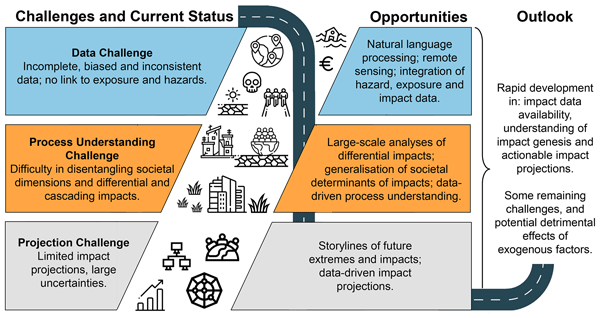
We identify three overarching challenges that hinder progress in understanding past, current and future societal impacts of climate extremes: the impact data challenge; the impact process understanding challenge and the impact projection challenge (Fig. 1).

Figure 1Current challenges facing research on understanding impacts of climate extremes, selected opportunities for a breakthrough and outlook for the field. Icons made by Freepik from http://www.flaticon.com (last access: 12 February 2026).
2.1 Data challenge
The availability and quality of impact data hinders research on impacts of climate extremes. We benefit from extensive in-situ and remote global climate observations, and their assimilation into numerical models enables physically consistent climate datasets – so-called reanalyses – providing uniform global coverage (e.g. Soci et al., 2024). This facilitates the rapid identification and characterisation of hazardous climate extremes. However, compiling the corresponding impact data remains challenging. Most impacts cannot be quantified automatically or remotely, in contrast to how a meteorological station or a satellite may provide quantitative data on climate hazards. Moreover, many categories of societal impacts are not systematically reported. For those that are, the reporting standards can vary widely across countries or even between sources within the same country. For example, heat stress often causes fatalities by exacerbating pre-existing medical conditions, rather than being the primary cause of death. This makes it problematic to rely on cause-of-death records to quantify heat-related mortality (Longden, 2025). Similarly, impact reports for the same event may differ considerably across sources. Heavy rainfall in late 2009 and early 2010 led to severe flooding in the Kilosa district of Tanzania. The International Federation of Red Cross and Red Crescent Societies reported 50 000 people affected and 28 000 rendered homeless (IFRC, 2011). Tanzania's National Disaster Management Strategy instead listed 26 000 people affected by the same event in the same district (United Republic of Tanzania, 2022). These discrepancies are difficult to resolve due to the lack of a reliable ground truth. In the above example, it is in practice impossible to determine with certainty which estimate for the number of affected people is closer to the “true”, yet unknown, figure. As a result, different impact databases often contain conflicting information (Panwar and Sen, 2019), even for well-observed hazards in developed economies (Moemken et al., 2024). Moreover, some indirect or intangible impact categories are inherently hard to quantify. Climate extremes can affect human well-being and recreation (e.g. Niggli et al., 2022; Shyrokaya et al., 2023), but putting a number on these poses a conceptual problem. Additional challenges related to impact data include missing data (Jones et al., 2022, 2023) and non-uniform spatial and temporal data coverage, with a bias towards events in recent decades and in developed economies (Donatti et al., 2024). Finally, many disaster databases provide little or no information on the physical hazard and exposure associated with the reported impacts (Lindersson and Messori, 2025). The above data limitations hinder analyses of vulnerability, evaluation of adaptation measures, quantification of temporal trends in impacts, and the assessment of indirect and intangible impacts of non-economic loss and damage (Preston, 2017). Robust and extensive impact data is also key to effective disaster risk reduction strategies, including impact forecasting systems.
2.2 Process understanding challenge
Elucidating the processes leading to societal impacts of climate extremes can be challenging, even when reliable data on both the hazards and impacts is available. The impacts of a climate extreme often arise from complex interactions between biophysical, technological and societal factors (Balch et al., 2020), and may cascade within and across sectors and regions (de Brito, 2021). An example of the first is how the impacts of heavy precipitation can be radically altered by reservoir management (Di Baldassarre et al., 2017). The failure of the Wivenhoe dam to alleviate the Brisbane floods of 2011 in Australia, due to operation rules prioritising water storage for drought buffering, is a case-in-point. Such societal determinants, which extend to multiple characteristics of human activities, are potentially subject to rapid changes. These can result from the implementation of new policies following catastrophic events (Fouillet et al., 2008), or from personal and cultural behavioural adaptations (Ahmed et al., 2025). An example of cascading impacts is the 2021 Ahr Valley floods in Germany, where flood-induced damage to transportation infrastructure impeded evacuation and restricted access to medical care (de Brito et al., 2024). This cascade was mediated by the characteristics of the built environment, underscoring the complex processes leading to impacts. Moreover, the aggregated impacts for a given event often conceal how structural inequalities and pre-existing vulnerabilities shape differential impacts across populations. During recent droughts in Cape Town and Maputo, water restrictions primarily affected informal settlements and low-income households, while more affluent households experienced comparatively minor impacts (Enqvist and Ziervogel, 2019; Rusca et al., 2024). This disparity is not seen in aggregated water consumption figures. Finally, a given impact can be associated with multiple connected climate hazards, often referred to as compound events (Muheki et al., 2024; Jäger et al., 2025; Worou and Messori, 2025). The deadly 2025 floods in Texas occurred on the background of a severe drought (NOAA, 2025), which decreased the ability of the soil to absorb water. Isolating the role of the extreme rainfall from the preconditioning effect of the drought in causing fatalities is challenging. Further complicating the picture, the connected hazards triggering large impacts can display varying levels of extremity, or in some cases not even be extreme in the statistical sense of the term (Leonard et al., 2014). In 2016, northern France experienced an unprecedented wheat crop loss. This was likely due to a record-low number of cold days during winter, followed by a wet but not record-breaking spring (Pfleiderer et al., 2021). As a result of these complex drivers, crop forecast models at the time were unable to predict the crop loss event (Ben-Ari et al., 2018). The presence of multivariate drivers thus hinders understanding the processes underlying the impacts. The inherent complexity in understanding how and why specific climate extremes and the associated hazards result in societal impacts makes it challenging to generalise studies of vulnerability and mechanistic analyses of impact processes beyond specific locations, extreme event types and time periods. In most cases, researchers must navigate a trade-off between the spatial and temporal scope of a study and the depth of process-level understanding of the impacts.
2.3 Projection challenge
Projections of potential future impacts of climate extremes remain limited, even though such projections are crucial for adaptation planning amid accelerating changes in global climate and in many societies. There is extensive work on projections of future hazards related to climate extremes from global to local scales, chiefly through numerical and data-driven climate and Earth system modelling (e.g. Cook et al., 2020; Zhao et al., 2021; Sangelantoni et al., 2024; Gónzalez-Abad and Gutiérrez, 2025). Considerable work has also been conducted on exposure projections for such hazards (e.g. Thiery et al., 2021; Gampe et al., 2024), and some studies – notably in the field of public health – have also dealt with future societal vulnerability (Lay et al., 2021). Furthermore, there have been coordinated efforts to leverage hazard projections to model the associated impacts. An example is the Inter-Sectoral Impact Model Intercomparison Project (ISIMIP; Frieler et al., 2024). ISIMIP provides valuable insights into the potential implications of future climate extremes. However, in many cases the ISIMIP impact models do not inform on actual impacts, but rather model derived hazards (Messori et al., 2025). An example is flooding. Climate models typically output precipitation, which together with other climate variables is then translated into flooding by hydrological and flood models. However, flooding in itself is not an impact, but rather a hazard derived from precipitation. The impacts would then be for example the number of fatalities, the number of displaced people or the economic losses due to a flood. Moreover, extending the modelling chain from climate models to impact models comes at the cost of amplified uncertainty. Climate models simulate a range of possible future climates, which depend on model uncertainty, scenario uncertainty and internal climate variability (Lehner et al., 2020). Any one of these different future climates can be used to force multiple impact models simulating the same impact (or derived hazard) category, which come with their own model uncertainty. As a result, quantitative impact projections are comparatively rare, and concentrated in specific sectors such as agriculture or public health (e.g. Quijal-Zamorano et al., 2021; Slater et al., 2022), although there are some counterexamples (García-León et al., 2021; Severino et al., 2024). With few exceptions, notably in public health, these impact projections also overlook differential impacts and how the exposure to and impacts of a given event can be modulated by societal characteristics and human activities. This lack of comprehensive and disaggregated impact projections constrains adaptation planning and policymaking, particularly by limiting the ability to quantify the implications of future climate extremes across different regions and populations for diverse socioeconomic development pathways.
Recent methodological and technical developments offer a window of opportunity to address the multiple challenges outlined above (Fig. 1). Some aspects of these challenges, such as the lack of ground truth information for impact data validation, are likely to persist in the future. However, there is considerable potential for rapid progress in several other aspects, which we outline below. This is not intended as a comprehensive review of all recent developments in the literature. Rather, we select some specific examples which we view as potentially transformative for research on understanding societal impacts of climate extremes.
3.1 Enhancing availability and interpretability of impact data
Multiple avenues offer improvements in the availability and interpretability of impact data. A large amount of information on impacts of climate extremes is contained in textual documents, making it difficult to identify and use. Automated extraction of textual information on impacts of climate extremes has been conducted for several years (e.g. de Brito et al., 2020). However, the recent explosive development of large language models enables more extensive and detailed extraction work, including automatically compiling quantitative impact data in a format similar to that of existing manually-compiled impact databases (Li et al., 2024). Related work leveraging natural language processing and machine-learning algorithms, evidences how such tools can elucidate the spatio-temporal dynamics and propagation of impacts of climate extremes (Sodoge et al., 2024). The automated analysis of textual sources comes with both technical challenges and limitations in data quality. Any automated approach, including large language models, can introduce errors in the output, and thus requires robust validation through open and reproducible pipelines. Moreover, even for a “perfect” language model and postprocessing, the data will only be as good as what is in the textual source. Nonetheless, these methods enable the use of previously untapped impact data sources by the research community. Another opportunity is offered by methodological approaches for translating remotely-sensed data to impacts. Night light data has previously been linked to human displacement (Enenkel et al., 2020) and its use was recently extended to estimate multiple dimensions of flood impacts (Hu et al., 2025). Such approaches can help fill coverage gaps in existing impact databases, even in regions where impact reporting is incomplete or absent. A third promising development is the improved potential to connect hazards, exposure and impacts (e.g. Lindersson and Messori, 2025). This is facilitated by recent global climate datasets, with both longer temporal coverage (e.g. Soci et al., 2024) and higher spatial resolution (e.g. Beck et al., 2022) than in the past, and new global high-resolution exposure datasets (e.g. Kummu et al., 2025). Such data enable studying vulnerabilities at regional-to-local scale, while also conducting multi-country analyses. They also support the development of effective impact forecasting.
3.2 Advancing understanding of processes leading to impacts
There are several new opportunities for better understanding the processes leading from climate extremes to societal impacts. First, the improved data availability outlined above supports large-scale analyses which investigate differential impacts (e.g. Wang et al., 2025). These new data also enable highly-resolved analyses of local differential impacts across large numbers of extreme events. A second opportunity comes from the gathered experience of collaboration between the social and natural sciences on impacts of climate extremes. The large number of case studies and theoretical analyses conducted on the topic enable identifying common patterns and generalisable elements, applicable across a broad range of contexts (Rusca et al., 2021; Kuhlicke et al., 2023; Rusca et al., 2023). We particularly highlight recent applications integrating quantitative and qualitative data, through approaches such as system dynamics models and agent-based models (Colon et al., 2021; Mazzoleni et al., 2024). The field of sociohydrology has been pioneering a connected line of work for over a decade (Sivapalan et al., 2014; Di Baldassarre et al., 2015). This has included analyses of how structural inequalities driven by power asymmetries can lead to parts of society having lower adaptive capacity, higher vulnerability and ultimately experiencing larger impacts (e.g. Lindersson et al., 2023). We now see the opportunity for a broader applicability of similar interdisciplinary approaches across multiple climate extremes and impacts. A third promising avenue lies in applying data-driven methods to elucidate how intersecting vulnerabilities (e.g. age, income, ethnicity, legal status) shape differential exposure and impacts of climate extremes. These methods help capture structural inequalities, and have recently been applied in other field such as the study of health risk behaviours (McCabe et al., 2025).
3.3 Innovations in projecting future impacts
We see a strong potential for innovation in projecting future impacts. Quantitative deterministic or probabilistic projections come with inherent limitations. The first risk giving a false sense of certainty, by being “precisely wrong”. The second may not fully characterise uncertainty, and are challenging to interpret and to translate into concrete policy or adaptation actions (Shepherd et al., 2018). There have indeed been claims that a formal probabilistic assessment of the risk associated with climate change is virtually impossible (van den Hurk et al., 2023). While continued development of process-based impact models is valuable, we thus argue for the need to complement such models with non-probabilistic approaches such as “storylines”, namely narratives of plausible future events. Storylines initially focused on physical climate hazards, building on climate model simulations to develop “tales of future weather” (Hazeleger et al., 2015), including plausible outcomes of regional climate change (Levine et al., 2024; Klimiuk et al., 2025). Building on this, the storyline paradigm has been expanded to combine quantitative climate information with the societal factors that shape the impacts of climate extremes (Rusca et al., 2021; van den Hurk et al., 2023). Recent work has developed guidelines for the use of storylines by humanitarian practitioners (Jack et al., 2024), frameworks for plural storylines that incorporate local knowledge and societal justice considerations (Rusca et al., 2024) and storylines that consider the role of infrastructure in modulating future climate impacts (Goulart et al., 2025). The storyline canon thus enables combining the societal dimension and the anthroposphere with projections of future climate extremes, and accounting for multiple hazards, differential vulnerabilities and impacts and complex impact cascades (Rusca et al., 2023; Raffetti et al., 2024). The storylines' usefulness and usability can be maximised by continued cross-pollination among different approaches and research fields (Baulenas et al., 2023). Storylines thus complement quantitative, process-based projections of future impacts of climate extremes by providing situated and actionable information, which is accessible to non-specialist users. Actionable and locally relevant information on future impacts can also be obtained by reversing the conventional impact quantification chain, for example linking specific local climate risk thresholds associated with large impacts to climate change scenarios (Pfleiderer et al., 2025). A radically different, but equally promising opportunity lies in the use of data-driven approaches for estimating future impacts of climate extremes. These have seen relatively widespread adoption in specific subfields, such as for crop yield projections (e.g. Taniushkina et al., 2024), but are yet to be widely implemented for climate-related societal impacts. There is however great potential, including for estimating indirect impacts (e.g. Qiu et al., 2024). A third promising development is the integration of human dynamics in Earth System Models (Tapiador and Navarro, 2024), enabling to resolve the two-way interactions between future climate extremes and societal dynamics, which in turn modulate climate impacts. The above approaches above are highly complementary: storylines provide context-specific and locally grounded insights, while numerical and data-driven impact projections can offer a large-scale perspective. Moreover, the latter can inform the former.
Some of the above opportunities – such as those issuing from the processing of textual data with large language models – are already being exploited. Others – such as the use of high-resolution hazard and exposure data for global intercomparisons of local-scale vulnerability – remain promising possibilities. Even in the first cases, the potential of these new research avenues is far from having been leveraged in full.
Understanding the impacts of climate extremes requires multidisciplinary efforts to account for natural and human systems, and their interplay. The topic holds significant societal and economic value, yet faces distinctive challenges which partly stem from its positioning at the interface of different disciplines. In this paper, we identified three such challenges issuing from a natural sciences perspective: the impact data challenge, the impact process understanding challenge, and the impact projection challenge (Fig. 1). These challenges hinder both scientific development in the field, and the practical usability of research findings.
Nonetheless, we see reason for cautious optimism. Newly released datasets and recent methodological and technical advances open a window of opportunity to address several dimensions of the challenges that we have identified here. Notable examples include extracting impact information from textual sources using large language models and developing impact projections using data-driven approaches. Moreover, interdisciplinary collaborations between the social and natural sciences can elucidate processes underlying past climate impacts and enable building storylines of future societal impacts.
This optimism should however not be naïve. Some dimensions of the challenges that we outline are structural and unlikely to be resolved in the near-term. An example is the lack of ground truth information to validate discrepant impact data. We should also be wary of the “perfect tomorrow” fallacy, namely of delaying investigations indefinitely, waiting for better impact data and analysis tools to become available. While current data and analysis approaches do have limitations, there is much valuable research that can still be performed on understanding societal impacts of climate extremes, even in the absence of major data and methodological developments. Exogenous factors that we have not discussed in detail can also modulate advances in the field. A growing concern is the ongoing privatisation of climate impact data, with the climate risk analytics market growing into a multi-billion dollar industry (Mankin, 2024). The private sector can provide added value to research on climate impacts, but it is important that data developed by the private sector remains accessible for non-commercial research. Else, the risk is that only some parts of society will benefit from it and successfully adapt to future climate extremes, while others may be left behind.
Here, we focused on understanding the societal impacts of climate extremes. However, several of the challenges and opportunities that we outline apply more generally to the study of hazardous environmental events and their impacts on natural and human systems. These hazardous events may or may not be “extreme” in the conventional meaning of the term, and indeed both events of moderate physical magnitude (McPhillips et al., 2018) and slow-onset events (Van Der Geest and Van Den Berg, 2021) can result in large impacts.
A holistic understanding of the multifaceted impacts of climate extremes, of the biophysical, technological and societal factors shaping such impacts, and projections of potential future impacts, are valuable tools to ensure just and resilient societies in the face of a changing climate. We therefore call for building momentum in seizing the many methodological, technical and collaborative opportunities now emerging for a breakthrough in the study of impacts of climate extremes. Achieving meaningful progress will require interdisciplinary and intersectoral research, and strong collaboration across academic, policy and practitioner communities.
No data sets were used in this article.
GM conceived and wrote the original draft, the revised draft and produced the figure. All authors contributed to reviewing and updating the text and figure.
At least one of the (co-)authors is a member of the editorial board of Earth System Dynamics. The peer-review process was guided by an independent editor, and the authors also have no other competing interests to declare.
Publisher's note: Copernicus Publications remains neutral with regard to jurisdictional claims made in the text, published maps, institutional affiliations, or any other geographical representation in this paper. The authors bear the ultimate responsibility for providing appropriate place names. Views expressed in the text are those of the authors and do not necessarily reflect the views of the publisher.
The authors thank the affiliates of the Swedish Centre for Impacts of Climate Extremes (climes), M. M. de Brito and K. Kornhuber for the many discussions on topics related to this perspective, which have helped us to conceptualise the challenges and opportunities that we discuss.
This research has been supported by the Swedish Research Council Vetenskpasrådet (grant nos. 2022-03448 and 2022-06599).
The publication of this article was funded by the Swedish Research Council, Forte, Formas, and Vinnova.
This paper was edited by Axel Kleidon and reviewed by two anonymous referees.
Ahmed, I., van Esch, M. M. E., and van der Hoeven, F. D.: Behavioural adaptation to heatwaves in a temperate city: Insights from Rotterdam, Cities, 165, 106160, https://doi.org/10.1016/j.cities.2025.106160, 2025.
Balch, J. K., Iglesias, V., Braswell, A. E., Rossi, M. W., Joseph, M. B., Mahood, A. L., Shrum, T. R., White, C. T., Scholl, V. M., McGuire, B., Karban, C., Buckland, M., and Travis, W. R.: Social-environmental extremes: Rethinking extraordinary events as outcomes of interacting biophysical and social systems, Earth's Future, 8, e2019EF001319, https://doi.org/10.1029/2019EF001319, 2020.
Baulenas, E., Versteeg, G., Terrado, M., Mindlin, J., and Bojovic, D.: Assembling the climate story: Use of storyline approaches in climate-related science, Global Challenges, 7, 2200183, https://doi.org/10.1002/gch2.202200183, 2023.
Beck, H. E., Van Dijk, A. I. J. M., Larraondo, P. R., McVicar, T. R., Pan, M., Dutra, E., and Miralles, D. G.: MSWX: Global 3-hourly 0.1° bias-corrected meteorological data including near-real-time updates and forecast ensembles, Bull. Am. Meteorol. Soc., 103, E710–E732, 2022.
Ben-Ari, T., Boé, J., Ciais, P., Lecerf, R., Van der Velde, M., and Makowski, D.: Causes and implications of the unforeseen 2016 extreme yield loss in the breadbasket of France, Nat. Commun., 9, 1627, https://doi.org/10.1038/s41467-018-04028-8, 2018.
Colon, C., Hallegatte, S., and Rozenberg, J.: Criticality analysis of a country's transport network via an agent-based supply chain model, Nat. Sustain., 4, 209–215, 2021.
Cook, B. I., Mankin, J. S., Marvel, K., Williams, A. P., Smerdon, J. E., and Anchukaitis, K. J.: Twenty-first century drought projections in the CMIP6 forcing scenarios, Earth's Future, 8, e2019EF001461, https://doi.org/10.1029/2019EF001461, 2020.
Di Baldassarre, G., Viglione, A., Carr, G., Kuil, L., Yan, K., Brandimarte, L., and Blöschl, G.: Debates–Perspectives on socio-hydrology: Capturing feedbacks between physical and social processes, Water Resour. Res., 51, 4770–4781, https://doi.org/10.1002/2015WR017896, 2015.
Di Baldassarre, G., Martinez, F., Kalantari, Z., and Viglione, A.: Drought and flood in the Anthropocene: feedback mechanisms in reservoir operation, Earth Syst. Dynam., 8, 225–233, https://doi.org/10.5194/esd-8-225-2017, 2017.
de Brito, M. M., Kuhlicke, C., and Marx, A.: Near-real-time drought impact assessment: A text mining approach on the 2018/19 drought in Germany, Environ. Res. Lett., 15, 1040a9, 2020.
de Brito, M. M.: Compound and cascading drought impacts do not happen by chance: A proposal to quantify their relationships, Sci. Total Environ., 778, 146236, https://doi.org/10.1016/j.scitotenv.2021.146236, 2021.
de Brito, M. M., Sodoge, J., Fekete, A., Hagenlocher, M., Koks, E. E., Kuhlicke, C., Ward, P. J., Messori, G., de Ruiter, M., Schweizer, P. J., and Ward, P. J.: Uncovering the dynamics of multi-sector impacts of hydrological extremes: A methods overview, Earth's Future, 12, e2023EF003906, https://doi.org/10.1029/2023EF003906, 2024.
Donatti, C. I., Nicholas, K., Fedele, G., Delforge, D., Speybroeck, N., Moraga, P., Blatter, J., Below, R., and Zvoleff, A.: Global hotspots of climate-related disasters, Int. J. Disaster Risk Reduct., 108, 104488, https://doi.org/10.1016/j.ijdrr.2024.104488, 2024
EC: European Commission: EU Adaptation Strategy, European Commission, https://climate.ec.europa.eu/eu-action/adaptation-climate-change/eu-adaptation-strategy_en (last access: 2 July 2025), 2021.
Enenkel, M., Shrestha, R. M., Stokes, E., Roman, M., Wang, Z., Espinosa, M. T. M., Hajzmanova, I., Ginnetti, J., and Vinck, P.: Emergencies do not stop at night: Advanced analysis of displacement based on satellite-derived nighttime light observations, IBM J. Res. Dev., 64, 8:1–8:12, 2020.
Enqvist, J. P. and Ziervogel, G.: Water governance and justice in Cape Town: An overview, WIREs Water, 6, e1354, https://doi.org/10.1002/wat2.1354, 2019.
Fouillet, A., Rey, G., Wagner, V., Laaidi, K., Empereur-Bissonnet, P., Le Tertre, A., Frayssinet, P., Bessemoulin, P., Laurent, F., Jougla, E., and Hémon, D.: Has the impact of heat waves on mortality changed in France since the European heat wave of summer 2003? A study of the 2006 heat wave, Int. J. Epidemiol., 37, 309–317, https://doi.org/10.1093/ije/dym253, 2008.
Frieler, K., Volkholz, J., Lange, S., Schewe, J., Mengel, M., del Rocío Rivas López, M., Otto, C., Reyer, C. P. O., Karger, D. N., Malle, J. T., Treu, S., Menz, C., Blanchard, J. L., Harrison, C. S., Petrik, C. M., Eddy, T. D., Ortega-Cisneros, K., Novaglio, C., Rousseau, Y., Watson, R. A., Stock, C., Liu, X., Heneghan, R., Tittensor, D., Maury, O., Büchner, M., Vogt, T., Wang, T., Sun, F., Sauer, I. J., Koch, J., Vanderkelen, I., Jägermeyr, J., Müller, C., Rabin, S., Klar, J., Vega del Valle, I. D., Lasslop, G., Chadburn, S., Burke, E., Gallego-Sala, A., Smith, N., Chang, J., Hantson, S., Burton, C., Gädeke, A., Li, F., Gosling, S. N., Müller Schmied, H., Hattermann, F., Wang, J., Yao, F., Hickler, T., Marcé, R., Pierson, D., Thiery, W., Mercado-Bettín, D., Ladwig, R., Ayala-Zamora, A. I., Forrest, M., and Bechtold, M.: Scenario setup and forcing data for impact model evaluation and impact attribution within the third round of the Inter-Sectoral Impact Model Intercomparison Project (ISIMIP3a), Geosci. Model Dev., 17, 1–51, https://doi.org/10.5194/gmd-17-1-2024, 2024.
Fritz, H. M., Blount, C. D., Thwin, S., Thu, M. K., and Chan, N.: Cyclone Nargis storm surge in Myanmar, Nat. Geosci., 2, 448–449, https://doi.org/10.1038/ngeo551, 2009.
Gampe, D., Schwingshackl, C., Böhnisch, A., Mittermeier, M., Sandstad, M., and Wood, R. R.: Applying global warming levels of emergence to highlight the increasing population exposure to temperature and precipitation extremes, Earth Syst. Dynam., 15, 589–605, https://doi.org/10.5194/esd-15-589-2024, 2024.
García-León, D., Casanueva, A., Standardi, G., Marra, F., Tejedor, A., and Sanchez, J.: Current and projected regional economic impacts of heatwaves in Europe, Nat. Commun., 12, 5807, https://doi.org/10.1038/s41467-021-26050-z, 2021.
González-Abad, J. and Gutiérrez, J. M.: Are deep learning methods suitable for downscaling global climate projections? An intercomparison for temperature and precipitation over Spain, Artificial Intelligence for the Earth Systems, 4, 240121, https://doi.org/10.1175/AIES-D-24-0121.1, 2025.
Goulart, H. M., Athanasiou, P., van Ginkel, K., van der Wiel, K., Winter, G., Pinto, I., and van den Hurk, B.: Exploring coastal climate adaptation through storylines: Insights from cyclone Idai in Beira, Mozambique, Cell Rep. Sustain., 2, 100194, https://doi.org/10.1016/j.crsus.2024.100270, 2025.
Hazeleger, W., Severijns, C., Semmler, T., Shapiro, M., Huang, B., Selten, F., van den Hurk, B., van Oldenborgh, G., Döscher, R., and Roeckner, E.: Tales of future weather, Nat. Clim. Change, 5, 107–113, https://doi.org/10.1038/nclimate2451, 2015.
Hu, Y., Yamazaki, D., Zhou, X., and Zhao, G.: Flood impact assessment using nighttime light remote sensing data, SSRN [preprint], https://doi.org/10.2139/ssrn.5011700, 2025.
van den Hurk, B. J. J. M., Pacchetti, M. B., Boere, E., Ciullo, A., Coulter, L., Dessai, S., Donnelly, C., Ebi, K. L., Fisher, J. B., and Witpas, K.: Climate impact storylines for assessing socio-economic responses to remote events, Clim. Risk Manage., 40, 100500, https://doi.org/10.1016/j.crm.2023.100500, 2023.
IFRC: International Federation of Red Cross and Red Crescent Societies: Final Report Tanzania: Floods, Emergency appeal no. MDRTZ010 GLIDE no. FL-2009-000264-TZA, https://www.ifrc.org/docs/appeals/10/MDRTZ010fr.pdf (last access: 2 July 2025), 2011.
Jack, C., Korodimou, M., Vogel, M., Heinrich, D., Jaime, C., and El Hajj, R.: Climate risk storylines: Navigating the uncertainties of climate change: Guidelines for humanitarian practitioners, Red Cross Red Crescent Climate Centre, https://www.climatecentre.org/wp-content/uploads/Red-Cross-Red-Crescent-Climate-Impact-Storylines.pdf (last access: 24 February 2026), 2024.
Janoš, T., Quijal-Zamorano, M., Shartova, N., Gallo, E., Méndez Turrubiates, R. F., Beltrán Barrón, D., Vázquez-Armijo, A., and Ballester, J.: Heat-related mortality in Europe during 2024 and health emergency forecasting to reduce preventable deaths, Nat. Med., 1–10, https://doi.org/10.1038/s41591-025-03954-7, 2025.
Jones, R. L., Guha-Sapir, D., and Tubeuf, S.: Human and economic impacts of natural disasters: can we trust the global data?, Sci. Data, 9, 572, https://doi.org/10.1038/s41597-022-01667-x, 2022.
Jones, R. L., Kharb, A., and Tubeuf, S.: The untold story of missing data in disaster research: a systematic review of the empirical literature utilising the Emergency Events Database (EM-DAT), Environ. Res. Lett., 18, 103006, https://doi.org/10.1088/1748-9326/acfd42, 2023.
Jäger, W. S., de Ruiter, M. C., Tiggeloven, T., and Ward, P. J.: What can we learn about multi-hazard impacts from global disaster records?, Nat. Hazards Earth Syst. Sci., 25, 2751–2769, https://doi.org/10.5194/nhess-25-2751-2025, 2025.
Klimiuk, T., Ludwig, P., Sanchez-Benitez, A., Goessling, H. F., Braesicke, P., and Pinto, J. G.: The European summer heatwave of 2019 – a regional storyline perspective, Earth Syst. Dynam., 16, 239–255, https://doi.org/10.5194/esd-16-239-2025, 2025.
Kuhlicke, C., de Brito, M. M., Bartkowski, B., Botzen, W., Doğulu, C., Han, S., Hudson, P., Nuray Karanci, A., Klassert C. J., Otto, D., Scolobig, A., Moreno Soares, T., and Rufat, S.: Spinning in circles? A systematic review on the role of theory in social vulnerability, resilience and adaptation research, Glob. Environ. Change, 80, 102672, https://doi.org/10.1016/j.gloenvcha.2023.102672, 2023.
Kummu, M., Kosonen, M., and Masoumzadeh Sayyar, S.: Downscaled gridded global dataset for gross domestic product (GDP) per capita PPP over 1990–2022, Sci. Data, 12, 178, https://doi.org/10.1038/s41597-025-04487-x, 2025.
Lay, C. R., Sarofim, M. C., Zilberg, A. V., Mills, D. M., Jones, R. W., Schwartz, J., and Kinney, P. L.: City-level vulnerability to temperature-related mortality in the USA and future projections: a geographically clustered meta-regression, Lancet Planet. Health, 5, e338–e346,, 2021.
Lehner, F., Deser, C., Maher, N., Marotzke, J., Fischer, E. M., Brunner, L., Knutti, R., and Hawkins, E.: Partitioning climate projection uncertainty with multiple large ensembles and CMIP5/6, Earth Syst. Dynam., 11, 491–508, https://doi.org/10.5194/esd-11-491-2020, 2020.
Leonard, M., Westra, S., Phatak, A., Lambert, M., van den Hurk, B., McInnes, K., Risbey, J., Schuster, S., Jakob, D., and Stafford-Smith, M.: A compound event framework for understanding extreme impacts, WIREs Clim. Change, 5, 113–128, https://doi.org/10.1002/wcc.245, 2014.
Levine, X. J., Williams, R. S., Marshall, G., Orr, A., Seland Graff, L., Handorf, D., Karpechko, A., Köhler, R., Wijngaard, R. R., Johnston, N., Lee, H., Nieradzik, L., and Mooney, P. A.: Storylines of summer Arctic climate change constrained by Barents–Kara seas and Arctic tropospheric warming for climate risk assessment, Earth Syst. Dynam., 15, 1161–1177, https://doi.org/10.5194/esd-15-1161-2024, 2024
Li, N., Zahra, S., de Brito, M. M., Flynn, C. M., Görnerup, O., Worou, K., Kurfalı, M., Meng, C., Thiery, W., Zscheischler, J., Messori, G., and Nivre, J.: Using LLMs to build a database of climate extreme impacts, Proceedings of NLP meets Climate Change @ ACL 2024, Association for Computational Linguistics, https://doi.org/10.18653/v1/2024.climatenlp-1.7, 2024.
Li, Z. and Yu, W.: Economic impact of the Los Angeles wildfires, Technical Report, UCLA Anderson Forecast, https://www.anderson.ucla.edu/about/centers/ucla-anderson-forecast/economic-impact-los-angeles-wildfires (last access: 19 March 2025), 2025.
Lindersson, S. and Messori, G.: SHEDIS-Temperature: linking temperature-related disaster impacts to subnational data on meteorology and human exposure, Earth Syst. Sci. Data, 17, 6379–6403, https://doi.org/10.5194/essd-17-6379-2025, 2025.
Lindersson, S., Raffetti, E., Rusca, M., Brandimarte, L., Mård, J., and Di Baldassarre, G.: The wider the gap between rich and poor the higher the flood mortality, Nat. Sustain., 6, 995–1005, 2023.
Longden, T.: Underestimating heat-related mortality – a comparison of excess mortality and death record studies for Australia, Lancet Reg. Health West. Pac., 58, 100395, https://doi.org/10.1016/j.lanwpc.2025.101557, 2025.
Mankin, J. S.: The People Have a Right to Climate Data, Int. N.Y. Times, https://www.nytimes.com/2024/01/20/opinion/climate-risk-disasters-data.html (last access: 2 July 2025), 2024.
Mazzoleni, M., Mondino, E., Matanó, A., Van Loon, A. F., and Barendrecht, M. H.: Modelling the role of multiple risk attitudes in implementing adaptation measures to reduce drought and flood losses, J. Hydrol., 636, 131305, https://doi.org/10.1016/j.jhydrol.2024.131305, 2024.
McCabe, C. J., Helm, J. L., Halvorson, M. A., Blaikie, K. J., Lee, C. M., and Rhew, I. C.: Estimating substance use disparities across intersectional social positions using machine learning: An application of group-lasso interaction network, Psychol. Addict. Behav., 39, 113–126, https://doi.org/10.1037/adb0001020, 2025.
McPhillips, L. E., Chang, H., Chester, M. V., Depietri, Y., Friedman, E., Grimm, N. B., Kominoski, J. S., McPhearson, T., Méndez-Lázaro, P., Rosi, E. J., and Shafiei Shiva, J.: Defining extreme events: A cross-disciplinary review, Earth's Future, 6, 441–455, https://doi.org/10.1002/2017EF000632, 2018.
Merz, B., Kuhlicke, C., Kunz, M., Pittore, M., Babeyko, A., Bresch, D. N., Domeisen, D. I. V., Feser, F., Koszalka, I., Kreibich, H., Pantillon, F., Parolai, S., Pinto, J. G., Punge, H. G., Rivalta, E., Schröter, K., Strehlow, K., Weisse, R., and Wurpt, A.: Impact forecasting to support emergency management of natural hazards, Rev. Geophys., 58, e2020RG000704, https://doi.org/10.1029/2020RG000704, 2020.
Messori, G., Muheki, D., Batibeniz, F., Bevacqua, E., Suarez-Gutierrez, L., and Thiery, W.: Global mapping of concurrent hazards and impacts associated with climate extremes under climate change, Earth's Future, 13, e2025EF006325, https://doi.org/10.1029/2025EF006325, 2025.
Moemken, J., Messori, G., and Pinto, J. G.: Windstorm losses in Europe – What to gain from damage datasets, Weather Clim. Extrem., 44, 100661, https://doi.org/10.1016/j.wace.2024.100661, 2024.
Muheki, D., Deijns, A. A. J., Bevacqua, E., Messori, G., Zscheischler, J., and Thiery, W.: The perfect storm? Co-occurring climate extremes in East Africa, Earth Syst. Dynam., 15, 429–466, https://doi.org/10.5194/esd-15-429-2024, 2024.
Niggli, L., Huggel, C., Muccione, V., Neukom, R., and Salzmann, N.: Towards improved understanding of cascading and interconnected risks from concurrent weather extremes: Analysis of historical heat and drought extreme events, PLoS Climate, 1, e0000057, https://doi.org/10.1371/journal.pclm.0000057, 2022.
NOAA: Looking Ahead at Summer Drought in 2025, https://www.drought.gov/news/looking-ahead-summer-drought-2025-05-28 (last access: 16 July 2025), 2025.
Panwar, V. and Sen, S.: Economic impact of natural disasters: An empirical re-examination, Margin J. Appl. Econ. Res., 13, 109–139, 2019.
Pfleiderer, P., Jézéquel, A., Legrand, J., Legrix, N., Markantonis, I., Vignotto, E., and Yiou, P.: Simulating compound weather extremes responsible for critical crop failure with stochastic weather generators, Earth Syst. Dynam., 12, 103–120, https://doi.org/10.5194/esd-12-103-2021, 2021.
Pfleiderer, P., Frölicher, T. L., Kropf, C. M., Lamboll, R. D., Lejeune, Q., Capela Lourenço, T., Maussion, F., McCaughey, J. W., Quilcaille, Y., Rogelj, J., Sanderson, B., Schuster, L., Sillmann, J., Smith, C., Theokritoff, E., and Schleussner, C.-F.: Reversal of the impact chain for actionable climate information, Nat. Geosci., 18, 10–19, https://doi.org/10.1038/s41561-024-01597-w, 2025.
Preston, C. J.: Challenges and opportunities for understanding non-economic loss and damage, Ethics Policy Environ., 20, 143–155, 2017.
Quijal-Zamorano, M., Martínez-Solanas, È., Achebak, H., Petrova, D., Robine, J.-M., Herrmann, F. R., Rodó, X., and Ballester, J.: Seasonality reversal of temperature attributable mortality projections due to previously unobserved extreme heat in Europe, Lancet Planet. Health, 5, e573–e575, https://doi.org/10.1016/S2542-5196(21)00211-4, 2021.
Qiu,M., Li, J., Gould, C. F., Jing, R., Kelp, M., Childs, M., Kiang, M., Heft-Neal, S., Diffenbaugh, N., and Burke, M.: Mortality burden from wildfire smoke under climate change, National Bureau of Economic Research Working Paper No. w32307, National Bureau of Economic Research, https://doi.org/10.3386/w32307, 2024.
Raffetti, E., Ahrne, M., Döring, S., Hagström, A., Mazzoleni, M., Messori, G., Rusca, M., and Zarantonello, L.: Sustainable transformations for healthcare systems in a changing climate, Cell Rep. Sustain., 1, 100339, https://doi.org/10.1016/j.crsus.2024.100054, 2024.
Rusca, M., Messori, G., and Di Baldassarre, G.: Scenarios of human responses to unprecedented social-environmental extreme events, Earth's Future, 9, e2020EF001911, https://doi.org/10.1029/2020EF001911, 2021.
Rusca, M., Savelli, E., Di Baldassarre, Biza. A., and Messori, G..: Unprecedented droughts are expected to exacerbate urban inequalities in Southern Africa, Nat. Clim. Change, 13, 98–105, 2023.
Rusca, M., Sverdlik, A., Acharya, A., Basel, B., Boyd, E., Comelli, T., Dodman, D., Fraser, A., Harris, D. M., Lindersson, S., Mazzoleni, M., Mbah, M. F., Mitlin, D., Ogra, A., Pelling, M., Raffetti, E., Sultana, F., Thompson, E., Tozzi, A., Zwarteveen, M., and Messori, G.: Plural climate storylines to foster just urban futures, Nat. Cities, 1, 732–740, https://doi.org/10.1038/s44284-024-00133-6, 2024.
Sangelantoni, L., Sobolowski, S., Lorenz, T., Hodnebrog, Ø., Cardoso, R. M., Soares, P. M. M., Ferretti, R., Lavín-Gullón, A., Fernandez, J., Goergen, K., Milovac, J., Katragkou, E., Kartsios, S., Coppola, E., Pichelli, E., Adinolfi, M., Mercogliano, P., Berthou, S., de Vries, H., Dobler, A., Belušić, D., Feldmann, H., Tölle, M. H., and Bastin, S.: Investigating the representation of heatwaves from an ensemble of km-scale regional climate simulations within CORDEX-FPS convection, Clim. Dyn., 62, 4635–4671, https://doi.org/10.1007/s00382-023-06769-9, 2024
Seneviratne, S. I., Zhang, X., Adnan, M., Badi, W., Dereczynski, C., Luca, A. D., Ghosh, S., Iskandar, I., Kossin, J., Lewis, S., Otto, F., Pinto, I., Satoh, M., Vicente-Serrano, S. M., Wehner, M., Zhou, B., and Allan, R.: Weather and climate extreme events in a changing climate, in: Masson-Delmotte, V. P., Zhai, A., Pirani, S. L., and Connors, C.: Climate Change 2021: The Physical Science Basis: Working Group I contribution to the Sixth Assessment Report of the Intergovernmental Panel on Climate Change, Cambridge University Press, Cambridge, UK, 1513–1766, https://doi.org/10.1017/9781009157896.013, 2021.
Severino, L. G., Kropf, C. M., Afargan-Gerstman, H., Fairless, C., de Vries, A. J., Domeisen, D. I. V., and Bresch, D. N.: Projections and uncertainties of winter windstorm damage in Europe in a changing climate, Nat. Hazards Earth Syst. Sci., 24, 1555–1578, https://doi.org/10.5194/nhess-24-1555-2024, 2024.
Shepherd, T. G., Boyd, E., Calel, R. A., Chapman, S. C., Dessai, S., Dima-West, I. M., Fowler, H. J., James, R., Maraun, D., Martius, O., Senior, C. A., Sobel, A. H., Stainforth, D. A., Tett, S. F. B., Trenberth, K. E., van den Hurk, B. J. J. M., Watkins, N. W., Wilby, R. L., and Zenghelis, D. A.: Storylines: an alternative approach to representing uncertainty in physical aspects of climate change, Clim. Change, 151, 555–571, https://doi.org/10.1007/s10584-018-2317-9, 2018
Shyrokaya, A., Messori, G., Pechlivanidis, I., Pappenberger, F., Cloke, H. L., and Di Baldassarre, G.: Significant relationships between drought indicators and impacts for the 2018–2019 drought in Germany, Environ. Res. Lett., 19, 014037, https://doi.org/10.1088/1748-9326/ad10d9, 2023.
Sivapalan, M., Konar, M., Srinivasan, V., Chhatre, A., Wutich, A., Scott, C. A., Wescoat, J. L., and Rodríguez-Iturbe, I.: Socio-hydrology: Use-inspired water sustainability science for the Anthropocene, Earth's Future, 2, 225–230, https://doi.org/10.1002/2013EF000164, 2014.
Slater, L. J., Huntingford, C., Pywell, R. F., Redhead, J. W., and Kendon, E. J.: Resilience of UK crop yields to compound climate change, Earth Syst. Dynam., 13, 1377–1396, https://doi.org/10.5194/esd-13-1377-2022, 2022.
Soci, C., Hersbach, H., Simmons, A., Poli, P., Bell, B., Berrisford, P., Horányi, A., Muñoz-Sabater, J., Nicolas, J., Radu, R., Schepers, D., Villaume, S., Haimberger, L., Woollen, J., Buontempo, C., and Thépaut, J.-N.: The ERA5 global reanalysis from 1940 to 2022, Q. J. R. Meteorol. Soc., 150, 764, 4014–4048, https://doi.org/10.1002/qj.4803, 2024.
Sodoge, J., Kuhlicke, C., Mahecha, M. D., and de Brito, M. M.: Text mining uncovers the unique dynamics of socio-economic impacts of the 2018–2022 multi-year drought in Germany, Nat. Hazards Earth Syst. Sci., 24, 1757–1777, https://doi.org/10.5194/nhess-24-1757-2024, 2024.
Tapiador, F. J. and Navarro, A.: Coupling human dynamics with the physics of climate: a path towards Human Earth Systems Models, Environ. Res. Clim., 3, 043001, https://doi.org/10.1088/2752-5295/ad7974, 2024.
Thiery, W., Lange, S., Rogelj, J., Schleussner, C.-F., Gudmundsson, L., Seneviratne, S. I., Andrijevic, M., Frieler, K., Emanuel, K., Geiger, T., Bresch, D. N., Zhao, F., Willner, S. N., Büchner, M., Volkholz, J., Bauer, N., Chang, J., Ciais, P., Dury, M., François, L., Grillakis, M., Gosling, S. N., Hanasaki, N., Hickler, T., Huber, V., Ito, A., Jägermeyr, J., Khabarov, N., Koutroulis, A., Liu, W., Lutz, W., Mengel, M., Müller, C., Ostberg, S., Reyer, C. P. O., Stacke, T., and Wada, Y.: Intergenerational inequities in exposure to climate extremes, Science, 374, 158–160, https://doi.org/10.1126/science.abi7339, 2021
Taniushkina, D., Lukashevich, A., Shevchenko, V., Belalov, I. S., Sotiriadi, N., Narozhnaia, V., Kovalev, K., Krenke, A., Lazarichev, N., Bulkin, A., and Maximov, Y.: Case study on climate change effects and food security in Southeast Asia, Sci. Rep., 14, 16150, https://doi.org/10.1038/s41598-024-65140-y, 2024.
United Republic of Tanzania: National Disaster Management Strategy 2022–2027, Prime Minister's Office, Disaster Management Division, 2022.
Van Der Geest, K. and Van Den Berg, R.: Slow-onset events: a review of the evidence from the IPCC Special Reports on Land, Oceans and Cryosphere, Current Opinion in Environmental Sustainability, 50, 109–120, 2021.
Wang, N., Sun, F., Yang, S., Feng, Y., Sun, H., and Wang, Z.: Flood fatalities and displacement influence human migration in floodplains of developing countries, Commun. Earth Environ., 6, 319, https://doi.org/10.1038/s43247-025-02293-2, 2025.
WEF: World Economic Forum: Global Risks Report 2025, https://reports.weforum.org/docs/WEF_Global_Risks_Report_2025.pdf (last access: 2 July 2025), 2025.
WMO: Atlas of Mortality and Economic Losses from Weather, Climate and Water-related Hazards (1970–2021), WMO-No. 1267, https://wmo.int/publication-series/atlas-of-mortality-and-economic-losses-from-weather-climate-and-water-related-hazards-1970-2021 (last access: 2 July 2025), 2023.
Worou, K. and Messori, G.: Compounding droughts and floods amplify socio-economic impacts, Environ. Res. Lett., 20, 104024, https://doi.org/10.1088/1748-9326/ace30e, 2025.
Wang, N., Sun, F., Yang, S., Feng, Y., Sun, H., and Wang, Z.: Flood fatalities and displacement influence human migration in floodplains of developing countries, Commun. Earth Environ., 6, 319, https://doi.org/10.1038/s43247-025-02293-2, 2025.
Zhao, L., Oleson, K. W., Bou-Zeid, E., Krayenhoff, E. S., Bray, A., Zhu, Q., Zheng, Z., Chen, C., and Oppenheimer, M.: Global multi-model projections of local urban climates, Nat. Clim. Change, 11, 152–157, https://doi.org/10.1038/s41558-020-00958-8, 2021.