
Articles | Volume 17, issue 6
https://doi.org/10.5194/esd-17-1719-2026
© Author(s) 2026. This work is distributed under
the Creative Commons Attribution 4.0 License.
the Creative Commons Attribution 4.0 License.
Special issue:
https://doi.org/10.5194/esd-17-1719-2026
© Author(s) 2026. This work is distributed under
the Creative Commons Attribution 4.0 License.
the Creative Commons Attribution 4.0 License.
Research article
| 
19 Nov 2026
Research article |
| 19 Nov 2026
| 19 Nov 2026
Spatial patterns in indirect effects of human activity on climate, land, and water: comparing top-down and bottom-up clustering approaches

Stockholm Resilience Centre, Stockholm University, Albanovägen 28, 10691 Stockholm, Sweden
Steven J. Lade
Stockholm Resilience Centre, Stockholm University, Albanovägen 28, 10691 Stockholm, Sweden
Fenner School of Environment & Society, Australian National University, Canberra ACT 2600, Australia
C. Kendra Gotangco Gonzales
Fenner School of Environment & Society, Australian National University, Canberra ACT 2600, Australia
Ingo Fetzer
Stockholm Resilience Centre, Stockholm University, Albanovägen 28, 10691 Stockholm, Sweden
Nitin Chaudhary
Stockholm Resilience Centre, Stockholm University, Albanovägen 28, 10691 Stockholm, Sweden
Earth and Environmental Sciences, Lund University, Sölvegatan 12, 22362 Lund, Sweden
Juan C. Rocha
Stockholm Resilience Centre, Stockholm University, Albanovägen 28, 10691 Stockholm, Sweden
Related authors
C. Kendra Gotangco Gonzales, Aryanie Amellina, Nitin Chaudhary, Beatrice Crona, Ingo Fetzer, Tanya Fiedler, Dario Marone, Giorgio Parlato, Juan Carlos Rocha, Lan Wang-Erlandsson, Hannah Zoller, and Steven J. Lade
EGUsphere, https://doi.org/10.5194/egusphere-2026-5352, https://doi.org/10.5194/egusphere-2026-5352, 2026
Short summary
Short summary
The Earth System Impact (ESI) metric scores an organization’s systemic impacts relative to planetary limits for climate, land and freshwater change. Building on a 2021 prototype, the ESI metric draws from the latest boundaries research and updated simulations from a dynamic global vegetation model. Ecosystem coverage is expanded. The ESI scores reflect the sensitivity of small areas to pressures, amplification of impacts due to interactions, and existing transgressions at the sub-global level.
Hannah Zoller, Steven J. Lade, C. Kendra Gotangco Gonzales, Ingo Fetzer, Nitin Chaudhary, and Juan C. Rocha
EGUsphere, https://doi.org/10.5194/egusphere-2025-3341, https://doi.org/10.5194/egusphere-2025-3341, 2025
Preprint archived
Short summary
Short summary
In order to assess the full impact of local human pressures on critical Earth system processes, it is crucial to take account of their biophysical interplay. We provide spatially resolved world maps of interaction strength between the processes of change in carbon dioxide concentration, natural vegetation cover, and surface water runoff. A comparison of the resulting global pattern to established natural partitions of the Earth reveals the risks of current aggregation approaches.
C. Kendra Gotangco Gonzales, Aryanie Amellina, Nitin Chaudhary, Beatrice Crona, Ingo Fetzer, Tanya Fiedler, Dario Marone, Giorgio Parlato, Juan Carlos Rocha, Lan Wang-Erlandsson, Hannah Zoller, and Steven J. Lade
EGUsphere, https://doi.org/10.5194/egusphere-2026-5352, https://doi.org/10.5194/egusphere-2026-5352, 2026
Short summary
Short summary
The Earth System Impact (ESI) metric scores an organization’s systemic impacts relative to planetary limits for climate, land and freshwater change. Building on a 2021 prototype, the ESI metric draws from the latest boundaries research and updated simulations from a dynamic global vegetation model. Ecosystem coverage is expanded. The ESI scores reflect the sensitivity of small areas to pressures, amplification of impacts due to interactions, and existing transgressions at the sub-global level.
Xiaoying Shi, Daniel M. Ricciuto, Yaoping Wang, Joe R. Melton, Fortunat Joos, Yiqi Luo, Xiaofeng Xu, Dafeng Hui, Qianlai Zhuang, Chunjing Qiu, Hongxing He, Siya Shao, Xingjie Lu, Yongjiu Dai, Akihiko Ito, Qing Sun, Nitin Chaudhary, Ayesha Hussain, Mousong Wu, Jian Zhou, Jingwei Zhang, Ye Yuan, Rachael H. Turton, Eleanor J. Burke, Jiafu Mao, Yuefeng Hao, Natalie A. Griffiths, Verity Salmon, Paul J. Hanson, Melanie A. Mayes, and Peter E. Thornton
EGUsphere, https://doi.org/10.5194/egusphere-2026-5193, https://doi.org/10.5194/egusphere-2026-5193, 2026
Short summary
Short summary
Northern peatlands store vast amounts of carbon, but their response to climate change remains uncertain. We compared 15 ecosystem models with observations from a long-term warming and elevated carbon dioxide experiment in Minnesota. Models differed widely in their carbon responses, reflecting differences in ecosystem processes and model parameters. The results identify priorities for improving peatland models and projections of future carbon–climate feedbacks.
John M. Anderies, Max Bechthold, Jonathan F. Donges, Ingo Fetzer, Nico Wunderling, Wolfram Barfuss, and Johan Rockström
EGUsphere, https://doi.org/10.5194/egusphere-2025-6345, https://doi.org/10.5194/egusphere-2025-6345, 2026
Short summary
Short summary
This paper explores a new approach to understanding human-Earth system resilience. It introduces a measure that estimates how likely a system is to reach a safe and just state. Available knowledge about how the system works, its boundaries, and potential disruptions centrally constrain the measure. It could help decision-makers strike a balance between gaining knowledge, building capacity to act, and taking practical measures to improve resilience in many different types of systems.
Nielja Knecht, Romi Amilia Lotcheris, Ingo Fetzer, and Juan Rocha
EGUsphere, https://doi.org/10.5194/egusphere-2025-4902, https://doi.org/10.5194/egusphere-2025-4902, 2025
Preprint archived
Short summary
Short summary
Forests worldwide are increasingly dying from droughts and heatwaves, but predicting such events remains difficult. Using global forest mortality records and satellite time series, we assess several statistical Early Warning Signals. Despite their widespread application, we find these signals do not reliably predict mortality and are mostly influenced by methodological choices. We call for caution in applying overly simplified indicators and outline directions for improving future warning tools.
Hannah Zoller, Steven J. Lade, C. Kendra Gotangco Gonzales, Ingo Fetzer, Nitin Chaudhary, and Juan C. Rocha
EGUsphere, https://doi.org/10.5194/egusphere-2025-3341, https://doi.org/10.5194/egusphere-2025-3341, 2025
Preprint archived
Short summary
Short summary
In order to assess the full impact of local human pressures on critical Earth system processes, it is crucial to take account of their biophysical interplay. We provide spatially resolved world maps of interaction strength between the processes of change in carbon dioxide concentration, natural vegetation cover, and surface water runoff. A comparison of the resulting global pattern to established natural partitions of the Earth reveals the risks of current aggregation approaches.
Arne Tobian, Sarah Cornell, Ingo Fetzer, Dieter Gerten, and Johan Rockström
EGUsphere, https://doi.org/10.5194/egusphere-2025-2202, https://doi.org/10.5194/egusphere-2025-2202, 2025
Short summary
Short summary
The land use change reallocation tool LUCATOO enables the creation of future land use change scenario datasets tailored to specific requirements in model study applications. Its usability is demonstrated in the planetary boundaries interaction context. Being written in the programming language R and made openly accessible, LUCATOO can be easily adapted to be employed in contexts other than the planetary boundaries framework.
Paul Pearce-Kelly, Andrew H. Altieri, John F. Bruno, Christopher E. Cornwall, Melanie McField, Aarón Israel Muñiz-Castillo, Juan Rocha, Renee O. Setter, Charles Sheppard, Rosa Maria Roman-Cuesta, and Chris Yesson
Earth Syst. Dynam., 16, 275–292, https://doi.org/10.5194/esd-16-275-2025, https://doi.org/10.5194/esd-16-275-2025, 2025
Short summary
Short summary
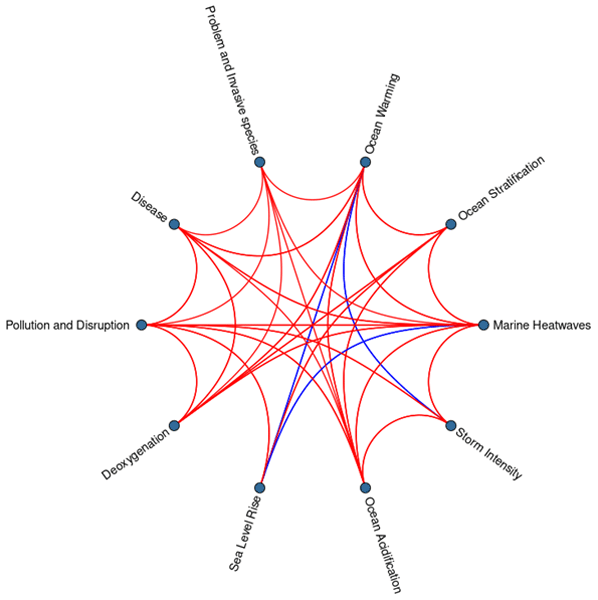
Coral reefs face unprecedented threats from multiple stressors, many of which are linked to human activities. Some stressors have tipping points that, if exceeded, could cause coral collapse. These include temperatures rising 1.2 °C above pre-industrial levels and atmospheric CO2 above 350 parts per million. Uncertainty remains for these thresholds; many stressors interact in ways we do not understand. It is important to study these and employ a precautionary principle when planning our actions.
Chandrakant Singh, Ruud van der Ent, Ingo Fetzer, and Lan Wang-Erlandsson
Earth Syst. Dynam., 15, 1543–1565, https://doi.org/10.5194/esd-15-1543-2024, https://doi.org/10.5194/esd-15-1543-2024, 2024
Short summary
Short summary
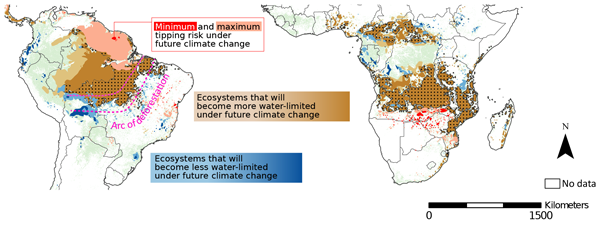
Tropical rainforests risk tipping to savanna under future climate change. By analysing ecosystem root zone dynamics using hydroclimate data from Earth system models, we project the tipping risks for these rainforests. Our findings suggest that although some transition risks may be inevitable, most can still be mitigated by adapting to less severe climate change scenarios. Limiting global surface temperatures to meet the Paris Agreement targets is critical to preserving these ecosystems.
Laura M. Pereira, Ignacio Gianelli, Therezah Achieng, Diva Amon, Sally Archibald, Suchinta Arif, Azucena Castro, Tapiwa Prosper Chimbadzwa, Kaera Coetzer, Tracy-Lynn Field, Odirilwe Selomane, Nadia Sitas, Nicola Stevens, Sebastian Villasante, Mohammed Armani, Duncan M. Kimuyu, Ibukun J. Adewumi, David M. Lapola, David Obura, Patricia Pinho, Felipe Roa-Clavijo, Juan Rocha, and U. Rashid Sumaila
Earth Syst. Dynam., 15, 341–366, https://doi.org/10.5194/esd-15-341-2024, https://doi.org/10.5194/esd-15-341-2024, 2024
Short summary
Short summary
Narratives around tipping points, such as the need for
positivetipping points in energy transitions to avoid
negativeEarth system tipping points, do not take into account the entire spectrum of impacts the proposed interventions could have or still rely on narratives that maintain current unsustainable behaviours and marginalize many people. We unpack these ideas in the context of what they mean for the concept of tipping points, using a critical decolonial view from the Global South.
Nico Wunderling, Anna S. von der Heydt, Yevgeny Aksenov, Stephen Barker, Robbin Bastiaansen, Victor Brovkin, Maura Brunetti, Victor Couplet, Thomas Kleinen, Caroline H. Lear, Johannes Lohmann, Rosa Maria Roman-Cuesta, Sacha Sinet, Didier Swingedouw, Ricarda Winkelmann, Pallavi Anand, Jonathan Barichivich, Sebastian Bathiany, Mara Baudena, John T. Bruun, Cristiano M. Chiessi, Helen K. Coxall, David Docquier, Jonathan F. Donges, Swinda K. J. Falkena, Ann Kristin Klose, David Obura, Juan Rocha, Stefanie Rynders, Norman Julius Steinert, and Matteo Willeit
Earth Syst. Dynam., 15, 41–74, https://doi.org/10.5194/esd-15-41-2024, https://doi.org/10.5194/esd-15-41-2024, 2024
Short summary
Short summary
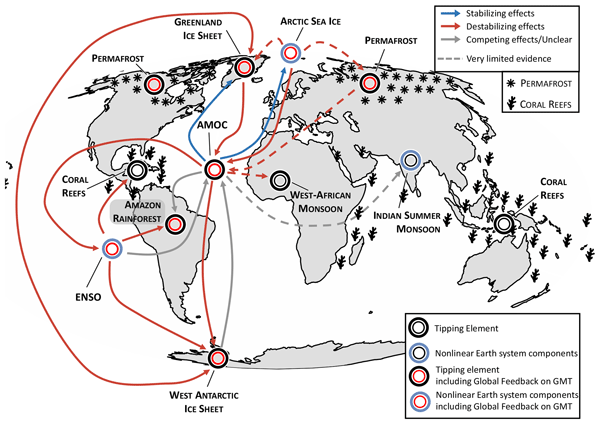
This paper maps out the state-of-the-art literature on interactions between tipping elements relevant for current global warming pathways. We find indications that many of the interactions between tipping elements are destabilizing. This means that tipping cascades cannot be ruled out on centennial to millennial timescales at global warming levels between 1.5 and 2.0 °C or on shorter timescales if global warming surpasses 2.0 °C.
Sebastian Westermann, Thomas Ingeman-Nielsen, Johanna Scheer, Kristoffer Aalstad, Juditha Aga, Nitin Chaudhary, Bernd Etzelmüller, Simon Filhol, Andreas Kääb, Cas Renette, Louise Steffensen Schmidt, Thomas Vikhamar Schuler, Robin B. Zweigel, Léo Martin, Sarah Morard, Matan Ben-Asher, Michael Angelopoulos, Julia Boike, Brian Groenke, Frederieke Miesner, Jan Nitzbon, Paul Overduin, Simone M. Stuenzi, and Moritz Langer
Geosci. Model Dev., 16, 2607–2647, https://doi.org/10.5194/gmd-16-2607-2023, https://doi.org/10.5194/gmd-16-2607-2023, 2023
Short summary
Short summary
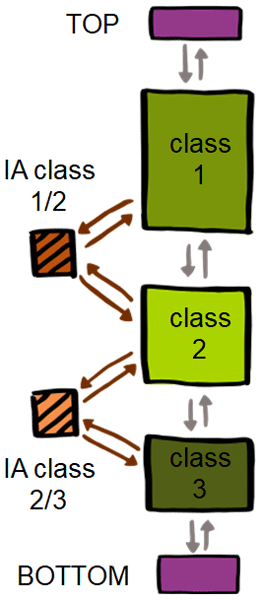
The CryoGrid community model is a new tool for simulating ground temperatures and the water and ice balance in cold regions. It is a modular design, which makes it possible to test different schemes to simulate, for example, permafrost ground in an efficient way. The model contains tools to simulate frozen and unfrozen ground, snow, glaciers, and other massive ice bodies, as well as water bodies.
Cited articles
Betts, R., Boucher, O., Collins, M., Cox, P., Falloon, P., Gedney, N., Hemming, D., Huntingford, C., Jones, C., Sexton, D., and Webb, M.: Projected Increase in Continental Runoff Due to Plant Responses to Increasing Carbon Dioxide, Nature, 448, 1037–41, https://doi.org/10.1038/nature06045, 2007. a
Chavent, M., Kuentz-Simonet, V., Labenne, A., and Saracco, J.: ClustGeo: an R package for hierarchical clustering with spatial constraints, Computation. Stat., 33, 1799–1822, https://doi.org/10.1007/s00180-018-0791-1, 2018. a, b, c
Chen, J., Lei, C., Chu, H., Li, X., Torn, M., Wang, Y., Sciusco, P., and Robertson, G.: Overlooked cooling effects of albedo in terrestrial ecosystems, Environ. Res. Lett., 19, 093001, https://doi.org/10.1088/1748-9326/ad661d, 2024. a
Cramer, W., Bondeau, A., Woodward, I., Prentice, I., Betts, R., Brovkin, V., Cox, P., Fisher, V., Foley, J., Friend, A., Kucharik, C., Lomas, M., Ramankutty, N., Sitch, S., Smith, B., White, A., and Young-Molling, C.: Global response of terrestrial ecosystem structure and function to CO2 and climate change: Results from six dynamic global vegetation models, Glob. Change Biol., 7, 357–373, https://doi.org/10.1046/j.1365-2486.2001.00383.x, 2001. a
Dinerstein, E., Olson, D. P., Graham, D. J., Webster, A. L., Primm, S. A., Bookbinder, M. P., and Ledec, G. C.: A Conservation Assessment of the Terrestrial Ecoregions of Latin America and the Caribbean, Environ. Conserv., 23, 378–379, https://api.semanticscholar.org/CorpusID:131043914 (last access: 13 November 2026), 1995. a, b
Dinerstein, E., Olson, D., Joshi, A., Vynne, C., Burgess, N. D., Wikramanayake, E., Hahn, N., Palminteri, S., Hedao, P., Noss, R., Hansen, M., Locke, H., Ellis, E. C., Jones, B., Barber, C. V., Hayes, R., Kormos, C., Martin, V., Crist, E., Sechrest, W., Price, L., Baillie, J. E. M., Weeden, D., Suckling, K., Davis, C., Sizer, N., Moore, R., Thau, D., Birch, T., Potapov, P., Turubanova, S., Tyukavina, A., de Souza, N., Pintea, L., Brito, J. C., Llewellyn, O. A., Miller, A. G., Patzelt, A., Ghazanfar, S. A., Timberlake, J., Klöser, H., Shennan-Farpón, Y., Kindt, R., Lillesø, J.-P. B., van Breugel, P., Graudal, L., Voge, M., Al-Shammari, K. F., and Saleem, M.: Ecoregions2017 © Resolve, https://ecoregions.appspot.com/ (last access: 28 February 2025), 2017. a, b
Drüke, M., Lucht, W., von Bloh, W., Petri, S., Sakschewski, B., Tobian, A., Loriani, S., Schaphoff, S., Feulner, G., and Thonicke, K.: The long-term impact of transgressing planetary boundaries on biophysical atmosphere–land interactions, Earth Syst. Dynam., 15, 467–483, https://doi.org/10.5194/esd-15-467-2024, 2024. a
Guo, R., Chen, T., Chen, X., Yuan, W., Liu, S., He, B., Li, L., Wang, S., Hu, T., Yan, Q., Wei, X., and Dai, J.: Estimating Global GPP From the Plant Functional Type Perspective Using a Machine Learning Approach, J. Geophys. Res.-Biogeo., 128, e2022JG007100, https://doi.org/10.1029/2022JG007100, 2023. a
Gupta, J., Bai, X., Liverman, D. M., Rockström, J., Qin, D., and Stewart-Koste, B.: A just world on a safe planet: a Lancet Planetary Health–Earth Commission report on Earth-system boundaries, translations, and transformations, The Lancet Planetary Health, 8, https://doi.org/10.1016/S2542-5196(24)00042-1, 2024. a
Harris, I.: CRU TS3.21: Climatic Research Unit (CRU) Time-Series (TS) Version 3.21 of High Resolution Gridded Data of Month-by-month Variation in Climate (Jan. 1901–Dec. 2012), NCAS British Atmospheric Data Centre [data set], https://doi.org/10.5285/D0E1585D-3417-485F-87AE-4FCECF10A992, 2013. a, b
Harris, I., Jones, P., Osborn, T., and Lister, D.: Updated high-resolution grids of monthly climatic observations – the CRU TS3.10 Dataset, Int. J. Climatol., 34, 623–642, https://doi.org/10.1002/joc.3711, 2014. a, b, c, d
Hasler, N., Williams, C. A., Carrasco Denney, V., Ellis, P. W., Shrestha, S., Terasaki Hart, D. E., Wolff, N. H., Yeo, S., Crowther, T. W., Werden, L. K., and Cook-Patton, S. C.: Accounting for albedo change to identify climate-positive tree cover restoration, Nat. Commun., 15, 2275, https://doi.org/10.1038/s41467-024-46577-1, 2024. a
Ito, A. and Inatomi, M.: Water-Use Efficiency of the Terrestrial Biosphere: A Model Analysis Focusing on Interactions between the Global Carbon and Water Cycles, J. Hydrometeorol., 13, 681–694, https://doi.org/10.1175/JHM-D-10-05034.1, 2012. a
Jong, R., Schaepman, M., Furrer, R., de Bruin, S., and Verburg, P.: Spatial relationship between climatologies and changes in global vegetation activity, Glob. Change Biol., 19, https://doi.org/10.1111/gcb.12193, 2013. a
Koirala, S., Jung, M., Reichstein, M., de Graaf, I. E. M., Camps-Valls, G., Ichii, K., Papale, D., Ráduly, B., Schwalm, C. R., Tramontana, G., and Carvalhais, N.: Global distribution of groundwater-vegetation spatial covariation, Geophys. Res. Lett., 44, 4134–4142, https://doi.org/10.1002/2017GL072885, 2017. a
Kottek, M., Grieser, J., Beck, C., Rudolf, B., and Rubel, F.: World Map of the Köppen-Geiger Climate Classification Updated, Meteorol. Z., 15, 259–263, https://doi.org/10.1127/0941-2948/2006/0130, 2006. a, b
Lade, S., Steffen, W., Vries, W., Carpenter, S., Donges, J., Gerten, D., Hoff, H., Newbold, T., Richardson, K., and Rockström, J.: Human impacts on planetary boundaries amplified by Earth system interactions, Nature Sustainability, 3, 119–128, https://doi.org/10.1038/s41893-019-0454-4, 2020. a
Lade, S. J., Fetzer, I., Cornell, S. E., and Crona, B.: Prototype Earth system impact metric: code and data, Zenodo [code and data set], https://doi.org/10.5281/zenodo.4738009, 2021a. a, b
Luo, Y., Gerten, D., le Maire, G., Parton, W., Weng, E., Zhou, X., Keough, C., Beier, C., Ciais, P., Cramer, W., Dukes, J., Emmett, B., Hanson, P., Knapp, A., Linder, S., Nepstad, D., and Rustad, L.: Modeled Interactive Effects of Precipitation, temperature, and [CO2] on Ecosystem Carbon and Water Dynamics in Different Climatic Zones, Glob. Change Biol., 14, 1986–1999, https://doi.org/10.1111/j.1365-2486.2008.01629.x, 2008. a
Mohamed, A., DeClerck, F., Verburg, P. H., Obura, D., Abrams, J. F., Zafra-Calvo, N., Rocha, J., Estrada-Carmona, N., Fremier, A., Jones, S. K., Meier, I. C., and Stewart-Koster, B.: Securing Nature’s Contributions to People requires at least 20 %–25 % (semi-)natural habitat in human-modified landscapes, One Earth, 7, 59–71, https://doi.org/10.1016/j.oneear.2023.12.008, 2024. a
Ostberg, S., Lucht, W., Schaphoff, S., and Gerten, D.: Critical impacts of global warming on land ecosystems, Earth Syst. Dynam., 4, 347–357, https://doi.org/10.5194/esd-4-347-2013, 2013. a, b
Page, J., Abramowitz, G., De Kauwe, M., and Pitman, A.: Are Plant Functional Types Fit for Purpose?, Geophys. Res. Lett., 51, https://doi.org/10.1029/2023GL104962, 2023. a, b
Piao, S., Friedlingstein, P., Ciais, P., de Noblet-Ducoudré, N., Labat, D., and Zaehle, S.: Changes in climate and land use have a larger direct impact than rising CO2 on global river runoff trends, P. Natl. Acad. Sci. USA, 104, 15242–15247, https://doi.org/10.1073/pnas.0707213104, 2007. a, b, c, d
Priesner, J., Hötten, D., Schötz, D., Tietjen, B., Gelbrecht, M., Billing, M., Stenzel, F., and Thonicke, K.: Reducing the computational cost of dynamic global vegetation models with locally weighted hierarchical clustering, The European Physical Journal Special Topics, https://doi.org/10.1140/epjs/s11734-026-02526-1 , 2026. a
Richardson, K., Steffen, W., Lucht, W., Bendtsen, J., Cornell, S. E., Donges, J. F., Drüke, M., Fetzer, I., Bala, G., von Bloh, W., Feulner, G., Fiedler, S., Gerten, D., Gleeson, T., Hofmann, M., Huiskamp, W., Kummu, M., Mohan, C., Nogués-Bravo, D., Petri, S., Porkka, M., Rahmstorf, S., Schaphoff, S., Thonicke, K., Tobian, A., Virkki, V., Wang-Erlandsson, L., Weber, L., and Rockström, J.: Earth beyond six of nine planetary boundaries, Science Advances, 9, eadh2458, https://doi.org/10.1126/sciadv.adh2458, 2023. a
Runge, J., Bathiany, S., Bollt, E., Camps-Valls, G., Coumou, D., Deyle, E., Glymour, D., Kretschmer, M., Mahecha, M., Muñoz-Marí, J., van Nes, E., Peters, J., Quax, R., Reichstein, M., Scheffer, M., Schölkopf, B., Spirtes, P., Sugihara, G., Su, J., Zhang, K., and Zscheischler, J.: Inferring causation from time series in Earth system sciences, Nat. Commun., 10, 2553, https://doi.org/10.1038/s41467-019-10105-3, 2019. a
Schaphoff, S., von Bloh, W., Rammig, A., Thonicke, K., Biemans, H., Forkel, M., Gerten, D., Heinke, J., Jägermeyr, J., Langerwisch, F., Lucht, W., Rolinski, S., Waha, K., Ostberg, S., Wirth, S. B., Fader, M., Drüke, M., Jans, Y., Lutz, F., Herzfeld, T., Minoli, S., Porwollik, V., Stehfest, E., de Waal, L., Beringer (Erbrecht), T., Rost (Jachner), S., Gumpenberger, M., Heyder, U., Werner, C., Braun, J., Breier, J., Stenzel, F., Mathesius, S., Hemmen, M., Billing, M., Oberhagemann, L., Sakschewski, B., Hötten, D., and Müller, C.: compilation_of_land_use_datasets - PIK-LPJmL/LPJmL GitHub Wiki, GitHub [code], https://github-wiki-see.page/m/PIK-LPJmL/LPJmL/wiki/compilation_of_land_use_datasets (last access: 18 November 2026), 2018a. a
Schaphoff, S., von Bloh, W., Rammig, A., Thonicke, K., Biemans, H., Forkel, M., Gerten, D., Heinke, J., Jägermeyr, J., Knauer, J., Langerwisch, F., Lucht, W., Müller, C., Rolinski, S., and Waha, K.: LPJmL4 – a dynamic global vegetation model with managed land – Part 1: Model description, Geosci. Model Dev., 11, 1343–1375, https://doi.org/10.5194/gmd-11-1343-2018, 2018b. a, b
Sterling, S., Ducharne, A., and Polcher, J.: The impact of global land-cover change on the terrestrial water cycle, Nat. Clim. Change, 3, 385–390, https://doi.org/10.1038/nclimate1690, 2013. a, b, c
Terrer, C., Jackson, R. B., Prentice, I. C., Keenan, T. F., Kaiser, C., Vicca, S., Fisher, J. B., Reich, P. B., Stocker, B. D., Hungate, B. A., Peñuelas, J., McCallum, I., Soudzilovskaia, N. A., Cernusak, L. A., Talhelm, A. F., Van Sundert, K., Piao, S., Newton, P. C. D., Hovenden, M. J., Blumenthal, D. M., Liu, Y. Y., Müller, C., Winter, K., Field, C. B., Viechtbauer, W., Van Lissa, C. J., Hoosbeek, M. R., Watanabe, M., Koike, T., Leshyk, V. O., Wayne Polley, H., and Franklin, O.: Nitrogen and phosphorus constrain the CO2 fertilization of global plant biomass, Nat. Clim. Change, 9, 684–689, https://doi.org/10.1038/s41558-019-0545-2, 2019. a
Tobian, A., Gerten, D., Fetzer, I., Schaphoff, S., Andersen, L., Cornell, S., and Rockström, J.: Climate change critically affects the status of the land-system change planetary boundary, Environ. Res. Lett., 19, https://doi.org/10.1088/1748-9326/ad40c2, 2024. a
Todeschini, R., Ballabio, D., Termopoli, V., and Consonni, V.: Extended multivariate comparison of 68 cluster validity indices. A review, Chemometr. Intell. Lab., 251, 105117, https://doi.org/10.1016/j.chemolab.2024.105117, 2024. a, b
Trewin, B.: Assessing Internal Variability of Global Mean Surface Temperature From Observational Data and Implications for Reaching Key Thresholds, J. Geophys. Res.-Atmos., 127, e2022JD036747, https://doi.org/10.1029/2022JD036747, 2022. a
Udvardy, M.: A Classification of the Biogeographical Provinces of the World, International Union for Conservation of Nature and Natural Resources, https://portals.iucn.org/library/sites/library/files/documents/OP-018.pdf (last access: 13 November 2026), 1975. a
Short summary
Human pressures on one Earth system component typically entail indirect effects on other components. The strength of such effects can show a high spatial variation and corresponding studies often report them by climate- or vegetation zone. We systematically compare the ability of different aggregation approaches to capture the spatial pattern of indirect effects. Our results provide a reference point and highlight the risk of information loss inherent in commonly used aggregation approaches.
Human pressures on one Earth system component typically entail indirect effects on other...


Special issue
Altmetrics
Final-revised paper
Preprint