
Articles | Volume 17, issue 1
https://doi.org/10.5194/esd-17-151-2026
© Author(s) 2026. This work is distributed under
the Creative Commons Attribution 4.0 License.
the Creative Commons Attribution 4.0 License.
https://doi.org/10.5194/esd-17-151-2026
© Author(s) 2026. This work is distributed under
the Creative Commons Attribution 4.0 License.
the Creative Commons Attribution 4.0 License.
Research article
| Highlight paper
| 
03 Feb 2026
Research article | Highlight paper |
| 03 Feb 2026
| 03 Feb 2026
The largest crop production shocks: magnitude, causes and frequency
Florian Ulrich Jehn
CORRESPONDING AUTHOR

Alliance to Feed the Earth in Disasters (ALLFED), Lafayette, CO, USA
Societal Dynamics (SoDy)
Center for Critical Computational Studies (CS), Goethe University Frankfurt, Frankfurt am Main, Germany
James Mulhall
Alliance to Feed the Earth in Disasters (ALLFED), Lafayette, CO, USA
Simon Blouin
Alliance to Feed the Earth in Disasters (ALLFED), Lafayette, CO, USA
Łukasz G. Gajewski
Alliance to Feed the Earth in Disasters (ALLFED), Lafayette, CO, USA
Nico Wunderling
CORRESPONDING AUTHOR
Center for Critical Computational Studies (CS), Goethe University Frankfurt, Frankfurt am Main, Germany
Earth Resilience Science Unit, Potsdam Institute for Climate Impact Research (PIK), Member of the Leibniz Association, Potsdam, Germany
High Meadows Environmental Institute, Princeton University, Princeton, NJ, USA
Related authors
Florian Ulrich Jehn, Łukasz G. Gajewski, Johanna Hedlund, Constantin W. Arnscheidt, Lili Xia, Nico Wunderling, and David Denkenberger
Earth Syst. Dynam., 16, 1585–1603, https://doi.org/10.5194/esd-16-1585-2025, https://doi.org/10.5194/esd-16-1585-2025, 2025
Short summary
Short summary
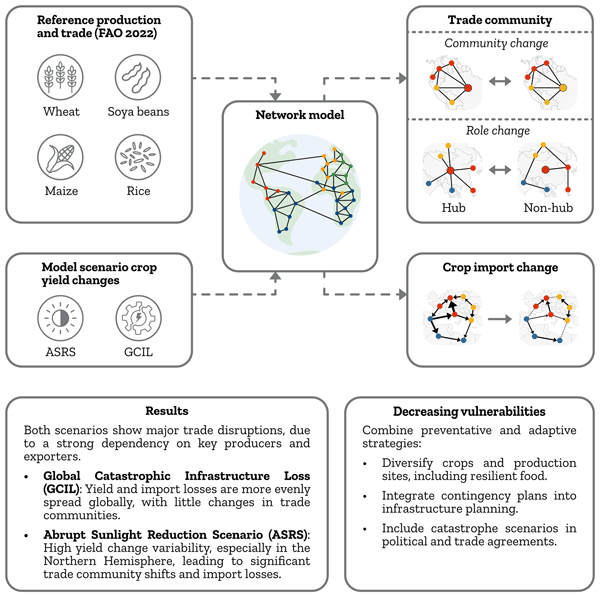
The global food trade system can handle small disturbances, but large disasters could cause major disruptions. We looked at how nuclear war or severe infrastructure loss would affect global trade in key crops. Both would be catastrophic, but a nuclear war would cause more severe disruptions, with many countries losing most of their food imports. Both scenarios highlight the need for better preparation to protect global food security.

Florian Ulrich Jehn, John-Oliver Engler, Constantin W. Arnscheidt, Magdalena Wache, Ekaterina Ilin, Laura Cook, Lalitha S. Sundaram, Frederic Hanusch, and Luke Kemp
Earth Syst. Dynam., 16, 1053–1084, https://doi.org/10.5194/esd-16-1053-2025, https://doi.org/10.5194/esd-16-1053-2025, 2025
Short summary
Short summary
This study presents the first systematic analysis of the global catastrophic risk and existential risk literature, examining 3437 documents from OpenAlex. Using bibliographic coupling, we identify and describe 10 research clusters aligned with major risks. The field shows geographic concentration in the US/UK, gender imbalance, and a small number of prolific authors. We recommend improving diversity, fostering cross-cluster collaboration, and building connections with adjacent disciplines.
Niki Lohmann, David Strahl, Annika Högner, Willem Huiskamp, Matthias Boehm, and Nico Wunderling
Nonlin. Processes Geophys., 33, 313–334, https://doi.org/10.5194/npg-33-313-2026, https://doi.org/10.5194/npg-33-313-2026, 2026
Short summary
Short summary
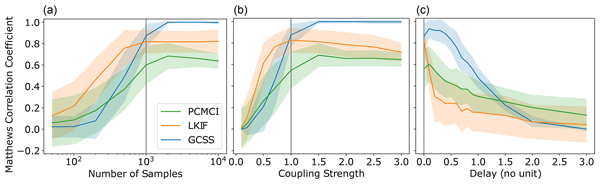
Causal inference methods could be used to study the interaction of climate tipping elements, which may degrade abruptly due to climate change. We compare three of these methods to determine their reliability and apply two of them to the Arctic summer sea ice and the Atlantic Meridional Overturning Circulation (AMOC). Our results imply that a weaker AMOC would stabilize Arctic summer sea ice, and that a loss of Arctic summer sea ice would likely stabilize the AMOC in the short term.
Jakob Harteg, Nico Wunderling, and Jonathan F. Donges
Earth Syst. Dynam., 17, 673–686, https://doi.org/10.5194/esd-17-673-2026, https://doi.org/10.5194/esd-17-673-2026, 2026
Short summary
Short summary
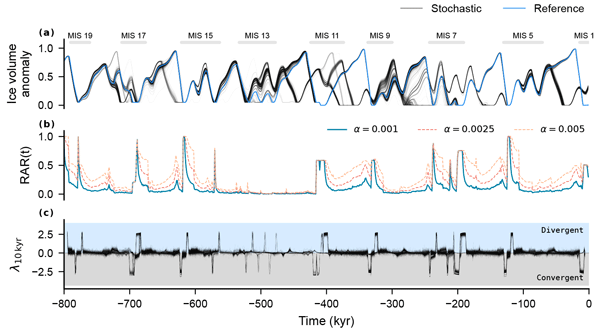
We investigate how resilient Earth’s climate system is to disturbances by analysing glacial-interglacial cycles using a simple climate model. By simulating small and large shocks to ice volume, we show that Earth’s climate more easily returns to its natural path during warm periods. These results improve our understanding of how Earth resilience varies over time in systems driven by external forces.
Jacques Bara, Nico Wunderling, and Wolfram Barfuss
Earth Syst. Dynam., 17, 333–352, https://doi.org/10.5194/esd-17-333-2026, https://doi.org/10.5194/esd-17-333-2026, 2026
Short summary
Short summary
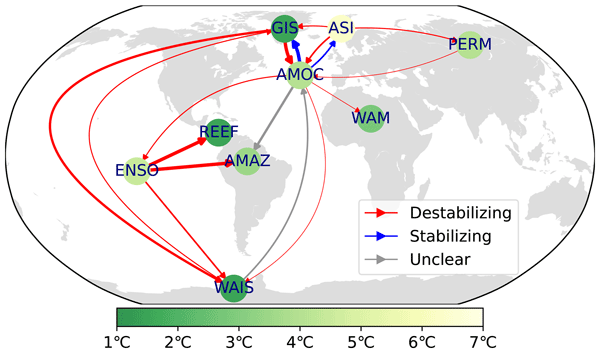
When one tipping element collapses the likelihood of another collapsing may be significantly affected. Using our simplified network model, we find that on the whole these interactions destabilise the Earth system, both in the short term and at equilibrium, though the effects are most noticeable after the year 2100. We find that to minimise tipping risks, it is essential to keep temperatures as close as possible to 1.5 °C in the short term and below 1 °C in the longer run.
Nils Bochow, Jonathan Krönke, Julius Garbe, and Nico Wunderling
EGUsphere, https://doi.org/10.5194/egusphere-2026-614, https://doi.org/10.5194/egusphere-2026-614, 2026
Short summary
Short summary
We provide a simple, updateable tool that turns comprehensive simulations into fast dynamical models for the three major tipping elements; the Greenland Ice Sheet, the West Antarctic Ice Sheet, and the Atlantic Meridional Overturning circulation. By fitting our framework to existing comprehensive simulations, it matches both short-term change and long-term stable states. This helps produce more consistent, policy-ready risk estimates as new simulations arrive.
John M. Anderies, Max Bechthold, Jonathan F. Donges, Ingo Fetzer, Nico Wunderling, Wolfram Barfuss, and Johan Rockström
EGUsphere, https://doi.org/10.5194/egusphere-2025-6345, https://doi.org/10.5194/egusphere-2025-6345, 2026
Short summary
Short summary
This paper explores a new approach to understanding human-Earth system resilience. It introduces a measure that estimates how likely a system is to reach a safe and just state. Available knowledge about how the system works, its boundaries, and potential disruptions centrally constrain the measure. It could help decision-makers strike a balance between gaining knowledge, building capacity to act, and taking practical measures to improve resilience in many different types of systems.
E. Keith Smith, Carl Folke, Niklas Kitzmann, Manjana Milkoreit, Per Olsson, Ricarda Winkelmann, Anne-Sophie Crépin, Christina Eder, Niklas Harring, Jobst Heitzig, Alexia Katsanidou, Timothy M. Lenton, Franz Mauelshagen, Kelton Minor, Ilona M. Otto, Armon Rezai, Jürgen Scheffran, Isabelle Stadelmann-Steffen, Rick van der Ploeg, Nico Wunderling, and Jonathan F. Donges
EGUsphere, https://doi.org/10.5194/egusphere-2026-177, https://doi.org/10.5194/egusphere-2026-177, 2026
This preprint is open for discussion and under review for Earth System Dynamics (ESD).
Short summary
Short summary
Achieving climate and sustainability goals requires rapid, large-scale change. We introduce criticality – the likelihood a system is near a social tipping point – and critical agency – the capacity to shape those conditions. Our framework shows how coalitions and policies can trigger desired shifts and avoid harmful ones, linking complex systems theory with evidence to guide policymakers and practitioners.
Florian Ulrich Jehn, Łukasz G. Gajewski, Johanna Hedlund, Constantin W. Arnscheidt, Lili Xia, Nico Wunderling, and David Denkenberger
Earth Syst. Dynam., 16, 1585–1603, https://doi.org/10.5194/esd-16-1585-2025, https://doi.org/10.5194/esd-16-1585-2025, 2025
Short summary
Short summary
The global food trade system can handle small disturbances, but large disasters could cause major disruptions. We looked at how nuclear war or severe infrastructure loss would affect global trade in key crops. Both would be catastrophic, but a nuclear war would cause more severe disruptions, with many countries losing most of their food imports. Both scenarios highlight the need for better preparation to protect global food security.
Florian Ulrich Jehn, John-Oliver Engler, Constantin W. Arnscheidt, Magdalena Wache, Ekaterina Ilin, Laura Cook, Lalitha S. Sundaram, Frederic Hanusch, and Luke Kemp
Earth Syst. Dynam., 16, 1053–1084, https://doi.org/10.5194/esd-16-1053-2025, https://doi.org/10.5194/esd-16-1053-2025, 2025
Short summary
Short summary
This study presents the first systematic analysis of the global catastrophic risk and existential risk literature, examining 3437 documents from OpenAlex. Using bibliographic coupling, we identify and describe 10 research clusters aligned with major risks. The field shows geographic concentration in the US/UK, gender imbalance, and a small number of prolific authors. We recommend improving diversity, fostering cross-cluster collaboration, and building connections with adjacent disciplines.
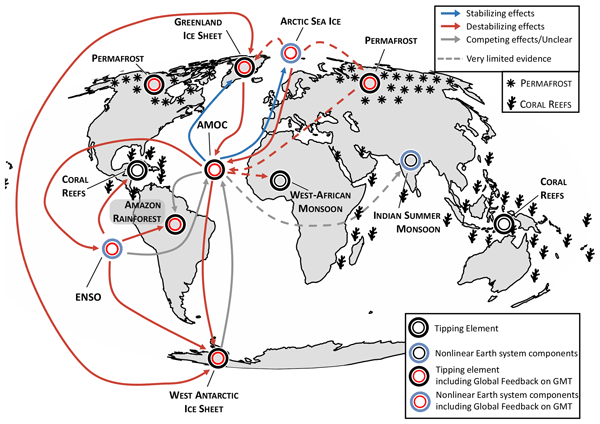
Nico Wunderling, Anna S. von der Heydt, Yevgeny Aksenov, Stephen Barker, Robbin Bastiaansen, Victor Brovkin, Maura Brunetti, Victor Couplet, Thomas Kleinen, Caroline H. Lear, Johannes Lohmann, Rosa Maria Roman-Cuesta, Sacha Sinet, Didier Swingedouw, Ricarda Winkelmann, Pallavi Anand, Jonathan Barichivich, Sebastian Bathiany, Mara Baudena, John T. Bruun, Cristiano M. Chiessi, Helen K. Coxall, David Docquier, Jonathan F. Donges, Swinda K. J. Falkena, Ann Kristin Klose, David Obura, Juan Rocha, Stefanie Rynders, Norman Julius Steinert, and Matteo Willeit
Earth Syst. Dynam., 15, 41–74, https://doi.org/10.5194/esd-15-41-2024, https://doi.org/10.5194/esd-15-41-2024, 2024
Short summary
Short summary
This paper maps out the state-of-the-art literature on interactions between tipping elements relevant for current global warming pathways. We find indications that many of the interactions between tipping elements are destabilizing. This means that tipping cascades cannot be ruled out on centennial to millennial timescales at global warming levels between 1.5 and 2.0 °C or on shorter timescales if global warming surpasses 2.0 °C.
Cited articles
Alvarado, K. A., Mill, A., Pearce, J. M., Vocaet, A., and Denkenberger, D.: Scaling of greenhouse crop production in low sunlight scenarios, Science of The Total Environment, 707, 136012, https://doi.org/10.1016/j.scitotenv.2019.136012, 2020.
Anderson, W., Baethgen, W., Capitanio, F., Ciais, P., Cook, B. I., Cunha, C. G. R. da, Goddard, L., Schauberger, B., Sonder, K., Podestá, G., van der Velde, M., and You, L.: Climate variability and simultaneous breadbasket yield shocks as observed in long-term yield records, Agricultural and Forest Meteorology, 331, 109321, https://doi.org/10.1016/j.agrformet.2023.109321, 2023.
Bajaj, K., Mehrabi, Z., Kastner, T., Jägermeyr, J., Müller, C., Schwarzmüller, F., Hertel, T. W., and Ramankutty, N.: Current food trade helps mitigate future climate change impacts in lower-income nations, PLOS ONE, 20, e0314722, https://doi.org/10.1371/journal.pone.0314722, 2025.
Bernard de Raymond, A., Alpha, A., Ben-Ari, T., Daviron, B., Nesme, T., and Tétart, G.: Systemic risk and food security. Emerging trends and future avenues for research, Global Food Security, 29, 100547, https://doi.org/10.1016/j.gfs.2021.100547, 2021.
Brönnimann, S. and Krämer, D.: Tambora and the “Year Without a Summer” of 1816. A Perspective on Earth and Human Systems Science, CH, ISBN 978-3-905835-45-8, 2016.
Cassidy, E. S., West, P. C., Gerber, J. S., and Foley, J. A.: Redefining agricultural yields: from tonnes to people nourished per hectare, Environ. Res. Lett., 8, 034015, https://doi.org/10.1088/1748-9326/8/3/034015, 2013.
Cassidy, M. and Mani, L.: Huge volcanic eruptions: time to prepare, Nature, 608, 469–471, https://doi.org/10.1038/d41586-022-02177-x, 2022.
Cima, R. J. and Library of Congress (Eds.): Vietnam: a country study, 1st ed., Federal Research Division, Library of Congress, Washington, D.C, 386 pp., https://www.loc.gov/item/88600482/ (last access: 28 January 2026), 1989.
Clapp, J.: Concentration and crises: exploring the deep roots of vulnerability in the global industrial food system, The Journal of Peasant Studies, 50, 1–25, https://doi.org/10.1080/03066150.2022.2129013, 2023.
Collingham, L.: The Taste of War: World War Two and the Battle for Food, Penguin, London, 672 pp., ISBN-10 0143123017, 2012.
Cottrell, R. S., Nash, K. L., Halpern, B. S., Remenyi, T. A., Corney, S. P., Fleming, A., Fulton, E. A., Hornborg, S., Johne, A., Watson, R. A., and Blanchard, J. L.: Food production shocks across land and sea, Nat Sustain, 2, 130–137, https://doi.org/10.1038/s41893-018-0210-1, 2019.
Coupe, J., Bardeen, C. G., Robock, A., and Toon, O. B.: Nuclear Winter Responses to Nuclear War Between the United States and Russia in the Whole Atmosphere Community Climate Model Version 4 and the Goddard Institute for Space Studies ModelE, Journal of Geophysical Research: Atmospheres, 124, 8522–8543, https://doi.org/10.1029/2019JD030509, 2019.
Daryanto, S., Wang, L., and Jacinthe, P.-A.: Global Synthesis of Drought Effects on Maize and Wheat Production, PLoS One, 11, e0156362, https://doi.org/10.1371/journal.pone.0156362, 2016.
Davies, S., Pettersson, T., and Öberg, M.: Organized violence 1989–2022, and the return of conflict between states, Journal of Peace Research, 60, 691–708, https://doi.org/10.1177/00223433231185169, 2023.
Defalco, R. C.: Justice and Starvation in Cambodia: The Khmer Rouge Famine – Cambodia Law & Policy Journal, The Cambodia Law and Policy Journal, 3, https://www.cambodialpj.org/article/justice-and-starvation-in-cambodia-the-khmer-rouge-famine/ (last access: 28 January 2026), 2014.
Delannoy, L., Verzier, A., Bastien-Olvera, B. A., Benra, F., Nyström, M., and Jørgensen, P. S.: Dynamics of the polycrisis: temporal trends, spatial distribution, and co-occurrences of national shocks (1970–2019), Global Sustainability, 8, e24, https://doi.org/10.1017/sus.2025.10008, 2025.
Do, T., Anderson, K., and Brorsen, B. W.: The World's wheat supply, Oklahoma Cooperative Extension Service, https://openresearch.okstate.edu/server/api/core/bitstreams/aac93bb5-ad8a-4ca5-9573-c543392a5e6b/content (last access: 28 January 2026), 2010.
Dowlah, C.: The politics and economics of food and famine in Bangladesh in the early 1970s – with special reference to Amartya Sen's interpretation of the 1974 famine, International Journal of Social Welfare, 15, 344–356, https://doi.org/10.1111/j.1468-2397.2006.00448.x, 2006.
Fanzo, J., Carducci, B., Louis-Jean, J., Herrero, M., Karl, K., and Rosenzweig, C.: Climate Change, Extreme Weather Events, Food Security, and Nutrition: Evolving Relationships and Critical Challenges, Annual Review of Nutrition, https://doi.org/10.1146/annurev-nutr-111324-111252, 2025.
FAO: The State of Food and Agriculture 1955, Food And Agriculture Organization of the United Nations, Rome, Italy, https://www.fao.org/4/ap643e/ap643e.pdf (last access: 28 January 2026), 1955.
FAO: Special Report: FAO/WFP Crop and Food Supply Assessment Mission to Rwanda, Food and Agriculture Organization of the United Nations and World Food Programme, Rome, https://www.fao.org/4/w2151e/w2151e00.htm (last access: 28 January 2026) , 1996.
FAO: Crop and Food Supply Assessment Mission to Democratic People's Republic of Korea – Democratic People's Republic of Korea | ReliefWeb, https://reliefweb.int/report/democratic-peoples-republic-korea/faowfp-crop-and-food-supply-assessment-mission-democratic-1 (last access: 28 January 2026) , 1997.
FAO: Food Outlook: Europe, Food and Agriculture Organization of the United Nations, https://www.fao.org/3/x3109e/pays/euro9909.htm (last access: 28 January 2026), 1999.
FAO: Food balance sheets: A handbook, Food and Agriculture Organization of the United Nations, Rome, Italy, https://openknowledge.fao.org/items/048df0d6-f495-4560-949c-76625afb0f21 (last access: 28 January 2026), 2001a.
FAO: Report of the FAO Asia-Pacific Conference on Early Warning, Prevention, Preparedness and Management of Disasters in Food and Agriculture, https://www.fao.org/4/ac120e/AC120e00.htm (last access: 28 January 2026), 2001b.
FAO: Assessment of the impact of locust damage on crops and pastures in Madagascar – Madagascar | ReliefWeb, https://reliefweb.int/report/madagascar/assessment-impact-locust-damage-crops-and-pastures-madagascar (last access: 28 January 2026), 2013.
FAO: Agricultural production statistics 2010–2023, https://www.fao.org/statistics/highlights-archive/highlights-detail/agricultural-production-statistics-2010-2023/en (last access: 28 January 2026), 2024.
García Martínez, J. B., Pearce, J. M., Throup, J., Cates, J., Lackner, M., and Denkenberger, D. C.: Methane Single Cell Protein: Potential to Secure a Global Protein Supply Against Catastrophic Food Shocks, Frontiers in Bioengineering and Biotechnology, 10, https://doi.org/10.3389/fbioe.2022.906704, 2022.
García Martínez, J. B., Behr, J., Pearce, J., and Denkenberger, D.: Resilient foods for preventing global famine: a review of food supply interventions for global catastrophic food shocks including nuclear winter and infrastructure collapse, Critical Reviews in Food Science and Nutrition, 0, 1–27, https://doi.org/10.1080/10408398.2024.2431207, 2025.
Gaupp, F., Hall, J., Hochrainer-Stigler, S., and Dadson, S.: Changing risks of simultaneous global breadbasket failure, Nat. Clim. Chang., 10, 54–57, https://doi.org/10.1038/s41558-019-0600-z, 2020.
Ghoneim, E., Dorofeeva, A., Benedetti, M., Gamble, D., Leonard, L., and AbuBakr, M.: Vegetation Drought Analysis In Tunisia: A Geospatial Investigation, HAES, 1, 1–9, https://doi.org/10.24966/aes-8780/100002, 2017.
Grant, L., Vanderkelen, I., Gudmundsson, L., Fischer, E., Seneviratne, S. I., and Thiery, W.: Global emergence of unprecedented lifetime exposure to climate extremes, Nature, 641, 374–379, https://doi.org/10.1038/s41586-025-08907-1, 2025.
Herre, B., Samborska, V., Hasell, J., and Roser, M.: Famines, Our World in Data, https://ourworldindata.org/famines (last access: 28 January 2026), 2017.
Hertel, T., Elouafi, I., Tanticharoen, M., and Ewert, F.: Diversification for enhanced food systems resilience, Nat. Food, 2, 832–834, https://doi.org/10.1038/s43016-021-00403-9, 2021.
Honey, M. and Ottaway, D. B.: Idi Amin Squandered the Wealth of Uganda, The Washington Post, 29 May, https://www.washingtonpost.com/archive/politics/1979/05/29/idi-amin-squandered-the-wealth-of-uganda/7511e07b-8be8-45f3-895c-5a7f4e5ebc39/ (last access: 28 January 2026), 1979.
HRDAG: Guatemala Memory of Silence: Report of the Commission for Historical Clarification Conclusions and Recommendations, HRDAG – Human Rights Data Analysis Group, http://www.jstor.org/stable/23778631 (last access: 28 January 2026), 1999.
IFES – The International Foundation for Electoral Systems: Elections in Congo: The Winding Road to Democracy, IFES – The International Foundation for Electoral Systems, https://www.ifes.org/publications/elections-congo-winding-road-democracy (last access: 28 January 2026), 1992.
IPCC (Ed.): Climate change 2007: impacts, adaptation and vulnerability: contribution of Working Group II to the fourth assessment report of the Intergovernmental Panel on Climate Change, Cambridge university press, Cambridge, U.K. New York, ISBN 978052188010-7 , 2007.
Jahn, M.: How “Multiple Breadbasket Failure” Became a Policy Issue, Issues in Science and Technology, https://issues.org/wp-content/uploads/2021/01/80–86-Jahn-How-Multiple-Breadbasket-Failure-Became-a (last access: 28 January 2026), 2021.
Jain, S.: Mapping Global Cereal Flow at Subnational Scales Unveils Key Insights for Food Systems Resilience, https://doi.org/10.21203/rs.3.rs-5204730/v1, 4 December 2024.
Jehn, F. U. and Mulhall, J.: allfed/Historical-Food-Shocks: First full release, Zenodo, https://doi.org/10.5281/ZENODO.16962681, 2025.
Jehn, F. U., Gajewski, Ł. G., Hedlund, J., Arnscheidt, C. W., Xia, L., Wunderling, N., and Denkenberger, D.: Food trade disruption after global catastrophes, https://eartharxiv.org/repository/view/7339/, last access: 29 June 2024a.
Jehn, F. U., Dingal, F. J., Mill, A., Harrison, C., Ilin, E., Roleda, M. Y., James, S. C., and Denkenberger, D.: Seaweed as a resilient food solution after a nuclear war, Earth's Future, 12, https://doi.org/10.1029/2023EF003710, 2024b.
Ji, G., Zhong, H., Feukam Nzudie, H. L., Wang, P., and Tian, P.: The structure, dynamics, and vulnerability of the global food trade network, Journal of Cleaner Production, 434, 140439, https://doi.org/10.1016/j.jclepro.2023.140439, 2024.
Keys, P. W., Barnes, E. A., Diffenbaugh, N. S., Hertel, T. W., Baldos, U. L. C., and Hedlund, J.: Exposure to compound climate hazards transmitted via global agricultural trade networks, Environ. Res. Lett., 20, 044039, https://doi.org/10.1088/1748-9326/adb86a, 2025.
Kuhla, K., Puma, M., Schewe, J., Kubiczek, P., and Otto, C.: Learning from the international response to the Russian invasion of Ukraine to avert the next major food crisis, Research Gate, https://doi.org/10.13140/RG.2.2.30912.00001, 4 January 2023.
Kung, J. K. and Lin, J. Y.: The Causes of China's Great Leap Famine, 1959–1961, Economic Development and Cultural Change, 52, 51–73, https://doi.org/10.1086/380584, 2003.
Laio, F., Ridolfi, L., and D'Odorico, P.: The past and future of food stocks, Environ. Res. Lett., 11, 035010, https://doi.org/10.1088/1748-9326/11/3/035010, 2016.
Lenton, T. M., Armstrong McKay, D., Loriani, S., Abrams, J. F., Lade, S. J., Donges, J. F., Milkoreit, M., Powell, T., Smith, S. R., Zimm, C., Bailey, E., Buxton, J. E., Dyke, J. G., Ghadiali, A., and Laybourn, L.: Global Tipping Points Report 2023, University of Exeter, https://doi.org/10.5281/zenodo.15188118, 2023.
Mandel, E.: The Roots of the Polish Economic Crisis, International Viewpoint, 0, 29–34, 1982.
Marchand, P., Carr, J. A., Dell'Angelo, J., Fader, M., Gephart, J. A., Kummu, M., Magliocca, N. R., Porkka, M., Puma, M. J., Ratajczak, Z., Rulli, M. C., Seekell, D. A., Suweis, S., Tavoni, A., and D'Odorico, P.: Reserves and trade jointly determine exposure to food supply shocks, Environ. Res. Lett., 11, 095009, https://doi.org/10.1088/1748-9326/11/9/095009, 2016.
Martinez, L.: The Algerian civil war: 1990–1998, 1. publ. in the UK, Hurst, London, 265 pp., ISBN 0231119968, 2000.
Meng, X., Qian, N., and Yared, P.: The Institutional Causes of China's Great Famine, 1959–1961, The Review of Economic Studies, 82, 1568–1611, https://doi.org/10.1093/restud/rdv016, 2015.
Moersdorf, J., Rivers, M., Denkenberger, D., Breuer, L., and Jehn, F. U.: The Fragile State of Industrial Agriculture: Estimating Crop Yield Reductions in a Global Catastrophic Infrastructure Loss Scenario, Global Challenges, 8, 2300206, https://doi.org/10.1002/gch2.202300206, 2024.
Offer, A.: The First World War: an agrarian interpretation, 1. issued in paperback (with corr.), Clarendon Press, Oxford, 449 pp., https://doi.org/10.1093/oso/9780198202790.001.0001, 1991.
Piñeiro, M. and Piñeiro, V.: Geopolitical changes and their implications for agricultural trade negotiations, https://hdl.handle.net/10568/151905 (last access: 28 January 2026), 2024.
Puma, M. J., Bose, S., Chon, S. Y., and Cook, B. I.: Assessing the evolving fragility of the global food system, Environ. Res. Lett., 10, 024007, https://doi.org/10.1088/1748-9326/10/2/024007, 2015.
Reuters: Suriname's Leader and Rebel Chief Vow to Negotiate Uprising's End, The New York Times, 27th March, https://www.nytimes.com/1991/03/27/world/suriname-s-leader-and-rebel-chief-vow-to-negotiate-uprising-s-end.html (last access: 28 January 2026), 1991.
Savary, S., Willocquet, L., Pethybridge, S. J., Esker, P., McRoberts, N., and Nelson, A.: The global burden of pathogens and pests on major food crops, Nat. Ecol. Evol., 3, 430–439, https://doi.org/10.1038/s41559-018-0793-y, 2019.
Savitzky, A. and Golay, M. J. E.: Smoothing and Differentiation of Data by Simplified Least Squares Procedures, Anal. Chem., 36, 1627–1639, https://doi.org/10.1021/ac60214a047, 1964.
Sgroi, L. C., Lovino, M. A., Berbery, E. H., and Müller, G. V.: Characteristics of droughts in Argentina's core crop region, Hydrol. Earth Syst. Sci., 25, 2475–2490, https://doi.org/10.5194/hess-25-2475-2021, 2021.
Simons, M.: Mexican Drought, Frost May Increase Migration, The Washington Post, 17th January, https://www.washingtonpost.com/archive/politics/1980/01/17/mexican-drought-frost-may-increase-migration/b9962daa-fefa-403b-a1c1-1ac5165ec6af/ (last access: 28 January 2026), 1980.
Smith, B.: Dutch disease and the oil boom and bust, Canadian Journal of Economics/Revue Canadienne d'Économique, 52, 584–623, https://doi.org/10.1111/caje.12376, 2019.
Stehl, J., Vonderschmidt, A., Vollmer, S., Alexander, P., and Jaacks, L. M.: Gap between national food production and food-based dietary guidance highlights lack of national self-sufficiency, Nat Food, 6, 571–576, https://doi.org/10.1038/s43016-025-01173-4, 2025.
Steinberg, D. I.: Burma's Road Toward Development: Growth And Ideology Under Military Rule, Routledge, New York, 256 pp., https://doi.org/10.4324/9780429048722, 2019.
Szayna, T. S., Watts, S., O'Mahony, A., Frederick, B., and Kavanagh, J.: What Are the Trends in Armed Conflicts, and What Do They Mean for U.S. Defense Policy?, https://www.rand.org/content/dam/rand/pubs/research_reports/RR1900/RR1904/RAND_RR1904.pdf (last access: 28 January 2026), 2017.
Tambi, M.: Economic Growth, Crisis, and Recovery in Cameroon: A Literature Review, Journal of Industrial Distribution & Business, 6, 5–15, https://doi.org/10.13106/ijidb.2015.vol6.no1.5, 2015.
Throup, J., García Martínez, J. B., Bals, B., Cates, J., Pearce, J. M., and Denkenberger, D. C.: Rapid repurposing of pulp and paper mills, biorefineries, and breweries for lignocellulosic sugar production in global food catastrophes, Food and Bioproducts Processing, 131, 22–39, https://doi.org/10.1016/j.fbp.2021.10.012, 2022.
Ummenhofer, C. C., England, M. H., McIntosh, P. C., Meyers, G. A., Pook, M. J., Risbey, J. S., Gupta, A. S., and Taschetto, A. S.: What causes southeast Australia's worst droughts?, Geophysical Research Letters, 36, https://doi.org/10.1029/2008GL036801, 2009.
UN Department of Humanitarian Affairs: Bolivia - Drought Aug 1983 UNDRO Situation Reports 1-13 – Bolivia (Plurinational State of) | ReliefWeb, UN Department of Humanitarian Affairs, https://reliefweb.int/report/bolivia/bolivia-drought-aug-1983-undro-situation-reports-1-13 (last access: 28 January 2026), 1983.
UN Department of Humanitarian Affairs: Djibouti – Floods Apr 1989 UNDRO Situation Reports 1-4 – Djibouti | ReliefWeb, UN Department of Humanitarian Affairs, https://reliefweb.int/report/djibouti/djibouti-floods-apr-1989-undro-situation-reports-1-4 (last access: 28 January 2026), 1989.
UNDP: Independent Country Programme Evaluation: Guinea, United Nations Development Programme, https://www.undp.org/sites/g/files/zskgke326/files/2023-11/22388_ICPE_Guinea_EN_v03_RC_pages.pdf (last access: 28 January 2026), 2023.
United Nations World Food Programme: Famine Hits Parts Of South Sudan, https://news.un.org/en/story/2017/02/551812 (last access: 28 January 2026), 2017.
U.S. Central Intelligence Agency: Allende's Chile: The Widening Supply-Demand Gap, U.S. Central Intelligence Agency, https://www.cia.gov/readingroom/docs/CIA-RDP85T00875R001700040058-3.pdf (last access: 28 January 2026), 1972.
USDA Foreign Agricultural Service: Drought in Paraguay, USDA Foreign Agricultural Service, https://ipad.fas.usda.gov/highlights/2012/02/Paraguay_Drought/ (last access: 28 January 2026), 2012.
Vasiliades, L. and Tzabiras, J.: Evaluation of Climate Change on Drought Impulses in Thessaly, Greece, European Water, 17, https://www.researchgate.net/publication/267833212_Evaluation_of_Climate_Change_on_Drought_Impulses_in_Thessaly_Greece (last access: 28 January 2026), 2007.
Velazco, J.: Agricultural Production in Peru (1950–1995):: Sources of Growth, FAO, https://www.fao.org/4/X9447E/x9447e08.htm (last access: 28 January 2026), 1999.
Vellutini, R.: Macroeconomic adjustments, agricultural performance, and income distribution in Brazil since 1973, United Nations University Press, https://journals.sagepub.com/doi/pdf/10.1177/156482658700900111 (last access: 28 January 2026), 1987.
Verschuur, J., Murgatroyd, A., Vittis, Y., Mosnier, A., Obersteiner, M., Godfray, C., and Hall, J.: The impacts of polycrises on global grain availability and prices, Research Square, https://doi.org/10.21203/rs.3.rs-3969801/v1, 8 March 2024.
Virtanen, P., Gommers, R., Oliphant, T. E., Haberland, M., Reddy, T., Cournapeau, D., Burovski, E., Peterson, P., Weckesser, W., Bright, J., van der Walt, S. J., Brett, M., Wilson, J., Millman, K. J., Mayorov, N., Nelson, A. R. J., Jones, E., Kern, R., Larson, E., Carey, C. J., Polat, İ., Feng, Y., Moore, E. W., VanderPlas, J., Laxalde, D., Perktold, J., Cimrman, R., Henriksen, I., Quintero, E. A., Harris, C. R., Archibald, A. M., Ribeiro, A. H., Pedregosa, F., and van Mulbregt, P.: SciPy 1.0: fundamental algorithms for scientific computing in Python, Nat Methods, 17, 261–272, https://doi.org/10.1038/s41592-019-0686-2, 2020.
Wang, X., Ma, L., Yan, S., Chen, X., and Growe, A.: Trade for Food Security: The Stability of Global Agricultural Trade Networks, Foods, 12, 271, https://doi.org/10.3390/foods12020271, 2023.
Weather Underground: Most Expensive Weather Disaster of 2018: a $3.9 Billion Drought in Argentina and Uruguay, https://www.wunderground.com/cat6/most-expensive-weather-disaster-2018-39-billion-drought (last access: 28 January 2026), 2018.
Wescombe, N. J., Martínez, J. G., Jehn, F. U., Wunderling, N., Tzachor, A., Sandström, V., Cassidy, M., Ainsworth, R., and Denkenberger, D.: It's time to consider global catastrophic food failures, Global Food Security, 46, 100880, https://doi.org/10.1016/j.gfs.2025.100880, 2025.
Wheaton, E., Kulshreshtha, S., Wittrock, V., and Koshida, G.: Dry times: hard lessons from the Canadian drought of 2001 and 2002, Canadian Geographies/Géographies canadiennes, 52, 241–262, https://doi.org/10.1111/j.1541-0064.2008.00211.x, 2008.
Xia, L., Robock, A., Scherrer, K., Harrison, C. S., Bodirsky, B. L., Weindl, I., Jägermeyr, J., Bardeen, C. G., Toon, O. B., and Heneghan, R.: Global food insecurity and famine from reduced crop, marine fishery and livestock production due to climate disruption from nuclear war soot injection, Nat. Food, 1–11, https://doi.org/10.1038/s43016-022-00573-0, 2022.
Yu, C., Huang, X., Chen, H., Huang, G., Ni, S., Wright, J. S., Hall, J., Ciais, P., Zhang, J., Xiao, Y., Sun, Z., Wang, X., and Yu, L.: Assessing the Impacts of Extreme Agricultural Droughts in China Under Climate and Socioeconomic Changes, Earth's Future, 6, 689–703, https://doi.org/10.1002/2017EF000768, 2018.
Zhang, D. D., Lee, H. F., Wang, C., Li, B., Pei, Q., Zhang, J., and An, Y.: The causality analysis of climate change and large-scale human crisis, Proceedings of the National Academy of Sciences, 108, 17296–17301, https://doi.org/10.1073/pnas.1104268108, 2011.
Zheng, Y., Tam, C.-Y., and Collins, M.: Indian Ocean Dipole Impacts on Eastern African Short Rains Across Observations, Historical Simulations and Future Projections, Earth's Future, 13, e2024EF005219, https://doi.org/10.1029/2024EF005219, 2025.
Zipper, S. C., Qiu, J., and Kucharik, C. J.: Drought effects on US maize and soybean production: spatiotemporal patterns and historical changes, Environ. Res. Lett., 11, 094021, https://doi.org/10.1088/1748-9326/11/9/094021, 2016.
Editorial statement
This work shows that massive crop failures—averaging nearly 30% and sometimes reaching 80%—have already happened repeatedly in the real world, not just in future climate scenarios. It directly connects climate change, natural disasters, and food security to everyday risks, highlighting that global food reserves often last less than a year. By grounding catastrophic crop failure in historical data, the research offers a compelling, evidence-based narrative about how close societies may already be to severe food crises.
This work shows that massive crop failures—averaging nearly 30% and sometimes reaching...
Short summary
Large crop failures happen regularly around the world, threatening food security. We analyzed sixty years of global crop production data and found that every country has experienced major crop losses. Climate events like droughts cause most severe disruptions, with some African nations losing up to eighty percent of production. While global crop shocks above five percent are rare, regional disruptions occur frequently. These findings show our food system faces regular large-scale threats.
Large crop failures happen regularly around the world, threatening food security. We analyzed...


Altmetrics
Final-revised paper
Preprint