
Articles | Volume 17, issue 3
https://doi.org/10.5194/esd-17-811-2026
© Author(s) 2026. This work is distributed under
the Creative Commons Attribution 4.0 License.
the Creative Commons Attribution 4.0 License.
https://doi.org/10.5194/esd-17-811-2026
© Author(s) 2026. This work is distributed under
the Creative Commons Attribution 4.0 License.
the Creative Commons Attribution 4.0 License.
Research article
| 
23 Jun 2026
Research article |
| 23 Jun 2026
| 23 Jun 2026
Large impact of extreme precipitation on projected blue–green water partitioning
Simon P. Heselschwerdt
CORRESPONDING AUTHOR

Climate Service Center Germany (GERICS), Helmholtz-Zentrum Hereon, Hamburg, Germany
Institute of Environmental Science and Geography, University of Potsdam, Potsdam, Germany
Thorsten Wagener
Institute of Environmental Science and Geography, University of Potsdam, Potsdam, Germany
Lan Wang-Erlandsson
Stockholm Resilience Centre, Stockholm University, Stockholm, Sweden
Bolin Centre for Climate Research, Stockholm University, Stockholm, Sweden
Anthropocene Laboratory, The Royal Swedish Academy of Sciences, Stockholm, Sweden
Potsdam Institute for Climate Impact Research (PIK), Member of the Leibniz Association, Potsdam, Germany
Anna M. Ukkola
ARC Centre of Excellence for Climate Extremes, University of New South Wales, Sydney, NSW, Australia
Climate Change Research Centre, University of New South Wales, Sydney, NSW, Australia
Yannis Markonis
Department of Water Resources and Environmental Modeling, Faculty of Environmental Sciences, Czech University of Life Sciences Prague, Praha – Suchdol, Czech Republic
Yuting Yang
State Key Laboratory of Hydroscience and Engineering, Department of Hydraulic Engineering, Tsinghua University, Beijing, China
Key Laboratory of Hydrosphere Sciences of the Ministry of Water Resources, Beijing, China
Peter Greve
Climate Service Center Germany (GERICS), Helmholtz-Zentrum Hereon, Hamburg, Germany
Related authors
Simon P. Heselschwerdt, Abhinav Dengri, Nora L. S. Fahrenbach, and Peter Greve
EGUsphere, https://doi.org/10.5194/egusphere-2026-513, https://doi.org/10.5194/egusphere-2026-513, 2026
Short summary
Short summary
Land-use and land-cover change (LULCC) can alter how precipitation is divided between river flow and water used by plants. To understand the water impacts of future LULCC, we analyse four Earth system models under a sustainable LULCC pathway. Conservation often increases plant water use, strongest in tropical dry seasons. Yet, additional rainfall reduces losses in river water in some places. Differences among models mean regional water outcomes remain uncertain for land and water planning.
C. Kendra Gotangco Gonzales, Aryanie Amellina, Nitin Chaudhary, Beatrice Crona, Ingo Fetzer, Tanya Fiedler, Dario Marone, Giorgio Parlato, Juan Carlos Rocha, Lan Wang-Erlandsson, Hannah Zoller, and Steven J. Lade
EGUsphere, https://doi.org/10.5194/egusphere-2026-5352, https://doi.org/10.5194/egusphere-2026-5352, 2026
This preprint is open for discussion and under review for Earth System Dynamics (ESD).
Short summary
Short summary
The Earth System Impact (ESI) metric scores an organization’s systemic impacts relative to planetary limits for climate, land and freshwater change. Building on a 2021 prototype, the ESI metric draws from the latest boundaries research and updated simulations from a dynamic global vegetation model. Ecosystem coverage is expanded. The ESI scores reflect the sensitivity of small areas to pressures, amplification of impacts due to interactions, and existing transgressions at the sub-global level.
Johanna Ruth Thomson, Yannis Markonis, Riya Dutta, Simone Fatichi, Martin Hanel, Akash Koppa, Petr Máca, Vishal Thakur, Mijael Rodrigo Vargas Godoy, and Athanasios Paschalis
Earth Syst. Sci. Data Discuss., https://doi.org/10.5194/essd-2026-334, https://doi.org/10.5194/essd-2026-334, 2026
Short summary
Short summary
We compared 14 global datasets of evapotranspiration, the movement of water from land to the atmosphere, to examine how estimates of recent change differ across products. Most datasets suggest increasing evapotranspiration since 2000, but many disagree on where changes occur, how large they are, and even whether trends are positive or negative. We also introduce a framework that classifies the roles datasets play within ensembles, helping users better understand uncertainty and dataset behavior.
Qidong Fang, Mostaquimur Rahman, Thorsten Wagener, and Francesca Pianosi
EGUsphere, https://doi.org/10.5194/egusphere-2026-3267, https://doi.org/10.5194/egusphere-2026-3267, 2026
This preprint is open for discussion and under review for Hydrology and Earth System Sciences (HESS).
Short summary
Short summary
It is unclear whether deep learning models can predict groundwater level at places without measurements using attributes of the places. Our deep learning model captured temporal variation well, especially in more responsive aquifers, similarly to a process-based model. Interpretation tools showed that meteorological and environmental information at places helped predictions at unseen wells. We highlight the potential of deep learning models for regional groundwater level predictions.
Peter Greve, Amelie U. Schmitt, Sina Jasmin Schreiber, Augustin Clédat, and Peter Burek
EGUsphere, https://doi.org/10.5194/egusphere-2026-2366, https://doi.org/10.5194/egusphere-2026-2366, 2026
Short summary
Short summary
We introduce a new water resources and river flow model to improve our understanding of interactions between human water management and the Earth system. Many Earth system models oversimplify water management and its influence on processes at the interface between the land surface and the atmosphere. Our model can establish a link between these processes and enable faster, more realistic studies of climate change impacts on water availability and human decision-making.
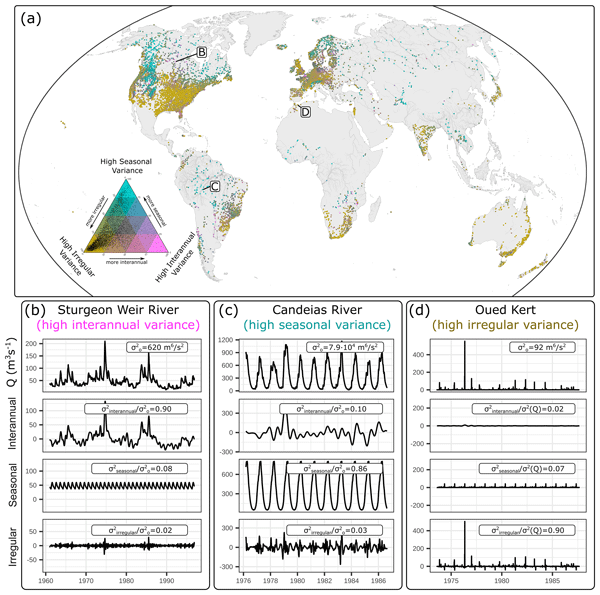
Sacha W. Ruzzante, Wouter J. M. Knoben, Thorsten Wagener, Tom Gleeson, and Markus Schnorbus
Hydrol. Earth Syst. Sci., 30, 2337–2355, https://doi.org/10.5194/hess-30-2337-2026, https://doi.org/10.5194/hess-30-2337-2026, 2026
Short summary
Short summary
Common metrics used to evaluate hydrologic models make it relatively easy to achieve high performance scores in highly seasonal catchments. However, we analysed 18 hydrologic models and found that almost all were worse at simulating interannual variability and change in seasonal streamflow regimes. This suggests that climate change impacts on streamflow may not be accurately predicted in highly seasonal tropical, alpine, and polar regions, which are highly vulnerable to climate change.
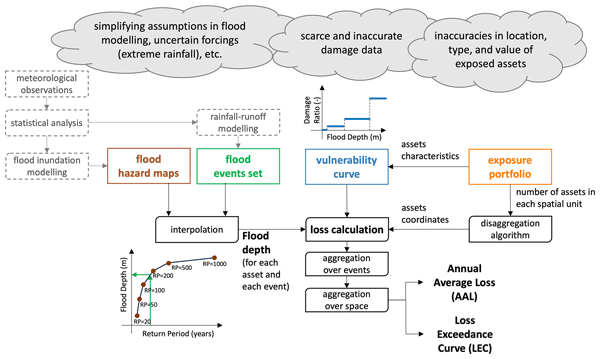
Francesca Pianosi, Georgios Sarailidis, Kirsty Styles, Philip Oldham, Stephen Hutchings, Rob Lamb, and Thorsten Wagener
Nat. Hazards Earth Syst. Sci., 26, 1727–1743, https://doi.org/10.5194/nhess-26-1727-2026, https://doi.org/10.5194/nhess-26-1727-2026, 2026
Short summary
Short summary
Mathematical modelling is essential to support flood risk management. As these models simulate complex interactions between climate, the natural and the built environment, they unavoidably embed a range of simplifying assumptions. In this paper, we propose a more rigorous approach to analyse the impact of uncertain assumptions on modelling results. This is important to improve model transparency and set priorities for improving models.
Simon P. Heselschwerdt, Abhinav Dengri, Nora L. S. Fahrenbach, and Peter Greve
EGUsphere, https://doi.org/10.5194/egusphere-2026-513, https://doi.org/10.5194/egusphere-2026-513, 2026
Short summary
Short summary
Land-use and land-cover change (LULCC) can alter how precipitation is divided between river flow and water used by plants. To understand the water impacts of future LULCC, we analyse four Earth system models under a sustainable LULCC pathway. Conservation often increases plant water use, strongest in tropical dry seasons. Yet, additional rainfall reduces losses in river water in some places. Differences among models mean regional water outcomes remain uncertain for land and water planning.
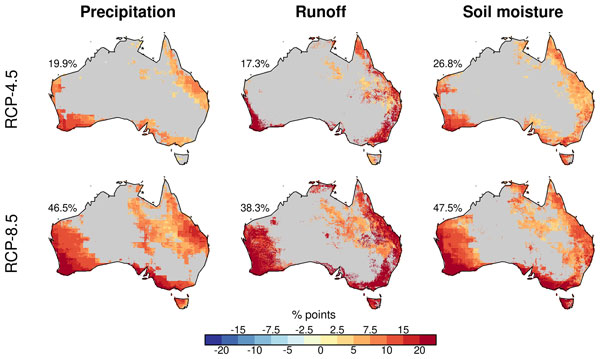
Anna M. Ukkola, Steven Thomas, Elisabeth Vogel, Ulrike Bende-Michl, Steven Siems, Vjekoslav Matic, and Wendy Sharples
Hydrol. Earth Syst. Sci., 30, 1463–1485, https://doi.org/10.5194/hess-30-1463-2026, https://doi.org/10.5194/hess-30-1463-2026, 2026
Short summary
Short summary
Future drought changes in Australia –the driest inhabited continent on Earth– have remained stubbornly uncertain. We assess future drought changes in Australia using projections from climate and hydrological models. We show an increasing probability of drought in highly-populated and agricultural regions of Australia in coming decades, suggesting potential impacts on agricultural activities, ecosystems and urban water supply.
Sadaf Nasreen, Oldrich Rakovec, Rohini Kumar, Manuela I. Brunner, Ujjwal Singh, Petr Maca, Yannis Markonis, and Martin Hanel
EGUsphere, https://doi.org/10.5194/egusphere-2026-973, https://doi.org/10.5194/egusphere-2026-973, 2026
Short summary
Short summary
European droughts threaten water and agriculture, but how distinct drought processes will change under warming is uncertain. We examine seven mechanisms across Europe using 1971 to 2000 observations and 2070 to 2099 projections. Changes are regional: the Mediterranean shifts to longer, more severe droughts, while Northern and Western Central Europe often improve. Temperature-driven mechanisms, especially rain to snow transitions, respond most, guiding targeted adaptation.
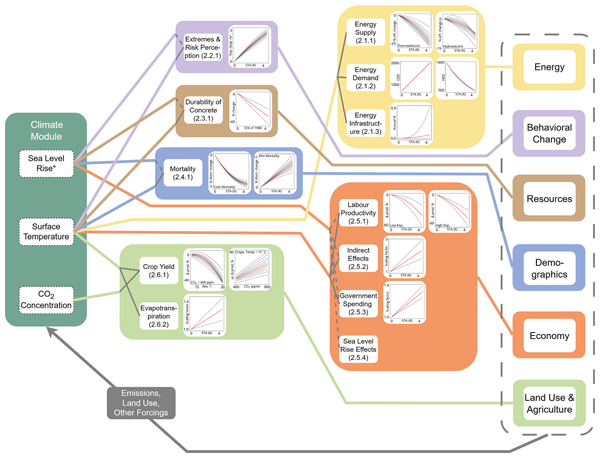
Christopher D. Wells, Benjamin Blanz, Lennart Ramme, Jannes Breier, Beniamino Callegari, Adakudlu Muralidhar, Jefferson K. Rajah, Andreas Nicolaidis Lindqvist, Axel E. Eriksson, William Alexander Schoenberg, Alexandre C. Köberle, Lan Wang-Erlandsson, Cecilie Mauritzen, Martin B. Grimeland, and Chris Smith
Geosci. Model Dev., 19, 1229–1260, https://doi.org/10.5194/gmd-19-1229-2026, https://doi.org/10.5194/gmd-19-1229-2026, 2026
Short summary
Short summary
Computer models built to study future developments of human activity and climate change often exclude the impacts of climate change. Here, we include these effects in a new model. We create functions connecting changes in global temperature, carbon dioxide, and sea level to energy supply and demand, food systems, mortality, economic damages, and other important quantities. Including these effects will allow us to explore their impact on future changes in the human and climate realms.

Jon Cranko Page, Martin G. De Kauwe, Andy J. Pitman, Isaac R. Towers, Gabriele Arduini, Martin J. Best, Craig R. Ferguson, Jürgen Knauer, Hyungjun Kim, David M. Lawrence, Tomoko Nitta, Keith W. Oleson, Catherine Ottlé, Anna Ukkola, Nicholas Vuichard, Xiaoni Wang-Faivre, and Gab Abramowitz
Biogeosciences, 23, 263–282, https://doi.org/10.5194/bg-23-263-2026, https://doi.org/10.5194/bg-23-263-2026, 2026
Short summary
Short summary
This paper used a large dataset of observations, machine learning predictions, and computer model simulations to test how well land surface models represent the water, energy, and carbon cycles. We found that the models work well under "normal" weather but do not meet performance expectations during coinciding extreme conditions. Since these extremes are relatively rare, targeted model improvements could deliver major performance gains.
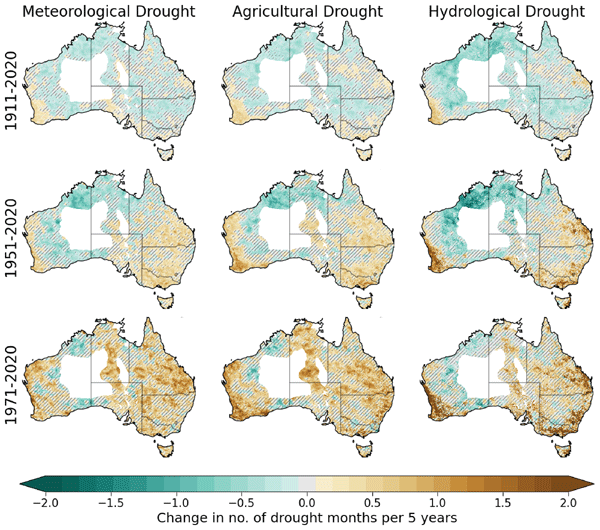
Matthew O. Grant, Anna M. Ukkola, Elisabeth Vogel, Sanaa Hobeichi, Andy J. Pitman, Alex Raymond Borowiak, and Keirnan Fowler
Hydrol. Earth Syst. Sci., 29, 5555–5573, https://doi.org/10.5194/hess-29-5555-2025, https://doi.org/10.5194/hess-29-5555-2025, 2025
Short summary
Short summary
Australia is regularly subjected to severe and widespread drought. By using multiple drought indicators, we show that although there have been widespread decreases in droughts since the beginning of the 20th century, many regions have seen an increase in droughts in more recent decades. Despite these changes, our analysis shows that they remain within the range of observed variability and are not unprecedented in the context of past droughts.
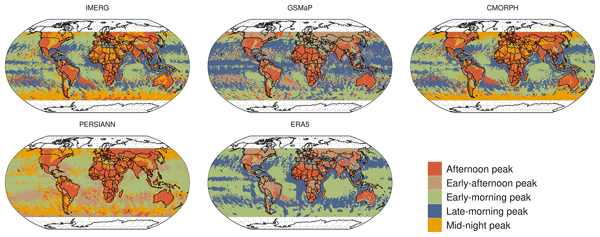
Rajani Kumar Pradhan, Yannis Markonis, Francesco Marra, Efthymios I. Nikolopoulos, Simon Michael Papalexiou, and Vincenzo Levizzani
Hydrol. Earth Syst. Sci., 29, 4929–4949, https://doi.org/10.5194/hess-29-4929-2025, https://doi.org/10.5194/hess-29-4929-2025, 2025
Short summary
Short summary
This study compared global satellite and reanalysis precipitation datasets to assess diurnal variability. We found that all datasets capture key diurnal precipitation patterns, with maximum precipitation in the afternoon over land and early morning over the ocean. However, there are differences in the exact timing and amount of precipitation. This suggests that it is better to use a combination of datasets for potential applications rather than relying on a single dataset.
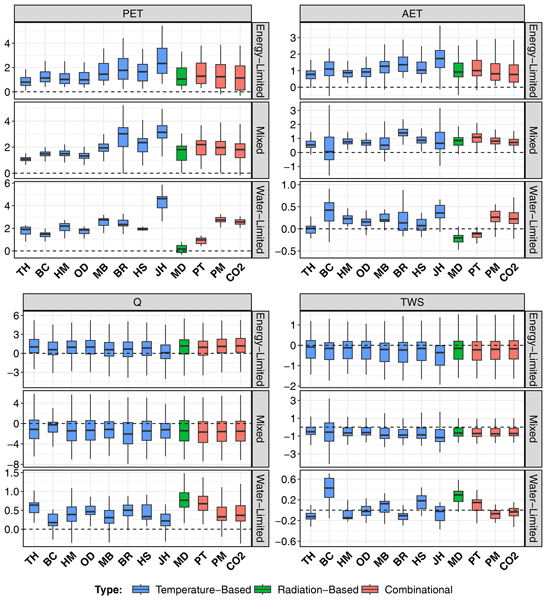
Vishal Thakur, Yannis Markonis, Rohini Kumar, Johanna Ruth Thomson, Mijael Rodrigo Vargas Godoy, Martin Hanel, and Oldrich Rakovec
Hydrol. Earth Syst. Sci., 29, 4395–4416, https://doi.org/10.5194/hess-29-4395-2025, https://doi.org/10.5194/hess-29-4395-2025, 2025
Short summary
Short summary
Understanding the changes in water movement in earth is crucial for everyone. To quantify this water movement there are several techniques. We examined how different methods of estimating evaporation impact predictions of various types of water movement across Europe. We found that, while these methods generally agree on whether changes are increasing or decreasing, they differ in magnitude. This means selecting the right evaporation method is crucial for accurate predictions of water movement.
Zhuoyi Tu, Taihua Wang, Juntai Han, Hansjörg Seybold, Shaozhen Liu, Cansu Culha, Yuting Yang, and James W. Kirchner
EGUsphere, https://doi.org/10.5194/egusphere-2025-3018, https://doi.org/10.5194/egusphere-2025-3018, 2025
Preprint archived
Short summary
Short summary
This study provides the first event-scale observational evidence that runoff sensitivity to precipitation decreases significantly in degrading permafrost regions of the Tibetan Plateau. Data-driven analysis reveals that permafrost thaw enhances infiltration and subsurface storage, reducing peak runoff and runoff coefficients, especially during heavy rainfall. These results are important for drought and flood risk management under climate change.
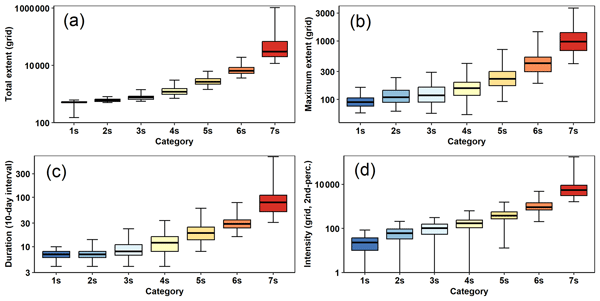
Jan Řehoř, Rudolf Brázdil, Oldřich Rakovec, Martin Hanel, Milan Fischer, Rohini Kumar, Jan Balek, Markéta Poděbradská, Vojtěch Moravec, Luis Samaniego, Yannis Markonis, and Miroslav Trnka
Hydrol. Earth Syst. Sci., 29, 3341–3358, https://doi.org/10.5194/hess-29-3341-2025, https://doi.org/10.5194/hess-29-3341-2025, 2025
Short summary
Short summary
We present a robust method for identification and classification of global land drought events (GLDEs) based on soil moisture. Two models were used to calculate soil moisture and delimit soil drought over global land from 1980–2022, with clusters of 775 and 630 GLDEs. Using four spatiotemporal and three motion-related characteristics, we categorized GLDEs into seven severity and seven dynamic categories. The frequency of GLDEs has generally increased in recent decades.
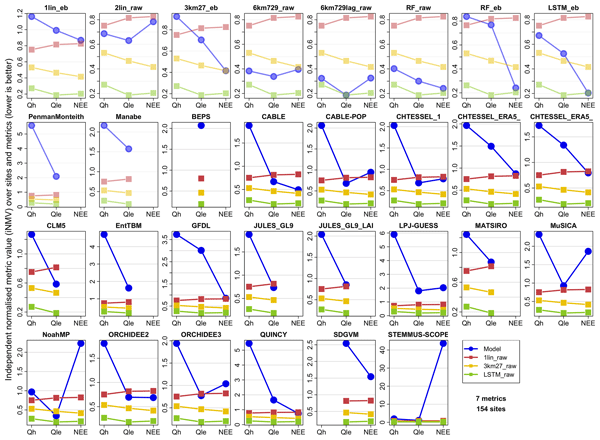
Gab Abramowitz, Anna Ukkola, Sanaa Hobeichi, Jon Cranko Page, Mathew Lipson, Martin G. De Kauwe, Samuel Green, Claire Brenner, Jonathan Frame, Grey Nearing, Martyn Clark, Martin Best, Peter Anthoni, Gabriele Arduini, Souhail Boussetta, Silvia Caldararu, Kyeungwoo Cho, Matthias Cuntz, David Fairbairn, Craig R. Ferguson, Hyungjun Kim, Yeonjoo Kim, Jürgen Knauer, David Lawrence, Xiangzhong Luo, Sergey Malyshev, Tomoko Nitta, Jerome Ogee, Keith Oleson, Catherine Ottlé, Phillipe Peylin, Patricia de Rosnay, Heather Rumbold, Bob Su, Nicolas Vuichard, Anthony P. Walker, Xiaoni Wang-Faivre, Yunfei Wang, and Yijian Zeng
Biogeosciences, 21, 5517–5538, https://doi.org/10.5194/bg-21-5517-2024, https://doi.org/10.5194/bg-21-5517-2024, 2024
Short summary
Short summary
This paper evaluates land models – computer-based models that simulate ecosystem dynamics; land carbon, water, and energy cycles; and the role of land in the climate system. It uses machine learning and AI approaches to show that, despite the complexity of land models, they do not perform nearly as well as they could given the amount of information they are provided with about the prediction problem.
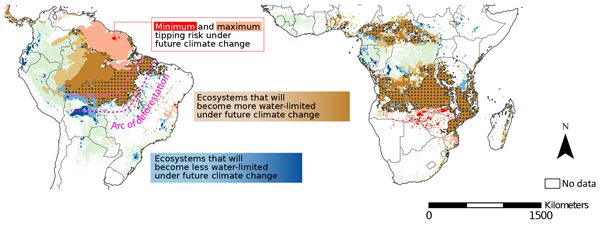
Chandrakant Singh, Ruud van der Ent, Ingo Fetzer, and Lan Wang-Erlandsson
Earth Syst. Dynam., 15, 1543–1565, https://doi.org/10.5194/esd-15-1543-2024, https://doi.org/10.5194/esd-15-1543-2024, 2024
Short summary
Short summary
Tropical rainforests risk tipping to savanna under future climate change. By analysing ecosystem root zone dynamics using hydroclimate data from Earth system models, we project the tipping risks for these rainforests. Our findings suggest that although some transition risks may be inevitable, most can still be mitigated by adapting to less severe climate change scenarios. Limiting global surface temperatures to meet the Paris Agreement targets is critical to preserving these ecosystems.
Shailendra Pratap, Yannis Markonis, and Cécile Blanchet
Clim. Past Discuss., https://doi.org/10.5194/cp-2024-68, https://doi.org/10.5194/cp-2024-68, 2024
Preprint withdrawn
Short summary
Short summary
Our study investigates the influence of oceanic changes on regional hydroclimate (precipitation and temperature) patterns, in Europe and North America during the Medieval Climate Anomaly period. Our findings suggest that centennial-scale variations in terrestrial thermodynamics, sea surface temperatures, and shifts in the Intertropical Convergence Zone likely played a role in shaping regional hydroclimate patterns. Our outcomes will offer insights into how hydroclimate may evolve in the future.
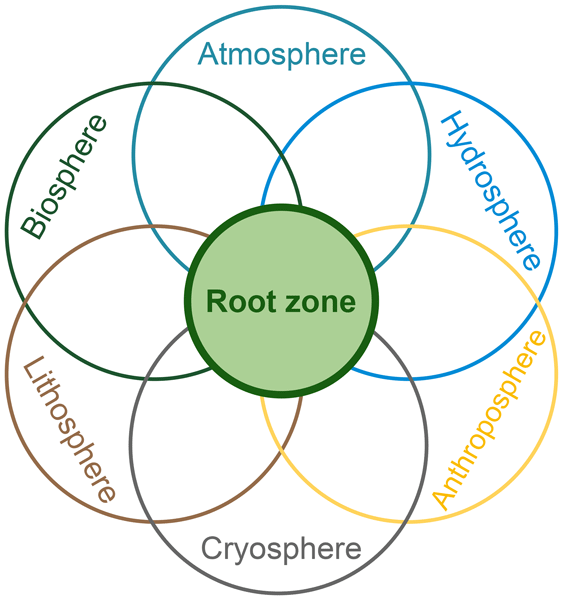
Hongkai Gao, Markus Hrachowitz, Lan Wang-Erlandsson, Fabrizio Fenicia, Qiaojuan Xi, Jianyang Xia, Wei Shao, Ge Sun, and Hubert H. G. Savenije
Hydrol. Earth Syst. Sci., 28, 4477–4499, https://doi.org/10.5194/hess-28-4477-2024, https://doi.org/10.5194/hess-28-4477-2024, 2024
Short summary
Short summary
The concept of the root zone is widely used but lacks a precise definition. Its importance in Earth system science is not well elaborated upon. Here, we clarified its definition with several similar terms to bridge the multi-disciplinary gap. We underscore the key role of the root zone in the Earth system, which links the biosphere, hydrosphere, lithosphere, atmosphere, and anthroposphere. To better represent the root zone, we advocate for a paradigm shift towards ecosystem-centred modelling.
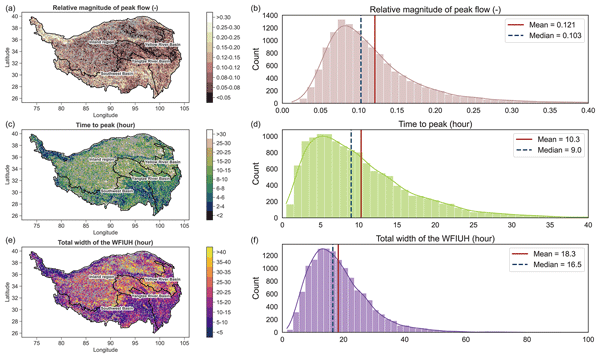
Yuhan Guo, Hongxing Zheng, Yuting Yang, Yanfang Sang, and Congcong Wen
Earth Syst. Sci. Data, 16, 1651–1665, https://doi.org/10.5194/essd-16-1651-2024, https://doi.org/10.5194/essd-16-1651-2024, 2024
Short summary
Short summary
We have provided an inaugural version of the hydrogeomorphic dataset for catchments over the Tibetan Plateau. We first provide the width-function-based instantaneous unit hydrograph (WFIUH) for each HydroBASINS catchment, which can be used to investigate the spatial heterogeneity of hydrological behavior across the Tibetan Plateau. It is expected to facilitate hydrological modeling across the Tibetan Plateau.
Georgina M. Falster, Nicky M. Wright, Nerilie J. Abram, Anna M. Ukkola, and Benjamin J. Henley
Hydrol. Earth Syst. Sci., 28, 1383–1401, https://doi.org/10.5194/hess-28-1383-2024, https://doi.org/10.5194/hess-28-1383-2024, 2024
Short summary
Short summary
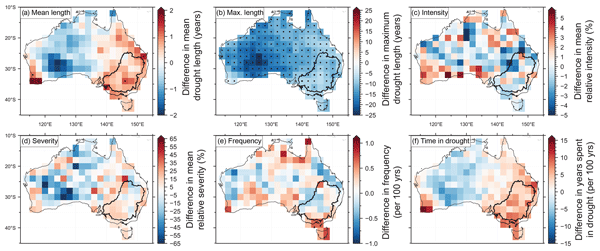
Multi-year droughts have severe environmental and economic impacts, but the instrumental record is too short to characterise multi-year drought variability. We assessed the nature of Australian multi-year droughts using simulations of the past millennium from 11 climate models. We show that multi-decadal
megadroughtsare a natural feature of the Australian hydroclimate. Human-caused climate change is also driving a tendency towards longer droughts in eastern and southwestern Australia.
Mijael Rodrigo Vargas Godoy, Yannis Markonis, Oldrich Rakovec, Michal Jenicek, Riya Dutta, Rajani Kumar Pradhan, Zuzana Bešťáková, Jan Kyselý, Roman Juras, Simon Michael Papalexiou, and Martin Hanel
Hydrol. Earth Syst. Sci., 28, 1–19, https://doi.org/10.5194/hess-28-1-2024, https://doi.org/10.5194/hess-28-1-2024, 2024
Short summary
Short summary
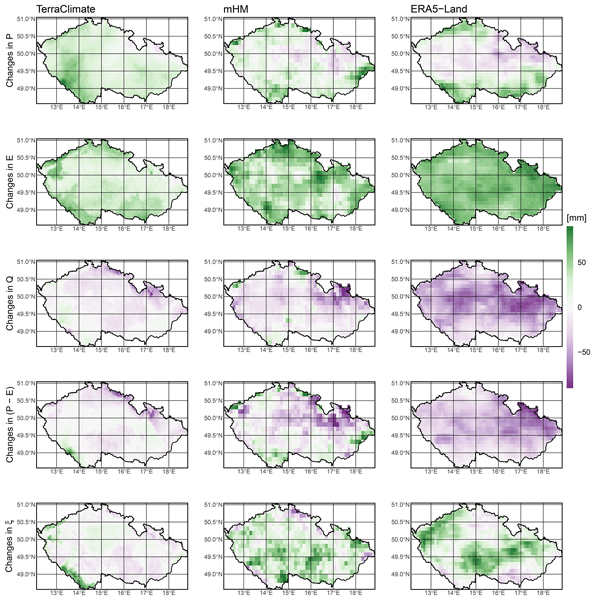
The study introduces a novel benchmarking method based on the water cycle budget for hydroclimate data fusion. Using this method and multiple state-of-the-art datasets to assess the spatiotemporal patterns of water cycle changes in Czechia, we found that differences in water availability distribution are dominated by evapotranspiration. Furthermore, while the most significant temporal changes in Czechia occur during spring, the median spatial patterns stem from summer changes in the water cycle.
En Ning Lai, Lan Wang-Erlandsson, Vili Virkki, Miina Porkka, and Ruud J. van der Ent
Hydrol. Earth Syst. Sci., 27, 3999–4018, https://doi.org/10.5194/hess-27-3999-2023, https://doi.org/10.5194/hess-27-3999-2023, 2023
Short summary
Short summary
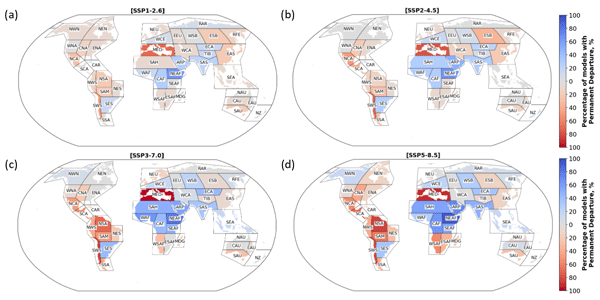
This research scrutinized predicted changes in root zone soil moisture dynamics across different climate scenarios and different climate regions globally between 2021 and 2100. The Mediterranean and most of South America stood out as regions that will likely experience permanently drier conditions, with greater severity observed in the no-climate-policy scenarios. These findings underscore the impact that possible future climates can have on green water resources.
Trevor Page, Paul Smith, Keith Beven, Francesca Pianosi, Fanny Sarrazin, Susana Almeida, Liz Holcombe, Jim Freer, Nick Chappell, and Thorsten Wagener
Hydrol. Earth Syst. Sci., 27, 2523–2534, https://doi.org/10.5194/hess-27-2523-2023, https://doi.org/10.5194/hess-27-2523-2023, 2023
Short summary
Short summary
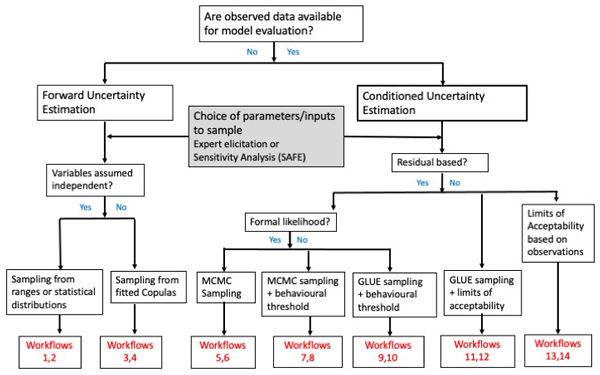
This publication provides an introduction to the CREDIBLE Uncertainty Estimation (CURE) toolbox. CURE offers workflows for a variety of uncertainty estimation methods. One of its most important features is the requirement that all of the assumptions on which a workflow analysis depends be defined. This facilitates communication with potential users of an analysis. An audit trail log is produced automatically from a workflow for future reference.
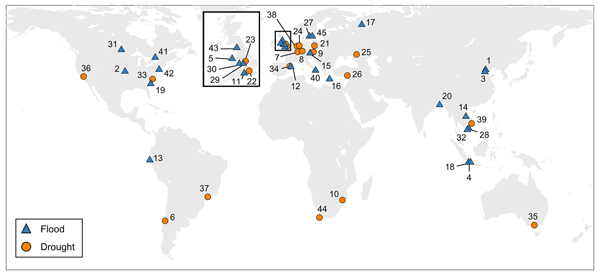
Heidi Kreibich, Kai Schröter, Giuliano Di Baldassarre, Anne F. Van Loon, Maurizio Mazzoleni, Guta Wakbulcho Abeshu, Svetlana Agafonova, Amir AghaKouchak, Hafzullah Aksoy, Camila Alvarez-Garreton, Blanca Aznar, Laila Balkhi, Marlies H. Barendrecht, Sylvain Biancamaria, Liduin Bos-Burgering, Chris Bradley, Yus Budiyono, Wouter Buytaert, Lucinda Capewell, Hayley Carlson, Yonca Cavus, Anaïs Couasnon, Gemma Coxon, Ioannis Daliakopoulos, Marleen C. de Ruiter, Claire Delus, Mathilde Erfurt, Giuseppe Esposito, Didier François, Frédéric Frappart, Jim Freer, Natalia Frolova, Animesh K. Gain, Manolis Grillakis, Jordi Oriol Grima, Diego A. Guzmán, Laurie S. Huning, Monica Ionita, Maxim Kharlamov, Dao Nguyen Khoi, Natalie Kieboom, Maria Kireeva, Aristeidis Koutroulis, Waldo Lavado-Casimiro, Hong-Yi Li, Maria Carmen LLasat, David Macdonald, Johanna Mård, Hannah Mathew-Richards, Andrew McKenzie, Alfonso Mejia, Eduardo Mario Mendiondo, Marjolein Mens, Shifteh Mobini, Guilherme Samprogna Mohor, Viorica Nagavciuc, Thanh Ngo-Duc, Huynh Thi Thao Nguyen, Pham Thi Thao Nhi, Olga Petrucci, Nguyen Hong Quan, Pere Quintana-Seguí, Saman Razavi, Elena Ridolfi, Jannik Riegel, Md Shibly Sadik, Nivedita Sairam, Elisa Savelli, Alexey Sazonov, Sanjib Sharma, Johanna Sörensen, Felipe Augusto Arguello Souza, Kerstin Stahl, Max Steinhausen, Michael Stoelzle, Wiwiana Szalińska, Qiuhong Tang, Fuqiang Tian, Tamara Tokarczyk, Carolina Tovar, Thi Van Thu Tran, Marjolein H. J. van Huijgevoort, Michelle T. H. van Vliet, Sergiy Vorogushyn, Thorsten Wagener, Yueling Wang, Doris E. Wendt, Elliot Wickham, Long Yang, Mauricio Zambrano-Bigiarini, and Philip J. Ward
Earth Syst. Sci. Data, 15, 2009–2023, https://doi.org/10.5194/essd-15-2009-2023, https://doi.org/10.5194/essd-15-2009-2023, 2023
Short summary
Short summary
As the adverse impacts of hydrological extremes increase in many regions of the world, a better understanding of the drivers of changes in risk and impacts is essential for effective flood and drought risk management. We present a dataset containing data of paired events, i.e. two floods or two droughts that occurred in the same area. The dataset enables comparative analyses and allows detailed context-specific assessments. Additionally, it supports the testing of socio-hydrological models.
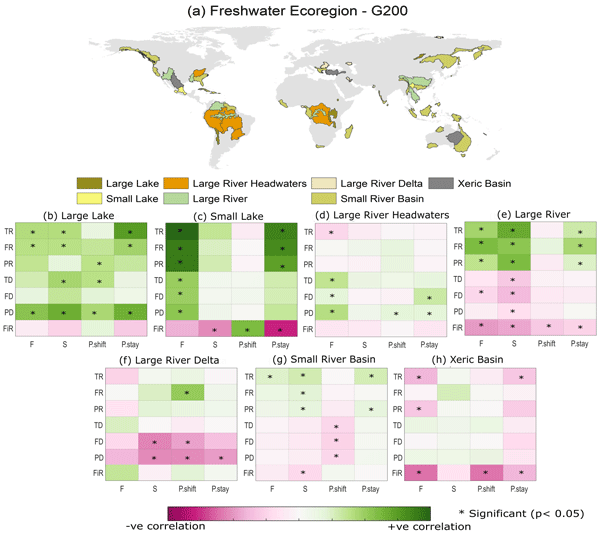
Chinchu Mohan, Tom Gleeson, James S. Famiglietti, Vili Virkki, Matti Kummu, Miina Porkka, Lan Wang-Erlandsson, Xander Huggins, Dieter Gerten, and Sonja C. Jähnig
Hydrol. Earth Syst. Sci., 26, 6247–6262, https://doi.org/10.5194/hess-26-6247-2022, https://doi.org/10.5194/hess-26-6247-2022, 2022
Short summary
Short summary
The relationship between environmental flow violations and freshwater biodiversity at a large scale is not well explored. This study intended to carry out an exploratory evaluation of this relationship at a large scale. While our results suggest that streamflow and EF may not be the only determinants of freshwater biodiversity at large scales, they do not preclude the existence of relationships at smaller scales or with more holistic EF methods or with other biodiversity data or metrics.
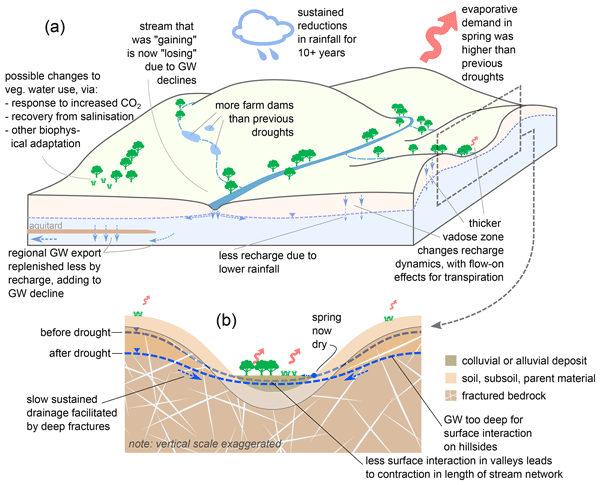
Keirnan Fowler, Murray Peel, Margarita Saft, Tim J. Peterson, Andrew Western, Lawrence Band, Cuan Petheram, Sandra Dharmadi, Kim Seong Tan, Lu Zhang, Patrick Lane, Anthony Kiem, Lucy Marshall, Anne Griebel, Belinda E. Medlyn, Dongryeol Ryu, Giancarlo Bonotto, Conrad Wasko, Anna Ukkola, Clare Stephens, Andrew Frost, Hansini Gardiya Weligamage, Patricia Saco, Hongxing Zheng, Francis Chiew, Edoardo Daly, Glen Walker, R. Willem Vervoort, Justin Hughes, Luca Trotter, Brad Neal, Ian Cartwright, and Rory Nathan
Hydrol. Earth Syst. Sci., 26, 6073–6120, https://doi.org/10.5194/hess-26-6073-2022, https://doi.org/10.5194/hess-26-6073-2022, 2022
Short summary
Short summary
Recently, we have seen multi-year droughts tending to cause shifts in the relationship between rainfall and streamflow. In shifted catchments that have not recovered, an average rainfall year produces less streamflow today than it did pre-drought. We take a multi-disciplinary approach to understand why these shifts occur, focusing on Australia's over-10-year Millennium Drought. We evaluate multiple hypotheses against evidence, with particular focus on the key role of groundwater processes.
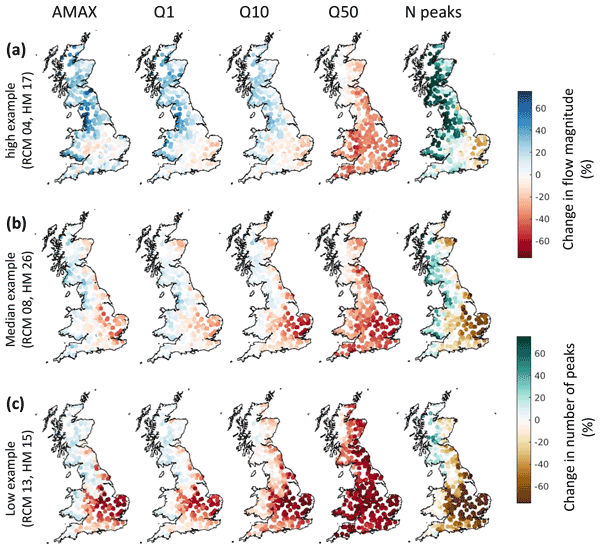
Rosanna A. Lane, Gemma Coxon, Jim Freer, Jan Seibert, and Thorsten Wagener
Hydrol. Earth Syst. Sci., 26, 5535–5554, https://doi.org/10.5194/hess-26-5535-2022, https://doi.org/10.5194/hess-26-5535-2022, 2022
Short summary
Short summary
This study modelled the impact of climate change on river high flows across Great Britain (GB). Generally, results indicated an increase in the magnitude and frequency of high flows along the west coast of GB by 2050–2075. In contrast, average flows decreased across GB. All flow projections contained large uncertainties; the climate projections were the largest source of uncertainty overall but hydrological modelling uncertainties were considerable in some regions.

Luca Guillaumot, Mikhail Smilovic, Peter Burek, Jens de Bruijn, Peter Greve, Taher Kahil, and Yoshihide Wada
Geosci. Model Dev., 15, 7099–7120, https://doi.org/10.5194/gmd-15-7099-2022, https://doi.org/10.5194/gmd-15-7099-2022, 2022
Short summary
Short summary
We develop and test the first large-scale hydrological model at regional scale with a very high spatial resolution that includes a water management and groundwater flow model. This study infers the impact of surface and groundwater-based irrigation on groundwater recharge and on evapotranspiration in both irrigated and non-irrigated areas. We argue that water table recorded in boreholes can be used as validation data if water management is well implemented and spatial resolution is ≤ 100 m.
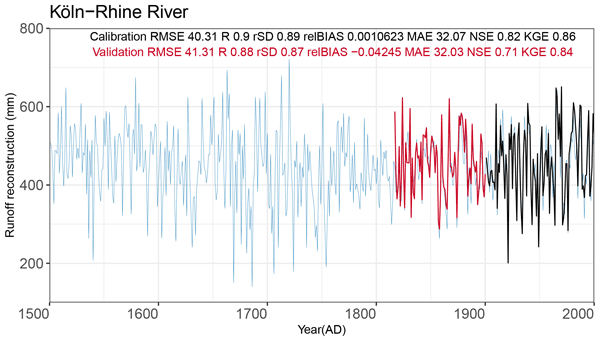
Sadaf Nasreen, Markéta Součková, Mijael Rodrigo Vargas Godoy, Ujjwal Singh, Yannis Markonis, Rohini Kumar, Oldrich Rakovec, and Martin Hanel
Earth Syst. Sci. Data, 14, 4035–4056, https://doi.org/10.5194/essd-14-4035-2022, https://doi.org/10.5194/essd-14-4035-2022, 2022
Short summary
Short summary
This article presents a 500-year reconstructed annual runoff dataset for several European catchments. Several data-driven and hydrological models were used to derive the runoff series using reconstructed precipitation and temperature and a set of proxy data. The simulated runoff was validated using independent observed runoff data and documentary evidence. The validation revealed a good fit between the observed and reconstructed series for 14 catchments, which are available for further analysis.
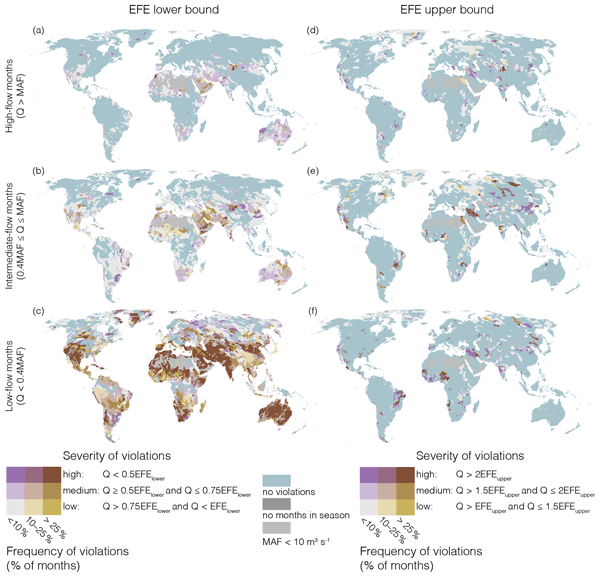
Vili Virkki, Elina Alanärä, Miina Porkka, Lauri Ahopelto, Tom Gleeson, Chinchu Mohan, Lan Wang-Erlandsson, Martina Flörke, Dieter Gerten, Simon N. Gosling, Naota Hanasaki, Hannes Müller Schmied, Niko Wanders, and Matti Kummu
Hydrol. Earth Syst. Sci., 26, 3315–3336, https://doi.org/10.5194/hess-26-3315-2022, https://doi.org/10.5194/hess-26-3315-2022, 2022
Short summary
Short summary
Direct and indirect human actions have altered streamflow across the world since pre-industrial times. Here, we apply a method of environmental flow envelopes (EFEs) that develops the existing global environmental flow assessments by methodological advances and better consideration of uncertainty. By assessing the violations of the EFE, we comprehensively quantify the frequency, severity, and trends of flow alteration during the past decades, illustrating anthropogenic effects on streamflow.
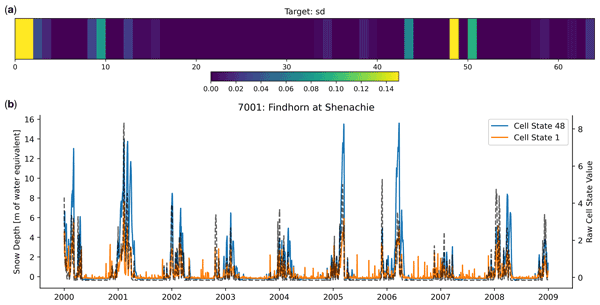
Thomas Lees, Steven Reece, Frederik Kratzert, Daniel Klotz, Martin Gauch, Jens De Bruijn, Reetik Kumar Sahu, Peter Greve, Louise Slater, and Simon J. Dadson
Hydrol. Earth Syst. Sci., 26, 3079–3101, https://doi.org/10.5194/hess-26-3079-2022, https://doi.org/10.5194/hess-26-3079-2022, 2022
Short summary
Short summary
Despite the accuracy of deep learning rainfall-runoff models, we are currently uncertain of what these models have learned. In this study we explore the internals of one deep learning architecture and demonstrate that the model learns about intermediate hydrological stores of soil moisture and snow water, despite never having seen data about these processes during training. Therefore, we find evidence that the deep learning approach learns a physically realistic mapping from inputs to outputs.
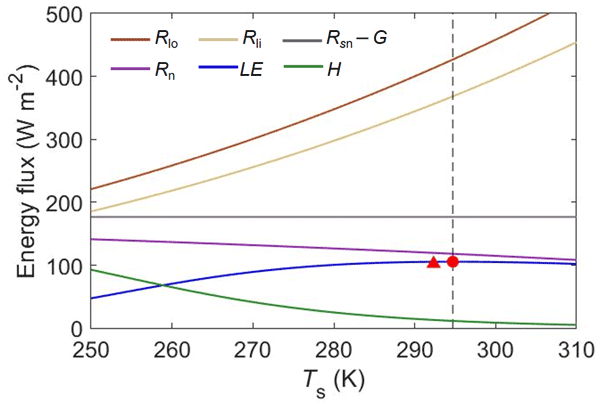
Zhuoyi Tu, Yuting Yang, and Michael L. Roderick
Hydrol. Earth Syst. Sci., 26, 1745–1754, https://doi.org/10.5194/hess-26-1745-2022, https://doi.org/10.5194/hess-26-1745-2022, 2022
Short summary
Short summary
Here we test a maximum evaporation theory that acknowledges the interdependence between radiation, surface temperature, and evaporation over saturated land. We show that the maximum evaporation approach recovers observed evaporation and surface temperature under non-water-limited conditions across a broad range of bio-climates. The implication is that the maximum evaporation concept can be used to predict potential evaporation that has long been a major difficulty for the hydrological community.
Anna M. Ukkola, Gab Abramowitz, and Martin G. De Kauwe
Earth Syst. Sci. Data, 14, 449–461, https://doi.org/10.5194/essd-14-449-2022, https://doi.org/10.5194/essd-14-449-2022, 2022
Short summary
Short summary
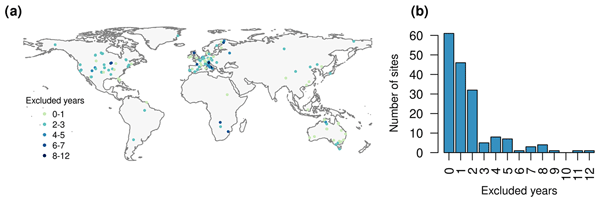
Flux towers provide measurements of water, energy, and carbon fluxes. Flux tower data are invaluable in improving and evaluating land models but are not suited to modelling applications as published. Here we present flux tower data tailored for land modelling, encompassing 170 sites globally. Our dataset resolves several key limitations hindering the use of flux tower data in land modelling, including incomplete forcing variable, data format, and low data quality.

Sami W. Rifai, Martin G. De Kauwe, Anna M. Ukkola, Lucas A. Cernusak, Patrick Meir, Belinda E. Medlyn, and Andy J. Pitman
Biogeosciences, 19, 491–515, https://doi.org/10.5194/bg-19-491-2022, https://doi.org/10.5194/bg-19-491-2022, 2022
Short summary
Short summary
Australia's woody ecosystems have experienced widespread greening despite a warming climate and repeated record-breaking droughts and heat waves. Increasing atmospheric CO2 increases plant water use efficiency, yet quantifying the CO2 effect is complicated due to co-occurring effects of global change. Here we harmonized a 38-year satellite record to separate the effects of climate change, land use change, and disturbance to quantify the CO2 fertilization effect on the greening phenomenon.
Tom Gleeson, Thorsten Wagener, Petra Döll, Samuel C. Zipper, Charles West, Yoshihide Wada, Richard Taylor, Bridget Scanlon, Rafael Rosolem, Shams Rahman, Nurudeen Oshinlaja, Reed Maxwell, Min-Hui Lo, Hyungjun Kim, Mary Hill, Andreas Hartmann, Graham Fogg, James S. Famiglietti, Agnès Ducharne, Inge de Graaf, Mark Cuthbert, Laura Condon, Etienne Bresciani, and Marc F. P. Bierkens
Geosci. Model Dev., 14, 7545–7571, https://doi.org/10.5194/gmd-14-7545-2021, https://doi.org/10.5194/gmd-14-7545-2021, 2021
Short summary
Short summary
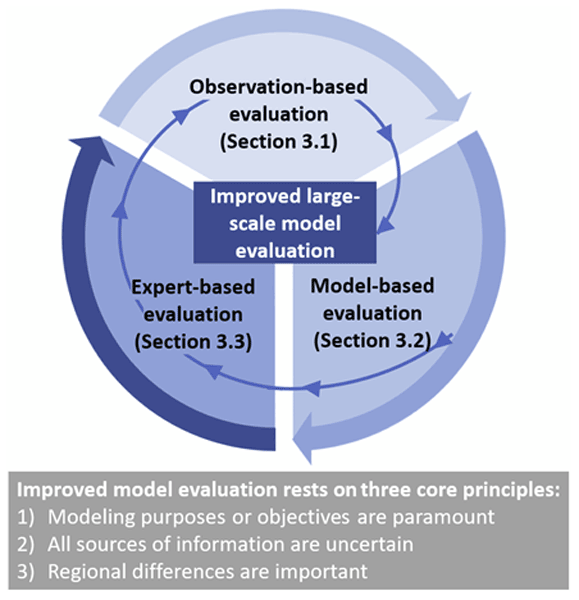
Groundwater is increasingly being included in large-scale (continental to global) land surface and hydrologic simulations. However, it is challenging to evaluate these simulations because groundwater is
hiddenunderground and thus hard to measure. We suggest using multiple complementary strategies to assess the performance of a model (
model evaluation).
Cited articles
Althoff, D. and Destouni, G.: Global patterns in water flux partitioning: Irrigated and rainfed agriculture drives asymmetrical flux to vegetation over runoff, One Earth, 6, 1246–1257, https://doi.org/10.1016/j.oneear.2023.08.002, 2023. a, b
Barnett, T. P., Adam, J. C., and Lettenmaier, D. P.: Potential impacts of a warming climate on water availability in snow-dominated regions, Nature, 438, 303–309, https://doi.org/10.1038/nature04141, 2005. a
Berg, A. and Sheffield, J.: Evapotranspiration Partitioning in CMIP5 Models: Uncertainties and Future Projections, J. Clim., 32, 2653–2671, https://doi.org/10.1175/JCLI-D-18-0583.1, 2019. a
Bouaziz, L. J. E., Aalbers, E. E., Weerts, A. H., Hegnauer, M., Buiteveld, H., Lammersen, R., Stam, J., Sprokkereef, E., Savenije, H. H. G., and Hrachowitz, M.: Ecosystem adaptation to climate change: the sensitivity of hydrological predictions to time-dynamic model parameters, Hydrol. Earth Syst. Sci., 26, 1295–1318, https://doi.org/10.5194/hess-26-1295-2022, 2022. a
Breiman, L.: Random Forests, Mach. Learn., 45, 5–32, https://doi.org/10.1023/A:1010933404324, 2001. a
Brunner, L., Poschlod, B., Dutra, E., Fischer, E. M., Martius, O., and Sillmann, J.: A global perspective on the spatial representation of climate extremes from km-scale models, Environ. Res. Lett., 20, 074054, https://doi.org/10.1088/1748-9326/ade1ef, 2025. a
Buck, A. L.: New Equations for Computing Vapor Pressure and Enhancement Factor, J. Appl. Meteorol. Climatol., 20, 1527–1532, https://doi.org/10.1175/1520-0450(1981)020<1527:NEFCVP>2.0.CO;2, 1981. a
Budyko, M. I.: Climate and Life, Academic Press, New York, ISBN 978-0-12-139450-9, 1974. a
Clark, M. P., Fan, Y., Lawrence, D. M., Adam, J. C., Bolster, D., Gochis, D. J., Hooper, R. P., Kumar, M., Leung, L. R., Mackay, D. S., Maxwell, R. M., Shen, C., Swenson, S. C., and Zeng, X.: Improving the representation of hydrologic processes in Earth System Models, Water Resour. Res., 51, 5929–5956, https://doi.org/10.1002/2015WR017096, 2015. a, b
Denissen, J. M. C., Teuling, A. J., Pitman, A. J., Koirala, S., Migliavacca, M., Li, W., Reichstein, M., Winkler, A. J., Zhan, C., and Orth, R.: Widespread shift from ecosystem energy to water limitation with climate change, Nat. Clim. Change, 12, 677–684, https://doi.org/10.1038/s41558-022-01403-8, 2022. a, b, c
Donat, M. G., Lowry, A. L., Alexander, L. V., O'Gorman, P. A., and Maher, N.: More extreme precipitation in the world’s dry and wet regions, Nat. Clim. Change, 6, 508–513, https://doi.org/10.1038/nclimate2941, 2016. a, b
Dunn, R. J. H., Donat, M. G., and Alexander, L. V.: Comparing extremes indices in recent observational and reanalysis products, Front. Clim., 4, https://doi.org/10.3389/fclim.2022.989505, 2022. a
Dutta, R. and Markonis, Y.: Does ERA5-land capture the changes in the terrestrial hydrological cycle across the globe?, Environ. Res. Lett., 19, 024054, https://doi.org/10.1088/1748-9326/ad1d3a, 2024. a
Eekhout, J. P. C., Hunink, J. E., Terink, W., and de Vente, J.: Why increased extreme precipitation under climate change negatively affects water security, Hydrol. Earth Syst. Sci., 22, 5935–5946, https://doi.org/10.5194/hess-22-5935-2018, 2018. a
Eyring, V., Bony, S., Meehl, G. A., Senior, C. A., Stevens, B., Stouffer, R. J., and Taylor, K. E.: Overview of the Coupled Model Intercomparison Project Phase 6 (CMIP6) experimental design and organization, Geosci. Model Dev.t, 9, 1937–1958, https://doi.org/10.5194/gmd-9-1937-2016, 2016. a, b
Falkenmark, M.: Land–water linkages: a synopsis, in: Land and Water Integration and River Basin Management, Proceedings of the FAO Workshop, Rome, 31 January–2 February 1993, 15–17, FAO, Rome, https://www.fao.org/4/v5400e/v5400e00.htm (last access: 21 June 2026), 1995. a
Falkenmark, M.: Growing water scarcity in agriculture: future challenge to global water security, Philos. T. Roy. Soc. A, 371, 20120410, https://doi.org/10.1098/rsta.2012.0410, 2013. a
Falkenmark, M. and Rockström, J.: The New Blue and Green Water Paradigm: Breaking New Ground for Water Resources Planning and Management, J. Water Res. Pl., 132, 129–132, https://doi.org/10.1061/(ASCE)0733-9496(2006)132:3(129), 2006. a
Falkenmark, M., Wang-Erlandsson, L., and Rockström, J.: Understanding of water resilience in the Anthropocene, J. Hydrol. X, 2, 100009, https://doi.org/10.1016/j.hydroa.2018.100009, 2019. a, b, c
Fiedler, S., Crueger, T., D’Agostino, R., Peters, K., Becker, T., Leutwyler, D., Paccini, L., Burdanowitz, J., Buehler, S. A., Cortes, A. U., Dauhut, T., Dommenget, D., Fraedrich, K., Jungandreas, L., Maher, N., Naumann, A. K., Rugenstein, M., Sakradzija, M., Schmidt, H., Sielmann, F., Stephan, C., Timmreck, C., Zhu, X., and Stevens, B.: Simulated Tropical Precipitation Assessed across Three Major Phases of the Coupled Model Intercomparison Project (CMIP), Mon. Weather Rev., 148, 3653–3680, https://doi.org/10.1175/MWR-D-19-0404.1, 2020. a
Forzieri, G., Miralles, D. G., Ciais, P., Alkama, R., Ryu, Y., Duveiller, G., Zhang, K., Robertson, E., Kautz, M., Martens, B., Jiang, C., Arneth, A., Georgievski, G., Li, W., Ceccherini, G., Anthoni, P., Lawrence, P., Wiltshire, A., Pongratz, J., Piao, S., Sitch, S., Goll, D. S., Arora, V. K., Lienert, S., Lombardozzi, D., Kato, E., Nabel, J. E. M. S., Tian, H., Friedlingstein, P., and Cescatti, A.: Increased control of vegetation on global terrestrial energy fluxes, Nat. Clim. Change, 10, 356–362, https://doi.org/10.1038/s41558-020-0717-0, 2020. a
Friedman, J. H., Hastie, T., and Tibshirani, R.: Regularization Paths for Generalized Linear Models via Coordinate Descent, J. Stat. Softw., 33, 1–22, https://doi.org/10.18637/jss.v033.i01, 2010. a
Fujimori, S., Hasegawa, T., Masui, T., Takahashi, K., Herran, D. S., Dai, H., Hijioka, Y., and Kainuma, M.: SSP3: AIM implementation of Shared Socioeconomic Pathways, Glob. Environ. Change, 42, 268–283, https://doi.org/10.1016/j.gloenvcha.2016.06.009, 2017. a
Ghiggi, G., Humphrey, V., Seneviratne, S. I., and Gudmundsson, L.: GRUN: an observation-based global gridded runoff dataset from 1902 to 2014, Earth Syst. Sci. Data, 11, 1655–1674, https://doi.org/10.5194/essd-11-1655-2019, 2019. a
Gier, B. K., Schlund, M., Friedlingstein, P., Jones, C. D., Jones, C., Zaehle, S., and Eyring, V.: Representation of the terrestrial carbon cycle in CMIP6, Biogeosciences, 21, 5321–5360, https://doi.org/10.5194/bg-21-5321-2024, 2024. a
Gleeson, T., Wang-Erlandsson, L., Porkka, M., Zipper, S. C., Jaramillo, F., Gerten, D., Fetzer, I., Cornell, S. E., Piemontese, L., Gordon, L. J., Rockström, J., Oki, T., Sivapalan, M., Wada, Y., Brauman, K. A., Flörke, M., Bierkens, M. F. P., Lehner, B., Keys, P., Kummu, M., Wagener, T., Dadson, S., Troy, T. J., Steffen, W., Falkenmark, M., and Famiglietti, J. S.: Illuminating water cycle modifications and Earth system resilience in the Anthropocene, Water Resour. Res., 56, e2019WR024957, https://doi.org/10.1029/2019WR024957, 2020. a, b, c
Gnann, S., Baldwin, J. W., Cuthbert, M. O., Gleeson, T., Schwanghart, W., and Wagener, T.: The Influence of Topography on the Global Terrestrial Water Cycle, Rev. Geophys., 63, e2023RG000810, https://doi.org/10.1029/2023RG000810, 2025. a
Greve, P., Orlowsky, B., Mueller, B., Sheffield, J., Reichstein, M., and Seneviratne, S. I.: Global assessment of trends in wetting and drying over land, Nat. Geosci., 7, 716–721, https://doi.org/10.1038/ngeo2247, 2014. a
Gudmundsson, L., Brunner, M. I., Döll, P., Fluet-Chouinard, E., Frolova, N., Gosling, S. N., Hirabayashi, Y., Kireeva, M. B., Liu, X., Müller Schmied, H., Magritskiy, D., Slater, L. J., Stein, L., Tramblay, Y., Wang, K., Wasko, C., Yamazaki, D., and Zhou, X.: Past and future change in global river flows, Nat. Rev. Earth Environ., 7, 7–23, https://doi.org/10.1038/s43017-025-00745-z, 2026. a
Han, J., Yang, Y., Roderick, M. L., McVicar, T. R., Yang, D., Zhang, S., and Beck, H. E.: Assessing the Steady-State Assumption in Water Balance Calculation Across Global Catchments, Water Resour. Res., 56, e2020WR027392, https://doi.org/10.1029/2020WR027392, 2020. a
Hausfather, Z. and Peters, G. P.: Emissions – the “business as usual” story is misleading, Nature, 577, 618–620, https://doi.org/10.1038/d41586-020-00177-3, 2020. a
He, M., Piao, S., Huntingford, C., Xu, H., Wang, X., Bastos, A., Cui, J., and Gasser, T.: Amplified warming from physiological responses to carbon dioxide reduces the potential of vegetation for climate change mitigation, Commun. Earth Environ., 3, 160, https://doi.org/10.1038/s43247-022-00489-4, 2022. a
Heselschwerdt, S. P.: simonheselschwerdt/bgws_analysis: Code for publication of manuscript at ESD (v1.1.0), Zenodo [code], https://doi.org/10.5281/zenodo.20783899, 2026. a
Hou, Y., Guo, H., Yang, Y., and Liu, W.: Global Evaluation of Runoff Simulation From Climate, Hydrological and Land Surface Models, Water Resour. Res.h, 59, e2021WR031817, https://doi.org/10.1029/2021WR031817, 2023. a
Huang, H., Liu, J., Chen, A., Ruiz-Vásquez, M., and Orth, R.: State-of-the-art hydrological datasets exhibit low water balance consistency globally, Earth Syst. Sci. Data, 18, 3109–3124, https://doi.org/10.5194/essd-18-3109-2026, 2026. a
Hurtt, G. C., Chini, L., Sahajpal, R., Frolking, S., Bodirsky, B. L., Calvin, K., Doelman, J. C., Fisk, J., Fujimori, S., Klein Goldewijk, K., Hasegawa, T., Havlik, P., Heinimann, A., Humpenöder, F., Jungclaus, J., Kaplan, J. O., Kennedy, J., Krisztin, T., Lawrence, D., Lawrence, P., Ma, L., Mertz, O., Pongratz, J., Popp, A., Poulter, B., Riahi, K., Shevliakova, E., Stehfest, E., Thornton, P., Tubiello, F. N., van Vuuren, D. P., and Zhang, X.: Harmonization of global land use change and management for the period 850–2100 (LUH2) for CMIP6, Geosci. Model Dev., 13, 5425–5464, https://doi.org/10.5194/gmd-13-5425-2020, 2020. a
IPCC: Annex II: Glossary, in: Climate Change 2022: Impacts, Adaptation and Vulnerability. Contribution of Working Group II to the Sixth Assessment Report of the Intergovernmental Panel on Climate Change, 2897–2930, Cambridge University Press, Cambridge, UK and New York, NY, USA, https://doi.org/10.1017/9781009325844.029, 2022. a
Iturbide, M., Gutiérrez, J. M., Alves, L. M., Bedia, J., Cerezo-Mota, R., Cimadevilla, E., Cofiño, A. S., Di Luca, A., Faria, S. H., Gorodetskaya, I. V., Hauser, M., Herrera, S., Hennessy, K., Hewitt, H. T., Jones, R. G., Krakovska, S., Manzanas, R., Martínez-Castro, D., Narisma, G. T., Nurhati, I. S., Pinto, I., Seneviratne, S. I., van den Hurk, B., and Vera, C. S.: An update of IPCC climate reference regions for subcontinental analysis of climate model data: definition and aggregated datasets, Earth Syst. Sci. Data, 12, 2959–2970, https://doi.org/10.5194/essd-12-2959-2020, 2020. a
Keenan, T. F., Hollinger, D. Y., Bohrer, G., Dragoni, D., Munger, J. W., Schmid, H. P., and Richardson, A. D.: Increase in forest water-use efficiency as atmospheric carbon dioxide concentrations rise, Nature, 499, 324–327, https://doi.org/10.1038/nature12291, 2013. a
Knoben, W. J. M., Woods, R. A., and Freer, J. E.: A Quantitative Hydrological Climate Classification Evaluated With Independent Streamflow Data, Water Resour. Res., 54, 5088–5109, https://doi.org/10.1029/2018WR022913, 2018. a
Knutti, R., Furrer, R., Tebaldi, C., Cermak, J., and Meehl, G. A.: Challenges in Combining Projections from Multiple Climate Models, Journal of Climate, 23, 2739–2758, https://doi.org/10.1175/2009JCLI3361.1, 2010. a
Lawrence, D. M., Thornton, P. E., Oleson, K. W., and Bonan, G. B.: The Partitioning of Evapotranspiration into Transpiration, Soil Evaporation, and Canopy Evaporation in a GCM: Impacts on Land–Atmosphere Interaction, J. Hydrometeorol., 8, 862–880, https://doi.org/10.1175/JHM596.1, 2007. a, b, c
Leakey, A. D. B., Ainsworth, E. A., Bernacchi, C. J., Rogers, A., Long, S. P., and Ort, D. R.: Elevated CO2 effects on plant carbon, nitrogen, and water relations: six important lessons from FACE, J. Experiment. Bot., 60, 2859–2876, https://doi.org/10.1093/jxb/erp096, 2009. a
Li, C., Zwiers, F., Zhang, X., Li, G., Sun, Y., and Wehner, M.: Changes in Annual Extremes of Daily Temperature and Precipitation in CMIP6 Models, J. Clim., 34, 3441–3460, https://doi.org/10.1175/JCLI-D-19-1013.1, 2021a. a
Li, J., Miao, C., Wei, W., Zhang, G., Hua, L., Chen, Y., and Wang, X.: Evaluation of CMIP6 Global Climate Models for Simulating Land Surface Energy and Water Fluxes During 1979–2014, J. Adv. Model. Earth Sy., 13, e2021MS002515, https://doi.org/10.1029/2021MS002515, 2021b. a
Lian, X., Piao, S., Chen, A., Huntingford, C., Fu, B., Li, L. Z. X., Huang, J., Sheffield, J., Berg, A. M., Keenan, T. F., McVicar, T. R., Wada, Y., Wang, X., Wang, T., Yang, Y., and Roderick, M. L.: Multifaceted characteristics of dryland aridity changes in a warming world, Nat. Rev. Earth Environ., 2, 232–250, https://doi.org/10.1038/s43017-021-00144-0, 2021. a
Liao, C., Leung, L. R., Fang, Y., Tesfa, T., and Negron-Juarez, R.: Representing lateral groundwater flow from land to river in Earth system models, Geosci. Model Dev., 18, 4601–4624, https://doi.org/10.5194/gmd-18-4601-2025, 2025. a, b
Mankin, J. S., Smerdon, J. E., Cook, B. I., Williams, A. P., and Seager, R.: The Curious Case of Projected Twenty-First-Century Drying but Greening in the American West, J. Clim., 30, 8689–8710, https://doi.org/10.1175/JCLI-D-17-0213.1, 2017. a
Mankin, J. S., Seager, R., Smerdon, J. E., Cook, B. I., Williams, A. P., and Horton, R. M.: Blue Water Trade-Offs With Vegetation in a CO2-Enriched Climate, Geophys. Res. Lett., 45, 3115–3125, https://doi.org/10.1002/2018GL077051, 2018. a, b, c, d
Mankin, J. S., Seager, R., Smerdon, J. E., Cook, B. I., and Williams, A. P.: Mid-latitude freshwater availability reduced by projected vegetation responses to climate change, Nat. Geosci., 12, 983–988, https://doi.org/10.1038/s41561-019-0480-x, 2019. a, b, c
Maxwell, R. M. and Condon, L. E.: Connections between groundwater flow and transpiration partitioning, Science, 353, 377–380, https://doi.org/10.1126/science.aaf7891, 2016. a, b
Milly, P. C. D. and Dunne, K. A.: Potential evapotranspiration and continental drying, Nat. Clim. Change, 6, 946–949, https://doi.org/10.1038/nclimate3046, 2016. a
Milly, P. C. D. and Dunne, K. A.: Colorado River flow dwindles as warming-driven loss of reflective snow energizes evaporation, Science, 367, 1252–1255, https://doi.org/10.1126/science.aay9187, 2020. a
Miralles, D. G., Holmes, T. R. H., De Jeu, R. a. M., Gash, J. H., Meesters, A. G. C. A., and Dolman, A. J.: Global land-surface evaporation estimated from satellite-based observations, Hydrol. Earth Syst Sci., 15, 453–469, https://doi.org/10.5194/hess-15-453-2011, 2011. a
Muñoz-Sabater, J., Dutra, E., Agustí-Panareda, A., Albergel, C., Arduini, G., Balsamo, G., Boussetta, S., Choulga, M., Harrigan, S., Hersbach, H., Martens, B., Miralles, D. G., Piles, M., Rodríguez-Fernández, N. J., Zsoter, E., Buontempo, C., and Thépaut, J.-N.: ERA5-Land: a state-of-the-art global reanalysis dataset for land applications, Earth Syst. Sci. Data, 13, 4349–4383, https://doi.org/10.5194/essd-13-4349-2021, 2021. a
Nelson, J. A., Pérez-Priego, O., Zhou, S., Poyatos, R., Zhang, Y., Blanken, P. D., Gimeno, T. E., Wohlfahrt, G., Desai, A. R., Gioli, B., Limousin, J.-M., Bonal, D., Paul-Limoges, E., Scott, R. L., Varlagin, A., Fuchs, K., Montagnani, L., Wolf, S., Delpierre, N., Berveiller, D., Gharun, M., Belelli Marchesini, L., Gianelle, D., Šigut, L., Mammarella, I., Siebicke, L., Andrew Black, T., Knohl, A., Hörtnagl, L., Magliulo, V., Besnard, S., Weber, U., Carvalhais, N., Migliavacca, M., Reichstein, M., and Jung, M.: Ecosystem transpiration and evaporation: Insights from three water flux partitioning methods across FLUXNET sites, Glob. Change Biol., 26, 6916–6930, https://doi.org/10.1111/gcb.15314, 2020. a
Nijssen, B., O'Donnell, G. M., Hamlet, A. F., and Lettenmaier, D. P.: Hydrologic Sensitivity of Global Rivers to Climate Change, Climatic Change, 50, 143–175, https://doi.org/10.1023/A:1010616428763, 2001. a
Niu, G.-Y., Yang, Z.-L., Dickinson, R. E., and Gulden, L. E.: A simple TOPMODEL-based runoff parameterization (SIMTOP) for use in global climate models, J. Geophys. Res.-Atmos., 110, https://doi.org/10.1029/2005JD006111, 2005. a
Orth, R. and Destouni, G.: Drought reduces blue-water fluxes more strongly than green-water fluxes in Europe, Nat. Commun., 9, 3602, https://doi.org/10.1038/s41467-018-06013-7, 2018. a, b
Padrón, R. S., Gudmundsson, L., Liu, L., Humphrey, V., and Seneviratne, S. I.: Drivers of intermodel uncertainty in land carbon sink projections, Biogeosciences, 19, 5435–5448, https://doi.org/10.5194/bg-19-5435-2022, 2022. a, b, c
Riahi, K., Van Vuuren, D. P., Kriegler, E., Edmonds, J., O’Neill, B. C., Fujimori, S., Bauer, N., Calvin, K., Dellink, R., Fricko, O., Lutz, W., Popp, A., Cuaresma, J. C., Kc, S., Leimbach, M., Jiang, L., Kram, T., Rao, S., Emmerling, J., Ebi, K., Hasegawa, T., Havlik, P., Humpenöder, F., Da Silva, L. A., Smith, S., Stehfest, E., Bosetti, V., Eom, J., Gernaat, D., Masui, T., Rogelj, J., Strefler, J., Drouet, L., Krey, V., Luderer, G., Harmsen, M., Takahashi, K., Baumstark, L., Doelman, J. C., Kainuma, M., Klimont, Z., Marangoni, G., Lotze-Campen, H., Obersteiner, M., Tabeau, A., and Tavoni, M.: The Shared Socioeconomic Pathways and their energy, land use, and greenhouse gas emissions implications: An overview, Glob. Environ. Change, 42, 153–168, https://doi.org/10.1016/j.gloenvcha.2016.05.009, 2017. a
Rockström, J. and Gordon, L.: Assessment of green water flows to sustain major biomes of the world: Implications for future ecohydrological landscape management, Phys. Chem. Earth Pt. B, 26, 843–851, https://doi.org/10.1016/S1464-1909(01)00096-X, 2001. a
Ruehr, S., Keenan, T. F., Williams, C., Zhou, Y., Lu, X., Bastos, A., Canadell, J. G., Prentice, I. C., Sitch, S., and Terrer, C.: Evidence and attribution of the enhanced land carbon sink, Nat. Rev. Earth Environ., 4, 518–534, https://doi.org/10.1038/s43017-023-00456-3, 2023. a
Scheff, J., Coats, S., and Laguë, M. M.: Why do the Global Warming Responses of Land-Surface Models and Climatic Dryness Metrics Disagree?, Earth's Future, 10, e2022EF002814, https://doi.org/10.1029/2022EF002814, 2022. a, b, c
Schleussner, C.-F., Lissner, T. K., Fischer, E. M., Wohland, J., Perrette, M., Golly, A., Rogelj, J., Childers, K., Schewe, J., Frieler, K., Mengel, M., Hare, W., and Schaeffer, M.: Differential climate impacts for policy-relevant limits to global warming: the case of 1.5 °C and 2 °C, Earth Syst. Dynam., 7, 327–351, https://doi.org/10.5194/esd-7-327-2016, 2016. a
Schneider, U., Hänsel, S., Finger, P., Rustemeier, E., and Ziese, M.: GPCC Full Data Monthly Product Version 2022 at 1.0°: Monthly Land-Surface Precipitation from Rain-Gauges built on GTS-based and Historical Data, Deutscher Wetterdienst [data set], https://doi.org/10.5676/DWD_GPCC/CLIM_M_V2022_100, 2022. a
Seneviratne, S. I., Corti, T., Davin, E. L., Hirschi, M., Jaeger, E. B., Lehner, I., Orlowsky, B., and Teuling, A. J.: Investigating soil moisture–climate interactions in a changing climate: A review, Earth-Sci. Rev., 99, 125–161, https://doi.org/10.1016/j.earscirev.2010.02.004, 2010. a, b, c
Singh, N. K., Emanuel, R. E., McGlynn, B. L., and Miniat, C. F.: Soil Moisture Responses to Rainfall: Implications for Runoff Generation, Water Resour. Res., 57, e2020WR028827, https://doi.org/10.1029/2020WR028827, 2021. a
Skinner, C. B., Poulsen, C. J., Chadwick, R., Diffenbaugh, N. S., and Fiorella, R. P.: The Role of Plant CO2 Physiological Forcing in Shaping Future Daily-Scale Precipitation, J. Clim., 30, 2319–2340, https://doi.org/10.1175/JCLI-D-16-0603.1, 2017. a
Stein, L., Mukkavilli, S. K., Pfitzmann, B. M., Staar, P. W. J., Ozturk, U., Berrospi, C., Brunschwiler, T., and Wagener, T.: Wealth Over Woe: Global Biases in Hydro-Hazard Research, Earth's Future, 12, e2024EF004590, https://doi.org/10.1029/2024EF004590, 2024. a
Stigter, E. E., Litt, M., Steiner, J. F., Bonekamp, P. N. J., Shea, J. M., Bierkens, M. F. P., and Immerzeel, W. W.: The Importance of Snow Sublimation on a Himalayan Glacier, Front. Earth Sci., 6, https://doi.org/10.3389/feart.2018.00108, 2018. a
Swann, A. L. S., Hoffman, F. M., Koven, C. D., and Randerson, J. T.: Plant responses to increasing CO2 reduce estimates of climate impacts on drought severity, P. Natl. Acad. Sci. USA, 113, 10019–10024, https://doi.org/10.1073/pnas.1604581113, 2016. a, b
Tabari, H.: Climate change impact on flood and extreme precipitation increases with water availability, Sci. Rep., 10, 13768, https://doi.org/10.1038/s41598-020-70816-2, 2020. a, b
Trenberth, K. E.: Changes in precipitation with climate change, Clim. Res., 47, 123–138, https://doi.org/10.3354/cr00953, 2011. a
Ukkola, A. M., Prentice, I. C., Keenan, T. F., van Dijk, A. I. J. M., Viney, N. R., Myneni, R. B., and Bi, J.: Reduced streamflow in water-stressed climates consistent with CO2 effects on vegetation, Nat. Clim. Change, 6, 75–78, https://doi.org/10.1038/nclimate2831, 2016. a, b, c
Wada, Y., van Beek, L. P. H., and Bierkens, M. F. P.: Modelling global water stress of the recent past: on the relative importance of trends in water demand and climate variability, Hydrol. Earth Syst. Sci., 15, 3785–3808, https://doi.org/10.5194/hess-15-3785-2011, 2011. a
Wada, Y., Flörke, M., Hanasaki, N., Eisner, S., Fischer, G., Tramberend, S., Satoh, Y., van Vliet, M. T. H., Yillia, P., Ringler, C., Burek, P., and Wiberg, D.: Modeling global water use for the 21st century: the Water Futures and Solutions (WFaS) initiative and its approaches, Geosci. Model Dev., 9, 175–222, https://doi.org/10.5194/gmd-9-175-2016, 2016. a
Wagener, T., Reinecke, R., and Pianosi, F.: On the evaluation of climate change impact models, WIREs Clim. Change, 13, e772, https://doi.org/10.1002/wcc.772, 2022. a
Wei, H., Zhang, Y., Huang, Q., Chiew, F. H. S., Luan, J., Xia, J., and Liu, C.: Direct vegetation response to recent CO2 rise shows limited effect on global streamflow, Nat. Commun., 15, 9423, https://doi.org/10.1038/s41467-024-53879-x, 2024. a
Weiskel, P. K., Wolock, D. M., Zarriello, P. J., Vogel, R. M., Levin, S. B., and Lent, R. M.: Hydroclimatic regimes: a distributed water-balance framework for hydrologic assessment, classification, and management, Hydrol. Earth Syst. Sci., 18, 3855–3872, https://doi.org/10.5194/hess-18-3855-2014, 2014. a
Yang, H., Piao, S., Huntingford, C., Ciais, P., Li, Y., Wang, T., Peng, S., Yang, Y., Yang, D., and Chang, J.: Changing the retention properties of catchments and their influence on runoff under climate change, Environ. Res. Lett., 13, 094019, https://doi.org/10.1088/1748-9326/aadd32, 2018. a, b, c
Yang, Y., McVicar, T. R., Yang, D., Zhang, Y., Piao, S., Peng, S., and Beck, H. E.: Low and contrasting impacts of vegetation CO2 fertilization on global terrestrial runoff over 1982–2010: accounting for aboveground and belowground vegetation–CO2 effects, Hydrol. Earth Syst. Sci., 25, 3411–3427, https://doi.org/10.5194/hess-25-3411-2021, 2021. a
Yang, Y., Roderick, M. L., Guo, H., Miralles, D. G., Zhang, L., Fatichi, S., Luo, X., Zhang, Y., McVicar, T. R., Tu, Z., Keenan, T. F., Fisher, J. B., Gan, R., Zhang, X., Piao, S., Zhang, B., and Yang, D.: Evapotranspiration on a greening Earth, Nat. Rev. Earth Environ., 4, 626–641, https://doi.org/10.1038/s43017-023-00464-3, 2023. a, b, c, d
Yin, J., Gentine, P., Zhou, S., Sullivan, S. C., Wang, R., Zhang, Y., and Guo, S.: Large increase in global storm runoff extremes driven by climate and anthropogenic changes, Nat. Commun., 9, 4389, https://doi.org/10.1038/s41467-018-06765-2, 2018. a
Young, A. M., Friedl, M. A., Novick, K., Scott, R. L., Moon, M., Frolking, S., Li, X., Carrillo, C. M., and Richardson, A. D.: Disentangling the Relative Drivers of Seasonal Evapotranspiration Across a Continental-Scale Aridity Gradient, J. Geophys. Res.-Biogeo., 127, e2022JG006916, https://doi.org/10.1029/2022JG006916, 2022. a
Zaitchik, B. F., Rodell, M., Biasutti, M., and Seneviratne, S. I.: Wetting and drying trends under climate change, Nature Water, 1, 502–513, https://doi.org/10.1038/s44221-023-00073-w, 2023. a
Zhao, Q., Zhu, Z., Zeng, H., Zhao, W., and Myneni, R. B.: Future greening of the Earth may not be as large as previously predicted, Agr. Forest Meteorol., 292–293, 108111, https://doi.org/10.1016/j.agrformet.2020.108111, 2020. a
Zheng, H., Yang, Z.-L., Lin, P., Wei, J., Wu, W.-Y., Li, L., Zhao, L., and Wang, S.: On the Sensitivity of the Precipitation Partitioning Into Evapotranspiration and Runoff in Land Surface Parameterizations, Water Resour. Res., 55, 95–111, https://doi.org/10.1029/2017WR022236, 2019. a, b
Zhu, Z., Piao, S., Myneni, R. B., Huang, M., Zeng, Z., Canadell, J. G., Ciais, P., Sitch, S., Friedlingstein, P., Arneth, A., Cao, C., Cheng, L., Kato, E., Koven, C., Li, Y., Lian, X., Liu, Y., Liu, R., Mao, J., Pan, Y., Peng, S., Peñuelas, J., Poulter, B., Pugh, T. A. M., Stocker, B. D., Viovy, N., Wang, X., Wang, Y., Xiao, Z., Yang, H., Zaehle, S., and Zeng, N.: Greening of the Earth and its drivers, Nat. Clim. Change, 6, 791–795, https://doi.org/10.1038/nclimate3004, 2016. a
Short summary
Precipitation on land is split into different pathways, contributing to runoff (blue water) or to plant water use (green water). Climate change alters this balance and shapes how future precipitation is divided. We use Earth system models to study these changes and their controls. We find that stronger extreme five-day precipitation is the main control and routes more future precipitation into blue water, even where average precipitation decreases, with implications for freshwater availability.
Precipitation on land is split into different pathways, contributing to runoff (blue water) or...


Altmetrics
Final-revised paper
Preprint