
the Creative Commons Attribution 4.0 License.
the Creative Commons Attribution 4.0 License.
 | 16 Nov 2026
To tip or not to tip

Henk A. Dijkstra
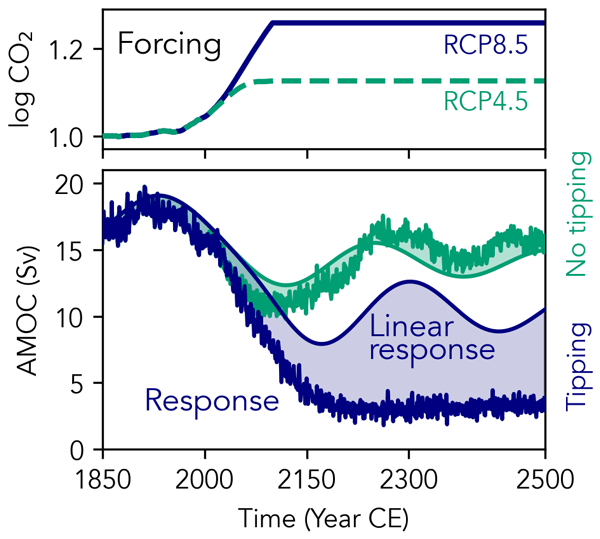
Tipping points have become a buzzword in Earth sciences, but ambiguous or overly narrow definitions of tipping are causing confusion around the concept. Agreeing on what tipping means, and whether a system tips or not, is important for robust science and communicating tipping risk. Based on a critical evaluation of existing tipping definitions, we propose a revised, general definition that characterizes a tipping event as a persistent nonlinear transition in forced systems. Our definition emphasizes both the phenomenology (observed time series) and cause (feedback mechanism) of a tipping event. Inspired by response theory, our proposition is compatible with more specific mathematical formulations while avoiding challenging notions such as bifurcations, equilibrium states, abruptness and irreversibility – making the definition testable also on transient dynamics in diverse complex systems under time-varying forcing. We showcase its practical use and limitations in a toy model and a case study of Earth system model data.
- Article
(1491 KB) - Full-text XML
- BibTeX
- EndNote


Fifty years ago, René Thom's catastrophe theory was popularized as a mathematical framework capable of explaining sudden, abrupt changes in a wide range of real-world contexts (Thom, 1974; Zeeman, 1976). The theory describes such changes, or “catastrophes”, in terms of singularities where a control parameter reaches a critical point. Seemingly a universal and powerful tool, the theory received great attention in science and beyond, finding application in diverse fields from biology (Thom, 1969) to economics (Zeeman, 1974), psychology (Stewart and Peregoy, 1983) and even linguistics (Wildgen, 1981).
However, soon after the initial rise, criticism grew regarding the theory's lack of justification and predictive power in applications (Zahler and Sussmann, 1977; Kolata, 1977). Dissonance emerged between the rather narrow mathematical assumptions underlying catastrophe theory and the complexity of systems under study. Arguably, loose applications of the theory and the difficulty of testing its hypotheses with empirical evidence eventually led to its demise (Rosser, 2007).
In recent years, a theory of tipping dynamics has been developed to describe and understand critical change, centered around the concept of tipping points. Much of the mathematical formalism is rooted in bifurcation theory of dynamical systems (Ashwin et al., 2012; Kuehn, 2011), which is closely related to concepts of catastrophe theory (Arnol'd and Gamkrelidze, 1994). Popularized by Gladwell (2000), the term “tipping point” has been adopted in various scientific disciplines – sometimes referring to a well-defined mathematical scenario while at other times invoked rather as a metaphor for large, rapid change (Russill and Nyssa, 2009; Lohmann, 2026a). Also here, concerns about overuse, ambiguity and limited applicability of the concept are increasingly being raised (Russill, 2015; van Nes et al., 2016; Milkoreit, 2023; Kopp et al., 2025a, b; Shaw and Stevens, 2025; Hansson et al., 2026). If not sufficiently clarified, there is a danger that tipping theory will suffer the same fate as catastrophe theory.
Since their introduction to Earth system science (Lenton et al., 2008), “climate tipping points” have become a fast-growing research topic as well as a buzzword in climate change communication to the public (van der Hel et al., 2018; Armstrong McKay et al., 2022; Abrams et al., 2026; Hegerl et al., 2026). The Lenton et al. (2025) report discusses tipping points in the physical climate system and in society, extending the scope to both natural and socio-economic or technological systems. However, also here a lack of consensus persists about a general definition of tipping points and tipping behavior (Abrams et al., 2026; Boers et al., 2026). In light of the ongoing seventh assessment cycle of the Intergovernmental Panel on Climate Change (IPCC), we see a need and opportunity to revisit current tipping definitions, with the aim of establishing a terminology that accommodates both the mathematical formalism and the real-world complexity of tipping phenomena. Agreeing on what tipping means, and whether a system tips or not, is important both for robust science as well as for communicating about nonlinear change.
This paper seeks to provide the discussion of tipping behavior with a clear, practical foundation. While we focus here on the domain of Earth system science, our proposition is more general and intended to be meaningful also in other contexts. Our goal is to define a tipping event – rather than a tipping point – in a way that is empirically testable and avoids overly restrictive assumptions, yet remains compatible with the existing mathematics and intuition of tipping phenomena. In Sect. 2, we critically evaluate current tipping definitions, highlighting key issues. Based on this, we propose a revised definition of tipping and discuss its implications (Sect. 3). We illustrate its connection with bifurcation-, noise-, rate-induced and overshoot tipping and apply the definition to earth system model simulations of an example climate tipping system (Sect. 4). Finally, we reflect on the wider applicability and implications of our tipping definition.
The glossary of the latest IPCC Assessment Report defines a tipping point as “a critical threshold beyond which a system reorganizes, often abruptly and/or irreversibly” (IPCC, 2023). Other versions have been proposed by Lenton et al. (2008) and updated in the Global Tipping Points (2023); Lenton et al. (2025) reports (see also van Nes et al., 2016; Milkoreit et al., 2018; Brovkin et al., 2021; Armstrong McKay et al., 2022; Winkelmann et al., 2025; Abrams et al., 2026), but we argue in the following that they share common challenges causing confusion and misperceptions. These are mainly a lack of specificity, uniqueness and testability.
2.1 Threshold or event?
Originally, the term “tipping point” was predominantly used to refer to a threshold, either in an external forcing parameter (control parameter) or in the system's state (Lenton et al., 2008; van Nes et al., 2016). A single, tiny perturbation past the threshold would cause a drastic change in the long-term behavior of the system. In the case of a forcing threshold, this can be mathematically described as a bifurcation where the stability properties of the system change instantly and qualitatively. In particular, the fold (or saddle-node) bifurcation has become a paradigm of a tipping point, and bifurcation-induced tipping (Ashwin et al., 2012) shapes much of the thinking about tipping dynamics.
The problem is that such bifurcations characterize the equilibrium properties of the system. If the forcing changes slowly compared to internal system timescales (referred to as quasi-equilibrium conditions), the equilibrium description usually yields an adequate approximation of the dynamics: the tipping transition occurs at the critical forcing level, and the system change is abrupt and irreversible relative to the forcing change. However, in most situations of interest (including anthropogenic climate change), the system and forcing timescales are not cleanly separated, meaning that the system can be driven far from equilibrium and transient dynamics become important (Lai and Tél, 2011; Caraballo and Han, 2016; Hastings et al., 2018; Lohmann, 2026b). A common misunderstanding is that crossing a tipping threshold always coincides with observing a tipping event. On the contrary, owing to multiscale dynamics, inertia and chaos, tipping can be significantly delayed after crossing a threshold, avoided under temporary threshold overshoot, or happen even without crossing a forcing threshold (Bastiaansen et al., 2023; Ritchie et al., 2021; Hastings et al., 2026).
The concepts of rate-induced (Wieczorek et al., 2023; Ritchie et al., 2023) and noise-induced (Freidlin and Wentzell, 1998; Horsthemke and Lefever, 1984) tipping deal with scenarios where the system is pushed out of equilibrium by time-dependent forcing or random variability (Ashwin et al., 2012). Here, the relevant threshold (in multistable systems; Feudel, 2008) is a basin boundary that separates competing basins of attraction (Feudel, 2023). The basin boundary can be a complicated geometrical object partitioning the state space – a tipping surface1 rather than a tipping point in systems with more than one dimension. This tipping boundary generally moves in state space as a function of system parameters. Tipping occurs when the basin boundary is crossed without returning. Also bifurcation-induced tipping may be viewed as a special case of exiting a basin of attraction, provided that it corresponds to a situation where the stable equilibrium itself collides with its basin boundary and thereby disappears (e.g. a fold bifurcation).
Thus, from a dynamical systems perspective, it seems reasonable to generally define tipping as the persistent crossing of a state space boundary partitioning different domains of stability. However, applying this definition in practice requires knowledge of the global stability landscape of the system. This is often not known and the location of basin boundaries cannot simply be derived from observed trajectories of the system.
Given the challenges of identifying critical thresholds in complex systems (Hillebrand et al., 2020; van Westen et al., 2026a), the term “tipping point” is increasingly used to refer to an event, not a threshold. For example, the Lenton et al. (2025) report defines: a tipping point “occurs when change in part of the system becomes self-perpetuating beyond some threshold […]”. This shift from threshold to occurrence is widely reflected in current tipping point language, where many use “tipping point” as a synonym for transition. However, this blurs the important distinction between the stability properties of the system and its transient dynamics, causing misunderstanding about the timing and predictability of tipping. For example, a change point detected in a timeseries generally does not indicate the location of a critical threshold but is often labeled as the tipping point.
2.2 Abruptness and/or irreversibility
Tipping behavior is considered important because it is associated with large, rapid and possibly unexpected change that cannot easily be reversed. Emphasizing this high-impact potential, the notions of abruptness and irreversibility are central to many tipping definitions (IPCC, 2023; Lenton et al., 2025; Winkelmann et al., 2025). However, defining a type of dynamics based on relevance or impact bears the risk of being subjective, poorly distinctive and inconsistent with mathematical descriptions. In fact, abruptness and irreversibility are neither necessary nor sufficient criteria for tipping, as is evident in the IPCC formulation, “often abrupt and/or irreversible” (IPCC, 2023).
Abruptness implies a rapid change relative to a given timescale, but the choice of reference timescale is unclear. Is it the forcing timescale (Lenton et al., 2025), the typical rate of change in the system's history (IPCC, 2023), or a timescale of policy relevance (Lenton et al., 2008)? For example, present-day mass loss of ice sheets may be considered fast compared to glaciological (multi-millennial) timescales but not compared to the current forcing timescale, and is arguably not perceived as abrupt in society. Some tipping events may thus appear slow and gradual, especially relative to changing external influences. Nonetheless, it is possible to distinguish a slow tipping event from other gradual changes (see Sect. 3). On the other hand, arguably not all abrupt changes should classify as tipping events: they could be entirely driven by an abrupt forcing change or represent an extreme event without a “reorganization” (IPCC, 2023) of the system. Various dynamical mechanisms can produce an abrupt change in an observable despite the absence of critical thresholds or alternative stable states.
Defining irreversibility is an open problem in itself and, like abruptness, requires a clarification of timescales (Buhr et al., 2025). Some call a change irreversible if it is not reversed under reversal of the forcing that caused it (Lenton et al., 2025). Under quasi-equilibrium conditions, this is known as (static) hysteresis and indicates a forcing range, bounded by a bifurcation, in which the system features multistability. One major problem with linking tipping to irreversibility is that even a linear system (which cannot have tipping points) can be irreversible under forcing reversal if it has inertia. On a finite time horizon, transient forcing that interferes with the system's internal damping timescales can result in spurious hysteresis effects (Broner et al., 1997; Hankel and Tziperman, 2023). In the glossary of the IPCC (2023), irreversibility relates to an entirely different property in dynamical systems theory, the recovery rate of a system after a perturbation. There, irreversibility is attributed to a system state rather than a change process, which neglects the importance of path dependence.
Irreversibility on finite timescales does not imply tipping, but does tipping imply irreversibility? There is controversy about whether nonlinear but reversible shifts should be considered tipping events. This question relates to the debate about including Arctic sea ice and permafrost in the list of Earth system tipping elements (Notz, 2009; Li et al., 2013; Wagner and Eisenman, 2015; Levermann et al., 2012; Brovkin et al., 2025; Armstrong McKay et al., 2022). As demonstrated in monostable toy models without bifurcations, a nonlinear sensitivity to a control parameter can give rise to relatively abrupt, lasting shifts in the system state that match the classical phenomenology of tipping behavior even though no multistability or hysteresis exists (Scheffer et al., 2001).
In summary, while abruptness and irreversibility can be important features of tipping behavior, they are poorly suited to define tipping dynamics and to distinguish tipping from other forms of change. Moreover, irreversibility with respect to forcing reversal can only be empirically verified if the forcing is actually reversed, making it difficult to test in practice.
2.3 Metastability
The coexistence of multiple stable states (multistability) is central to many tipping definitions (van Nes et al., 2016; Milkoreit et al., 2018; Boers et al., 2026). The mathematical concepts of bifurcation-, rate-, and noise-induced tipping are commonly illustrated using bistable systems (Ashwin et al., 2012). At the same time, the IPCC and Global Tipping Points definitions are more vague, requiring merely a “reorganization” (IPCC, 2023) of the system or “substantial and widespread impacts” (Lenton et al., 2025), without mention of an alternative stable state.
Multistability is an important concept for understanding tipping dynamics, but it describes the equilibrium properties of the system – like bifurcations. The term “metastability” has been introduced to account also for transient dynamics, such as long transients (Morozov et al., 2020), transient chaos (Grebogi et al., 1983; Lai and Tél, 2011), excitability (Crucifix, 2012; Pierini and Ghil, 2021) and nonautonomous dynamics (Wieczorek et al., 2011). Metastability does not rely on equilibrium states but more generally refers to distinct, relatively long-lived dynamical regimes and shifts between them (Rossi et al., 2025; Koch et al., 2024a). An example are ghost states (Koch et al., 2024b), which can lead to climate tipping after a long transient (Börner et al., 2026). Metastability allows to generalize the concept of basins of attraction to domains of state space with attracting or “sticky” dynamics on a finite timescale.
We argue that defining tipping as a transition between different stable equilibrium states makes it difficult to apply the definition to the full variety of tipping phenomena observed in complex systems. As mentioned above, the global stability properties are often not known. In adaptive systems and systems exposed to continuous time-dependent forcing, the notion of equilibrium can become less clear since the system may never settle in an equilibrium. A general tipping definition should accommodate aspects of metastable, transient dynamics and clarify what form of “reorganization” occurs.
Besides threshold behavior, abruptness, and irreversibility, a common aspect of existing tipping definitions is the self-amplifying, self-sustaining or accelerating nature of the change (Abrams et al., 2026; Armstrong McKay et al., 2022; Milkoreit et al., 2018). This is typically linked to a positive (i.e. destabilizing) feedback mechanism becoming dominant in the system, leading to an internally driven nonlinear response. Feedback is a widespread concept in the study of natural, social and engineered complex systems (Åström and Murray, 2008; DeAngelis et al., 1986), central for building conceptual models of tipping dynamics (Dijkstra, 2024; DeAngelis and Waterhouse, 1987; Thomas and d'Ari, 1990). Importantly, understanding of feedbacks helps link the observed behavior (phenomenology) to the underlying mechanisms (cause). We propose that a robust tipping definition combines both aspects. Phenomenologically, a tipping event is a transition process in the system's state. The cause aspect of tipping requires system-specific knowledge about internal feedback processes and the mechanistic connection between forcing and response.
3.1 Definition
In short, we define a tipping event as a persistent nonlinear transition driven by a self-amplifying feedback process. Persistence means that the system settles in an alternative dynamical regime following the transition. By nonlinear we mean that the system observable responds disproportionately to a driver (nonlinear response), which could be an external forcing or internal fluctuations. The change of the observable is thus not merely a linear response to a nonlinear forcing. Self-amplification means that a change in the observable causes further change of the observable in the same direction.
To make this more precise, let denote a time horizon over which the time series of the system observable ψ(t) and the relevant forcing F(t) are known. This time horizon sets the reference timescale on which tipping is assessed. If tipping occurs (once) during τ, we can conceptually divide τ into a pre-tipping interval , a transition phase , and a post-tipping phase , where (Fig. 1). The exact choice of ts and te is not important but τtr should roughly reflect the transition suspected in the time series of ψ. Furthermore, we require that for some persistence P≥1, which means that τB should last at least as long as τtr.
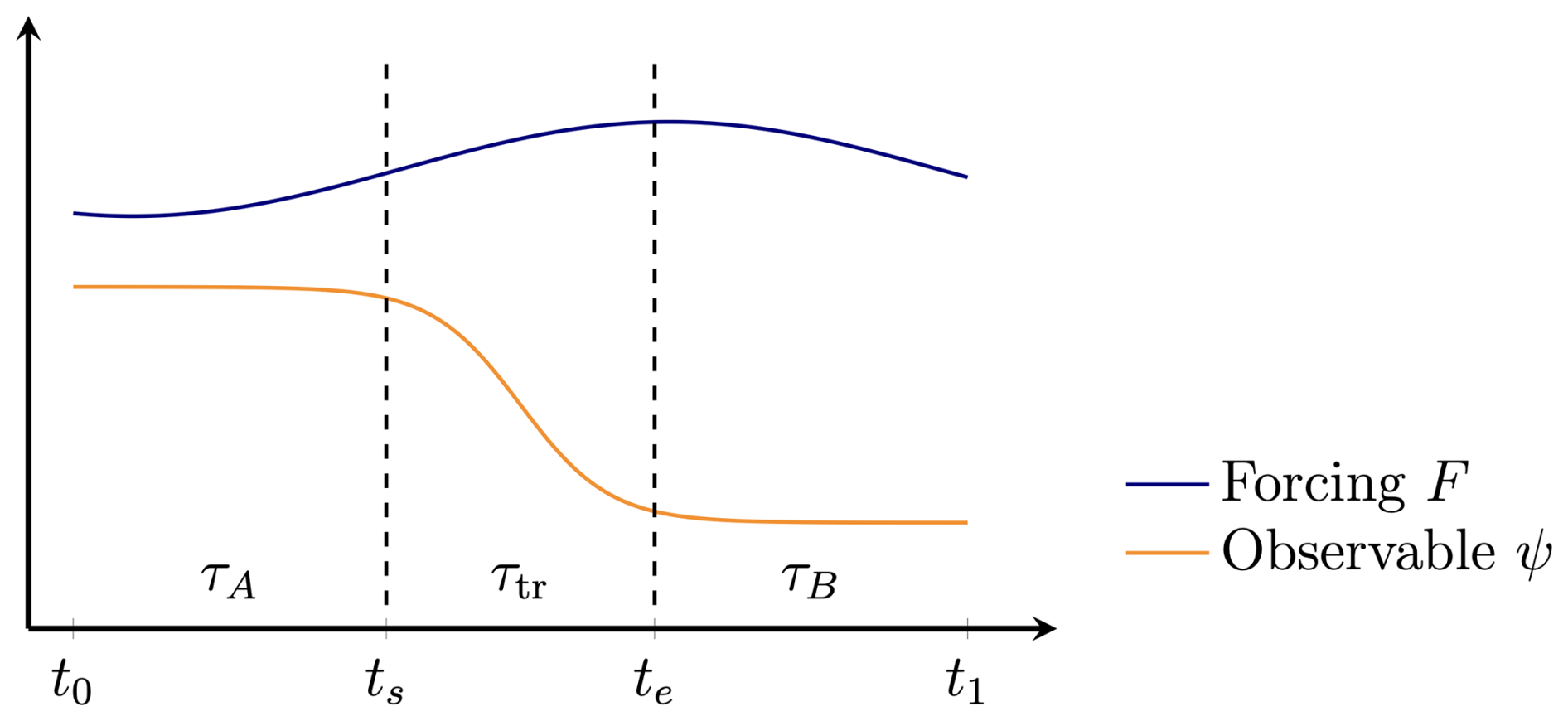
Figure 1Schematic of the problem setting. During the time interval , is the system tipping in the observable ψ under the forcing F?
We define that tipping occurs during τ if and only if there exists ts, te such that
-
A persistent nonlinear transition occurs, i.e. the observable ψ
- a.
evolves in a regime of approximately linear response during τA;
- b.
increasingly and significantly deviates from linear response during τtr;
- c.
persists in a dynamically distinct (compared to τA) regime of approximately linear response during τB.
- a.
-
The deviation from linear response during τtr is attributed to a positive feedback process that operates on the timescale τtr.
Criterion 1 (phenomenology) and criterion 2 (cause) are necessary conditions for tipping: phenomenology and system understanding must come together. In combination, these criteria are sufficient. How to identify linear response regimes and significant deviations from them is outlined in Sect. 3.2 and illustrated in Sect. 4. The attribution to a positive feedback is discussed in Sect. 4.
A tipping system is a dynamical system in which tipping can occur. The tipping duration, i.e. the duration of the tipping event, can be inferred from the duration of the amplifying nonlinear response. The tipping onset marks the point in time where the balance of internal feedbacks begins to drive a self-amplifying response. This point in time does not necessarily coincide with an abrupt change point in the timeseries of the observable.
On a given forcing timescale, a tipping system is a fast (slow) tipping system if τtr is short (long) compared to the timescale on which the forcing varies. Tipping events can be bifurcation-induced, rate-induced or noise-induced as defined by Ashwin et al. (2012), Wieczorek et al. (2023), or a combination of these. Furthermore, tipping can be induced by a singular shock (Klinshov et al., 2015; Halekotte and Feudel, 2020) or occur spontaneously following a long transient (Hastings et al., 2026; Börner et al., 2026).
Remarks
-
Our definition assumes that tipping can be determined based on the evolution of the forcing and observable during the finite time horizon τ, without knowledge of the system's history before τ. This is only the case if the system has sufficiently lost its memory at the beginning of τ. Furthermore, without knowledge of the future after τ, persistence (criterion 1c) is assessed on the timescale τB. The value of P should be large enough to ascertain whether a dynamically distinct linear response regime has been reached. Setting τ or P too small for the given context can result in a misclassification of tipping (Bastiaansen et al., 2023).
-
Our definition permits both irreversible and reversible tipping in the quasi-equilibrium sense. Bifurcations are not necessary; also a monostable system with a nonlinear sensitivity to a forcing parameter could produce tipping events in the sense of our definition. We justify this from a phenomenological or impact perspective: different mathematical structures can lead to observable timeseries that are qualitatively equivalent and mechanistically relate to a positive feedback.
-
We strongly recommend to distinguish between abrupt change and tipping. A tipping event can occur as an abrupt shift but may also appear more gradual in slow tipping systems. Conversely, not every abrupt shift is a tipping event: it can be a linear response to an abrupt change in the forcing, for example, or a non-persistent deviation from linear response. The persistence of a distinct dynamical regime after τtr also clarifies the distinction between a tipping event (persistent change) and an extreme event (non-persistent change).
-
Constant forcing, for all t∈τ, represents a special case where any transition is a result of internal variability. Noise-induced transitions between metastable states will typically fulfill the phenomenology criteria of our tipping definition, as well as chaotic transients between a long-lived unstable chaotic set and an attractor. We believe that classifying such events as tipping events is desired, except in cases described in the following remark.
-
In multiscale systems with a slow timescale relative to τ, fast-slow oscillations are another form of internal variability that could be labeled as tipping events by our definition. Specifically, if τ covers a fraction of one oscillation period in which a fast switch occurs between slow regimes, that transition might classify as tipping on the timescale τ – whereas on longer timescales it would be interpreted as a mode of internal variability associated with a single dynamical regime. From a dynamical systems perspective, this may be considered a misclassification caused by an incomplete estimation of the linear response regime and inappropriate choice of τ. From an impact perspective on the time horizon τ, we may argue again that such dynamics have characteristics of a tipping event. This question applies, for example, to Dansgaard-Oeschger events (Crucifix, 2012; Dijkstra et al., 2026).
3.2 Tipping test
To be useful, a tipping definition should be testable in the sense that applying the definition to empirical data yields a consistent detection of whether tipping has occurred. In the following, we present a generic tipping test inspired by response theory (Ruelle, 2009; Ghil and Lucarini, 2020) that aligns with our tipping definition in Sect. 3.
Given a timeseries pair of an observable ψ(t) and forcing F(t), the general idea is to test the null hypothesis: the evolution of ψ(t) can be explained by a linear response model (null model) subjected to F(t). Rejection of this null hypothesis is a necessary condition for tipping. If the deviation from the null model is then shown to be persistent and attributed to a plausible feedback mechanism, this signifies tipping.
3.2.1 Deviation from linear response
Consider a nonlinear dynamical system described by2 . The state vector u maps to the observable ψ via the projection ψ(u). For simplicity, we assume here that the unperturbed system has an equilibrium at reference forcing F* (let without loss of generality), where denotes the expectation value with respect to the reference state. The idea sketched below can be extended to more general cases and multiple forcings (see Appendix A).
The null model predicts the solution
for the expectation value x(t) of a counterfactual linear system, given the initial condition x0=ψ(t0). Here the exponential decay term describes the unforced relaxation towards equilibrium with damping timescale m related to the system's inertia, more specifically the leading relaxation mode of the linearized dynamics. The linear response to the forcing F, described by the integral term, is encoded in the (first-order) Green's function G (Kubo, 1966; Ghil and Lucarini, 2020; Ragone et al., 2016; Lucarini and Chekroun, 2024). Although Eq. (1) assumes a single damping timescale and linearity of the response and projection, such linear response formulas often remain valid approximations also in complex nonlinear systems for a relatively wide range of forced perturbations (Leith, 1975; Bell, 1980; Majda et al., 2010; Hairer and Majda, 2010; Wormell and Gottwald, 2019). However, linear response breaks down near tipping thresholds (among other possible reasons, such as large perturbations) (Lucarini et al., 2014; Lucarini and Chekroun, 2023).
We introduce the absolute residual,
which quantifies the deviation from linear response. The timeseries of η during τ can be analyzed to identify tipping. The null hypothesis is rejected if η diverges significantly from zero, i.e. η(t)>ηc for some tolerance ηc and t∈τ. In practice, tipping requires that:
-
The null model explains the behavior during τA (i.e. η(t)≤ηc for almost all t∈τA).
-
The same null model persistently fails to predict the behavior during τB (i.e. η(t)>ηc during most of τB), but a recalibrated null model (e.g. with a different reference state) captures the behavior during τB.
-
The increase of η(t) during τtr is attributed to a positive feedback process.
This practical test highlights several implications of our tipping definition. First, if the system does not fulfill approximately linear response conditions before and after the transition, tipping cannot be asserted. This seems a reasonable restriction, since tipping should lead from one well-defined dynamical regime to another; it is less restrictive than considering transitions between equilibrium states. Essentially, this reflects that tipping is difficult to detect if the system is strongly forced or features strong nonlinear variability on the timescale τ. Secondly, tipping can only be determined retrospectively, after observing the system during the persistence interval . Of course, it may be possible to monitor tipping indicators throughout τ, such as an increase in nonlinear response (), or to potentially predict tipping based on knowledge of the system's stability properties and feedback processes.
The purpose of constructing a null model is that it allows to separate linear from nonlinear response. With suitable null models, the evolution of the residual η provides an approximation of linear response regimes (criteria 1a and 1c in Sect. 3.1) as well as the deviation from linear response (criterion 1b). The null model also provides a counterfactual system in which the positive feedback that drives tipping is absent.
3.2.2 Elementary null models
In applications where the Green's function G is not known for the specific system, a simple Green's function can be fitted to the empirical data. The simplest choice is an exponential memory kernel,
where β is the sensitivity to the forcing F and the timescale m represents the system's inertia. This Green's function corresponds to the null model,
with free parameters m, β and x*. This null model captures the inertial relaxation to a moving reference equilibrium (provided that the system has sufficiently lost memory of its history before t0; otherwise the pullback attractor must be considered; Ghil and Lucarini, 2020). However, it cannot describe internal oscillations of the system. For systems featuring oscillatory dynamics, a more appropriate null model is given by the damped, driven harmonic oscillator (see Appendix B). Equation (4) may be viewed as a harmonic oscillator in the overdamped limit.
To illustrate our tipping definition, we apply the tipping test to simulated tipping events in a simple toy model and in an Earth system model.
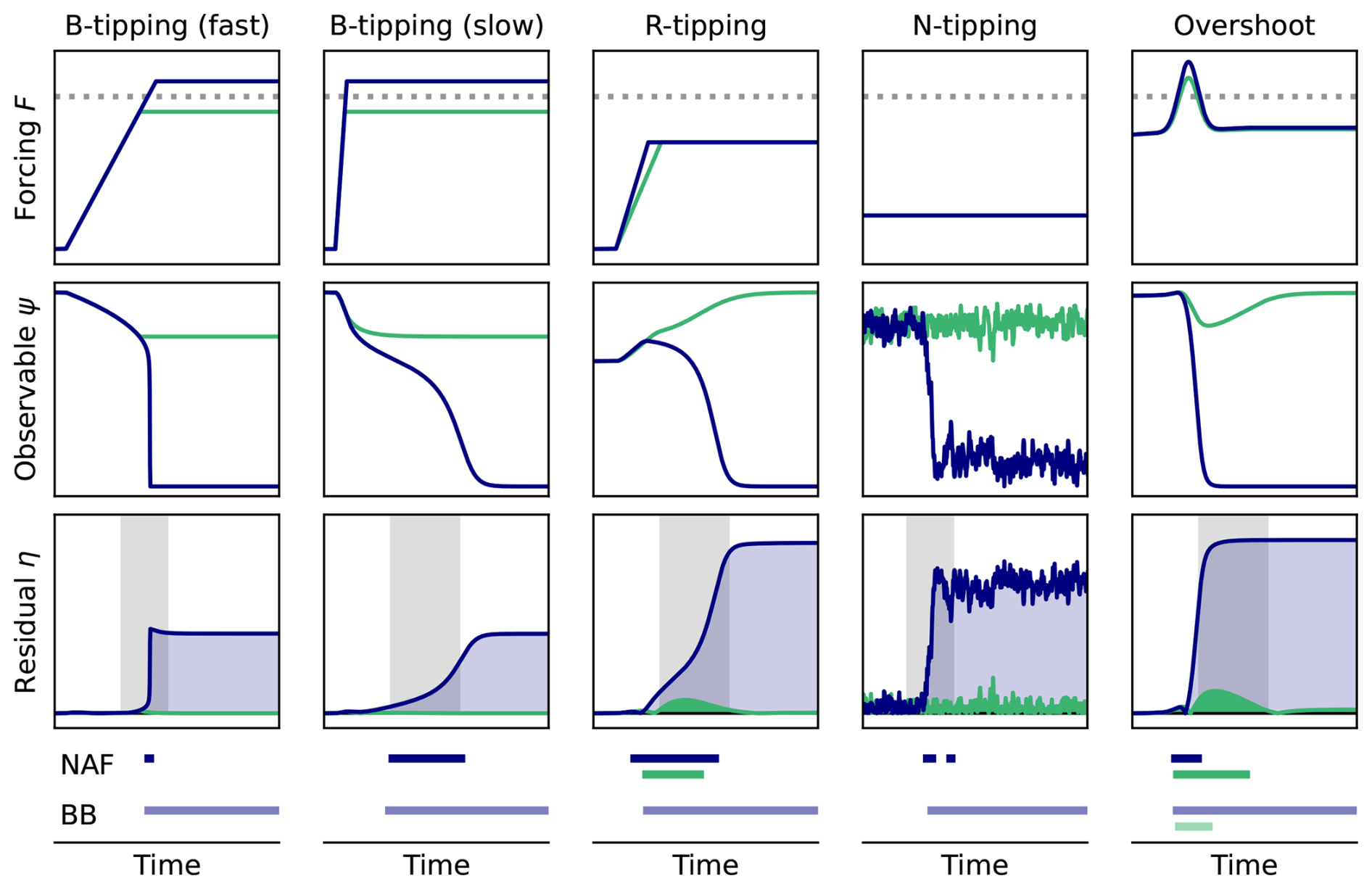
Figure 2Different types of tipping demonstrated in the simple tipping system (Eq. 5). Each scenario (column) shows a tipping case (blue) and a non-tipping case (green). Top row: Forcing protocols; the gray dotted line marks the fold bifurcation (i.e. the “classical” tipping point). Row 2: Trajectories of the system determined under the respective forcing. Row 3: Nonlinear residual of the response η (see Eq. 2). The null model (Eq. 4) is fitted to each non-tipping case outside of the gray shaded area marking τtr (see Appendix C). Bottom: Horizontal bars mark the time periods during which the system evolves in a region of net accelerating feedback (NAF, defined by a downward concave potential landscape) or has crossed the basin boundary (BB) to the competing stable state.
4.1 Simple tipping system
Consider a simple dynamical system that features a bistable regime with basin instability (O'Keeffe and Wieczorek, 2020), bounded by a fold bifurcation (based on Ritchie et al., 2023):
where m denotes inertia, A and s are parameters and Wt represents a Wiener process (Gaussian white noise) scaled by the noise strength σ≥0. This system is susceptible to bifurcation-, rate-, and noise-induced tipping. We can thus test our definition on these different cases as well as an overshoot case where the bifurcation threshold is crossed temporarily (Ritchie et al., 2021).
As a null model, we use the linear system in Eq. (4), with x* set to the upper stable fixed point at reference forcing F0=F(t0). For each tipping scenario, we generate one trajectory that tracks the initial fixed point (non-tipping) and one trajectory that tips to the alternative stable fixed point (Fig. 2; details in Appendix C). We exclude noise (σ=0) except in the noise-induced scenario, where we set σ>0 under otherwise constant forcing. We consider bifurcation-induced tipping both in a fast system (small inertia) and a slow system (large inertia). In the fast case, tipping is abrupt relative to the forcing. In the slow case, both the tipping and non-tipping trajectories continue to change long after the forcing has stabilized, and the transition in the tipping case is delayed compared to the crossing time of the bifurcation.
In all non-tipping cases, the fitted null model accurately describes the evolution of the observable during τA and τB, even though the system is nonlinear (Fig. 2). During τtr, a transient nonlinear response signal is sometimes visible, for example under overshoot forcing. This is because the system temporarily crosses the fold bifurcation; the positive feedback amplifies the response but is subsequently reversed. The key point is that the residual η decays back to zero in the non-tipping cases, whereas it grows significantly larger and never recovers in the tipping cases. After the transition, the residual stabilizes in the tipping cases, showing a linear response again but now with the alternative stable fixed point as reference state.
Since the system is one-dimensional, the only possible feedback is the state variable y feeding back on itself. A positive feedback arises from the presence of an unstable equilibrium that generates a basin boundary and, locally, a downward concave stability landscape (see Appendix C). Within the concave state space region, the linearized dynamics are destabilizing and accelerating, which we propose to interpret as a net positive feedback in an out-of-equilibrium context. Indeed, major increases of the nonlinear residual coincide with periods in which the system evolves within the region of net positive feedback (Fig. 2). Additionally, tipping occurs when the system crosses the unstable equilibrium (here equivalent to the basin boundary) permanently. We can thus attribute this nonlinear response to the action of a positive feedback.
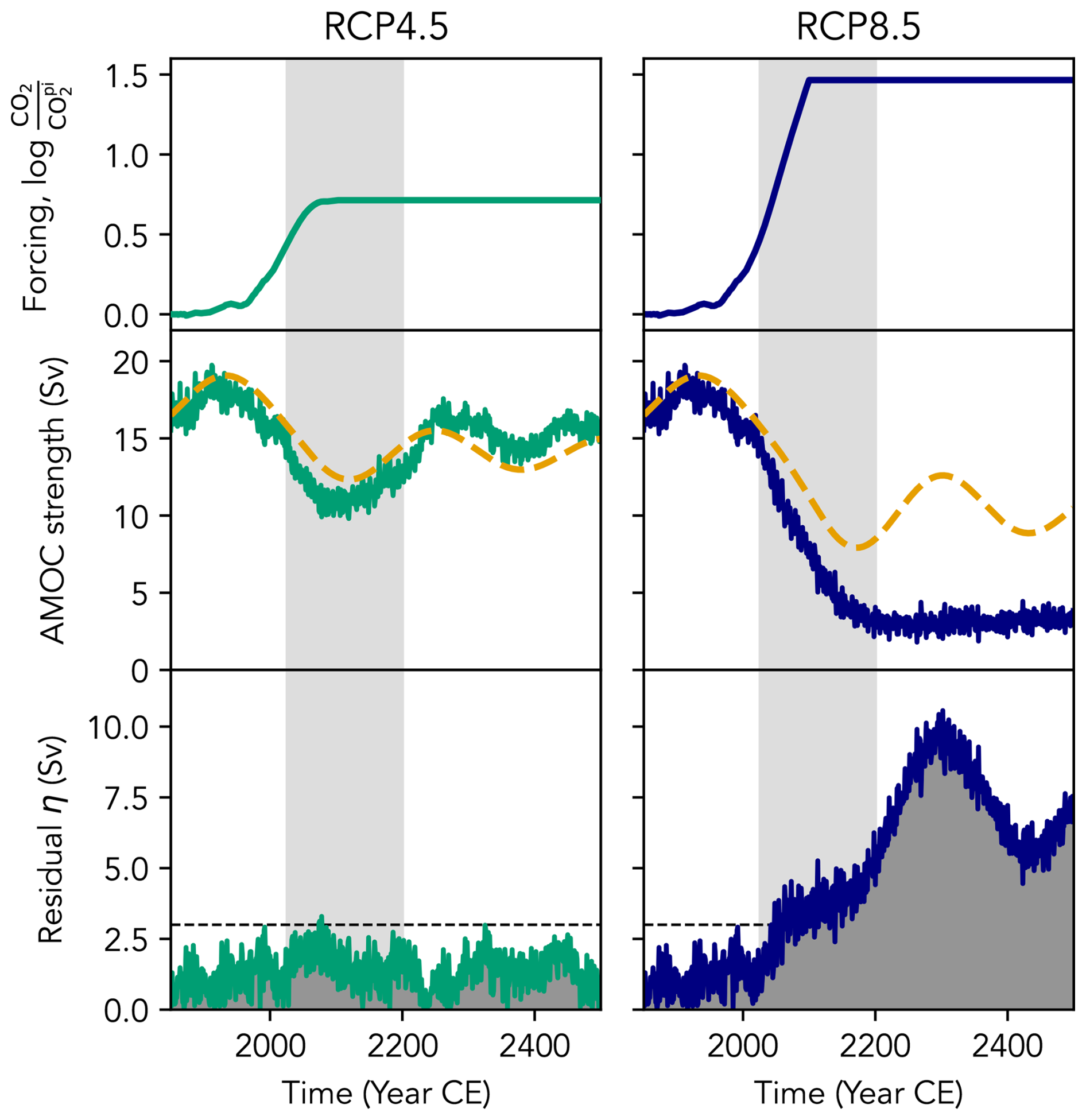
Figure 3Tipping analysis of CESM simulations under the RCP4.5 (left) and RCP8.5 (right) scenarios for constant Sv. The light gray shaded interval indicates τtr. The null model (orange dashed, see Table D1 for parameter values and Appendix D for details) is fitted to the RCP4.5 case using data outside of τtr, with logarithmic CO2 concentration as forcing. The same null model is applied to the RCP8.5 case. In RCP4.5, the absolute residual η remains almost entirely below ηc=3 Sv (black dashed line), whereas in RCP8.5 η significantly increases during τtr and persists above ηc thereafter.
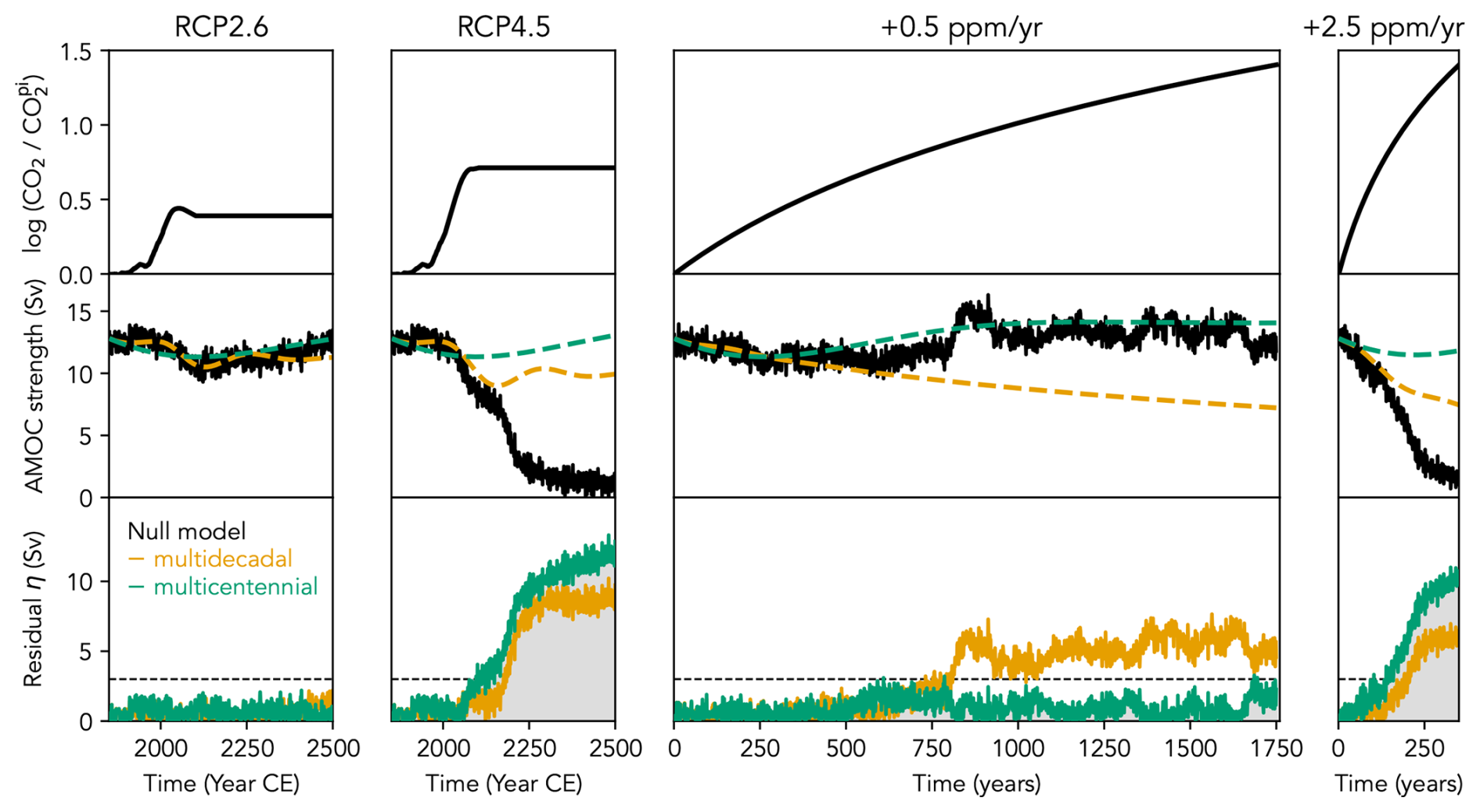
Figure 4Tipping analysis of CESM simulations with constant Sv for two RCP scenarios (from 1850 CE extended to 2500 CE, van Westen et al., 2025a) and two linear CO2 ramp protocols with different rates (+0.5 ppm yr−1 and +2.5 ppm yr−1, van Westen et al., 2026a). All trajectories are initialized from the same statistical equilibrium state (preindustrial reference). Predictions of a null model with multidecadal (orange) and multicentennial (green) oscillations are shown for each case (see Appendix D and Table D1). Tipping cases (RCP4.5 and +2.5 ppm yr−1) and non-tipping cases (RCP2.6 and +0.5 ppm yr−1) are accurately classified by the multicentennial null model but not by the multidecadal null model, which would classify also the +0.5 ppm yr−1 simulation as tipping (to a stronger AMOC state). The dashed horizontal line indicates ηc=3 Sv.
4.2 AMOC tipping in an Earth system model
We next consider simulations with the Community Earth System Model (CESM) version 1, a comprehensive climate model with around 107 degrees of freedom (Hurrell et al., 2013). This model has been used extensively to study the tipping behavior of the Atlantic Meridional Overturning Circulation (AMOC), a major ocean current system, under changes in atmospheric CO2 concentrations (van Westen et al., 2025a, 2026a; Oh et al., 2025). The AMOC is a widely studied climate tipping system and has been shown to feature bistability in CESM, where the two stable states correspond to a strong and a collapsed circulation, respectively (Dijkstra et al., 2026).
The AMOC response to radiative forcing depends strongly on the forcing path, meaning that not only the magnitude but also the rate of radiative forcing change is crucial (Stocker and Schmittner, 1997; Hankel, 2025; van Westen et al., 2026a). In CESM, the AMOC tips under certain CO2 forcing scenarios while recovering in others, sometimes after a transient weakening and sometimes exhibiting ensemble splitting (Oh et al., 2025). Since radiative forcing is related to the logarithm of CO2 concentration, we use ) as the forcing parameter F, where CO ppm is the preindustrial reference. The AMOC state is also affected by the surface freshwater forcing , which is set to a constant background value in the simulations (van Westen et al., 2025a). The observable ψ is the AMOC strength (defined in Appendix D), measured as volume transport in units of Sv (1 Sv =106 m3 s−1), and x* corresponds to the mean equilibrium AMOC strength under reference forcing.
One complication with the CESM simulations is that the AMOC strength can feature oscillatory dynamics in response to the forcing. The damped, driven harmonic oscillator is thus a candidate elementary null model. With a background freshwater forcing of Sv, the AMOC tips under the high-emissions Representative Concentration Pathways (RCP; van Vuuren et al., 2011) scenario RCP8.5 but recovers to a strong AMOC state in the intermediate-emissions scenario RCP4.5. A null model with a natural frequency of roughly yr−1 and damping ratio of around 0.1 (see Appendix B) can approximately explain the AMOC evolution under RCP4.5 (Fig. 3), suggesting that no tipping occurs. If the response would be linear, the same null model should also describe the evolution under RCP8.5; however, the null model persistently underestimates the magnitude of AMOC weakening, resulting in a nonlinear residual of more than 3 Sv. Beyond the year 2200, both the forcing and the AMOC strength are relatively constant under RCP8.5, giving a linear, non-oscillating response with a significantly weaker AMOC as the reference state.
A second complication arises from the timescale-dependent relationship between the AMOC and CO2 forcing (van Westen et al., 2026a), shown for a background freshwater forcing of Sv (Fig. 4). Under rapid CO2 increase (+2.5 ppm yr−1), the AMOC strength tends to decrease, implying a negative forcing sensitivity β in Eq. (B1). Conversely, the AMOC can strengthen due to a slow (+0.5 ppm yr−1) multi-centennial increase in CO2 concentration. An overdamped null model or multi-decadal oscillator model cannot simultaneously explain the linear response of the AMOC to slow and fast radiative forcing change. However, when allowing for centennial-scale variability, we can determine a single null model that correctly distinguishes between tipping and non-tipping cases under various forcing scenarios (Fig. 4; details in Appendix D).
Determining the role of feedbacks is generally challenging in high-dimensional climate models, but in the case of AMOC tipping there is strong evidence for the salt-advection feedback being the dominant positive feedback mechanism (Kuhlbrodt et al., 2007; Dijkstra et al., 2026). This process understanding is derived from a model hierarchy linking the dynamics of earth system models to conceptual models in which the feedbacks are explicitly represented. In CESM, a mechanistic analysis has shown that the salt-advection feedback indeed dominates the internal feedbacks that destabilize the AMOC (Vanderborght et al., 2025). For scenarios where the AMOC undergoes a persistent nonlinear transition, the residual η is consistent in strength and timescale with this feedback, so we conclude that we can attribute the deviation from linear response to the salt-advection feedback.
This example demonstrates that our tipping test can be successfully applied to complex tipping phenomena in high-dimensional, multiscale dynamical systems. It also highlights the challenges of determining an appropriate null model based on limited empirical data. A poorly constrained choice of null model can inhibit the robustness of the tipping test and yield false positives or negatives.
Tipping points have become a highly popular concept in Earth sciences, but inconsistent language around tipping points is causing concern. In this paper, we critically evaluated existing tipping definitions, in particular the definition used by the Intergovernmental Panel on Climate Change (IPCC). We identified several key issues: confusion between tipping thresholds versus tipping events, a problematic focus on abruptness and irreversibility, and a reliance on equilibrium concepts that have limited applicability to transient dynamics.
We proposed a revised definition that characterizes tipping as a persistent nonlinear transition of a system observable in relation to external drivers. In line with Boers et al. (2026), this effectively shifts the focus from tipping points to tipping transitions, acknowledging the increasingly common and sometimes confusing use of the term “tipping point” as a synonym for transition. Our goal was to define tipping in a general way that applies to diverse complex systems, minimizing restrictive assumptions while still formulating clear, testable, necessary and sufficient criteria for tipping. The definition avoids notions of abruptness, irreversibility, bifurcations and equilibria, instead emphasizing the nonlinearity and persistence of the change driven by a self-amplifying feedback process. Attributing tipping to a mechanistic cause ensures that the use of tipping terminology is grounded in a robust understanding of system dynamics. Conceptual models and model hierarchies are important tools for developing this understanding.
Our tipping definition is inspired by the idea that linear response breaks down near tipping points. While we did not aim to make this rigorous here, the relationship between response theory, tipping behavior and climate prediction is an active research field (Santos Gutiérrez and Lucarini, 2022; Lucarini and Chekroun, 2024; Galatolo and Lucarini, 2026; Nathaniel et al., 2026). Moreover, there has been great interest recently in data-driven approaches for estimating Green's functions (Torres Mendonça et al., 2021; Zagli et al., 2026; Lucarini, 2026; Aengenheyster et al., 2018). This holds potential for expanding the mathematical basis of our tipping definition, and for developing more advanced null models. Conceptualizing tipping as a deviation from a counterfactual linear world frames the problem in terms of detection and attribution (Hasselmann, 1993; Palmer, 1999; Lucarini and Chekroun, 2024), which can offer a useful complement to the prediction problem posed by early warning methods (Dakos et al., 2008; Rietkerk et al., 2026). How our definition applies to adaptive systems, such as socio-technical or biological systems, is an interesting question for future work.
Overly simplistic pictures of tipping dynamics have led to a common belief that tipping is restricted to simple systems (Shaw and Stevens, 2025; Kopp et al., 2025a). However, the mathematical theory of tipping goes far beyond fold bifurcations and quasi-equilibrium dynamics. Methods from global stability analysis, nonautonomous dynamics and chaos theory have been successfully applied to high-dimensional systems, and concepts such as rate-induced tipping enable a more nuanced view that incorporates transient, metastable dynamics. What has been missing is a practical and overarching tipping definition that bridges between specific mathematical scenarios and purely qualitative notions that often remain vague.
Carefully defining what tipping means is important because it shapes research questions and the public perception of tipping risk. A strong emphasis on abruptness has possibly caused a misunderstanding of climate tipping events occurring instantly once a threshold is crossed, conveying a misleadingly binary picture of “safe” versus “catastrophic” climate change. We argue that from an impact perspective, the essential aspect is the internally driven nonlinearity of the change because the change is then no longer externally controlled, making it difficult to stop or reverse. Prediction models based on linearity would then fail and lead to false risk assessments.
The linear response formula in Eq. (1) is based on the simplifying assumptions that (i) the unforced dynamics are well approximated by linear relaxation with a single damping timescale associated with a dominant leading eigenmode of the linearized dynamics, (ii) the reference state is a stationary equilibrium with a representative expectation value x* of the observable ψ, and (iii) the relevant forcing is captured by a single scalar variable F(t).
However, the linear response framework (Ruelle, 2009) can be extended to more general settings (Wormell and Gottwald, 2019; Lucarini and Chekroun, 2023; Chekroun and Lucarini, 2026). The unforced dynamics can be described by a spectrum of relaxation modes or, most generally, by the propagator P(t2,t1) that evolves the expectation value x(t1) of the unforced system at time t1 to time t2. Recent work has also considered the case where the reference state is time-dependent, e.g. periodic in time (Branicki and Uda, 2021; Galatolo and Lucarini, 2026). Moreover, it is straightforward to extend linear response to multiple forcings acting simultaneously (Lucarini and Chekroun, 2024). In linear response, the forcings combine additively; higher-order terms accounting for the interacting effects of multiple forcings are neglected.
Considering these aspects, a more general version of Eq. (1) takes the form
where x is, as before, the expectation value of an observable of the system. Note that there is an individual Green's function Gi for each forcing Fi.
A simple linear null model for oscillatory dynamics is given by the damped, driven harmonic oscillator,
Here denotes the second time derivative (acceleration) of the state x, which relaxes to the time-dependent equilibrium with inertia m. Displacements out of equilibrium lead to damped oscillations with eigenfrequency and damping ratio . The oscillator is overdamped (underdamped) if ξ>1 (ξ<1).
Equation (B1) can equivalently be written as a pair of first-order ordinary differential equations,
which can be solved given an initial condition (x0,v0) comprising the initial displacement x0=x(t0) and velocity v0=v(t0).
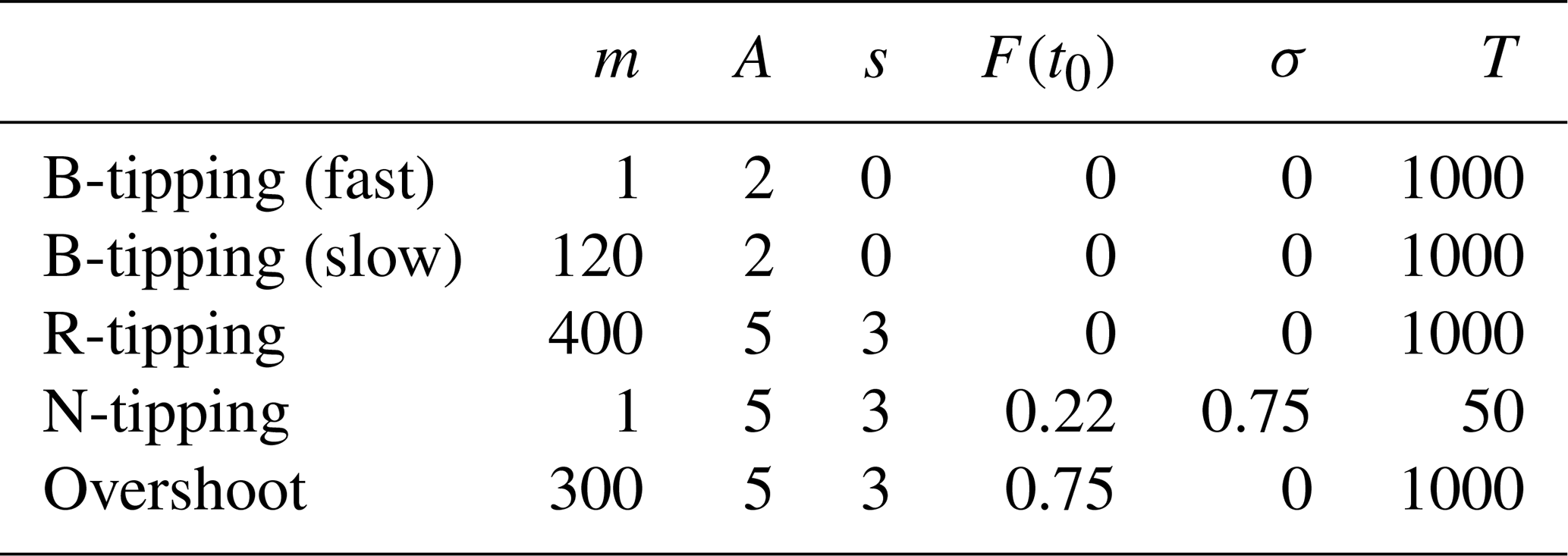
Trajectories of the simple tipping system (Eq. 5) shown in Fig. 2 were generated using the parameter settings given in Table C1. The fold bifurcation occurs at F=1. In the B-tipping cases, the forcing F is linearly increased up to a final constant value of F=0.9 (no tipping) or F=1.1 (tipping). In the R-tipping case, the linear increase is stopped at F=0.7; the durations of increase are (no tipping) and (tipping), where . In the N-tipping case, F=0.22 is held constant. In the overshoot case, the forcing profile is given by with h=0.355 (no tipping) and h=0.455 (tipping).
The location of the saddle point yS is given by for F<1. The potential V of the system is defined as , where . The inflection points of the potential (where its curvature changes sign) are located at .
In all CESM simulations, the atmospheric CO2 concentration is prescribed as a function of time. The AMOC strength ψ (Johns et al., 2023) is defined as the maximum of the Atlantic meridional overturning streamfunction at the latitude N and below z0=1000 m depth, , where
Here v is the meridional velocity field, which is a function of longitude x, latitude y, depth z and time t. The inner integral is over the Atlantic basin from its western (xW) to eastern (xE) boundary. The observable ψ is thus a nonlinear one-dimensional mapping of the full state vector including ocean variables (velocity, temperature, salinity, …), atmospheric variables (air temperature, pressure, humidity, …) and all other model variables such as sea ice, soil moisture etc. at all model grid points.
The null model trajectories shown in Figs. 3 and 4 are generated with the harmonic oscillator null model (Eq. B1) using the parameter values and initial conditions listed in Table D1. In the case Sv (Fig. 3), we fitted the null model to the RCP4.5 scenario using the data in and , where the years refer to the Common Era (CE).

The TippingTest.jl package (https://github.com/reykboerner/TippingTest.jl, last access: 16 November 2026, https://doi.org/10.5281/zenodo.24206610) provides a generic implementation of our tipping test in the Julia language (Börner, 2026). The package repository includes the simulation data and example code used to produce Figs. 3 and 4. The CESM model simulation data used in this work are also archived on Zenodo under the DOIs https://doi.org/10.5281/zenodo.14510336 (van Westen et al., 2025b, Fig. 3) and https://doi.org/10.5281/zenodo.18599844 (van Westen et al., 2026b, Fig. 4).
RB and HAD conceived the study and developed the tipping definition. RB performed the analysis and created the figures. RB wrote the manuscript with input from HAD.
The contact author has declared that neither of the authors has any competing interests.
Publisher's note: Copernicus Publications remains neutral with regard to jurisdictional claims made in the text, published maps, institutional affiliations, or any other geographical representation in this paper. The authors bear the ultimate responsibility for providing appropriate place names. Views expressed in the text are those of the authors and do not necessarily reflect the views of the publisher.
This work was motivated by conversations at and after the ClimTip/TipESM project meeting in April 2025, involving M. Ghil, T. Stocker, V. Lucarini, C. Kuehn, N. Boers, H.A.D. and others. R.B. thanks A. Koseska and K. Rossi for their hospitality at the Max Planck Institute for Neurobiology of Behavior and the great conversations facilitated by these visits. The authors further wish to thank L. Jackson and an anonymous reviewer for useful comments on the manuscript, and N. Boers, V. Lucarini, M. Santos Gutierrez, A.K. Klose, A. Romanou and the AMOC group at the Institute for Marine and Atmospheric research Utrecht for insightful discussions. This is ClimTip contribution #191.
The ClimTip project has received funding from the European Union's Horizon Europe research and innovation programme under grant agreement no. 101137601: Funded by the European Union. This research has also been supported by the European Research Council through the ERC-AdG project TAOC (grant no. 101055096).
This paper was edited by Ben Kravitz and reviewed by two anonymous referees.
Abrams, J. F., Pereira, L. M., Spaiser, V., Wunderling, N., Villasante, S., Tàbara, J. D., Biggs, R., Armstrong McKay, D. I., Zimm, C., Milkoreit, M., Constantino, S. M., Debnath, R., Dakos, V., Ritchie, P. D. L., Smith, S. R., Rocha, J. C., Kéfi, S., Buxton, J. E., Boulton, C. A., Greenlees, K., Juhola, S., Bhowmik, A., Fesenfeld, L. P., Clarke, J., Dyke, J. G., Laybourn, L., Lade, S. J., Marjanović-Abrams, M., Dickenson Bampton, B., and Lenton, T. M.: Integrating Tipping Point Concepts across Diverse Systems, Commun. Sustain., 1, 68, https://doi.org/10.1038/s44458-026-00063-5, 2026. a, b, c, d, e
Aengenheyster, M., Feng, Q. Y., van der Ploeg, F., and Dijkstra, H. A.: The point of no return for climate action: effects of climate uncertainty and risk tolerance, Earth Syst. Dynam., 9, 1085–1095, https://doi.org/10.5194/esd-9-1085-2018, 2018. a
Armstrong McKay, D. I., Staal, A., Abrams, J. F., Winkelmann, R., Sakschewski, B., Loriani, S., Fetzer, I., Cornell, S. E., Rockström, J., and Lenton, T. M.: Exceeding 1.5 °C Global Warming Could Trigger Multiple Climate Tipping Points, Science, 377, eabn7950, https://doi.org/10.1126/science.abn7950, 2022. a, b, c, d
Arnol'd, V. I. and Gamkrelidze, R. V. (Eds.): Dynamical Systems V: Bifurcation Theory and Catastrophe Theory, vol. 5 of Encyclopaedia of Mathematical Sciences, Springer, Berlin, Heidelberg, ISBN 978-3-540-65379-0 978-3-642-57884-7, https://doi.org/10.1007/978-3-642-57884-7, 1994. a
Ashwin, P., Wieczorek, S., Vitolo, R., and Cox, P.: Tipping Points in Open Systems: Bifurcation, Noise-Induced and Rate-Dependent Examples in the Climate System, Philos. T. A, 370, 1166–1184, https://doi.org/10.1098/rsta.2011.0306, 2012. a, b, c, d, e
Åström, K. J. and Murray, R. M.: Feedback Systems: An Introduction for Scientists and Engineers, Princeton University Press, ISBN 978-0-691-13576-2, https://doi.org/10.2307/j.ctvcm4gdk, 2008. a
Bastiaansen, R., Ashwin, P., and von der Heydt, A. S.: Climate Response and Sensitivity: Time Scales and Late Tipping Points, Proc. A, 479, 20220483, https://doi.org/10.1098/rspa.2022.0483, 2023. a, b
Bell, T. L.: Climate Sensitivity from Fluctuation Dissipation: Some Simple Model Tests, J. Atmos. Sci., 37, 1700–1707, https://doi.org/10.1175/1520-0469(1980)037<1700:CSFFDS>2.0.CO;2, 1980. a
Boers, N., Kopp, R. E., Ashwin, P., Bathiany, S., Ben-Yami, M., Börner, R., Carnicer, J., Dijkstra, H., Frölicher, T. L., Ghil, M., Gilmore, E., Hegerl, G. C., Jackson, L., Jain, S., Lapola, D., Lenton, T. M., Lucarini, V., Liu, T., Meccia, V. L., Morr, A., Romanou, A., Stocker, T. F., Yang, S., and Xiao, C.: Clarifying Tipping Terminology, arXiv [preprint], https://doi.org/10.48550/arXiv.2610.14930, 2026. a, b, c
Börner, R.: TippingTest.jl v0.3.1, Zenodo [software], https://doi.org/10.5281/zenodo.24206610, 2026. a
Börner, R., Mehling, O., von Hardenberg, J., and Lucarini, V.: Global Stability of the Atlantic Overturning Circulation: Edge State, Long Transients and Boundary Crisis under CO2 Forcing, Philos. T. A, 384, 20250087, https://doi.org/10.1098/rsta.2025.0087, 2026. a, b
Branicki, M. and Uda, K.: Time-Periodic Measures, Random Periodic Orbits, and the Linear Response for Dissipative Non-Autonomous Stochastic Differential Equations, Res. Math. Sci., 8, 42, https://doi.org/10.1007/s40687-021-00256-5, 2021. a
Broner, F., Goldsztein, G. H., and Strogatz, S. H.: Dynamical Hysteresis without Static Hysteresis: Scaling Laws and Asymptotic Expansions, SIAM J. Appl. Math., 57, 1163–1187, https://doi.org/10.1137/S0036139995290733, 1997. a
Brovkin, V., Brook, E., Williams, J. W., Bathiany, S., Lenton, T. M., Barton, M., DeConto, R. M., Donges, J. F., Ganopolski, A., McManus, J., Praetorius, S., de Vernal, A., Abe-Ouchi, A., Cheng, H., Claussen, M., Crucifix, M., Gallopín, G., Iglesias, V., Kaufman, D. S., Kleinen, T., Lambert, F., van der Leeuw, S., Liddy, H., Loutre, M.-F., McGee, D., Rehfeld, K., Rhodes, R., Seddon, A. W. R., Trauth, M. H., Vanderveken, L., and Yu, Z.: Past Abrupt Changes, Tipping Points and Cascading Impacts in the Earth System, Nat. Geosci., 14, 550–558, https://doi.org/10.1038/s41561-021-00790-5, 2021. a
Brovkin, V., Bartsch, A., Hugelius, G., Calamita, E., Lever, J. J., Goo, E., Kim, H., Stacke, T., and de Vrese, P.: Permafrost and Freshwater Systems in the Arctic as Tipping Elements of the Climate System, Surv. Geophys., 46, 303–326, https://doi.org/10.1007/s10712-025-09885-9, 2025. a
Buhr, L., Lenzi, D. S., Pols, A. J. K., Brunner, C. E., Fischer, A., Staal, A., Hofbauer, B. P., and Bovenkerk, B.: The Concepts of Irreversibility and Reversibility in Research on Anthropogenic Environmental Changes, PNAS Nexus, 4, pgae577, https://doi.org/10.1093/pnasnexus/pgae577, 2025. a
Caraballo, T. and Han, X.: Applied Nonautonomous and Random Dynamical Systems, SpringerBriefs in Mathematics, Springer International Publishing, Cham, ISBN 978-3-319-49246-9 978-3-319-49247-6, https://doi.org/10.1007/978-3-319-49247-6, 2016. a
Chekroun, M. D. and Lucarini, V.: Ruelle–Pollicott Theory for Metastable Systems: A Unified Framework for Tipping Transitions, arXiv [preprint], https://doi.org/10.48550/arXiv.2609.02614, 2026. a
Crucifix, M.: Oscillators and Relaxation Phenomena in Pleistocene Climate Theory, Philos. T. A, 370, 1140–1165, https://doi.org/10.1098/rsta.2011.0315, 2012. a, b
Dakos, V., Scheffer, M., van Nes, E. H., Brovkin, V., Petoukhov, V., and Held, H.: Slowing down as an Early Warning Signal for Abrupt Climate Change, P. Natl. Acad. Sci. USA, 105, 14308–14312, https://doi.org/10.1073/pnas.0802430105, 2008. a
DeAngelis, D. L. and Waterhouse, J. C.: Equilibrium and Nonequilibrium Concepts in Ecological Models, Ecol. Monogr., 57, 1–21, https://doi.org/10.2307/1942636, 1987. a
DeAngelis, D. L., Post, W. M., and Travis, C. C.: Positive Feedback in Natural Systems, vol. 15 of Biomathematics, Springer, Berlin, Heidelberg, ISBN 978-3-642-82627-6 978-3-642-82625-2, https://doi.org/10.1007/978-3-642-82625-2, 1986. a
Dijkstra, H. A.: The Role of Conceptual Models in Climate Research, Physica D, 457, 133984, https://doi.org/10.1016/j.physd.2023.133984, 2024. a
Dijkstra, H. A., Krauskopf, B., Börner, R., and van Westen, R. M.: Transitions of the Atlantic Ocean Circulation, Nat. Rev. Phys., 8, 410–424, https://doi.org/10.1038/s42254-026-00945-6, 2026. a, b, c
Feudel, U.: Complex Dynamics in Multistable Systems, Int. J. Bifurcation Chaos, 18, 1607–1626, https://doi.org/10.1142/S0218127408021233, 2008. a
Feudel, U.: Rate-induced tipping in ecosystems and climate: the role of unstable states, basin boundaries and transient dynamics, Nonlin. Processes Geophys., 30, 481–502, https://doi.org/10.5194/npg-30-481-2023, 2023. a
Freidlin, M. I. and Wentzell, A. D.: Random Perturbations of Dynamical Systems, Springer, https://doi.org/10.1007/978-1-4612-0611-8, 1998. a
Galatolo, S. and Lucarini, V.: A Mathematical Framework for Linear Response Theory for Nonautonomous Systems, arXiv [preprint], https://doi.org/10.48550/arXiv.2603.19509, 2026. a, b
Ghil, M. and Lucarini, V.: The Physics of Climate Variability and Climate Change, Rev. Mod. Phys., 92, 035002, https://doi.org/10.1103/RevModPhys.92.035002, 2020. a, b, c
Gladwell, M.: The Tipping Point: How Little Things Can Make a Big Difference, Little, Brown, Boston, ISBN 0-316-31696-2, 2000. a
Global Tipping Points: The Global Tipping Points Report 2023, Report, University of Exeter, Exeter, UK, 2023. a
Grebogi, C., Ott, E., and Yorke, J. A.: Crises, Sudden Changes in Chaotic Attractors, and Transient Chaos, Physica D, 7, 181–200, https://doi.org/10.1016/0167-2789(83)90126-4, 1983. a
Hairer, M. and Majda, A. J.: A Simple Framework to Justify Linear Response Theory, Nonlinearity, 23, 909, https://doi.org/10.1088/0951-7715/23/4/008, 2010. a
Halekotte, L. and Feudel, U.: Minimal Fatal Shocks in Multistable Complex Networks, Sci. Rep., 10, 11783, https://doi.org/10.1038/s41598-020-68805-6, 2020. a
Hankel, C.: The Effect of CO2 Ramping Rate on the Transient Weakening of the Atlantic Meridional Overturning Circulation, P. Natl. Acad. Sci. USA, 122, e2411357121, https://doi.org/10.1073/pnas.2411357121, 2025. a
Hankel, C. and Tziperman, E.: An approach for projecting the timing of abrupt winter Arctic sea ice loss, Nonlin. Processes Geophys., 30, 299–309, https://doi.org/10.5194/npg-30-299-2023, 2023. a
Hansson, A., Anshelm, J., and Haikola, S.: Navigating Climate Change: A Narrative Analysis of the Public Tipping Point Discourse, Climate and Development, 0, 1–12, https://doi.org/10.1080/17565529.2026.2655961, 2026. a
Hasselmann, K.: Optimal Fingerprints for the Detection of Time-Dependent Climate Change, J. Climate, 6, 1957–1971, https://doi.org/10.1175/1520-0442(1993)006<1957:OFFTDO>2.0.CO;2, 1993. a
Hastings, A., Abbott, K. C., Cuddington, K., Francis, T., Gellner, G., Lai, Y.-C., Morozov, A., Petrovskii, S., Scranton, K., and Zeeman, M. L.: Transient Phenomena in Ecology, Science, 361, eaat6412, https://doi.org/10.1126/science.aat6412, 2018. a
Hastings, A., Petrovskii, S., Lucarini, V., and Morozov, A.: Tipping Points in Complex Ecological Systems, Nat. Rev. Phys., 1–16, https://doi.org/10.1038/s42254-026-00987-w, 2026. a, b
Hegerl, G., Abba Omar, S., Al Khourdajie, A., Bartsch, A., Brovkin, V., Colleoni, F., Frölicher, T. L., Koenigk, T., Liddy, H. M., Liu, L., Moyer, J. D., Naish, T., Otto-Bliesner, B. L., Romanou, A., Teckentrup, L., van der Wel, N., Winkelmann, R., Abbott, P., Abe-Ouchi, A., Abram, N. J., Adefisan, E. A., Alexander, P., Ashwin, P., Bathiany, S., Betts, R., Braconnot, P., Bradley, R. S., Cheung, W., Chiessi, C. M., DeConto, R. M., Ebi, K. L., Edwards, T., Friedlingstein, P., Gaupp, F., Goelzer, H., Golledge, N. R., Gwinneth, B., Haasnoot, M., Heil, P., Hirota, M., Hugelius, G., Inogwabini, B.-I., Jones, C., Kawamiya, M., Klose, A. K., Kopp, R. E., Lamboll, R. D., Langebroek, P., Lapola, D. M. L., Lawrence, J., Lawrence, D. M., Lenton, T. M., Lipscomb, W. H., Lucarini, V., Majszak, M., Marotzke, J., Marzeion, B., Maussion, F., Macneill, K., Meier, W. N., Morlighem, M., Nieradzik, L. P., Nitzbon, J., Nowicki, S., Otosaka, I. N., Pathak, M., Rodrigues, R. R., Roy, J., Schaedel, C., Schuster, L., Seneviratne, S. I., Seroussi, H., Sherwood, S., Siegert, M. J., Sierra, J. P., Silvano, A., Staal, A., Stocker, T. F., Swingedouw, D., van de Wal, R. S. W., Vargo, L., Wille, J. D., Yang, S., Zekollari, H., and Zimm, C.: High-Impact Climate Events and Tipping Dynamics: Assessing Scientific Understanding and Future Challenges, ESS Open Archive [preprint], https://doi.org/10.22541/essoar.15008733/v1, 2026. a
Hillebrand, H., Donohue, I., Harpole, W. S., Hodapp, D., Kucera, M., Lewandowska, A. M., Merder, J., Montoya, J. M., and Freund, J. A.: Thresholds for Ecological Responses to Global Change Do Not Emerge from Empirical Data, Nat. Ecol. Evol., 4, 1502–1509, https://doi.org/10.1038/s41559-020-1256-9, 2020. a
Horsthemke, W. and Lefever, R.: Noise-Induced Transitions in Physics, Chemistry, and Biology, in: Noise-Induced Transitions: Theory and Applications in Physics, Chemistry, and Biology, pp. 164–200, Springer, Berlin, Heidelberg, ISBN 978-3-540-36852-6, https://doi.org/10.1007/3-540-36852-3_7, 1984. a
Hurrell, J. W., Holland, M. M., Gent, P. R., Ghan, S., Kay, J. E., Kushner, P. J., Lamarque, J.-F., Large, W. G., Lawrence, D., Lindsay, K., Lipscomb, W. H., Long, M. C., Mahowald, N., Marsh, D. R., Neale, R. B., Rasch, P., Vavrus, S., Vertenstein, M., Bader, D., Collins, W. D., Hack, J. J., Kiehl, J., and Marshall, S.: The Community Earth System Model: A Framework for Collaborative Research, B. Am. Meteorol. Soc., 94, 1339–1360, https://doi.org/10.1175/BAMS-D-12-00121.1, 2013. a
IPCC: Climate Change 2021 – The Physical Science Basis: Working Group I Contribution to the Sixth Assessment Report of the Intergovernmental Panel on Climate Change, Cambridge University Press, 1st edn., ISBN 978-1-009-15789-6, https://doi.org/10.1017/9781009157896, 2023. a, b, c, d, e, f, g
Johns, W. E., Elipot, S., Smeed, D. A., Moat, B., King, B., Volkov, D. L., and Smith, R. H.: Towards Two Decades of Atlantic Ocean Mass and Heat Transports at 26.5° N, Philos. T. R. Soc. A, 381, 20220188, https://doi.org/10.1098/rsta.2022.0188, 2023. a
Klinshov, V. V., Nekorkin, V. I., and Kurths, J.: Stability Threshold Approach for Complex Dynamical Systems, New J. Phys., 18, 013004, https://doi.org/10.1088/1367-2630/18/1/013004, 2015. a
Koch, D., Nandan, A., Ramesan, G., and Koseska, A.: Biological Computations: Limitations of Attractor-Based Formalisms and the Need for Transients, Biochem. Bioph. Res. Co., 720, 150069, https://doi.org/10.1016/j.bbrc.2024.150069, 2024a. a
Koch, D., Nandan, A., Ramesan, G., Tyukin, I., Gorban, A., and Koseska, A.: Ghost Channels and Ghost Cycles Guiding Long Transients in Dynamical Systems, Phys. Rev. Lett., 133, 047202, https://doi.org/10.1103/PhysRevLett.133.047202, 2024b. a
Kolata, G. B.: Catastrophe Theory: The Emperor Has No Clothes, Science, 196, 287–351, https://doi.org/10.1126/science.196.4287.287, 1977. a
Kopp, R., Gilmore, E., and Shwom, R.: Climate Change Will Surprise Us, but so-Called “Tipping Points” May Lead Us Astray, B. Atom. Sci., 81, 121–125, https://doi.org/10.1080/00963402.2025.2464445, 2025a. a, b
Kopp, R. E., Gilmore, E. A., Shwom, R. L., Adams, H., Adler, C., Oppenheimer, M., Patwardhan, A., Russill, C., Schmidt, D. N., and York, R.: “Tipping Points” Confuse and Can Distract from Urgent Climate Action, Nat. Clim. Chang., 15, 29–36, https://doi.org/10.1038/s41558-024-02196-8, 2025b. a
Kubo, R.: The Fluctuation-Dissipation Theorem, Rep. Prog. Phys., 29, 255, https://doi.org/10.1088/0034-4885/29/1/306, 1966. a
Kuehn, C.: A Mathematical Framework for Critical Transitions: Bifurcations, Fast–Slow Systems and Stochastic Dynamics, Physica D, 240, 1020–1035, https://doi.org/10.1016/j.physd.2011.02.012, 2011. a
Kuhlbrodt, T., Griesel, A., Montoya, M., Levermann, A., Hofmann, M., and Rahmstorf, S.: On the Driving Processes of the Atlantic Meridional Overturning Circulation, Rev. Geophys., 45, https://doi.org/10.1029/2004RG000166, 2007. a
Lai, Y.-C. and Tél, T.: Transient Chaos: Complex Dynamics on Finite Time Scales, vol. 173, Springer New York, NY, ISBN 978-1-4419-6986-6, https://doi.org/10.1007/978-1-4419-6987-3, 2011. a, b
Leith, C. E.: Climate Response and Fluctuation Dissipation, J. Atmos. Sci., 32, 2022–2026, https://doi.org/10.1175/1520-0469(1975)032<2022:CRAFD>2.0.CO;2, 1975. a
Lenton, T. M., Held, H., Kriegler, E., Hall, J. W., Lucht, W., Rahmstorf, S., and Schellnhuber, H. J.: Tipping Elements in the Earth's Climate System, P. Natl. Acad. Sci. USA, 105, 1786–1793, https://doi.org/10.1073/pnas.0705414105, 2008. a, b, c, d
Lenton, T. M., Milkoreit, M., Willcock, S., Abrams, J. F., Armstrong McKay, D. I., Buxton, J. E., Donges, J. F., Loriani, S., Wunderling, N., Alkemade, F., Barrett, M., Constantino, S., Powell, T., Smith, S. R., Boulton, C. A., Pinho, P., Dijkstra, H. A., Pearce-Kelly, P., Roman-Cuesta, R. M., and Dennis, D. (Eds.): The Global Tipping Points Report 2025. University of Exeter, Exeter, UK. © The Global Tipping Points Report 2025, University of Exeter, UK, https://global-tipping-points.org (last access: 9 November 2026), 2025. a, b, c, d, e, f, g
Levermann, A., Bamber, J. L., Drijfhout, S., Ganopolski, A., Haeberli, W., Harris, N. R. P., Huss, M., Krüger, K., Lenton, T. M., Lindsay, R. W., Notz, D., Wadhams, P., and Weber, S.: Potential Climatic Transitions with Profound Impact on Europe, Clim. Change, 110, 845–878, https://doi.org/10.1007/s10584-011-0126-5, 2012. a
Li, C., Notz, D., Tietsche, S., and Marotzke, J.: The Transient versus the Equilibrium Response of Sea Ice to Global Warming, J. Climate, 26, 5624–5636, https://doi.org/10.1175/JCLI-D-12-00492.1, 2013. a
Lohmann, G.: Models and Metaphors for Interdisciplinarity and Communication in Earth System Science, Ocean-Land-Atmos. Res., 5, 0140, https://doi.org/10.34133/olar.0140, 2026a. a
Lohmann, J.: Predicting Tipping Points: The Many Shades of Non-Equilibrium and Catch-22s of Early-Warning, arXiv [preprint], https://doi.org/10.48550/arXiv.2609.10378, 2026b. a
Lucarini, V.: Interpretable and Equation-Free Response Theory for Complex Systems, Philos. T. R. Soc. A, 384, 20250081, https://doi.org/10.1098/rsta.2025.0081, 2026. a
Lucarini, V. and Chekroun, M. D.: Theoretical Tools for Understanding the Climate Crisis from Hasselmann's Programme and beyond, Nat. Rev. Phys., 5, 744–765, https://doi.org/10.1038/s42254-023-00650-8, 2023. a, b
Lucarini, V. and Chekroun, M. D.: Detecting and Attributing Change in Climate and Complex Systems: Foundations, Green's Functions, and Nonlinear Fingerprints, Phys. Rev. Lett., 133, 244201, https://doi.org/10.1103/PhysRevLett.133.244201, 2024. a, b, c, d
Lucarini, V., Blender, R., Herbert, C., Ragone, F., Pascale, S., and Wouters, J.: Mathematical and Physical Ideas for Climate Science, Rev. Geophys., 52, 809–859, https://doi.org/10.1002/2013RG000446, 2014. a
Majda, A. J., Abramov, R., and Gershgorin, B.: High Skill in Low-Frequency Climate Response through Fluctuation Dissipation Theorems despite Structural Instability, P. Natl. Acad. Sci. USA, 107, 581–586, https://doi.org/10.1073/pnas.0912997107, 2010. a
Milkoreit, M.: Social Tipping Points Everywhere? – Patterns and Risks of Overuse, WIREs Climate Change, 14, e813, https://doi.org/10.1002/wcc.813, 2023. a
Milkoreit, M., Hodbod, J., Baggio, J., Benessaiah, K., Calderón-Contreras, R., Donges, J. F., Mathias, J.-D., Rocha, J. C., Schoon, M., and Werners, S. E.: Defining Tipping Points for Social-Ecological Systems Scholarship – an Interdisciplinary Literature Review, Environ. Res. Lett., 13, 033005, https://doi.org/10.1088/1748-9326/aaaa75, 2018. a, b, c
Morozov, A., Abbott, K., Cuddington, K., Francis, T., Gellner, G., Hastings, A., Lai, Y.-C., Petrovskii, S., Scranton, K., and Zeeman, M. L.: Long Transients in Ecology: Theory and Applications, Phys. Life Rev., 32, 1–40, https://doi.org/10.1016/j.plrev.2019.09.004, 2020. a
Nathaniel, J., Roesch, C., DeSantis, D., Kooloth, P., Fan, H., Lucarini, V., Romanou, A., and Gentine, P.: Koopman Early Warning Signals for Bifurcation and Rate-Induced Tipping, arXiv [preprint], https://doi.org/10.48550/arXiv.2608.14716, 2026. a
Notz, D.: The Future of Ice Sheets and Sea Ice: Between Reversible Retreat and Unstoppable Loss, P. Natl. Acad. Sci. USA, 106, 20590–20595, https://doi.org/10.1073/pnas.0902356106, 2009. a
Oh, J.-H., Kug, J.-S., Shin, Y., Geng, X., Wang, S., Jin, F.-F., An, S.-I., Xie, S.-P., and Liu, W.: Noise-Induced Tipping of Atlantic Meridional Overturning Circulation under Climate Mitigation Scenarios, Nat. Commun., 16, 11515, https://doi.org/10.1038/s41467-025-66494-1, 2025. a, b
O'Keeffe, P. E. and Wieczorek, S.: Tipping Phenomena and Points of No Return in Ecosystems: Beyond Classical Bifurcations, SIAM J. Appl. Dyn. Syst., 19, 2371–2402, https://doi.org/10.1137/19M1242884, 2020. a
Palmer, T. N.: A Nonlinear Dynamical Perspective on Climate Prediction, J. Climate, 12, 575–591, https://doi.org/10.1175/1520-0442(1999)012<0575:ANDPOC>2.0.CO;2, 1999. a
Pierini, S. and Ghil, M.: Tipping Points Induced by Parameter Drift in an Excitable Ocean Model, Sci. Rep., 11, 11126, https://doi.org/10.1038/s41598-021-90138-1, 2021. a
Ragone, F., Lucarini, V., and Lunkeit, F.: A New Framework for Climate Sensitivity and Prediction: A Modelling Perspective, Clim. Dynam., 46, 1459–1471, https://doi.org/10.1007/s00382-015-2657-3, 2016. a
Rietkerk, M., Haasnoot, M., and van Vuuren, D. P.: Warning for Climate Tipping without Compromising Credibility, Clim. Change, 179, 122, https://doi.org/10.1007/s10584-026-04197-2, 2026. a
Ritchie, P. D. L., Clarke, J. J., Cox, P. M., and Huntingford, C.: Overshooting Tipping Point Thresholds in a Changing Climate, Nature, 592, 517–523, https://doi.org/10.1038/s41586-021-03263-2, 2021. a, b
Ritchie, P. D. L., Alkhayuon, H., Cox, P. M., and Wieczorek, S.: Rate-induced tipping in natural and human systems, Earth Syst. Dynam., 14, 669–683, https://doi.org/10.5194/esd-14-669-2023, 2023. a, b
Rosser, J. B.: The Rise and Fall of Catastrophe Theory Applications in Economics: Was the Baby Thrown out with the Bathwater?, Journal of Economic Dynamics and Control, 31, 3255–3280, https://doi.org/10.1016/j.jedc.2006.09.013, 2007. a
Rossi, K. L., Budzinski, R. C., Medeiros, E. S., Boaretto, B. R. R., Muller, L., and Feudel, U.: Dynamical Properties and Mechanisms of Metastability: A Perspective in Neuroscience, Phys. Rev. E, 111, 021001, https://doi.org/10.1103/PhysRevE.111.021001, 2025. a
Ruelle, D.: A Review of Linear Response Theory for General Differentiable Dynamical Systems, Nonlinearity, 22, 855, https://doi.org/10.1088/0951-7715/22/4/009, 2009. a, b
Russill, C.: Climate Change Tipping Points: Origins, Precursors, and Debates, WIREs Climate Change, 6, 427–434, https://doi.org/10.1002/wcc.344, 2015. a
Russill, C. and Nyssa, Z.: The Tipping Point Trend in Climate Change Communication, Global Environ. Chang., 19, 336–344, https://doi.org/10.1016/j.gloenvcha.2009.04.001, 2009. a
Santos Gutiérrez, M. and Lucarini, V.: On Some Aspects of the Response to Stochastic and Deterministic Forcings, J. Phys. A, 55, 425002, https://doi.org/10.1088/1751-8121/ac90fd, 2022. a
Scheffer, M., Carpenter, S., Foley, J. A., Folke, C., and Walker, B.: Catastrophic Shifts in Ecosystems, Nature, 413, 591–596, https://doi.org/10.1038/35098000, 2001. a
Shaw, T. A. and Stevens, B.: The Other Climate Crisis, Nature, 639, 877–887, https://doi.org/10.1038/s41586-025-08680-1, 2025. a, b
Stewart, I. N. and Peregoy, P. L.: Catastrophe Theory Modeling in Psychology, Psychol. B., 94, 336–362, https://doi.org/10.1037/0033-2909.94.2.336, 1983. a
Stocker, T. F. and Schmittner, A.: Influence of CO2 Emission Rates on the Stability of the Thermohaline Circulation, Nature, 388, 862–865, https://doi.org/10.1038/42224, 1997. a
Thom, R.: Topological Models in Biology, Topology, 8, 313–335, https://doi.org/10.1016/0040-9383(69)90018-4, 1969. a
Thom, R.: Stabilité Structurelle et Morphogenèse, Poetics, 3, 7–19, https://doi.org/10.1016/0304-422X(74)90010-2, 1974. a
Thomas, R. and d'Ari, R.: Biological Feedback, 1st edn., CRC Press, https://doi.org/10.1201/9781003574842, 1990. a
Torres Mendonça, G. L., Pongratz, J., and Reick, C. H.: Identification of linear response functions from arbitrary perturbation experiments in the presence of noise – Part 1: Method development and toy model demonstration, Nonlin. Processes Geophys., 28, 501–532, https://doi.org/10.5194/npg-28-501-2021, 2021. a
Vanderborght, E., van Westen, R. M., and Dijkstra, H. A.: Feedback Processes Causing an AMOC Collapse in the Community Earth System Model, J. Climate, 38, 5083–5102, https://doi.org/10.1175/JCLI-D-24-0570.1, 2025. a
van der Hel, S., Hellsten, I., and Steen, G.: Tipping Points and Climate Change: Metaphor Between Science and the Media, Environ. Commun., 12, 605–620, https://doi.org/10.1080/17524032.2017.1410198, 2018. a
van Nes, E. H., Arani, B. M. S., Staal, A., van der Bolt, B., Flores, B. M., Bathiany, S., and Scheffer, M.: What Do You Mean, “Tipping Point”?, Trends Ecol. Evol., 31, 902–904, https://doi.org/10.1016/j.tree.2016.09.011, 2016. a, b, c, d
van Vuuren, D. P., Edmonds, J., Kainuma, M., Riahi, K., Thomson, A., Hibbard, K., Hurtt, G. C., Kram, T., Krey, V., Lamarque, J.-F., Masui, T., Meinshausen, M., Nakicenovic, N., Smith, S. J., and Rose, S. K.: The Representative Concentration Pathways: An Overview, Clim. Change, 109, 5, https://doi.org/10.1007/s10584-011-0148-z, 2011. a
van Westen, R. M., Vanderborght, E., Kliphuis, M., and Dijkstra, H. A.: Physics-Based Indicators for the Onset of an AMOC Collapse Under Climate Change, J. Geophys. Res.-Oceans, 130, e2025JC022651, https://doi.org/10.1029/2025JC022651, 2025a. a, b, c
van Westen, R. M., Vanderborght, E., and Dijkstra, H. A.: RenevanWesten/AMOC-Saddle-Node: AMOC-Saddle-Node, Zenodo [data set], https://doi.org/10.5281/zenodo.14510336, 2025b. a
van Westen, R. M., Börner, R., and Dijkstra, H. A.: Failure to Track a Stable AMOC State under Rapid Climate Change, Nat. Clim. Chang., 16, 1195–1206, https://doi.org/10.1038/s41558-026-02730-w, 2026a. a, b, c, d, e
van Westen, R., Börner, R., and Dijkstra, H.: AMOC Tracking under Climate Change, Zenodo [data set], https://doi.org/10.5281/zenodo.18599844, 2026b. a
Wagner, T. J. W. and Eisenman, I.: How Climate Model Complexity Influences Sea Ice Stability, J. Climate, 28, 3998–4014, https://doi.org/10.1175/JCLI-D-14-00654.1, 2015. a
Wieczorek, S., Ashwin, P., Luke, C. M., and Cox, P. M.: Excitability in Ramped Systems: The Compost-Bomb Instability, Proceedings: Mathematical, Physical and Engineering Sciences, 467, 1243–1269, 2011. a
Wieczorek, S., Xie, C., and Ashwin, P.: Rate-Induced Tipping: Thresholds, Edge States and Connecting Orbits, Nonlinearity, 36, 3238, https://doi.org/10.1088/1361-6544/accb37, 2023. a, b
Wildgen, W.: Archetypal Dynamics in Word Semantics: An Application of Catastrophe Theory, in: Words, Worlds, and Contexts, edited by: Eikmeyer, H. J. and Rieser, H., DE GRUYTER, Berlin, Boston, ISBN 978-3-11-084252-4, https://doi.org/10.1515/9783110842524-013, 1981. a
Winkelmann, R., Dennis, D. P., Donges, J. F., Loriani, S., Klose, A. K., Abrams, J. F., Alvarez-Solas, J., Albrecht, T., Armstrong McKay, D., Bathiany, S., Blasco Navarro, J., Brovkin, V., Burke, E., Danabasoglu, G., Donner, R. V., Drüke, M., Georgievski, G., Goelzer, H., Harper, A. B., Hegerl, G., Hirota, M., Hu, A., Jackson, L. C., Jones, C., Kim, H., Koenigk, T., Lawrence, P., Lenton, T. M., Liddy, H., Licón-Saláiz, J., Menthon, M., Montoya, M., Nitzbon, J., Nowicki, S., Otto-Bliesner, B., Pausata, F., Rahmstorf, S., Ramin, K., Robinson, A., Rockström, J., Romanou, A., Sakschewski, B., Schädel, C., Sherwood, S., Smith, R. S., Steinert, N. J., Swingedouw, D., Willeit, M., Weijer, W., Wood, R., Wyser, K., and Yang, S.: The Tipping Points Modelling Intercomparison Project (TIPMIP): Assessing tipping point risks in the Earth system, EGUsphere [preprint], https://doi.org/10.5194/egusphere-2025-1899, 2025. a, b
Wormell, C. L. and Gottwald, G. A.: Linear Response for Macroscopic Observables in High-Dimensional Systems, Chaos, 29, 113127, https://doi.org/10.1063/1.5122740, 2019. a, b
Zagli, N., Colbrook, M. J., Lucarini, V., Mezić, I., and Moroney, J.: Bridging the Gap Between Koopmanism and Response Theory: Using Natural Variability to Predict Forced Response, SIAM J. Appl. Dyn. Syst., 25, 196–229, https://doi.org/10.1137/24M1699206, 2026. a
Zahler, R. S. and Sussmann, H. J.: Claims and Accomplishments of Applied Catastrophe Theory, Nature, 269, 759–763, https://doi.org/10.1038/269759a0, 1977. a
Zeeman, E. C.: On the Unstable Behaviour of Stock Exchanges, J. Math. Econ., 1, 39–49, https://doi.org/10.1016/0304-4068(74)90034-2, 1974. a
Zeeman, E. C.: Catastrophe Theory, Sci. Am., 234, 65–83, 1976. a
Note that the tipping surface in state space discussed here is different from a tipping surface in parameter space (or forcing space) discussed by Abrams et al. (2026).
Here is typical short-hand notation for .
- Abstract
- Introduction
- Problems with existing definitions
- Revised tipping definition
- Examples
- Discussion and conclusion
- Appendix A: Linear response equation
- Appendix B: Damped oscillator null model
- Appendix C: Simple tipping system
- Appendix D: CESM simulations
- Code and data availability
- Author contributions
- Competing interests
- Disclaimer
- Acknowledgements
- Financial support
- Review statement
- References
- Abstract
- Introduction
- Problems with existing definitions
- Revised tipping definition
- Examples
- Discussion and conclusion
- Appendix A: Linear response equation
- Appendix B: Damped oscillator null model
- Appendix C: Simple tipping system
- Appendix D: CESM simulations
- Code and data availability
- Author contributions
- Competing interests
- Disclaimer
- Acknowledgements
- Financial support
- Review statement
- References